







 Chat with AI

Deck 22: Landscape Ecology and Global Biodiversity
Full screen (f)

Question

Question
Question
Question
Question
Question
Question
Question
Question
Question
Question
Question
Question
Question
Question
Question
Question
Question
Question
Question
Question
Question
Question
Question
Question
Question
Question
Question
Question
Question
Question
Question
Question
Question
Question
Question
Question
Question
Question
Question
Question
Question
Question
Question
Question
Question
Question
Question
Question
Question
Question
Question
Question
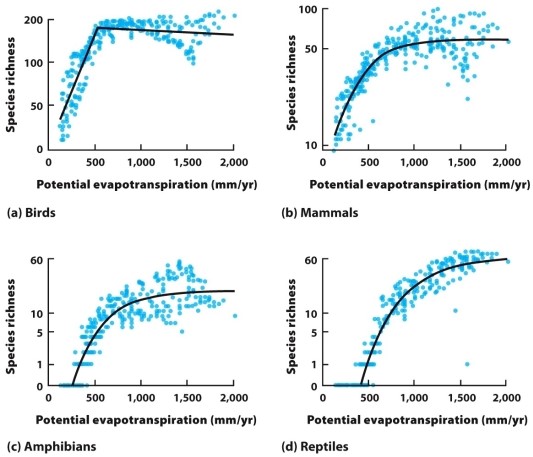 (Figure 22.24) As you can see in the figure, species richness for animals and plants increases with average potential evapotranspiration, but the curves level off at high levels of evapotranspiration. Why are high levels of evapotranspiration associated with a plateau in species richness?
 Question
Question
Question
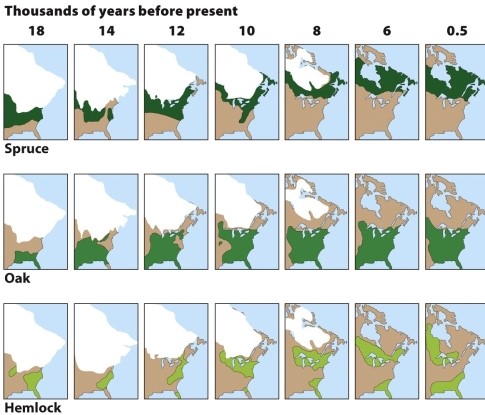 (Figure 22.27) What caused changing tree distributions seen in the figure? As global warming increases temperatures, what can be expected to happen to tree distributions of spruce, hemlock, and oak?
 Question
Question
Question
Question
Question
Question
Question
Question
Question
Question
Question
Question

Unlock Deck
Sign up to unlock the cards in this deck!
Unlock Deck
Unlock Deck
1/68

Play

Full screen (f)
Deck 22: Landscape Ecology and Global Biodiversity
1
The number of species in a relatively small area of homogeneous habitat is called
A) regional diversity.
B) local diversity.
C) regional species pool.
D) gamma diversity.
A) regional diversity.
B) local diversity.
C) regional species pool.
D) gamma diversity.
B
2
Which field considers the spatial arrangement of habitats at different scales?
A) community ecology
B) landscape ecology
C) ecosystem ecology
D) population ecology
A) community ecology
B) landscape ecology
C) ecosystem ecology
D) population ecology
B
3
When habitat is fragmented, a(n) _____ forms along the edges.
A) ecotone
B) biome
C) mesocosm
D) microhabitat
A) ecotone
B) biome
C) mesocosm
D) microhabitat
A
4
Which is NOT a way that edge habitat differs from interior habitat?
A) Edge habitat has more sunlight.
B) Edge habitat has warmer temperatures.
C) Edge habitat has higher soil moisture.
D) Edge habitat has higher rates of evaporation.
A) Edge habitat has more sunlight.
B) Edge habitat has warmer temperatures.
C) Edge habitat has higher soil moisture.
D) Edge habitat has higher rates of evaporation.
Unlock Deck
Unlock for access to all 68 flashcards in this deck.
Unlock Deck
k this deck
5
Regional species diversity is also called _____ diversity.
A) beta
B) alpha
C) delta
D) gamma
A) beta
B) alpha
C) delta
D) gamma
Unlock Deck
Unlock for access to all 68 flashcards in this deck.
Unlock Deck
k this deck
6
Which of the following describes the log-log form of the species area curve?
A) log S + log c = z log A
B) log S = log c × z log A
C) log S = log c + z log A
D) log S + z log A = log c
A) log S + log c = z log A
B) log S = log c × z log A
C) log S = log c + z log A
D) log S + z log A = log c
Unlock Deck
Unlock for access to all 68 flashcards in this deck.
Unlock Deck
k this deck
7
What do studies of Roman Empire settlements tell us about the legacy effects of humans on the landscape? How do human settlements cause legacy effects?
Unlock Deck
Unlock for access to all 68 flashcards in this deck.
Unlock Deck
k this deck
8
All of the species in all of the habitats that constitute a large geographic area are called
A) regional diversity.
B) alpha diversity.
C) local diversity.
D) regional species pool.
A) regional diversity.
B) alpha diversity.
C) local diversity.
D) regional species pool.
Unlock Deck
Unlock for access to all 68 flashcards in this deck.
Unlock Deck
k this deck
9
Arranging species in the regional pool among localities according to their adaptations and interactions is called _____ sorting.
A) biodiversity
B) species
C) gamma
D) alpha
A) biodiversity
B) species
C) gamma
D) alpha
Unlock Deck
Unlock for access to all 68 flashcards in this deck.
Unlock Deck
k this deck
10
A long-lasting influence of historical processes on the current ecology of an area is called a _____ effect.
A) retention
B) landscape
C) legacy
D) spatial
A) retention
B) landscape
C) legacy
D) spatial
Unlock Deck
Unlock for access to all 68 flashcards in this deck.
Unlock Deck
k this deck
11
Eskers are legacy effects of
A) volcanic eruptions.
B) asteroid strikes.
C) glaciers.
D) floods.
A) volcanic eruptions.
B) asteroid strikes.
C) glaciers.
D) floods.
Unlock Deck
Unlock for access to all 68 flashcards in this deck.
Unlock Deck
k this deck
12
How does fire cause habitat heterogeneity?
Unlock Deck
Unlock for access to all 68 flashcards in this deck.
Unlock Deck
k this deck
13
Researchers studying soil conditions and plant species between 0 and 500 meters from former Roman settlements found that sites closer to settlements had
A) lower soil pH.
B) more available nitrogen.
C) greater species richness.
D) less species richness.
A) lower soil pH.
B) more available nitrogen.
C) greater species richness.
D) less species richness.
Unlock Deck
Unlock for access to all 68 flashcards in this deck.
Unlock Deck
k this deck
14
Local species diversity is also called _____ diversity.
A) gamma
B) beta
C) alpha
D) delta
A) gamma
B) beta
C) alpha
D) delta
Unlock Deck
Unlock for access to all 68 flashcards in this deck.
Unlock Deck
k this deck
15
Which of the following is NOT an effect of fragmentation of a large contiguous habitat?
A) The amount of edge habitat decreases.
B) The total amount of habitat decreases.
C) The number of habitat patches increases.
D) Patch isolation increases.
A) The amount of edge habitat decreases.
B) The total amount of habitat decreases.
C) The number of habitat patches increases.
D) Patch isolation increases.
Unlock Deck
Unlock for access to all 68 flashcards in this deck.
Unlock Deck
k this deck
16
A regional species pool is the collection of species
A) that occur within a region.
B) that occur between two habitats.
C) in a relatively small area of homogeneous habitat.
D) in a large area of homogeneous habitat.
A) that occur within a region.
B) that occur between two habitats.
C) in a relatively small area of homogeneous habitat.
D) in a large area of homogeneous habitat.
Unlock Deck
Unlock for access to all 68 flashcards in this deck.
Unlock Deck
k this deck
17
As habitat _____, species diversity _____.
A) homogeneity decreases; decreases
B) homogeneity increases; increases
C) heterogeneity decreases; increases
D) heterogeneity increases; increases
A) homogeneity decreases; decreases
B) homogeneity increases; increases
C) heterogeneity decreases; increases
D) heterogeneity increases; increases
Unlock Deck
Unlock for access to all 68 flashcards in this deck.
Unlock Deck
k this deck
18
Which of the following equations describes the species-area curve?
A) S = cAz
B) A = cSz
C) S = czA
D) SA = cz
A) S = cAz
B) A = cSz
C) S = czA
D) SA = cz
Unlock Deck
Unlock for access to all 68 flashcards in this deck.
Unlock Deck
k this deck
19
A classic study by MacArthur and Wilson demonstrated that as the size of islands increases, species
A) richness increases.
B) richness decreases.
C) population size increases.
D) population size decreases.
A) richness increases.
B) richness decreases.
C) population size increases.
D) population size decreases.
Unlock Deck
Unlock for access to all 68 flashcards in this deck.
Unlock Deck
k this deck
20
In species-area curves, S represents
A) number of species.
B) area of the site.
C) species diversity.
D) a constant fitted to the data.
A) number of species.
B) area of the site.
C) species diversity.
D) a constant fitted to the data.
Unlock Deck
Unlock for access to all 68 flashcards in this deck.
Unlock Deck
k this deck
21
A graph of the number of species observed in relation to the number of individuals sampled is called a species _____ curve.
A) increase
B) accretion
C) accumulation
D) area
A) increase
B) accretion
C) accumulation
D) area
Unlock Deck
Unlock for access to all 68 flashcards in this deck.
Unlock Deck
k this deck
22
Given average temperature and humidity, potential evapotranspiration is the amount of water that could be
A) evaporated from the soil.
B) transpired by plants.
C) evaporated from the habitat.
D) evaporated from the soil and transpired by plants.
A) evaporated from the soil.
B) transpired by plants.
C) evaporated from the habitat.
D) evaporated from the soil and transpired by plants.
Unlock Deck
Unlock for access to all 68 flashcards in this deck.
Unlock Deck
k this deck
23
In North America, reptile diversity is greatest in the
A) south.
B) east.
C) west.
D) north.
A) south.
B) east.
C) west.
D) north.
Unlock Deck
Unlock for access to all 68 flashcards in this deck.
Unlock Deck
k this deck
24
How can we apply the theory of island biogeography to determine which characteristics might give a nature reserve the highest probable success rate in preserving a region's biodiversity? Discuss size, number, proximity, spatial arrangement, connectivity, and shape of the reserve.
Unlock Deck
Unlock for access to all 68 flashcards in this deck.
Unlock Deck
k this deck
25
Smaller islands at equilibrium contain fewer species than larger islands at equilibrium because smaller islands have
A) less colonization.
B) greater extinction.
C) greater isolation.
D) greater emigration.
A) less colonization.
B) greater extinction.
C) greater isolation.
D) greater emigration.
Unlock Deck
Unlock for access to all 68 flashcards in this deck.
Unlock Deck
k this deck
26
Based on the theory of island biogeography, which statement about reserve designs is TRUE?
A) Small reserves are better than large reserves.
B) Oval reserves are better than circular reserves.
C) One large reserve is better than many small reserves.
D) Remote reserves are better than nearby reserves.
A) Small reserves are better than large reserves.
B) Oval reserves are better than circular reserves.
C) One large reserve is better than many small reserves.
D) Remote reserves are better than nearby reserves.
Unlock Deck
Unlock for access to all 68 flashcards in this deck.
Unlock Deck
k this deck
27
Species
Community A
Community B
Betula lenta
42
29
Acer saccharum
33
35
Acer pensylvanicum
12
20
Fagus grandifoia
10
1
Tilia Americana
1
8
Quercus rubra
9
2
Prunus serotina
1
1
Robinia pseudoacacia
3
8
Acer rubrum
1
2
Prunus pensylvanica
2
0
The table lists tree species observed in communities A and B. Based on these data, calculate the estimated number of species in each community. How does the number of species represented by single individuals affect the estimated number of species in the community?
Community A
Community B
Betula lenta
42
29
Acer saccharum
33
35
Acer pensylvanicum
12
20
Fagus grandifoia
10
1
Tilia Americana
1
8
Quercus rubra
9
2
Prunus serotina
1
1
Robinia pseudoacacia
3
8
Acer rubrum
1
2
Prunus pensylvanica
2
0
The table lists tree species observed in communities A and B. Based on these data, calculate the estimated number of species in each community. How does the number of species represented by single individuals affect the estimated number of species in the community?
Unlock Deck
Unlock for access to all 68 flashcards in this deck.
Unlock Deck
k this deck
28
Islands at equilibrium that are farther from the mainland contain fewer species than nearer islands at equilibrium because farther islands have
A) less colonization.
B) greater emigration.
C) less isolation.
D) greater extinction.
A) less colonization.
B) greater emigration.
C) less isolation.
D) greater extinction.
Unlock Deck
Unlock for access to all 68 flashcards in this deck.
Unlock Deck
k this deck
29
In the Northern Hemisphere, the number of species of plants generally
A) decreases from east to west.
B) increases from east to west.
C) decreases from north to south.
D) increases from north to south.
A) decreases from east to west.
B) increases from east to west.
C) decreases from north to south.
D) increases from north to south.
Unlock Deck
Unlock for access to all 68 flashcards in this deck.
Unlock Deck
k this deck
30
In the equilibrium theory of island biogeography, occurs where extinction _____ colonization.
A) is greater than
B) equals
C) is less than
D) None of the above
A) is greater than
B) equals
C) is less than
D) None of the above
Unlock Deck
Unlock for access to all 68 flashcards in this deck.
Unlock Deck
k this deck
31
The equilibrium theory of island biogeography states that the number of species on an island reflects a balance between
A) emigration of existing species and extinction of existing species.
B) colonization of new species and extinction of existing species.
C) evolution of new species and emigration of existing species.
D) colonization of new species and emigration of existing species.
A) emigration of existing species and extinction of existing species.
B) colonization of new species and extinction of existing species.
C) evolution of new species and emigration of existing species.
D) colonization of new species and emigration of existing species.
Unlock Deck
Unlock for access to all 68 flashcards in this deck.
Unlock Deck
k this deck
32
MacArthur and Wilson's theory of island biogeography considers both species-area relationships and
A) biomes.
B) productivity.
C) isolation.
D) environment.
A) biomes.
B) productivity.
C) isolation.
D) environment.
Unlock Deck
Unlock for access to all 68 flashcards in this deck.
Unlock Deck
k this deck
33
In North America, the number of species of mammals generally
A) increases from north to south.
B) decreases from north to south.
C) increases from east to west.
D) decreases from east to west.
A) increases from north to south.
B) decreases from north to south.
C) increases from east to west.
D) decreases from east to west.
Unlock Deck
Unlock for access to all 68 flashcards in this deck.
Unlock Deck
k this deck
34
Small intervening patches that dispersing organisms can use to move between large favorable habitats are called
A) habitat corridors.
B) stepping stones.
C) glades.
D) matrix pathways.
A) habitat corridors.
B) stepping stones.
C) glades.
D) matrix pathways.
Unlock Deck
Unlock for access to all 68 flashcards in this deck.
Unlock Deck
k this deck
35
PET is a measurement that combines the amount of solar radiation and
A) temperature.
B) precipitation.
C) transpiration.
D) evaporation.
A) temperature.
B) precipitation.
C) transpiration.
D) evaporation.
Unlock Deck
Unlock for access to all 68 flashcards in this deck.
Unlock Deck
k this deck
36
For marine organisms, the highest diversity is seen at _____ and the lowest diversity is seen at _____.
A) low longitudes; high longitudes
B) high longitudes; low longitudes
C) low latitudes; high latitudes
D) high latitudes; low latitudes
A) low longitudes; high longitudes
B) high longitudes; low longitudes
C) low latitudes; high latitudes
D) high latitudes; low latitudes
Unlock Deck
Unlock for access to all 68 flashcards in this deck.
Unlock Deck
k this deck
37
How does habitat fragmentation increase the total edge habitat? Describe the effect of habitat fragmentation on a 600-meter by 600-meter forest plot that has been divided into nine 200-meter by 200-meter sections using calculations of edge size.
Unlock Deck
Unlock for access to all 68 flashcards in this deck.
Unlock Deck
k this deck
38
In North America, amphibian diversity is greatest in the
A) northeast.
B) northwest.
C) southeast.
D) southwest.
A) northeast.
B) northwest.
C) southeast.
D) southwest.
Unlock Deck
Unlock for access to all 68 flashcards in this deck.
Unlock Deck
k this deck
39
Researchers in the Florida Keys fumigated islands to remove most arthropods and then observed colonization of species over time. The fumigated islands were near other islands, far from other islands, or at intermediate distances from other islands. What did their results show?
Unlock Deck
Unlock for access to all 68 flashcards in this deck.
Unlock Deck
k this deck
40
Which of the following is NOT associated with low terrestrial diversity?
A) recent glaciation
B) variation in vegetation
C) high temperature
D) low precipitation
A) recent glaciation
B) variation in vegetation
C) high temperature
D) low precipitation
Unlock Deck
Unlock for access to all 68 flashcards in this deck.
Unlock Deck
k this deck
41
Why does Australia have a wide variety of unique animals and plants? Give examples.
Unlock Deck
Unlock for access to all 68 flashcards in this deck.
Unlock Deck
k this deck
42
According to the _____ hypothesis, sites with higher amounts of energy are able to support more species.
A) energetic-diversity
B) energy-diversity
C) energy-biodiversity
D) bioenergetics-diversity
A) energetic-diversity
B) energy-diversity
C) energy-biodiversity
D) bioenergetics-diversity
Unlock Deck
Unlock for access to all 68 flashcards in this deck.
Unlock Deck
k this deck
43
Time since glaciation is one possible predictor of species diversity. Explain how time since glaciation leads to differences in terrestrial diversity between polar and tropical regions.
Unlock Deck
Unlock for access to all 68 flashcards in this deck.
Unlock Deck
k this deck
44
Which biogeographic region is also called the Oriental region?
A) Indomalayan
B) Afrotropical
C) Australian
D) Palearctic
A) Indomalayan
B) Afrotropical
C) Australian
D) Palearctic
Unlock Deck
Unlock for access to all 68 flashcards in this deck.
Unlock Deck
k this deck
45
Marine environments are most diverse in _____ environments and most productive in _____ environments.
A) tropical; tropical
B) tropical; temperate
C) temperate; tropical
D) temperate; temperate
A) tropical; tropical
B) tropical; temperate
C) temperate; tropical
D) temperate; temperate
Unlock Deck
Unlock for access to all 68 flashcards in this deck.
Unlock Deck
k this deck
46
When the continents divided 60 million years ago, there was a land bridge between
A) Africa and Europe.
B) India and Asia.
C) North America and South America.
D) Asia and North America.
A) Africa and Europe.
B) India and Asia.
C) North America and South America.
D) Asia and North America.
Unlock Deck
Unlock for access to all 68 flashcards in this deck.
Unlock Deck
k this deck
47
You own a small backyard lot behind your home that you have fertilized and mowed consistently over the years as a lawn. You decide you want to refocus your backyard lot and emphasize species diversity. What might you do to your backyard lot to enhance species diversity?
Unlock Deck
Unlock for access to all 68 flashcards in this deck.
Unlock Deck
k this deck
48
The movement of landmasses across the surface of Earth is called
A) tectonic spread.
B) Pangaea.
C) continental drift.
D) continental divide.
A) tectonic spread.
B) Pangaea.
C) continental drift.
D) continental divide.
Unlock Deck
Unlock for access to all 68 flashcards in this deck.
Unlock Deck
k this deck
49
Discuss the confounding issue that areas are losing species while at the same time increasing in biodiversity.
Unlock Deck
Unlock for access to all 68 flashcards in this deck.
Unlock Deck
k this deck
50
North and South America were joined by the Isthmus of Panama
A) 3 million to 6 million years ago.
B) 10 million to 12 million years ago.
C) 5 million to 8 million years ago.
D) 1 million to 2 million years ago.
A) 3 million to 6 million years ago.
B) 10 million to 12 million years ago.
C) 5 million to 8 million years ago.
D) 1 million to 2 million years ago.
Unlock Deck
Unlock for access to all 68 flashcards in this deck.
Unlock Deck
k this deck
51
About 250 million years ago, all of Earth's landmasses were joined as a single landmass called
A) Pangaea.
B) Gondwana.
C) Laurasia.
D) Indomalaysia.
A) Pangaea.
B) Gondwana.
C) Laurasia.
D) Indomalaysia.
Unlock Deck
Unlock for access to all 68 flashcards in this deck.
Unlock Deck
k this deck
52
Which of the following is NOT a Southern Hemisphere biogeographic region?
A) Afrotropical
B) Indomalayan
C) Nearctic
D) Neotropical
A) Afrotropical
B) Indomalayan
C) Nearctic
D) Neotropical
Unlock Deck
Unlock for access to all 68 flashcards in this deck.
Unlock Deck
k this deck
53
(Figure 22.24) As you can see in the figure, species richness for animals and plants increases with average potential evapotranspiration, but the curves level off at high levels of evapotranspiration. Why are high levels of evapotranspiration associated with a plateau in species richness? Unlock Deck
Unlock for access to all 68 flashcards in this deck.
Unlock Deck
k this deck
54
Eventually _____ split into South America, Africa, Antarctica, Australia, and India.
A) Gondwana
B) Pangaea
C) Indomalaysia
D) Laurasia
A) Gondwana
B) Pangaea
C) Indomalaysia
D) Laurasia
Unlock Deck
Unlock for access to all 68 flashcards in this deck.
Unlock Deck
k this deck
55
In which biogeographic region is Egypt?
A) Neotropical
B) Afrotropical
C) Indomalayan
D) Palearctic
A) Neotropical
B) Afrotropical
C) Indomalayan
D) Palearctic
Unlock Deck
Unlock for access to all 68 flashcards in this deck.
Unlock Deck
k this deck
56
(Figure 22.27) What caused changing tree distributions seen in the figure? As global warming increases temperatures, what can be expected to happen to tree distributions of spruce, hemlock, and oak? Unlock Deck
Unlock for access to all 68 flashcards in this deck.
Unlock Deck
k this deck
57
Landmass movement occurs because islands of _____ rock are moved by _____ currents of semimolten material.
A) high-density; convection
B) low-density; convection
C) high-density; conduction
D) low-density; conduction
A) high-density; convection
B) low-density; convection
C) high-density; conduction
D) low-density; conduction
Unlock Deck
Unlock for access to all 68 flashcards in this deck.
Unlock Deck
k this deck
58
About 150 million years ago the single landmass separated into northern and southern landmasses called
A) Laurasia and Gondwana.
B) Gondwana and Afrotropica.
C) Pangaea and Laurasia.
D) Nearctica and Palearctica.
A) Laurasia and Gondwana.
B) Gondwana and Afrotropica.
C) Pangaea and Laurasia.
D) Nearctica and Palearctica.
Unlock Deck
Unlock for access to all 68 flashcards in this deck.
Unlock Deck
k this deck
59
In which biogeographic region is the United States?
A) Neotropical
B) Nearctic
C) Palearctic
D) Indomalayan
A) Neotropical
B) Nearctic
C) Palearctic
D) Indomalayan
Unlock Deck
Unlock for access to all 68 flashcards in this deck.
Unlock Deck
k this deck
60
Eventually _____ split into North America, Europe, and Asia.
A) Gondwana
B) Pangaea
C) Laurasia
D) Neotropica
A) Gondwana
B) Pangaea
C) Laurasia
D) Neotropica
Unlock Deck
Unlock for access to all 68 flashcards in this deck.
Unlock Deck
k this deck
61
On which type of island should we expect to see the lowest level of biodiversity when equilibrium is reached?
A) a small island located far from the source of colonizing species
B) a small island located nearer to the source of colonizing species
C) a large island located far from the source of colonizing species
D) a large island located nearer to the source of colonizing species
A) a small island located far from the source of colonizing species
B) a small island located nearer to the source of colonizing species
C) a large island located far from the source of colonizing species
D) a large island located nearer to the source of colonizing species
Unlock Deck
Unlock for access to all 68 flashcards in this deck.
Unlock Deck
k this deck
62
Which of the following is NOT true with regard to the species-area relationship?
A) The relationship only holds for terrestrial environments and not aquatic (i.e., wetlands).
B) The species-area curve is represented by the equation S = cAz.
C) The relationship is not always represented as a linear relationship.
D) The relationship is found among various taxa.
A) The relationship only holds for terrestrial environments and not aquatic (i.e., wetlands).
B) The species-area curve is represented by the equation S = cAz.
C) The relationship is not always represented as a linear relationship.
D) The relationship is found among various taxa.
Unlock Deck
Unlock for access to all 68 flashcards in this deck.
Unlock Deck
k this deck
63
The bronzed cowbird is a species of bird that thrives in edge habitat. This species is a nest parasite, which means what?
A) The female of the species takes over the nests built by other species and incubates and raises its young in these nests.
B) The male of the species steals nest materials from the nests of other species to be used in building its own nests.
C) The male and female of the species destroy the nests of other birds and then claim the location as their own to build their own nest.
D) The female of the species lays her eggs in the nests of other species and then departs, leaving the eggs to be incubated by the other species and the young to be raised by the other species.
A) The female of the species takes over the nests built by other species and incubates and raises its young in these nests.
B) The male of the species steals nest materials from the nests of other species to be used in building its own nests.
C) The male and female of the species destroy the nests of other birds and then claim the location as their own to build their own nest.
D) The female of the species lays her eggs in the nests of other species and then departs, leaving the eggs to be incubated by the other species and the young to be raised by the other species.
Unlock Deck
Unlock for access to all 68 flashcards in this deck.
Unlock Deck
k this deck
64
The reduction in habitat size resulting from fragmentation causes a decline in species diversity for what reason?
A) Fragments are more diverse, leading to greater specialization.
B) Fragments are more diverse, leading to greater generalization.
C) Fragments support smaller populations that are more prone to extinction.
D) Fragments tend to have more predators than unfragmented areas.
A) Fragments are more diverse, leading to greater specialization.
B) Fragments are more diverse, leading to greater generalization.
C) Fragments support smaller populations that are more prone to extinction.
D) Fragments tend to have more predators than unfragmented areas.
Unlock Deck
Unlock for access to all 68 flashcards in this deck.
Unlock Deck
k this deck
65
According to researchers, how has forest fragmentation led to the potential higher rate of exposure to Lyme disease?
A) Forest fragmentation has led to a decrease in population size of the bird species that feed on ticks.
B) Forest fragmentation has led to a warmer and drier environment that is not suitable for tick growth.
C) Forest fragmentation has led to an increase white-footed mice populations that are serve as hosts for ticks
D) Forest fragmentation has led more human contact with the smaller parcels of forests
A) Forest fragmentation has led to a decrease in population size of the bird species that feed on ticks.
B) Forest fragmentation has led to a warmer and drier environment that is not suitable for tick growth.
C) Forest fragmentation has led to an increase white-footed mice populations that are serve as hosts for ticks
D) Forest fragmentation has led more human contact with the smaller parcels of forests
Unlock Deck
Unlock for access to all 68 flashcards in this deck.
Unlock Deck
k this deck
66
Based on MacArthur and Wilson's equilibrium theory of island biogeography at Ŝ,
A) the rate of colonization exceeds the rate of extinction.
B) the number of species on the island stays the same though the actual species present on the island may be changing.
C) the rate of extinction exceeds the rate of colonization.
D) the number of species on the island stays the same and the actual species present on the island is unchanging.
A) the rate of colonization exceeds the rate of extinction.
B) the number of species on the island stays the same though the actual species present on the island may be changing.
C) the rate of extinction exceeds the rate of colonization.
D) the number of species on the island stays the same and the actual species present on the island is unchanging.
Unlock Deck
Unlock for access to all 68 flashcards in this deck.
Unlock Deck
k this deck
67
Discuss what MacArthur and Wilson meant by the species-area curve. What implications does this curve have for the management of nature centers/reserves?
Unlock Deck
Unlock for access to all 68 flashcards in this deck.
Unlock Deck
k this deck
68
Why are nature reserves that are more circular more likely to be preferred than nature reserves that are more oval in shape?
A) Oval-shaped nature reserves act more like corridors; thus, species are less likely to reside in them as compared to circular-shaped nature reserves.
B) Oval-shaped nature reserves have more edge and less interior than do more circular-shaped nature reserves; thus, oval-shaped nature reserves will favor edge species.
C) In circular-shaped nature reserves, edge species are all equidistant to the center of the reserve.
D) There is no difference between oval-shaped and circular-shaped nature reserves based solely on their geometric shape.
A) Oval-shaped nature reserves act more like corridors; thus, species are less likely to reside in them as compared to circular-shaped nature reserves.
B) Oval-shaped nature reserves have more edge and less interior than do more circular-shaped nature reserves; thus, oval-shaped nature reserves will favor edge species.
C) In circular-shaped nature reserves, edge species are all equidistant to the center of the reserve.
D) There is no difference between oval-shaped and circular-shaped nature reserves based solely on their geometric shape.
Unlock Deck
Unlock for access to all 68 flashcards in this deck.
Unlock Deck
k this deck
Unlock Deck
Unlock for access to all 68 flashcards in this deck.






