







 Chat with AI

Deck 19: The Economics of Labor Market Discrimination
Full screen (f)

Question

Question
Question
Question
Question
Question
Question
Question
Question
Question
Question
Question
Question
Question
Question
Question
Question
Question
Question
Question
Question
Question
Question
Question
Question
Question
Question
Question
Question
Question
Question
Question
Question
Consider the graph.Market wage is at P3. 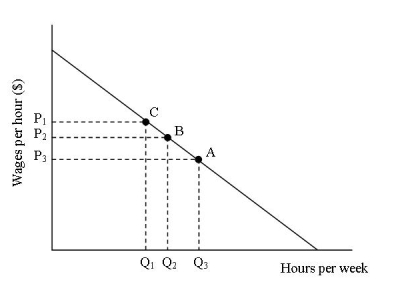 If a firm discriminates against a specific segment of the work force it will
A)hire Q2 if the firm perceives the costs of hiring the specific segment to be higher than their actual market wage.
B)hire Q1 if the firm perceives the costs of hiring the specific segment to be equal to their actual market wage.
C)hire Q3 because it is the actual market wage.
D)hire Q2 regardless of costs.
If a firm discriminates against a specific segment of the work force it willA)hire Q2 if the firm perceives the costs of hiring the specific segment to be higher than their actual market wage.
B)hire Q1 if the firm perceives the costs of hiring the specific segment to be equal to their actual market wage.
C)hire Q3 because it is the actual market wage.
D)hire Q2 regardless of costs.

Unlock Deck
Sign up to unlock the cards in this deck!
Unlock Deck
Unlock Deck
1/33

Play

Full screen (f)
Deck 19: The Economics of Labor Market Discrimination
1
Discrimination occurs in the taste-for-discrimination model because discriminating employers
A)refuse to hire certain segments of the workforce.
B)act as if additional costs will incur if a certain segment of the workforce is hired increasing costs of production.
C)characterize certain segments of the workforce by statistical information.
D)will only hire a certain segment of the workforce.
A)refuse to hire certain segments of the workforce.
B)act as if additional costs will incur if a certain segment of the workforce is hired increasing costs of production.
C)characterize certain segments of the workforce by statistical information.
D)will only hire a certain segment of the workforce.
B
2
In the fourth quarter 2012 the median weekly earning for men in current dollars was $868, while the median weekly earnings for women was $690.The male/female earnings ratio was
A)0.26.
B)0.79.
C)1.23.
D)1.79.
A)0.26.
B)0.79.
C)1.23.
D)1.79.
C
3
Another term for the income disparity between two groups of the workforce is
A)the Gini index.
B)the wealth index.
C)an earnings ratio.
D)the GNH.
A)the Gini index.
B)the wealth index.
C)an earnings ratio.
D)the GNH.
C
4
The form of labor market discrimination that results in Joan receiving a higher wage not because of productivity but due to some other characteristic is
A)wage discrimination.
B)employment discrimination.
C)industrial discrimination.
D)harassment.
A)wage discrimination.
B)employment discrimination.
C)industrial discrimination.
D)harassment.
Unlock Deck
Unlock for access to all 33 flashcards in this deck.
Unlock Deck
k this deck
5
The percent difference in earnings between two groups is known as the
A)earnings ratio.
B)Gini Index.
C)GNH.
D)pay gap.
A)earnings ratio.
B)Gini Index.
C)GNH.
D)pay gap.
Unlock Deck
Unlock for access to all 33 flashcards in this deck.
Unlock Deck
k this deck
6
Joan will always go to another female cashier when shopping.This would be an example of
A)statistical discrimination.
B)customer discrimination.
C)employer discrimination.
D)taste-based discrimination.
A)statistical discrimination.
B)customer discrimination.
C)employer discrimination.
D)taste-based discrimination.
Unlock Deck
Unlock for access to all 33 flashcards in this deck.
Unlock Deck
k this deck
7
The taste-based model of discrimination assumes discrimination occurs because people
A)will receive more utility if they have to work with the selected group.
B)will receive less utility if they have to work with the selected group.
C)perceive costs will be lower when they have to work with the selected group.
D)perceive revenue will be affected.
A)will receive more utility if they have to work with the selected group.
B)will receive less utility if they have to work with the selected group.
C)perceive costs will be lower when they have to work with the selected group.
D)perceive revenue will be affected.
Unlock Deck
Unlock for access to all 33 flashcards in this deck.
Unlock Deck
k this deck
8
Members of the labor market who are equally productive but treated differently based on characteristics not related to productivity are victims of
A)harassment.
B)segregation.
C)discrimination.
D)labor disputes.
A)harassment.
B)segregation.
C)discrimination.
D)labor disputes.
Unlock Deck
Unlock for access to all 33 flashcards in this deck.
Unlock Deck
k this deck
9
The median weekly earnings for Asian men in the fourth quarter of 2012 were $1,051.The median weekly earnings for White men for the same time period were $895.The earnings ratio of Asian men to White men is
A)0.17.
B)1.17.
C)0.85.
D)1.85.
A)0.17.
B)1.17.
C)0.85.
D)1.85.
Unlock Deck
Unlock for access to all 33 flashcards in this deck.
Unlock Deck
k this deck
10
___________ discrimination occurs when customers base their purchasing decisions on the race, sex, or to other demographic characteristics of the workers with whom they interact.
A)Statistical
B)Customer
C)Employer
D)Taste-based
A)Statistical
B)Customer
C)Employer
D)Taste-based
Unlock Deck
Unlock for access to all 33 flashcards in this deck.
Unlock Deck
k this deck
11
Labor market discrimination includes
A)employment discrimination.
B)wage discrimination.
C)industrial discrimination.
D)employment and wage discrimination.
A)employment discrimination.
B)wage discrimination.
C)industrial discrimination.
D)employment and wage discrimination.
Unlock Deck
Unlock for access to all 33 flashcards in this deck.
Unlock Deck
k this deck
12
The comparison of earnings of two groups of the labor force is known as
A)the Gini index.
B)the wealth index.
C)an earnings ratio.
D)the GNH.
A)the Gini index.
B)the wealth index.
C)an earnings ratio.
D)the GNH.
Unlock Deck
Unlock for access to all 33 flashcards in this deck.
Unlock Deck
k this deck
13
The model of discrimination that illustrates how preferences create discrimination in the work place is the
A)employer discrimination model.
B)rational discrimination model.
C)comprehensive discrimination model.
D)taste-based model of discrimination.
A)employer discrimination model.
B)rational discrimination model.
C)comprehensive discrimination model.
D)taste-based model of discrimination.
Unlock Deck
Unlock for access to all 33 flashcards in this deck.
Unlock Deck
k this deck
14
Predominant economic theories of discrimination can be categorized by
A)personal prejudice.
B)logistical prejudice.
C)incomplete information.
D)personal prejudice and incomplete information.
A)personal prejudice.
B)logistical prejudice.
C)incomplete information.
D)personal prejudice and incomplete information.
Unlock Deck
Unlock for access to all 33 flashcards in this deck.
Unlock Deck
k this deck
15
The form of labor market discrimination that results in Joe being hired before Jane because of sex, race, or other demographic characteristics is
A)wage discrimination.
B)employment discrimination.
C)industrial discrimination.
D)harassment.
A)wage discrimination.
B)employment discrimination.
C)industrial discrimination.
D)harassment.
Unlock Deck
Unlock for access to all 33 flashcards in this deck.
Unlock Deck
k this deck
16
The U.S.workforce has become
A)more racially but less gender diverse over the past 30 years.
B)less racially but more gender diverse over the past 30 years.
C)more racially and gender diverse over the past 30 years.
D)less racially and gender diverse over the past 30 years.
A)more racially but less gender diverse over the past 30 years.
B)less racially but more gender diverse over the past 30 years.
C)more racially and gender diverse over the past 30 years.
D)less racially and gender diverse over the past 30 years.
Unlock Deck
Unlock for access to all 33 flashcards in this deck.
Unlock Deck
k this deck
17
Which of the following is an example of employment discrimination?
A)John and Carrie work in the same office and have the same job responsibility.John is paid ten cents more an hour because he has a family.
B)Louis and Arnie work on the same production line.Both receive the same base rate but Louis also receives an additional per hour stipend.
C)Nattie and Jacob apply for the same open position.Both have similar educational and prior work experiences.Jacob is hired over Nattie because administration felt the position was better suited for a man.
D)Grace, who is married, earns less than Gabby who is not married.
A)John and Carrie work in the same office and have the same job responsibility.John is paid ten cents more an hour because he has a family.
B)Louis and Arnie work on the same production line.Both receive the same base rate but Louis also receives an additional per hour stipend.
C)Nattie and Jacob apply for the same open position.Both have similar educational and prior work experiences.Jacob is hired over Nattie because administration felt the position was better suited for a man.
D)Grace, who is married, earns less than Gabby who is not married.
Unlock Deck
Unlock for access to all 33 flashcards in this deck.
Unlock Deck
k this deck
18
Sources of the pay gaps among groups in the work force can be found using
A)marginal analysis.
B)cost-benefit analysis.
C)aggregate demand and aggregate supply model.
D)demand and supply models.
A)marginal analysis.
B)cost-benefit analysis.
C)aggregate demand and aggregate supply model.
D)demand and supply models.
Unlock Deck
Unlock for access to all 33 flashcards in this deck.
Unlock Deck
k this deck
19
In the fourth quarter 2012 the median weekly earning for men in current dollars was $868, while the median weekly earnings for women was $690.The pay gap between men and women is
A)0.24
B)0.27
C)0.47
D)0.79
A)0.24
B)0.27
C)0.47
D)0.79
Unlock Deck
Unlock for access to all 33 flashcards in this deck.
Unlock Deck
k this deck
20
When employers base their employment decisions on prejudice against certain workers ______________ occurs.
A)statistical discrimination.
B)comprehensive discrimination.
C)employer discrimination.
D)taste-based discrimination.
A)statistical discrimination.
B)comprehensive discrimination.
C)employer discrimination.
D)taste-based discrimination.
Unlock Deck
Unlock for access to all 33 flashcards in this deck.
Unlock Deck
k this deck
21
During periods of U.S.history certain groups of immigrants were avoided by employers due to their preference against the targeted group.This illustrates
A)statistical discrimination.
B)comprehensive discrimination.
C)employer discrimination.
D)taste-based discrimination.
A)statistical discrimination.
B)comprehensive discrimination.
C)employer discrimination.
D)taste-based discrimination.
Unlock Deck
Unlock for access to all 33 flashcards in this deck.
Unlock Deck
k this deck
22
The 1964 Civil Rights Act was the first federal legislation to prohibit employment discrimination based on all of the following except
A)race.
B)religion.
C)gender.
D)age.
A)race.
B)religion.
C)gender.
D)age.
Unlock Deck
Unlock for access to all 33 flashcards in this deck.
Unlock Deck
k this deck
23
Incomplete information gives rise to ________________ when wages and hiring are based in part on group characteristics.
A)statistical discrimination
B)comprehensive discrimination
C)employer discrimination
D)taste-based discrimination
A)statistical discrimination
B)comprehensive discrimination
C)employer discrimination
D)taste-based discrimination
Unlock Deck
Unlock for access to all 33 flashcards in this deck.
Unlock Deck
k this deck
24
The practice of charging higher rates to male drivers under the age of 25 regardless of their driving history illustrates
A)statistical discrimination.
B)comprehensive discrimination.
C)employer discrimination.
D)taste-based discrimination.
A)statistical discrimination.
B)comprehensive discrimination.
C)employer discrimination.
D)taste-based discrimination.
Unlock Deck
Unlock for access to all 33 flashcards in this deck.
Unlock Deck
k this deck
25
The first federal legislation to prohibit employment discrimination was the
A)Age Discrimination in Employment Act of 1967.
B)Fair Employment Act of 1941.
C)Equal Pay Act of 1963.
D)Civil Rights Act of 1964.
A)Age Discrimination in Employment Act of 1967.
B)Fair Employment Act of 1941.
C)Equal Pay Act of 1963.
D)Civil Rights Act of 1964.
Unlock Deck
Unlock for access to all 33 flashcards in this deck.
Unlock Deck
k this deck
26
Using characteristics of workers' demographic groups to predict potential in the absence of information on individual workers' productivity is known as
A)statistical discrimination.
B)comprehensive discrimination.
C)employer discrimination.
D)taste-based discrimination.
A)statistical discrimination.
B)comprehensive discrimination.
C)employer discrimination.
D)taste-based discrimination.
Unlock Deck
Unlock for access to all 33 flashcards in this deck.
Unlock Deck
k this deck
27
A goal of antidiscrimination laws is to
A)increase the supply of protected workers.
B)decrease the supply of protected workers.
C)increase the demand of protected workers.
D)decrease the demand of protected workers.
A)increase the supply of protected workers.
B)decrease the supply of protected workers.
C)increase the demand of protected workers.
D)decrease the demand of protected workers.
Unlock Deck
Unlock for access to all 33 flashcards in this deck.
Unlock Deck
k this deck
28
If a firm discriminates against a segment of the workforce it
A)perceives the marginal revenue will be greater and will hire fewer workers.
B)perceives the marginal revenue product will be less and will hire fewer workers.
C)perceives the cost of hiring will be greater and will hire fewer workers.
D)perceives the cost of hiring will be less and will hire fewer workers.
A)perceives the marginal revenue will be greater and will hire fewer workers.
B)perceives the marginal revenue product will be less and will hire fewer workers.
C)perceives the cost of hiring will be greater and will hire fewer workers.
D)perceives the cost of hiring will be less and will hire fewer workers.
Unlock Deck
Unlock for access to all 33 flashcards in this deck.
Unlock Deck
k this deck
29
When hiring decisions are based on factors other than productivity
A)total revenue increases compared to nondiscriminatory firms.
B)profit will be lower compared to nondiscriminatory firms.
C)costs will be lower compared to nondiscriminatory firms.
D)profit will be approximately the same as nondiscriminatory firms.
A)total revenue increases compared to nondiscriminatory firms.
B)profit will be lower compared to nondiscriminatory firms.
C)costs will be lower compared to nondiscriminatory firms.
D)profit will be approximately the same as nondiscriminatory firms.
Unlock Deck
Unlock for access to all 33 flashcards in this deck.
Unlock Deck
k this deck
30
____________________ is a set of policies that mandate taking action to ensure the equal treatment of people regardless of their race, creed, color or national origin.
A)The Equal Opportunity Act
B)Affirmative Action
C)The Civil Rights Act of 1968
D)The Fair Employment Act of 1941
A)The Equal Opportunity Act
B)Affirmative Action
C)The Civil Rights Act of 1968
D)The Fair Employment Act of 1941
Unlock Deck
Unlock for access to all 33 flashcards in this deck.
Unlock Deck
k this deck
31
Carrie and Stacy apply for the same entry-level position that requires a small amount of traveling.Both are 27 years old and have the same educational and prior work experience.Carrie has been married for two years.Stacy does not plan on getting married in the near future.Stacy is hired for the position because administration is concerned that the trend for newlyweds is to begin planning a family requiring time away from the company.This is an example of
A)statistical discrimination.
B)comprehensive discrimination.
C)employer discrimination.
D)taste-based discrimination.
A)statistical discrimination.
B)comprehensive discrimination.
C)employer discrimination.
D)taste-based discrimination.
Unlock Deck
Unlock for access to all 33 flashcards in this deck.
Unlock Deck
k this deck
32
A consequence of the ADA is that it
A)includes lower levels of employment of disabled workers because of concerns for additional costs of hiring disabled workers.
B)eliminates concerns of additional costs of hiring disabled workers increasing demand.
C)contains provisions that eliminate employer and customer discrimination.
D)increases levels of employment of older and disabled workers.
A)includes lower levels of employment of disabled workers because of concerns for additional costs of hiring disabled workers.
B)eliminates concerns of additional costs of hiring disabled workers increasing demand.
C)contains provisions that eliminate employer and customer discrimination.
D)increases levels of employment of older and disabled workers.
Unlock Deck
Unlock for access to all 33 flashcards in this deck.
Unlock Deck
k this deck
33
Consider the graph.Market wage is at P3. If a firm discriminates against a specific segment of the work force it will
A)hire Q2 if the firm perceives the costs of hiring the specific segment to be higher than their actual market wage.
B)hire Q1 if the firm perceives the costs of hiring the specific segment to be equal to their actual market wage.
C)hire Q3 because it is the actual market wage.
D)hire Q2 regardless of costs.
If a firm discriminates against a specific segment of the work force it willA)hire Q2 if the firm perceives the costs of hiring the specific segment to be higher than their actual market wage.
B)hire Q1 if the firm perceives the costs of hiring the specific segment to be equal to their actual market wage.
C)hire Q3 because it is the actual market wage.
D)hire Q2 regardless of costs.
Unlock Deck
Unlock for access to all 33 flashcards in this deck.
Unlock Deck
k this deck
Unlock Deck
Unlock for access to all 33 flashcards in this deck.






