







 Chat with AI

Deck 20: Poverty and the Distribution of Income
Full screen (f)

Question

Question
Question
Question
Question
Question
Question
Question
Question
Question
Question
Question
Question
Consider Figure 8 from your text.Which of the listed countries has the highest level of income inequality, which has the lowest level of income equality? 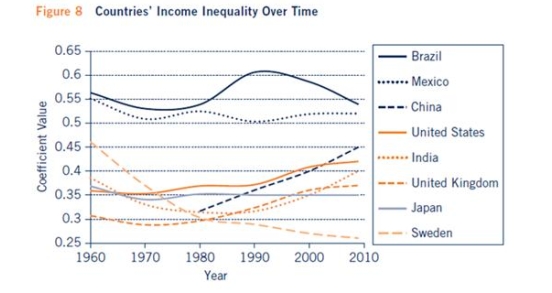
A)Mexico; India
B)India; Mexico
C)Brazil; Sweden
D)Sweden; Brazil
A)Mexico; India
B)India; Mexico
C)Brazil; Sweden
D)Sweden; Brazil
Question
Question
Question
Question
Question
Question
Question
Question
Question
Question
Question
Question
Question
Question
Question
Question
Question
Question
Question
Question
Question
Question
Question
Question

Unlock Deck
Sign up to unlock the cards in this deck!
Unlock Deck
Unlock Deck
1/37

Play

Full screen (f)
Deck 20: Poverty and the Distribution of Income
1
The 85:15 ratio
A)compares the income of household at the 85th percentile with the income of households at the 15th percentile and provides a coefficient of comparison
B)compares the income of household at the 15th percentile with the income of households at the 85th percentile and provides an index of income comparison
C)compares the income of household at the 85th percentile with the income of households at the 15th percentile and provides a multiplier for income
D)compares the income of household at the 15th percentile with the income of households at the 85th percentile and provides a margin of income growth
A)compares the income of household at the 85th percentile with the income of households at the 15th percentile and provides a coefficient of comparison
B)compares the income of household at the 15th percentile with the income of households at the 85th percentile and provides an index of income comparison
C)compares the income of household at the 85th percentile with the income of households at the 15th percentile and provides a multiplier for income
D)compares the income of household at the 15th percentile with the income of households at the 85th percentile and provides a margin of income growth
A
2
A Gini coefficient of 0.9 indicates
A)relatively high rates of income inequality
B)High rates of income inequality
C)Moderate rates of income inequality
D)Low rates of income inequality
A)relatively high rates of income inequality
B)High rates of income inequality
C)Moderate rates of income inequality
D)Low rates of income inequality
A
3
The income at the 90th percentile for a hypothetical country is $120,000 and the income at the 10th percentile is $15,000.The 90:10 income ratio is
A)0.111
B)0.125
C)8
D)10.50
A)0.111
B)0.125
C)8
D)10.50
C
4
The poverty line
A)is the income threshold for a person to be classified as in poverty
B)is the consumption threshold for a person to be classified as in poverty
C)is the income or consumption threshold for a person to be classified as in poverty
D)is the national income baseline for measuring global poverty
A)is the income threshold for a person to be classified as in poverty
B)is the consumption threshold for a person to be classified as in poverty
C)is the income or consumption threshold for a person to be classified as in poverty
D)is the national income baseline for measuring global poverty
Unlock Deck
Unlock for access to all 37 flashcards in this deck.
Unlock Deck
k this deck
5
When considering the U.S.income distribution which of the following is correct?
A)Since the 1960s the lowest earning quintile of the U.S.income distribution has earned a smaller share of the nation's income.
B)The highest earning quintile of the U.S.income distribution earned a smaller share of the nation's income in 1969 than in 2009.
C)The highest earning quintile of the income distribution earned a larger share of the nation's income in 1969 than in 2009.
D)The highest earning quintile of the U.S.income distribution earned a larger share of the nation's income in 1969 than in 2009.
A)Since the 1960s the lowest earning quintile of the U.S.income distribution has earned a smaller share of the nation's income.
B)The highest earning quintile of the U.S.income distribution earned a smaller share of the nation's income in 1969 than in 2009.
C)The highest earning quintile of the income distribution earned a larger share of the nation's income in 1969 than in 2009.
D)The highest earning quintile of the U.S.income distribution earned a larger share of the nation's income in 1969 than in 2009.
Unlock Deck
Unlock for access to all 37 flashcards in this deck.
Unlock Deck
k this deck
6
The income distribution in the United States is
A)evenly distributed
B)has a normal distribution
C)skewed
D)biased
A)evenly distributed
B)has a normal distribution
C)skewed
D)biased
Unlock Deck
Unlock for access to all 37 flashcards in this deck.
Unlock Deck
k this deck
7
In 2011 the U.S.poverty guideline defined as a single household as 'in poverty" if annual income was
A)at $22, 350
B)at $18, 500
C)at $10, 890
D)$1.25 per day
A)at $22, 350
B)at $18, 500
C)at $10, 890
D)$1.25 per day
Unlock Deck
Unlock for access to all 37 flashcards in this deck.
Unlock Deck
k this deck
8
The largest ____________ economies in the world earned roughly ___________ of the world's income.
A)10; one-half
B)12; two-thirds
C)15; one-third
D)20; one-fourth
A)10; one-half
B)12; two-thirds
C)15; one-third
D)20; one-fourth
Unlock Deck
Unlock for access to all 37 flashcards in this deck.
Unlock Deck
k this deck
9
The total value of everything own less any debt owed is
A)a flow of assets
B)a stock of assets
C)wealth
D)capital
A)a flow of assets
B)a stock of assets
C)wealth
D)capital
Unlock Deck
Unlock for access to all 37 flashcards in this deck.
Unlock Deck
k this deck
10
The percentage of people with incomes below the poverty line is known as the
A)Gini coefficient
B)poverty rate
C)pay gap
D)GNH
A)Gini coefficient
B)poverty rate
C)pay gap
D)GNH
Unlock Deck
Unlock for access to all 37 flashcards in this deck.
Unlock Deck
k this deck
11
The income distribution in the United States is
A)considered evenly distributed because income has increased, on average, evenly for all wage earners
B)has a normal distribution because the highest bracket of income earners is still at the medium wage
C)considered skewed since a very small percentage of households can earn very high incomes and a large percentage of households earn low incomes.
D)evenly proportioned as income is proportionate to skills.
A)considered evenly distributed because income has increased, on average, evenly for all wage earners
B)has a normal distribution because the highest bracket of income earners is still at the medium wage
C)considered skewed since a very small percentage of households can earn very high incomes and a large percentage of households earn low incomes.
D)evenly proportioned as income is proportionate to skills.
Unlock Deck
Unlock for access to all 37 flashcards in this deck.
Unlock Deck
k this deck
12
__________________ are a common measurement of income inequality.
A)GNH indices
B)Lorenz curves
C)Income ratios
D)Pay gaps
A)GNH indices
B)Lorenz curves
C)Income ratios
D)Pay gaps
Unlock Deck
Unlock for access to all 37 flashcards in this deck.
Unlock Deck
k this deck
13
Consider Figure 8 from your text.Which of the listed countries has the highest level of income inequality, which has the lowest level of income equality?
A)Mexico; India
B)India; Mexico
C)Brazil; Sweden
D)Sweden; Brazil
A)Mexico; India
B)India; Mexico
C)Brazil; Sweden
D)Sweden; Brazil
Unlock Deck
Unlock for access to all 37 flashcards in this deck.
Unlock Deck
k this deck
14
Traditionally, poverty has been measured using
A)national income guidelines
B)income guidelines
C)consumption guidelines
D)both income and consumption guidelines
A)national income guidelines
B)income guidelines
C)consumption guidelines
D)both income and consumption guidelines
Unlock Deck
Unlock for access to all 37 flashcards in this deck.
Unlock Deck
k this deck
15
This measurement of income inequality compares the incomes of those in the upper end of an income distribution to the incomes of those in the lower end of the income distribution.
A)GNH indices
B)Lorenz curves
C)income ratios
D)pay gaps
A)GNH indices
B)Lorenz curves
C)income ratios
D)pay gaps
Unlock Deck
Unlock for access to all 37 flashcards in this deck.
Unlock Deck
k this deck
16
A commonly used measurement of income inequality that ranges from 0 to 1 is the
A)Laffer curves
B)Lorenz curves
C)income ratios
D)Gini Coefficient
A)Laffer curves
B)Lorenz curves
C)income ratios
D)Gini Coefficient
Unlock Deck
Unlock for access to all 37 flashcards in this deck.
Unlock Deck
k this deck
17
The income at the 85th percentile for an Econogreat is $100,000 and the income at the 15th percentile is $8,500.Which of the following is true?
A)The incomes of those at the 85th percentile of the income distribution for Econogreat are 8.l5 percent as large as the incomes of those at the 15th percentile.
B)The incomes of those at the 85th percentile of the income distribution for Econogreat are 1.5 percent as large as the incomes of those at the 15th percentile.
C)The incomes of those at the 85th percentile of the income distribution for Econogreat are 11.8 times as large as the incomes of those at the 15th percentile.
D)The incomes of those at the 85th percentile of the income distribution for Econogreat are 1.5 times as large as the incomes of those at the 15th percentile.
A)The incomes of those at the 85th percentile of the income distribution for Econogreat are 8.l5 percent as large as the incomes of those at the 15th percentile.
B)The incomes of those at the 85th percentile of the income distribution for Econogreat are 1.5 percent as large as the incomes of those at the 15th percentile.
C)The incomes of those at the 85th percentile of the income distribution for Econogreat are 11.8 times as large as the incomes of those at the 15th percentile.
D)The incomes of those at the 85th percentile of the income distribution for Econogreat are 1.5 times as large as the incomes of those at the 15th percentile.
Unlock Deck
Unlock for access to all 37 flashcards in this deck.
Unlock Deck
k this deck
18
A measurement of income inequality that compares the earnings of those at one point in the income distribution to the earnings of those at another point in the income distribution is a
A)Laffer curves
B)Lorenz curves
C)income ratios
D)Gini Coefficient
A)Laffer curves
B)Lorenz curves
C)income ratios
D)Gini Coefficient
Unlock Deck
Unlock for access to all 37 flashcards in this deck.
Unlock Deck
k this deck
19
A tool used to show the levels of income in an economy and the percentage of individuals or households earning those income levels is an)
A)income distribution
B)income index
C)Gini index
D)Laffer curve
A)income distribution
B)income index
C)Gini index
D)Laffer curve
Unlock Deck
Unlock for access to all 37 flashcards in this deck.
Unlock Deck
k this deck
20
In 2011 the U.S.poverty guideline defined the poverty line for a family of four at
A)at $22, 350
B)at $18, 500
C)at $10, 890
D)$1.25 per day
A)at $22, 350
B)at $18, 500
C)at $10, 890
D)$1.25 per day
Unlock Deck
Unlock for access to all 37 flashcards in this deck.
Unlock Deck
k this deck
21
Which of the following would most likely have a lower rate of poverty?
A)married couples
B)a person under 18 years of age
C)males head of household, no wife
D)Asian
A)married couples
B)a person under 18 years of age
C)males head of household, no wife
D)Asian
Unlock Deck
Unlock for access to all 37 flashcards in this deck.
Unlock Deck
k this deck
22
Which of the following would most likely have a higher rate of poverty?
A)a person with four years of college or more
B)married couples
C)a person under 18
D)a female head of household
A)a person with four years of college or more
B)married couples
C)a person under 18
D)a female head of household
Unlock Deck
Unlock for access to all 37 flashcards in this deck.
Unlock Deck
k this deck
23
An absolute measure of poverty
A)uses position in the income distribution to determine the poverty line
B)is a moderate measurement of poverty
C)uses a fixed income or consumption level to set the poverty line
D)similar to measuring income inequality
A)uses position in the income distribution to determine the poverty line
B)is a moderate measurement of poverty
C)uses a fixed income or consumption level to set the poverty line
D)similar to measuring income inequality
Unlock Deck
Unlock for access to all 37 flashcards in this deck.
Unlock Deck
k this deck
24
Factors of the causes of poverty can be grouped as
A)structural and cyclical factors
B)structural and individual-level factors
C)cyclical and frictional
D)individual-level and cyclical
A)structural and cyclical factors
B)structural and individual-level factors
C)cyclical and frictional
D)individual-level and cyclical
Unlock Deck
Unlock for access to all 37 flashcards in this deck.
Unlock Deck
k this deck
25
Structural causes of poverty income include all of the following except
A)macroeconomic downturns
B)resource availability and resource use
C)government institutions
D)discrimination
A)macroeconomic downturns
B)resource availability and resource use
C)government institutions
D)discrimination
Unlock Deck
Unlock for access to all 37 flashcards in this deck.
Unlock Deck
k this deck
26
Less than ______________ percent of population in North America, Australia, and Russia live on less than __________ per day.
A)2; $1.25
B)4; $1.75
C)10; $2.25
D)20; $10.5
A)2; $1.25
B)4; $1.75
C)10; $2.25
D)20; $10.5
Unlock Deck
Unlock for access to all 37 flashcards in this deck.
Unlock Deck
k this deck
27
The MDG is
A)An organization focusing on global cooperation to address global poverty introduced by the United States
B)an effort established by the United Nations and other intergovernmental organizations and consist of a set of goals and targets to eliminate extreme poverty
C)an organization established by the World Bank to address and enforce policies in place to address global poverty.
D)a movement by developed countries to find solutions to global income inequality and poverty.
A)An organization focusing on global cooperation to address global poverty introduced by the United States
B)an effort established by the United Nations and other intergovernmental organizations and consist of a set of goals and targets to eliminate extreme poverty
C)an organization established by the World Bank to address and enforce policies in place to address global poverty.
D)a movement by developed countries to find solutions to global income inequality and poverty.
Unlock Deck
Unlock for access to all 37 flashcards in this deck.
Unlock Deck
k this deck
28
Global poverty rates generally are measured using a poverty line of
A)at $22, 350
B)at $18, 500
C)at $10, 890
D)$1.25 per day
A)at $22, 350
B)at $18, 500
C)at $10, 890
D)$1.25 per day
Unlock Deck
Unlock for access to all 37 flashcards in this deck.
Unlock Deck
k this deck
29
The personal rate of productivity
A)has a direct relationship with the demand for their labor and income
B)has an inverse relationship with the demand for their labor and income
C)has a direct relationship with the demand for their labor and an inverse relationship with income
D)has an inverse relationship with the demand for their labor and a direct relationship with income
A)has a direct relationship with the demand for their labor and income
B)has an inverse relationship with the demand for their labor and income
C)has a direct relationship with the demand for their labor and an inverse relationship with income
D)has an inverse relationship with the demand for their labor and a direct relationship with income
Unlock Deck
Unlock for access to all 37 flashcards in this deck.
Unlock Deck
k this deck
30
Individual-level causes of poverty include all of the following except
A)productivity
B)government institutions
C)restricted opportunities
D)incentives and preferences
A)productivity
B)government institutions
C)restricted opportunities
D)incentives and preferences
Unlock Deck
Unlock for access to all 37 flashcards in this deck.
Unlock Deck
k this deck
31
An example of an absolute measure of poverty is
A)60% of national median
B)the minimum level of income
C)median household income
D)standard of living
A)60% of national median
B)the minimum level of income
C)median household income
D)standard of living
Unlock Deck
Unlock for access to all 37 flashcards in this deck.
Unlock Deck
k this deck
32
Patterns of poverty can be characterized by
A)demographics
B)family
C)educational characteristics
D)all of the above
A)demographics
B)family
C)educational characteristics
D)all of the above
Unlock Deck
Unlock for access to all 37 flashcards in this deck.
Unlock Deck
k this deck
33
Which of the following statements is true about global poverty?
A)Eastern Asia and Western Asia has experience a slight decline in poverty since 1990
B)most regions of the world have experienced a decline in poverty rates since 1990
C)Northern Africa has seen an increase in poverty since 1990
D)Southern Asia's level of poverty has remained constant.
A)Eastern Asia and Western Asia has experience a slight decline in poverty since 1990
B)most regions of the world have experienced a decline in poverty rates since 1990
C)Northern Africa has seen an increase in poverty since 1990
D)Southern Asia's level of poverty has remained constant.
Unlock Deck
Unlock for access to all 37 flashcards in this deck.
Unlock Deck
k this deck
34
Demographics, family characteristics and educational characteristics are considered
A)structural factors of poverty
B)cyclical factors of poverty
C)individual-level factors of poverty
D)frictional factors of poverty
A)structural factors of poverty
B)cyclical factors of poverty
C)individual-level factors of poverty
D)frictional factors of poverty
Unlock Deck
Unlock for access to all 37 flashcards in this deck.
Unlock Deck
k this deck
35
A complicating issue for global poverty policies includes
A)political unrest that directs priorities away from global cooperation efforts
B)lack of labor and capital resources in undeveloped countries to build on poverty policies
C)the crossing of geographical and governmental lines resulting in no institution that has the ability to set and enforce poverty policy
D)the lack of support from governments for appropriate poverty policies
A)political unrest that directs priorities away from global cooperation efforts
B)lack of labor and capital resources in undeveloped countries to build on poverty policies
C)the crossing of geographical and governmental lines resulting in no institution that has the ability to set and enforce poverty policy
D)the lack of support from governments for appropriate poverty policies
Unlock Deck
Unlock for access to all 37 flashcards in this deck.
Unlock Deck
k this deck
36
Poverty rates are high for all of the following except
A)people with low levels of education
B)non-Hispanic whites
C)households headed by single women
D)people under 18
A)people with low levels of education
B)non-Hispanic whites
C)households headed by single women
D)people under 18
Unlock Deck
Unlock for access to all 37 flashcards in this deck.
Unlock Deck
k this deck
37
All of the following except ____________ are included in the U.S.poverty policies.
A)direct payments
B)school lunch programs
C)Head Start
D)Unemployment benefits
A)direct payments
B)school lunch programs
C)Head Start
D)Unemployment benefits
Unlock Deck
Unlock for access to all 37 flashcards in this deck.
Unlock Deck
k this deck
Unlock Deck
Unlock for access to all 37 flashcards in this deck.






