







 Chat with AI

Deck 43: Conservation Biology and Global Change
Full screen (f)

Question

Question
Question
Question
Question
Question
Question
Question
Question
Question
Question
Question
Question
Question
Question
Review the formula for effective population size: Ne (effective population)=  .Imagine a total population of 1,000 small rodents.Of these,300 are breeding females,300 are breeding males,and 400 are nonbreeding juveniles.What is the effective population size?
A)1,000
B)1,200
C)600
D)400
E)300
.Imagine a total population of 1,000 small rodents.Of these,300 are breeding females,300 are breeding males,and 400 are nonbreeding juveniles.What is the effective population size?A)1,000
B)1,200
C)600
D)400
E)300
Question
Question
Question
Question
Question
Question
Question
Question
Question
Question
Question
Question
Question
Question
Question
Question
Question
Question
Question
Question
Question
Question
Question
Question
Question
Question
Question
Please use the following information to answer the questions below.
Three forest areas are being considered for a conservation reserve.Each area contains the same number of trees and is the same cumulative size.The area surrounding the forest patches is a mix of agricultural land and residential homes.
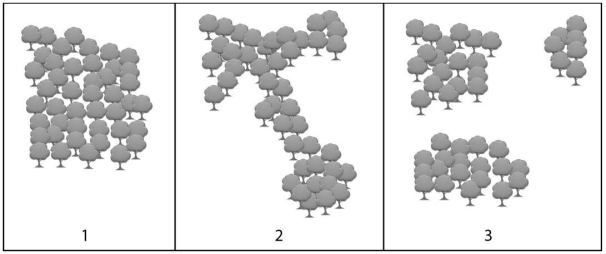
Which area(s)would be most suitable for conserving amphibians,which are highly susceptible to a pathogenic (disease-causing)chytrid fungus?
A)1 and 2
B)2 and 3
C)1 only
D)2 only
E)3 only
Three forest areas are being considered for a conservation reserve.Each area contains the same number of trees and is the same cumulative size.The area surrounding the forest patches is a mix of agricultural land and residential homes.
Which area(s)would be most suitable for conserving amphibians,which are highly susceptible to a pathogenic (disease-causing)chytrid fungus?
A)1 and 2
B)2 and 3
C)1 only
D)2 only
E)3 only
Question
Please use the following information to answer the questions below.
Three forest areas are being considered for a conservation reserve.Each area contains the same number of trees and is the same cumulative size.The area surrounding the forest patches is a mix of agricultural land and residential homes.
Which area(s)would be able to support the most scarlet tanagers,a bird species that is restricted to forest interior habitat?
A)1 and 2
B)2 and 3
C)1 only
D)2 only
E)3 only
Three forest areas are being considered for a conservation reserve.Each area contains the same number of trees and is the same cumulative size.The area surrounding the forest patches is a mix of agricultural land and residential homes.
Which area(s)would be able to support the most scarlet tanagers,a bird species that is restricted to forest interior habitat?
A)1 and 2
B)2 and 3
C)1 only
D)2 only
E)3 only
Question
Question
Question
Question
Question
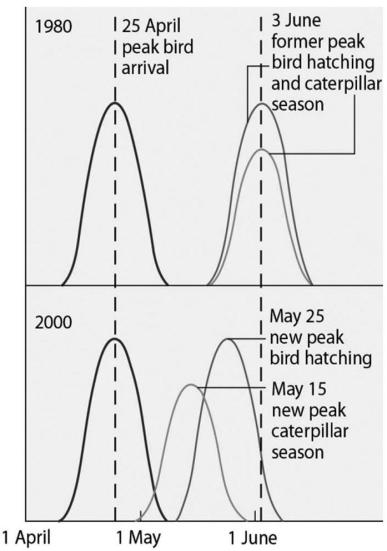 Figure 42.3
Use the graph in Figure 43.3 and the information provided in the paragraph below to answer the following questions.
Flycatcher birds that migrate from Africa to Europe feed their nestlings a diet that is almost exclusively moth caterpillars.The graph in Figure 43.3 shows the mean (peak)dates of bird arrival,bird hatching,and caterpillar season for the years 1980 and 2000.
The shift in the peak of caterpillar season between 1980 and 2000 is most likely due to
A)pesticide use in the area.
B)earlier flycatcher migration.
C)global climate change.
D)acid precipitation in Europe.
Question
Question
Question
Question
Question
Question
Question
Question
Question
Question
Question
Question
Question
Question
Question
Question
Question
Question
Question
Question
Question
Question
Question

Unlock Deck
Sign up to unlock the cards in this deck!
Unlock Deck
Unlock Deck
1/71

Play

Full screen (f)
Deck 43: Conservation Biology and Global Change
1
What is our natural appreciation of wild environments and living organisms called?
A)biodiversity
B)biophilia
C)conservation
D)ecology
A)biodiversity
B)biophilia
C)conservation
D)ecology
B
2
Which of the following is the most direct threat to global biodiversity?
A)increases in atmospheric carbon dioxide
B)the depletion of the protective ozone layer
C)overexploitation of selected plant species
D)habitat destruction due to human activity
A)increases in atmospheric carbon dioxide
B)the depletion of the protective ozone layer
C)overexploitation of selected plant species
D)habitat destruction due to human activity
D
3
How might the extinction of some Pacific Island bats called flying foxes threaten the survival of over 75% of the tree species in those islands?
A)Flying foxes protect trees from invasive herbivores.
B)Flying foxes are increasingly hunted as a luxury food.
C)Flying foxes spread disease between trees in a population.
D)Flying foxes pollinate tree flowers and disperse seeds.
A)Flying foxes protect trees from invasive herbivores.
B)Flying foxes are increasingly hunted as a luxury food.
C)Flying foxes spread disease between trees in a population.
D)Flying foxes pollinate tree flowers and disperse seeds.
D
4
If the sex ratio in a population is significantly different from 50:50,then which of the following will always be true?
A)The genetic variation in the population will increase over time.
B)The genetic variation in the population will decrease over time.
C)The effective population size will be greater than the effective population size.
D)The effective population size will be less than the effective population size.
A)The genetic variation in the population will increase over time.
B)The genetic variation in the population will decrease over time.
C)The effective population size will be greater than the effective population size.
D)The effective population size will be less than the effective population size.
Unlock Deck
Unlock for access to all 71 flashcards in this deck.
Unlock Deck
k this deck
5
It is estimated that 99% of all species that ever lived are now extinct.Why,then,do we say we are now experiencing an extinction (loss of biodiversity)crisis?
A)Humans are ethically responsible for protecting endangered species,but protection is limited.
B)Most of the species on Earth have been identified,so rates of extinction can be quantified.
C)The current rate of extinction is high,and human activities threaten biodiversity at all levels.
D)High human need for plant-based medicinal compounds is leading to plant species extinction.
E)Most biodiversity hot spots have been destroyed by recent ecological disasters,such as floods.
A)Humans are ethically responsible for protecting endangered species,but protection is limited.
B)Most of the species on Earth have been identified,so rates of extinction can be quantified.
C)The current rate of extinction is high,and human activities threaten biodiversity at all levels.
D)High human need for plant-based medicinal compounds is leading to plant species extinction.
E)Most biodiversity hot spots have been destroyed by recent ecological disasters,such as floods.
Unlock Deck
Unlock for access to all 71 flashcards in this deck.
Unlock Deck
k this deck
6
Which of the following examples poses the greatest potential threat to biodiversity?
A)replanting a single culture of native trees in a clear-cut old-growth forest
B)allowing farmland to lie idle and begin to fill in with weeds and then shrubs
C)lack of regulations to limit the harvesting of the medicinal plant ginseng
D)human damming of a large river in a South American tropical rain forest
A)replanting a single culture of native trees in a clear-cut old-growth forest
B)allowing farmland to lie idle and begin to fill in with weeds and then shrubs
C)lack of regulations to limit the harvesting of the medicinal plant ginseng
D)human damming of a large river in a South American tropical rain forest
Unlock Deck
Unlock for access to all 71 flashcards in this deck.
Unlock Deck
k this deck
7
What is the biological significance of genetic diversity between populations?
A)Genes for adaptive traits to local conditions make microevolution possible.
B)The population that is most fit would survive by competitive exclusion.
C)Genetic diversity allows for species stability by preventing speciation.
D)Diseases and parasites are not spread between separated populations.
A)Genes for adaptive traits to local conditions make microevolution possible.
B)The population that is most fit would survive by competitive exclusion.
C)Genetic diversity allows for species stability by preventing speciation.
D)Diseases and parasites are not spread between separated populations.
Unlock Deck
Unlock for access to all 71 flashcards in this deck.
Unlock Deck
k this deck
8
Estimates of current rates of extinction
A)indicate that rates of speciation equal extinction,so an equilibrium has been reached.
B)suggest that one-half of all animal and plant species may be gone by the year 2100.
C)indicate that rates may be greater than extinction rates seen in the fossil records.
D)indicate that only 1% of all of the species that have ever lived on Earth are still alive.
E)suggest that rates of extinction have decreased globally but have increased locally.
A)indicate that rates of speciation equal extinction,so an equilibrium has been reached.
B)suggest that one-half of all animal and plant species may be gone by the year 2100.
C)indicate that rates may be greater than extinction rates seen in the fossil records.
D)indicate that only 1% of all of the species that have ever lived on Earth are still alive.
E)suggest that rates of extinction have decreased globally but have increased locally.
Unlock Deck
Unlock for access to all 71 flashcards in this deck.
Unlock Deck
k this deck
9
Which of the following will have the most effect on species biodiversity in the future?
A)presence of invasive zebra mussels in Lake Michigan
B)prolonged industrial mercury runoff into Lake Ontario
C)oil and gas pipeline construction in tropical rain forests
D)reduced water supply downstream due to a dam in China
A)presence of invasive zebra mussels in Lake Michigan
B)prolonged industrial mercury runoff into Lake Ontario
C)oil and gas pipeline construction in tropical rain forests
D)reduced water supply downstream due to a dam in China
Unlock Deck
Unlock for access to all 71 flashcards in this deck.
Unlock Deck
k this deck
10
The introduction of the brown tree snake in the 1940s to the island of Guam has resulted in
A)eradication of invasive rats and other undesirable/pest species.
B)the extinction of many of the island's bird and reptile species.
C)a new hybrid snake species as a result of species crossbreeding.
D)local extinction of the brown tree snake due to native competition.
A)eradication of invasive rats and other undesirable/pest species.
B)the extinction of many of the island's bird and reptile species.
C)a new hybrid snake species as a result of species crossbreeding.
D)local extinction of the brown tree snake due to native competition.
Unlock Deck
Unlock for access to all 71 flashcards in this deck.
Unlock Deck
k this deck
11
Which of the following terms includes all of the others?
A)species diversity
B)biological diversity
C)genetic diversity
D)ecosystem diversity
A)species diversity
B)biological diversity
C)genetic diversity
D)ecosystem diversity
Unlock Deck
Unlock for access to all 71 flashcards in this deck.
Unlock Deck
k this deck
12
The wood turtle (Glyptemys insculpta)is endangered through much of its range in North America.As the populations shrink in size,it becomes even more difficult for turtles to find mates,and small populations have steadily become smaller.What best describes what the wood turtles in small populations are experiencing?
A)overharvesting
B)an extinction vortex
C)habitat loss
D)climate change
A)overharvesting
B)an extinction vortex
C)habitat loss
D)climate change
Unlock Deck
Unlock for access to all 71 flashcards in this deck.
Unlock Deck
k this deck
13
Overharvesting encourages extinction and is most likely to affect
A)animals that occupy a very broad ecological niche.
B)large animals with low intrinsic reproductive rates.
C)most organisms that live in the lakes and oceans.
D)terrestrial organisms more than aquatic organisms.
A)animals that occupy a very broad ecological niche.
B)large animals with low intrinsic reproductive rates.
C)most organisms that live in the lakes and oceans.
D)terrestrial organisms more than aquatic organisms.
Unlock Deck
Unlock for access to all 71 flashcards in this deck.
Unlock Deck
k this deck
14
Although extinction is a natural process,current extinctions are of concern to environmentalists because
A)more animals than ever before are going extinct globally.
B)most current extinctions are caused by introduced species.
C)the rate of extinction is higher than former extinction rates.
D)current extinction is primarily affecting plant diversity.
A)more animals than ever before are going extinct globally.
B)most current extinctions are caused by introduced species.
C)the rate of extinction is higher than former extinction rates.
D)current extinction is primarily affecting plant diversity.
Unlock Deck
Unlock for access to all 71 flashcards in this deck.
Unlock Deck
k this deck
15
Review the formula for effective population size: Ne (effective population)= .Imagine a total population of 1,000 small rodents.Of these,300 are breeding females,300 are breeding males,and 400 are nonbreeding juveniles.What is the effective population size?
A)1,000
B)1,200
C)600
D)400
E)300
.Imagine a total population of 1,000 small rodents.Of these,300 are breeding females,300 are breeding males,and 400 are nonbreeding juveniles.What is the effective population size?A)1,000
B)1,200
C)600
D)400
E)300
Unlock Deck
Unlock for access to all 71 flashcards in this deck.
Unlock Deck
k this deck
16
Which of the following conditions is the most likely indicator of a population in an extinction vortex?
A)The population is geographically divided into many populations.
B)The species is now found only in small pockets of its former range.
C)The effective population size of the species studied falls below 500.
D)Genetic measurements indicate a loss of genetic variation over time.
A)The population is geographically divided into many populations.
B)The species is now found only in small pockets of its former range.
C)The effective population size of the species studied falls below 500.
D)Genetic measurements indicate a loss of genetic variation over time.
Unlock Deck
Unlock for access to all 71 flashcards in this deck.
Unlock Deck
k this deck
17
Which of the following species was driven to extinction by overharvesting by hunters/fishermen?
A)African elephant
B)the great auk
C)flying foxes
D)zebra mussels
A)African elephant
B)the great auk
C)flying foxes
D)zebra mussels
Unlock Deck
Unlock for access to all 71 flashcards in this deck.
Unlock Deck
k this deck
18
Humans alter natural ecosystems.Which of the following would be the most likely detrimental effect of human disturbance of a natural ecosystem for the purpose of urban development?
A)increases in waste decomposition by soil bacteria
B)decreases in oxygen release by autotrophic plants
C)increases in pollination rates by native insects
D)decrease in toxins in the soil and groundwater
A)increases in waste decomposition by soil bacteria
B)decreases in oxygen release by autotrophic plants
C)increases in pollination rates by native insects
D)decrease in toxins in the soil and groundwater
Unlock Deck
Unlock for access to all 71 flashcards in this deck.
Unlock Deck
k this deck
19
The difference between an endangered species and a threatened one is that
A)an endangered species is closer to extinction.
B)a threatened species is closer to extinction.
C)endangered species are mainly tropical.
D)only endangered species are vertebrates.
A)an endangered species is closer to extinction.
B)a threatened species is closer to extinction.
C)endangered species are mainly tropical.
D)only endangered species are vertebrates.
Unlock Deck
Unlock for access to all 71 flashcards in this deck.
Unlock Deck
k this deck
20
Which of the following ecological locations,if destroyed,would result in the greatest loss of species diversity?
A)Antarctic tundra
B)deciduous forests
C)tropical rain forest
D)temperate grasslands
E)Pacific Ocean islands
A)Antarctic tundra
B)deciduous forests
C)tropical rain forest
D)temperate grasslands
E)Pacific Ocean islands
Unlock Deck
Unlock for access to all 71 flashcards in this deck.
Unlock Deck
k this deck
21
Which of the following is true about the current research regarding forest fragmentation?
A)Small patches of forest result in greater biodiversity of forest-interior species.
B)Large patches of forest result in greater biodiversity of forest-exterior species.
C)Small patches of forest result in lesser biodiversity of forest-interior species.
D)Large patches of forest result in lesser biodiversity of forest-exterior species.
A)Small patches of forest result in greater biodiversity of forest-interior species.
B)Large patches of forest result in greater biodiversity of forest-exterior species.
C)Small patches of forest result in lesser biodiversity of forest-interior species.
D)Large patches of forest result in lesser biodiversity of forest-exterior species.
Unlock Deck
Unlock for access to all 71 flashcards in this deck.
Unlock Deck
k this deck
22
What is a critical load?
A)the nutrient supplementation necessary to bring a depleted habitat back to its former level
B)the level of a given toxin in an ecosystem that is lethal to 50% of the species present
C)the population of a particular species beyond which additional numbers will degrade a habitat
D)the amount of added nutrient that can be absorbed by plants without damaging the ecosystem
A)the nutrient supplementation necessary to bring a depleted habitat back to its former level
B)the level of a given toxin in an ecosystem that is lethal to 50% of the species present
C)the population of a particular species beyond which additional numbers will degrade a habitat
D)the amount of added nutrient that can be absorbed by plants without damaging the ecosystem
Unlock Deck
Unlock for access to all 71 flashcards in this deck.
Unlock Deck
k this deck
23
If global warming continues at its present rate,which biomes will likely take the place of the coniferous forest (taiga)?
A)Arctic tundra and polar ice
B)temperate broadleaf forest and grassland
C)tropical forest and savanna
D)tropical and temperate broadleaf forest
A)Arctic tundra and polar ice
B)temperate broadleaf forest and grassland
C)tropical forest and savanna
D)tropical and temperate broadleaf forest
Unlock Deck
Unlock for access to all 71 flashcards in this deck.
Unlock Deck
k this deck
24
Burning fossil fuels releases oxides of sulfur and nitrogen.These air pollutants can be responsible for
A)the increase of fish populations in lakes.
B)precipitation with a pH as low as 3.0.
C)biological magnification of toxins.
D)preventing the eutrophic process.
A)the increase of fish populations in lakes.
B)precipitation with a pH as low as 3.0.
C)biological magnification of toxins.
D)preventing the eutrophic process.
Unlock Deck
Unlock for access to all 71 flashcards in this deck.
Unlock Deck
k this deck
25
Which of the following is consistent with forest fragmentation research?
A)The number of species is the same in both fragmented forests and forest interiors.
B)Edge communities consistently have lower species diversity than interior ones.
C)Forest-interior species show declines in population in small patch communities.
D)Fragmented forests with small patches support more species than continuous forest.
A)The number of species is the same in both fragmented forests and forest interiors.
B)Edge communities consistently have lower species diversity than interior ones.
C)Forest-interior species show declines in population in small patch communities.
D)Fragmented forests with small patches support more species than continuous forest.
Unlock Deck
Unlock for access to all 71 flashcards in this deck.
Unlock Deck
k this deck
26
As the climate changes because of global warming,species' ranges of plants in the Northern Hemisphere may move northward,using effective reproductive adaptations to disperse their seeds.The trees that are most likely to avoid extinction in such an environment are those that
A)have seeds that are easily dispersed by wind or animals.
B)produce seeds that contain large nutrient stores for growth.
C)have seeds that become viable only after a forest fire.
D)disperse many seeds in close proximity to the parent tree.
A)have seeds that are easily dispersed by wind or animals.
B)produce seeds that contain large nutrient stores for growth.
C)have seeds that become viable only after a forest fire.
D)disperse many seeds in close proximity to the parent tree.
Unlock Deck
Unlock for access to all 71 flashcards in this deck.
Unlock Deck
k this deck
27
According to the small-population approach,what would be the best strategy for saving a population from extinction in its current environment?
A)determining the minimum viable population size
B)establishing a nature reserve to protect its habitat
C)translocating the same species from other areas
D)determining and remedying the cause of decline
E)reducing the population size of competing species
A)determining the minimum viable population size
B)establishing a nature reserve to protect its habitat
C)translocating the same species from other areas
D)determining and remedying the cause of decline
E)reducing the population size of competing species
Unlock Deck
Unlock for access to all 71 flashcards in this deck.
Unlock Deck
k this deck
28
The word triage originated during World War I and was first used by French doctors in prioritizing patients based on the severity of their wounds because there were more wounded soldiers in need of urgent care than there were resources to treat them.Conservation biologists have to make similar determinations with degraded ecosystems.Which of the following is the most important consideration when it comes to managing for maintenance of biodiversity?
A)creating public awareness of endangered vertebrate species and plans to save them
B)determining which species is most important for conserving biodiversity as a whole
C)altering a non-native habitat to be more suitable for an invasive rare bird species
D)sustaining optimum population size of all plant and animal species in the ecosystem
A)creating public awareness of endangered vertebrate species and plans to save them
B)determining which species is most important for conserving biodiversity as a whole
C)altering a non-native habitat to be more suitable for an invasive rare bird species
D)sustaining optimum population size of all plant and animal species in the ecosystem
Unlock Deck
Unlock for access to all 71 flashcards in this deck.
Unlock Deck
k this deck
29
How can human-caused environmental changes create problems for selecting a site for a preserve?
A)Nutrient enrichment prevents preserves from being connected by corridors.
B)The site's environmental conditions may change because of climate change.
C)Global warming makes all climates less suitable for maintaining high diversity.
D)Only lands that are not useful to human activities are available for preserves.
A)Nutrient enrichment prevents preserves from being connected by corridors.
B)The site's environmental conditions may change because of climate change.
C)Global warming makes all climates less suitable for maintaining high diversity.
D)Only lands that are not useful to human activities are available for preserves.
Unlock Deck
Unlock for access to all 71 flashcards in this deck.
Unlock Deck
k this deck
30
The success with which plants extend their range northward following glacial retreat is best determined by
A)their tolerance to shade.
B)their seed dispersal rate.
C)their physical size.
D)their growth rate.
A)their tolerance to shade.
B)their seed dispersal rate.
C)their physical size.
D)their growth rate.
Unlock Deck
Unlock for access to all 71 flashcards in this deck.
Unlock Deck
k this deck
31
Brown-headed cowbirds,an edge-adapted species,utilize fragmented forests effectively by
A)feeding on the fruits of shrubs that tend to grow at the forest/open-field interface.
B)parasitizing forest bird nests and feeding on open-field insects in their patches.
C)roosting in forest trees during mating season and nesting in grassy edge fields.
D)outcompeting other songbird species for insects in fragmented communities.
E)using forest cover to escape from predators in their normal grassland habitat.
A)feeding on the fruits of shrubs that tend to grow at the forest/open-field interface.
B)parasitizing forest bird nests and feeding on open-field insects in their patches.
C)roosting in forest trees during mating season and nesting in grassy edge fields.
D)outcompeting other songbird species for insects in fragmented communities.
E)using forest cover to escape from predators in their normal grassland habitat.
Unlock Deck
Unlock for access to all 71 flashcards in this deck.
Unlock Deck
k this deck
32
Biodiversity hot spots are not necessarily the best choice for nature preserves because
A)hot spots need to be situated in remote areas not accessible to wildlife viewers.
B)their ecological importance makes land purchase very expensive in those areas.
C)a hot spot for one group of organisms may not be a hot spot for another group.
D)hot spots are designated by the abiotic factors present,not the biotic factors.
A)hot spots need to be situated in remote areas not accessible to wildlife viewers.
B)their ecological importance makes land purchase very expensive in those areas.
C)a hot spot for one group of organisms may not be a hot spot for another group.
D)hot spots are designated by the abiotic factors present,not the biotic factors.
Unlock Deck
Unlock for access to all 71 flashcards in this deck.
Unlock Deck
k this deck
33
Relatively small geographic areas with high concentrations of endemic species and a large number of endangered and threatened species are known as
A)nature reserves.
B)movement corridors.
C)biodiversity hot spots.
D)extinction vortices.
A)nature reserves.
B)movement corridors.
C)biodiversity hot spots.
D)extinction vortices.
Unlock Deck
Unlock for access to all 71 flashcards in this deck.
Unlock Deck
k this deck
34
Which of the following can potentially influence effective population size (Ne)?
A)length of life span after reproduction
B)body size of individual members
C)number of alleles per each trait
D)genetic relatedness of members
A)length of life span after reproduction
B)body size of individual members
C)number of alleles per each trait
D)genetic relatedness of members
Unlock Deck
Unlock for access to all 71 flashcards in this deck.
Unlock Deck
k this deck
35
How are movement corridors potentially harmful to certain species?
A)They increase inbreeding.
B)They promote dispersion.
C)They allow disease transmission.
D)They permit seasonal migration.
A)They increase inbreeding.
B)They promote dispersion.
C)They allow disease transmission.
D)They permit seasonal migration.
Unlock Deck
Unlock for access to all 71 flashcards in this deck.
Unlock Deck
k this deck
36
Which of the following nations has become a world leader in the establishment of zoned reserves?
A)Costa Rica
B)Canada
C)China
D)United States
E)Mexico
A)Costa Rica
B)Canada
C)China
D)United States
E)Mexico
Unlock Deck
Unlock for access to all 71 flashcards in this deck.
Unlock Deck
k this deck
37
Many temperate regions are affected by climate change.Which of the following investigations would lend understanding to the future distribution of organisms in temperate regions?
A)Remove,to the mineral soil,all the organisms from an experimental plot,and monitor the colonization of the area over time in terms of both species diversity and abundance.
B)Look at the climatic changes that occurred since the last ice age and how species redistributed as glaciers melted,then make predictions on future distribution in species based on past trends.
C)Quantify the impact of humankind's activities on present-day populations of threatened and endangered species to assess the rate of extirpation and extinction.
D)There is no scientific investigation that can help make predictions on the future distribution of organisms.
A)Remove,to the mineral soil,all the organisms from an experimental plot,and monitor the colonization of the area over time in terms of both species diversity and abundance.
B)Look at the climatic changes that occurred since the last ice age and how species redistributed as glaciers melted,then make predictions on future distribution in species based on past trends.
C)Quantify the impact of humankind's activities on present-day populations of threatened and endangered species to assess the rate of extirpation and extinction.
D)There is no scientific investigation that can help make predictions on the future distribution of organisms.
Unlock Deck
Unlock for access to all 71 flashcards in this deck.
Unlock Deck
k this deck
38
The primary difference between the small-population approach (S-PA)and the declining-population approach (D-PA)to biodiversity recovery is
A)S-PA is interested in bolstering the genetic diversity of a threatened population rather than the environmental factors that caused the population's decline.
B)D-PA would likely involve bringing together individuals from scattered small populations to interbreed in order to promote genetic diversity.
C)S-PA would investigate and eliminate all of the human impacts on the habitat of the species being studied for recovery.
D)D-PA would use recently collected population data to calculate an effective population size.
A)S-PA is interested in bolstering the genetic diversity of a threatened population rather than the environmental factors that caused the population's decline.
B)D-PA would likely involve bringing together individuals from scattered small populations to interbreed in order to promote genetic diversity.
C)S-PA would investigate and eliminate all of the human impacts on the habitat of the species being studied for recovery.
D)D-PA would use recently collected population data to calculate an effective population size.
Unlock Deck
Unlock for access to all 71 flashcards in this deck.
Unlock Deck
k this deck
39
Managing southeastern forests specifically for the red-cockaded woodpecker
A)required the growth of a dense understory of trees and shrubs.
B)included providing nesting cavities for breeding groups.
C)caused other species of songbird to decline in population.
D)involved the creation of fragmented forest habitat.
A)required the growth of a dense understory of trees and shrubs.
B)included providing nesting cavities for breeding groups.
C)caused other species of songbird to decline in population.
D)involved the creation of fragmented forest habitat.
Unlock Deck
Unlock for access to all 71 flashcards in this deck.
Unlock Deck
k this deck
40
How is habitat fragmentation related to biodiversity loss?
A)Less carbon dioxide is absorbed by plants in fragmented habitats.
B)In smaller fragmented habitats,more soil erosion takes place.
C)Smaller fragmented populations are more prone to extinction.
D)Animals and plants are forced out of smaller habitat fragments.
A)Less carbon dioxide is absorbed by plants in fragmented habitats.
B)In smaller fragmented habitats,more soil erosion takes place.
C)Smaller fragmented populations are more prone to extinction.
D)Animals and plants are forced out of smaller habitat fragments.
Unlock Deck
Unlock for access to all 71 flashcards in this deck.
Unlock Deck
k this deck
41
Which of the following refers to the reflecting and absorption of infrared radiation by atmospheric methane,carbon dioxide,and water?
A)acid precipitation
B)biological magnification
C)greenhouse effect
D)eutrophication
A)acid precipitation
B)biological magnification
C)greenhouse effect
D)eutrophication
Unlock Deck
Unlock for access to all 71 flashcards in this deck.
Unlock Deck
k this deck
42
Please use the following information to answer the questions below.
Three forest areas are being considered for a conservation reserve.Each area contains the same number of trees and is the same cumulative size.The area surrounding the forest patches is a mix of agricultural land and residential homes.
Which area(s)would be most suitable for conserving amphibians,which are highly susceptible to a pathogenic (disease-causing)chytrid fungus?
A)1 and 2
B)2 and 3
C)1 only
D)2 only
E)3 only
Three forest areas are being considered for a conservation reserve.Each area contains the same number of trees and is the same cumulative size.The area surrounding the forest patches is a mix of agricultural land and residential homes.
Which area(s)would be most suitable for conserving amphibians,which are highly susceptible to a pathogenic (disease-causing)chytrid fungus?
A)1 and 2
B)2 and 3
C)1 only
D)2 only
E)3 only
Unlock Deck
Unlock for access to all 71 flashcards in this deck.
Unlock Deck
k this deck
43
Please use the following information to answer the questions below.
Three forest areas are being considered for a conservation reserve.Each area contains the same number of trees and is the same cumulative size.The area surrounding the forest patches is a mix of agricultural land and residential homes.
Which area(s)would be able to support the most scarlet tanagers,a bird species that is restricted to forest interior habitat?
A)1 and 2
B)2 and 3
C)1 only
D)2 only
E)3 only
Three forest areas are being considered for a conservation reserve.Each area contains the same number of trees and is the same cumulative size.The area surrounding the forest patches is a mix of agricultural land and residential homes.
Which area(s)would be able to support the most scarlet tanagers,a bird species that is restricted to forest interior habitat?
A)1 and 2
B)2 and 3
C)1 only
D)2 only
E)3 only
Unlock Deck
Unlock for access to all 71 flashcards in this deck.
Unlock Deck
k this deck
44
What causes extremely high levels of toxic chemicals in fish-eating birds?
A)acid precipitation
B)biological magnification
C)greenhouse effect
D)eutrophication
A)acid precipitation
B)biological magnification
C)greenhouse effect
D)eutrophication
Unlock Deck
Unlock for access to all 71 flashcards in this deck.
Unlock Deck
k this deck
45
Which of the following best explains the reduction in human population growth rates over the past four decades?
A)education on global famine
B)improved worldwide health care
C)voluntary reduction of family size
D)improved sanitary conditions
E)reduction of casualties of war
A)education on global famine
B)improved worldwide health care
C)voluntary reduction of family size
D)improved sanitary conditions
E)reduction of casualties of war
Unlock Deck
Unlock for access to all 71 flashcards in this deck.
Unlock Deck
k this deck
46
Agricultural lands frequently require nutrient augmentation because
A)pesticide use has decreased the nitrogen-fixing bacteria population in the soil.
B)nutrients in plant biomass are not returned to the same soil where they are harvested.
C)grains raised for feeding livestock must be fortified and thus require extra nutrients.
D)cultivation of agricultural land inhibits the decomposition of organic matter.
A)pesticide use has decreased the nitrogen-fixing bacteria population in the soil.
B)nutrients in plant biomass are not returned to the same soil where they are harvested.
C)grains raised for feeding livestock must be fortified and thus require extra nutrients.
D)cultivation of agricultural land inhibits the decomposition of organic matter.
Unlock Deck
Unlock for access to all 71 flashcards in this deck.
Unlock Deck
k this deck
47
Which of the following best illustrates human efforts to improve environmental sustainability?
A)rerouting major highways around cities to avoid traffic congestion
B)increasing our reliance on renewable sources of energy,such as wind
C)upgrading computers every few years to improve performance
D)converting automobiles from gasoline to ethanol as a new fuel source
A)rerouting major highways around cities to avoid traffic congestion
B)increasing our reliance on renewable sources of energy,such as wind
C)upgrading computers every few years to improve performance
D)converting automobiles from gasoline to ethanol as a new fuel source
Unlock Deck
Unlock for access to all 71 flashcards in this deck.
Unlock Deck
k this deck
48
Figure 42.3Use the graph in Figure 43.3 and the information provided in the paragraph below to answer the following questions.
Flycatcher birds that migrate from Africa to Europe feed their nestlings a diet that is almost exclusively moth caterpillars.The graph in Figure 43.3 shows the mean (peak)dates of bird arrival,bird hatching,and caterpillar season for the years 1980 and 2000.
The shift in the peak of caterpillar season between 1980 and 2000 is most likely due to
A)pesticide use in the area.
B)earlier flycatcher migration.
C)global climate change.
D)acid precipitation in Europe.
Unlock Deck
Unlock for access to all 71 flashcards in this deck.
Unlock Deck
k this deck
49
Why were ecologists concerned about the shift in the peak caterpillar season from June 3,1980,to May 15,2000?
A)The caterpillars would have eaten much of the foliage of the trees where flycatchers would have nested,rendering their nests more open to predation.
B)The earlier hatching of caterpillars would compete with other insect larval forms that the flycatchers would also use to feed their young.
C)The flycatcher nestlings in 2000 would miss the peak caterpillar season and might not be as well fed,leading to population reductions.
D)The flycatchers would have to migrate sooner to match their brood-rearing to the time of peak caterpillar season.
A)The caterpillars would have eaten much of the foliage of the trees where flycatchers would have nested,rendering their nests more open to predation.
B)The earlier hatching of caterpillars would compete with other insect larval forms that the flycatchers would also use to feed their young.
C)The flycatcher nestlings in 2000 would miss the peak caterpillar season and might not be as well fed,leading to population reductions.
D)The flycatchers would have to migrate sooner to match their brood-rearing to the time of peak caterpillar season.
Unlock Deck
Unlock for access to all 71 flashcards in this deck.
Unlock Deck
k this deck
50
Suppose you attend a town meeting at which some experts tell the audience that they have performed a cost-benefit analysis of a proposed transit system that would probably reduce overall air pollution and fossil fuel consumption.The analysis,however,reveals that ticket prices will not cover the cost of operating the system when fuel,wages,and equipment are taken into account.As a biologist,you know that if ecosystem services had been included in the analysis,the experts might have arrived at a different answer.Why are ecosystem services rarely included in economic analyses?
A)People take them for granted because we generally do not pay for them.
B)They are not worth much and would not greatly change the cost-benefit analysis.
C)There are too many variables to include in ecosystem services,making their calculation impossible.
D)Ecosystem services take into account only abiotic factors that affect local environments.
A)People take them for granted because we generally do not pay for them.
B)They are not worth much and would not greatly change the cost-benefit analysis.
C)There are too many variables to include in ecosystem services,making their calculation impossible.
D)Ecosystem services take into account only abiotic factors that affect local environments.
Unlock Deck
Unlock for access to all 71 flashcards in this deck.
Unlock Deck
k this deck
51
Which of the following best illustrates the sustainable use of a resource?
A)Coal mines in West Virginia remove the tops of mountains to extract large amounts of coal.
B)Improved fishing methods now result in removal of more than 90% of the fish in a region.
C)Huge windmills in Texas are able to capture 50% of the wind energy in a specific region.
D)Corporations are converting their company automobiles from gasoline to natural gas.
A)Coal mines in West Virginia remove the tops of mountains to extract large amounts of coal.
B)Improved fishing methods now result in removal of more than 90% of the fish in a region.
C)Huge windmills in Texas are able to capture 50% of the wind energy in a specific region.
D)Corporations are converting their company automobiles from gasoline to natural gas.
Unlock Deck
Unlock for access to all 71 flashcards in this deck.
Unlock Deck
k this deck
52
The use of DDT as an insecticide in the United States has been outlawed since 1971,yet it is still a problem for certain top-level carnivores in the United States.Which of the following terms best explains this apparent incongruity?
A)habitat fragmentation
B)biological magnification
C)extinction vortex
D)biological manipulation
A)habitat fragmentation
B)biological magnification
C)extinction vortex
D)biological manipulation
Unlock Deck
Unlock for access to all 71 flashcards in this deck.
Unlock Deck
k this deck
53
Which of the following is the most sustainable source of energy?
A)natural gas used to heat homes
B)gasoline used to run cars
C)solar panels on rooftops
D)a coal fueled power plant
A)natural gas used to heat homes
B)gasoline used to run cars
C)solar panels on rooftops
D)a coal fueled power plant
Unlock Deck
Unlock for access to all 71 flashcards in this deck.
Unlock Deck
k this deck
54
What is caused by excessive nutrient runoff into aquatic ecosystems?
A)acid precipitation
B)biological magnification
C)greenhouse effect
D)eutrophication
A)acid precipitation
B)biological magnification
C)greenhouse effect
D)eutrophication
Unlock Deck
Unlock for access to all 71 flashcards in this deck.
Unlock Deck
k this deck
55
The concept of sustainable development emphasizes
A)the resource needs of future generations.
B)trade between all nations of the world.
C)the importance of developing the arts.
D)the fastest ways to economic prosperity.
A)the resource needs of future generations.
B)trade between all nations of the world.
C)the importance of developing the arts.
D)the fastest ways to economic prosperity.
Unlock Deck
Unlock for access to all 71 flashcards in this deck.
Unlock Deck
k this deck
56
Which statement is true with regard to the rate of current human population growth?
A)It is at a zero growth rate.
B)There is exponential increase.
C)Its rate of growth is slowing.
D)Its rate of growth is increasing.
A)It is at a zero growth rate.
B)There is exponential increase.
C)Its rate of growth is slowing.
D)Its rate of growth is increasing.
Unlock Deck
Unlock for access to all 71 flashcards in this deck.
Unlock Deck
k this deck
57
Considering the most important ecological issue of the future,what is the biggest challenge that Costa Rica will likely face in its dedication to conservation and restoration in the future?
A)the pressures of its growing population
B)the country's size and limited resources
C)spread of disease and parasites via corridors
D)the number of species in an extinction vortex
A)the pressures of its growing population
B)the country's size and limited resources
C)spread of disease and parasites via corridors
D)the number of species in an extinction vortex
Unlock Deck
Unlock for access to all 71 flashcards in this deck.
Unlock Deck
k this deck
58
The typical ecological footprint for a person in the United States is 8 global hectares (gha).How would you estimate the number of Earths required to support the entire population of the United States?
A)Multiply the typical U.S.ecological footprint by the number of people who live there,and divide by the total global hectares of biologically productive land.
B)Multiply the typical U.S.ecological footprint by the effective population size of the United States,and divide by the total global hectares of biologically productive land.
C)Take the difference between the typical U.S.ecological footprint and the 1.7 gha sustainable ecological footprint,and multiply this difference by the number of people who live in the United States.
D)Take the difference between the typical U.S.ecological footprint and the 1.7 gha sustainable ecological footprint,and multiply this difference by the total global hectares of productive land.
A)Multiply the typical U.S.ecological footprint by the number of people who live there,and divide by the total global hectares of biologically productive land.
B)Multiply the typical U.S.ecological footprint by the effective population size of the United States,and divide by the total global hectares of biologically productive land.
C)Take the difference between the typical U.S.ecological footprint and the 1.7 gha sustainable ecological footprint,and multiply this difference by the number of people who live in the United States.
D)Take the difference between the typical U.S.ecological footprint and the 1.7 gha sustainable ecological footprint,and multiply this difference by the total global hectares of productive land.
Unlock Deck
Unlock for access to all 71 flashcards in this deck.
Unlock Deck
k this deck
59
The American lady butterfly (Vanessa virginiensis)inhabits only forest edges and does not disperse well across unsuitable habitat.Which of the following area(s)would support the highest numbers of this butterfly?
A)1 and 2
B)2 and 3
C)1 only
D)2 only
E)3 only
A)1 and 2
B)2 and 3
C)1 only
D)2 only
E)3 only
Unlock Deck
Unlock for access to all 71 flashcards in this deck.
Unlock Deck
k this deck
60
The main goal of sustainable development is to
A)involve more countries in global conservation efforts.
B)use only natural resources in new building construction.
C)use natural resources such that they do not decline over time.
D)reevaluate and re-implement management plans over time.
A)involve more countries in global conservation efforts.
B)use only natural resources in new building construction.
C)use natural resources such that they do not decline over time.
D)reevaluate and re-implement management plans over time.
Unlock Deck
Unlock for access to all 71 flashcards in this deck.
Unlock Deck
k this deck
61
Please use the following information to answer the questions below.
A scientist hypothesizes that biological magnification of heavy metals in fragment-dwelling,insect-eating birds should be greater in forest fragments with relatively more edge habitat.This is because edge-dwelling bird species may forage for insects in areas contaminated by heavy metals outside of the forest.Forest fragments with more interior habitat would not have as much biological magnification because insect-eating interior bird species would have less exposure to insects that contain heavy metals.
To test this hypothesis,the scientist conducts an experiment.Which of the following designs would be most informative?
A)Locate a single forest fragment with equal amounts of edge and interior habitat,then sample the blood of insect-eating birds at regular distances across the widest point of the fragment.
B)Locate several forest fragments of similar sizes but different shapes,then sample the blood of insect-eating birds at regular distances along a 100-m path in each fragment.
C)Locate several forest fragments of different sizes but similar shapes,then sample the blood of insect-eating birds at regular distances along a path across the widest point of each fragment.
D)Locate several forest fragments of similar sizes and shapes,then sample the blood of insect-eating birds at regular distances along a 100-m path in each fragment.
A scientist hypothesizes that biological magnification of heavy metals in fragment-dwelling,insect-eating birds should be greater in forest fragments with relatively more edge habitat.This is because edge-dwelling bird species may forage for insects in areas contaminated by heavy metals outside of the forest.Forest fragments with more interior habitat would not have as much biological magnification because insect-eating interior bird species would have less exposure to insects that contain heavy metals.
To test this hypothesis,the scientist conducts an experiment.Which of the following designs would be most informative?
A)Locate a single forest fragment with equal amounts of edge and interior habitat,then sample the blood of insect-eating birds at regular distances across the widest point of the fragment.
B)Locate several forest fragments of similar sizes but different shapes,then sample the blood of insect-eating birds at regular distances along a 100-m path in each fragment.
C)Locate several forest fragments of different sizes but similar shapes,then sample the blood of insect-eating birds at regular distances along a path across the widest point of each fragment.
D)Locate several forest fragments of similar sizes and shapes,then sample the blood of insect-eating birds at regular distances along a 100-m path in each fragment.
Unlock Deck
Unlock for access to all 71 flashcards in this deck.
Unlock Deck
k this deck
62
Which of the following strategies would most rapidly increase the genetic diversity of a population in an extinction vortex?
A)Establish a reserve that protects the population's habitat from any external pressures.
B)Introduce new individuals transported from other populations of the same species.
C)Sterilize the least fit individuals in the population,so that they cannot reproduce.
D)Control populations of the endangered population's predators and competitors.
A)Establish a reserve that protects the population's habitat from any external pressures.
B)Introduce new individuals transported from other populations of the same species.
C)Sterilize the least fit individuals in the population,so that they cannot reproduce.
D)Control populations of the endangered population's predators and competitors.
Unlock Deck
Unlock for access to all 71 flashcards in this deck.
Unlock Deck
k this deck
63
Your friend is wary of environmentalists' claims that climate change could lead to major biological change on Earth.Which of the following statements should you use to support the biological predictions associated with climate change?
A)Studies show that atmospheric CO2 has increased over the past 150 years.
B)CO2 levels and temperature fluctuations are directly correlated in the studies.
C)The distribution of many organisms has already shifted as a result of warming.
D)Sea levels will fall,displacing as much as 50% of the world's human population.
A)Studies show that atmospheric CO2 has increased over the past 150 years.
B)CO2 levels and temperature fluctuations are directly correlated in the studies.
C)The distribution of many organisms has already shifted as a result of warming.
D)Sea levels will fall,displacing as much as 50% of the world's human population.
Unlock Deck
Unlock for access to all 71 flashcards in this deck.
Unlock Deck
k this deck
64
How should the scientist draw a graph of the data to best address the hypothesis?
A)Plot the heavy metal concentration on the y-axis and the relative amount of edge habitat on the x-axis.
B)Plot the total amount of edge habitat on the y-axis and the total amount of interior habitat on the x-axis.
C)Plot the number of birds on the y-axis and the size of the fragment on the x-axis.
D)Plot the density of insects on the y-axis and the total amount of edge habitat on the x-axis.
A)Plot the heavy metal concentration on the y-axis and the relative amount of edge habitat on the x-axis.
B)Plot the total amount of edge habitat on the y-axis and the total amount of interior habitat on the x-axis.
C)Plot the number of birds on the y-axis and the size of the fragment on the x-axis.
D)Plot the density of insects on the y-axis and the total amount of edge habitat on the x-axis.
Unlock Deck
Unlock for access to all 71 flashcards in this deck.
Unlock Deck
k this deck
65
Of the following statements about protected areas that have been established to preserve biodiversity,which one is the most correct?
A)About 75% of Earth's land area is now protected.
B)National parks are the only type of protected area.
C)Management of a protected area is an isolated process.
D)It is especially important to protect biodiversity hot spots.
A)About 75% of Earth's land area is now protected.
B)National parks are the only type of protected area.
C)Management of a protected area is an isolated process.
D)It is especially important to protect biodiversity hot spots.
Unlock Deck
Unlock for access to all 71 flashcards in this deck.
Unlock Deck
k this deck
66
What is the single greatest threat to biodiversity?
A)overharvesting of commercially important species
B)habitat alteration,fragmentation,and destruction
C)introduced species that compete with native species
D)pollution of Earth's atmosphere,freshwater,and soil
A)overharvesting of commercially important species
B)habitat alteration,fragmentation,and destruction
C)introduced species that compete with native species
D)pollution of Earth's atmosphere,freshwater,and soil
Unlock Deck
Unlock for access to all 71 flashcards in this deck.
Unlock Deck
k this deck
67
Which of the following is a consequence of biological magnification?
A)Toxic chemicals in the environment pose greater risk to top-level predators than to primary consumers.
B)Populations of top-level predators are generally smaller than populations of primary consumers.
C)The biomass of producers in an ecosystem is generally higher than the biomass of primary consumers.
D)Only a small portion of the energy captured by primary producers is transferred to primary consumers.
A)Toxic chemicals in the environment pose greater risk to top-level predators than to primary consumers.
B)Populations of top-level predators are generally smaller than populations of primary consumers.
C)The biomass of producers in an ecosystem is generally higher than the biomass of primary consumers.
D)Only a small portion of the energy captured by primary producers is transferred to primary consumers.
Unlock Deck
Unlock for access to all 71 flashcards in this deck.
Unlock Deck
k this deck
68
One characteristic that distinguishes a population in an extinction vortex from most other populations is that
A)it is a population of a rare,top-level predator species.
B)it is effective population is less than total population.
C)it is a small population with a loss of genetic diversity.
D)it is not well adapted to edge-fragment conditions.
A)it is a population of a rare,top-level predator species.
B)it is effective population is less than total population.
C)it is a small population with a loss of genetic diversity.
D)it is not well adapted to edge-fragment conditions.
Unlock Deck
Unlock for access to all 71 flashcards in this deck.
Unlock Deck
k this deck
69
The scientist finds that the heavy metal concentration in the insect-eating birds of a fragment does not depend on the relative amount of edge habitat of that fragment.Which of the following describes how experimental error may have influenced the results?
A)The density of birds is higher in edge habitat compared to the density in interior habitat.
B)The forest fragments studied were too small,and there was no true interior habitat.
C)The insects eaten by both edge and interior birds do not differ in heavy metal concentration.
D)Heavy metals deposited from atmospheric pollution are equal across the landscape.
A)The density of birds is higher in edge habitat compared to the density in interior habitat.
B)The forest fragments studied were too small,and there was no true interior habitat.
C)The insects eaten by both edge and interior birds do not differ in heavy metal concentration.
D)Heavy metals deposited from atmospheric pollution are equal across the landscape.
Unlock Deck
Unlock for access to all 71 flashcards in this deck.
Unlock Deck
k this deck
70
The main cause of the increase in the amount of CO2 in Earth's atmosphere over the past 150 years is
A)increased worldwide primary production.
B)increased worldwide standing crop.
C)increased absorption of infrared radiation.
D)increased amounts of fossil fuel burning.
A)increased worldwide primary production.
B)increased worldwide standing crop.
C)increased absorption of infrared radiation.
D)increased amounts of fossil fuel burning.
Unlock Deck
Unlock for access to all 71 flashcards in this deck.
Unlock Deck
k this deck
71
The scientist wishes to summarize the data in a way that can be compared to other studies on biological magnification of heavy metals in insect-eating birds that live in other forest fragments.What is the best way for the scientist to summarize the data for comparative purposes?
A)Calculate the mean concentration of heavy metals measured in the birds that were found in a fragment.
B)Calculate the mean concentration of heavy metals measured in the birds that were found in a fragment,and divide by the size of the fragment.
C)Calculate the sum total concentrations of heavy metals across all the birds found in a fragment.
D)Calculate the sum total concentrations of heavy metals across all the birds found in a fragment,and divide by the size of the fragment.
A)Calculate the mean concentration of heavy metals measured in the birds that were found in a fragment.
B)Calculate the mean concentration of heavy metals measured in the birds that were found in a fragment,and divide by the size of the fragment.
C)Calculate the sum total concentrations of heavy metals across all the birds found in a fragment.
D)Calculate the sum total concentrations of heavy metals across all the birds found in a fragment,and divide by the size of the fragment.
Unlock Deck
Unlock for access to all 71 flashcards in this deck.
Unlock Deck
k this deck
Unlock Deck
Unlock for access to all 71 flashcards in this deck.






