







 Chat with AI

Deck 9: Competitive Markets
Full screen (f)

Question

Question
Question
Question
Question
Question
Question
Question
Question
Question
Question
Question
Question
Question
Question
Question
Question
Question
Question
Question
Question
Question
Question
Question
Question
Question
Question
Question
Question
Question
Question
Question
Question
Question
Question
Question
Question
Question
Question
Question
Question
Assume the following total cost schedule for a perfectly competitive firm. 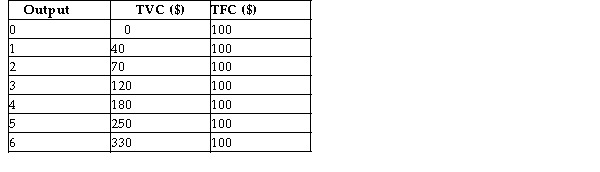 TABLE 9-2
Refer to Table 9-2. What is the marginal cost of producing the 5th unit of output?
A) $30
B) $35
C) $50
D) $70
E) $80
TABLE 9-2Refer to Table 9-2. What is the marginal cost of producing the 5th unit of output?
A) $30
B) $35
C) $50
D) $70
E) $80
Question
Question
Assume the following total cost schedule for a perfectly competitive firm. TABLE 9-2
Refer to Table 9-2. This profit-maximizing firm would produce no output in the short run if the market price of its output dropped below
A) $35.
B) $40.
C) $70.
D) $90.
E) $100.
TABLE 9-2Refer to Table 9-2. This profit-maximizing firm would produce no output in the short run if the market price of its output dropped below
A) $35.
B) $40.
C) $70.
D) $90.
E) $100.
Question
Consider the price and quantity data below for a perfectly competitive firm producing mousetraps. 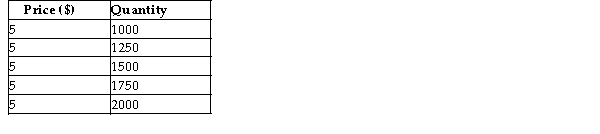 TABLE 9-1
Refer to Table 9-1. Suppose this firm is currently selling 1750 mousetraps at the market price of $5. If the firm raises its price to $6, itʹs average revenue will be
A) $0.
B) $5.
C) $6.
D) between $5 and $6.
E) greater than $6.
TABLE 9-1Refer to Table 9-1. Suppose this firm is currently selling 1750 mousetraps at the market price of $5. If the firm raises its price to $6, itʹs average revenue will be
A) $0.
B) $5.
C) $6.
D) between $5 and $6.
E) greater than $6.
Question
Consider the following total cost schedule for a perfectly competitive firm producing ball-point pens. 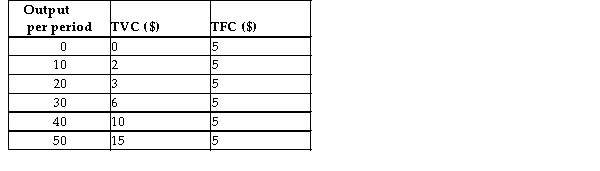 TABLE 9-3
Refer to Table 9-3. If this firm were producing at an output level of 30 units, the AFC would be and the AVC would be .
A) $5; $6
B) $6; $5
C) $0.17; $0.20
D) $0.20; $0.17
E) $0.10; $0.30
TABLE 9-3Refer to Table 9-3. If this firm were producing at an output level of 30 units, the AFC would be and the AVC would be .
A) $5; $6
B) $6; $5
C) $0.17; $0.20
D) $0.20; $0.17
E) $0.10; $0.30
Question
Assume the following total cost schedule for a perfectly competitive firm. TABLE 9-2
Refer to Table 9-2. If the market price were $75, this perfectly competitive firm wishing to maximize its profits would
A) produce 2 units of output.
B) produce 6 units of output.
C) produce 5 units of output.
D) not produce because P < minimum of ATC.
E) not produce because P < TFC.
TABLE 9-2Refer to Table 9-2. If the market price were $75, this perfectly competitive firm wishing to maximize its profits would
A) produce 2 units of output.
B) produce 6 units of output.
C) produce 5 units of output.
D) not produce because P < minimum of ATC.
E) not produce because P < TFC.
Question
Question
Assume the following total cost schedule for a perfectly competitive firm. TABLE 9-2
Refer to Table 9-2. In order to maximize its profits, the firm should continue to produce in the short run even if the market price is less than its ATC as long as the price is greater than or equal to
A) AVC.
B) MC.
C) AFC.
D) TVC.
E) TC.
TABLE 9-2Refer to Table 9-2. In order to maximize its profits, the firm should continue to produce in the short run even if the market price is less than its ATC as long as the price is greater than or equal to
A) AVC.
B) MC.
C) AFC.
D) TVC.
E) TC.
Question
Question
Assume the following total cost schedule for a perfectly competitive firm. TABLE 9-2
Refer to Table 9-2. What is the marginal cost of producing the 2nd unit of output?
A) $10
B) $15
C) $5
D) $30
E) $35
TABLE 9-2Refer to Table 9-2. What is the marginal cost of producing the 2nd unit of output?
A) $10
B) $15
C) $5
D) $30
E) $35
Question
Question
Assume the following total cost schedule for a perfectly competitive firm. TABLE 9-2
Refer to Table 9-2. If the firm is producing at an output level of 4 units, the ATC is and the AVC is
)
A) $280; $180
B) $25; $45
C) $70; $45
D) $70; $35
E) $180; $100
TABLE 9-2Refer to Table 9-2. If the firm is producing at an output level of 4 units, the ATC is and the AVC is
)
A) $280; $180
B) $25; $45
C) $70; $45
D) $70; $35
E) $180; $100
Question
Consider the price and quantity data below for a perfectly competitive firm producing mousetraps. TABLE 9-1
Refer to Table 9-1. Suppose this firm is currently selling 1750 mousetraps at the market price of $5. If the firm raises its price to $6, its total revenue will be
A) $0.
B) greater than or equal to $1750.
C) greater than or equal to $6250.
D) $10 500.
E) greater than $10 500.
TABLE 9-1Refer to Table 9-1. Suppose this firm is currently selling 1750 mousetraps at the market price of $5. If the firm raises its price to $6, its total revenue will be
A) $0.
B) greater than or equal to $1750.
C) greater than or equal to $6250.
D) $10 500.
E) greater than $10 500.
Question
Assume the following total cost schedule for a perfectly competitive firm. TABLE 9-2
Refer to Table 9-2. The total cost of producing 6 units of output is
A) $71.67.
B) $100.
C) $230.
D) $330.
E) $430.
TABLE 9-2Refer to Table 9-2. The total cost of producing 6 units of output is
A) $71.67.
B) $100.
C) $230.
D) $330.
E) $430.
Question
Assume the following total cost schedule for a perfectly competitive firm. TABLE 9-2
Refer to Table 9-2. If the firm is producing at an output level of 2 units, the ATC is and the AVC is
)
A) $100; $70
B) $70; $35
C) $50; $50
D) $140; $40
E) $85; $35
TABLE 9-2Refer to Table 9-2. If the firm is producing at an output level of 2 units, the ATC is and the AVC is
)
A) $100; $70
B) $70; $35
C) $50; $50
D) $140; $40
E) $85; $35
Question
Assume the following total cost schedule for a perfectly competitive firm. TABLE 9-2
Refer to Table 9-2. At what price would a profit-maximizing firm earn zero economic profits?
A) $40
B) $70
C) $145
D) $220
E) $430
TABLE 9-2Refer to Table 9-2. At what price would a profit-maximizing firm earn zero economic profits?
A) $40
B) $70
C) $145
D) $220
E) $430
Question
Question
Assume the following total cost schedule for a perfectly competitive firm. TABLE 9-2
Refer to Table 9-2. If the firm is producing at an output level of 6 units, the ATC is and the AVC is
)
A) $55; $16.67
B) $38.33; $16.67
C) $80; $55
D) $55; $80
E) $71.67; $55
TABLE 9-2Refer to Table 9-2. If the firm is producing at an output level of 6 units, the ATC is and the AVC is
)
A) $55; $16.67
B) $38.33; $16.67
C) $80; $55
D) $55; $80
E) $71.67; $55
Question
Consider the price and quantity data below for a perfectly competitive firm producing mousetraps. TABLE 9-1
Refer to Table 9-1. If this firm is producing 1250 mousetraps, its total revenue is , its average revenue is and its marginal revenue is .
A) $5; $5; $5
B) $6250; $250; $5
C) $1750; $250; $5
D) $5000; $5; $250
E) $6250; $5; $5
TABLE 9-1Refer to Table 9-1. If this firm is producing 1250 mousetraps, its total revenue is , its average revenue is and its marginal revenue is .
A) $5; $5; $5
B) $6250; $250; $5
C) $1750; $250; $5
D) $5000; $5; $250
E) $6250; $5; $5
Question
Question
Question
Question
Question
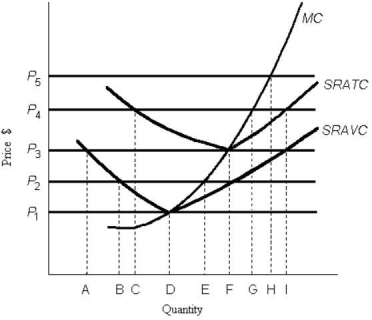 FIGURE 9-1
Refer to Figure 9-1. The diagram shows cost curves for a perfectly competitive firm. If the market price is P4, the profit-maximizing firm in the short run should produce output
A) C.
B) F.
C) G.
D) H.
E) I.
Question
Consider the following total cost schedule for a perfectly competitive firm producing ball-point pens. TABLE 9-3
Refer to Table 9-3. This firm would produce no output in the short run if the market price of its output
A) dropped below $0.15.
B) dropped below $0.20.
C) dropped below $0.30.
D) dropped below $2.00.
E) dropped below $3.00.
TABLE 9-3Refer to Table 9-3. This firm would produce no output in the short run if the market price of its output
A) dropped below $0.15.
B) dropped below $0.20.
C) dropped below $0.30.
D) dropped below $2.00.
E) dropped below $3.00.
Question
FIGURE 9-1Refer to Figure 9-1. The diagram shows cost curves for a perfectly competitive firm. If the market price is P1, the profit-maximizing firm in the short run should
A) produce output A.
B) produce output B.
C) produce output C.
D) produce output D or shut down as it doesnʹt really matter which.
E) definitely shut down.
Question
FIGURE 9-1Refer to Figure 9-1. The diagram shows cost curves for a perfectly competitive firm. If the market price is P2, the profit-maximizing firm in the short run should
A) produce output B.
B) produce output C.
C) produce output D.
D) produce output E.
E) shut down, as it is incurring losses.
Question
Consider the following total cost schedule for a perfectly competitive firm producing ball-point pens. TABLE 9-3
Refer to Table 9-3. Suppose the prevailing market price for this firmʹs product is $0.45. If the firm is producing 20 units of output per period, then its profit per unit is and its total profit per period is .
A) $9; $180
B) $0.05; $1.00
C) $6; $120
D) $0.01; $2
E) $0.40; $8
TABLE 9-3Refer to Table 9-3. Suppose the prevailing market price for this firmʹs product is $0.45. If the firm is producing 20 units of output per period, then its profit per unit is and its total profit per period is .
A) $9; $180
B) $0.05; $1.00
C) $6; $120
D) $0.01; $2
E) $0.40; $8
Question
FIGURE 9-1Refer to Figure 9-1. The diagram shows cost curves for a perfectly competitive firm. If the market price is P3, the profit-maximizing firm in the short run should
A) produce output A.
B) produce output F or shut down, as it doesnʹt matter which.
C) produce output D.
D) shut down because more profits could be earned in another industry.
E) produce output F.
Question
Consider the following total cost schedule for a perfectly competitive firm producing ball-point pens. TABLE 9-3
Refer to Table 9-3. What is the marginal cost of producing the 15th unit of output?
A) $0.10
B) $0.17
C) $0.375
D) $0.40
E) $0.50
TABLE 9-3Refer to Table 9-3. What is the marginal cost of producing the 15th unit of output?
A) $0.10
B) $0.17
C) $0.375
D) $0.40
E) $0.50
Question
Consider the following total cost schedule for a perfectly competitive firm producing ball-point pens. TABLE 9-3
Refer to Table 9-3. What is the marginal cost of producing the 35th unit of output?
A) $0.10
B) $0.17
C) $0.375
D) $0.40
E) $0.50
TABLE 9-3Refer to Table 9-3. What is the marginal cost of producing the 35th unit of output?
A) $0.10
B) $0.17
C) $0.375
D) $0.40
E) $0.50
Question
Question
FIGURE 9-1Refer to Figure 9-1. The diagram shows cost curves for a perfectly competitive firm. The short-run shut down price for the firm is
A) P1.
B) P2.
C) P3.
D) P4.
E) P5.
Question
Consider the following total cost schedule for a perfectly competitive firm producing ball-point pens. TABLE 9-3
Refer to Table 9-3. Suppose the prevailing market price for this firmʹs product is $0.42 and the firm produces its profit-maximizing level of output. At this price
A) the firm is earning zero economic profits.
B) the firm is earning positive economic profits.
C) the firm is suffering economic losses and this firm will exit the industry.
D) the firm should increase output.
E) the firm should decrease output.
TABLE 9-3Refer to Table 9-3. Suppose the prevailing market price for this firmʹs product is $0.42 and the firm produces its profit-maximizing level of output. At this price
A) the firm is earning zero economic profits.
B) the firm is earning positive economic profits.
C) the firm is suffering economic losses and this firm will exit the industry.
D) the firm should increase output.
E) the firm should decrease output.
Question
Consider the following total cost schedule for a perfectly competitive firm producing ball-point pens. TABLE 9-3
Refer to Table 9-3. Suppose the prevailing market price for this firmʹs product is $0.14 and the firm is currently producing 20 units of output. This competitive firm wishing to maximize profits would
A) increase output because marginal revenue is greater than marginal cost.
B) decrease output because marginal revenue is less than marginal cost.
C) increase output because marginal revenue is less than marginal cost.
D) decrease output because marginal revenue is greater than marginal cost.
E) produce zero output because price is less than the minimum average variable cost.
TABLE 9-3Refer to Table 9-3. Suppose the prevailing market price for this firmʹs product is $0.14 and the firm is currently producing 20 units of output. This competitive firm wishing to maximize profits would
A) increase output because marginal revenue is greater than marginal cost.
B) decrease output because marginal revenue is less than marginal cost.
C) increase output because marginal revenue is less than marginal cost.
D) decrease output because marginal revenue is greater than marginal cost.
E) produce zero output because price is less than the minimum average variable cost.
Question
FIGURE 9-1Refer to Figure 9-1. The diagram shows cost curves for a perfectly competitive firm. The firmʹs short-run supply curve starts at output and rises along the marginal cost MC) curve.
A) D
B) E
C) F
D) G
E) H
Question
Question
Question
Consider the following total cost schedule for a perfectly competitive firm producing ball-point pens. TABLE 9-3
Refer to Table 9-3. As this firm increases output from 40 units to 50 units per period, its marginal cost rises to
A) $0.10.
B) $0.17.
C) $0.375.
D) $0.40.
E) $0.50.
TABLE 9-3Refer to Table 9-3. As this firm increases output from 40 units to 50 units per period, its marginal cost rises to
A) $0.10.
B) $0.17.
C) $0.375.
D) $0.40.
E) $0.50.
Question
Consider the following total cost schedule for a perfectly competitive firm producing ball-point pens. TABLE 9-3
Refer to Table 9-3. Suppose the prevailing market price for this firmʹs product is $0.40. The profit -maximizing level of output for this firm is between
A) 0 and 10 units.
B) 10 and 20 units.
C) 20 and 30 units.
D) 30 and 40 units.
E) 40 and 50 units.
TABLE 9-3Refer to Table 9-3. Suppose the prevailing market price for this firmʹs product is $0.40. The profit -maximizing level of output for this firm is between
A) 0 and 10 units.
B) 10 and 20 units.
C) 20 and 30 units.
D) 30 and 40 units.
E) 40 and 50 units.

Unlock Deck
Sign up to unlock the cards in this deck!
Unlock Deck
Unlock Deck
1/153

Play

Full screen (f)
Deck 9: Competitive Markets
1
The term ʺperfect competitionʺ refers to
A) rivalrous behaviour.
B) ideal economic behaviour.
C) a type of market structure.
D) the most prevalent market structure in a capitalist economy.
E) the most realistic market structure.
A) rivalrous behaviour.
B) ideal economic behaviour.
C) a type of market structure.
D) the most prevalent market structure in a capitalist economy.
E) the most realistic market structure.
C
2
The demand curve facing a perfectly competitive firm
A) is the same as the industry or market demand curve.
B) is almost perfectly elastic at the market price.
C) depends on the firmʹs technology.
D) depends on the firmʹs costs of production.
E) depends on the firmʹs output.
A) is the same as the industry or market demand curve.
B) is almost perfectly elastic at the market price.
C) depends on the firmʹs technology.
D) depends on the firmʹs costs of production.
E) depends on the firmʹs output.
B
3
A firm is said to have ʺmarket powerʺ only when
A) it has the ability to influence the price of its product.
B) it has the ability to choose its own profit-maximizing level of output.
C) its demand curve is the market demand curve.
D) it is one of 10 or fewer firms in the industry.
E) it is one of 25 or fewer firms in the industry.
A) it has the ability to influence the price of its product.
B) it has the ability to choose its own profit-maximizing level of output.
C) its demand curve is the market demand curve.
D) it is one of 10 or fewer firms in the industry.
E) it is one of 25 or fewer firms in the industry.
A
4
An example of a product that could most closely satisfy the homogeneous product assumption of perfect competition is
A) barley.
B) cars.
C) shampoo.
D) personal computers.
E) pizza.
A) barley.
B) cars.
C) shampoo.
D) personal computers.
E) pizza.
Unlock Deck
Unlock for access to all 153 flashcards in this deck.
Unlock Deck
k this deck
5
When economists say that a firm is a ʺprice takerʺ they mean that
A) the firm initially takes price as given and tries to influence it through advertising.
B) the firm can alter its rate of production and sales without affecting the market price of the product.
C) at the price prevailing in the market, the firm will be willing to sell an infinite quantity.
D) the demand curve that the firm faces is perfectly inelastic.
E) the firm can alter the market price as it changes its rate of production.
A) the firm initially takes price as given and tries to influence it through advertising.
B) the firm can alter its rate of production and sales without affecting the market price of the product.
C) at the price prevailing in the market, the firm will be willing to sell an infinite quantity.
D) the demand curve that the firm faces is perfectly inelastic.
E) the firm can alter the market price as it changes its rate of production.
Unlock Deck
Unlock for access to all 153 flashcards in this deck.
Unlock Deck
k this deck
6
Given the usual assumptions about perfect competition, a perfectly competitive firm
A) can set the price it charges.
B) can sell as much of its product as it wishes at the market price.
C) can affect the market conditions in a significant way.
D) is aware of its competitorsʹ costs.
E) competes actively with other sellers in the industry.
A) can set the price it charges.
B) can sell as much of its product as it wishes at the market price.
C) can affect the market conditions in a significant way.
D) is aware of its competitorsʹ costs.
E) competes actively with other sellers in the industry.
Unlock Deck
Unlock for access to all 153 flashcards in this deck.
Unlock Deck
k this deck
7
Suppose XYZ Corp. is a profit-maximizing firm that is producing and selling 1 billion disposable wooden chopsticks per month at a price of $0.04 per unit. Further, suppose market demand for this product is 1.5 billion units per month. What can we conclude about market structure in this case?
A) This is not a perfectly competitive market because XYZ Corp. is small relative to the size of the industry.
B) This is not a perfectly competitive market because XYZ Corp. is selling its product at a price that is not equal to marginal cost.
C) This is a perfectly competitive market because there is freedom of entry and exit in the industry.
D) This is a perfectly competitive market because the product is homogeneous.
E) This is not a perfectly competitive market because XYZ Corp. is large relative to the size of the industry.
A) This is not a perfectly competitive market because XYZ Corp. is small relative to the size of the industry.
B) This is not a perfectly competitive market because XYZ Corp. is selling its product at a price that is not equal to marginal cost.
C) This is a perfectly competitive market because there is freedom of entry and exit in the industry.
D) This is a perfectly competitive market because the product is homogeneous.
E) This is not a perfectly competitive market because XYZ Corp. is large relative to the size of the industry.
Unlock Deck
Unlock for access to all 153 flashcards in this deck.
Unlock Deck
k this deck
8
A firm in a perfectly competitive market
A) has no power to influence the market price.
B) is limited in the amount of product it can sell without affecting the price.
C) is dependant upon the behaviour of its competitors.
D) is aware of its competitorsʹ costs.
E) competes actively with other sellers in the industry.
A) has no power to influence the market price.
B) is limited in the amount of product it can sell without affecting the price.
C) is dependant upon the behaviour of its competitors.
D) is aware of its competitorsʹ costs.
E) competes actively with other sellers in the industry.
Unlock Deck
Unlock for access to all 153 flashcards in this deck.
Unlock Deck
k this deck
9
Which of the following terms would best describe the price elasticity of demand facing a perfectly competitive firm?
A) perfectly inelastic
B) inelastic
C) unit
D) elastic
E) perfectly elastic
A) perfectly inelastic
B) inelastic
C) unit
D) elastic
E) perfectly elastic
Unlock Deck
Unlock for access to all 153 flashcards in this deck.
Unlock Deck
k this deck
10
Which of the following statements is one of the assumptions of the theory of perfect competition?
A) Firms compete with each other by varying their price.
B) Firms are price setters.
C) Consumers know the prices charged by each firm.
D) Firms produce a wide variety of versions of the product.
E) A firmʹs entry to the market is regulated by the federal Competition Bureau.
A) Firms compete with each other by varying their price.
B) Firms are price setters.
C) Consumers know the prices charged by each firm.
D) Firms produce a wide variety of versions of the product.
E) A firmʹs entry to the market is regulated by the federal Competition Bureau.
Unlock Deck
Unlock for access to all 153 flashcards in this deck.
Unlock Deck
k this deck
11
The price elasticity of demand faced by an individual wheat farmer would come closest to which following value?
A) 0.00007
B) 0.7
C) 1.0
D) 71.0
E) 71 000
A) 0.00007
B) 0.7
C) 1.0
D) 71.0
E) 71 000
Unlock Deck
Unlock for access to all 153 flashcards in this deck.
Unlock Deck
k this deck
12
Which of the following is NOT a determinant of market structure?
A) The number of sellers.
B) The nature of the product.
C) The ease of entering the industry.
D) The capital-labour ratio of the firm.
E) The market share of the sellers.
A) The number of sellers.
B) The nature of the product.
C) The ease of entering the industry.
D) The capital-labour ratio of the firm.
E) The market share of the sellers.
Unlock Deck
Unlock for access to all 153 flashcards in this deck.
Unlock Deck
k this deck
13
In economics, perfect competition refers to a market structure where
A) firms behave strategically.
B) all firms are earning profits.
C) firms co-operate with each other.
D) each firm has zero market power.
E) firms can set the price of their product.
A) firms behave strategically.
B) all firms are earning profits.
C) firms co-operate with each other.
D) each firm has zero market power.
E) firms can set the price of their product.
Unlock Deck
Unlock for access to all 153 flashcards in this deck.
Unlock Deck
k this deck
14
Which of the following statements does NOT apply to a perfectly competitive market?
A) There is freedom of entry and exit of firms in the industry.
B) Consumers can shop for the lowest available price.
C) Consumers prefer certain brands over others.
D) All firms have realized the possible economies of scale.
E) All firms in the industry are price takers.
A) There is freedom of entry and exit of firms in the industry.
B) Consumers can shop for the lowest available price.
C) Consumers prefer certain brands over others.
D) All firms have realized the possible economies of scale.
E) All firms in the industry are price takers.
Unlock Deck
Unlock for access to all 153 flashcards in this deck.
Unlock Deck
k this deck
15
In order to decide the appropriate output to produce, the manager of a perfectly competitive firm needs to know
A) the industry or market demand.
B) the industry or market supply.
C) what other firms in the industry are producing.
D) the prevailing market price for the firmʹs output.
E) its competitorsʹ market strategies.
A) the industry or market demand.
B) the industry or market supply.
C) what other firms in the industry are producing.
D) the prevailing market price for the firmʹs output.
E) its competitorsʹ market strategies.
Unlock Deck
Unlock for access to all 153 flashcards in this deck.
Unlock Deck
k this deck
16
Why will a perfectly competitive firm not sell its product below the prevailing market price?
A) It faces inelastic demand.
B) It can sell all it wishes at the market price.
C) The sellers in the market have agreed to not sell below a specified price.
D) Its costs would increase dramatically.
E) This would lead to a price war among sellers.
A) It faces inelastic demand.
B) It can sell all it wishes at the market price.
C) The sellers in the market have agreed to not sell below a specified price.
D) Its costs would increase dramatically.
E) This would lead to a price war among sellers.
Unlock Deck
Unlock for access to all 153 flashcards in this deck.
Unlock Deck
k this deck
17
The conditions for a perfectly competitive market include which one of the following?
A) Firms behave as price takers.
B) Profits are zero in the short run.
C) New entrants cannot threaten the position of existing firms.
D) Firms can control prices.
E) Firms must employ the newest technologies as soon as they are developed.
A) Firms behave as price takers.
B) Profits are zero in the short run.
C) New entrants cannot threaten the position of existing firms.
D) Firms can control prices.
E) Firms must employ the newest technologies as soon as they are developed.
Unlock Deck
Unlock for access to all 153 flashcards in this deck.
Unlock Deck
k this deck
18
The theory of perfect competition is built on several assumptions, including that
A) the individual firm can affect the price of the product it sells.
B) the individual firm can influence demand by advertising.
C) each firm must earn economic profits to remain in the industry.
D) any firm can easily enter or leave the industry.
E) there are few producers of an identical product.
A) the individual firm can affect the price of the product it sells.
B) the individual firm can influence demand by advertising.
C) each firm must earn economic profits to remain in the industry.
D) any firm can easily enter or leave the industry.
E) there are few producers of an identical product.
Unlock Deck
Unlock for access to all 153 flashcards in this deck.
Unlock Deck
k this deck
19
If a firm in a perfectly competitive market were to raise its price, its
A) revenue would decrease only if market demand were elastic.
B) revenue would increase only if market demand were inelastic.
C) total costs would increase.
D) revenue would fall dramatically.
E) profits would increase as long as costs remained constant.
A) revenue would decrease only if market demand were elastic.
B) revenue would increase only if market demand were inelastic.
C) total costs would increase.
D) revenue would fall dramatically.
E) profits would increase as long as costs remained constant.
Unlock Deck
Unlock for access to all 153 flashcards in this deck.
Unlock Deck
k this deck
20
Which of the following producers operate in a market structure closely approximated by perfect competition?
A) a restaurant in your neighbourhood
B) Air Canada
C) a Safeway grocery store
D) A British Columbia peach grower.
E) the Bank of Montreal
A) a restaurant in your neighbourhood
B) Air Canada
C) a Safeway grocery store
D) A British Columbia peach grower.
E) the Bank of Montreal
Unlock Deck
Unlock for access to all 153 flashcards in this deck.
Unlock Deck
k this deck
21
For a given market price, a perfectly competitive firmʹs total-revenue curve
A) is a positively sloped straight line, starting from the origin.
B) increases to the right and then declines when MC = MR.
C) is a straight line that coincides with the market demand curve.
D) is the same as the firmʹs demand curve.
E) is the same as the firmʹs MR curve.
A) is a positively sloped straight line, starting from the origin.
B) increases to the right and then declines when MC = MR.
C) is a straight line that coincides with the market demand curve.
D) is the same as the firmʹs demand curve.
E) is the same as the firmʹs MR curve.
Unlock Deck
Unlock for access to all 153 flashcards in this deck.
Unlock Deck
k this deck
22
Firms have several different concepts of revenue: total revenue, average revenue, marginal revenue, and price. For a profit-maximizing perfectly competitive firm, which statement below is true?
A) Total revenue, average revenue, marginal revenue, and price are all equal.
B) Average revenue, marginal revenue, and price are equal.
C) Only marginal revenue and price are equal.
D) Only average revenue and price are equal.
E) None of these revenues are equal.
A) Total revenue, average revenue, marginal revenue, and price are all equal.
B) Average revenue, marginal revenue, and price are equal.
C) Only marginal revenue and price are equal.
D) Only average revenue and price are equal.
E) None of these revenues are equal.
Unlock Deck
Unlock for access to all 153 flashcards in this deck.
Unlock Deck
k this deck
23
For any firm operating in any market structure, marginal revenue is defined as
A) total revenue divided by the number of units sold.
B) the change in total revenue resulting from the sale of an additional unit of the product.
C) the total amount received by the seller from the sale of a product.
D) the change in price resulting from the sale of an additional unit of the product.
E) price times quantity of the product sold.
A) total revenue divided by the number of units sold.
B) the change in total revenue resulting from the sale of an additional unit of the product.
C) the total amount received by the seller from the sale of a product.
D) the change in price resulting from the sale of an additional unit of the product.
E) price times quantity of the product sold.
Unlock Deck
Unlock for access to all 153 flashcards in this deck.
Unlock Deck
k this deck
24
When economists say that a perfectly competitive firm is a ʺquantity adjuster,ʺ they mean that
A) it adjusts its output in response to changes in prices.
B) it can vary its output by an infinite amount.
C) it is not concerned with cost factors.
D) its marginal-cost curve coincides with its own demand curve.
E) changing the output level does not affect the costs of production.
A) it adjusts its output in response to changes in prices.
B) it can vary its output by an infinite amount.
C) it is not concerned with cost factors.
D) its marginal-cost curve coincides with its own demand curve.
E) changing the output level does not affect the costs of production.
Unlock Deck
Unlock for access to all 153 flashcards in this deck.
Unlock Deck
k this deck
25
When a firm is referred to as a ʺprice taker,ʺ
A) the firm initially takes price as given and tries to influence it through advertising.
B) the firm can alter its rate of production and sales without affecting the market price of the product.
C) the firm will be willing to sell an infinite quantity at the market price.
D) the demand curve that the firm faces is perfectly inelastic.
E) the firm can alter the market price as it changes its rate of production.
A) the firm initially takes price as given and tries to influence it through advertising.
B) the firm can alter its rate of production and sales without affecting the market price of the product.
C) the firm will be willing to sell an infinite quantity at the market price.
D) the demand curve that the firm faces is perfectly inelastic.
E) the firm can alter the market price as it changes its rate of production.
Unlock Deck
Unlock for access to all 153 flashcards in this deck.
Unlock Deck
k this deck
26
In the short run, the profit-maximizing behaviour for a price-taking firm requires it to operate where
A) P = MC, given that P is greater than or equal to ATC.
B) P = TR = TC.
C) P > MR > MC.
D) AVC = AR.
E) P = MC, given that P is greater than or equal to AVC.
A) P = MC, given that P is greater than or equal to ATC.
B) P = TR = TC.
C) P > MR > MC.
D) AVC = AR.
E) P = MC, given that P is greater than or equal to AVC.
Unlock Deck
Unlock for access to all 153 flashcards in this deck.
Unlock Deck
k this deck
27
A perfectly competitive firmʹs demand curve coincides with
A) its average-revenue curve and total-revenue curve.
B) its total-revenue curve.
C) both its marginal and average-revenue curves.
D) both its marginal and total-revenue curves.
E) the market demand curve.
A) its average-revenue curve and total-revenue curve.
B) its total-revenue curve.
C) both its marginal and average-revenue curves.
D) both its marginal and total-revenue curves.
E) the market demand curve.
Unlock Deck
Unlock for access to all 153 flashcards in this deck.
Unlock Deck
k this deck
28
If the demand curve faced by a firm is downward sloping, we can reasonably believe that the
A) firm can influence the price of the product it sells.
B) firm will have no effect on the price of the product it sells.
C) firm must lower prices if it hopes to increase its profits.
D) firmʹs contributions to total output of the product is insignificant.
E) firm has no control over the price of the product it sells but can vary the output.
A) firm can influence the price of the product it sells.
B) firm will have no effect on the price of the product it sells.
C) firm must lower prices if it hopes to increase its profits.
D) firmʹs contributions to total output of the product is insignificant.
E) firm has no control over the price of the product it sells but can vary the output.
Unlock Deck
Unlock for access to all 153 flashcards in this deck.
Unlock Deck
k this deck
29
The market demand curve for a perfectly competitive industry is typically
A) identical to the competitive firmʹs demand curve.
B) downward sloping.
C) upward sloping.
D) infinitely elastic.
E) a rectangular hyperbola.
A) identical to the competitive firmʹs demand curve.
B) downward sloping.
C) upward sloping.
D) infinitely elastic.
E) a rectangular hyperbola.
Unlock Deck
Unlock for access to all 153 flashcards in this deck.
Unlock Deck
k this deck
30
Total revenue TR) for an individual firm in a perfectly competitive market equals
A) p × q.
B) p × q)/q.
C) △p × △q.
D) △q/△p.
E) △p × q)/△q.
A) p × q.
B) p × q)/q.
C) △p × △q.
D) △q/△p.
E) △p × q)/△q.
Unlock Deck
Unlock for access to all 153 flashcards in this deck.
Unlock Deck
k this deck
31
The perfectly elastic demand curve faced by a competitive firm means that
A) it could actually sell an infinite amount of output at the going price.
B) the firm could increase total revenue by increasing the price.
C) as the firm expands output its marginal revenue will fall.
D) total revenue is constant regardless of quantity produced.
E) the productʹs price will be unaffected by any realistic change in the firmʹs level of output.
A) it could actually sell an infinite amount of output at the going price.
B) the firm could increase total revenue by increasing the price.
C) as the firm expands output its marginal revenue will fall.
D) total revenue is constant regardless of quantity produced.
E) the productʹs price will be unaffected by any realistic change in the firmʹs level of output.
Unlock Deck
Unlock for access to all 153 flashcards in this deck.
Unlock Deck
k this deck
32
Average revenue AR) for an individual firm in a perfectly competitive market equals
A) p × q.
B) p.
C) △p × △q.
D) △q/△p.
E) p × q)/△q.
A) p × q.
B) p.
C) △p × △q.
D) △q/△p.
E) p × q)/△q.
Unlock Deck
Unlock for access to all 153 flashcards in this deck.
Unlock Deck
k this deck
33
A perfectly competitive firmʹs total revenue is equal to which of the following?
A) average revenue multiplied by price.
B) price times quantity of the product sold, divided by quantity of the product sold.
C) the revenue received on the last unit sold.
D) marginal revenue times quantity of the product sold.
E) price multiplied by marginal revenue.
A) average revenue multiplied by price.
B) price times quantity of the product sold, divided by quantity of the product sold.
C) the revenue received on the last unit sold.
D) marginal revenue times quantity of the product sold.
E) price multiplied by marginal revenue.
Unlock Deck
Unlock for access to all 153 flashcards in this deck.
Unlock Deck
k this deck
34
For any firm operating in any market structure, marginal revenue MR) equals
A) p × q.
B) p × q)/q.
C) △p × △q.
D) △q/△p.
E) △p × q)/△q.
A) p × q.
B) p × q)/q.
C) △p × △q.
D) △q/△p.
E) △p × q)/△q.
Unlock Deck
Unlock for access to all 153 flashcards in this deck.
Unlock Deck
k this deck
35
The demand curve facing a perfectly competitive firm depends on
A) market demand alone.
B) market demand and the firmʹs supply curve.
C) market demand and the market supply curve.
D) market supply alone.
E) the marginal cost of the firm.
A) market demand alone.
B) market demand and the firmʹs supply curve.
C) market demand and the market supply curve.
D) market supply alone.
E) the marginal cost of the firm.
Unlock Deck
Unlock for access to all 153 flashcards in this deck.
Unlock Deck
k this deck
36
A perfectly competitive firmʹs demand curve
A) has unit elasticity.
B) is identical to the market demand curve.
C) yields constant total revenues.
D) is a horizontal line where P = AR = MR.
E) is downward sloping.
A) has unit elasticity.
B) is identical to the market demand curve.
C) yields constant total revenues.
D) is a horizontal line where P = AR = MR.
E) is downward sloping.
Unlock Deck
Unlock for access to all 153 flashcards in this deck.
Unlock Deck
k this deck
37
Any firmʹs average revenue is defined as
A) total revenue divided by the number of units sold.
B) the change in total revenue resulting from the sale of an additional unit of the product.
C) the total amount received by the seller from the sale of a product.
D) the change in price resulting from the sale of an additional unit of the product.
E) price times quantity of the product sold.
A) total revenue divided by the number of units sold.
B) the change in total revenue resulting from the sale of an additional unit of the product.
C) the total amount received by the seller from the sale of a product.
D) the change in price resulting from the sale of an additional unit of the product.
E) price times quantity of the product sold.
Unlock Deck
Unlock for access to all 153 flashcards in this deck.
Unlock Deck
k this deck
38
Average revenue AR) for an individual firm in a perfectly competitive market equals
A) p × q.
B) p × q)/q.
C) △p × △q.
D) △q/△p.
E) p × q)/△q.
A) p × q.
B) p × q)/q.
C) △p × △q.
D) △q/△p.
E) p × q)/△q.
Unlock Deck
Unlock for access to all 153 flashcards in this deck.
Unlock Deck
k this deck
39
Average revenue AR) for an individual firm in a perfectly competitive market equals
A) MR/TR.
B) MR/q.
C) MR × q.
D) MR.
E) TR/MR.
A) MR/TR.
B) MR/q.
C) MR × q.
D) MR.
E) TR/MR.
Unlock Deck
Unlock for access to all 153 flashcards in this deck.
Unlock Deck
k this deck
40
Under perfect competition, the demand curve facing an individual firm is
A) the same as the industryʹs demand curve.
B) downward sloping.
C) upward sloping.
D) infinitely price elastic.
E) a rectangular hyperbola.
A) the same as the industryʹs demand curve.
B) downward sloping.
C) upward sloping.
D) infinitely price elastic.
E) a rectangular hyperbola.
Unlock Deck
Unlock for access to all 153 flashcards in this deck.
Unlock Deck
k this deck
41
Assume the following total cost schedule for a perfectly competitive firm. TABLE 9-2
Refer to Table 9-2. What is the marginal cost of producing the 5th unit of output?
A) $30
B) $35
C) $50
D) $70
E) $80
TABLE 9-2Refer to Table 9-2. What is the marginal cost of producing the 5th unit of output?
A) $30
B) $35
C) $50
D) $70
E) $80
Unlock Deck
Unlock for access to all 153 flashcards in this deck.
Unlock Deck
k this deck
42
Suppose XYZ Corp. is producing and selling disposable wooden chopsticks in a perfectly competitive market. The market price is $0.04 per unit and the firm is currently producing 1 million units per month. The firmʹs total revenue is per month. The firmʹs marginal revenue is .
A) $25 000; $0.04
B) $40 000; $0.04
C) $15 000; $0.015
D) $40 000; $0.015
E) $40 000; $0.025
A) $25 000; $0.04
B) $40 000; $0.04
C) $15 000; $0.015
D) $40 000; $0.015
E) $40 000; $0.025
Unlock Deck
Unlock for access to all 153 flashcards in this deck.
Unlock Deck
k this deck
43
Assume the following total cost schedule for a perfectly competitive firm. TABLE 9-2
Refer to Table 9-2. This profit-maximizing firm would produce no output in the short run if the market price of its output dropped below
A) $35.
B) $40.
C) $70.
D) $90.
E) $100.
TABLE 9-2Refer to Table 9-2. This profit-maximizing firm would produce no output in the short run if the market price of its output dropped below
A) $35.
B) $40.
C) $70.
D) $90.
E) $100.
Unlock Deck
Unlock for access to all 153 flashcards in this deck.
Unlock Deck
k this deck
44
Consider the price and quantity data below for a perfectly competitive firm producing mousetraps. TABLE 9-1
Refer to Table 9-1. Suppose this firm is currently selling 1750 mousetraps at the market price of $5. If the firm raises its price to $6, itʹs average revenue will be
A) $0.
B) $5.
C) $6.
D) between $5 and $6.
E) greater than $6.
TABLE 9-1Refer to Table 9-1. Suppose this firm is currently selling 1750 mousetraps at the market price of $5. If the firm raises its price to $6, itʹs average revenue will be
A) $0.
B) $5.
C) $6.
D) between $5 and $6.
E) greater than $6.
Unlock Deck
Unlock for access to all 153 flashcards in this deck.
Unlock Deck
k this deck
45
Consider the following total cost schedule for a perfectly competitive firm producing ball-point pens. TABLE 9-3
Refer to Table 9-3. If this firm were producing at an output level of 30 units, the AFC would be and the AVC would be .
A) $5; $6
B) $6; $5
C) $0.17; $0.20
D) $0.20; $0.17
E) $0.10; $0.30
TABLE 9-3Refer to Table 9-3. If this firm were producing at an output level of 30 units, the AFC would be and the AVC would be .
A) $5; $6
B) $6; $5
C) $0.17; $0.20
D) $0.20; $0.17
E) $0.10; $0.30
Unlock Deck
Unlock for access to all 153 flashcards in this deck.
Unlock Deck
k this deck
46
Assume the following total cost schedule for a perfectly competitive firm. TABLE 9-2
Refer to Table 9-2. If the market price were $75, this perfectly competitive firm wishing to maximize its profits would
A) produce 2 units of output.
B) produce 6 units of output.
C) produce 5 units of output.
D) not produce because P < minimum of ATC.
E) not produce because P < TFC.
TABLE 9-2Refer to Table 9-2. If the market price were $75, this perfectly competitive firm wishing to maximize its profits would
A) produce 2 units of output.
B) produce 6 units of output.
C) produce 5 units of output.
D) not produce because P < minimum of ATC.
E) not produce because P < TFC.
Unlock Deck
Unlock for access to all 153 flashcards in this deck.
Unlock Deck
k this deck
47
For a given market price, a perfectly competitive firmʹs average -revenue curve
A) is a positively sloped straight line, starting from the origin.
B) increases to the right and then declines when MC = MR.
C) is a straight line that coincides with the market demand curve.
D) is the same as the firmʹs demand curve.
E) is the same as the firmʹs TR curve.
A) is a positively sloped straight line, starting from the origin.
B) increases to the right and then declines when MC = MR.
C) is a straight line that coincides with the market demand curve.
D) is the same as the firmʹs demand curve.
E) is the same as the firmʹs TR curve.
Unlock Deck
Unlock for access to all 153 flashcards in this deck.
Unlock Deck
k this deck
48
Assume the following total cost schedule for a perfectly competitive firm. TABLE 9-2
Refer to Table 9-2. In order to maximize its profits, the firm should continue to produce in the short run even if the market price is less than its ATC as long as the price is greater than or equal to
A) AVC.
B) MC.
C) AFC.
D) TVC.
E) TC.
TABLE 9-2Refer to Table 9-2. In order to maximize its profits, the firm should continue to produce in the short run even if the market price is less than its ATC as long as the price is greater than or equal to
A) AVC.
B) MC.
C) AFC.
D) TVC.
E) TC.
Unlock Deck
Unlock for access to all 153 flashcards in this deck.
Unlock Deck
k this deck
49
Suppose XYZ Corp. is producing and selling disposable wooden chopsticks in a perfectly competitive market. The market price is $0.05 per unit and the firm is currently producing 600 000 units per month. What is the firmʹs average revenue?
A) $3000
B) $30 000
C) $0.01
D) $0.05
E) $0.10
A) $3000
B) $30 000
C) $0.01
D) $0.05
E) $0.10
Unlock Deck
Unlock for access to all 153 flashcards in this deck.
Unlock Deck
k this deck
50
Assume the following total cost schedule for a perfectly competitive firm. TABLE 9-2
Refer to Table 9-2. What is the marginal cost of producing the 2nd unit of output?
A) $10
B) $15
C) $5
D) $30
E) $35
TABLE 9-2Refer to Table 9-2. What is the marginal cost of producing the 2nd unit of output?
A) $10
B) $15
C) $5
D) $30
E) $35
Unlock Deck
Unlock for access to all 153 flashcards in this deck.
Unlock Deck
k this deck
51
Suppose XYZ Corp. is producing and selling disposable wooden chopsticks in a perfectly competitive market. The market price is $0.04 per unit and the firm is selling 1 million units per month. Now suppose the firm increases its stated price to $0.05 per unit. According to the theory of perfect competition, the result will be
A) total revenue for this firm will increase, but by less than $10 000 per month.
B) total revenue will increase from $40 000 to $50 000 per month.
C) total revenue will decrease from $50 000 to $40 000 per month.
D) total revenue for this firm will fall dramatically, perhaps to zero.
E) no change in the firmʹs total revenue.
A) total revenue for this firm will increase, but by less than $10 000 per month.
B) total revenue will increase from $40 000 to $50 000 per month.
C) total revenue will decrease from $50 000 to $40 000 per month.
D) total revenue for this firm will fall dramatically, perhaps to zero.
E) no change in the firmʹs total revenue.
Unlock Deck
Unlock for access to all 153 flashcards in this deck.
Unlock Deck
k this deck
52
Assume the following total cost schedule for a perfectly competitive firm. TABLE 9-2
Refer to Table 9-2. If the firm is producing at an output level of 4 units, the ATC is and the AVC is
)
A) $280; $180
B) $25; $45
C) $70; $45
D) $70; $35
E) $180; $100
TABLE 9-2Refer to Table 9-2. If the firm is producing at an output level of 4 units, the ATC is and the AVC is
)
A) $280; $180
B) $25; $45
C) $70; $45
D) $70; $35
E) $180; $100
Unlock Deck
Unlock for access to all 153 flashcards in this deck.
Unlock Deck
k this deck
53
Consider the price and quantity data below for a perfectly competitive firm producing mousetraps. TABLE 9-1
Refer to Table 9-1. Suppose this firm is currently selling 1750 mousetraps at the market price of $5. If the firm raises its price to $6, its total revenue will be
A) $0.
B) greater than or equal to $1750.
C) greater than or equal to $6250.
D) $10 500.
E) greater than $10 500.
TABLE 9-1Refer to Table 9-1. Suppose this firm is currently selling 1750 mousetraps at the market price of $5. If the firm raises its price to $6, its total revenue will be
A) $0.
B) greater than or equal to $1750.
C) greater than or equal to $6250.
D) $10 500.
E) greater than $10 500.
Unlock Deck
Unlock for access to all 153 flashcards in this deck.
Unlock Deck
k this deck
54
Assume the following total cost schedule for a perfectly competitive firm. TABLE 9-2
Refer to Table 9-2. The total cost of producing 6 units of output is
A) $71.67.
B) $100.
C) $230.
D) $330.
E) $430.
TABLE 9-2Refer to Table 9-2. The total cost of producing 6 units of output is
A) $71.67.
B) $100.
C) $230.
D) $330.
E) $430.
Unlock Deck
Unlock for access to all 153 flashcards in this deck.
Unlock Deck
k this deck
55
Assume the following total cost schedule for a perfectly competitive firm. TABLE 9-2
Refer to Table 9-2. If the firm is producing at an output level of 2 units, the ATC is and the AVC is
)
A) $100; $70
B) $70; $35
C) $50; $50
D) $140; $40
E) $85; $35
TABLE 9-2Refer to Table 9-2. If the firm is producing at an output level of 2 units, the ATC is and the AVC is
)
A) $100; $70
B) $70; $35
C) $50; $50
D) $140; $40
E) $85; $35
Unlock Deck
Unlock for access to all 153 flashcards in this deck.
Unlock Deck
k this deck
56
Assume the following total cost schedule for a perfectly competitive firm. TABLE 9-2
Refer to Table 9-2. At what price would a profit-maximizing firm earn zero economic profits?
A) $40
B) $70
C) $145
D) $220
E) $430
TABLE 9-2Refer to Table 9-2. At what price would a profit-maximizing firm earn zero economic profits?
A) $40
B) $70
C) $145
D) $220
E) $430
Unlock Deck
Unlock for access to all 153 flashcards in this deck.
Unlock Deck
k this deck
57
Suppose XYZ Corp. is producing and selling disposable wooden chopsticks in a perfectly competitive market. The market price is $0.05 per unit and the firm is currently producing 600 000 units per month. The firmʹs total revenue is per month. The firmʹs marginal revenue is .
A) $30 000; $0.05
B) $12 million; $0.05
C) $1.2 million; $0.01
D) $3000; $0.50
E) $3000; $0.05
A) $30 000; $0.05
B) $12 million; $0.05
C) $1.2 million; $0.01
D) $3000; $0.50
E) $3000; $0.05
Unlock Deck
Unlock for access to all 153 flashcards in this deck.
Unlock Deck
k this deck
58
Assume the following total cost schedule for a perfectly competitive firm. TABLE 9-2
Refer to Table 9-2. If the firm is producing at an output level of 6 units, the ATC is and the AVC is
)
A) $55; $16.67
B) $38.33; $16.67
C) $80; $55
D) $55; $80
E) $71.67; $55
TABLE 9-2Refer to Table 9-2. If the firm is producing at an output level of 6 units, the ATC is and the AVC is
)
A) $55; $16.67
B) $38.33; $16.67
C) $80; $55
D) $55; $80
E) $71.67; $55
Unlock Deck
Unlock for access to all 153 flashcards in this deck.
Unlock Deck
k this deck
59
Consider the price and quantity data below for a perfectly competitive firm producing mousetraps. TABLE 9-1
Refer to Table 9-1. If this firm is producing 1250 mousetraps, its total revenue is , its average revenue is and its marginal revenue is .
A) $5; $5; $5
B) $6250; $250; $5
C) $1750; $250; $5
D) $5000; $5; $250
E) $6250; $5; $5
TABLE 9-1Refer to Table 9-1. If this firm is producing 1250 mousetraps, its total revenue is , its average revenue is and its marginal revenue is .
A) $5; $5; $5
B) $6250; $250; $5
C) $1750; $250; $5
D) $5000; $5; $250
E) $6250; $5; $5
Unlock Deck
Unlock for access to all 153 flashcards in this deck.
Unlock Deck
k this deck
60
Farmer Anna is producing tomatoes in a perfectly competitive market. In Year 1 she sells 4000 bushels of tomatoes at a price of $12.00 each. In Year 2 she sells 4800 bushels at $13.00 each. In Year 2, her average revenue is and her marginal revenue is .
A) $13.00; $1.00
B) $12.50; $12.50
C) $13.00; $13.00
D) $12.00; $12.00
E) $12.00; $1.00
A) $13.00; $1.00
B) $12.50; $12.50
C) $13.00; $13.00
D) $12.00; $12.00
E) $12.00; $1.00
Unlock Deck
Unlock for access to all 153 flashcards in this deck.
Unlock Deck
k this deck
61
Suppose ABC Corp. is a firm producing newsprint in a perfectly competitive industry. We have the following information about the firmʹs production:
- output Q) = 1500 tonnes per month
- average total cost ATC) = $627 per tonne
- average variable cost AVC) = $614 per tonne
- marginal revenue MR) = $620 per tonne
- marginal cost MC) = $620 per tonne In the short run, this firm should
A) reduce output because the price per tonne is less than ATC.
B) shut down because the firm is incurring economic losses.
C) maintain production at the current level.
D) increase output because MR is greater than AVC.
E) Not possible to determine because the price of the product is not known.
- output Q) = 1500 tonnes per month
- average total cost ATC) = $627 per tonne
- average variable cost AVC) = $614 per tonne
- marginal revenue MR) = $620 per tonne
- marginal cost MC) = $620 per tonne In the short run, this firm should
A) reduce output because the price per tonne is less than ATC.
B) shut down because the firm is incurring economic losses.
C) maintain production at the current level.
D) increase output because MR is greater than AVC.
E) Not possible to determine because the price of the product is not known.
Unlock Deck
Unlock for access to all 153 flashcards in this deck.
Unlock Deck
k this deck
62
Suppose ABC Corp. is a firm producing newsprint in a perfectly competitive industry. We have the following information about the firmʹs production:
- output Q) = 1500 tonnes per month
- average total cost ATC) = $627 per tonne
- average variable cost AVC) = $614 per tonne
- marginal revenue MR) = $620 per tonne
- marginal cost MC) = $620 per tonne
At the current level of output, this firm is profit and is earning economic profit of per month.
A) maximizing; $10 500
B) maximizing; -$10 500
C) not maximizing; -$10 500
D) not maximizing; -$9000
E) maximizing; $9000
- output Q) = 1500 tonnes per month
- average total cost ATC) = $627 per tonne
- average variable cost AVC) = $614 per tonne
- marginal revenue MR) = $620 per tonne
- marginal cost MC) = $620 per tonne
At the current level of output, this firm is profit and is earning economic profit of per month.
A) maximizing; $10 500
B) maximizing; -$10 500
C) not maximizing; -$10 500
D) not maximizing; -$9000
E) maximizing; $9000
Unlock Deck
Unlock for access to all 153 flashcards in this deck.
Unlock Deck
k this deck
63
A firm in a perfectly competitive industry will maximize profits by adjusting
A) price until marginal revenue equals marginal cost.
B) output until marginal cost equals marginal revenue.
C) price until average revenue equals average total cost.
D) output until average revenue equals short-run average total cost.
E) average total cost until it equals price.
A) price until marginal revenue equals marginal cost.
B) output until marginal cost equals marginal revenue.
C) price until average revenue equals average total cost.
D) output until average revenue equals short-run average total cost.
E) average total cost until it equals price.
Unlock Deck
Unlock for access to all 153 flashcards in this deck.
Unlock Deck
k this deck
64
FIGURE 9-1Refer to Figure 9-1. The diagram shows cost curves for a perfectly competitive firm. If the market price is P4, the profit-maximizing firm in the short run should produce output
A) C.
B) F.
C) G.
D) H.
E) I.
Unlock Deck
Unlock for access to all 153 flashcards in this deck.
Unlock Deck
k this deck
65
Consider the following total cost schedule for a perfectly competitive firm producing ball-point pens. TABLE 9-3
Refer to Table 9-3. This firm would produce no output in the short run if the market price of its output
A) dropped below $0.15.
B) dropped below $0.20.
C) dropped below $0.30.
D) dropped below $2.00.
E) dropped below $3.00.
TABLE 9-3Refer to Table 9-3. This firm would produce no output in the short run if the market price of its output
A) dropped below $0.15.
B) dropped below $0.20.
C) dropped below $0.30.
D) dropped below $2.00.
E) dropped below $3.00.
Unlock Deck
Unlock for access to all 153 flashcards in this deck.
Unlock Deck
k this deck
66
FIGURE 9-1Refer to Figure 9-1. The diagram shows cost curves for a perfectly competitive firm. If the market price is P1, the profit-maximizing firm in the short run should
A) produce output A.
B) produce output B.
C) produce output C.
D) produce output D or shut down as it doesnʹt really matter which.
E) definitely shut down.
Unlock Deck
Unlock for access to all 153 flashcards in this deck.
Unlock Deck
k this deck
67
FIGURE 9-1Refer to Figure 9-1. The diagram shows cost curves for a perfectly competitive firm. If the market price is P2, the profit-maximizing firm in the short run should
A) produce output B.
B) produce output C.
C) produce output D.
D) produce output E.
E) shut down, as it is incurring losses.
Unlock Deck
Unlock for access to all 153 flashcards in this deck.
Unlock Deck
k this deck
68
Consider the following total cost schedule for a perfectly competitive firm producing ball-point pens. TABLE 9-3
Refer to Table 9-3. Suppose the prevailing market price for this firmʹs product is $0.45. If the firm is producing 20 units of output per period, then its profit per unit is and its total profit per period is .
A) $9; $180
B) $0.05; $1.00
C) $6; $120
D) $0.01; $2
E) $0.40; $8
TABLE 9-3Refer to Table 9-3. Suppose the prevailing market price for this firmʹs product is $0.45. If the firm is producing 20 units of output per period, then its profit per unit is and its total profit per period is .
A) $9; $180
B) $0.05; $1.00
C) $6; $120
D) $0.01; $2
E) $0.40; $8
Unlock Deck
Unlock for access to all 153 flashcards in this deck.
Unlock Deck
k this deck
69
FIGURE 9-1Refer to Figure 9-1. The diagram shows cost curves for a perfectly competitive firm. If the market price is P3, the profit-maximizing firm in the short run should
A) produce output A.
B) produce output F or shut down, as it doesnʹt matter which.
C) produce output D.
D) shut down because more profits could be earned in another industry.
E) produce output F.
Unlock Deck
Unlock for access to all 153 flashcards in this deck.
Unlock Deck
k this deck
70
Consider the following total cost schedule for a perfectly competitive firm producing ball-point pens. TABLE 9-3
Refer to Table 9-3. What is the marginal cost of producing the 15th unit of output?
A) $0.10
B) $0.17
C) $0.375
D) $0.40
E) $0.50
TABLE 9-3Refer to Table 9-3. What is the marginal cost of producing the 15th unit of output?
A) $0.10
B) $0.17
C) $0.375
D) $0.40
E) $0.50
Unlock Deck
Unlock for access to all 153 flashcards in this deck.
Unlock Deck
k this deck
71
Consider the following total cost schedule for a perfectly competitive firm producing ball-point pens. TABLE 9-3
Refer to Table 9-3. What is the marginal cost of producing the 35th unit of output?
A) $0.10
B) $0.17
C) $0.375
D) $0.40
E) $0.50
TABLE 9-3Refer to Table 9-3. What is the marginal cost of producing the 35th unit of output?
A) $0.10
B) $0.17
C) $0.375
D) $0.40
E) $0.50
Unlock Deck
Unlock for access to all 153 flashcards in this deck.
Unlock Deck
k this deck
72
Consider a perfectly competitive industry in the short-run. When a firm in this industry is at its profit-maximizing level of output, it
A) is doing as well as it can and is making a profit.
B) may be making a profit or incurring a loss.
C) is producing where P = AVC.
D) is producing where MC = AC.
E) is producing where price exceeds marginal cost.
A) is doing as well as it can and is making a profit.
B) may be making a profit or incurring a loss.
C) is producing where P = AVC.
D) is producing where MC = AC.
E) is producing where price exceeds marginal cost.
Unlock Deck
Unlock for access to all 153 flashcards in this deck.
Unlock Deck
k this deck
73
FIGURE 9-1Refer to Figure 9-1. The diagram shows cost curves for a perfectly competitive firm. The short-run shut down price for the firm is
A) P1.
B) P2.
C) P3.
D) P4.
E) P5.
Unlock Deck
Unlock for access to all 153 flashcards in this deck.
Unlock Deck
k this deck
74
Consider the following total cost schedule for a perfectly competitive firm producing ball-point pens. TABLE 9-3
Refer to Table 9-3. Suppose the prevailing market price for this firmʹs product is $0.42 and the firm produces its profit-maximizing level of output. At this price
A) the firm is earning zero economic profits.
B) the firm is earning positive economic profits.
C) the firm is suffering economic losses and this firm will exit the industry.
D) the firm should increase output.
E) the firm should decrease output.
TABLE 9-3Refer to Table 9-3. Suppose the prevailing market price for this firmʹs product is $0.42 and the firm produces its profit-maximizing level of output. At this price
A) the firm is earning zero economic profits.
B) the firm is earning positive economic profits.
C) the firm is suffering economic losses and this firm will exit the industry.
D) the firm should increase output.
E) the firm should decrease output.
Unlock Deck
Unlock for access to all 153 flashcards in this deck.
Unlock Deck
k this deck
75
Consider the following total cost schedule for a perfectly competitive firm producing ball-point pens. TABLE 9-3
Refer to Table 9-3. Suppose the prevailing market price for this firmʹs product is $0.14 and the firm is currently producing 20 units of output. This competitive firm wishing to maximize profits would
A) increase output because marginal revenue is greater than marginal cost.
B) decrease output because marginal revenue is less than marginal cost.
C) increase output because marginal revenue is less than marginal cost.
D) decrease output because marginal revenue is greater than marginal cost.
E) produce zero output because price is less than the minimum average variable cost.
TABLE 9-3Refer to Table 9-3. Suppose the prevailing market price for this firmʹs product is $0.14 and the firm is currently producing 20 units of output. This competitive firm wishing to maximize profits would
A) increase output because marginal revenue is greater than marginal cost.
B) decrease output because marginal revenue is less than marginal cost.
C) increase output because marginal revenue is less than marginal cost.
D) decrease output because marginal revenue is greater than marginal cost.
E) produce zero output because price is less than the minimum average variable cost.
Unlock Deck
Unlock for access to all 153 flashcards in this deck.
Unlock Deck
k this deck
76
FIGURE 9-1Refer to Figure 9-1. The diagram shows cost curves for a perfectly competitive firm. The firmʹs short-run supply curve starts at output and rises along the marginal cost MC) curve.
A) D
B) E
C) F
D) G
E) H
Unlock Deck
Unlock for access to all 153 flashcards in this deck.
Unlock Deck
k this deck
77
In the short run, a profit-maximizing firm will expand output
A) as long as marginal revenue is greater than marginal cost.
B) until marginal cost begins to rise.
C) until marginal revenue equals average variable cost.
D) until total revenue equals total cost.
E) as long as marginal cost is greater than marginal revenue.
A) as long as marginal revenue is greater than marginal cost.
B) until marginal cost begins to rise.
C) until marginal revenue equals average variable cost.
D) until total revenue equals total cost.
E) as long as marginal cost is greater than marginal revenue.
Unlock Deck
Unlock for access to all 153 flashcards in this deck.
Unlock Deck
k this deck
78
Suppose ABC Corp. is a firm producing newsprint in a perfectly competitive industry. Its output is 1500 tonnes per month, the marginal cost of the last tonne produced is $710, and the average revenue per tonne is $620. In the short run, this firm should
A) reduce output.
B) increase output until average revenue is equal to marginal cost.
C) increase output until marginal revenue is equal to marginal cost.
D) definitely shut down.
E) The price of the product is not known, so it is not possible to determine.
A) reduce output.
B) increase output until average revenue is equal to marginal cost.
C) increase output until marginal revenue is equal to marginal cost.
D) definitely shut down.
E) The price of the product is not known, so it is not possible to determine.
Unlock Deck
Unlock for access to all 153 flashcards in this deck.
Unlock Deck
k this deck
79
Consider the following total cost schedule for a perfectly competitive firm producing ball-point pens. TABLE 9-3
Refer to Table 9-3. As this firm increases output from 40 units to 50 units per period, its marginal cost rises to
A) $0.10.
B) $0.17.
C) $0.375.
D) $0.40.
E) $0.50.
TABLE 9-3Refer to Table 9-3. As this firm increases output from 40 units to 50 units per period, its marginal cost rises to
A) $0.10.
B) $0.17.
C) $0.375.
D) $0.40.
E) $0.50.
Unlock Deck
Unlock for access to all 153 flashcards in this deck.
Unlock Deck
k this deck
80
Consider the following total cost schedule for a perfectly competitive firm producing ball-point pens. TABLE 9-3
Refer to Table 9-3. Suppose the prevailing market price for this firmʹs product is $0.40. The profit -maximizing level of output for this firm is between
A) 0 and 10 units.
B) 10 and 20 units.
C) 20 and 30 units.
D) 30 and 40 units.
E) 40 and 50 units.
TABLE 9-3Refer to Table 9-3. Suppose the prevailing market price for this firmʹs product is $0.40. The profit -maximizing level of output for this firm is between
A) 0 and 10 units.
B) 10 and 20 units.
C) 20 and 30 units.
D) 30 and 40 units.
E) 40 and 50 units.
Unlock Deck
Unlock for access to all 153 flashcards in this deck.
Unlock Deck
k this deck
Unlock Deck
Unlock for access to all 153 flashcards in this deck.






