







 Chat with AI

Deck 33: Trade Policy
Full screen (f)

Question

Question
Question
Question
Question
Question
Question
Question
Question
Question
Question
Question
Question
Question
Question
Question
Question
Question
Question
Question
Question
Question
Question
Question
Question
Question
Question
Question
Question
Question
Question
Question
Question
Question
Question
Question
Question
Question
Question
Question
Question
The diagram below shows the demand and supply curves for refrigerators in Canada.
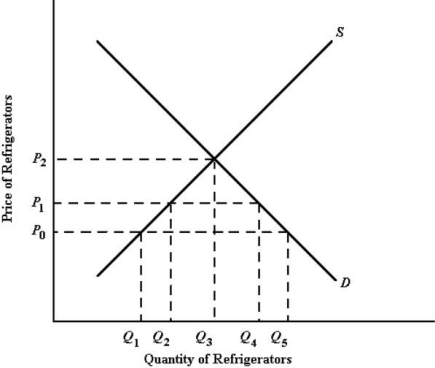 FIGURE 33-1
Refer to Figure 33-1. The free-market equilibrium price of refrigerators in Canada is P0, implying that P0 is the
A) tariff-protected price.
B) quota-induced price.
C) cartel-induced price.
D) world price.
E) Canadian autarkic price.
FIGURE 33-1Refer to Figure 33-1. The free-market equilibrium price of refrigerators in Canada is P0, implying that P0 is the
A) tariff-protected price.
B) quota-induced price.
C) cartel-induced price.
D) world price.
E) Canadian autarkic price.
Question
Question
The diagram below shows the domestic demand and supply curves for denim jeans in Canada. The prevailing world price is P W. Assume that all jeans are identical.
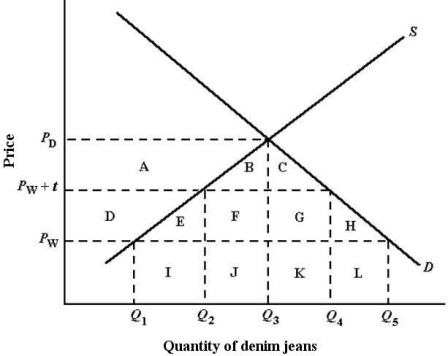 FIGURE 33-2
Refer to Figure 33-2. In the presence of free international trade, Canadaʹs production will be at the quantity
A) Q1
B) Q2
C) Q3
D) Q4
E) Q5
FIGURE 33-2Refer to Figure 33-2. In the presence of free international trade, Canadaʹs production will be at the quantity
A) Q1
B) Q2
C) Q3
D) Q4
E) Q5
Question
Question
The diagram below shows the demand and supply curves for refrigerators in Canada.
FIGURE 33-1
Refer to Figure 33-1. If we compare the effect of an import tariff with the effect of an import quota in this market, both of which cause the Canadian price to increase by the same amount, the major difference between the two policies is
A) the quota does not directly reduce the quantity whereas the tariff does.
B) the tariff raises revenue for the government whereas the quota benefits foreign producers.
C) the tariff raises revenue for the protected producers whereas the quota benefits the government.
D) the tariff does not directly affect the price consumers pay whereas the quota does.
E) the tariff directly affects the price consumers pay whereas the quota has neither direct nor indirect price effects.
FIGURE 33-1Refer to Figure 33-1. If we compare the effect of an import tariff with the effect of an import quota in this market, both of which cause the Canadian price to increase by the same amount, the major difference between the two policies is
A) the quota does not directly reduce the quantity whereas the tariff does.
B) the tariff raises revenue for the government whereas the quota benefits foreign producers.
C) the tariff raises revenue for the protected producers whereas the quota benefits the government.
D) the tariff does not directly affect the price consumers pay whereas the quota does.
E) the tariff directly affects the price consumers pay whereas the quota has neither direct nor indirect price effects.
Question
The diagram below shows the demand and supply curves for refrigerators in Canada.
FIGURE 33-1
Refer to Figure 33-1. At the price P0, the quantity of refrigerators imported into the Canadian market is
A) Q3Q5.
B) Q2Q4.
C) Q2Q5.
D) Q2Q3.
E) Q1Q5.
FIGURE 33-1Refer to Figure 33-1. At the price P0, the quantity of refrigerators imported into the Canadian market is
A) Q3Q5.
B) Q2Q4.
C) Q2Q5.
D) Q2Q3.
E) Q1Q5.
Question
The diagram below shows the demand and supply curves for refrigerators in Canada.
FIGURE 33-1
Refer to Figure 33-1. Suppose P0 is the world price. If Canada imposes a tariff causing the price of refrigerators in Canada to rise from P0 to P1, the Canadian government will collect tariff revenues equal to
A) the original price P0, multiplied by the original quantity of refrigerators imported into Canada, Q1Q5.
B) P1 - P0) multiplied by the tariff-induced quantity of refrigerators imported into Canada, Q1Q5.
C) P1 - P0) multiplied by the tariff-induced quantity of refrigerators imported into Canada, Q2Q4.
D) the new price, P1, multiplied by the total quantity of refrigerators purchased in Canada, Q4.
E) the new price, P1, multiplied by the total quantity of refrigerators purchased in Canada, Q2.
FIGURE 33-1Refer to Figure 33-1. Suppose P0 is the world price. If Canada imposes a tariff causing the price of refrigerators in Canada to rise from P0 to P1, the Canadian government will collect tariff revenues equal to
A) the original price P0, multiplied by the original quantity of refrigerators imported into Canada, Q1Q5.
B) P1 - P0) multiplied by the tariff-induced quantity of refrigerators imported into Canada, Q1Q5.
C) P1 - P0) multiplied by the tariff-induced quantity of refrigerators imported into Canada, Q2Q4.
D) the new price, P1, multiplied by the total quantity of refrigerators purchased in Canada, Q4.
E) the new price, P1, multiplied by the total quantity of refrigerators purchased in Canada, Q2.
Question
The diagram below shows the demand and supply curves for refrigerators in Canada.
FIGURE 33-1
Refer to Figure 33-1. Suppose P0 is the world price. If Canada imposes a tariff causing the price of refrigerators in Canada to rise from P0 to P1, the consequence would be that
A) both domestic production and domestic consumption would decrease by equal amounts.
B) domestic production will increase from Q1 to Q2 and domestic consumption will fall from Q5 to Q4.
C) domestic production will increase from Q1 to Q3 and domestic consumption will fall from Q5 to Q3.
D) domestic production will exceed domestic consumption.
E) both domestic production and domestic consumption would increase by equal amounts.
FIGURE 33-1Refer to Figure 33-1. Suppose P0 is the world price. If Canada imposes a tariff causing the price of refrigerators in Canada to rise from P0 to P1, the consequence would be that
A) both domestic production and domestic consumption would decrease by equal amounts.
B) domestic production will increase from Q1 to Q2 and domestic consumption will fall from Q5 to Q4.
C) domestic production will increase from Q1 to Q3 and domestic consumption will fall from Q5 to Q3.
D) domestic production will exceed domestic consumption.
E) both domestic production and domestic consumption would increase by equal amounts.
Question
Question
The diagram below shows the demand and supply curves for refrigerators in Canada.
FIGURE 33-1
Refer to Figure 33-1. Suppose P0 is the world price and Canada imports refrigerators. Suppose the Canadian government then responds to political pressure from domestic refrigerator manufacturers and imposes a tariff high enough that all imports are eliminated. As a result of this tariff, the price and quantity of refrigerators in Canada will be, respectively,
A) P0 and Q1.
B) P0 and Q5.
C) P1 and Q2.
D) P1 and Q3.
E) P2 and Q3.
FIGURE 33-1Refer to Figure 33-1. Suppose P0 is the world price and Canada imports refrigerators. Suppose the Canadian government then responds to political pressure from domestic refrigerator manufacturers and imposes a tariff high enough that all imports are eliminated. As a result of this tariff, the price and quantity of refrigerators in Canada will be, respectively,
A) P0 and Q1.
B) P0 and Q5.
C) P1 and Q2.
D) P1 and Q3.
E) P2 and Q3.
Question
Question
Question
Question
The diagram below shows the demand and supply curves for refrigerators in Canada.
FIGURE 33-1
Refer to Figure 33-1, and assume the world price is P0. The Canadian government now imposes an import quota of the amount Q2Q4. The result would be that the price in Canada would
A) stay at P0 and consumption would stay at Q5.
B) stay at P0 and consumption would rise to Q3.
C) rise to P2 and consumption would decrease to Q5.
D) rise to P2 and consumption would decrease to Q4.
E) rise to P1 and consumption would decrease to Q4.
FIGURE 33-1Refer to Figure 33-1, and assume the world price is P0. The Canadian government now imposes an import quota of the amount Q2Q4. The result would be that the price in Canada would
A) stay at P0 and consumption would stay at Q5.
B) stay at P0 and consumption would rise to Q3.
C) rise to P2 and consumption would decrease to Q5.
D) rise to P2 and consumption would decrease to Q4.
E) rise to P1 and consumption would decrease to Q4.
Question
The diagram below shows the demand and supply curves for refrigerators in Canada.
FIGURE 33-1
Refer to Figure 33-1. At the price P0, the quantity of refrigerators supplied to the Canadian market by domestic Canadian producers is
A) Q1.
B) Q2.
C) Q3.
D) Q4.
E) Q5.
FIGURE 33-1Refer to Figure 33-1. At the price P0, the quantity of refrigerators supplied to the Canadian market by domestic Canadian producers is
A) Q1.
B) Q2.
C) Q3.
D) Q4.
E) Q5.
Question
Question
The diagram below shows the domestic demand and supply curves for denim jeans in Canada. The prevailing world price is P W. Assume that all jeans are identical.
FIGURE 33-2
Refer to Figure 33-2. In the presence of free international trade, Canadaʹs consumption of denim jeans will be the quantity
A) Q1
B) Q2
C) Q3
D) Q4
E) Q5
FIGURE 33-2Refer to Figure 33-2. In the presence of free international trade, Canadaʹs consumption of denim jeans will be the quantity
A) Q1
B) Q2
C) Q3
D) Q4
E) Q5
Question
Question
Question
The diagram below shows the domestic demand and supply curves for denim jeans in Canada. The prevailing world price is P W. Assume that all jeans are identical.
FIGURE 33-2
Refer to Figure 33-2. If Canada were to engage in no international trade in denim jeans, then the quantity consumed and produced in Canada would be
A) Q1
B) Q2
C) Q3
D) Q4
E) Q5
FIGURE 33-2Refer to Figure 33-2. If Canada were to engage in no international trade in denim jeans, then the quantity consumed and produced in Canada would be
A) Q1
B) Q2
C) Q3
D) Q4
E) Q5
Question
The diagram below shows supply and demand curves for bicycles in the domestic Canadian market. Assume that all bicycles are identical.
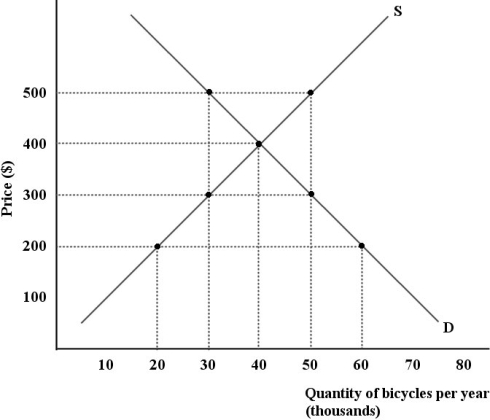 FIGURE 33-4
Refer to Figure 33-4. Assume there is free trade in bicycles. If the world price of bicycles is $500, domestic consumption is at a price of .
A) 40 000; $500
B) 40 000; $400
C) 30 000; $500
D) 50 000; $300
E) 30 000; $300
FIGURE 33-4Refer to Figure 33-4. Assume there is free trade in bicycles. If the world price of bicycles is $500, domestic consumption is at a price of .
A) 40 000; $500
B) 40 000; $400
C) 30 000; $500
D) 50 000; $300
E) 30 000; $300
Question
The diagram below shows the domestic demand and supply curves for cotton towels in Canada. The prevailing world price of cotton towels is PW. Assume that all cotton towels are identical.
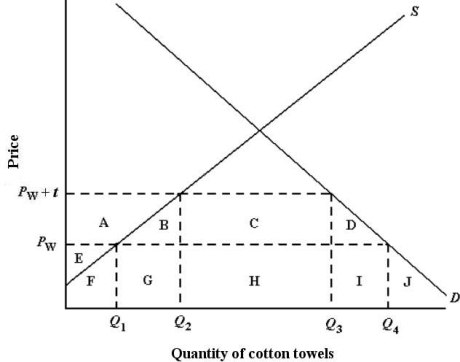 FIGURE 33-3
Refer to Figure 33-3. If Canada imposes a tariff of $t per cotton towel, Canadian towel producersʹ revenues will be equal to the amount
A) A + B + C + D.
B) A + B + C + E + F + G + H.
C) A + B + E + F + G.
D) E + F + G.
E) E + F + G + H.
FIGURE 33-3Refer to Figure 33-3. If Canada imposes a tariff of $t per cotton towel, Canadian towel producersʹ revenues will be equal to the amount
A) A + B + C + D.
B) A + B + C + E + F + G + H.
C) A + B + E + F + G.
D) E + F + G.
E) E + F + G + H.
Question
The diagram below shows the domestic demand and supply curves for cotton towels in Canada. The prevailing world price of cotton towels is PW. Assume that all cotton towels are identical.
FIGURE 33-3
Refer to Figure 33-3. If the Canadian government imposes a quota on imported cotton towels of the amount Q3 - Q2), then foreign producersʹ revenues from their sales in Canada will be equal to the area
A) B + C + D.
B) B + C + D + G + H + I.
C) C + H.
D) H.
E) G + H + I.
FIGURE 33-3Refer to Figure 33-3. If the Canadian government imposes a quota on imported cotton towels of the amount Q3 - Q2), then foreign producersʹ revenues from their sales in Canada will be equal to the area
A) B + C + D.
B) B + C + D + G + H + I.
C) C + H.
D) H.
E) G + H + I.
Question
The diagram below shows the domestic demand and supply curves for denim jeans in Canada. The prevailing world price is P W. Assume that all jeans are identical.
FIGURE 33-2
Refer to Figure 33-2. Suppose Canada has free trade in jeans. If Canada initially has no tariff on jeans but then imposes a tariff of $t per pair, Canadaʹs imports will
A) increase from Q4 - Q2) to Q5 - Q1).
B) increase from Q4 - Q2) to Q5 - Q3).
C) decrease from Q5 - Q1) to Q4 - Q2).
D) decrease from Q5 - Q3) to Q4 - Q2).
E) decrease fromQ5 - Q3) to Q3 - Q1).
FIGURE 33-2Refer to Figure 33-2. Suppose Canada has free trade in jeans. If Canada initially has no tariff on jeans but then imposes a tariff of $t per pair, Canadaʹs imports will
A) increase from Q4 - Q2) to Q5 - Q1).
B) increase from Q4 - Q2) to Q5 - Q3).
C) decrease from Q5 - Q1) to Q4 - Q2).
D) decrease from Q5 - Q3) to Q4 - Q2).
E) decrease fromQ5 - Q3) to Q3 - Q1).
Question
The diagram below shows the domestic demand and supply curves for cotton towels in Canada. The prevailing world price of cotton towels is PW. Assume that all cotton towels are identical.
FIGURE 33-3
Refer to Figure 33-3. If Canada imposes a tariff of $t per cotton towel, the Canadian governmentʹs tariff revenues will be equal to the area
A) A + B + C.
B) A + B + C + D.
C) B + C + D.
D) C.
E) C + H.
FIGURE 33-3Refer to Figure 33-3. If Canada imposes a tariff of $t per cotton towel, the Canadian governmentʹs tariff revenues will be equal to the area
A) A + B + C.
B) A + B + C + D.
C) B + C + D.
D) C.
E) C + H.
Question
The diagram below shows the domestic demand and supply curves for cotton towels in Canada. The prevailing world price of cotton towels is PW. Assume that all cotton towels are identical.
FIGURE 33-3
Refer to Figure 33-3. Consider the Canadian producers of towels currently in a free -trade situation in this market who then choose to lobby the government for protection of their industry. Suppose you are an advisor to this industry and are asked to recommend whether they should lobby for a tariff of $ t per unit or an import quota of Q3 - Q2). What should you recommend if the producers want to increase their revenues?
A) The tariff - their revenues will be higher.
B) The import quota - their revenues will be higher.
C) The tariff - the domestic producers will receive all of the revenue previously accruing to foreign suppliers.
D) Either - it makes no difference to their revenues either way.
E) Neither - their revenues will not increase with a tariff or an import quota.
FIGURE 33-3Refer to Figure 33-3. Consider the Canadian producers of towels currently in a free -trade situation in this market who then choose to lobby the government for protection of their industry. Suppose you are an advisor to this industry and are asked to recommend whether they should lobby for a tariff of $ t per unit or an import quota of Q3 - Q2). What should you recommend if the producers want to increase their revenues?
A) The tariff - their revenues will be higher.
B) The import quota - their revenues will be higher.
C) The tariff - the domestic producers will receive all of the revenue previously accruing to foreign suppliers.
D) Either - it makes no difference to their revenues either way.
E) Neither - their revenues will not increase with a tariff or an import quota.
Question
The diagram below shows the domestic demand and supply curves for denim jeans in Canada. The prevailing world price is P W. Assume that all jeans are identical.
FIGURE 33-2
Refer to Figure 33-2. Suppose Canada has free trade in jeans and then imposes a tariff of $ t per pair. Canadaʹs jean-producing firms will gain producer surplus equal to the area
A) A.
B) A + B + C.
C) A + D.
D) D.
E) D + E + F + G + H.
FIGURE 33-2Refer to Figure 33-2. Suppose Canada has free trade in jeans and then imposes a tariff of $ t per pair. Canadaʹs jean-producing firms will gain producer surplus equal to the area
A) A.
B) A + B + C.
C) A + D.
D) D.
E) D + E + F + G + H.
Question
The diagram below shows the domestic demand and supply curves for denim jeans in Canada. The prevailing world price is P W. Assume that all jeans are identical.
FIGURE 33-2
Refer to Figure 33-2. Suppose Canada has free trade in jeans and then imposes a tariff of $ t per pair. Canadian consumers will lose consumer surplus equal to the area
A) A.
B) A + B + C.
C) B + C + E + F + G + H.
D) D.
E) D + E + F + G + H.
FIGURE 33-2Refer to Figure 33-2. Suppose Canada has free trade in jeans and then imposes a tariff of $ t per pair. Canadian consumers will lose consumer surplus equal to the area
A) A.
B) A + B + C.
C) B + C + E + F + G + H.
D) D.
E) D + E + F + G + H.
Question
The diagram below shows the domestic demand and supply curves for denim jeans in Canada. The prevailing world price is P W. Assume that all jeans are identical.
FIGURE 33-2
Refer to Figure 33-2. Suppose Canada has free trade in jeans and then imposes a tariff of $ t per pair. Canadaʹs production will then be at the quantity
A) Q1
B) Q2
C) Q3
D) Q4
E) Q5
FIGURE 33-2Refer to Figure 33-2. Suppose Canada has free trade in jeans and then imposes a tariff of $ t per pair. Canadaʹs production will then be at the quantity
A) Q1
B) Q2
C) Q3
D) Q4
E) Q5
Question
The diagram below shows supply and demand curves for bicycles in the domestic Canadian market. Assume that all bicycles are identical.
FIGURE 33-4
Refer to Figure 33-4. Assume there is free trade in bicycles. If the world price of bicycles is $500, Canada will
Bicycles per year.
A) import 30 000
B) import 20 000
C) export 30 000
D) export 20 000
E) export 50 000
FIGURE 33-4Refer to Figure 33-4. Assume there is free trade in bicycles. If the world price of bicycles is $500, Canada will
Bicycles per year.
A) import 30 000
B) import 20 000
C) export 30 000
D) export 20 000
E) export 50 000
Question
The diagram below shows the domestic demand and supply curves for cotton towels in Canada. The prevailing world price of cotton towels is PW. Assume that all cotton towels are identical.
FIGURE 33-3
Refer to Figure 33-3. If the Canadian government imposes a quota on imported cotton towels of the amount Q3 - Q2), then the deadweight loss to the Canadian economy is shown by the area
A) B + C + D.
B) B +D.
C) C + H.
D) H.
E) G + H + I.
FIGURE 33-3Refer to Figure 33-3. If the Canadian government imposes a quota on imported cotton towels of the amount Q3 - Q2), then the deadweight loss to the Canadian economy is shown by the area
A) B + C + D.
B) B +D.
C) C + H.
D) H.
E) G + H + I.
Question
The diagram below shows the domestic demand and supply curves for denim jeans in Canada. The prevailing world price is P W. Assume that all jeans are identical.
FIGURE 33-2
Refer to Figure 33-2. Suppose Canada has free trade in jeans and then imposes a tariff of $ t per pair. The Canadian governmentʹs tariff revenues will be equal to
A) B + C.
B) E + F.
C) E + F + G + H.
D) F + G.
E) F + G + H.
FIGURE 33-2Refer to Figure 33-2. Suppose Canada has free trade in jeans and then imposes a tariff of $ t per pair. The Canadian governmentʹs tariff revenues will be equal to
A) B + C.
B) E + F.
C) E + F + G + H.
D) F + G.
E) F + G + H.
Question
The diagram below shows the domestic demand and supply curves for cotton towels in Canada. The prevailing world price of cotton towels is PW. Assume that all cotton towels are identical.
FIGURE 33-3
Refer to Figure 33-3. If Canada has free trade in cotton towels, foreign producersʹ revenues from their Canadian sales will be equal to the amount
A) A + B + E + F + G.
B) E + F.
C) E + F + G + H + I.
D) E + F + G + H + I + J.
E) G + H + I.
FIGURE 33-3Refer to Figure 33-3. If Canada has free trade in cotton towels, foreign producersʹ revenues from their Canadian sales will be equal to the amount
A) A + B + E + F + G.
B) E + F.
C) E + F + G + H + I.
D) E + F + G + H + I + J.
E) G + H + I.
Question
The diagram below shows the domestic demand and supply curves for cotton towels in Canada. The prevailing world price of cotton towels is PW. Assume that all cotton towels are identical.
FIGURE 33-3
Refer to Figure 33-3. Consider the Canadian producers of towels currently in a free -trade situation in this market. Now suppose the producers have successfully lobbied the government for protection for their industry. Suppose you are an advisor to the government and are asked to recommend whether they should impose a tariff of $t per unit or an import quota of Q3 - Q2). What should you recommend?
A) The import quota - the deadweight loss to the economy as a whole is smaller than with the tariff.
B) The tariff - the tariff revenues are collected by the government, rather than going to the foreign producers.
C) The tariff - the domestic producers will receive all of the revenue previously accruing to foreign suppliers.
D) Either - it makes no difference to the overall economy either way.
E) The import quota - revenues accruing to domestic producers will be higher than with the tariff, which is better for the overall economy.
FIGURE 33-3Refer to Figure 33-3. Consider the Canadian producers of towels currently in a free -trade situation in this market. Now suppose the producers have successfully lobbied the government for protection for their industry. Suppose you are an advisor to the government and are asked to recommend whether they should impose a tariff of $t per unit or an import quota of Q3 - Q2). What should you recommend?
A) The import quota - the deadweight loss to the economy as a whole is smaller than with the tariff.
B) The tariff - the tariff revenues are collected by the government, rather than going to the foreign producers.
C) The tariff - the domestic producers will receive all of the revenue previously accruing to foreign suppliers.
D) Either - it makes no difference to the overall economy either way.
E) The import quota - revenues accruing to domestic producers will be higher than with the tariff, which is better for the overall economy.
Question
The diagram below shows the domestic demand and supply curves for denim jeans in Canada. The prevailing world price is P W. Assume that all jeans are identical.
FIGURE 33-2
Refer to Figure 33-2. Suppose Canada has free trade in jeans and then imposes a tariff of $ t per pair. Canadian jean producersʹ revenues will increase by the area equal to
A) A + B + F + J.
B) D + E + I.
C) E + F + G + H.
D) F + G.
E) F + G + H.
FIGURE 33-2Refer to Figure 33-2. Suppose Canada has free trade in jeans and then imposes a tariff of $ t per pair. Canadian jean producersʹ revenues will increase by the area equal to
A) A + B + F + J.
B) D + E + I.
C) E + F + G + H.
D) F + G.
E) F + G + H.
Question
The diagram below shows the domestic demand and supply curves for denim jeans in Canada. The prevailing world price is P W. Assume that all jeans are identical.
FIGURE 33-2
Refer to Figure 33-2. Suppose Canada has free trade in jeans and then imposes a tariff of $ t per pair. The deadweight loss to the Canadian economy is represented by the area
A) E + H.
B) E + F + G + H.
C) D + E + F + G + H.
D) B + C.
E) A + B + C.
FIGURE 33-2Refer to Figure 33-2. Suppose Canada has free trade in jeans and then imposes a tariff of $ t per pair. The deadweight loss to the Canadian economy is represented by the area
A) E + H.
B) E + F + G + H.
C) D + E + F + G + H.
D) B + C.
E) A + B + C.
Question
The diagram below shows the domestic demand and supply curves for cotton towels in Canada. The prevailing world price of cotton towels is PW. Assume that all cotton towels are identical.
FIGURE 33-3
Refer to Figure 33-3. If Canada imposes a tariff of $t per cotton towel, foreign producersʹ revenues from their Canadian sales will be equal to the area
A) B + C + D.
B) B + C + D + G + H + I.
C) C + H.
D) H.
E) G +H + I.
FIGURE 33-3Refer to Figure 33-3. If Canada imposes a tariff of $t per cotton towel, foreign producersʹ revenues from their Canadian sales will be equal to the area
A) B + C + D.
B) B + C + D + G + H + I.
C) C + H.
D) H.
E) G +H + I.
Question
The diagram below shows the domestic demand and supply curves for cotton towels in Canada. The prevailing world price of cotton towels is PW. Assume that all cotton towels are identical.
FIGURE 33-3
Refer to Figure 33-3. If the Canadian government imposes a quota on imported cotton towels of the amount Q3 - Q2 ), then domestic towel producersʹ revenues will be equal to the area
A) A + B + C + D.
B) A + B + C + E + F + G + H.
C) A + B + E + F + G.
D) E + F + G.
E) E + F + G + H.
FIGURE 33-3Refer to Figure 33-3. If the Canadian government imposes a quota on imported cotton towels of the amount Q3 - Q2 ), then domestic towel producersʹ revenues will be equal to the area
A) A + B + C + D.
B) A + B + C + E + F + G + H.
C) A + B + E + F + G.
D) E + F + G.
E) E + F + G + H.
Question
The diagram below shows the domestic demand and supply curves for cotton towels in Canada. The prevailing world price of cotton towels is PW. Assume that all cotton towels are identical.
FIGURE 33-3
Refer to Figure 33-3. If Canada imposes a tariff of $t per cotton towel, the deadweight loss to the Canadian economy is shown by area
A) A + B + C.
B) A + B + C + D.
C) B + D.
D) C.
E) C + H.
FIGURE 33-3Refer to Figure 33-3. If Canada imposes a tariff of $t per cotton towel, the deadweight loss to the Canadian economy is shown by area
A) A + B + C.
B) A + B + C + D.
C) B + D.
D) C.
E) C + H.
Question
The diagram below shows the domestic demand and supply curves for denim jeans in Canada. The prevailing world price is P W. Assume that all jeans are identical.
FIGURE 33-2
Refer to Figure 33-2. Suppose Canada has free trade in jeans and then imposes a tariff of $ t per pair. Canadaʹs consumption will then be at the quantity
A) Q1
B) Q2
C) Q3
D) Q4
E) Q5
FIGURE 33-2Refer to Figure 33-2. Suppose Canada has free trade in jeans and then imposes a tariff of $ t per pair. Canadaʹs consumption will then be at the quantity
A) Q1
B) Q2
C) Q3
D) Q4
E) Q5

Unlock Deck
Sign up to unlock the cards in this deck!
Unlock Deck
Unlock Deck
1/126

Play

Full screen (f)
Deck 33: Trade Policy
1
A common argument for the use of tariffs for a large economy) when the objective is to maximize a countryʹs national income is to
A) improve the countryʹs terms of trade.
B) subject infant industries to the discipline of the market.
C) enjoy the advantages of diversification.
D) prevent learning-by-doing by potential trade partners.
E) increase the prices of domestic exports.
A) improve the countryʹs terms of trade.
B) subject infant industries to the discipline of the market.
C) enjoy the advantages of diversification.
D) prevent learning-by-doing by potential trade partners.
E) increase the prices of domestic exports.
A
2
Does free trade improve the living standards of all residents of a country?
A) Yes, definitely, because the gains from trade outweigh the losses in the import -competing industries.
B) Yes, because inefficient import-competing industries are replaced with efficient export industries.
C) Probably not - in principle, the net gains from trade could be divided such that every individual is better off, but in practice, some individuals are likely to be worse off.
D) No, because the benefits from free trade are only theoretical.
E) No, because the losses in the import-competing industries outweigh the gains from trade in the new export industries.
A) Yes, definitely, because the gains from trade outweigh the losses in the import -competing industries.
B) Yes, because inefficient import-competing industries are replaced with efficient export industries.
C) Probably not - in principle, the net gains from trade could be divided such that every individual is better off, but in practice, some individuals are likely to be worse off.
D) No, because the benefits from free trade are only theoretical.
E) No, because the losses in the import-competing industries outweigh the gains from trade in the new export industries.
C
3
A country can impose a tariff to improve its own terms of trade if it
A) constitutes a large fraction of the world demand for some commodity that it imports.
B) has a high level of industrial diversification.
C) has a significant trade surplus.
D) imports mostly primary products.
E) produces and exports a large fraction of the worldʹs supply of some commodity.
A) constitutes a large fraction of the world demand for some commodity that it imports.
B) has a high level of industrial diversification.
C) has a significant trade surplus.
D) imports mostly primary products.
E) produces and exports a large fraction of the worldʹs supply of some commodity.
A
4
A common, but invalid argument for using tariffs to maximize national income and raise domestic living standards is to
A) alter the terms of trade.
B) keep Canadian currency in Canada.
C) encourage learning by doing.
D) create a strategic trade advantage.
E) exploit economies of scale.
A) alter the terms of trade.
B) keep Canadian currency in Canada.
C) encourage learning by doing.
D) create a strategic trade advantage.
E) exploit economies of scale.
Unlock Deck
Unlock for access to all 126 flashcards in this deck.
Unlock Deck
k this deck
5
Many of the worldʹs industrialized countries initially developed their industries with heavy tariff protection. In Canadaʹs case, this was the basis for
A) the National Policy of 1876.
B) the National Energy Program of the 1980s.
C) reciprocity.
D) the NAFTA.
E) the Charlottetown Accord.
A) the National Policy of 1876.
B) the National Energy Program of the 1980s.
C) reciprocity.
D) the NAFTA.
E) the Charlottetown Accord.
Unlock Deck
Unlock for access to all 126 flashcards in this deck.
Unlock Deck
k this deck
6
Any policy designed to benefit domestic industries at the expense of foreign export industries is called
A) predatory practice.
B) monopolization.
C) commercialization.
D) cartelization.
E) protection.
A) predatory practice.
B) monopolization.
C) commercialization.
D) cartelization.
E) protection.
Unlock Deck
Unlock for access to all 126 flashcards in this deck.
Unlock Deck
k this deck
7
Continued tariff protection for industries that have already attained all the possible economies of scale will likely
A) reduce employment in the protected industries.
B) reduce the stream of tariff revenue to the government.
C) redistribute income away from the factors used in the protected industries.
D) maintain high prices to consumers of the products produced in the protected industries.
E) result in lower domestic prices for the products they produce.
A) reduce employment in the protected industries.
B) reduce the stream of tariff revenue to the government.
C) redistribute income away from the factors used in the protected industries.
D) maintain high prices to consumers of the products produced in the protected industries.
E) result in lower domestic prices for the products they produce.
Unlock Deck
Unlock for access to all 126 flashcards in this deck.
Unlock Deck
k this deck
8
The main objective of protectionist trade policies is to
A) create a level playing field.
B) raise average real wages in the economy.
C) raise government revenues through tariffs.
D) maximize world production.
E) shield local producers from foreign competition.
A) create a level playing field.
B) raise average real wages in the economy.
C) raise government revenues through tariffs.
D) maximize world production.
E) shield local producers from foreign competition.
Unlock Deck
Unlock for access to all 126 flashcards in this deck.
Unlock Deck
k this deck
9
Economists would tend to accept which of the following arguments in favour of tariffs?
A) Tariffs are needed to avoid exporting jobs.
B) Tariffs are needed to limit imports and reduce the capital flow from the country.
C) Tariffs help to reduce inflation by reducing the price of domestic products.
D) Temporary tariff protection in some situations may help to generate an eventual comparative advantage in that product.
E) Tariffs will stimulate the domestic economy.
A) Tariffs are needed to avoid exporting jobs.
B) Tariffs are needed to limit imports and reduce the capital flow from the country.
C) Tariffs help to reduce inflation by reducing the price of domestic products.
D) Temporary tariff protection in some situations may help to generate an eventual comparative advantage in that product.
E) Tariffs will stimulate the domestic economy.
Unlock Deck
Unlock for access to all 126 flashcards in this deck.
Unlock Deck
k this deck
10
According to the infant-industry argument for trade protection, a new small industry
A) must be protected even if it will never have a comparative advantage.
B) must be protected permanently to provide for a diversified economy.
C) will need protection once it has exploited available economies of scale.
D) may need protection temporarily until it can exploit its economies of scale.
E) must be protected in order to provide a domestic supply of the product.
A) must be protected even if it will never have a comparative advantage.
B) must be protected permanently to provide for a diversified economy.
C) will need protection once it has exploited available economies of scale.
D) may need protection temporarily until it can exploit its economies of scale.
E) must be protected in order to provide a domestic supply of the product.
Unlock Deck
Unlock for access to all 126 flashcards in this deck.
Unlock Deck
k this deck
11
Consider trade between country A and country B. If country A has wages that are substantially less than those in country B,
A) country A will have an absolute advantage over country B.
B) country A will not have to subsidize its export industries.
C) country B will import from A but will not be able to export to country A.
D) country B will benefit by placing tariffs on imports from country A.
E) the pattern of comparative advantage will depend also on the relative productivities of labour in the two countries.
A) country A will have an absolute advantage over country B.
B) country A will not have to subsidize its export industries.
C) country B will import from A but will not be able to export to country A.
D) country B will benefit by placing tariffs on imports from country A.
E) the pattern of comparative advantage will depend also on the relative productivities of labour in the two countries.
Unlock Deck
Unlock for access to all 126 flashcards in this deck.
Unlock Deck
k this deck
12
A business which contends that it needs temporary protection so that it can expand significantly and thereby reduce its costs so as to enable it to compete with foreign producers is using an argument known as the
A) infant-industry case for tariffs.
B) monopolistic competition case for tariffs.
C) strategic case for tariffs.
D) price fluctuations case for tariffs.
E) social advantages case for tariffs.
A) infant-industry case for tariffs.
B) monopolistic competition case for tariffs.
C) strategic case for tariffs.
D) price fluctuations case for tariffs.
E) social advantages case for tariffs.
Unlock Deck
Unlock for access to all 126 flashcards in this deck.
Unlock Deck
k this deck
13
Continued tariff protection for industries that have already attained all potential economies of scale and possibilities for learning by doing is likely to
A) increase employment in the protected industries.
B) reduce average real income for the countryʹs residents.
C) redistribute income away from the factors used in the protected industries.
D) decrease prices to consumers of the products produced in the protected industries.
E) both A and B are correct.
A) increase employment in the protected industries.
B) reduce average real income for the countryʹs residents.
C) redistribute income away from the factors used in the protected industries.
D) decrease prices to consumers of the products produced in the protected industries.
E) both A and B are correct.
Unlock Deck
Unlock for access to all 126 flashcards in this deck.
Unlock Deck
k this deck
14
Continued tariff protection for industries that have already attained all potential economies of scale and opportunities for learning by doing is likely to
A) reduce employment in the protected industries.
B) reduce the stream of tariff revenue to the government.
C) redistribute income in favour of the factors used in the protected industries.
D) decrease prices to consumers of the products produced in the protected industries.
E) result in increased demand for imports.
A) reduce employment in the protected industries.
B) reduce the stream of tariff revenue to the government.
C) redistribute income in favour of the factors used in the protected industries.
D) decrease prices to consumers of the products produced in the protected industries.
E) result in increased demand for imports.
Unlock Deck
Unlock for access to all 126 flashcards in this deck.
Unlock Deck
k this deck
15
Suppose a national government chooses to impose barriers to trade in an effort to promote a more diversified economy. This objective would be particularly important to, for example, an economy largely dependent on one or two agricultural products because
A) that countryʹs terms of trade will continue to deteriorate over time if it continues to specialize.
B) it will allow firms in the economy to exploit economies of scale in newly developed industries.
C) it will certainly maximize national income and raise average living standards.
D) it will increase net exports for the economy.
E) any volatility in the world prices of those commodities leads to great volatility in national income.
A) that countryʹs terms of trade will continue to deteriorate over time if it continues to specialize.
B) it will allow firms in the economy to exploit economies of scale in newly developed industries.
C) it will certainly maximize national income and raise average living standards.
D) it will increase net exports for the economy.
E) any volatility in the world prices of those commodities leads to great volatility in national income.
Unlock Deck
Unlock for access to all 126 flashcards in this deck.
Unlock Deck
k this deck
16
If wages in Mexico are lower than those in Canada,
A) Canadian living standards can be raised by imposing tariffs on imports from Mexico.
B) Canadian consumers can benefit by purchasing some low-cost goods from Mexico.
C) Canada may have a comparative advantage in all products.
D) Mexico may have a comparative advantage in all products.
E) Mexico probably has an absolute advantage in all products due to its low labour costs.
A) Canadian living standards can be raised by imposing tariffs on imports from Mexico.
B) Canadian consumers can benefit by purchasing some low-cost goods from Mexico.
C) Canada may have a comparative advantage in all products.
D) Mexico may have a comparative advantage in all products.
E) Mexico probably has an absolute advantage in all products due to its low labour costs.
Unlock Deck
Unlock for access to all 126 flashcards in this deck.
Unlock Deck
k this deck
17
Consider the government of a small economy that is opposed to free international trade. Of the following, which is the most valid argument for their opposition?
A) to maximize national income
B) to protect against low-wage labour from abroad
C) to discourage imports and encourage exports
D) to diversify production in the domestic economy
E) to prevent domestic currency from going abroad
A) to maximize national income
B) to protect against low-wage labour from abroad
C) to discourage imports and encourage exports
D) to diversify production in the domestic economy
E) to prevent domestic currency from going abroad
Unlock Deck
Unlock for access to all 126 flashcards in this deck.
Unlock Deck
k this deck
18
In the past few decades, an example of the infant-industry argument at work has been the
A) Canadian forest-products industry.
B) Canadian agriculture industry.
C) Japanese agriculture industry.
D) European commercial aircraft industry.
E) U.S. automobile industry.
A) Canadian forest-products industry.
B) Canadian agriculture industry.
C) Japanese agriculture industry.
D) European commercial aircraft industry.
E) U.S. automobile industry.
Unlock Deck
Unlock for access to all 126 flashcards in this deck.
Unlock Deck
k this deck
19
Suppose you are an economist advising the Canadian government as to whether to erect trade barriers for the protection of Canadaʹs textile industry. You are likely to study the gains to be realized in this industry and weigh those against
A) the effect on factor incomes of Canadaʹs trading partners.
B) the lower factor prices that occur in competing domestic industries.
C) the cost in terms of higher prices to Canadian consumers.
D) the cost in terms of lower national income of Canadaʹs trading partners.
A) the effect on factor incomes of Canadaʹs trading partners.
B) the lower factor prices that occur in competing domestic industries.
C) the cost in terms of higher prices to Canadian consumers.
D) the cost in terms of lower national income of Canadaʹs trading partners.
Unlock Deck
Unlock for access to all 126 flashcards in this deck.
Unlock Deck
k this deck
20
An example of the ʺinfant industryʺ argument for trade protection is that
A) tariffs should be implemented in order to improve the terms of trade and thereby maximize the gains from trade.
B) tariffs should not be imposed on countries that have democratic governments.
C) in the presence of unexploited scale economies, tariff protection may permit a country to develop future comparative advantage in certain products.
D) imports of certain products should be limited in the interests of national defence.
E) ʺstrategicʺ trade policy is helpful when other countries are also being strategic.
A) tariffs should be implemented in order to improve the terms of trade and thereby maximize the gains from trade.
B) tariffs should not be imposed on countries that have democratic governments.
C) in the presence of unexploited scale economies, tariff protection may permit a country to develop future comparative advantage in certain products.
D) imports of certain products should be limited in the interests of national defence.
E) ʺstrategicʺ trade policy is helpful when other countries are also being strategic.
Unlock Deck
Unlock for access to all 126 flashcards in this deck.
Unlock Deck
k this deck
21
Canada is a net importer of durable consumer goods washing machines, refrigerators, etc.). If Canada, a small country in global markets, imposes a 15% tariff on these goods, it will cause
A) a reduction in the consumption of these goods in Canada.
B) an increase in the quantity imported of these goods.
C) an upward shift in the demand curve for these goods.
D) a decrease in the price consumers pay for these goods in Canada.
E) a reduction in tariff revenue collected by the Canadian government.
A) a reduction in the consumption of these goods in Canada.
B) an increase in the quantity imported of these goods.
C) an upward shift in the demand curve for these goods.
D) a decrease in the price consumers pay for these goods in Canada.
E) a reduction in tariff revenue collected by the Canadian government.
Unlock Deck
Unlock for access to all 126 flashcards in this deck.
Unlock Deck
k this deck
22
If all countries try to expand their exports and restrict their imports through the use of export subsidies and import tariffs, the net effect will probably be
A) a fall in the volume of trade and an increase in the standard of living in each country.
B) a fall in the volume of trade and a decline in the average living standards in each country.
C) an increase in the volume of trade but little change in unemployment levels.
D) no change in the volume of trade but an increase in the overall unemployment rates.
E) no change in the volume of trade but less unemployment.
A) a fall in the volume of trade and an increase in the standard of living in each country.
B) a fall in the volume of trade and a decline in the average living standards in each country.
C) an increase in the volume of trade but little change in unemployment levels.
D) no change in the volume of trade but an increase in the overall unemployment rates.
E) no change in the volume of trade but less unemployment.
Unlock Deck
Unlock for access to all 126 flashcards in this deck.
Unlock Deck
k this deck
23
Consider the following statement: ʺCanada is unambiguously better off if it is exporting more, in dollar value, to the rest of the world than it is importing.ʺ This statement is because .
A) correct; exports are good and imports are bad
B) correct; it is based on the mercantilist doctrine
C) incorrect; it fails to recognize that the gains from trade come from the volume rather than the balance of trade
D) incorrect; it does not recognize the operation of the foreign -exchange market
E) incorrect; imports improve Canadaʹs terms of trade
A) correct; exports are good and imports are bad
B) correct; it is based on the mercantilist doctrine
C) incorrect; it fails to recognize that the gains from trade come from the volume rather than the balance of trade
D) incorrect; it does not recognize the operation of the foreign -exchange market
E) incorrect; imports improve Canadaʹs terms of trade
Unlock Deck
Unlock for access to all 126 flashcards in this deck.
Unlock Deck
k this deck
24
If a tariff is imposed in a country that is too small to have global market power, the domestic consumer will face a price, and the price paid to foreign producers will .
A) higher; fall
B) higher; not change
C) higher; rise
D) lower; not change
E) lower; rise
A) higher; fall
B) higher; not change
C) higher; rise
D) lower; not change
E) lower; rise
Unlock Deck
Unlock for access to all 126 flashcards in this deck.
Unlock Deck
k this deck
25
The imposition of a tariff on an imported good causes consumer surplus to and producer surplus to
)
A) increase; increase
B) decrease; decrease
C) decrease; increase
D) increase; decrease
E) remain the same; decrease
)
A) increase; increase
B) decrease; decrease
C) decrease; increase
D) increase; decrease
E) remain the same; decrease
Unlock Deck
Unlock for access to all 126 flashcards in this deck.
Unlock Deck
k this deck
26
It is not possible for one country to sell all products more cheaply than other countries for any length of time because the
A) importing countries will react by constructing severe trade barriers.
B) exporting country will find its cost of production decreasing relative to the importing country.
C) depreciation of the importing countriesʹ currencies ensures that trade will flow in both directions.
D) depreciation of the exporting countryʹs currency will lead to trade in both directions.
E) the principle of absolute advantage would then be violated.
A) importing countries will react by constructing severe trade barriers.
B) exporting country will find its cost of production decreasing relative to the importing country.
C) depreciation of the importing countriesʹ currencies ensures that trade will flow in both directions.
D) depreciation of the exporting countryʹs currency will lead to trade in both directions.
E) the principle of absolute advantage would then be violated.
Unlock Deck
Unlock for access to all 126 flashcards in this deck.
Unlock Deck
k this deck
27
Consider the following statement: ʺWithout a doubt, free trade improves the lives of every Canadian citizen.ʺ This statement is because .
A) correct; it is consistent with the idea of comparative advantage
B) correct; because Canada has long been a successful trading nation
C) incorrect; it fails to recognize that the movement to free trade involves both winners and losers
D) incorrect; we do not know much about the benefits of free trade
E) correct; there are no net costs associated with the movement to free trade
A) correct; it is consistent with the idea of comparative advantage
B) correct; because Canada has long been a successful trading nation
C) incorrect; it fails to recognize that the movement to free trade involves both winners and losers
D) incorrect; we do not know much about the benefits of free trade
E) correct; there are no net costs associated with the movement to free trade
Unlock Deck
Unlock for access to all 126 flashcards in this deck.
Unlock Deck
k this deck
28
Consider the following statement: ʺCanadians on average are worse off when some manufacturing jobs migrate from Canada to low-wage countries in Central America.ʺ This statement is because .
A) correct; the loss of manufacturing jobs leads to permanent income losses in Canada
B) correct; Canadian firms cannot compete with production in low-wage countries
C) incorrect; the permanent gains to consumers from lower prices outweigh the temporary losses to the displaced manufacturing workers
D) incorrect; low-wage countries do not produce manufactured goods
E) incorrect; there are no Canadians made worse off by such an event
A) correct; the loss of manufacturing jobs leads to permanent income losses in Canada
B) correct; Canadian firms cannot compete with production in low-wage countries
C) incorrect; the permanent gains to consumers from lower prices outweigh the temporary losses to the displaced manufacturing workers
D) incorrect; low-wage countries do not produce manufactured goods
E) incorrect; there are no Canadians made worse off by such an event
Unlock Deck
Unlock for access to all 126 flashcards in this deck.
Unlock Deck
k this deck
29
If a tariff is imposed by a country that is large enough to have market power in global markets, the domestic consumer will face an autarkic price than the world price for the product, and this world price will be
By the tariff.
A) higher; reduced
B) higher; increased
C) lower; increased
D) lower; unaffected
E) lower; reduced
By the tariff.
A) higher; reduced
B) higher; increased
C) lower; increased
D) lower; unaffected
E) lower; reduced
Unlock Deck
Unlock for access to all 126 flashcards in this deck.
Unlock Deck
k this deck
30
What is a tariff?
A) an encouragement to worldwide specialization and division of labour
B) a quota imposed on imported goods
C) a tax imposed on domestically produced manufactured goods
D) a tax imposed on exported goods
E) a tax imposed on imported goods
A) an encouragement to worldwide specialization and division of labour
B) a quota imposed on imported goods
C) a tax imposed on domestically produced manufactured goods
D) a tax imposed on exported goods
E) a tax imposed on imported goods
Unlock Deck
Unlock for access to all 126 flashcards in this deck.
Unlock Deck
k this deck
31
Many people argue that the imposition of tariffs in industry X will increase factor incomes in that industry and therefore be good for the country as a whole. The counter-argument is that
A) the increase in industry X factor incomes would be more than offset by reductions in real incomes to all other domestic residents.
B) the increase in factor incomes would increase unemployment.
C) the increase in factor incomes in industry X would reduce profits to business owners by an equal amount.
D) factor incomes would first rise and then decrease in industry X.
E) factor incomes overall would increase, but wages in industry X would fall, which would hurt workers in that industry.
A) the increase in industry X factor incomes would be more than offset by reductions in real incomes to all other domestic residents.
B) the increase in factor incomes would increase unemployment.
C) the increase in factor incomes in industry X would reduce profits to business owners by an equal amount.
D) factor incomes would first rise and then decrease in industry X.
E) factor incomes overall would increase, but wages in industry X would fall, which would hurt workers in that industry.
Unlock Deck
Unlock for access to all 126 flashcards in this deck.
Unlock Deck
k this deck
32
For most products, Canada is a small economy with no market power in the global market. If Canada imposed a tariff on imported goods from a low-wage foreign country, this would
A) reduce the price of the imported good in Canada.
B) improve Canadaʹs terms of trade.
C) increase the Canadian price of the imported good.
D) equalize the costs of production between the two countries.
E) increase wages in the low-wage foreign country.
A) reduce the price of the imported good in Canada.
B) improve Canadaʹs terms of trade.
C) increase the Canadian price of the imported good.
D) equalize the costs of production between the two countries.
E) increase wages in the low-wage foreign country.
Unlock Deck
Unlock for access to all 126 flashcards in this deck.
Unlock Deck
k this deck
33
For most products, Canada is a small economy with no market power in the global market. If Canada imposed a tariff on imported goods from a low-wage foreign country, this would
A) reduce the price of the imported good in Canada.
B) reduce the advantages of specialization and trade.
C) increase the income of the foreign producer.
D) equalize the costs of production between the two countries.
E) increase national income in the low-wage country.
A) reduce the price of the imported good in Canada.
B) reduce the advantages of specialization and trade.
C) increase the income of the foreign producer.
D) equalize the costs of production between the two countries.
E) increase national income in the low-wage country.
Unlock Deck
Unlock for access to all 126 flashcards in this deck.
Unlock Deck
k this deck
34
If a country is exporting more goods and services than it is importing, we should consider this to be ʺbeneficialʺ
Only in the sense that it
A) allows a country to add to its foreign-exchange reserves above the level needed to cope with fluctuations in private payments.
B) represents an accumulation of assets for the domestic economy that can be used in the future to finance consumption.
C) increases the standard of living through a larger national income.
D) is a necessary condition to enable a country to take full advantage of scale economies.
E) means that an economy is earning more than it is spending.
Only in the sense that it
A) allows a country to add to its foreign-exchange reserves above the level needed to cope with fluctuations in private payments.
B) represents an accumulation of assets for the domestic economy that can be used in the future to finance consumption.
C) increases the standard of living through a larger national income.
D) is a necessary condition to enable a country to take full advantage of scale economies.
E) means that an economy is earning more than it is spending.
Unlock Deck
Unlock for access to all 126 flashcards in this deck.
Unlock Deck
k this deck
35
The effect of imposing a tariff on a specific imported good is to the domestic price of the good and
The domestic production of the good.
A) decrease; decrease
B) decrease; to leave unaffected
C) decrease; increase
D) increase; increase
E) increase; decrease
The domestic production of the good.
A) decrease; decrease
B) decrease; to leave unaffected
C) decrease; increase
D) increase; increase
E) increase; decrease
Unlock Deck
Unlock for access to all 126 flashcards in this deck.
Unlock Deck
k this deck
36
Assume Canada is trading with a country that has lower costs of production for some good and can therefore sell that good at a lower price. If Canada imposes a tariff large enough to equalize the foreign countryʹs price with ours, then
A) this tariff will eliminate exploitation of Canadian markets.
B) Canada would gain absolute advantage.
C) a ʺlevel playing fieldʺ will be created.
D) all Canadians would realize an increase in their standard of living.
E) the gains from international specialization would be reduced.
A) this tariff will eliminate exploitation of Canadian markets.
B) Canada would gain absolute advantage.
C) a ʺlevel playing fieldʺ will be created.
D) all Canadians would realize an increase in their standard of living.
E) the gains from international specialization would be reduced.
Unlock Deck
Unlock for access to all 126 flashcards in this deck.
Unlock Deck
k this deck
37
Canada is a net importer of durable consumer goods washing machines, refrigerators, etc.). If Canada, a small country in global markets, imposes a 10% tariff on these goods, we would expect to observe
A) a reduction in the production of these goods in Canada.
B) an increase in the quantity imported of these goods.
C) an upward shift in the demand curve for these goods.
D) an increase in the price paid by Canadian consumers.
E) a decrease in the price paid by Canadian consumers.
A) a reduction in the production of these goods in Canada.
B) an increase in the quantity imported of these goods.
C) an upward shift in the demand curve for these goods.
D) an increase in the price paid by Canadian consumers.
E) a decrease in the price paid by Canadian consumers.
Unlock Deck
Unlock for access to all 126 flashcards in this deck.
Unlock Deck
k this deck
38
The effect of the imposition of a new tariff is to domestic production of the commodity and
The domestic consumption of the commodity.
A) decrease; increase
B) leave unaffected; decrease
C) decrease; decrease
D) increase; increase
E) increase; decrease
The domestic consumption of the commodity.
A) decrease; increase
B) leave unaffected; decrease
C) decrease; decrease
D) increase; increase
E) increase; decrease
Unlock Deck
Unlock for access to all 126 flashcards in this deck.
Unlock Deck
k this deck
39
Consider the following statement: ʺWith unemployment at its highest level in years, Canada needs to protect domestic jobs by promoting a ʺBuy Canadianʺ policy.ʺ This statement is because .
A) incorrect; it confuses the real and nominal gains from trade
B) incorrect; it fails to recognize that imports of foreign goods also help to encourage the export of domestic goods
C) correct; it recognizes that such a policy can sustain high levels of domestic employment
D) correct; a ʺBuy Canadianʺ policy will take advantage of Canadaʹs comparative advantage
E) incorrect; it will work against Canadaʹs pattern of absolute advantage
A) incorrect; it confuses the real and nominal gains from trade
B) incorrect; it fails to recognize that imports of foreign goods also help to encourage the export of domestic goods
C) correct; it recognizes that such a policy can sustain high levels of domestic employment
D) correct; a ʺBuy Canadianʺ policy will take advantage of Canadaʹs comparative advantage
E) incorrect; it will work against Canadaʹs pattern of absolute advantage
Unlock Deck
Unlock for access to all 126 flashcards in this deck.
Unlock Deck
k this deck
40
Over the long run, protecting a domestic industry using a high tariff is likely to new products and production methods, thus making it to compete in the global marketplace.
A) encourage it to develop; less able
B) encourage it to develop; more able
C) discourage it from developing; less able
D) discourage it from developing; more able
E) discourage it from developing; more focused on investing in its ability
A) encourage it to develop; less able
B) encourage it to develop; more able
C) discourage it from developing; less able
D) discourage it from developing; more able
E) discourage it from developing; more focused on investing in its ability
Unlock Deck
Unlock for access to all 126 flashcards in this deck.
Unlock Deck
k this deck
41
The diagram below shows the demand and supply curves for refrigerators in Canada.
FIGURE 33-1
Refer to Figure 33-1. The free-market equilibrium price of refrigerators in Canada is P0, implying that P0 is the
A) tariff-protected price.
B) quota-induced price.
C) cartel-induced price.
D) world price.
E) Canadian autarkic price.
FIGURE 33-1Refer to Figure 33-1. The free-market equilibrium price of refrigerators in Canada is P0, implying that P0 is the
A) tariff-protected price.
B) quota-induced price.
C) cartel-induced price.
D) world price.
E) Canadian autarkic price.
Unlock Deck
Unlock for access to all 126 flashcards in this deck.
Unlock Deck
k this deck
42
Suppose lumber, a homogeneous product, is exported from Canada at the current world price. If Canada imposes a 25% tariff on imported lumber, we would expect to observe
A) an increase in revenues for foreign lumber producers.
B) a decrease in domestic consumption and an increase in domestic production.
C) no change in the domestic consumption or production of lumber.
D) an increase in tariff revenues for the Canadian government.
E) a decrease in tariff revenues for the Canadian government.
A) an increase in revenues for foreign lumber producers.
B) a decrease in domestic consumption and an increase in domestic production.
C) no change in the domestic consumption or production of lumber.
D) an increase in tariff revenues for the Canadian government.
E) a decrease in tariff revenues for the Canadian government.
Unlock Deck
Unlock for access to all 126 flashcards in this deck.
Unlock Deck
k this deck
43
The diagram below shows the domestic demand and supply curves for denim jeans in Canada. The prevailing world price is P W. Assume that all jeans are identical.
FIGURE 33-2
Refer to Figure 33-2. In the presence of free international trade, Canadaʹs production will be at the quantity
A) Q1
B) Q2
C) Q3
D) Q4
E) Q5
FIGURE 33-2Refer to Figure 33-2. In the presence of free international trade, Canadaʹs production will be at the quantity
A) Q1
B) Q2
C) Q3
D) Q4
E) Q5
Unlock Deck
Unlock for access to all 126 flashcards in this deck.
Unlock Deck
k this deck
44
Suppose a $1 per-litre tariff on all wine imported into Canada was introduced. The effect of this tariff would be to
A) equally protect the production of all Canadian wines.
B) protect the production of expensive wines more than cheaper wines.
C) protect the production of cheaper wines more than expensive wines.
D) provide no protection at all to the Canadian wine industry.
E) create an incentive to produce better quality wines.
A) equally protect the production of all Canadian wines.
B) protect the production of expensive wines more than cheaper wines.
C) protect the production of cheaper wines more than expensive wines.
D) provide no protection at all to the Canadian wine industry.
E) create an incentive to produce better quality wines.
Unlock Deck
Unlock for access to all 126 flashcards in this deck.
Unlock Deck
k this deck
45
The diagram below shows the demand and supply curves for refrigerators in Canada.
FIGURE 33-1
Refer to Figure 33-1. If we compare the effect of an import tariff with the effect of an import quota in this market, both of which cause the Canadian price to increase by the same amount, the major difference between the two policies is
A) the quota does not directly reduce the quantity whereas the tariff does.
B) the tariff raises revenue for the government whereas the quota benefits foreign producers.
C) the tariff raises revenue for the protected producers whereas the quota benefits the government.
D) the tariff does not directly affect the price consumers pay whereas the quota does.
E) the tariff directly affects the price consumers pay whereas the quota has neither direct nor indirect price effects.
FIGURE 33-1Refer to Figure 33-1. If we compare the effect of an import tariff with the effect of an import quota in this market, both of which cause the Canadian price to increase by the same amount, the major difference between the two policies is
A) the quota does not directly reduce the quantity whereas the tariff does.
B) the tariff raises revenue for the government whereas the quota benefits foreign producers.
C) the tariff raises revenue for the protected producers whereas the quota benefits the government.
D) the tariff does not directly affect the price consumers pay whereas the quota does.
E) the tariff directly affects the price consumers pay whereas the quota has neither direct nor indirect price effects.
Unlock Deck
Unlock for access to all 126 flashcards in this deck.
Unlock Deck
k this deck
46
The diagram below shows the demand and supply curves for refrigerators in Canada.
FIGURE 33-1
Refer to Figure 33-1. At the price P0, the quantity of refrigerators imported into the Canadian market is
A) Q3Q5.
B) Q2Q4.
C) Q2Q5.
D) Q2Q3.
E) Q1Q5.
FIGURE 33-1Refer to Figure 33-1. At the price P0, the quantity of refrigerators imported into the Canadian market is
A) Q3Q5.
B) Q2Q4.
C) Q2Q5.
D) Q2Q3.
E) Q1Q5.
Unlock Deck
Unlock for access to all 126 flashcards in this deck.
Unlock Deck
k this deck
47
The diagram below shows the demand and supply curves for refrigerators in Canada.
FIGURE 33-1
Refer to Figure 33-1. Suppose P0 is the world price. If Canada imposes a tariff causing the price of refrigerators in Canada to rise from P0 to P1, the Canadian government will collect tariff revenues equal to
A) the original price P0, multiplied by the original quantity of refrigerators imported into Canada, Q1Q5.
B) P1 - P0) multiplied by the tariff-induced quantity of refrigerators imported into Canada, Q1Q5.
C) P1 - P0) multiplied by the tariff-induced quantity of refrigerators imported into Canada, Q2Q4.
D) the new price, P1, multiplied by the total quantity of refrigerators purchased in Canada, Q4.
E) the new price, P1, multiplied by the total quantity of refrigerators purchased in Canada, Q2.
FIGURE 33-1Refer to Figure 33-1. Suppose P0 is the world price. If Canada imposes a tariff causing the price of refrigerators in Canada to rise from P0 to P1, the Canadian government will collect tariff revenues equal to
A) the original price P0, multiplied by the original quantity of refrigerators imported into Canada, Q1Q5.
B) P1 - P0) multiplied by the tariff-induced quantity of refrigerators imported into Canada, Q1Q5.
C) P1 - P0) multiplied by the tariff-induced quantity of refrigerators imported into Canada, Q2Q4.
D) the new price, P1, multiplied by the total quantity of refrigerators purchased in Canada, Q4.
E) the new price, P1, multiplied by the total quantity of refrigerators purchased in Canada, Q2.
Unlock Deck
Unlock for access to all 126 flashcards in this deck.
Unlock Deck
k this deck
48
The diagram below shows the demand and supply curves for refrigerators in Canada.
FIGURE 33-1
Refer to Figure 33-1. Suppose P0 is the world price. If Canada imposes a tariff causing the price of refrigerators in Canada to rise from P0 to P1, the consequence would be that
A) both domestic production and domestic consumption would decrease by equal amounts.
B) domestic production will increase from Q1 to Q2 and domestic consumption will fall from Q5 to Q4.
C) domestic production will increase from Q1 to Q3 and domestic consumption will fall from Q5 to Q3.
D) domestic production will exceed domestic consumption.
E) both domestic production and domestic consumption would increase by equal amounts.
FIGURE 33-1Refer to Figure 33-1. Suppose P0 is the world price. If Canada imposes a tariff causing the price of refrigerators in Canada to rise from P0 to P1, the consequence would be that
A) both domestic production and domestic consumption would decrease by equal amounts.
B) domestic production will increase from Q1 to Q2 and domestic consumption will fall from Q5 to Q4.
C) domestic production will increase from Q1 to Q3 and domestic consumption will fall from Q5 to Q3.
D) domestic production will exceed domestic consumption.
E) both domestic production and domestic consumption would increase by equal amounts.
Unlock Deck
Unlock for access to all 126 flashcards in this deck.
Unlock Deck
k this deck
49
If Canada reduces the tariff imposed on a commodity from 10% to 5%, we would expect to observe
A) a reduction in the quantity consumed of the commodity in Canada.
B) a reduction in the quantity produced of the commodity in Canada.
C) an upward shift in the commodityʹs demand curve.
D) a downward shift in the commodityʹs demand curve.
E) an increase in quantity produced of the commodity in Canada.
A) a reduction in the quantity consumed of the commodity in Canada.
B) a reduction in the quantity produced of the commodity in Canada.
C) an upward shift in the commodityʹs demand curve.
D) a downward shift in the commodityʹs demand curve.
E) an increase in quantity produced of the commodity in Canada.
Unlock Deck
Unlock for access to all 126 flashcards in this deck.
Unlock Deck
k this deck
50
The diagram below shows the demand and supply curves for refrigerators in Canada.
FIGURE 33-1
Refer to Figure 33-1. Suppose P0 is the world price and Canada imports refrigerators. Suppose the Canadian government then responds to political pressure from domestic refrigerator manufacturers and imposes a tariff high enough that all imports are eliminated. As a result of this tariff, the price and quantity of refrigerators in Canada will be, respectively,
A) P0 and Q1.
B) P0 and Q5.
C) P1 and Q2.
D) P1 and Q3.
E) P2 and Q3.
FIGURE 33-1Refer to Figure 33-1. Suppose P0 is the world price and Canada imports refrigerators. Suppose the Canadian government then responds to political pressure from domestic refrigerator manufacturers and imposes a tariff high enough that all imports are eliminated. As a result of this tariff, the price and quantity of refrigerators in Canada will be, respectively,
A) P0 and Q1.
B) P0 and Q5.
C) P1 and Q2.
D) P1 and Q3.
E) P2 and Q3.
Unlock Deck
Unlock for access to all 126 flashcards in this deck.
Unlock Deck
k this deck
51
Suppose Canada reduces a tariff on imported solar panels from 20% to 5%. We would expect to observe
A) an increase in Canadaʹs terms of trade.
B) an increase in tariff revenue by the Government of Canada.
C) an upward shift in the demand curve for solar panels.
D) an increase in the number of solar panels imported into Canada.
E) a downward shift in the demand curve for solar panels.
A) an increase in Canadaʹs terms of trade.
B) an increase in tariff revenue by the Government of Canada.
C) an upward shift in the demand curve for solar panels.
D) an increase in the number of solar panels imported into Canada.
E) a downward shift in the demand curve for solar panels.
Unlock Deck
Unlock for access to all 126 flashcards in this deck.
Unlock Deck
k this deck
52
Canada is a net importer of durable consumer goods washing machines, refrigerators, etc.). If Canada initially has no tariffs and it then imposes a 10% tariff on these goods, we would expect to observe
A) a reduction in the production of the commodity in Canada.
B) an upward shift in the commodityʹs supply curve.
C) an upward shift in the commodityʹs demand curve.
D) a downward shift in the commodityʹs demand curve.
E) an increase in the tariff revenue collected by the Canadian government.
A) a reduction in the production of the commodity in Canada.
B) an upward shift in the commodityʹs supply curve.
C) an upward shift in the commodityʹs demand curve.
D) a downward shift in the commodityʹs demand curve.
E) an increase in the tariff revenue collected by the Canadian government.
Unlock Deck
Unlock for access to all 126 flashcards in this deck.
Unlock Deck
k this deck
53
Suppose Canada reduces a tariff on imported solar panels from 20% to 5%. We would expect to observe
A) a reduction in the quantity consumed of solar panels in Canada.
B) a reduction in the quantity imported of solar panels.
C) an upward shift in the demand curve for solar panels.
D) a downward shift in the demand curve for solar panels.
E) an increase in quantity consumed of solar panels in Canada.
A) a reduction in the quantity consumed of solar panels in Canada.
B) a reduction in the quantity imported of solar panels.
C) an upward shift in the demand curve for solar panels.
D) a downward shift in the demand curve for solar panels.
E) an increase in quantity consumed of solar panels in Canada.
Unlock Deck
Unlock for access to all 126 flashcards in this deck.
Unlock Deck
k this deck
54
The diagram below shows the demand and supply curves for refrigerators in Canada.
FIGURE 33-1
Refer to Figure 33-1, and assume the world price is P0. The Canadian government now imposes an import quota of the amount Q2Q4. The result would be that the price in Canada would
A) stay at P0 and consumption would stay at Q5.
B) stay at P0 and consumption would rise to Q3.
C) rise to P2 and consumption would decrease to Q5.
D) rise to P2 and consumption would decrease to Q4.
E) rise to P1 and consumption would decrease to Q4.
FIGURE 33-1Refer to Figure 33-1, and assume the world price is P0. The Canadian government now imposes an import quota of the amount Q2Q4. The result would be that the price in Canada would
A) stay at P0 and consumption would stay at Q5.
B) stay at P0 and consumption would rise to Q3.
C) rise to P2 and consumption would decrease to Q5.
D) rise to P2 and consumption would decrease to Q4.
E) rise to P1 and consumption would decrease to Q4.
Unlock Deck
Unlock for access to all 126 flashcards in this deck.
Unlock Deck
k this deck
55
The diagram below shows the demand and supply curves for refrigerators in Canada.
FIGURE 33-1
Refer to Figure 33-1. At the price P0, the quantity of refrigerators supplied to the Canadian market by domestic Canadian producers is
A) Q1.
B) Q2.
C) Q3.
D) Q4.
E) Q5.
FIGURE 33-1Refer to Figure 33-1. At the price P0, the quantity of refrigerators supplied to the Canadian market by domestic Canadian producers is
A) Q1.
B) Q2.
C) Q3.
D) Q4.
E) Q5.
Unlock Deck
Unlock for access to all 126 flashcards in this deck.
Unlock Deck
k this deck
56
If a country is small in world markets and imports some product at the world price, the country effectively faces a horizontal foreign supply curve for that product. If the country then restricts the volume of imports by imposing an import quota, the effect on the domestic market for that product is to
A) shift the entire supply curve to the left.
B) make the domestic demand curve a horizontal line at the permitted quantity of imports.
C) make the domestic demand curve a vertical line at the permitted quantity of imports.
D) make the foreign supply curve a vertical line determined by the permitted quantity of imports.
E) make the foreign supply curve a horizontal line at the current price.
A) shift the entire supply curve to the left.
B) make the domestic demand curve a horizontal line at the permitted quantity of imports.
C) make the domestic demand curve a vertical line at the permitted quantity of imports.
D) make the foreign supply curve a vertical line determined by the permitted quantity of imports.
E) make the foreign supply curve a horizontal line at the current price.
Unlock Deck
Unlock for access to all 126 flashcards in this deck.
Unlock Deck
k this deck
57
The diagram below shows the domestic demand and supply curves for denim jeans in Canada. The prevailing world price is P W. Assume that all jeans are identical.
FIGURE 33-2
Refer to Figure 33-2. In the presence of free international trade, Canadaʹs consumption of denim jeans will be the quantity
A) Q1
B) Q2
C) Q3
D) Q4
E) Q5
FIGURE 33-2Refer to Figure 33-2. In the presence of free international trade, Canadaʹs consumption of denim jeans will be the quantity
A) Q1
B) Q2
C) Q3
D) Q4
E) Q5
Unlock Deck
Unlock for access to all 126 flashcards in this deck.
Unlock Deck
k this deck
58
Suppose a 10% tariff on all wines imported into Canada was introduced. The effect of this tariff would be to
A) equally protect the production of all Canadian wines.
B) protect the expensive wines more than the cheaper wines.
C) protect the cheaper wines at the expense of the expensive wines.
D) provide no protection at all to the Canadian wine industry.
E) create the incentive to produce better quality wines.
A) equally protect the production of all Canadian wines.
B) protect the expensive wines more than the cheaper wines.
C) protect the cheaper wines at the expense of the expensive wines.
D) provide no protection at all to the Canadian wine industry.
E) create the incentive to produce better quality wines.
Unlock Deck
Unlock for access to all 126 flashcards in this deck.
Unlock Deck
k this deck
59
Suppose that at the current world price bananas are imported into Canada. Suppose also that domestic supply is perfectly inelastic and domestic demand has unit elasticity. If Canada were to place a tariff on imported bananas, the
A) revenues of the foreign exporters of bananas would rise.
B) quantity imported would be unaffected.
C) quantity imported would rise.
D) price of bananas in Canada would rise, but total domestic expenditures would fall.
E) price of bananas in Canada would rise, but total domestic expenditures would be unaffected.
A) revenues of the foreign exporters of bananas would rise.
B) quantity imported would be unaffected.
C) quantity imported would rise.
D) price of bananas in Canada would rise, but total domestic expenditures would fall.
E) price of bananas in Canada would rise, but total domestic expenditures would be unaffected.
Unlock Deck
Unlock for access to all 126 flashcards in this deck.
Unlock Deck
k this deck
60
The diagram below shows the domestic demand and supply curves for denim jeans in Canada. The prevailing world price is P W. Assume that all jeans are identical.
FIGURE 33-2
Refer to Figure 33-2. If Canada were to engage in no international trade in denim jeans, then the quantity consumed and produced in Canada would be
A) Q1
B) Q2
C) Q3
D) Q4
E) Q5
FIGURE 33-2Refer to Figure 33-2. If Canada were to engage in no international trade in denim jeans, then the quantity consumed and produced in Canada would be
A) Q1
B) Q2
C) Q3
D) Q4
E) Q5
Unlock Deck
Unlock for access to all 126 flashcards in this deck.
Unlock Deck
k this deck
61
The diagram below shows supply and demand curves for bicycles in the domestic Canadian market. Assume that all bicycles are identical.
FIGURE 33-4
Refer to Figure 33-4. Assume there is free trade in bicycles. If the world price of bicycles is $500, domestic consumption is at a price of .
A) 40 000; $500
B) 40 000; $400
C) 30 000; $500
D) 50 000; $300
E) 30 000; $300
FIGURE 33-4Refer to Figure 33-4. Assume there is free trade in bicycles. If the world price of bicycles is $500, domestic consumption is at a price of .
A) 40 000; $500
B) 40 000; $400
C) 30 000; $500
D) 50 000; $300
E) 30 000; $300
Unlock Deck
Unlock for access to all 126 flashcards in this deck.
Unlock Deck
k this deck
62
The diagram below shows the domestic demand and supply curves for cotton towels in Canada. The prevailing world price of cotton towels is PW. Assume that all cotton towels are identical.
FIGURE 33-3
Refer to Figure 33-3. If Canada imposes a tariff of $t per cotton towel, Canadian towel producersʹ revenues will be equal to the amount
A) A + B + C + D.
B) A + B + C + E + F + G + H.
C) A + B + E + F + G.
D) E + F + G.
E) E + F + G + H.
FIGURE 33-3Refer to Figure 33-3. If Canada imposes a tariff of $t per cotton towel, Canadian towel producersʹ revenues will be equal to the amount
A) A + B + C + D.
B) A + B + C + E + F + G + H.
C) A + B + E + F + G.
D) E + F + G.
E) E + F + G + H.
Unlock Deck
Unlock for access to all 126 flashcards in this deck.
Unlock Deck
k this deck
63
The diagram below shows the domestic demand and supply curves for cotton towels in Canada. The prevailing world price of cotton towels is PW. Assume that all cotton towels are identical.
FIGURE 33-3
Refer to Figure 33-3. If the Canadian government imposes a quota on imported cotton towels of the amount Q3 - Q2), then foreign producersʹ revenues from their sales in Canada will be equal to the area
A) B + C + D.
B) B + C + D + G + H + I.
C) C + H.
D) H.
E) G + H + I.
FIGURE 33-3Refer to Figure 33-3. If the Canadian government imposes a quota on imported cotton towels of the amount Q3 - Q2), then foreign producersʹ revenues from their sales in Canada will be equal to the area
A) B + C + D.
B) B + C + D + G + H + I.
C) C + H.
D) H.
E) G + H + I.
Unlock Deck
Unlock for access to all 126 flashcards in this deck.
Unlock Deck
k this deck
64
The diagram below shows the domestic demand and supply curves for denim jeans in Canada. The prevailing world price is P W. Assume that all jeans are identical.
FIGURE 33-2
Refer to Figure 33-2. Suppose Canada has free trade in jeans. If Canada initially has no tariff on jeans but then imposes a tariff of $t per pair, Canadaʹs imports will
A) increase from Q4 - Q2) to Q5 - Q1).
B) increase from Q4 - Q2) to Q5 - Q3).
C) decrease from Q5 - Q1) to Q4 - Q2).
D) decrease from Q5 - Q3) to Q4 - Q2).
E) decrease fromQ5 - Q3) to Q3 - Q1).
FIGURE 33-2Refer to Figure 33-2. Suppose Canada has free trade in jeans. If Canada initially has no tariff on jeans but then imposes a tariff of $t per pair, Canadaʹs imports will
A) increase from Q4 - Q2) to Q5 - Q1).
B) increase from Q4 - Q2) to Q5 - Q3).
C) decrease from Q5 - Q1) to Q4 - Q2).
D) decrease from Q5 - Q3) to Q4 - Q2).
E) decrease fromQ5 - Q3) to Q3 - Q1).
Unlock Deck
Unlock for access to all 126 flashcards in this deck.
Unlock Deck
k this deck
65
The diagram below shows the domestic demand and supply curves for cotton towels in Canada. The prevailing world price of cotton towels is PW. Assume that all cotton towels are identical.
FIGURE 33-3
Refer to Figure 33-3. If Canada imposes a tariff of $t per cotton towel, the Canadian governmentʹs tariff revenues will be equal to the area
A) A + B + C.
B) A + B + C + D.
C) B + C + D.
D) C.
E) C + H.
FIGURE 33-3Refer to Figure 33-3. If Canada imposes a tariff of $t per cotton towel, the Canadian governmentʹs tariff revenues will be equal to the area
A) A + B + C.
B) A + B + C + D.
C) B + C + D.
D) C.
E) C + H.
Unlock Deck
Unlock for access to all 126 flashcards in this deck.
Unlock Deck
k this deck
66
The diagram below shows the domestic demand and supply curves for cotton towels in Canada. The prevailing world price of cotton towels is PW. Assume that all cotton towels are identical.
FIGURE 33-3
Refer to Figure 33-3. Consider the Canadian producers of towels currently in a free -trade situation in this market who then choose to lobby the government for protection of their industry. Suppose you are an advisor to this industry and are asked to recommend whether they should lobby for a tariff of $ t per unit or an import quota of Q3 - Q2). What should you recommend if the producers want to increase their revenues?
A) The tariff - their revenues will be higher.
B) The import quota - their revenues will be higher.
C) The tariff - the domestic producers will receive all of the revenue previously accruing to foreign suppliers.
D) Either - it makes no difference to their revenues either way.
E) Neither - their revenues will not increase with a tariff or an import quota.
FIGURE 33-3Refer to Figure 33-3. Consider the Canadian producers of towels currently in a free -trade situation in this market who then choose to lobby the government for protection of their industry. Suppose you are an advisor to this industry and are asked to recommend whether they should lobby for a tariff of $ t per unit or an import quota of Q3 - Q2). What should you recommend if the producers want to increase their revenues?
A) The tariff - their revenues will be higher.
B) The import quota - their revenues will be higher.
C) The tariff - the domestic producers will receive all of the revenue previously accruing to foreign suppliers.
D) Either - it makes no difference to their revenues either way.
E) Neither - their revenues will not increase with a tariff or an import quota.
Unlock Deck
Unlock for access to all 126 flashcards in this deck.
Unlock Deck
k this deck
67
The diagram below shows the domestic demand and supply curves for denim jeans in Canada. The prevailing world price is P W. Assume that all jeans are identical.
FIGURE 33-2
Refer to Figure 33-2. Suppose Canada has free trade in jeans and then imposes a tariff of $ t per pair. Canadaʹs jean-producing firms will gain producer surplus equal to the area
A) A.
B) A + B + C.
C) A + D.
D) D.
E) D + E + F + G + H.
FIGURE 33-2Refer to Figure 33-2. Suppose Canada has free trade in jeans and then imposes a tariff of $ t per pair. Canadaʹs jean-producing firms will gain producer surplus equal to the area
A) A.
B) A + B + C.
C) A + D.
D) D.
E) D + E + F + G + H.
Unlock Deck
Unlock for access to all 126 flashcards in this deck.
Unlock Deck
k this deck
68
The diagram below shows the domestic demand and supply curves for denim jeans in Canada. The prevailing world price is P W. Assume that all jeans are identical.
FIGURE 33-2
Refer to Figure 33-2. Suppose Canada has free trade in jeans and then imposes a tariff of $ t per pair. Canadian consumers will lose consumer surplus equal to the area
A) A.
B) A + B + C.
C) B + C + E + F + G + H.
D) D.
E) D + E + F + G + H.
FIGURE 33-2Refer to Figure 33-2. Suppose Canada has free trade in jeans and then imposes a tariff of $ t per pair. Canadian consumers will lose consumer surplus equal to the area
A) A.
B) A + B + C.
C) B + C + E + F + G + H.
D) D.
E) D + E + F + G + H.
Unlock Deck
Unlock for access to all 126 flashcards in this deck.
Unlock Deck
k this deck
69
The diagram below shows the domestic demand and supply curves for denim jeans in Canada. The prevailing world price is P W. Assume that all jeans are identical.
FIGURE 33-2
Refer to Figure 33-2. Suppose Canada has free trade in jeans and then imposes a tariff of $ t per pair. Canadaʹs production will then be at the quantity
A) Q1
B) Q2
C) Q3
D) Q4
E) Q5
FIGURE 33-2Refer to Figure 33-2. Suppose Canada has free trade in jeans and then imposes a tariff of $ t per pair. Canadaʹs production will then be at the quantity
A) Q1
B) Q2
C) Q3
D) Q4
E) Q5
Unlock Deck
Unlock for access to all 126 flashcards in this deck.
Unlock Deck
k this deck
70
The diagram below shows supply and demand curves for bicycles in the domestic Canadian market. Assume that all bicycles are identical.
FIGURE 33-4
Refer to Figure 33-4. Assume there is free trade in bicycles. If the world price of bicycles is $500, Canada will
Bicycles per year.
A) import 30 000
B) import 20 000
C) export 30 000
D) export 20 000
E) export 50 000
FIGURE 33-4Refer to Figure 33-4. Assume there is free trade in bicycles. If the world price of bicycles is $500, Canada will
Bicycles per year.
A) import 30 000
B) import 20 000
C) export 30 000
D) export 20 000
E) export 50 000
Unlock Deck
Unlock for access to all 126 flashcards in this deck.
Unlock Deck
k this deck
71
The diagram below shows the domestic demand and supply curves for cotton towels in Canada. The prevailing world price of cotton towels is PW. Assume that all cotton towels are identical.
FIGURE 33-3
Refer to Figure 33-3. If the Canadian government imposes a quota on imported cotton towels of the amount Q3 - Q2), then the deadweight loss to the Canadian economy is shown by the area
A) B + C + D.
B) B +D.
C) C + H.
D) H.
E) G + H + I.
FIGURE 33-3Refer to Figure 33-3. If the Canadian government imposes a quota on imported cotton towels of the amount Q3 - Q2), then the deadweight loss to the Canadian economy is shown by the area
A) B + C + D.
B) B +D.
C) C + H.
D) H.
E) G + H + I.
Unlock Deck
Unlock for access to all 126 flashcards in this deck.
Unlock Deck
k this deck
72
The diagram below shows the domestic demand and supply curves for denim jeans in Canada. The prevailing world price is P W. Assume that all jeans are identical.
FIGURE 33-2
Refer to Figure 33-2. Suppose Canada has free trade in jeans and then imposes a tariff of $ t per pair. The Canadian governmentʹs tariff revenues will be equal to
A) B + C.
B) E + F.
C) E + F + G + H.
D) F + G.
E) F + G + H.
FIGURE 33-2Refer to Figure 33-2. Suppose Canada has free trade in jeans and then imposes a tariff of $ t per pair. The Canadian governmentʹs tariff revenues will be equal to
A) B + C.
B) E + F.
C) E + F + G + H.
D) F + G.
E) F + G + H.
Unlock Deck
Unlock for access to all 126 flashcards in this deck.
Unlock Deck
k this deck
73
The diagram below shows the domestic demand and supply curves for cotton towels in Canada. The prevailing world price of cotton towels is PW. Assume that all cotton towels are identical.
FIGURE 33-3
Refer to Figure 33-3. If Canada has free trade in cotton towels, foreign producersʹ revenues from their Canadian sales will be equal to the amount
A) A + B + E + F + G.
B) E + F.
C) E + F + G + H + I.
D) E + F + G + H + I + J.
E) G + H + I.
FIGURE 33-3Refer to Figure 33-3. If Canada has free trade in cotton towels, foreign producersʹ revenues from their Canadian sales will be equal to the amount
A) A + B + E + F + G.
B) E + F.
C) E + F + G + H + I.
D) E + F + G + H + I + J.
E) G + H + I.
Unlock Deck
Unlock for access to all 126 flashcards in this deck.
Unlock Deck
k this deck
74
The diagram below shows the domestic demand and supply curves for cotton towels in Canada. The prevailing world price of cotton towels is PW. Assume that all cotton towels are identical.
FIGURE 33-3
Refer to Figure 33-3. Consider the Canadian producers of towels currently in a free -trade situation in this market. Now suppose the producers have successfully lobbied the government for protection for their industry. Suppose you are an advisor to the government and are asked to recommend whether they should impose a tariff of $t per unit or an import quota of Q3 - Q2). What should you recommend?
A) The import quota - the deadweight loss to the economy as a whole is smaller than with the tariff.
B) The tariff - the tariff revenues are collected by the government, rather than going to the foreign producers.
C) The tariff - the domestic producers will receive all of the revenue previously accruing to foreign suppliers.
D) Either - it makes no difference to the overall economy either way.
E) The import quota - revenues accruing to domestic producers will be higher than with the tariff, which is better for the overall economy.
FIGURE 33-3Refer to Figure 33-3. Consider the Canadian producers of towels currently in a free -trade situation in this market. Now suppose the producers have successfully lobbied the government for protection for their industry. Suppose you are an advisor to the government and are asked to recommend whether they should impose a tariff of $t per unit or an import quota of Q3 - Q2). What should you recommend?
A) The import quota - the deadweight loss to the economy as a whole is smaller than with the tariff.
B) The tariff - the tariff revenues are collected by the government, rather than going to the foreign producers.
C) The tariff - the domestic producers will receive all of the revenue previously accruing to foreign suppliers.
D) Either - it makes no difference to the overall economy either way.
E) The import quota - revenues accruing to domestic producers will be higher than with the tariff, which is better for the overall economy.
Unlock Deck
Unlock for access to all 126 flashcards in this deck.
Unlock Deck
k this deck
75
The diagram below shows the domestic demand and supply curves for denim jeans in Canada. The prevailing world price is P W. Assume that all jeans are identical.
FIGURE 33-2
Refer to Figure 33-2. Suppose Canada has free trade in jeans and then imposes a tariff of $ t per pair. Canadian jean producersʹ revenues will increase by the area equal to
A) A + B + F + J.
B) D + E + I.
C) E + F + G + H.
D) F + G.
E) F + G + H.
FIGURE 33-2Refer to Figure 33-2. Suppose Canada has free trade in jeans and then imposes a tariff of $ t per pair. Canadian jean producersʹ revenues will increase by the area equal to
A) A + B + F + J.
B) D + E + I.
C) E + F + G + H.
D) F + G.
E) F + G + H.
Unlock Deck
Unlock for access to all 126 flashcards in this deck.
Unlock Deck
k this deck
76
The diagram below shows the domestic demand and supply curves for denim jeans in Canada. The prevailing world price is P W. Assume that all jeans are identical.
FIGURE 33-2
Refer to Figure 33-2. Suppose Canada has free trade in jeans and then imposes a tariff of $ t per pair. The deadweight loss to the Canadian economy is represented by the area
A) E + H.
B) E + F + G + H.
C) D + E + F + G + H.
D) B + C.
E) A + B + C.
FIGURE 33-2Refer to Figure 33-2. Suppose Canada has free trade in jeans and then imposes a tariff of $ t per pair. The deadweight loss to the Canadian economy is represented by the area
A) E + H.
B) E + F + G + H.
C) D + E + F + G + H.
D) B + C.
E) A + B + C.
Unlock Deck
Unlock for access to all 126 flashcards in this deck.
Unlock Deck
k this deck
77
The diagram below shows the domestic demand and supply curves for cotton towels in Canada. The prevailing world price of cotton towels is PW. Assume that all cotton towels are identical.
FIGURE 33-3
Refer to Figure 33-3. If Canada imposes a tariff of $t per cotton towel, foreign producersʹ revenues from their Canadian sales will be equal to the area
A) B + C + D.
B) B + C + D + G + H + I.
C) C + H.
D) H.
E) G +H + I.
FIGURE 33-3Refer to Figure 33-3. If Canada imposes a tariff of $t per cotton towel, foreign producersʹ revenues from their Canadian sales will be equal to the area
A) B + C + D.
B) B + C + D + G + H + I.
C) C + H.
D) H.
E) G +H + I.
Unlock Deck
Unlock for access to all 126 flashcards in this deck.
Unlock Deck
k this deck
78
The diagram below shows the domestic demand and supply curves for cotton towels in Canada. The prevailing world price of cotton towels is PW. Assume that all cotton towels are identical.
FIGURE 33-3
Refer to Figure 33-3. If the Canadian government imposes a quota on imported cotton towels of the amount Q3 - Q2 ), then domestic towel producersʹ revenues will be equal to the area
A) A + B + C + D.
B) A + B + C + E + F + G + H.
C) A + B + E + F + G.
D) E + F + G.
E) E + F + G + H.
FIGURE 33-3Refer to Figure 33-3. If the Canadian government imposes a quota on imported cotton towels of the amount Q3 - Q2 ), then domestic towel producersʹ revenues will be equal to the area
A) A + B + C + D.
B) A + B + C + E + F + G + H.
C) A + B + E + F + G.
D) E + F + G.
E) E + F + G + H.
Unlock Deck
Unlock for access to all 126 flashcards in this deck.
Unlock Deck
k this deck
79
The diagram below shows the domestic demand and supply curves for cotton towels in Canada. The prevailing world price of cotton towels is PW. Assume that all cotton towels are identical.
FIGURE 33-3
Refer to Figure 33-3. If Canada imposes a tariff of $t per cotton towel, the deadweight loss to the Canadian economy is shown by area
A) A + B + C.
B) A + B + C + D.
C) B + D.
D) C.
E) C + H.
FIGURE 33-3Refer to Figure 33-3. If Canada imposes a tariff of $t per cotton towel, the deadweight loss to the Canadian economy is shown by area
A) A + B + C.
B) A + B + C + D.
C) B + D.
D) C.
E) C + H.
Unlock Deck
Unlock for access to all 126 flashcards in this deck.
Unlock Deck
k this deck
80
The diagram below shows the domestic demand and supply curves for denim jeans in Canada. The prevailing world price is P W. Assume that all jeans are identical.
FIGURE 33-2
Refer to Figure 33-2. Suppose Canada has free trade in jeans and then imposes a tariff of $ t per pair. Canadaʹs consumption will then be at the quantity
A) Q1
B) Q2
C) Q3
D) Q4
E) Q5
FIGURE 33-2Refer to Figure 33-2. Suppose Canada has free trade in jeans and then imposes a tariff of $ t per pair. Canadaʹs consumption will then be at the quantity
A) Q1
B) Q2
C) Q3
D) Q4
E) Q5
Unlock Deck
Unlock for access to all 126 flashcards in this deck.
Unlock Deck
k this deck
Unlock Deck
Unlock for access to all 126 flashcards in this deck.






