







 Chat with AI

Deck 18: International Trade
Full screen (f)

Question

Question
Question
Question
Question
Question
Question
Question
Question
Question
Question
Question
Question
Question
Question
Question
Question
Question
Question
Question
Question
Exhibit 29-2 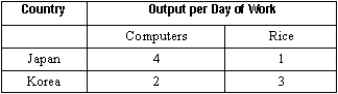
According to the data in Exhibit 29-2, the relative price of computers and rice for Japan is
A) 1/2 computer per unit of rice.
B) 1 computer per 4 units of rice.
C) 1/4 computer per unit of rice.
D) 4 computers per unit of rice.
E) 2 computers per unit of rice.
According to the data in Exhibit 29-2, the relative price of computers and rice for Japan is
A) 1/2 computer per unit of rice.
B) 1 computer per 4 units of rice.
C) 1/4 computer per unit of rice.
D) 4 computers per unit of rice.
E) 2 computers per unit of rice.
Question
Question
Exhibit 29-3 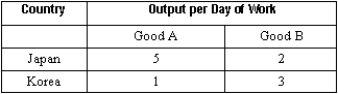
Referring to Exhibit 29-3, suppose the posttrade relative price between Japan and Korea is 1 computer per unit of rice. If Korea takes 10 workers out of computer production, puts the 10 workers in rice production, and sells the resulting rice to Japan in exchange for computers, Korea will gain
A) 3 computers.
B) 10 computers.
C) 2 computers.
D) 30 computers.
E) 20 computers.
Referring to Exhibit 29-3, suppose the posttrade relative price between Japan and Korea is 1 computer per unit of rice. If Korea takes 10 workers out of computer production, puts the 10 workers in rice production, and sells the resulting rice to Japan in exchange for computers, Korea will gain
A) 3 computers.
B) 10 computers.
C) 2 computers.
D) 30 computers.
E) 20 computers.
Question
Exhibit 29-2
According to the data in Exhibit 29-2, the relative price of computers and rice for Korea is
A) 1/2 computer per unit of rice.
B) 2 computers per unit of rice.
C) 3 computers per 2 units of rice.
D) 3/2 computers per unit of rice.
E) 2/3 computer per unit of rice.
According to the data in Exhibit 29-2, the relative price of computers and rice for Korea is
A) 1/2 computer per unit of rice.
B) 2 computers per unit of rice.
C) 3 computers per 2 units of rice.
D) 3/2 computers per unit of rice.
E) 2/3 computer per unit of rice.
Question
Question
Exhibit 29-3
Referring to Exhibit 29-3, suppose the posttrade relative price between Japan and Korea is 1 computer per unit of rice. If Japan takes 10 workers out of rice production, puts the 10 workers in computer production, and sells the resulting computers to Korea in exchange for rice, the net gain from trade for Japan is
A) 20 units of rice.
B) 3 units of rice.
C) 50 units of rice.
D) 30 units of rice.
E) 5 units of rice.
Referring to Exhibit 29-3, suppose the posttrade relative price between Japan and Korea is 1 computer per unit of rice. If Japan takes 10 workers out of rice production, puts the 10 workers in computer production, and sells the resulting computers to Korea in exchange for rice, the net gain from trade for Japan is
A) 20 units of rice.
B) 3 units of rice.
C) 50 units of rice.
D) 30 units of rice.
E) 5 units of rice.
Question
Question
Exhibit 29-2
Suppose the relative price of computers and rice in Japan is 2 computers per unit of rice. The relative price of computers and rice in Korea is 1/2 computer per unit of rice. If the two countries trade without government restrictions, transportation costs are negligible, and markets are competitive, then the likely terms of trade will fall in the range of
A) 3 computers per unit of rice.
B) 5 computers per unit of rice.
C) 1/4 computer per unit of rice.
D) 1 computer per unit of rice.
E) 2 computers per unit of rice
Suppose the relative price of computers and rice in Japan is 2 computers per unit of rice. The relative price of computers and rice in Korea is 1/2 computer per unit of rice. If the two countries trade without government restrictions, transportation costs are negligible, and markets are competitive, then the likely terms of trade will fall in the range of
A) 3 computers per unit of rice.
B) 5 computers per unit of rice.
C) 1/4 computer per unit of rice.
D) 1 computer per unit of rice.
E) 2 computers per unit of rice
Question
Question
Exhibit 29-2
Suppose the pretrade relative price of two goods in country X is 2 and the pretrade relative price of two goods in country Y is 4. The posttrade relative price will settle somewhere between 2 and 4 depending on
A) the level of wages in the two countries.
B) the level of demand in the two countries.
C) the opportunity cost of production in the two countries.
D) the level of labor productivity in the two countries.
E) which country has the absolute advantage.
Suppose the pretrade relative price of two goods in country X is 2 and the pretrade relative price of two goods in country Y is 4. The posttrade relative price will settle somewhere between 2 and 4 depending on
A) the level of wages in the two countries.
B) the level of demand in the two countries.
C) the opportunity cost of production in the two countries.
D) the level of labor productivity in the two countries.
E) which country has the absolute advantage.
Question
Exhibit 29-3
Referring to Exhibit 29-3, suppose the posttrade relative price between Japan and Korea is 1 computer per unit of rice. If Korea takes 10 workers out of rice production, puts the 10 workers in computer production, and sells the resulting computers to Japan in exchange for rice, Korea will
A) gain 20 units of rice.
B) lose 20 units of rice.
C) lose 30 units of rice.
D) gain 10 units of rice.
E) lose 40 units of rice.
Referring to Exhibit 29-3, suppose the posttrade relative price between Japan and Korea is 1 computer per unit of rice. If Korea takes 10 workers out of rice production, puts the 10 workers in computer production, and sells the resulting computers to Japan in exchange for rice, Korea will
A) gain 20 units of rice.
B) lose 20 units of rice.
C) lose 30 units of rice.
D) gain 10 units of rice.
E) lose 40 units of rice.
Question
Question
Exhibit 29-2
Suppose two countries trade two goods without government restrictions. If transportation costs are negligible and markets are competitive, then the price of the goods
A) will be lower in the high-wage country.
B) will be lower in the low-wage country.
C) must be the same in both countries.
D) could be lower in one country than the other.
E) could be higher in one country than the other.
Suppose two countries trade two goods without government restrictions. If transportation costs are negligible and markets are competitive, then the price of the goods
A) will be lower in the high-wage country.
B) will be lower in the low-wage country.
C) must be the same in both countries.
D) could be lower in one country than the other.
E) could be higher in one country than the other.
Question
Question
Question
Question
Question
Question
Question
Question
Question
Question
Question
Question
Exhibit 29-4 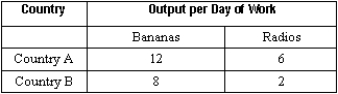
Referring to Exhibit 29-4, suppose you are given the following information about the production of two goods in two countries.

Referring to Exhibit 29-4, suppose you are given the following information about the production of two goods in two countries.
Question
Exhibit 29-4
Suppose the post-trade relative price is 1/3 radio per banana, or equivalently 1 radio per 3 bananas. Based on the information in Exhibit 29-4, demonstrate the gains from trade to each country by assuming each takes 10 units of labor from the production of one good, moves the units of production to the other good, and trades the extra production with the other country.
Suppose the post-trade relative price is 1/3 radio per banana, or equivalently 1 radio per 3 bananas. Based on the information in Exhibit 29-4, demonstrate the gains from trade to each country by assuming each takes 10 units of labor from the production of one good, moves the units of production to the other good, and trades the extra production with the other country.
Question
Question
Question
Question
Question
Question
Question
Question
Question
Question
Answer the questions below:

Question
Question
Question
Question
Question
Question
Question
Question
Question
Question
Question
Question
Question
Question
Question
Question
Question
Question
Question
Question
Question
Question
Question
Question

Unlock Deck
Sign up to unlock the cards in this deck!
Unlock Deck
Unlock Deck
1/234

Play

Full screen (f)
Deck 18: International Trade
1
In the last 50 years, international trade has grown
A) rapidly because of fewer trade barriers.
B) slowly because of increasing transportation costs.
C) slowly because of more government restrictions.
D) rapidly because it is more fashionable to consume foreign goods.
E) neither more slowly nor more rapidly than in past years.
A) rapidly because of fewer trade barriers.
B) slowly because of increasing transportation costs.
C) slowly because of more government restrictions.
D) rapidly because it is more fashionable to consume foreign goods.
E) neither more slowly nor more rapidly than in past years.
A
2
Suppose Rose has a comparative advantage over Sam in programming rather than in sales. If Rose sold programs rather than write them, then she would
A) sacrifice her programming time and her profits would rise.
B) not sacrifice her programming time and her profits would rise.
C) sacrifice her programming time and her profits would fall.
D) not sacrifice her programming time and her profits would fall.
E) not sacrifice her programming time because she could make just as much profits by selling as she could by programming.
A) sacrifice her programming time and her profits would rise.
B) not sacrifice her programming time and her profits would rise.
C) sacrifice her programming time and her profits would fall.
D) not sacrifice her programming time and her profits would fall.
E) not sacrifice her programming time because she could make just as much profits by selling as she could by programming.
C
3
According to the text, the most important reason international trade has grown so rapidly during the past 40 years is the reduction in the cost of transportation and communication.
False
4
A person with a lower opportunity cost of producing a good than another person
A) does not have a comparative advantage in either good.
B) has a comparative advantage in that good.
C) has no incentive to trade in that good.
D) has a comparative advantage in the other good.
E) has an absolute advantage in the other good.
A) does not have a comparative advantage in either good.
B) has a comparative advantage in that good.
C) has no incentive to trade in that good.
D) has a comparative advantage in the other good.
E) has an absolute advantage in the other good.
Unlock Deck
Unlock for access to all 234 flashcards in this deck.
Unlock Deck
k this deck
5
Why has international trade grown more rapidly over the past 30 years?
Unlock Deck
Unlock for access to all 234 flashcards in this deck.
Unlock Deck
k this deck
6
According to the theory of comparative advantage,
A) a country can gain from trade only if it can produce all goods at a lower cost than its trade partner.
B) a country can gain from trade only if it can produce a good at a lower cost than another country.
C) a country can gain from trade only if it can produce a good more efficiently than another country.
D) any country can gain from trade.
E) only high-income countries will gain from trade
A) a country can gain from trade only if it can produce all goods at a lower cost than its trade partner.
B) a country can gain from trade only if it can produce a good at a lower cost than another country.
C) a country can gain from trade only if it can produce a good more efficiently than another country.
D) any country can gain from trade.
E) only high-income countries will gain from trade
Unlock Deck
Unlock for access to all 234 flashcards in this deck.
Unlock Deck
k this deck
7
If country A can produce computers more efficiently than country B, then trade theory tells us that
A) country A has an information advantage in computer production.
B) country A has an opportunity cost advantage in computer production.
C) country A has an absolute advantage in computer production.
D) country A has a production advantage in computer production.
E) country A has a comparative advantage in computer production.
A) country A has an information advantage in computer production.
B) country A has an opportunity cost advantage in computer production.
C) country A has an absolute advantage in computer production.
D) country A has a production advantage in computer production.
E) country A has a comparative advantage in computer production.
Unlock Deck
Unlock for access to all 234 flashcards in this deck.
Unlock Deck
k this deck
8
International trade tends to
A) increase economic instability in the world.
B) increase the efficiency of production.
C) lower profit.
D) increase the cost of production.
E) increase income inequality around the world.
A) increase economic instability in the world.
B) increase the efficiency of production.
C) lower profit.
D) increase the cost of production.
E) increase income inequality around the world.
Unlock Deck
Unlock for access to all 234 flashcards in this deck.
Unlock Deck
k this deck
9
Rose has an absolute advantage over Sam in computer programming and sales. Her efficiency at programming compared to Sam's is greater than her efficiency at sales compared to Sam's.
A) Rose has a comparative advantage in sales.
B) Sam has an absolute advantage in sales.
C) Sam has a comparative advantage in programming.
D) Sam has a comparative advantage in sales.
E) Sam has an absolute advantage in programming.
A) Rose has a comparative advantage in sales.
B) Sam has an absolute advantage in sales.
C) Sam has a comparative advantage in programming.
D) Sam has a comparative advantage in sales.
E) Sam has an absolute advantage in programming.
Unlock Deck
Unlock for access to all 234 flashcards in this deck.
Unlock Deck
k this deck
10
Which of the following is the best definition of opportunity cost?
A) The value of the sum of all possible alternatives to a particular choice
B) The value of the next-best foregone alternative that was not chosen because something else was chosen
C) The value of a choice multiplied by the value of the next-best alternative
D) The cost of making an opportunistic choice
E) None of these is remotely close to an appropriate definition of opportunity cost.
A) The value of the sum of all possible alternatives to a particular choice
B) The value of the next-best foregone alternative that was not chosen because something else was chosen
C) The value of a choice multiplied by the value of the next-best alternative
D) The cost of making an opportunistic choice
E) None of these is remotely close to an appropriate definition of opportunity cost.
Unlock Deck
Unlock for access to all 234 flashcards in this deck.
Unlock Deck
k this deck
11
A situation in which a person or a country can produce one good at a lower opportunity cost than another person or country is known as
A) relative opportunity.
B) absolute advantage.
C) comparative advantage.
D) opportunity cost disparity.
E) discrepancy of opportunity.
A) relative opportunity.
B) absolute advantage.
C) comparative advantage.
D) opportunity cost disparity.
E) discrepancy of opportunity.
Unlock Deck
Unlock for access to all 234 flashcards in this deck.
Unlock Deck
k this deck
12
The share of 2015 world GDP accounted for by international trade was
A) between 10 and 12 percent.
B) between 70 and 78 percent.
C) approximately 60 percent.
D) approximately 14 percent.
E) between 20 and 25 percent.
A) between 10 and 12 percent.
B) between 70 and 78 percent.
C) approximately 60 percent.
D) approximately 14 percent.
E) between 20 and 25 percent.
Unlock Deck
Unlock for access to all 234 flashcards in this deck.
Unlock Deck
k this deck
13
Which of the following is not a reason why international trade has increased as a proportion of the world GDP in the last 50 years?
A) The reduction in transportation costs
B) The advent of the Internet and the subsequent reduction in the cost of doing international business
C) Reductions in government restrictions on trade between countries
D) All of the above are relevant in explaining the growth of international trade.
E) None of the above are relevant in explaining the growth of international trade.
A) The reduction in transportation costs
B) The advent of the Internet and the subsequent reduction in the cost of doing international business
C) Reductions in government restrictions on trade between countries
D) All of the above are relevant in explaining the growth of international trade.
E) None of the above are relevant in explaining the growth of international trade.
Unlock Deck
Unlock for access to all 234 flashcards in this deck.
Unlock Deck
k this deck
14
The commerce clause of the U.S. Constitution is a clause that
A) forbids tariffs and quotas that would hinder trade between the 50 states.
B) forbids dumping within the nation.
C) restricts the way in which Congress can sign free trade agreements.
D) regulates the process of outsourcing American jobs.
E) regulates foreign investment.
A) forbids tariffs and quotas that would hinder trade between the 50 states.
B) forbids dumping within the nation.
C) restricts the way in which Congress can sign free trade agreements.
D) regulates the process of outsourcing American jobs.
E) regulates foreign investment.
Unlock Deck
Unlock for access to all 234 flashcards in this deck.
Unlock Deck
k this deck
15
Many government interventions to restrict trade between countries
A) have increased economic efficiency.
B) involve a foreign firm attempting to monopolize a domestic market.
C) involve the existence of public goods.
D) have harmed rather than improved economic performance.
E) have improved a country's economic performance.
A) have increased economic efficiency.
B) involve a foreign firm attempting to monopolize a domestic market.
C) involve the existence of public goods.
D) have harmed rather than improved economic performance.
E) have improved a country's economic performance.
Unlock Deck
Unlock for access to all 234 flashcards in this deck.
Unlock Deck
k this deck
16
Rose has an absolute advantage over Sam in both computer programming and sales. Rose will hire Sam to sell her software if her efficiency at programming
A) is greater than her efficiency at sales.
B) compared to Sam's is less than her efficiency at sales compared to Sam's.
C) is less than her efficiency at sales.
D) compared to Sam's is greater than her efficiency at sales compared to Sam's.
E) is greater than or equal to her efficiency at sales.
A) is greater than her efficiency at sales.
B) compared to Sam's is less than her efficiency at sales compared to Sam's.
C) is less than her efficiency at sales.
D) compared to Sam's is greater than her efficiency at sales compared to Sam's.
E) is greater than or equal to her efficiency at sales.
Unlock Deck
Unlock for access to all 234 flashcards in this deck.
Unlock Deck
k this deck
17
Rose has a comparative advantage in computer programming whereas Sam has a comparative advantage in sales. Therefore,
A) Sam has a lower opportunity cost of spending his time selling than Rose does.
B) Rose should specialize in sales.
C) Sam should write computer programs.
D) Rose has a higher opportunity cost of spending her time writing computer programs than Sam does.
E) Sam has a higher opportunity cost of spending his time selling than Rose does.
A) Sam has a lower opportunity cost of spending his time selling than Rose does.
B) Rose should specialize in sales.
C) Sam should write computer programs.
D) Rose has a higher opportunity cost of spending her time writing computer programs than Sam does.
E) Sam has a higher opportunity cost of spending his time selling than Rose does.
Unlock Deck
Unlock for access to all 234 flashcards in this deck.
Unlock Deck
k this deck
18
Over the past 50 years, international trade, as a proportion of real GDP, has
A) declined by about 20 percent.
B) increased by about 15 percent.
C) increased by about 100 percent.
D) decreased by about 5 percent.
E) increased by about 50 percent.
A) declined by about 20 percent.
B) increased by about 15 percent.
C) increased by about 100 percent.
D) decreased by about 5 percent.
E) increased by about 50 percent.
Unlock Deck
Unlock for access to all 234 flashcards in this deck.
Unlock Deck
k this deck
19
Country A and country B both produce only two goods, cars and computers. If country A has a lower opportunity cost of producing cars, then
A) country B has an absolute advantage in computer production.
B) country B has a comparative advantage in computer production.
C) country A will have a comparative advantage in both goods if country A also has a lower opportunity cost of producing computers.
D) country A has an absolute advantage in car production.
E) country A can also have a lower opportunity cost of producing computers.
A) country B has an absolute advantage in computer production.
B) country B has a comparative advantage in computer production.
C) country A will have a comparative advantage in both goods if country A also has a lower opportunity cost of producing computers.
D) country A has an absolute advantage in car production.
E) country A can also have a lower opportunity cost of producing computers.
Unlock Deck
Unlock for access to all 234 flashcards in this deck.
Unlock Deck
k this deck
20
International trade as a share of world GDP has doubled in the last 40 years.
Unlock Deck
Unlock for access to all 234 flashcards in this deck.
Unlock Deck
k this deck
21
Exhibit 29-2
According to the data in Exhibit 29-2, the relative price of computers and rice for Japan is
A) 1/2 computer per unit of rice.
B) 1 computer per 4 units of rice.
C) 1/4 computer per unit of rice.
D) 4 computers per unit of rice.
E) 2 computers per unit of rice.
According to the data in Exhibit 29-2, the relative price of computers and rice for Japan is
A) 1/2 computer per unit of rice.
B) 1 computer per 4 units of rice.
C) 1/4 computer per unit of rice.
D) 4 computers per unit of rice.
E) 2 computers per unit of rice.
Unlock Deck
Unlock for access to all 234 flashcards in this deck.
Unlock Deck
k this deck
22
The principle of comparative advantage
A) does not hold true in cases of constant opportunity costs.
B) does not hold true in cases of increasing opportunity costs.
C) holds true in cases of constant opportunity costs but not in cases of increasing opportunity costs.
D) holds true in cases of increasing opportunity costs, as it does with constant opportunity costs.
E) may or may not hold true in cases of increasing opportunity costs.
A) does not hold true in cases of constant opportunity costs.
B) does not hold true in cases of increasing opportunity costs.
C) holds true in cases of constant opportunity costs but not in cases of increasing opportunity costs.
D) holds true in cases of increasing opportunity costs, as it does with constant opportunity costs.
E) may or may not hold true in cases of increasing opportunity costs.
Unlock Deck
Unlock for access to all 234 flashcards in this deck.
Unlock Deck
k this deck
23
Exhibit 29-3
Referring to Exhibit 29-3, suppose the posttrade relative price between Japan and Korea is 1 computer per unit of rice. If Korea takes 10 workers out of computer production, puts the 10 workers in rice production, and sells the resulting rice to Japan in exchange for computers, Korea will gain
A) 3 computers.
B) 10 computers.
C) 2 computers.
D) 30 computers.
E) 20 computers.
Referring to Exhibit 29-3, suppose the posttrade relative price between Japan and Korea is 1 computer per unit of rice. If Korea takes 10 workers out of computer production, puts the 10 workers in rice production, and sells the resulting rice to Japan in exchange for computers, Korea will gain
A) 3 computers.
B) 10 computers.
C) 2 computers.
D) 30 computers.
E) 20 computers.
Unlock Deck
Unlock for access to all 234 flashcards in this deck.
Unlock Deck
k this deck
24
Exhibit 29-2
According to the data in Exhibit 29-2, the relative price of computers and rice for Korea is
A) 1/2 computer per unit of rice.
B) 2 computers per unit of rice.
C) 3 computers per 2 units of rice.
D) 3/2 computers per unit of rice.
E) 2/3 computer per unit of rice.
According to the data in Exhibit 29-2, the relative price of computers and rice for Korea is
A) 1/2 computer per unit of rice.
B) 2 computers per unit of rice.
C) 3 computers per 2 units of rice.
D) 3/2 computers per unit of rice.
E) 2/3 computer per unit of rice.
Unlock Deck
Unlock for access to all 234 flashcards in this deck.
Unlock Deck
k this deck
25
A country can have an absolute advantage in the production of all goods.
Unlock Deck
Unlock for access to all 234 flashcards in this deck.
Unlock Deck
k this deck
26
Exhibit 29-3
Referring to Exhibit 29-3, suppose the posttrade relative price between Japan and Korea is 1 computer per unit of rice. If Japan takes 10 workers out of rice production, puts the 10 workers in computer production, and sells the resulting computers to Korea in exchange for rice, the net gain from trade for Japan is
A) 20 units of rice.
B) 3 units of rice.
C) 50 units of rice.
D) 30 units of rice.
E) 5 units of rice.
Referring to Exhibit 29-3, suppose the posttrade relative price between Japan and Korea is 1 computer per unit of rice. If Japan takes 10 workers out of rice production, puts the 10 workers in computer production, and sells the resulting computers to Korea in exchange for rice, the net gain from trade for Japan is
A) 20 units of rice.
B) 3 units of rice.
C) 50 units of rice.
D) 30 units of rice.
E) 5 units of rice.
Unlock Deck
Unlock for access to all 234 flashcards in this deck.
Unlock Deck
k this deck
27
The difference between production possibilities curves with and without trade represents the
A) country's absolute advantage.
B) terms of trade.
C) deadweight loss to a country.
D) gains from trade.
E) country's comparative advantage.
A) country's absolute advantage.
B) terms of trade.
C) deadweight loss to a country.
D) gains from trade.
E) country's comparative advantage.
Unlock Deck
Unlock for access to all 234 flashcards in this deck.
Unlock Deck
k this deck
28
Exhibit 29-2
Suppose the relative price of computers and rice in Japan is 2 computers per unit of rice. The relative price of computers and rice in Korea is 1/2 computer per unit of rice. If the two countries trade without government restrictions, transportation costs are negligible, and markets are competitive, then the likely terms of trade will fall in the range of
A) 3 computers per unit of rice.
B) 5 computers per unit of rice.
C) 1/4 computer per unit of rice.
D) 1 computer per unit of rice.
E) 2 computers per unit of rice
Suppose the relative price of computers and rice in Japan is 2 computers per unit of rice. The relative price of computers and rice in Korea is 1/2 computer per unit of rice. If the two countries trade without government restrictions, transportation costs are negligible, and markets are competitive, then the likely terms of trade will fall in the range of
A) 3 computers per unit of rice.
B) 5 computers per unit of rice.
C) 1/4 computer per unit of rice.
D) 1 computer per unit of rice.
E) 2 computers per unit of rice
Unlock Deck
Unlock for access to all 234 flashcards in this deck.
Unlock Deck
k this deck
29
According to the data in Exhibit 29-1, which of the following statements is true?
A) Chinese workers cannot gain from trade with India.
B) Labor productivity in both goods is higher in India than in China.
C) Wages will be higher in India than in China.
D) Labor productivity in both goods is higher in China than in India.
E) Labor productivity in the production of good A is higher in India than in China.
A) Chinese workers cannot gain from trade with India.
B) Labor productivity in both goods is higher in India than in China.
C) Wages will be higher in India than in China.
D) Labor productivity in both goods is higher in China than in India.
E) Labor productivity in the production of good A is higher in India than in China.
Unlock Deck
Unlock for access to all 234 flashcards in this deck.
Unlock Deck
k this deck
30
Exhibit 29-2
Suppose the pretrade relative price of two goods in country X is 2 and the pretrade relative price of two goods in country Y is 4. The posttrade relative price will settle somewhere between 2 and 4 depending on
A) the level of wages in the two countries.
B) the level of demand in the two countries.
C) the opportunity cost of production in the two countries.
D) the level of labor productivity in the two countries.
E) which country has the absolute advantage.
Suppose the pretrade relative price of two goods in country X is 2 and the pretrade relative price of two goods in country Y is 4. The posttrade relative price will settle somewhere between 2 and 4 depending on
A) the level of wages in the two countries.
B) the level of demand in the two countries.
C) the opportunity cost of production in the two countries.
D) the level of labor productivity in the two countries.
E) which country has the absolute advantage.
Unlock Deck
Unlock for access to all 234 flashcards in this deck.
Unlock Deck
k this deck
31
Exhibit 29-3
Referring to Exhibit 29-3, suppose the posttrade relative price between Japan and Korea is 1 computer per unit of rice. If Korea takes 10 workers out of rice production, puts the 10 workers in computer production, and sells the resulting computers to Japan in exchange for rice, Korea will
A) gain 20 units of rice.
B) lose 20 units of rice.
C) lose 30 units of rice.
D) gain 10 units of rice.
E) lose 40 units of rice.
Referring to Exhibit 29-3, suppose the posttrade relative price between Japan and Korea is 1 computer per unit of rice. If Korea takes 10 workers out of rice production, puts the 10 workers in computer production, and sells the resulting computers to Japan in exchange for rice, Korea will
A) gain 20 units of rice.
B) lose 20 units of rice.
C) lose 30 units of rice.
D) gain 10 units of rice.
E) lose 40 units of rice.
Unlock Deck
Unlock for access to all 234 flashcards in this deck.
Unlock Deck
k this deck
32
When countries specialize in producing products in which they have a comparative advantage, they
A) increase the amount of goods available for consumption.
B) decrease the amount of goods available for consumption.
C) gain at the expense of the whole society.
D) decrease the world total amount of resources available for production.
E) increase the world total amount of resources available for production.
A) increase the amount of goods available for consumption.
B) decrease the amount of goods available for consumption.
C) gain at the expense of the whole society.
D) decrease the world total amount of resources available for production.
E) increase the world total amount of resources available for production.
Unlock Deck
Unlock for access to all 234 flashcards in this deck.
Unlock Deck
k this deck
33
Exhibit 29-2
Suppose two countries trade two goods without government restrictions. If transportation costs are negligible and markets are competitive, then the price of the goods
A) will be lower in the high-wage country.
B) will be lower in the low-wage country.
C) must be the same in both countries.
D) could be lower in one country than the other.
E) could be higher in one country than the other.
Suppose two countries trade two goods without government restrictions. If transportation costs are negligible and markets are competitive, then the price of the goods
A) will be lower in the high-wage country.
B) will be lower in the low-wage country.
C) must be the same in both countries.
D) could be lower in one country than the other.
E) could be higher in one country than the other.
Unlock Deck
Unlock for access to all 234 flashcards in this deck.
Unlock Deck
k this deck
34
The slope of the linear production possibilities curve before trade is determined by the
A) available quantity of labor in the country divided by the average labor productivity.
B) average labor productivity divided by the average wage.
C) average labor productivity.
D) opportunity cost of production.
E) available quantity of labor in the country.
A) available quantity of labor in the country divided by the average labor productivity.
B) average labor productivity divided by the average wage.
C) average labor productivity.
D) opportunity cost of production.
E) available quantity of labor in the country.
Unlock Deck
Unlock for access to all 234 flashcards in this deck.
Unlock Deck
k this deck
35
The principle of comparative advantage implies that trade
A) decreases the level of world employment.
B) shifts production possibilities curves inward.
C) increases the amount of world production.
D) decreases the amount of world production.
E) decreases the amount of world consumption.
A) decreases the level of world employment.
B) shifts production possibilities curves inward.
C) increases the amount of world production.
D) decreases the amount of world production.
E) decreases the amount of world consumption.
Unlock Deck
Unlock for access to all 234 flashcards in this deck.
Unlock Deck
k this deck
36
Linear production possibilities curves explain why a country
A) tries to produce both products.
B) specializes in one product but not the one in which it has a comparative advantage.
C) does not specialize in the product in which it has a comparative advantage.
D) completely specializes in one product.
E) becomes self-sufficient.
A) tries to produce both products.
B) specializes in one product but not the one in which it has a comparative advantage.
C) does not specialize in the product in which it has a comparative advantage.
D) completely specializes in one product.
E) becomes self-sufficient.
Unlock Deck
Unlock for access to all 234 flashcards in this deck.
Unlock Deck
k this deck
37
Compared to production possibilities curves without trade, those with trade are
A) the same but with a different slope.
B) shifted inward.
C) sometimes shifted outward and sometimes shifted inward.
D) shifted outward.
E) the same.
A) the same but with a different slope.
B) shifted inward.
C) sometimes shifted outward and sometimes shifted inward.
D) shifted outward.
E) the same.
Unlock Deck
Unlock for access to all 234 flashcards in this deck.
Unlock Deck
k this deck
38
According to Exhibit 29-1, which of the following is true?
A) As workers are more productive in China, wages will be higher.
B) As workers are more productive in China, China will have a comparative advantage in the production of both goods.
C) As workers are less productive in India, wages will be lower, and they will have a comparative advantage in the production of both goods.
D) Indian workers are less productive at producing both goods, so China will not find it advantageous to trade with India.
E) Indian workers are less productive at producing both goods, so India will not be able to gain from trade with China.
A) As workers are more productive in China, wages will be higher.
B) As workers are more productive in China, China will have a comparative advantage in the production of both goods.
C) As workers are less productive in India, wages will be lower, and they will have a comparative advantage in the production of both goods.
D) Indian workers are less productive at producing both goods, so China will not find it advantageous to trade with India.
E) Indian workers are less productive at producing both goods, so India will not be able to gain from trade with China.
Unlock Deck
Unlock for access to all 234 flashcards in this deck.
Unlock Deck
k this deck
39
The negative slope of Korea's linear production possibilities curve between computers and rice means that
A) to get more computers, Korea must give up some production of rice.
B) Korea has a comparative advantage in rice.
C) Korea has a comparative advantage in computers.
D) Korea can produce more computers without having to give up some production of rice.
E) to get more computers, Korea must give up increasing amounts of production of rice.
A) to get more computers, Korea must give up some production of rice.
B) Korea has a comparative advantage in rice.
C) Korea has a comparative advantage in computers.
D) Korea can produce more computers without having to give up some production of rice.
E) to get more computers, Korea must give up increasing amounts of production of rice.
Unlock Deck
Unlock for access to all 234 flashcards in this deck.
Unlock Deck
k this deck
40
If a country's opportunity costs increase when it trades one product for another,
A) the country will stop trading in that product.
B) the country will have a linear production possibilities curve.
C) complete specialization can still occur but only in the product in which the country does not have a comparative advantage.
D) the country will specialize completely in the product in which it has a comparative advantage.
E) complete specialization does not occur.
A) the country will stop trading in that product.
B) the country will have a linear production possibilities curve.
C) complete specialization can still occur but only in the product in which the country does not have a comparative advantage.
D) the country will specialize completely in the product in which it has a comparative advantage.
E) complete specialization does not occur.
Unlock Deck
Unlock for access to all 234 flashcards in this deck.
Unlock Deck
k this deck
41
The relative price of two goods (units of A per unit of B) is the same as the opportunity cost of producing good B.
B.
True; Challenging
B.
True; Challenging
Unlock Deck
Unlock for access to all 234 flashcards in this deck.
Unlock Deck
k this deck
42
Countries with low labor productivity will not have a comparative advantage in the production of any good.
Unlock Deck
Unlock for access to all 234 flashcards in this deck.
Unlock Deck
k this deck
43
If a country has an absolute advantage in the production of both goods, then it is better off producing them both rather than producing only one good and trading with another country. True or False. Explain.
Unlock Deck
Unlock for access to all 234 flashcards in this deck.
Unlock Deck
k this deck
44
Central America would most likely have a comparative advantage over the United States in producing
A) automobiles.
B) tropical fruits.
C) computers.
D) pharmaceuticals.
E) financial services.
A) automobiles.
B) tropical fruits.
C) computers.
D) pharmaceuticals.
E) financial services.
Unlock Deck
Unlock for access to all 234 flashcards in this deck.
Unlock Deck
k this deck
45
Exhibit 29-4
Referring to Exhibit 29-4, suppose you are given the following information about the production of two goods in two countries.
Referring to Exhibit 29-4, suppose you are given the following information about the production of two goods in two countries.
Unlock Deck
Unlock for access to all 234 flashcards in this deck.
Unlock Deck
k this deck
46
Exhibit 29-4
Suppose the post-trade relative price is 1/3 radio per banana, or equivalently 1 radio per 3 bananas. Based on the information in Exhibit 29-4, demonstrate the gains from trade to each country by assuming each takes 10 units of labor from the production of one good, moves the units of production to the other good, and trades the extra production with the other country.
Suppose the post-trade relative price is 1/3 radio per banana, or equivalently 1 radio per 3 bananas. Based on the information in Exhibit 29-4, demonstrate the gains from trade to each country by assuming each takes 10 units of labor from the production of one good, moves the units of production to the other good, and trades the extra production with the other country.
Unlock Deck
Unlock for access to all 234 flashcards in this deck.
Unlock Deck
k this deck
47
Explain the connection between opportunity costs of production and complete specialization in the production of a good.
Unlock Deck
Unlock for access to all 234 flashcards in this deck.
Unlock Deck
k this deck
48
Explain the connection between the relative price and opportunity cost.
Unlock Deck
Unlock for access to all 234 flashcards in this deck.
Unlock Deck
k this deck
49
If there are increasing opportunity costs of production, the production possibilities curve will bow inward.
Unlock Deck
Unlock for access to all 234 flashcards in this deck.
Unlock Deck
k this deck
50
The gains from trade are larger for a particular country if the post-trade relative price settles closer to the pre-trade relative price of the other country.
Unlock Deck
Unlock for access to all 234 flashcards in this deck.
Unlock Deck
k this deck
51
To measure the gains from trade, we need to consider the relative prices in the two countries.
Unlock Deck
Unlock for access to all 234 flashcards in this deck.
Unlock Deck
k this deck
52
The slope of the pre-trade production possibilities curve is the opportunity cost of production.
Unlock Deck
Unlock for access to all 234 flashcards in this deck.
Unlock Deck
k this deck
53
A country cannot have a comparative advantage in the production of all goods.
Unlock Deck
Unlock for access to all 234 flashcards in this deck.
Unlock Deck
k this deck
54
Production can only occur along the pre-trade production possibilities frontier.
Unlock Deck
Unlock for access to all 234 flashcards in this deck.
Unlock Deck
k this deck
55
Consumption can only occur along the pre-trade production possibilities frontier.
Unlock Deck
Unlock for access to all 234 flashcards in this deck.
Unlock Deck
k this deck
56
Answer the questions below:
Unlock Deck
Unlock for access to all 234 flashcards in this deck.
Unlock Deck
k this deck
57
The United States may have a comparative advantage in pharmaceuticals because of
A) its investment in research.
B) its ability to bypass patent laws in various countries.
C) its natural resource endowment.
D) weather conditions.
E) its geographical location in the world.
A) its investment in research.
B) its ability to bypass patent laws in various countries.
C) its natural resource endowment.
D) weather conditions.
E) its geographical location in the world.
Unlock Deck
Unlock for access to all 234 flashcards in this deck.
Unlock Deck
k this deck
58
Country A has a comparative advantage over country B in the production of a good if the opportunity cost of producing the good in country A is less than in country B.
B.
True; Basic
B.
True; Basic
Unlock Deck
Unlock for access to all 234 flashcards in this deck.
Unlock Deck
k this deck
59
Explain the connection between opportunity costs of production and the shape of the production possibilities curve.
Unlock Deck
Unlock for access to all 234 flashcards in this deck.
Unlock Deck
k this deck
60
Explain the difference between absolute and comparative advantage.
Unlock Deck
Unlock for access to all 234 flashcards in this deck.
Unlock Deck
k this deck
61
Which of the following is least likely to explain a country's comparative advantage?
A) Its stock of natural resources
B) A skilled labor force
C) Its transportation system
D) The level of physical capital investment
E) The level of investment in research
A) Its stock of natural resources
B) A skilled labor force
C) Its transportation system
D) The level of physical capital investment
E) The level of investment in research
Unlock Deck
Unlock for access to all 234 flashcards in this deck.
Unlock Deck
k this deck
62
An implication of the Heckscher-Ohlin model is that trade will tend to
A) bring factor prices into equality in different countries.
B) cause factor prices to fall in different countries.
C) be diverted from countries with higher factor prices.
D) not have any effect on factor prices in different countries.
E) cause factor prices to rise in different countries.
A) bring factor prices into equality in different countries.
B) cause factor prices to fall in different countries.
C) be diverted from countries with higher factor prices.
D) not have any effect on factor prices in different countries.
E) cause factor prices to rise in different countries.
Unlock Deck
Unlock for access to all 234 flashcards in this deck.
Unlock Deck
k this deck
63
Trade will tend to equalize the price of goods, but not the price of factors of production.
Unlock Deck
Unlock for access to all 234 flashcards in this deck.
Unlock Deck
k this deck
64
A country should specialize in the production of those goods that use its most abundant factor most intensively.
Unlock Deck
Unlock for access to all 234 flashcards in this deck.
Unlock Deck
k this deck
65
Production that uses a relatively high level of capital per worker is called
A) labor abundant.
B) capital intensive.
C) labor intensive.
D) capital abundant.
E) labor deepened.
A) labor abundant.
B) capital intensive.
C) labor intensive.
D) capital abundant.
E) labor deepened.
Unlock Deck
Unlock for access to all 234 flashcards in this deck.
Unlock Deck
k this deck
66
Trade will tend to equalize factor prices.
Unlock Deck
Unlock for access to all 234 flashcards in this deck.
Unlock Deck
k this deck
67
The Heckscher-Ohlin model
A) provides support for levying tariffs on imported goods.
B) supports restrictions on trade.
C) provides an explanation for why a country has a comparative advantage in a good.
D) explains why mercantilism is inefficient.
E) explains why comparative advantage changes over time because of investment in physical and human capital.
A) provides support for levying tariffs on imported goods.
B) supports restrictions on trade.
C) provides an explanation for why a country has a comparative advantage in a good.
D) explains why mercantilism is inefficient.
E) explains why comparative advantage changes over time because of investment in physical and human capital.
Unlock Deck
Unlock for access to all 234 flashcards in this deck.
Unlock Deck
k this deck
68
If the United States is relatively abundant in high-skilled workers and other countries are relatively abundant in low-skilled workers, then high-skilled workers' wages should rise and low-skilled workers' wages should fall in the United States.
Unlock Deck
Unlock for access to all 234 flashcards in this deck.
Unlock Deck
k this deck
69
Changes in comparative advantage over time from investment in physical and human capital and in technology are called
A) static comparative advantage.
B) innovative comparative advantage.
C) resource-intensive comparative advantage.
D) dynamic comparative advantage.
E) differential comparative advantage.
A) static comparative advantage.
B) innovative comparative advantage.
C) resource-intensive comparative advantage.
D) dynamic comparative advantage.
E) differential comparative advantage.
Unlock Deck
Unlock for access to all 234 flashcards in this deck.
Unlock Deck
k this deck
70
Trade will tend to increase the cost of capital in a labor-abundant country.
Unlock Deck
Unlock for access to all 234 flashcards in this deck.
Unlock Deck
k this deck
71
The equilibrating of the price of labor and the price of capital across countries when they are engaging in free trade is called
A) the Leontief paradox.
B) the gains from trade model.
C) the complete specialization model.
D) factor-price equalization.
E) the comparative advantage model.
A) the Leontief paradox.
B) the gains from trade model.
C) the complete specialization model.
D) factor-price equalization.
E) the comparative advantage model.
Unlock Deck
Unlock for access to all 234 flashcards in this deck.
Unlock Deck
k this deck
72
If one country has a higher level of capital per worker than another country, it is relatively
A) capital abundant.
B) labor abundant.
C) labor intensive.
D) capital intensive.
E) capital deepened.
A) capital abundant.
B) labor abundant.
C) labor intensive.
D) capital intensive.
E) capital deepened.
Unlock Deck
Unlock for access to all 234 flashcards in this deck.
Unlock Deck
k this deck
73
Trade will tend to increase wages in a labor-abundant country because the
A) supply of labor will increase.
B) supply of labor will decrease and the demand for labor will increase.
C) demand for labor will increase.
D) demand for labor will decrease.
E) supply of labor will decrease.
A) supply of labor will increase.
B) supply of labor will decrease and the demand for labor will increase.
C) demand for labor will increase.
D) demand for labor will decrease.
E) supply of labor will decrease.
Unlock Deck
Unlock for access to all 234 flashcards in this deck.
Unlock Deck
k this deck
74
Trade will tend to increase wages in a labor-abundant country.
Unlock Deck
Unlock for access to all 234 flashcards in this deck.
Unlock Deck
k this deck
75
A country would have a comparative advantage in a good if its production is
A) capital intensive and the country is capital abundant.
B) capital intensive and the country is labor abundant.
C) labor intensive and the country is capital abundant.
D) capital intensive but the country is neither capital nor labor abundant.
E) labor intensive but the country is neither capital nor labor abundant.
A) capital intensive and the country is capital abundant.
B) capital intensive and the country is labor abundant.
C) labor intensive and the country is capital abundant.
D) capital intensive but the country is neither capital nor labor abundant.
E) labor intensive but the country is neither capital nor labor abundant.
Unlock Deck
Unlock for access to all 234 flashcards in this deck.
Unlock Deck
k this deck
76
Wages in the developed world with high technology remain about equal to wages in the less-developed world with low technology.
Unlock Deck
Unlock for access to all 234 flashcards in this deck.
Unlock Deck
k this deck
77
If country A has a lower level of capital per worker than country B, then country A is relatively labor intensive.
Unlock Deck
Unlock for access to all 234 flashcards in this deck.
Unlock Deck
k this deck
78
If one country has a lower level of capital per worker than another country, it is relatively
A) labor abundant.
B) capital intensive.
C) capital abundant.
D) labor intensive.
E) labor deepened.
A) labor abundant.
B) capital intensive.
C) capital abundant.
D) labor intensive.
E) labor deepened.
Unlock Deck
Unlock for access to all 234 flashcards in this deck.
Unlock Deck
k this deck
79
If the comparative advantage between Japan and Korea was due only to differences in relative capital and labor abundance, then trade would tend to
A) increase real wages in the higher-wage country and lower real wages in the lower-wage country.
B) have no effect on the real wages in either country.
C) increase real wages in the lower-wage country and lower real wages in the higher-wage country.
D) decrease money wages in the lower-wage country and raise money wages in the higher-wage country.
E) prevent wages from changing in either country.
A) increase real wages in the higher-wage country and lower real wages in the lower-wage country.
B) have no effect on the real wages in either country.
C) increase real wages in the lower-wage country and lower real wages in the higher-wage country.
D) decrease money wages in the lower-wage country and raise money wages in the higher-wage country.
E) prevent wages from changing in either country.
Unlock Deck
Unlock for access to all 234 flashcards in this deck.
Unlock Deck
k this deck
80
Production that uses a relatively low level of capital per worker is called
A) labor abundant.
B) capital abundant.
C) labor intensive.
D) capital intensive.
E) capital deepened.
A) labor abundant.
B) capital abundant.
C) labor intensive.
D) capital intensive.
E) capital deepened.
Unlock Deck
Unlock for access to all 234 flashcards in this deck.
Unlock Deck
k this deck
Unlock Deck
Unlock for access to all 234 flashcards in this deck.






