







 Chat with AI

Deck 7: Junctional Dysrhythmias
Full screen (f)

Question

Question
Question
Question
Question
Question
Question
Question
Question
Question
Question
Question
Question
Question
Question
Question
Question
Question
Question
Question
Question
Question
Question
Question
Question
Question
Question
Question
You have recorded an ECG on a patient, and a portion of the tracing is shown here. What type of dysrhythmia does this patient have? 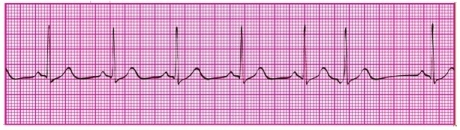
A)Junctional tachycardia
B)Junctional escape rhythm
C)Accelerated junctional rhythm
D)PJC
A)Junctional tachycardia
B)Junctional escape rhythm
C)Accelerated junctional rhythm
D)PJC
Question
Question
You have performed an ECG on a hospital patient who is known to be suffering from hypotension. A portion of the tracing is shown here. What might be the cause of this patient's hypotension? 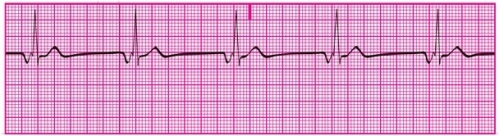
A)Sinus bradycardia
B)PJCs
C)Junctional escape rhythm
D)Accelerated junctional escape rhythm
A)Sinus bradycardia
B)PJCs
C)Junctional escape rhythm
D)Accelerated junctional escape rhythm
Question
Question
Question
Question
Question
Question
Question
Question
Question
Identify the following rhythm: 
A)Atrial fibrillation
B)Atrial flutter
C)Junctional tachycardia
D)SVT
A)Atrial fibrillation
B)Atrial flutter
C)Junctional tachycardia
D)SVT
Question
Question
What is the underlying rhythm in the ECG tracing shown here? 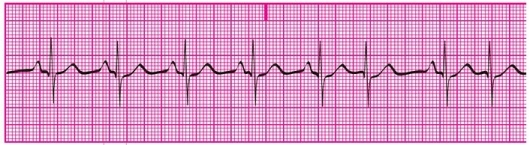
A)Normal sinus rhythm
B)Accelerated junctional rhythm
C)Junctional tachycardia
D)SVT
A)Normal sinus rhythm
B)Accelerated junctional rhythm
C)Junctional tachycardia
D)SVT
Question
Question
Question
Question
You have performed an ECG on a patient who has come to the clinic complaining of "fluttering" in his chest. A portion of the ECG tracing is shown here. What type of dysrhythmia does this patient have? 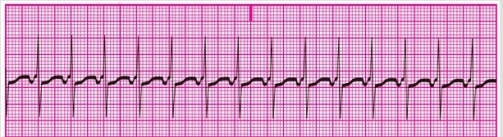
A)Sinus tachycardia
B)Accelerated junctional rhythm
C)Junctional tachycardia
D)Ventricular tachycardia
A)Sinus tachycardia
B)Accelerated junctional rhythm
C)Junctional tachycardia
D)Ventricular tachycardia
Question
You are recording an ECG for a patient at a wellness clinic. The patient appears to be in good health and has no obvious signs or symptoms of heart trouble. A portion of the ECG tracing is shown below. What are your conclusions? 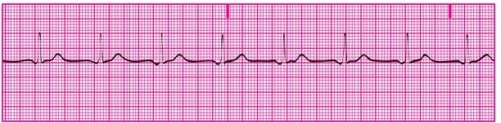
A)Normal sinus rhythm
B)Sinus tachycardia
C)Junctional tachycardia
D)Accelerated junctional rhythm
A)Normal sinus rhythm
B)Sinus tachycardia
C)Junctional tachycardia
D)Accelerated junctional rhythm
Question
Question
Question
You have performed an ECG on a hospital patient. A portion of the ECG tracing is shown here. What signs and symptoms would you expect this patient to have? 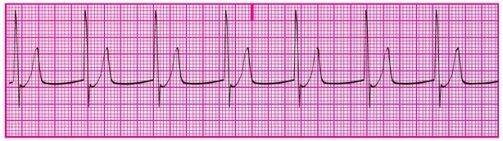
A)Hypotension and confusion
B)Pressure and pain in the chest
C)Difficulty breathing
D)No obvious symptoms
A)Hypotension and confusion
B)Pressure and pain in the chest
C)Difficulty breathing
D)No obvious symptoms
Question
Question

Unlock Deck
Sign up to unlock the cards in this deck!
Unlock Deck
Unlock Deck
1/51

Play

Full screen (f)
Deck 7: Junctional Dysrhythmias
1
Which of the following is a single early electrical impulse that originates in the AV junction, occurring before the next expected sinus impulse and causing an irregularity in the rhythm?
A)Junctional tachycardia
B)SVT
C)PJC
D)Junctional escape rhythm
A)Junctional tachycardia
B)SVT
C)PJC
D)Junctional escape rhythm
PJC
2
What is the normal, inherent rate of the AV node?
A)20 to 40 bpm
B)40 to 60 bpm
C)80 to 100 bpm
D)100 to 150 bpm
A)20 to 40 bpm
B)40 to 60 bpm
C)80 to 100 bpm
D)100 to 150 bpm
40 to 60 bpm
3
Junctional rhythms occur because the electrical impulse comes from the AV junction instead of the ________.
A)Purkinje fibers
B)Ventricles
C)Bundle of His
D)SA node
A)Purkinje fibers
B)Ventricles
C)Bundle of His
D)SA node
SA node
4
What symptoms will a patient have if PJCs occur more than four to six times per minute?
A)Hypertension, rapid pulse
B)Chest pain, lung congestion
C)Pale skin, rapid breathing
D)Hypotension, irregular pulse
A)Hypertension, rapid pulse
B)Chest pain, lung congestion
C)Pale skin, rapid breathing
D)Hypotension, irregular pulse
Unlock Deck
Unlock for access to all 51 flashcards in this deck.
Unlock Deck
k this deck
5
What causes the inverted P wave morphology found with junctional rhythms?
A)Electrical impulses are coming from the SA node, causing repolarization.
B)Electrical impulses are coming from areas of multiple ectopic foci.
C)Electrical impulses are coming from the AV node, causing atrial depolarization to flow retrogradely.
D)Rapid impulses originate in the atrial tissue
A)Electrical impulses are coming from the SA node, causing repolarization.
B)Electrical impulses are coming from areas of multiple ectopic foci.
C)Electrical impulses are coming from the AV node, causing atrial depolarization to flow retrogradely.
D)Rapid impulses originate in the atrial tissue
Unlock Deck
Unlock for access to all 51 flashcards in this deck.
Unlock Deck
k this deck
6
The effect of junctional tachycardia on the patient depends on ________.
A)The force of the ventricular contractions
B)The rate of the rhythm
C)The timing of the atrial contractions
D)The atrial kick
A)The force of the ventricular contractions
B)The rate of the rhythm
C)The timing of the atrial contractions
D)The atrial kick
Unlock Deck
Unlock for access to all 51 flashcards in this deck.
Unlock Deck
k this deck
7
What is the term for a fast, "fluttering" heartbeat sensation felt by a patient?
A)Palpation
B)Paresthesia
C)Palpitation
D)Pacemaker
A)Palpation
B)Paresthesia
C)Palpitation
D)Pacemaker
Unlock Deck
Unlock for access to all 51 flashcards in this deck.
Unlock Deck
k this deck
8
In junctional rhythms, where does the electrical current initiate?
A)AV junction
B)Bundle of His
C)Atria
D)Ventricles
A)AV junction
B)Bundle of His
C)Atria
D)Ventricles
Unlock Deck
Unlock for access to all 51 flashcards in this deck.
Unlock Deck
k this deck
9
What is the difference between accelerated junctional rhythm and junctional escape rhythm?
A)QRS duration
B)P wave
C)Heart rate
D)T wave
A)QRS duration
B)P wave
C)Heart rate
D)T wave
Unlock Deck
Unlock for access to all 51 flashcards in this deck.
Unlock Deck
k this deck
10
What type of rhythm occurs when the SA node fails to initiate the electrical activity and one of the backup pacemaker sites takes over?
A)Junctional escape rhythm
B)Heart block rhythm
C)Asystole
D)Normal sinus rhythm
A)Junctional escape rhythm
B)Heart block rhythm
C)Asystole
D)Normal sinus rhythm
Unlock Deck
Unlock for access to all 51 flashcards in this deck.
Unlock Deck
k this deck
11
What does the term "retrograde" mean?
A)Immediately
B)Backward
C)Horizontal
D)Flattened
A)Immediately
B)Backward
C)Horizontal
D)Flattened
Unlock Deck
Unlock for access to all 51 flashcards in this deck.
Unlock Deck
k this deck
12
What is the difference between accelerated junctional rhythm and junctional tachycardia?
A)P wave
B)QRS duration
C)PR interval
D)Heart rate
A)P wave
B)QRS duration
C)PR interval
D)Heart rate
Unlock Deck
Unlock for access to all 51 flashcards in this deck.
Unlock Deck
k this deck
13
What is the ventricular heart rate range for accelerated junctional rhythm?
A)20 to 40 bpm
B)40 to 60 bpm
C)60 to 100 bpm
D)100 to 150 bpm
A)20 to 40 bpm
B)40 to 60 bpm
C)60 to 100 bpm
D)100 to 150 bpm
Unlock Deck
Unlock for access to all 51 flashcards in this deck.
Unlock Deck
k this deck
14
What are the distinguishing characteristics of PJCs?
A)They have a changing P wave configuration with at least three variations in one lead.
B)They have an inverted or absent P wave or a P wave that follows the QRS complex.
C)They have an irregular rhythm; the P wave is inverted and may appear before, during, or after the QRS complex.
D)They have a clearly changing P wave and a heart rate of 101 to 150 bpm.
A)They have a changing P wave configuration with at least three variations in one lead.
B)They have an inverted or absent P wave or a P wave that follows the QRS complex.
C)They have an irregular rhythm; the P wave is inverted and may appear before, during, or after the QRS complex.
D)They have a clearly changing P wave and a heart rate of 101 to 150 bpm.
Unlock Deck
Unlock for access to all 51 flashcards in this deck.
Unlock Deck
k this deck
15
When is junctional tachycardia considered to be serious or life threatening?
A)After a recent myocardial infarction
B)After an exercise electrocardiography test
C)After a routine physical examination
D)After a recent viral infection
A)After a recent myocardial infarction
B)After an exercise electrocardiography test
C)After a routine physical examination
D)After a recent viral infection
Unlock Deck
Unlock for access to all 51 flashcards in this deck.
Unlock Deck
k this deck
16
What symptoms might occur in a patient with junctional escape rhythm?
A)Hypertension, lung congestion, and syncope
B)Hypotension, confusion, and disorientation
C)Chest pain, lung congestion, and palpitations
D)Hypotension, nausea, and syncope
A)Hypertension, lung congestion, and syncope
B)Hypotension, confusion, and disorientation
C)Chest pain, lung congestion, and palpitations
D)Hypotension, nausea, and syncope
Unlock Deck
Unlock for access to all 51 flashcards in this deck.
Unlock Deck
k this deck
17
Why is it unlikely that a patient would have symptoms of low cardiac output with accelerated junctional rhythm?
A)The heart rate is the same as normal sinus rhythm.
B)The heart rate is influenced by the respiratory cycle and variations of vagal tone.
C)The rhythm originates at the AV junctional tissue, producing retrograde depolarization of atrial tissue.
D)The heart rate is slower than normal and loses the atrial kick.
A)The heart rate is the same as normal sinus rhythm.
B)The heart rate is influenced by the respiratory cycle and variations of vagal tone.
C)The rhythm originates at the AV junctional tissue, producing retrograde depolarization of atrial tissue.
D)The heart rate is slower than normal and loses the atrial kick.
Unlock Deck
Unlock for access to all 51 flashcards in this deck.
Unlock Deck
k this deck
18
What is the ventricular heart rate for junctional escape rhythm?
A)20 to 40 bpm
B)40 to 60 bpm
C)60 to 100 bpm
D)100 to 150 bpm
A)20 to 40 bpm
B)40 to 60 bpm
C)60 to 100 bpm
D)100 to 150 bpm
Unlock Deck
Unlock for access to all 51 flashcards in this deck.
Unlock Deck
k this deck
19
What is the ventricular heart rate with junctional tachycardia?
A)60 to 100 bpm
B)100 to 180 bpm
C)150 to 300 bpm
D)Greater than 300 bpm
A)60 to 100 bpm
B)100 to 180 bpm
C)150 to 300 bpm
D)Greater than 300 bpm
Unlock Deck
Unlock for access to all 51 flashcards in this deck.
Unlock Deck
k this deck
20
What are the distinguishing characteristics of junctional escape rhythm?
A)The rhythm is regular; the P wave may occur before, during, or after the QRS; and the P wave is inverted.
B)The rhythm is irregular, the P wave is inverted, and the P wave may immediately precede or follow the QRS complex.
C)The P wave may occur simultaneously with the T wave or may occur before, during, or after the QRS complex.
D)The P waves cannot be identified, there is chaotic electrical activity, and f waves may be seen.
A)The rhythm is regular; the P wave may occur before, during, or after the QRS; and the P wave is inverted.
B)The rhythm is irregular, the P wave is inverted, and the P wave may immediately precede or follow the QRS complex.
C)The P wave may occur simultaneously with the T wave or may occur before, during, or after the QRS complex.
D)The P waves cannot be identified, there is chaotic electrical activity, and f waves may be seen.
Unlock Deck
Unlock for access to all 51 flashcards in this deck.
Unlock Deck
k this deck
21
What is the term for an ectopic focus originating above the ventricles in the atria or junctional region?
A)An escape rhythm
B)Supraventricular
C)Ventricular
D)A heart block rhythm
A)An escape rhythm
B)Supraventricular
C)Ventricular
D)A heart block rhythm
Unlock Deck
Unlock for access to all 51 flashcards in this deck.
Unlock Deck
k this deck
22
What is the term for a condition in which a patient's blood pressure is not adequate to maintain good blood supply to the vital organs?
A)Hypoxia
B)Hyperventilation
C)Hypotension
D)Hypertension
A)Hypoxia
B)Hyperventilation
C)Hypotension
D)Hypertension
Unlock Deck
Unlock for access to all 51 flashcards in this deck.
Unlock Deck
k this deck
23
Which of the following statements is true of all junctional dysrhythmias?
A)The heart rate is regular.
B)The QRS measurement is within normal limits.
C)The PR interval is constant.
D)A P wave occurs before every QRS complex.
A)The heart rate is regular.
B)The QRS measurement is within normal limits.
C)The PR interval is constant.
D)A P wave occurs before every QRS complex.
Unlock Deck
Unlock for access to all 51 flashcards in this deck.
Unlock Deck
k this deck
24
What might you be asked to do when a patient has a supraventricular dysrhythmia?
A)Increase the paper speed so the tracing can be analyzed more carefully
B)Call a code blue and immediately start CPR and advanced life support
C)Perform an exercise stress test on the patient
D)Perform electrical cardioversion on the patient
A)Increase the paper speed so the tracing can be analyzed more carefully
B)Call a code blue and immediately start CPR and advanced life support
C)Perform an exercise stress test on the patient
D)Perform electrical cardioversion on the patient
Unlock Deck
Unlock for access to all 51 flashcards in this deck.
Unlock Deck
k this deck
25
What is the primary difficulty in classifying an SVT?
A)Determining the origin of the tachycardia
B)Determining the patient's ventricular heart rate
C)Measuring the QRS complex
D)Identifying the delta waves
A)Determining the origin of the tachycardia
B)Determining the patient's ventricular heart rate
C)Measuring the QRS complex
D)Identifying the delta waves
Unlock Deck
Unlock for access to all 51 flashcards in this deck.
Unlock Deck
k this deck
26
Wolff-Parkinson-White syndrome is an example of which type of dysrhythmia?
A)Reentry dysrhythmia
B)Ventricular dysrhythmia
C)Reciprocating dysrhythmia
D)Sinus dysrhythmia
A)Reentry dysrhythmia
B)Ventricular dysrhythmia
C)Reciprocating dysrhythmia
D)Sinus dysrhythmia
Unlock Deck
Unlock for access to all 51 flashcards in this deck.
Unlock Deck
k this deck
27
Which of the following is one criterion for classifying a dysrhythmia as an SVT?
A)A wide QRS complex
B)Heart rate between 150 and 250 bpm
C)Identical atrial and ventricular rates
D)A clear, easily identifiable P wave
A)A wide QRS complex
B)Heart rate between 150 and 250 bpm
C)Identical atrial and ventricular rates
D)A clear, easily identifiable P wave
Unlock Deck
Unlock for access to all 51 flashcards in this deck.
Unlock Deck
k this deck
28
You have recorded an ECG on a patient, and a portion of the tracing is shown here. What type of dysrhythmia does this patient have?
A)Junctional tachycardia
B)Junctional escape rhythm
C)Accelerated junctional rhythm
D)PJC
A)Junctional tachycardia
B)Junctional escape rhythm
C)Accelerated junctional rhythm
D)PJC
Unlock Deck
Unlock for access to all 51 flashcards in this deck.
Unlock Deck
k this deck
29
Which dysrhythmia does not have a consistent PR interval that measures less than 0.12 seconds?
A)Junctional escape rhythm
B)Accelerated junctional rhythm
C)Supraventricular tachycardia
D)Junctional tachycardia
A)Junctional escape rhythm
B)Accelerated junctional rhythm
C)Supraventricular tachycardia
D)Junctional tachycardia
Unlock Deck
Unlock for access to all 51 flashcards in this deck.
Unlock Deck
k this deck
30
You have performed an ECG on a hospital patient who is known to be suffering from hypotension. A portion of the tracing is shown here. What might be the cause of this patient's hypotension?
A)Sinus bradycardia
B)PJCs
C)Junctional escape rhythm
D)Accelerated junctional escape rhythm
A)Sinus bradycardia
B)PJCs
C)Junctional escape rhythm
D)Accelerated junctional escape rhythm
Unlock Deck
Unlock for access to all 51 flashcards in this deck.
Unlock Deck
k this deck
31
What type of heart rate is characteristic of a patient who has junctional escape rhythm?
A)Faster than normal
B)Irregular
C)Slower than normal
D)Normal
A)Faster than normal
B)Irregular
C)Slower than normal
D)Normal
Unlock Deck
Unlock for access to all 51 flashcards in this deck.
Unlock Deck
k this deck
32
What symptom might a stable patient complain about when experiencing SVT?
A)Back pain
B)Chest pain
C)Palpitations
D)Edema
A)Back pain
B)Chest pain
C)Palpitations
D)Edema
Unlock Deck
Unlock for access to all 51 flashcards in this deck.
Unlock Deck
k this deck
33
Which of the following originates from the AV junction?
A)Atrial flutter
B)Premature atrial complex
C)Junctional escape rhythm
D)Sinus bradycardia
A)Atrial flutter
B)Premature atrial complex
C)Junctional escape rhythm
D)Sinus bradycardia
Unlock Deck
Unlock for access to all 51 flashcards in this deck.
Unlock Deck
k this deck
34
Which of the following treatments may be needed to terminate junctional tachycardia?
A)Medication
B)Moderate exercise program
C)Cardioversion
D)Modified diet
A)Medication
B)Moderate exercise program
C)Cardioversion
D)Modified diet
Unlock Deck
Unlock for access to all 51 flashcards in this deck.
Unlock Deck
k this deck
35
In terms of treating the patient, when a patient has a supraventricular tachycardia, when should the specific type of dysrhythmia be identified?
A)When the patient first complains of any signs or symptoms
B)When the patient's heart rate has decreased to 100 bpm
C)After the patient takes medication
D)After the rhythm has converted to normal sinus rhythm
A)When the patient first complains of any signs or symptoms
B)When the patient's heart rate has decreased to 100 bpm
C)After the patient takes medication
D)After the rhythm has converted to normal sinus rhythm
Unlock Deck
Unlock for access to all 51 flashcards in this deck.
Unlock Deck
k this deck
36
According to your patient's chart, she has junctional tachycardia and her normal resting heart rate is 86 bpm. Your ECG tracing shows a current resting heart rate of 148 bpm. What should you look for in this patient?
A)Signs and symptoms of low cardiac output
B)Signs and symptoms of pulmonary edema
C)Signs and symptoms of myocardial infarction
D)Signs and symptoms of congestive heart failure
A)Signs and symptoms of low cardiac output
B)Signs and symptoms of pulmonary edema
C)Signs and symptoms of myocardial infarction
D)Signs and symptoms of congestive heart failure
Unlock Deck
Unlock for access to all 51 flashcards in this deck.
Unlock Deck
k this deck
37
What is the origination point of an SVT?
A)Left ventricle
B)Atria or junctional region
C)Purkinje fibers
D)Right ventricle
A)Left ventricle
B)Atria or junctional region
C)Purkinje fibers
D)Right ventricle
Unlock Deck
Unlock for access to all 51 flashcards in this deck.
Unlock Deck
k this deck
38
Which of the following dysrhythmias is not considered part of the SVT classification?
A)Atrial fibrillation
B)Sinus tachycardia
C)Junctional tachycardia
D)Ventricular tachycardia
A)Atrial fibrillation
B)Sinus tachycardia
C)Junctional tachycardia
D)Ventricular tachycardia
Unlock Deck
Unlock for access to all 51 flashcards in this deck.
Unlock Deck
k this deck
39
Identify the following rhythm:
A)Atrial fibrillation
B)Atrial flutter
C)Junctional tachycardia
D)SVT
A)Atrial fibrillation
B)Atrial flutter
C)Junctional tachycardia
D)SVT
Unlock Deck
Unlock for access to all 51 flashcards in this deck.
Unlock Deck
k this deck
40
The PR interval can be measured only if the P wave occurs ________ the QRS complex.
A)Before
B)After
C)During
D)Buried in
A)Before
B)After
C)During
D)Buried in
Unlock Deck
Unlock for access to all 51 flashcards in this deck.
Unlock Deck
k this deck
41
What is the underlying rhythm in the ECG tracing shown here?
A)Normal sinus rhythm
B)Accelerated junctional rhythm
C)Junctional tachycardia
D)SVT
A)Normal sinus rhythm
B)Accelerated junctional rhythm
C)Junctional tachycardia
D)SVT
Unlock Deck
Unlock for access to all 51 flashcards in this deck.
Unlock Deck
k this deck
42
Reentry dysrhythmias occur as a result of which of the following situations?
A)An abnormal electrical conduction pathway between an atrium and a ventricle
B)A blockage or short circuit in the normal electrical conduction pathway
C)Ectopic foci originating in the ventricles
D)Ventricular preexcitation
A)An abnormal electrical conduction pathway between an atrium and a ventricle
B)A blockage or short circuit in the normal electrical conduction pathway
C)Ectopic foci originating in the ventricles
D)Ventricular preexcitation
Unlock Deck
Unlock for access to all 51 flashcards in this deck.
Unlock Deck
k this deck
43
A patient has an accelerated junctional rhythm. When you record the ECG, the tracing shows that the P waves follow the QRS complexes and that the distance from each P wave to the next R wave is 0.6 seconds. What is the PR interval?
A)0)6 seconds
B)0)12 seconds
C)1)2 seconds
D)The interval cannot be determined.
A)0)6 seconds
B)0)12 seconds
C)1)2 seconds
D)The interval cannot be determined.
Unlock Deck
Unlock for access to all 51 flashcards in this deck.
Unlock Deck
k this deck
44
If the electrical impulse is initiated at the midpoint of the AV junction, where would you expect the P waves to appear on the ECG tracing?
A)Before the QRS complex
B)After the QRS complex
C)Within the QRS complex
D)P waves are absent entirely
A)Before the QRS complex
B)After the QRS complex
C)Within the QRS complex
D)P waves are absent entirely
Unlock Deck
Unlock for access to all 51 flashcards in this deck.
Unlock Deck
k this deck
45
You have performed an ECG on a patient who has come to the clinic complaining of "fluttering" in his chest. A portion of the ECG tracing is shown here. What type of dysrhythmia does this patient have?
A)Sinus tachycardia
B)Accelerated junctional rhythm
C)Junctional tachycardia
D)Ventricular tachycardia
A)Sinus tachycardia
B)Accelerated junctional rhythm
C)Junctional tachycardia
D)Ventricular tachycardia
Unlock Deck
Unlock for access to all 51 flashcards in this deck.
Unlock Deck
k this deck
46
You are recording an ECG for a patient at a wellness clinic. The patient appears to be in good health and has no obvious signs or symptoms of heart trouble. A portion of the ECG tracing is shown below. What are your conclusions?
A)Normal sinus rhythm
B)Sinus tachycardia
C)Junctional tachycardia
D)Accelerated junctional rhythm
A)Normal sinus rhythm
B)Sinus tachycardia
C)Junctional tachycardia
D)Accelerated junctional rhythm
Unlock Deck
Unlock for access to all 51 flashcards in this deck.
Unlock Deck
k this deck
47
What is the collective term for the AV node and the surrounding tissue, including the bundle of His?
A)Bachmann's bundle
B)Purkinje network
C)AV junction
D)SA complex
A)Bachmann's bundle
B)Purkinje network
C)AV junction
D)SA complex
Unlock Deck
Unlock for access to all 51 flashcards in this deck.
Unlock Deck
k this deck
48
How does the preexcitation of the ventricles in reentry dysrhythmias appear on an ECG tracing?
A)Inverted P wave
B)Delta wave
C)U wave
D)Inverted T wave
A)Inverted P wave
B)Delta wave
C)U wave
D)Inverted T wave
Unlock Deck
Unlock for access to all 51 flashcards in this deck.
Unlock Deck
k this deck
49
You have performed an ECG on a hospital patient. A portion of the ECG tracing is shown here. What signs and symptoms would you expect this patient to have?
A)Hypotension and confusion
B)Pressure and pain in the chest
C)Difficulty breathing
D)No obvious symptoms
A)Hypotension and confusion
B)Pressure and pain in the chest
C)Difficulty breathing
D)No obvious symptoms
Unlock Deck
Unlock for access to all 51 flashcards in this deck.
Unlock Deck
k this deck
50
What type of rhythm would be present if abnormal impulses are ignored?
A)Basal heart rate
B)Underlying rhythm
C)Resting heart rhythm
D)Reentry dysrhythmia
A)Basal heart rate
B)Underlying rhythm
C)Resting heart rhythm
D)Reentry dysrhythmia
Unlock Deck
Unlock for access to all 51 flashcards in this deck.
Unlock Deck
k this deck
51
Which of the following is the best definition of reentry dysrhythmias?
A)Abnormal slowing of conduction through the bundle of His
B)Blockage or short circuit of the normal electrical conduction pathway
C)Ischemia around the SA node
D)Ectopic impulses originating in the Purkinje network
A)Abnormal slowing of conduction through the bundle of His
B)Blockage or short circuit of the normal electrical conduction pathway
C)Ischemia around the SA node
D)Ectopic impulses originating in the Purkinje network
Unlock Deck
Unlock for access to all 51 flashcards in this deck.
Unlock Deck
k this deck
Unlock Deck
Unlock for access to all 51 flashcards in this deck.






