







 Chat with AI

Deck 5: Rhythm Strip Interpretation and Sinus Rhythms
Full screen (f)

Question

Question
Question
Question
Question
Question
Question
Question
Question
Question
Question
Question
Question
Question
Question
Identify the following rhythm: 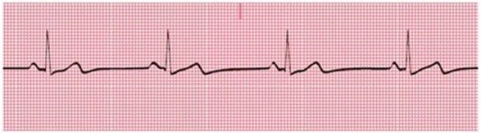
A)Sinus bradycardia
B)Sinus tachycardia
C)Sinus dysrhythmia
D)Normal sinus rhythm
A)Sinus bradycardia
B)Sinus tachycardia
C)Sinus dysrhythmia
D)Normal sinus rhythm
Question
Question
Question
Question
Question
Question
Question
Question
Question
Question
Question
You have performed an ECG on a patient, resulting in the following ECG tracing. How would you classify the patient's rhythm? 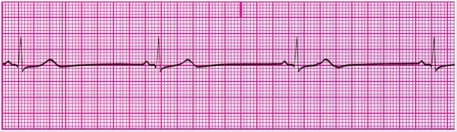
A)Sinus bradycardia
B)Sinus tachycardia
C)Sinus dysrhythmia
D)Normal sinus rhythm
A)Sinus bradycardia
B)Sinus tachycardia
C)Sinus dysrhythmia
D)Normal sinus rhythm
Question
Question
The part of the ECG tracing below that is circled in blue is the: 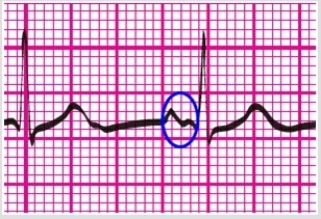
A)QRS complex.
B)P wave.
C)PR interval.
D)ST segment.
A)QRS complex.
B)P wave.
C)PR interval.
D)ST segment.
Question
Question
You have performed an ECG on a patient, resulting in the following ECG tracing. How would you classify the patient's rhythm? 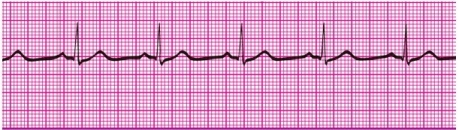
A)Sinus bradycardia
B)Sinus tachycardia
C)Sinus dysrhythmia
D)Normal sinus rhythm
A)Sinus bradycardia
B)Sinus tachycardia
C)Sinus dysrhythmia
D)Normal sinus rhythm
Question
Question
Question
Question
Question
Question
Question
Question
Question
Question
Question
You have performed an ECG on a patient, resulting in the following ECG tracing. How would you classify the patient's rhythm? 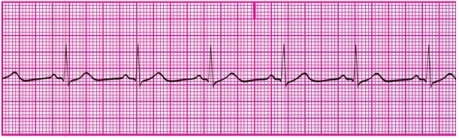
A)Sinus bradycardia
B)Sinus tachycardia
C)Sinus dysrhythmia
D)Normal sinus rhythm
A)Sinus bradycardia
B)Sinus tachycardia
C)Sinus dysrhythmia
D)Normal sinus rhythm
Question
You have performed an ECG on a patient, resulting in the following ECG tracing. How would you classify the patient's rhythm? 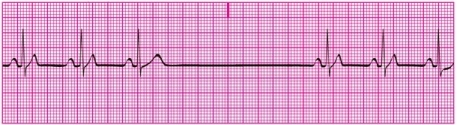
A)Sinus bradycardia
B)Sinus tachycardia
C)Sinus dysrhythmia
D)Sinus arrest
A)Sinus bradycardia
B)Sinus tachycardia
C)Sinus dysrhythmia
D)Sinus arrest
Question
Question
Question
Question
Question
Question
You have performed an ECG on a patient, resulting in the following ECG tracing. How would you classify the patient's rhythm? 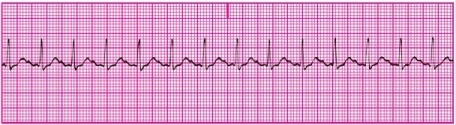
A)Sinus arrest
B)Sinus tachycardia
C)Sinus dysrhythmia
D)Normal sinus rhythm
A)Sinus arrest
B)Sinus tachycardia
C)Sinus dysrhythmia
D)Normal sinus rhythm
Question
You have performed an ECG on a patient, resulting in the following ECG tracing. How would you classify the patient's rhythm? 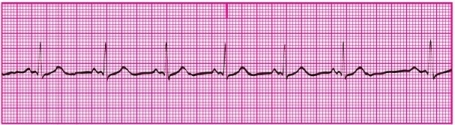
A)Sinus bradycardia
B)Sinus dysrhythmia
C)Sinus tachycardia
D)Normal sinus rhythm
A)Sinus bradycardia
B)Sinus dysrhythmia
C)Sinus tachycardia
D)Normal sinus rhythm
Question
Question
Question
Question
You have performed an ECG on a patient, resulting in the following ECG tracing. How would you classify the patient's rhythm? 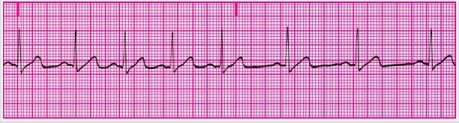
A)Sinus bradycardia
B)Sinus tachycardia
C)Sinus dysrhythmia
D)Sinus arrest
A)Sinus bradycardia
B)Sinus tachycardia
C)Sinus dysrhythmia
D)Sinus arrest
Question
Question

Unlock Deck
Sign up to unlock the cards in this deck!
Unlock Deck
Unlock Deck
1/55

Play

Full screen (f)
Deck 5: Rhythm Strip Interpretation and Sinus Rhythms
1
The shape of the P wave is analyzed to determine whether:
A)the atrial impulses caused the ventricular contraction.
B)atrial depolarization occurred.
C)all of the atrial current is moving in the same pathway.
D)the atria and ventricles are contracting together.
A)the atrial impulses caused the ventricular contraction.
B)atrial depolarization occurred.
C)all of the atrial current is moving in the same pathway.
D)the atria and ventricles are contracting together.
all of the atrial current is moving in the same pathway.
2
Which sinus rhythm has a rate of less than 60 beats per minute?
A)Sinus tachycardia
B)Sinus bradycardia
C)Sinus dysrhythmia
D)Normal sinus rhythm
A)Sinus tachycardia
B)Sinus bradycardia
C)Sinus dysrhythmia
D)Normal sinus rhythm
Sinus bradycardia
3
The ECG tracing is considered a legal document and needs to be included in the patient's medical record. What four items must be on each ECG tracing?
A)Patient's date of birth, today's date and time, physician's name
B)Patient's Social Security number, diagnosis, today's date and time
C)Patient's name, today's date and time, initials of the ECG technician
D)Patient's name, patient's date of birth, diagnosis, type of insurance the patient has
A)Patient's date of birth, today's date and time, physician's name
B)Patient's Social Security number, diagnosis, today's date and time
C)Patient's name, today's date and time, initials of the ECG technician
D)Patient's name, patient's date of birth, diagnosis, type of insurance the patient has
Patient's name, today's date and time, initials of the ECG technician
4
Which of the following are common symptoms of low cardiac output?
A)Nausea, vomiting
B)Headache, diarrhea
C)Shortness of breath, hypotension
D)Muscle aches, low back pain
A)Nausea, vomiting
B)Headache, diarrhea
C)Shortness of breath, hypotension
D)Muscle aches, low back pain
Unlock Deck
Unlock for access to all 55 flashcards in this deck.
Unlock Deck
k this deck
5
Sinus tachycardia may be a normal finding in people as a result of:
A)cardiac arrest.
B)exercise.
C)low cardiac output.
D)hypertension.
A)cardiac arrest.
B)exercise.
C)low cardiac output.
D)hypertension.
Unlock Deck
Unlock for access to all 55 flashcards in this deck.
Unlock Deck
k this deck
6
QRS duration measurement is essential to determine the time it takes for:
A)atrial depolarization.
B)ventricular depolarization.
C)ventricular relaxation.
D)atrial relaxation.
A)atrial depolarization.
B)ventricular depolarization.
C)ventricular relaxation.
D)atrial relaxation.
Unlock Deck
Unlock for access to all 55 flashcards in this deck.
Unlock Deck
k this deck
7
What is evaluated and classified when determining dysrhythmias?
A)Rate, artifact, and complexes on the ECG tracing
B)Artifact, complexes, and patient symptoms
C)Waves, segments, and intervals on the ECG tracing
D)Patient condition and symptoms
A)Rate, artifact, and complexes on the ECG tracing
B)Artifact, complexes, and patient symptoms
C)Waves, segments, and intervals on the ECG tracing
D)Patient condition and symptoms
Unlock Deck
Unlock for access to all 55 flashcards in this deck.
Unlock Deck
k this deck
8
The normal range for the QRS complex duration is:
A)0)12 to 0.20 second.
B)greater than 0.12 second.
C)0)06 to 0.10 second.
D)less than 0.06 second.
A)0)12 to 0.20 second.
B)greater than 0.12 second.
C)0)06 to 0.10 second.
D)less than 0.06 second.
Unlock Deck
Unlock for access to all 55 flashcards in this deck.
Unlock Deck
k this deck
9
Sinus tachycardia is considered serious or life-threatening in patients who have had a recent:
A)stress test.
B)loss of consciousness.
C)viral infection.
D)myocardial infarction.
A)stress test.
B)loss of consciousness.
C)viral infection.
D)myocardial infarction.
Unlock Deck
Unlock for access to all 55 flashcards in this deck.
Unlock Deck
k this deck
10
The QRS complex represents the time it takes for:
A)the ventricles to depolarize or contract.
B)repolarization to take place.
C)the electrical current to be initiated at the SA node.
D)the current to move through the atria.
A)the ventricles to depolarize or contract.
B)repolarization to take place.
C)the electrical current to be initiated at the SA node.
D)the current to move through the atria.
Unlock Deck
Unlock for access to all 55 flashcards in this deck.
Unlock Deck
k this deck
11
What is the rate of a normal sinus rhythm?
A)60 to 100 bpm
B)40 to 60 bpm
C)100 to 150 bpm
D)Greater than 150 bpm
A)60 to 100 bpm
B)40 to 60 bpm
C)100 to 150 bpm
D)Greater than 150 bpm
Unlock Deck
Unlock for access to all 55 flashcards in this deck.
Unlock Deck
k this deck
12
A patient with sinus bradycardia may require what type of treatment?
A)Medication or a pacemaker
B)Physical therapy and a stress test
C)IV fluids and oxygen
D)Open-heart surgery
A)Medication or a pacemaker
B)Physical therapy and a stress test
C)IV fluids and oxygen
D)Open-heart surgery
Unlock Deck
Unlock for access to all 55 flashcards in this deck.
Unlock Deck
k this deck
13
The normal PR interval measurement is:
A)0)06 to 0.12 second.
B)0)20 to 0.24 second.
C)0)12 to 0.20 second.
D)0)10 to 0.16 second.
A)0)06 to 0.12 second.
B)0)20 to 0.24 second.
C)0)12 to 0.20 second.
D)0)10 to 0.16 second.
Unlock Deck
Unlock for access to all 55 flashcards in this deck.
Unlock Deck
k this deck
14
Which of the following serves as the pacemaker in a normal heart?
A)AV node
B)Bundle of His
C)SA node
D)Bundle branches
A)AV node
B)Bundle of His
C)SA node
D)Bundle branches
Unlock Deck
Unlock for access to all 55 flashcards in this deck.
Unlock Deck
k this deck
15
Identify the following rhythm:
A)Sinus bradycardia
B)Sinus tachycardia
C)Sinus dysrhythmia
D)Normal sinus rhythm
A)Sinus bradycardia
B)Sinus tachycardia
C)Sinus dysrhythmia
D)Normal sinus rhythm
Unlock Deck
Unlock for access to all 55 flashcards in this deck.
Unlock Deck
k this deck
16
Which sinus rhythm has a rate of more than 100 beats per minute?
A)Sinus bradycardia
B)Sinus tachycardia
C)Normal sinus rhythm
D)Sinus dysrhythmia
A)Sinus bradycardia
B)Sinus tachycardia
C)Normal sinus rhythm
D)Sinus dysrhythmia
Unlock Deck
Unlock for access to all 55 flashcards in this deck.
Unlock Deck
k this deck
17
If you can't identify an R wave on the ECG tracing, which of the following wave(s)can you use to determine the regularity of the ventricles?
A)Q and S wave junction
B)P and R wave junction
C)T wave
D)P wave
A)Q and S wave junction
B)P and R wave junction
C)T wave
D)P wave
Unlock Deck
Unlock for access to all 55 flashcards in this deck.
Unlock Deck
k this deck
18
Which of the following questions is necessary to analyze a P wave on an ECG tracing?
A)Does each P wave have a QRS complex following it?
B)Is the interval between the P wave and the QRS complex constant?
C)Are the atrial and ventricular rates the same?
D)Is the ST segment at the isoelectric line?
A)Does each P wave have a QRS complex following it?
B)Is the interval between the P wave and the QRS complex constant?
C)Are the atrial and ventricular rates the same?
D)Is the ST segment at the isoelectric line?
Unlock Deck
Unlock for access to all 55 flashcards in this deck.
Unlock Deck
k this deck
19
Identify a rhythm using these criteria: regular rhythm, ventricular and atrial rates are 74 beats/minute, P wave precedes each QRS, PR interval and QRS duration within normal limits.
A)Sinus bradycardia
B)Sinus tachycardia
C)Normal sinus rhythm
D)Sinus dysrhythmia
A)Sinus bradycardia
B)Sinus tachycardia
C)Normal sinus rhythm
D)Sinus dysrhythmia
Unlock Deck
Unlock for access to all 55 flashcards in this deck.
Unlock Deck
k this deck
20
Measuring the PR interval requires the ECG technician to measure from the:
A)beginning of the Q wave to the J point.
B)beginning of the Q wave to the beginning to the T wave.
C)beginning of the P wave to the end of the R wave.
D)beginning of the P wave to the beginning of the QRS complex.
A)beginning of the Q wave to the J point.
B)beginning of the Q wave to the beginning to the T wave.
C)beginning of the P wave to the end of the R wave.
D)beginning of the P wave to the beginning of the QRS complex.
Unlock Deck
Unlock for access to all 55 flashcards in this deck.
Unlock Deck
k this deck
21
What must occur if sinus arrest exceeds 6 seconds?
A)Medical emergency procedures must be initiated.
B)Repeat ECGs must be done.
C)Oxygen must be given.
D)A licensed practitioner must be notified.
A)Medical emergency procedures must be initiated.
B)Repeat ECGs must be done.
C)Oxygen must be given.
D)A licensed practitioner must be notified.
Unlock Deck
Unlock for access to all 55 flashcards in this deck.
Unlock Deck
k this deck
22
In which dysrhythmia do the P-P and R-R intervals progressively widen, and then narrow, following the patient's breathing pattern?
A)Sinus tachycardia
B)Sinus dysrhythmia
C)Sinus bradycardia
D)Normal sinus rhythm
A)Sinus tachycardia
B)Sinus dysrhythmia
C)Sinus bradycardia
D)Normal sinus rhythm
Unlock Deck
Unlock for access to all 55 flashcards in this deck.
Unlock Deck
k this deck
23
Lack of blood supply to an area of tissue due to a blockage in the circulation to that area is known as:
A)infarct.
B)interval.
C)ischemia.
D)dysrhythmia.
A)infarct.
B)interval.
C)ischemia.
D)dysrhythmia.
Unlock Deck
Unlock for access to all 55 flashcards in this deck.
Unlock Deck
k this deck
24
On the ECG tracing, what precedes and follows the sinus arrest period?
A)Complete cardiac complexes
B)Junctional escape beats
C)Premature atrial contractions
D)Changing P waves
A)Complete cardiac complexes
B)Junctional escape beats
C)Premature atrial contractions
D)Changing P waves
Unlock Deck
Unlock for access to all 55 flashcards in this deck.
Unlock Deck
k this deck
25
To determine the actual rhythm on an ECG tracing, the ECG technician:
A)views the computerized interpretation from the ECG machine.
B)analyzes the characteristics of the rhythm and matches them to specific rhythm criteria.
C)asks the physician to interpret the ECG tracing.
D)estimates the distance between QRS complexes.
A)views the computerized interpretation from the ECG machine.
B)analyzes the characteristics of the rhythm and matches them to specific rhythm criteria.
C)asks the physician to interpret the ECG tracing.
D)estimates the distance between QRS complexes.
Unlock Deck
Unlock for access to all 55 flashcards in this deck.
Unlock Deck
k this deck
26
You have performed an ECG on a patient, resulting in the following ECG tracing. How would you classify the patient's rhythm?
A)Sinus bradycardia
B)Sinus tachycardia
C)Sinus dysrhythmia
D)Normal sinus rhythm
A)Sinus bradycardia
B)Sinus tachycardia
C)Sinus dysrhythmia
D)Normal sinus rhythm
Unlock Deck
Unlock for access to all 55 flashcards in this deck.
Unlock Deck
k this deck
27
If a QRS complex measures 0.12 second or wider, it most likely indicates:
A)normal ventricular conduction.
B)delayed ventricular conduction.
C)increased delay at the AV node.
D)myocardial infarction.
A)normal ventricular conduction.
B)delayed ventricular conduction.
C)increased delay at the AV node.
D)myocardial infarction.
Unlock Deck
Unlock for access to all 55 flashcards in this deck.
Unlock Deck
k this deck
28
The part of the ECG tracing below that is circled in blue is the:
A)QRS complex.
B)P wave.
C)PR interval.
D)ST segment.
A)QRS complex.
B)P wave.
C)PR interval.
D)ST segment.
Unlock Deck
Unlock for access to all 55 flashcards in this deck.
Unlock Deck
k this deck
29
A condition in which no rhythm or electrical current travels through the cardiac conduction system is known as:
A)atrial kick.
B)apnea.
C)syncope.
D)asystole.
A)atrial kick.
B)apnea.
C)syncope.
D)asystole.
Unlock Deck
Unlock for access to all 55 flashcards in this deck.
Unlock Deck
k this deck
30
You have performed an ECG on a patient, resulting in the following ECG tracing. How would you classify the patient's rhythm?
A)Sinus bradycardia
B)Sinus tachycardia
C)Sinus dysrhythmia
D)Normal sinus rhythm
A)Sinus bradycardia
B)Sinus tachycardia
C)Sinus dysrhythmia
D)Normal sinus rhythm
Unlock Deck
Unlock for access to all 55 flashcards in this deck.
Unlock Deck
k this deck
31
What symptom do patients with sinus tachycardia often complain of?
A)Hypotension
B)Palpitations
C)Decreased urinary output
D)Headache
A)Hypotension
B)Palpitations
C)Decreased urinary output
D)Headache
Unlock Deck
Unlock for access to all 55 flashcards in this deck.
Unlock Deck
k this deck
32
Which rhythm shows an irregularity during inspiration and expiration?
A)Sinus tachycardia
B)Sinus bradycardia
C)Sinus dysrhythmia
D)Normal sinus rhythm
A)Sinus tachycardia
B)Sinus bradycardia
C)Sinus dysrhythmia
D)Normal sinus rhythm
Unlock Deck
Unlock for access to all 55 flashcards in this deck.
Unlock Deck
k this deck
33
A condition in which the patient loses consciousness or faints is known as:
A)seizure.
B)syncope.
C)asystole.
D)apnea.
A)seizure.
B)syncope.
C)asystole.
D)apnea.
Unlock Deck
Unlock for access to all 55 flashcards in this deck.
Unlock Deck
k this deck
34
The condition in which stimulation of the vagus nerve causes changes in heart rate is known as:
A)vagal tone.
B)ventricular tone.
C)vascular tone.
D)valvular tone.
A)vagal tone.
B)ventricular tone.
C)vascular tone.
D)valvular tone.
Unlock Deck
Unlock for access to all 55 flashcards in this deck.
Unlock Deck
k this deck
35
Sinus bradycardia has almost the same criteria as normal sinus rhythm; the only difference is that the:
A)P-P intervals are irregular.
B)PR interval measurement is greater than 0.12 second.
C)heart rate is slower.
D)QRS duration is within normal limits.
A)P-P intervals are irregular.
B)PR interval measurement is greater than 0.12 second.
C)heart rate is slower.
D)QRS duration is within normal limits.
Unlock Deck
Unlock for access to all 55 flashcards in this deck.
Unlock Deck
k this deck
36
In sinus dysrhythmia, if the heart rate decreases to 40 to 50 beats per minute, the patient may complain of:
A)decreased urinary output.
B)lung congestion, cough.
C)hypertension, pale skin.
D)palpitations, dizziness.
A)decreased urinary output.
B)lung congestion, cough.
C)hypertension, pale skin.
D)palpitations, dizziness.
Unlock Deck
Unlock for access to all 55 flashcards in this deck.
Unlock Deck
k this deck
37
Which dysrhythmia occurs when the SA node stops firing, causing a pause in electrical activity?
A)Sinus bradycardia
B)Sinus tachycardia
C)Sinus arrest
D)Normal sinus rhythm
A)Sinus bradycardia
B)Sinus tachycardia
C)Sinus arrest
D)Normal sinus rhythm
Unlock Deck
Unlock for access to all 55 flashcards in this deck.
Unlock Deck
k this deck
38
In determining the type of ECG rhythm the patient has, the ECG technician evaluates the components of the ECG rhythm strip, including all of the following except:
A)regularity.
B)U wave.
C)rate.
D)PR interval.
A)regularity.
B)U wave.
C)rate.
D)PR interval.
Unlock Deck
Unlock for access to all 55 flashcards in this deck.
Unlock Deck
k this deck
39
Signs and symptoms of adequate cardiac output include:
A)an alert and oriented patient.
B)difficulty breathing.
C)chest pain or pressure.
D)hypotension.
A)an alert and oriented patient.
B)difficulty breathing.
C)chest pain or pressure.
D)hypotension.
Unlock Deck
Unlock for access to all 55 flashcards in this deck.
Unlock Deck
k this deck
40
What should you do if the patient you are monitoring is very pale and breathing very fast, yet his monitor indicates he is in normal sinus rhythm?
A)Report his condition to a licensed practitioner immediately.
B)Perform another ECG tracing to see if the rhythm changes.
C)Call a Code Blue medical emergency.
D)Tell the patient to take deep breaths.
A)Report his condition to a licensed practitioner immediately.
B)Perform another ECG tracing to see if the rhythm changes.
C)Call a Code Blue medical emergency.
D)Tell the patient to take deep breaths.
Unlock Deck
Unlock for access to all 55 flashcards in this deck.
Unlock Deck
k this deck
41
You have performed an ECG on a patient, resulting in the following ECG tracing. How would you classify the patient's rhythm?
A)Sinus bradycardia
B)Sinus tachycardia
C)Sinus dysrhythmia
D)Normal sinus rhythm
A)Sinus bradycardia
B)Sinus tachycardia
C)Sinus dysrhythmia
D)Normal sinus rhythm
Unlock Deck
Unlock for access to all 55 flashcards in this deck.
Unlock Deck
k this deck
42
You have performed an ECG on a patient, resulting in the following ECG tracing. How would you classify the patient's rhythm?
A)Sinus bradycardia
B)Sinus tachycardia
C)Sinus dysrhythmia
D)Sinus arrest
A)Sinus bradycardia
B)Sinus tachycardia
C)Sinus dysrhythmia
D)Sinus arrest
Unlock Deck
Unlock for access to all 55 flashcards in this deck.
Unlock Deck
k this deck
43
In which rhythm does the SA node initiate an electrical impulse, but the impulse is not conducted to the atria?
A)Sinus arrest
B)Sinus dysrhythmia
C)Sinus exit block
D)Sinus bradycardia
A)Sinus arrest
B)Sinus dysrhythmia
C)Sinus exit block
D)Sinus bradycardia
Unlock Deck
Unlock for access to all 55 flashcards in this deck.
Unlock Deck
k this deck
44
The PR interval is measured from the:
A)end of the P wave to the end of the T waves
B)end of the P wave to the end of the QRS complex
C)beginning of the P wave to the beginning of the QRS complex
D)beginning of the P wave to the beginning of the T wave
A)end of the P wave to the end of the T waves
B)end of the P wave to the end of the QRS complex
C)beginning of the P wave to the beginning of the QRS complex
D)beginning of the P wave to the beginning of the T wave
Unlock Deck
Unlock for access to all 55 flashcards in this deck.
Unlock Deck
k this deck
45
Sinus exit block and sinus arrest result in similar ECG tracings. The distinguishing factor is that in sinus exit block, the:
A)QRS is slightly wider than normal.
B)P waves are inverted or entirely absent.
C)pause duration is usually greater than 6 seconds.
D)pause duration is a multiple of the R-R or P-P interval.
A)QRS is slightly wider than normal.
B)P waves are inverted or entirely absent.
C)pause duration is usually greater than 6 seconds.
D)pause duration is a multiple of the R-R or P-P interval.
Unlock Deck
Unlock for access to all 55 flashcards in this deck.
Unlock Deck
k this deck
46
What treatment may be needed for patients who have frequent episodes of sinus exit block with bradycardia?
A)Physical therapy
B)Temporary or permanent pacemaker
C)Medication such as digitalis or quinidine
D)Coronary bypass
A)Physical therapy
B)Temporary or permanent pacemaker
C)Medication such as digitalis or quinidine
D)Coronary bypass
Unlock Deck
Unlock for access to all 55 flashcards in this deck.
Unlock Deck
k this deck
47
Which of the following is a characteristic of sinus bradycardia?
A)The QRS duration is between 0.10 and 0.16 second.
B)The heart rate is less than 60 beats per minute.
C)The shape of the P waves varies from one beat to the next.
D)The PR interval is between 0.06 and 0.10 second.
A)The QRS duration is between 0.10 and 0.16 second.
B)The heart rate is less than 60 beats per minute.
C)The shape of the P waves varies from one beat to the next.
D)The PR interval is between 0.06 and 0.10 second.
Unlock Deck
Unlock for access to all 55 flashcards in this deck.
Unlock Deck
k this deck
48
You have performed an ECG on a patient, resulting in the following ECG tracing. How would you classify the patient's rhythm?
A)Sinus arrest
B)Sinus tachycardia
C)Sinus dysrhythmia
D)Normal sinus rhythm
A)Sinus arrest
B)Sinus tachycardia
C)Sinus dysrhythmia
D)Normal sinus rhythm
Unlock Deck
Unlock for access to all 55 flashcards in this deck.
Unlock Deck
k this deck
49
You have performed an ECG on a patient, resulting in the following ECG tracing. How would you classify the patient's rhythm?
A)Sinus bradycardia
B)Sinus dysrhythmia
C)Sinus tachycardia
D)Normal sinus rhythm
A)Sinus bradycardia
B)Sinus dysrhythmia
C)Sinus tachycardia
D)Normal sinus rhythm
Unlock Deck
Unlock for access to all 55 flashcards in this deck.
Unlock Deck
k this deck
50
Which of the following statements about sinus dysrhythmia is true?
A)The PR interval varies along with the heart rate.
B)The QRS duration varies along with the heart rate.
C)The intervals between the P-P and R-R waves vary.
D)The P waves are usually inverted in deflection.
A)The PR interval varies along with the heart rate.
B)The QRS duration varies along with the heart rate.
C)The intervals between the P-P and R-R waves vary.
D)The P waves are usually inverted in deflection.
Unlock Deck
Unlock for access to all 55 flashcards in this deck.
Unlock Deck
k this deck
51
Which of the following conditions may result in sinus exit block?
A)Acute myocardial infarction
B)Congestive heart failure
C)Sinus tachycardia
D)Chronic bronchitis
A)Acute myocardial infarction
B)Congestive heart failure
C)Sinus tachycardia
D)Chronic bronchitis
Unlock Deck
Unlock for access to all 55 flashcards in this deck.
Unlock Deck
k this deck
52
Which of the following patients is most likely to exhibit signs and symptoms of low cardiac output?
A)A 55-year-old female athlete with a resting heart rate of 56 beats per minute
B)A 60-year-old male with a heart rate of 74, whose tracing shows infrequent periods of sinus arrest lasting 1 second
C)A 43-year-old female who has been walking on a treadmill and has a heart rate of 110 beats per minute
D)A 48-year-old male with a heart rate of 52, whose tracing shows frequent periods of sinus arrest lasting 2.5 seconds
A)A 55-year-old female athlete with a resting heart rate of 56 beats per minute
B)A 60-year-old male with a heart rate of 74, whose tracing shows infrequent periods of sinus arrest lasting 1 second
C)A 43-year-old female who has been walking on a treadmill and has a heart rate of 110 beats per minute
D)A 48-year-old male with a heart rate of 52, whose tracing shows frequent periods of sinus arrest lasting 2.5 seconds
Unlock Deck
Unlock for access to all 55 flashcards in this deck.
Unlock Deck
k this deck
53
You have performed an ECG on a patient, resulting in the following ECG tracing. How would you classify the patient's rhythm?
A)Sinus bradycardia
B)Sinus tachycardia
C)Sinus dysrhythmia
D)Sinus arrest
A)Sinus bradycardia
B)Sinus tachycardia
C)Sinus dysrhythmia
D)Sinus arrest
Unlock Deck
Unlock for access to all 55 flashcards in this deck.
Unlock Deck
k this deck
54
Which of the following is not characteristic of sinus tachycardia?
A)The R-R intervals and the P-P intervals are equal and constant.
B)The heart rate is between 100 and 150 beats per minute.
C)The PR interval is between 0.12 and 0.20 second.
D)The QRS duration is between 0.10 and 0.16 second.
A)The R-R intervals and the P-P intervals are equal and constant.
B)The heart rate is between 100 and 150 beats per minute.
C)The PR interval is between 0.12 and 0.20 second.
D)The QRS duration is between 0.10 and 0.16 second.
Unlock Deck
Unlock for access to all 55 flashcards in this deck.
Unlock Deck
k this deck
55
Which of the following is a characteristic of sinus arrest?
A)The cardiac complexes before and after the sinus pause are usually regular.
B)The PR interval is affected by the pause during a sinus arrest episode.
C)The atrial and ventricular rates are different.
D)The QRS morphology varies during periods of sinus arrest.
A)The cardiac complexes before and after the sinus pause are usually regular.
B)The PR interval is affected by the pause during a sinus arrest episode.
C)The atrial and ventricular rates are different.
D)The QRS morphology varies during periods of sinus arrest.
Unlock Deck
Unlock for access to all 55 flashcards in this deck.
Unlock Deck
k this deck
Unlock Deck
Unlock for access to all 55 flashcards in this deck.






