







 Chat with AI

Deck 8: Market Failure Versus Government Failure
Full screen (f)

Question

Question
Question
Question
Question
Question
Question
Question
Question
Question
Question
Question
Question
Question
Question
Question
Question
Question
Question
Question
Question
Question
Question
Question
Question
Question
Question
Question
Question
Question
The diagram below illustrates a negative externality. S is the marginal private cost and S1 is the marginal social cost. 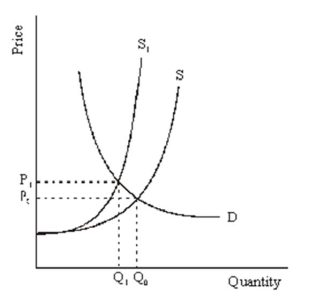 Referencing this diagram, describe how a government can use direct regulation to eliminate the problem caused by the negative externality. What is a potential problem with this approach?
Referencing this diagram, describe how a government can use direct regulation to eliminate the problem caused by the negative externality. What is a potential problem with this approach? Question
Question
Question
Question
Question
Question
The diagram below illustrates a positive externality. D is the marginal private benefit and D1 is the marginal social benefit. 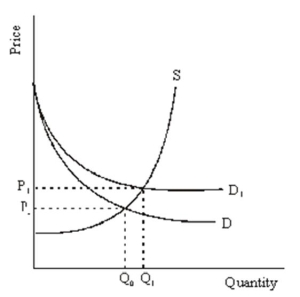 Referencing this diagram describe how a government can use direct regulation to eliminate the problem caused by the positive externality. What is a potential problem with this approach?
Referencing this diagram describe how a government can use direct regulation to eliminate the problem caused by the positive externality. What is a potential problem with this approach? Question
The following table shows the quantity demanded of a public good at different price levels by John and Elizabeth. 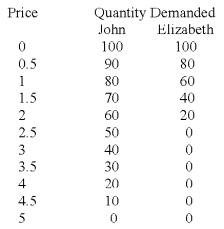 Answer the following questions:
(1) Draw the demand curve for both John and Elizabeth.
(2) Draw the market demand for this public good.
(3) If the marginal cost of providing one unit of the good is $3 per unit, what is the socially optimal amount of the public good (show this on the same graph)?
(4) In this case, how much will each individual be willing to pay?
Answer the following questions:(1) Draw the demand curve for both John and Elizabeth.
(2) Draw the market demand for this public good.
(3) If the marginal cost of providing one unit of the good is $3 per unit, what is the socially optimal amount of the public good (show this on the same graph)?
(4) In this case, how much will each individual be willing to pay?
Question
The following table shows the marginal private cost (MPC) and the marginal social cost (MSC) of a chemical factory.
 Answer the following questions:
(1) What is the marginal cost of the factory's externality? Is it constant at all quantities?
(2) If the factory is a perfectly competitive firm and is not required by the government to internalize its external cost, how many tons should the factory produce, given that the market price of a ton of chemicals is $130?
(3) If the factory is a perfectly competitive firm and is required by the government to internalize its external cost, how many tons should the factory produce, given that the market price of a ton of chemicals is $130?
(4) Draw a graph illustrating your answers.
Answer the following questions:(1) What is the marginal cost of the factory's externality? Is it constant at all quantities?
(2) If the factory is a perfectly competitive firm and is not required by the government to internalize its external cost, how many tons should the factory produce, given that the market price of a ton of chemicals is $130?
(3) If the factory is a perfectly competitive firm and is required by the government to internalize its external cost, how many tons should the factory produce, given that the market price of a ton of chemicals is $130?
(4) Draw a graph illustrating your answers.

Unlock Deck
Sign up to unlock the cards in this deck!
Unlock Deck
Unlock Deck
1/38

Play

Full screen (f)
Deck 8: Market Failure Versus Government Failure
1
What is a public good? Give two examples of a public good.
A public good is a good that is nonexclusive (no one can be excluded from its benefits) and nonrival (consumption by one does not preclude consumption by others). There are many possible examples of public goods, two of which are national defense and police protection.
2
A government failure occurs when the government intervention in the market that was intended to correct a market failure actually makes the situation worse. Such a failure could occur for one or more of the following reasons:
(1) Government doesn't have an incentive to correct the problem. Political pressure to benefit some group or another will often dominate over pursuing the general welfare.
(2) Governments don't have enough information to deal with the problem. To intervene effectively, the government must have good information; but just as buyers and sellers often lack adequate information, so does government.
(3) Intervention in markets is almost always more complicated than it initially seems. Almost all actions have unintended consequences. Government intervention can prevent the market from dealing with the problem more effectively. As government deals with short run problems it eliminates the incentive that would have brought about long run market solutions.
(4) The bureaucratic nature of government intervention does not allow fine-tuning. When problems change, the government's solution often responds more slowly than the market.
(5) Government intervention leads to more government intervention. Opening the door to government intervention in one area where it may be helpful often enables the government to enter into other areas where intervention may be harmful.
(2) Governments don't have enough information to deal with the problem. To intervene effectively, the government must have good information; but just as buyers and sellers often lack adequate information, so does government.
(3) Intervention in markets is almost always more complicated than it initially seems. Almost all actions have unintended consequences. Government intervention can prevent the market from dealing with the problem more effectively. As government deals with short run problems it eliminates the incentive that would have brought about long run market solutions.
(4) The bureaucratic nature of government intervention does not allow fine-tuning. When problems change, the government's solution often responds more slowly than the market.
(5) Government intervention leads to more government intervention. Opening the door to government intervention in one area where it may be helpful often enables the government to enter into other areas where intervention may be harmful.
3
What problems are associated with determining how much of a public good should be provided?
The problems associated with the provision of public goods include the following. First, it may be difficult to decide what is a public good since what is and is not a public good depends upon technology. For example roads used to be privately provided when the main mode of transportation was the horse and buggy and toll collection was easy. But with the advent of the automobile, toll collection became difficult and roads became more like public goods. A second problem is that it is difficult to determine how much consumers are willing to pay for public goods. This is the case because once a public good is provided to one consumer all consumers may use it (so there is little incentive to reveal how much it is worth to you). Surveys may not provide accurate information because respondents have an incentive to overstate or understate their True willingness to pay for public goods.
4
Explain why incentive programs are more efficient than direct regulation as a means of eliminating the problems of externalities.
Unlock Deck
Unlock for access to all 38 flashcards in this deck.
Unlock Deck
k this deck
5
What are three major sources of market failure?
Unlock Deck
Unlock for access to all 38 flashcards in this deck.
Unlock Deck
k this deck
6
Should all professionals be licensed? Or only some? Discuss the argument for licensing and for the information alternative for one of these professions: 1. medical doctors, 2. college professors, 3. lawyers, 4. auto mechanics, 5. beauticians. Then choose one other profession, and briefly indicate how (if at all) the weight of the arguments would change.
Unlock Deck
Unlock for access to all 38 flashcards in this deck.
Unlock Deck
k this deck
7
Why do information problems constitute market failures?
Unlock Deck
Unlock for access to all 38 flashcards in this deck.
Unlock Deck
k this deck
8
What is a market failure? Why do market failures occur?
Unlock Deck
Unlock for access to all 38 flashcards in this deck.
Unlock Deck
k this deck
9
What are the arguments for and against government intervention to deal with information problems?
Unlock Deck
Unlock for access to all 38 flashcards in this deck.
Unlock Deck
k this deck
10
Explain what a public good is and give an example. What problems are associated with determining what is a public good and how much of a public good should be provided?
Unlock Deck
Unlock for access to all 38 flashcards in this deck.
Unlock Deck
k this deck
11
One of the solutions to pollution that economists advocate more often than non-economists is a marketable certificate program. Explain how such a program would work, and why economists tend to favor such an approach.
Unlock Deck
Unlock for access to all 38 flashcards in this deck.
Unlock Deck
k this deck
12
The city of Spillsville is worried that its municipal landfill is going to fill up. As a result, the city's sanitation engineer has proposed two solutions:
Solution 1: Require each household to reduce its garbage disposal by 100 pounds per month.
Solution 2: Impose a tax of $.05 per pound of garbage that will overall result in the same decline in garbage disposal as Solution 1.
Which of the two solutions would an economist prefer to have implemented? Explain.
Solution 1: Require each household to reduce its garbage disposal by 100 pounds per month.
Solution 2: Impose a tax of $.05 per pound of garbage that will overall result in the same decline in garbage disposal as Solution 1.
Which of the two solutions would an economist prefer to have implemented? Explain.
Unlock Deck
Unlock for access to all 38 flashcards in this deck.
Unlock Deck
k this deck
13
What are the three alternative methods of dealing with externalities? Briefly explain each one.
Unlock Deck
Unlock for access to all 38 flashcards in this deck.
Unlock Deck
k this deck
14
Describe how voluntary restrictions can be used to address externalities. What problem tends to arise with this method?
Unlock Deck
Unlock for access to all 38 flashcards in this deck.
Unlock Deck
k this deck
15
Three methods of dealing with externalities are direct regulation, incentive policies, and voluntary restrictions. Explain and evaluate each of these options.
Unlock Deck
Unlock for access to all 38 flashcards in this deck.
Unlock Deck
k this deck
16
Why can imperfect information lead to market failure? Explain the adverse selection problem and give an example. How could markets for information resolve this problem?
Unlock Deck
Unlock for access to all 38 flashcards in this deck.
Unlock Deck
k this deck
17
What is Pareto optimality? What are the three criticisms of using perfect competition as a benchmark to evaluate the society's goals?
Unlock Deck
Unlock for access to all 38 flashcards in this deck.
Unlock Deck
k this deck
18
What is an optimal policy? If a policy is not optimal, what does it imply in terms of utilization of resources?
Unlock Deck
Unlock for access to all 38 flashcards in this deck.
Unlock Deck
k this deck
19
What is the difference between a negative and a positive externality? Give an example of each.
Unlock Deck
Unlock for access to all 38 flashcards in this deck.
Unlock Deck
k this deck
20
Explain what a public good is and give an example. What problems are associated with determining how much of a public good should be provided?
Unlock Deck
Unlock for access to all 38 flashcards in this deck.
Unlock Deck
k this deck
21
What is the adverse selection problem? Give an example in the market for used cars or health insurance.
Unlock Deck
Unlock for access to all 38 flashcards in this deck.
Unlock Deck
k this deck
22
What is the moral hazard problem? Give an example.
Unlock Deck
Unlock for access to all 38 flashcards in this deck.
Unlock Deck
k this deck
23
Information problems may be a problem of the lack of a market. Explain.
Unlock Deck
Unlock for access to all 38 flashcards in this deck.
Unlock Deck
k this deck
24
Big Construction Company wants to create a new housing development near Big City. Animal rights activists are adamantly opposed to the housing development since the proposed site would destroy the natural habitat of a rare spotted duck family. How would an economist analyze this situation and what would he suggest to rectify it? Illustrate your answer with a supply and demand diagram. What would be the most difficult part of implementing your plan?
Unlock Deck
Unlock for access to all 38 flashcards in this deck.
Unlock Deck
k this deck
25
Demonstrate graphically and explain verbally the impact of a negative externality on a supply and demand market outcome.
Unlock Deck
Unlock for access to all 38 flashcards in this deck.
Unlock Deck
k this deck
26
Demonstrate graphically and explain verbally how constructing the market demand for a public good is different than constructing the market demand for a private good.
Unlock Deck
Unlock for access to all 38 flashcards in this deck.
Unlock Deck
k this deck
27
Give the definition of "externality" and indicate why externalities can result in a failure to achieve equality between social marginal cost and social marginal benefit. Demonstrate your answer graphically with a negative externality.
Unlock Deck
Unlock for access to all 38 flashcards in this deck.
Unlock Deck
k this deck
28
Why can imperfect information lead to market failure?
Unlock Deck
Unlock for access to all 38 flashcards in this deck.
Unlock Deck
k this deck
29
What is a government failure? List four reasons why it might occur.
Unlock Deck
Unlock for access to all 38 flashcards in this deck.
Unlock Deck
k this deck
30
The diagram below illustrates a negative externality. S is the marginal private cost and S1 is the marginal social cost. Referencing this diagram, describe how a government can use direct regulation to eliminate the problem caused by the negative externality. What is a potential problem with this approach?
Referencing this diagram, describe how a government can use direct regulation to eliminate the problem caused by the negative externality. What is a potential problem with this approach? Unlock Deck
Unlock for access to all 38 flashcards in this deck.
Unlock Deck
k this deck
31
Demonstrate graphically and explain verbally the impact of a positive externality on a supply and demand market outcome.
Unlock Deck
Unlock for access to all 38 flashcards in this deck.
Unlock Deck
k this deck
32
Wearing a light long-sleeved sweater adds about 2 degrees of warmth to the wearer and allows such individuals to keep their homes at 2 degrees lower temperature. Such sweaters cost approximately $20, or three for $60. The 2-degree decrease in heat can save $200 a year in heating bills.
(a) Assuming that the government is committed to saving electricity, should it require people to wear such sweaters and keep their homes 2 degrees cooler?
(b) What are two alternatives to this regulation?
(c) If it is cheaper to keep warm with sweaters than with furnaces, why don't people voluntarily wear more sweaters?
(a) Assuming that the government is committed to saving electricity, should it require people to wear such sweaters and keep their homes 2 degrees cooler?
(b) What are two alternatives to this regulation?
(c) If it is cheaper to keep warm with sweaters than with furnaces, why don't people voluntarily wear more sweaters?
Unlock Deck
Unlock for access to all 38 flashcards in this deck.
Unlock Deck
k this deck
33
What is the difference between screening and signaling? How are they similar?
Unlock Deck
Unlock for access to all 38 flashcards in this deck.
Unlock Deck
k this deck
34
What are the arguments for and against government intervention to deal with externalities?
Unlock Deck
Unlock for access to all 38 flashcards in this deck.
Unlock Deck
k this deck
35
Problems that involve an externality (such as pollution) may be addressed by a number of alternative means. The most obvious is direct regulation, in which the use of some resource is directly limited by government. For example, pollution might be prohibited or limited to some fixed amount by direct regulation. Economists generally prefer some alternative solution to direct regulation, because regulation will not generally get persons to act so as to equate marginal social costs and marginal social benefits. Suppose it has been decided to implement a social policy to reduce electricity consumption by 10%, because the production of electricity results in pollution and consumes valuable resources.
(a) Give an example of how this goal could be achieved by direct regulation. What effect on incentives will the direct regulation you propose have? Will it equate the marginal benefits and marginal costs of electricity consumption? Why or why not?
(b) Now suggest two alternative methods to achieve the goal of 10% reduction in electricity consumption. What effect will these alternatives have on incentives? Will they result in the marginal benefits and marginal costs of electricity consumption being made equal?
(a) Give an example of how this goal could be achieved by direct regulation. What effect on incentives will the direct regulation you propose have? Will it equate the marginal benefits and marginal costs of electricity consumption? Why or why not?
(b) Now suggest two alternative methods to achieve the goal of 10% reduction in electricity consumption. What effect will these alternatives have on incentives? Will they result in the marginal benefits and marginal costs of electricity consumption being made equal?
Unlock Deck
Unlock for access to all 38 flashcards in this deck.
Unlock Deck
k this deck
36
The diagram below illustrates a positive externality. D is the marginal private benefit and D1 is the marginal social benefit. Referencing this diagram describe how a government can use direct regulation to eliminate the problem caused by the positive externality. What is a potential problem with this approach?
Referencing this diagram describe how a government can use direct regulation to eliminate the problem caused by the positive externality. What is a potential problem with this approach? Unlock Deck
Unlock for access to all 38 flashcards in this deck.
Unlock Deck
k this deck
37
The following table shows the quantity demanded of a public good at different price levels by John and Elizabeth. Answer the following questions:
(1) Draw the demand curve for both John and Elizabeth.
(2) Draw the market demand for this public good.
(3) If the marginal cost of providing one unit of the good is $3 per unit, what is the socially optimal amount of the public good (show this on the same graph)?
(4) In this case, how much will each individual be willing to pay?
Answer the following questions:(1) Draw the demand curve for both John and Elizabeth.
(2) Draw the market demand for this public good.
(3) If the marginal cost of providing one unit of the good is $3 per unit, what is the socially optimal amount of the public good (show this on the same graph)?
(4) In this case, how much will each individual be willing to pay?
Unlock Deck
Unlock for access to all 38 flashcards in this deck.
Unlock Deck
k this deck
38
The following table shows the marginal private cost (MPC) and the marginal social cost (MSC) of a chemical factory.
Answer the following questions:
(1) What is the marginal cost of the factory's externality? Is it constant at all quantities?
(2) If the factory is a perfectly competitive firm and is not required by the government to internalize its external cost, how many tons should the factory produce, given that the market price of a ton of chemicals is $130?
(3) If the factory is a perfectly competitive firm and is required by the government to internalize its external cost, how many tons should the factory produce, given that the market price of a ton of chemicals is $130?
(4) Draw a graph illustrating your answers.
Answer the following questions:(1) What is the marginal cost of the factory's externality? Is it constant at all quantities?
(2) If the factory is a perfectly competitive firm and is not required by the government to internalize its external cost, how many tons should the factory produce, given that the market price of a ton of chemicals is $130?
(3) If the factory is a perfectly competitive firm and is required by the government to internalize its external cost, how many tons should the factory produce, given that the market price of a ton of chemicals is $130?
(4) Draw a graph illustrating your answers.
Unlock Deck
Unlock for access to all 38 flashcards in this deck.
Unlock Deck
k this deck
Unlock Deck
Unlock for access to all 38 flashcards in this deck.






