







 Chat with AI

Deck 5: Civil Rights and Public Policy
Full screen (f)

Question
Questions 7-8 refer to the following graph. 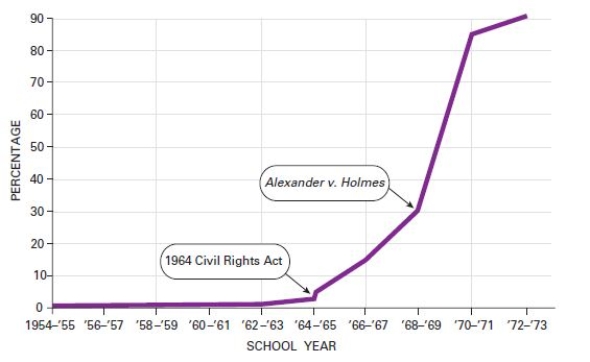 Source: Data from Lawrence Baum.
Based on the graph,which of the following led to the initial increase in southern school integration?
A)Alexander v.Holmes -Consider This: Alexander v.Holmes led to an even greater increase in integration than the Civil Rights Act.
B)Brown v.Board of Education
C)the Civil Rights Act of 1964
D)the Little Rock Nine
Source: Data from Lawrence Baum.Based on the graph,which of the following led to the initial increase in southern school integration?
A)Alexander v.Holmes -Consider This: Alexander v.Holmes led to an even greater increase in integration than the Civil Rights Act.
B)Brown v.Board of Education
C)the Civil Rights Act of 1964
D)the Little Rock Nine

Question
Questions 11 and 12 refer to the following image. 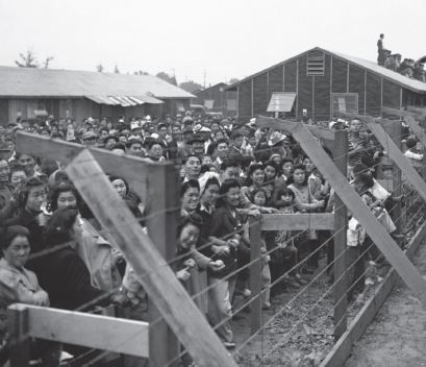 Credit: Library of Congress/Corbis Historical/VCG/Getty Images
Based on this photograph,how were Japanese Americans treated during World War II?
A)They received the same protections as other American citizens.
B)German Americans were perceived as the greater threat.-Consider This: German Americans were also targeted as potential spies,but not to the same extent as the Japanese population on the West Coast.
C)They were stripped of many legal and natural rights.
D)Only adults were targeted as potential threats.
Credit: Library of Congress/Corbis Historical/VCG/Getty ImagesBased on this photograph,how were Japanese Americans treated during World War II?
A)They received the same protections as other American citizens.
B)German Americans were perceived as the greater threat.-Consider This: German Americans were also targeted as potential spies,but not to the same extent as the Japanese population on the West Coast.
C)They were stripped of many legal and natural rights.
D)Only adults were targeted as potential threats.
Question
Question
Question
Question
Question
Question
Question
Question
Question
Questions 7-8 refer to the following graph. Source: Data from Lawrence Baum.
Which of the following contributed to the Supreme Court's decision in Alexander v.Holmes?
A)the refusal of African Americans to attend school with whites
B)freedom rides
C)de facto segregation
D)de jure segregation -Consider This: De jure segregation was made illegal by Brown v.Board of Education.
Source: Data from Lawrence Baum.Which of the following contributed to the Supreme Court's decision in Alexander v.Holmes?
A)the refusal of African Americans to attend school with whites
B)freedom rides
C)de facto segregation
D)de jure segregation -Consider This: De jure segregation was made illegal by Brown v.Board of Education.
Question
Question
Question
Question
Question
Questions 13 and 14 refer to the following image. 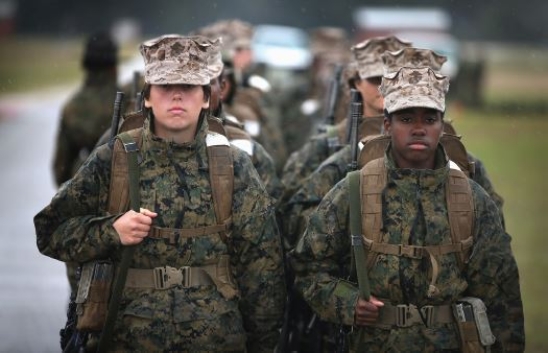 Credit: Scott Olson/Getty Images News/ Getty Images
Which of the following changes does this photo reflect?
A)There are an equal number of male and female military generals.
B)Women are part of the regular armed services,rather than separate units.
C)Both men and women must register for the draft.-Consider This: Though the image shows soldiers it doesn't indicate anything about the draft.
D)Women are permitted in the army,but not other branches of the military.
Credit: Scott Olson/Getty Images News/ Getty ImagesWhich of the following changes does this photo reflect?
A)There are an equal number of male and female military generals.
B)Women are part of the regular armed services,rather than separate units.
C)Both men and women must register for the draft.-Consider This: Though the image shows soldiers it doesn't indicate anything about the draft.
D)Women are permitted in the army,but not other branches of the military.
Question
Question
Questions 9-10 refer to the following map.
Minority population by state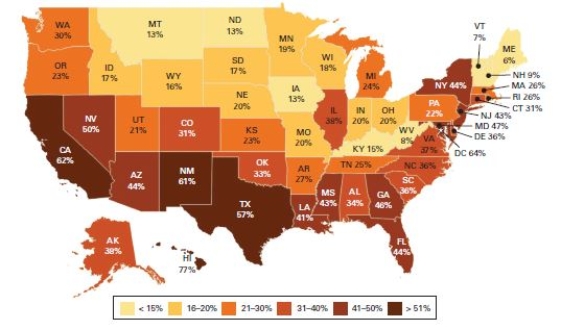 Source: U.S.Census Bureau,2016.
Which of the following regions has the largest minority population in the U.S.?
A)the Southwest
B)the Northwest -Consider This: Many states in the Northwest have relatively small minority populations,especially when Washington and Oregon are removed from consideration.
C)the Midwest
D)the Northeast
Minority population by state
Source: U.S.Census Bureau,2016.Which of the following regions has the largest minority population in the U.S.?
A)the Southwest
B)the Northwest -Consider This: Many states in the Northwest have relatively small minority populations,especially when Washington and Oregon are removed from consideration.
C)the Midwest
D)the Northeast
Question
Questions 9-10 refer to the following map.
Minority population by state Source: U.S.Census Bureau,2016.
Based on the map,why might it be increasingly necessary to address issues pertaining to minority rights?
A)Minority groups felt powerless in the U.S.before the Civil Rights Movement.
B)The Civil Rights Movement's successes did not affect other groups.
C)The minority population is growing in the U.S.,and is the majority in some states.
D)Minority groups have more political power than whites.-Consider This: Though this might be true in the future,a large part of the minority population is children; many minorities also remain disenfranchised.
Minority population by state
Source: U.S.Census Bureau,2016.Based on the map,why might it be increasingly necessary to address issues pertaining to minority rights?
A)Minority groups felt powerless in the U.S.before the Civil Rights Movement.
B)The Civil Rights Movement's successes did not affect other groups.
C)The minority population is growing in the U.S.,and is the majority in some states.
D)Minority groups have more political power than whites.-Consider This: Though this might be true in the future,a large part of the minority population is children; many minorities also remain disenfranchised.
Question
Questions 11 and 12 refer to the following image. Credit: Library of Congress/Corbis Historical/VCG/Getty Images
What did the Supreme Court decide in Korematsu v.United States (1944)regarding the treatment of American citizens of Japanese ancestry depicted in this photograph?
A)It was legally permissible.
B)It was unconstitutional,and Japanese Americans must be duly compensated.
C)It did not pass the strict scrutiny test,and the internment was promptly terminated.-Consider This: The Congress eventually offered reparations after years of debate.
D)It was unconstitutional,but it was too late to do anything about it.
Credit: Library of Congress/Corbis Historical/VCG/Getty ImagesWhat did the Supreme Court decide in Korematsu v.United States (1944)regarding the treatment of American citizens of Japanese ancestry depicted in this photograph?
A)It was legally permissible.
B)It was unconstitutional,and Japanese Americans must be duly compensated.
C)It did not pass the strict scrutiny test,and the internment was promptly terminated.-Consider This: The Congress eventually offered reparations after years of debate.
D)It was unconstitutional,but it was too late to do anything about it.
Question
Question
Question
Question
Question
Question
Question
Question
Question
Question
Question
Question
Question
Question
Question
Question
Question
Question
Question
Question
Question
Question
Question
Question

Unlock Deck
Sign up to unlock the cards in this deck!
Unlock Deck
Unlock Deck
1/44

Play

Full screen (f)
Deck 5: Civil Rights and Public Policy
1
Questions 7-8 refer to the following graph. Source: Data from Lawrence Baum.
Based on the graph,which of the following led to the initial increase in southern school integration?
A)Alexander v.Holmes -Consider This: Alexander v.Holmes led to an even greater increase in integration than the Civil Rights Act.
B)Brown v.Board of Education
C)the Civil Rights Act of 1964
D)the Little Rock Nine
Source: Data from Lawrence Baum.Based on the graph,which of the following led to the initial increase in southern school integration?
A)Alexander v.Holmes -Consider This: Alexander v.Holmes led to an even greater increase in integration than the Civil Rights Act.
B)Brown v.Board of Education
C)the Civil Rights Act of 1964
D)the Little Rock Nine
C
2
Questions 11 and 12 refer to the following image. Credit: Library of Congress/Corbis Historical/VCG/Getty Images
Based on this photograph,how were Japanese Americans treated during World War II?
A)They received the same protections as other American citizens.
B)German Americans were perceived as the greater threat.-Consider This: German Americans were also targeted as potential spies,but not to the same extent as the Japanese population on the West Coast.
C)They were stripped of many legal and natural rights.
D)Only adults were targeted as potential threats.
Credit: Library of Congress/Corbis Historical/VCG/Getty ImagesBased on this photograph,how were Japanese Americans treated during World War II?
A)They received the same protections as other American citizens.
B)German Americans were perceived as the greater threat.-Consider This: German Americans were also targeted as potential spies,but not to the same extent as the Japanese population on the West Coast.
C)They were stripped of many legal and natural rights.
D)Only adults were targeted as potential threats.
C
3
What rationale did the Supreme Court rely on when deciding that segregation in transportation was permissible in Plessy v.Ferguson?
A)Segregation in public facilities was not unconstitutional as long as the separate facilities were substantially equal.
B)Segregation was important for maintaining social order,a prerequisite for racial equality.
C)Jim Crow laws helped African Americans to achieve equality by building character through overcoming adversity.
D)The equal protection clause applied only to the actions of the federal government,not to actions of private businesses and individuals.-Consider This: The Court had previously limited the Fourteenth Amendment to the actions of the government in the Civil Rights Cases.
A)Segregation in public facilities was not unconstitutional as long as the separate facilities were substantially equal.
B)Segregation was important for maintaining social order,a prerequisite for racial equality.
C)Jim Crow laws helped African Americans to achieve equality by building character through overcoming adversity.
D)The equal protection clause applied only to the actions of the federal government,not to actions of private businesses and individuals.-Consider This: The Court had previously limited the Fourteenth Amendment to the actions of the government in the Civil Rights Cases.
A
4
What was the primary objective of the women's suffrage movement?
A)broad gender equality -Consider This: Advocates had hoped this would be included in the Fifteenth Amendment but they were ultimately disappointed by Congress.
B)the right to own property
C)equal pay for equal work
D)the right to vote
A)broad gender equality -Consider This: Advocates had hoped this would be included in the Fifteenth Amendment but they were ultimately disappointed by Congress.
B)the right to own property
C)equal pay for equal work
D)the right to vote
Unlock Deck
Unlock for access to all 44 flashcards in this deck.
Unlock Deck
k this deck
5
Why did states enact poll taxes?
A)to raise revenue for the government
B)to ensure that only people who really want to vote would do so
C)to get around the Fifteenth Amendment
D)to enfranchise former slaves -Consider This: To enfranchise means to give a person or a group the right to vote.
A)to raise revenue for the government
B)to ensure that only people who really want to vote would do so
C)to get around the Fifteenth Amendment
D)to enfranchise former slaves -Consider This: To enfranchise means to give a person or a group the right to vote.
Unlock Deck
Unlock for access to all 44 flashcards in this deck.
Unlock Deck
k this deck
6
When was the Thirteenth Amendment passed?
A)when the South seceded from the Union
B)during the Civil War
C)immediately after the Civil War
D)during the civil rights movement -Consider This: The Thirteenth,Fourteenth and Fifteenth Amendments are known as the Civil War amendments as they were passed as a result of the war.
A)when the South seceded from the Union
B)during the Civil War
C)immediately after the Civil War
D)during the civil rights movement -Consider This: The Thirteenth,Fourteenth and Fifteenth Amendments are known as the Civil War amendments as they were passed as a result of the war.
Unlock Deck
Unlock for access to all 44 flashcards in this deck.
Unlock Deck
k this deck
7
For example, no one, we presume, will contend that Congress can make any law in a Territory respecting the establishment of religion, or the free exercise thereof, or abridging the freedom of speech…
These powers, and others, in relation to rights of person, which it is not necessary here to enumerate, are, in express and positive terms, denied to the General Government; and the rights of private property have been guarded with equal care. Thus the rights of property are united with the rights of person, and placed on the same ground by the fifth amendment to the Constitution, which provides that no person shall be deprived of life, liberty, and property, without due process of law. And an act of Congress which deprives a citizen of the United States of his liberty or property, merely because he came himself or brought his property into a particular Territory of the United States, and who had committed no offence against the laws, could hardly be dignified with the name of due process of law.
--Chief Justice Roger Taney, Dred Scott v. Sandford, 1857
-The Supreme Court's Dred Scott v.Sandford (1857)decision narrowed the scope of the federal government's power by determining that __________.
A)state laws were supreme over conflicting national laws
B)states had inherent power to nullify federal laws -Consider This: The nullification question was not solved until after the Civil War.
C)Congress could not regulate interstate commerce
D)Congress lacked the authority to ban slavery in the territories
These powers, and others, in relation to rights of person, which it is not necessary here to enumerate, are, in express and positive terms, denied to the General Government; and the rights of private property have been guarded with equal care. Thus the rights of property are united with the rights of person, and placed on the same ground by the fifth amendment to the Constitution, which provides that no person shall be deprived of life, liberty, and property, without due process of law. And an act of Congress which deprives a citizen of the United States of his liberty or property, merely because he came himself or brought his property into a particular Territory of the United States, and who had committed no offence against the laws, could hardly be dignified with the name of due process of law.
--Chief Justice Roger Taney, Dred Scott v. Sandford, 1857
-The Supreme Court's Dred Scott v.Sandford (1857)decision narrowed the scope of the federal government's power by determining that __________.
A)state laws were supreme over conflicting national laws
B)states had inherent power to nullify federal laws -Consider This: The nullification question was not solved until after the Civil War.
C)Congress could not regulate interstate commerce
D)Congress lacked the authority to ban slavery in the territories
Unlock Deck
Unlock for access to all 44 flashcards in this deck.
Unlock Deck
k this deck
8
When did the modern civil rights begin?
A)when the Civil War ended -Consider This: The initial civil rights efforts in the United States focused primarily on de jure discrimination but later focused on de facto as well.
B)during Reconstruction with the passage of the 13th,14th,and 15th Amendments
C)in the 1950s with an increase in public policies seeking to foster racial equality
D)immediately prior to the passage of the Equal Rights Amendment
A)when the Civil War ended -Consider This: The initial civil rights efforts in the United States focused primarily on de jure discrimination but later focused on de facto as well.
B)during Reconstruction with the passage of the 13th,14th,and 15th Amendments
C)in the 1950s with an increase in public policies seeking to foster racial equality
D)immediately prior to the passage of the Equal Rights Amendment
Unlock Deck
Unlock for access to all 44 flashcards in this deck.
Unlock Deck
k this deck
9
How has the Equal Rights Amendment affected women's civil rights?
A)It has ensured that men and women are treated equally in the workplace.-Consider This: The Equal Rights Amendment was initially proposed in Congress in 1923.
B)It has ensured that the courts evaluate gender discrimination using the inherently suspect test.
C)It has eliminated gender discrimination in the military.
D)It has had little effect because it was not formally adopted.
A)It has ensured that men and women are treated equally in the workplace.-Consider This: The Equal Rights Amendment was initially proposed in Congress in 1923.
B)It has ensured that the courts evaluate gender discrimination using the inherently suspect test.
C)It has eliminated gender discrimination in the military.
D)It has had little effect because it was not formally adopted.
Unlock Deck
Unlock for access to all 44 flashcards in this deck.
Unlock Deck
k this deck
10
What did Jim Crow laws mandate?
A)property qualifications
B)racial segregation
C)poll taxes -Consider This: The Supreme Court affirmed Jim Crows laws in the nineteenth century by interpreting the Fourteenth Amendment very narrowly.
D)grandfather clauses
A)property qualifications
B)racial segregation
C)poll taxes -Consider This: The Supreme Court affirmed Jim Crows laws in the nineteenth century by interpreting the Fourteenth Amendment very narrowly.
D)grandfather clauses
Unlock Deck
Unlock for access to all 44 flashcards in this deck.
Unlock Deck
k this deck
11
Questions 7-8 refer to the following graph. Source: Data from Lawrence Baum.
Which of the following contributed to the Supreme Court's decision in Alexander v.Holmes?
A)the refusal of African Americans to attend school with whites
B)freedom rides
C)de facto segregation
D)de jure segregation -Consider This: De jure segregation was made illegal by Brown v.Board of Education.
Source: Data from Lawrence Baum.Which of the following contributed to the Supreme Court's decision in Alexander v.Holmes?
A)the refusal of African Americans to attend school with whites
B)freedom rides
C)de facto segregation
D)de jure segregation -Consider This: De jure segregation was made illegal by Brown v.Board of Education.
Unlock Deck
Unlock for access to all 44 flashcards in this deck.
Unlock Deck
k this deck
12
Which of the following did the Fourteenth Amendment attempt to guarantee to former slaves?
A)forty acres of farmland and a mule
B)debt forgiveness
C)economic equality with whites -Consider This: One of the main battles of the civil rights movement has been to fully implement the Fourteenth Amendment.
D)citizenship rights
A)forty acres of farmland and a mule
B)debt forgiveness
C)economic equality with whites -Consider This: One of the main battles of the civil rights movement has been to fully implement the Fourteenth Amendment.
D)citizenship rights
Unlock Deck
Unlock for access to all 44 flashcards in this deck.
Unlock Deck
k this deck
13
The Fifteenth Amendment guarantees citizens the right to vote regardless of __________.
A)race
B)economic status
C)involvement in insurrection
D)property ownership -Consider This: The primary purpose of the Civil War amendments (the Thirteenth,Fourteenth and Fifteenth amendments)was to provide legal equality to former slaves.
A)race
B)economic status
C)involvement in insurrection
D)property ownership -Consider This: The primary purpose of the Civil War amendments (the Thirteenth,Fourteenth and Fifteenth amendments)was to provide legal equality to former slaves.
Unlock Deck
Unlock for access to all 44 flashcards in this deck.
Unlock Deck
k this deck
14
For example, no one, we presume, will contend that Congress can make any law in a Territory respecting the establishment of religion, or the free exercise thereof, or abridging the freedom of speech…
These powers, and others, in relation to rights of person, which it is not necessary here to enumerate, are, in express and positive terms, denied to the General Government; and the rights of private property have been guarded with equal care. Thus the rights of property are united with the rights of person, and placed on the same ground by the fifth amendment to the Constitution, which provides that no person shall be deprived of life, liberty, and property, without due process of law. And an act of Congress which deprives a citizen of the United States of his liberty or property, merely because he came himself or brought his property into a particular Territory of the United States, and who had committed no offence against the laws, could hardly be dignified with the name of due process of law.
--Chief Justice Roger Taney, Dred Scott v. Sandford, 1857
-In the 1857 Dred Scott v.Sandford decision,the Supreme Court held that __________.
A)only Congress could ban slavery -Consider This: The Court's decision in this case helped push the country towards a civil war.
B)black men were citizens but black women were not
C)the Missouri Compromise was unconstitutional
D)slavery was immoral but necessary
These powers, and others, in relation to rights of person, which it is not necessary here to enumerate, are, in express and positive terms, denied to the General Government; and the rights of private property have been guarded with equal care. Thus the rights of property are united with the rights of person, and placed on the same ground by the fifth amendment to the Constitution, which provides that no person shall be deprived of life, liberty, and property, without due process of law. And an act of Congress which deprives a citizen of the United States of his liberty or property, merely because he came himself or brought his property into a particular Territory of the United States, and who had committed no offence against the laws, could hardly be dignified with the name of due process of law.
--Chief Justice Roger Taney, Dred Scott v. Sandford, 1857
-In the 1857 Dred Scott v.Sandford decision,the Supreme Court held that __________.
A)only Congress could ban slavery -Consider This: The Court's decision in this case helped push the country towards a civil war.
B)black men were citizens but black women were not
C)the Missouri Compromise was unconstitutional
D)slavery was immoral but necessary
Unlock Deck
Unlock for access to all 44 flashcards in this deck.
Unlock Deck
k this deck
15
What was the primary goal of the 1848 Seneca Falls Convention?
A)the prohibition of alcohol
B)women's rights
C)rights for former slaves -Consider This: This meeting was primarily organized by Elizabeth Cady Stanton and Lucretia Mott.
D)ending the Civil War
A)the prohibition of alcohol
B)women's rights
C)rights for former slaves -Consider This: This meeting was primarily organized by Elizabeth Cady Stanton and Lucretia Mott.
D)ending the Civil War
Unlock Deck
Unlock for access to all 44 flashcards in this deck.
Unlock Deck
k this deck
16
Questions 13 and 14 refer to the following image. Credit: Scott Olson/Getty Images News/ Getty Images
Which of the following changes does this photo reflect?
A)There are an equal number of male and female military generals.
B)Women are part of the regular armed services,rather than separate units.
C)Both men and women must register for the draft.-Consider This: Though the image shows soldiers it doesn't indicate anything about the draft.
D)Women are permitted in the army,but not other branches of the military.
Credit: Scott Olson/Getty Images News/ Getty ImagesWhich of the following changes does this photo reflect?
A)There are an equal number of male and female military generals.
B)Women are part of the regular armed services,rather than separate units.
C)Both men and women must register for the draft.-Consider This: Though the image shows soldiers it doesn't indicate anything about the draft.
D)Women are permitted in the army,but not other branches of the military.
Unlock Deck
Unlock for access to all 44 flashcards in this deck.
Unlock Deck
k this deck
17
What was Reconstruction?
A)the struggle for newly freed slaves to gain the right to vote,especially in the South
B)the gradual elimination of both Black Codes and Jim Crow laws
C)the refusal of Southern states to abide by the Fourteenth Amendment until forced to do so by the Supreme Court -Consider This: Reconstruction was ultimately ended due to the contested election of 1876.
D)the period after the Civil War when the South was occupied by the federal government
A)the struggle for newly freed slaves to gain the right to vote,especially in the South
B)the gradual elimination of both Black Codes and Jim Crow laws
C)the refusal of Southern states to abide by the Fourteenth Amendment until forced to do so by the Supreme Court -Consider This: Reconstruction was ultimately ended due to the contested election of 1876.
D)the period after the Civil War when the South was occupied by the federal government
Unlock Deck
Unlock for access to all 44 flashcards in this deck.
Unlock Deck
k this deck
18
Questions 9-10 refer to the following map.
Minority population by state Source: U.S.Census Bureau,2016.
Which of the following regions has the largest minority population in the U.S.?
A)the Southwest
B)the Northwest -Consider This: Many states in the Northwest have relatively small minority populations,especially when Washington and Oregon are removed from consideration.
C)the Midwest
D)the Northeast
Minority population by state
Source: U.S.Census Bureau,2016.Which of the following regions has the largest minority population in the U.S.?
A)the Southwest
B)the Northwest -Consider This: Many states in the Northwest have relatively small minority populations,especially when Washington and Oregon are removed from consideration.
C)the Midwest
D)the Northeast
Unlock Deck
Unlock for access to all 44 flashcards in this deck.
Unlock Deck
k this deck
19
Questions 9-10 refer to the following map.
Minority population by state Source: U.S.Census Bureau,2016.
Based on the map,why might it be increasingly necessary to address issues pertaining to minority rights?
A)Minority groups felt powerless in the U.S.before the Civil Rights Movement.
B)The Civil Rights Movement's successes did not affect other groups.
C)The minority population is growing in the U.S.,and is the majority in some states.
D)Minority groups have more political power than whites.-Consider This: Though this might be true in the future,a large part of the minority population is children; many minorities also remain disenfranchised.
Minority population by state
Source: U.S.Census Bureau,2016.Based on the map,why might it be increasingly necessary to address issues pertaining to minority rights?
A)Minority groups felt powerless in the U.S.before the Civil Rights Movement.
B)The Civil Rights Movement's successes did not affect other groups.
C)The minority population is growing in the U.S.,and is the majority in some states.
D)Minority groups have more political power than whites.-Consider This: Though this might be true in the future,a large part of the minority population is children; many minorities also remain disenfranchised.
Unlock Deck
Unlock for access to all 44 flashcards in this deck.
Unlock Deck
k this deck
20
Questions 11 and 12 refer to the following image. Credit: Library of Congress/Corbis Historical/VCG/Getty Images
What did the Supreme Court decide in Korematsu v.United States (1944)regarding the treatment of American citizens of Japanese ancestry depicted in this photograph?
A)It was legally permissible.
B)It was unconstitutional,and Japanese Americans must be duly compensated.
C)It did not pass the strict scrutiny test,and the internment was promptly terminated.-Consider This: The Congress eventually offered reparations after years of debate.
D)It was unconstitutional,but it was too late to do anything about it.
Credit: Library of Congress/Corbis Historical/VCG/Getty ImagesWhat did the Supreme Court decide in Korematsu v.United States (1944)regarding the treatment of American citizens of Japanese ancestry depicted in this photograph?
A)It was legally permissible.
B)It was unconstitutional,and Japanese Americans must be duly compensated.
C)It did not pass the strict scrutiny test,and the internment was promptly terminated.-Consider This: The Congress eventually offered reparations after years of debate.
D)It was unconstitutional,but it was too late to do anything about it.
Unlock Deck
Unlock for access to all 44 flashcards in this deck.
Unlock Deck
k this deck
21
Which of the following happened during Reconstruction?
A)Most African American men were banned from political offices because they did not own property.
B)Many former Confederate soldiers and officers held public office and restricted the rights of former slaves.-Consider This: During Reconstruction,people who held office in the Confederacy or served in the Confederate Army were banned from holding elected office.
C)Most African Americans moved to northern cities.
D)Many African American men held state and federal offices.
A)Most African American men were banned from political offices because they did not own property.
B)Many former Confederate soldiers and officers held public office and restricted the rights of former slaves.-Consider This: During Reconstruction,people who held office in the Confederacy or served in the Confederate Army were banned from holding elected office.
C)Most African Americans moved to northern cities.
D)Many African American men held state and federal offices.
Unlock Deck
Unlock for access to all 44 flashcards in this deck.
Unlock Deck
k this deck
22
With which of the following is majority rule is most likely to conflict?
A)the principle of equality.-Consider This: One risk of majority rule is that the majority can use their power to deprive the minority of certain freedoms.
B)individual liberty
C)consent of the governed
D)natural law
A)the principle of equality.-Consider This: One risk of majority rule is that the majority can use their power to deprive the minority of certain freedoms.
B)individual liberty
C)consent of the governed
D)natural law
Unlock Deck
Unlock for access to all 44 flashcards in this deck.
Unlock Deck
k this deck
23
Based on the Supreme Court's decision in Reed v.Reed,which of the following laws would most likely be overturned?
A)Twenty percent of university admissions slots are reserved for Latinos.-Consider This: This decision found that 'arbitrary' discrimination violated the equal protection clause of the Fourteenth Amendment.
B)Police officers must retire at 70 years old.
C)Men can vote at 17 years of age; women cannot vote until 18.
D)Pilots must have perfect vision to receive a license.
A)Twenty percent of university admissions slots are reserved for Latinos.-Consider This: This decision found that 'arbitrary' discrimination violated the equal protection clause of the Fourteenth Amendment.
B)Police officers must retire at 70 years old.
C)Men can vote at 17 years of age; women cannot vote until 18.
D)Pilots must have perfect vision to receive a license.
Unlock Deck
Unlock for access to all 44 flashcards in this deck.
Unlock Deck
k this deck
24
If you thought you were getting an inferior public education because of your ethnicity,which part of the Constitution would you rely on most heavily to justify your case?
A)the Equal Rights Amendment -Consider This: This amendment,passed shortly after the Civil War,is the cornerstone of modern civil rights law.
B)the Thirteenth Amendment
C)the Fourteenth Amendment
D)the Nineteenth Amendment
A)the Equal Rights Amendment -Consider This: This amendment,passed shortly after the Civil War,is the cornerstone of modern civil rights law.
B)the Thirteenth Amendment
C)the Fourteenth Amendment
D)the Nineteenth Amendment
Unlock Deck
Unlock for access to all 44 flashcards in this deck.
Unlock Deck
k this deck
25
Which of the following is an example of de jure segregation?
A)Jim Crow laws
B)the tendency for churches to be racially homogeneous -Consider This: Recall that de jure discrimination is contrasted with de facto discrimination.
C)the small number of African American senators
D)sequestering the jury in order to ensure a fair trial
A)Jim Crow laws
B)the tendency for churches to be racially homogeneous -Consider This: Recall that de jure discrimination is contrasted with de facto discrimination.
C)the small number of African American senators
D)sequestering the jury in order to ensure a fair trial
Unlock Deck
Unlock for access to all 44 flashcards in this deck.
Unlock Deck
k this deck
26
How are the Fourteenth Amendment and the Civil Rights Act of 1964 similar?
A)They both were enacted quickly and easily.-Consider This: Both policies are now considered essential parts of civil rights law.
B)They both passed the inherently suspect test administered by the Supreme Court.
C)They both sought equal rights for African Americans.
D)They both sought equal rights for women.
A)They both were enacted quickly and easily.-Consider This: Both policies are now considered essential parts of civil rights law.
B)They both passed the inherently suspect test administered by the Supreme Court.
C)They both sought equal rights for African Americans.
D)They both sought equal rights for women.
Unlock Deck
Unlock for access to all 44 flashcards in this deck.
Unlock Deck
k this deck
27
Which group's civil liberties were affirmed by the Supreme Court's decision in Lawrence v.Texas (2003)?
A)disabled Americans
B)Asian Americans -Consider This: Liberties for this group were further expanded following the Obergefell v.Hodges decision.
C)American Indians
D)gays and lesbians
A)disabled Americans
B)Asian Americans -Consider This: Liberties for this group were further expanded following the Obergefell v.Hodges decision.
C)American Indians
D)gays and lesbians
Unlock Deck
Unlock for access to all 44 flashcards in this deck.
Unlock Deck
k this deck
28
Which of the following accommodations would an employer most likely need to implement in order to be in compliance with the Americans with Disabilities Act?
A)hiring a disabled person instead of an equally qualified person without a disability -Consider This: The main purpose of the Americans with Disabilities Act was to prevent discrimination against persons with disabilities.
B)providing better medical insurance for employees who have a disability
C)lowering expectations for the quality of work performed by employees with disabilities
D)installing a ramp and other physical accommodations for someone who uses a wheelchair
A)hiring a disabled person instead of an equally qualified person without a disability -Consider This: The main purpose of the Americans with Disabilities Act was to prevent discrimination against persons with disabilities.
B)providing better medical insurance for employees who have a disability
C)lowering expectations for the quality of work performed by employees with disabilities
D)installing a ramp and other physical accommodations for someone who uses a wheelchair
Unlock Deck
Unlock for access to all 44 flashcards in this deck.
Unlock Deck
k this deck
29
If a group of people were systematically discriminated against in the past,which of the following would constitute an affirmative action policy designed as a remedy to help the members of this group overcome this legacy of discrimination?
A)a hiring policy that favors those with relatives working in government
B)a college admissions policy that gives preferential treatment to members of the group
C)a color-blind job application process to give members of this group an equal chance -Consider This: The Court has narrowed the scope of affirmative action policies but allows them if they are 'narrowly tailored' and needed for a 'compelling governmental interest.'
D)requiring that all job applicants have at least two years of prior experience
A)a hiring policy that favors those with relatives working in government
B)a college admissions policy that gives preferential treatment to members of the group
C)a color-blind job application process to give members of this group an equal chance -Consider This: The Court has narrowed the scope of affirmative action policies but allows them if they are 'narrowly tailored' and needed for a 'compelling governmental interest.'
D)requiring that all job applicants have at least two years of prior experience
Unlock Deck
Unlock for access to all 44 flashcards in this deck.
Unlock Deck
k this deck
30
After Reconstruction,which of the following was used to prevent African Americans from having a meaningful impact on the outcome of elections?
A)Jim Crow laws -Consider This: While Jim Crow laws were used to limit the rights of African Americans,a more specific mechanism was used to limit their electoral strength.
B)white primaries
C)majority-minority districts
D)affirmative action
A)Jim Crow laws -Consider This: While Jim Crow laws were used to limit the rights of African Americans,a more specific mechanism was used to limit their electoral strength.
B)white primaries
C)majority-minority districts
D)affirmative action
Unlock Deck
Unlock for access to all 44 flashcards in this deck.
Unlock Deck
k this deck
31
Which of the following situations would most likely be a violation of Title IX?
A)an election jurisdiction that does not provide bilingual ballots when there is a large bilingual community
B)a legal prohibition on hiring women for positions that are known to be hazardous to women's reproductive health
C)a college that spends significantly more on sports programs for men than for women
D)an employer who systematically pays women less than men for doing comparable work -Consider This: The focus of Title IX is on discrimination in education.
A)an election jurisdiction that does not provide bilingual ballots when there is a large bilingual community
B)a legal prohibition on hiring women for positions that are known to be hazardous to women's reproductive health
C)a college that spends significantly more on sports programs for men than for women
D)an employer who systematically pays women less than men for doing comparable work -Consider This: The focus of Title IX is on discrimination in education.
Unlock Deck
Unlock for access to all 44 flashcards in this deck.
Unlock Deck
k this deck
32
Which of the following guaranteed women the right to vote?
A)Korematsu v.United States
B)Reed v.Reed
C)the Nineteenth Amendment
D)the 1965 Voting Rights Act -Consider This: The Voting Rights Act was largely focused on providing voting rights to African Americans and other racial and ethnic minorities.
A)Korematsu v.United States
B)Reed v.Reed
C)the Nineteenth Amendment
D)the 1965 Voting Rights Act -Consider This: The Voting Rights Act was largely focused on providing voting rights to African Americans and other racial and ethnic minorities.
Unlock Deck
Unlock for access to all 44 flashcards in this deck.
Unlock Deck
k this deck
33
What strategy did the National Association for the Advancement of Colored People (NAACP)successfully use to fight against school segregation?
A)boycotts -Consider This: The civil rights movement used a variety of methods to combat discrimination but the NAACP was very effective using this tactic.
B)protests
C)litigation
D)marches and rallies
A)boycotts -Consider This: The civil rights movement used a variety of methods to combat discrimination but the NAACP was very effective using this tactic.
B)protests
C)litigation
D)marches and rallies
Unlock Deck
Unlock for access to all 44 flashcards in this deck.
Unlock Deck
k this deck
34
What did the Supreme Court determine in Adarand Constructors v.Peña?
A)affirmative action policies must be scrutinized using the same suspect standard that is used for other policies classifying people by race
B)affirmative action policies are subject to an intermediate standard whereby they are presumed to be permissible
C)affirmative action policies may be broadly tailored to accomplish a compelling government interest
D)affirmative action policies must be designed to address past discrimination without taking into account race,ethnicity,religion,or creed -Consider This: This decision made it more difficult for the federal government to implement affirmative action programs.
A)affirmative action policies must be scrutinized using the same suspect standard that is used for other policies classifying people by race
B)affirmative action policies are subject to an intermediate standard whereby they are presumed to be permissible
C)affirmative action policies may be broadly tailored to accomplish a compelling government interest
D)affirmative action policies must be designed to address past discrimination without taking into account race,ethnicity,religion,or creed -Consider This: This decision made it more difficult for the federal government to implement affirmative action programs.
Unlock Deck
Unlock for access to all 44 flashcards in this deck.
Unlock Deck
k this deck
35
Which form of discrimination did the freedom riders use civil disobedience to help end in the South?
A)lynchings by the Ku Klux Klan
B)racial segregation
C)racial quotas
D)voter discrimination -Consider This: These activists put themselves at risk by challenging local laws and regulations.
A)lynchings by the Ku Klux Klan
B)racial segregation
C)racial quotas
D)voter discrimination -Consider This: These activists put themselves at risk by challenging local laws and regulations.
Unlock Deck
Unlock for access to all 44 flashcards in this deck.
Unlock Deck
k this deck
36
Which of the following laws would the Supreme Court most likely examine using the inherently suspect standard to determine its constitutionality?
A)Male and female student athletes cannot compete on the same basketball team at the university level.
B)Businesses cannot discriminate against gays and lesbians in hiring and promotion decisions.-Consider This: The Court finds discrimination along these lines to be inherently suspect and it is held to the highest possible standard of review.
C)Those without a college degree are not eligible for upper-level civil service jobs.
D)Government contracts must be awarded to a contractor who is a racial minority whenever at least 10 percent of the bidders are minority-owned businesses.
A)Male and female student athletes cannot compete on the same basketball team at the university level.
B)Businesses cannot discriminate against gays and lesbians in hiring and promotion decisions.-Consider This: The Court finds discrimination along these lines to be inherently suspect and it is held to the highest possible standard of review.
C)Those without a college degree are not eligible for upper-level civil service jobs.
D)Government contracts must be awarded to a contractor who is a racial minority whenever at least 10 percent of the bidders are minority-owned businesses.
Unlock Deck
Unlock for access to all 44 flashcards in this deck.
Unlock Deck
k this deck
37
Which of the following was the Civil Rights Act of 1964 designed to overturn?
A)integration
B)Jim Crow laws
C)nonviolent resistance
D)Reconstruction -Consider This: This major piece of legislation followed the Brown v.Board of Education decision.
A)integration
B)Jim Crow laws
C)nonviolent resistance
D)Reconstruction -Consider This: This major piece of legislation followed the Brown v.Board of Education decision.
Unlock Deck
Unlock for access to all 44 flashcards in this deck.
Unlock Deck
k this deck
38
For which of the following would the Supreme Court most likely apply an "intermediate scrutiny" standard of review to determine whether the policy is an unconstitutional violation of the equal protection clause?
A)preventing whites from attending schools designed to serve African American students -Consider This: The Court adopted this standard in the case of Craig v.Boren.
B)prohibiting Jewish people from becoming members of a club
C)refusing to promote a Latina when she is the most qualified candidate
D)having different minimum ages for men and women to marry
A)preventing whites from attending schools designed to serve African American students -Consider This: The Court adopted this standard in the case of Craig v.Boren.
B)prohibiting Jewish people from becoming members of a club
C)refusing to promote a Latina when she is the most qualified candidate
D)having different minimum ages for men and women to marry
Unlock Deck
Unlock for access to all 44 flashcards in this deck.
Unlock Deck
k this deck
39
According to the Supreme Court's decisions in the Civil Rights Cases (1883),in which of the following areas could racial discrimination occur?
A)juries
B)hotels
C)post offices -Consider This: In these cases,the Court found discrimination by individuals and businesses to be acceptable.
D)running for office
A)juries
B)hotels
C)post offices -Consider This: In these cases,the Court found discrimination by individuals and businesses to be acceptable.
D)running for office
Unlock Deck
Unlock for access to all 44 flashcards in this deck.
Unlock Deck
k this deck
40
What provision of the Fourteenth Amendment serves as a cornerstone of struggles to win equality for certain groups?
A)the all men are created equal clause -Consider This: Initially the Court interpreted this provision narrowly,limiting its application.
B)the equal protection clause
C)the privileges and immunities clause
D)the Equal Rights Amendment
A)the all men are created equal clause -Consider This: Initially the Court interpreted this provision narrowly,limiting its application.
B)the equal protection clause
C)the privileges and immunities clause
D)the Equal Rights Amendment
Unlock Deck
Unlock for access to all 44 flashcards in this deck.
Unlock Deck
k this deck
41
Why did Congress pass the Voting Rights Act of 1965?
A)the Supreme Court had determined that only the national government could regulate elections -Consider This: Despite the Voting Rights Act,each state is still largely in control of the voting rules within that state.
B)because it was clear that many areas in the South had no intention of living up to the spirit of the Fifteenth Amendment
C)because Congress was afraid the Reverend Martin Luther King Jr.would lead a boycott of white businesses if the legislation was not passed
D)to prevent the race riots from spreading from African American neighborhoods into traditionally white neighborhoods
A)the Supreme Court had determined that only the national government could regulate elections -Consider This: Despite the Voting Rights Act,each state is still largely in control of the voting rules within that state.
B)because it was clear that many areas in the South had no intention of living up to the spirit of the Fifteenth Amendment
C)because Congress was afraid the Reverend Martin Luther King Jr.would lead a boycott of white businesses if the legislation was not passed
D)to prevent the race riots from spreading from African American neighborhoods into traditionally white neighborhoods
Unlock Deck
Unlock for access to all 44 flashcards in this deck.
Unlock Deck
k this deck
42
How are the Supreme Court decisions in Korematsu v.United States (1944)and Plessy v.Ferguson (1896)similar?
A)Both decisions upheld important constitutional principles.-Consider This: It is unlikely that the modern Court would uphold either decision today.
B)Both decisions were positive turning points in the history of American jurisprudence.
C)Both decisions limited the civil rights of racial or ethnic minorities.
D)Both decisions were important early victories in the struggle for civil rights.
A)Both decisions upheld important constitutional principles.-Consider This: It is unlikely that the modern Court would uphold either decision today.
B)Both decisions were positive turning points in the history of American jurisprudence.
C)Both decisions limited the civil rights of racial or ethnic minorities.
D)Both decisions were important early victories in the struggle for civil rights.
Unlock Deck
Unlock for access to all 44 flashcards in this deck.
Unlock Deck
k this deck
43
What is the status of affirmative action in college admissions after the Supreme Court decisions in the two cases involving the University of Michigan,Gratz v.Bollinger (2003)and Grutter v.Bollinger (2003)?
A)Affirmative action policies are generally permissible,but they cannot involve race-based quotas or numerical point systems.
B)Affirmative action policies are assumed to be unconstitutional unless the university can demonstrate the need to promote racial tolerance.
C)Affirmative action policies must ensure that all racial and ethnic groups are represented in accordance with the population of the nation as a whole.
D)All forms of affirmative action are unconstitutional because they unfairly favor some people over others based on the color of their skin.-Consider This: The Court has ruled that promoting diversity is a legitimate government objective.
A)Affirmative action policies are generally permissible,but they cannot involve race-based quotas or numerical point systems.
B)Affirmative action policies are assumed to be unconstitutional unless the university can demonstrate the need to promote racial tolerance.
C)Affirmative action policies must ensure that all racial and ethnic groups are represented in accordance with the population of the nation as a whole.
D)All forms of affirmative action are unconstitutional because they unfairly favor some people over others based on the color of their skin.-Consider This: The Court has ruled that promoting diversity is a legitimate government objective.
Unlock Deck
Unlock for access to all 44 flashcards in this deck.
Unlock Deck
k this deck
44
How do the inherently suspect and reasonableness standards differ?
A)The inherently suspect standard relies on observation; the reasonableness standard relies on data.
B)Under the inherently suspect standard the law is presumed to be valid; under the reasonableness standard the law is presumed to be invalid.
C)The inherently suspect standard is a higher threshold for determining whether the law is constitution.
D)The inherently suspect standard evaluates whether it is rationally connected to a legitimate government goal; the reasonableness standard evaluates whether it is the least restrictive way to achieve that goal.-Consider This: The former standard deals with race and ethnicity,while the latter deals with age and wealth.
A)The inherently suspect standard relies on observation; the reasonableness standard relies on data.
B)Under the inherently suspect standard the law is presumed to be valid; under the reasonableness standard the law is presumed to be invalid.
C)The inherently suspect standard is a higher threshold for determining whether the law is constitution.
D)The inherently suspect standard evaluates whether it is rationally connected to a legitimate government goal; the reasonableness standard evaluates whether it is the least restrictive way to achieve that goal.-Consider This: The former standard deals with race and ethnicity,while the latter deals with age and wealth.
Unlock Deck
Unlock for access to all 44 flashcards in this deck.
Unlock Deck
k this deck
Unlock Deck
Unlock for access to all 44 flashcards in this deck.






