







 Chat with AI

Deck 23: Childbirth at Risk: Prelabor Onset Complications
Full screen (f)

Question

Question
Question
Question
Question
Question
Question
Question
Question
Question
Question
Question
Question
Question
Question
Question
Question
Question
Question
Question
Question
A patient pregnant with twins late in the 3rd trimester has an ultrasound that shows the position of the fetuses as follows. What should the nurse expect will be planned for this patient?
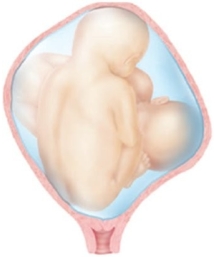
A) Cesarean birth
B) Vaginal delivery
C) Spinal block during labor
D) Continuous lumbar epidural
A) Cesarean birth
B) Vaginal delivery
C) Spinal block during labor
D) Continuous lumbar epidural
Question
Question
Question
The nurse is preparing teaching material for a pregnant patient with the following type of placenta previa. What information should the nurse provide the patient about this health problem?

A) Internal o s is partially covered by the placenta
B) Internal o s is covered completely by the placenta
C) Edge of the placenta is at the margin of the internal o s
D) Placenta is implanted in the lower segment but does not reach the o s
A) Internal o s is partially covered by the placenta
B) Internal o s is covered completely by the placenta
C) Edge of the placenta is at the margin of the internal o s
D) Placenta is implanted in the lower segment but does not reach the o s
Question
Question
Question
Question
Question
A pregnant patient is scheduled to have the procedure depicted in the diagram performed. What should the nurse explain is the purpose for this procedure?
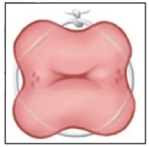
A) Correct marginal placenta previa
B) Prevent preterm cervical dilatation and pregnancy loss
C) Reduce the risk of developing central abruptio placentae
D) Assist the fetus to rotate into the appropriate position for delivery
A) Correct marginal placenta previa
B) Prevent preterm cervical dilatation and pregnancy loss
C) Reduce the risk of developing central abruptio placentae
D) Assist the fetus to rotate into the appropriate position for delivery
Question
Question
Question
A pregnant patient is diagnosed with premature separation of the placenta. The nurse provides the patient with the following diagram. What amount of placenta separation is this patient experiencing?
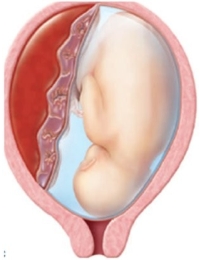
A) Central
B) Marginal
C) Complete
D) Anticipated
A) Central
B) Marginal
C) Complete
D) Anticipated

Unlock Deck
Sign up to unlock the cards in this deck!
Unlock Deck
Unlock Deck
1/32

Play

Full screen (f)
Deck 23: Childbirth at Risk: Prelabor Onset Complications
1
The nurse is performing an assessment on a client in the birthing unit who has acquired cervical insufficiency. Which other finding(s) may contribute to the client's condition?
Note: Credit will be given only if all correct choices and no incorrect choices are selected.
A) Inflammation
B) Infection
C) Cervical trauma
D) Cone biopsy
E) H P V positivity
Note: Credit will be given only if all correct choices and no incorrect choices are selected.
A) Inflammation
B) Infection
C) Cervical trauma
D) Cone biopsy
E) H P V positivity
A, B, C, D
2
The client at 30 weeks' gestation is admitted with painless late vaginal bleeding. The nurse understands that expectant management includes which of the following?
A) Limiting vaginal exams to only one per 24-hour period.
B) Evaluating the fetal heart rate with an internal monitor.
C) Monitoring for blood loss, pain, and uterine contractibility.
D) Assessing blood pressure every 2 hours.
A) Limiting vaginal exams to only one per 24-hour period.
B) Evaluating the fetal heart rate with an internal monitor.
C) Monitoring for blood loss, pain, and uterine contractibility.
D) Assessing blood pressure every 2 hours.
C
3
The nurse is performing a comprehensive assessment on a client admitted to the birthing unit with abruptio placentae. Which finding(s) contribute(s) to this condition?
Note: Credit will be given only if all correct choices and no incorrect choices are selected.
A) History of domestic violence
B) Presence of uterine fibroids
C) Alcohol consumption during pregnancy
D) Hypertension
E) Gestational diabetes mellitus
Note: Credit will be given only if all correct choices and no incorrect choices are selected.
A) History of domestic violence
B) Presence of uterine fibroids
C) Alcohol consumption during pregnancy
D) Hypertension
E) Gestational diabetes mellitus
A, B, C, D
4
The home health nurse is visiting a client at 18 weeks who is pregnant with twins. Which nursing action is most important?
A) Teach the client about foods that are good sources of protein.
B) Assess the client's blood pressure in her upper right arm.
C) Determine whether the pregnancy is the result of infertility treatment.
D) Collect a cervicovaginal fetal fibronectin (fF N) specimen.
A) Teach the client about foods that are good sources of protein.
B) Assess the client's blood pressure in her upper right arm.
C) Determine whether the pregnancy is the result of infertility treatment.
D) Collect a cervicovaginal fetal fibronectin (fF N) specimen.
Unlock Deck
Unlock for access to all 32 flashcards in this deck.
Unlock Deck
k this deck
5
A client is admitted to the birth setting in early labor. She is 3 c m dilated, -2 station, with intact membranes, and F H R of 150 b p m. Her membranes rupture spontaneously, and the F H R drops to 90 b p m with variable decelerations. What would the nurse's initial response be?
A) Perform a vaginal exam
B) Notify the physician
C) Place the client in a left lateral position
D) Administer oxygen at 2 L per nasal cannula
A) Perform a vaginal exam
B) Notify the physician
C) Place the client in a left lateral position
D) Administer oxygen at 2 L per nasal cannula
Unlock Deck
Unlock for access to all 32 flashcards in this deck.
Unlock Deck
k this deck
6
The nurse is caring for a client at 30 weeks' gestation who is experiencing preterm premature rupture of membranes (P P R O M). Which statement indicates that the client needs additional teaching?
A) "If I were having a singleton pregnancy instead of twins, my membranes would probably not have ruptured."
B) "If I develop a urinary tract infection in my next pregnancy, I might rupture membranes early again."
C) "If I want to become pregnant again, I will have to plan on being on bed rest for the whole pregnancy."
D) "If I have amniocentesis, I might rupture the membranes again."
A) "If I were having a singleton pregnancy instead of twins, my membranes would probably not have ruptured."
B) "If I develop a urinary tract infection in my next pregnancy, I might rupture membranes early again."
C) "If I want to become pregnant again, I will have to plan on being on bed rest for the whole pregnancy."
D) "If I have amniocentesis, I might rupture the membranes again."
Unlock Deck
Unlock for access to all 32 flashcards in this deck.
Unlock Deck
k this deck
7
During the nursing assessment of a woman with ruptured membranes, the nurse suspects a prolapsed umbilical cord. What would the nurse's priority action be?
A) To help the fetal head descend faster
B) To use gravity and manipulation to relieve compression on the cord
C) To facilitate dilation of the cervix with prostaglandin gel
D) To prevent head compression
A) To help the fetal head descend faster
B) To use gravity and manipulation to relieve compression on the cord
C) To facilitate dilation of the cervix with prostaglandin gel
D) To prevent head compression
Unlock Deck
Unlock for access to all 32 flashcards in this deck.
Unlock Deck
k this deck
8
The nurse on the birthing unit is collecting the obstetric history of a client at risk for cervical insufficiency. Which findings increase the client's risk for this condition?
Note: Credit will be given only if all correct choices and no incorrect choices are selected.
A) Multiple gestations
B) Previous preterm births
C) Progressively earlier births with each subsequent pregnancy
D) Cervical manipulation
E) Prolonged labors
Note: Credit will be given only if all correct choices and no incorrect choices are selected.
A) Multiple gestations
B) Previous preterm births
C) Progressively earlier births with each subsequent pregnancy
D) Cervical manipulation
E) Prolonged labors
Unlock Deck
Unlock for access to all 32 flashcards in this deck.
Unlock Deck
k this deck
9
A client is admitted to the labor and delivery unit in active labor. What nursing diagnoses might apply to the client with suspected abruptio placentae?
Note: Credit will be given only if all correct choices and no incorrect choices are selected.
A) Fluid Volume, Deficient, related to hypovolemia secondary to excessive blood loss
B) Tissue Perfusion: Peripheral, Ineffective, related to blood loss secondary to uterine atony following birth
C) Anxiety related to concern for own personal status and the baby's safety
D) Knowledge, Deficient related to lack of information about inherited genetic defects
E) Alteration in Respiratory Function related to blood loss
Note: Credit will be given only if all correct choices and no incorrect choices are selected.
A) Fluid Volume, Deficient, related to hypovolemia secondary to excessive blood loss
B) Tissue Perfusion: Peripheral, Ineffective, related to blood loss secondary to uterine atony following birth
C) Anxiety related to concern for own personal status and the baby's safety
D) Knowledge, Deficient related to lack of information about inherited genetic defects
E) Alteration in Respiratory Function related to blood loss
Unlock Deck
Unlock for access to all 32 flashcards in this deck.
Unlock Deck
k this deck
10
A client in her second trimester is complaining of spotting. Causes for spotting in the second trimester are diagnosed primarily through the use of which of the following?
A) A non-stress test
B) A vibroacoustic stimulation test
C) An ultrasound
D) A contraction stress test
A) A non-stress test
B) A vibroacoustic stimulation test
C) An ultrasound
D) A contraction stress test
Unlock Deck
Unlock for access to all 32 flashcards in this deck.
Unlock Deck
k this deck
11
A client was admitted to the labor area at 5 c m with ruptured membranes about 14 hours ago. What assessment data would be most beneficial for the nurse to collect?
A) Blood pressure
B) Temperature
C) Pulse
D) Respiration
A) Blood pressure
B) Temperature
C) Pulse
D) Respiration
Unlock Deck
Unlock for access to all 32 flashcards in this deck.
Unlock Deck
k this deck
12
Intervention to reduce preterm birth can be divided into primary prevention and secondary prevention. What does secondary prevention include?
A) Diagnosis and treatment of infections
B) Cervical cerclage
C) Progesterone administration
D) Antibiotic treatment and tocolysis
A) Diagnosis and treatment of infections
B) Cervical cerclage
C) Progesterone administration
D) Antibiotic treatment and tocolysis
Unlock Deck
Unlock for access to all 32 flashcards in this deck.
Unlock Deck
k this deck
13
The nurse admits into the labor area a client who is in preterm labor. What assessment finding would constitute a diagnosis of preterm labor?
A) Cervical effacement of 30% or more
B) Cervical change of 0.5 c m per hour
C) 2 contractions in 30 minutes
D) 8 contractions in 1 hour
A) Cervical effacement of 30% or more
B) Cervical change of 0.5 c m per hour
C) 2 contractions in 30 minutes
D) 8 contractions in 1 hour
Unlock Deck
Unlock for access to all 32 flashcards in this deck.
Unlock Deck
k this deck
14
The nurse on the birthing unit is caring for a client who has an amputated cervix and is about to undergo a cerclage procedure. Which type of cerclage procedure should the nurse anticipate?
A) Abdominal cerclage
B) Rescue cerclage
C) Emergency cerclage
D) Elective cerclage
A) Abdominal cerclage
B) Rescue cerclage
C) Emergency cerclage
D) Elective cerclage
Unlock Deck
Unlock for access to all 32 flashcards in this deck.
Unlock Deck
k this deck
15
A client admitted to the birthing unit with placenta previa asks the nurse, "What is the cause of my condition?" Which statement should be included in the nurse's response?
A) "The placenta is improperly implanted in the lower uterus."
B) "The placenta has separated prematurely."
C) "The placenta has grown too large."
D) "The placenta has prolapsed and is being compressed."
A) "The placenta is improperly implanted in the lower uterus."
B) "The placenta has separated prematurely."
C) "The placenta has grown too large."
D) "The placenta has prolapsed and is being compressed."
Unlock Deck
Unlock for access to all 32 flashcards in this deck.
Unlock Deck
k this deck
16
A client is admitted to the labor and delivery unit with a history of ruptured membranes for 2 hours. This is her sixth delivery; she is 40 years old, and smells of alcohol and cigarettes. What is this client at risk for?
A) Gestational diabetes
B) Placenta previa
C) Abruptio placentae
D) Placenta accreta
A) Gestational diabetes
B) Placenta previa
C) Abruptio placentae
D) Placenta accreta
Unlock Deck
Unlock for access to all 32 flashcards in this deck.
Unlock Deck
k this deck
17
The client is carrying monochorionic-monoamniotic twins. The nurse teaches the client what this is, and the implications of this finding. The nurse knows that teaching is successful when the client states which of the following?
A) "My babies came from two eggs."
B) "About two thirds of twins have this amniotic sac formation."
C) "My use of a fertility drug led to this issue."
D) "My babies have a lower chance of surviving to term than fraternal twins do."
A) "My babies came from two eggs."
B) "About two thirds of twins have this amniotic sac formation."
C) "My use of a fertility drug led to this issue."
D) "My babies have a lower chance of surviving to term than fraternal twins do."
Unlock Deck
Unlock for access to all 32 flashcards in this deck.
Unlock Deck
k this deck
18
What is the most significant maternal risk factor for preterm birth?
A) Previous preterm birth
B) Smoking
C) Stress
D) Substance abuse
A) Previous preterm birth
B) Smoking
C) Stress
D) Substance abuse
Unlock Deck
Unlock for access to all 32 flashcards in this deck.
Unlock Deck
k this deck
19
When counseling a newly pregnant client at 8 weeks' gestation with twins, the nurse teaches the woman about the need for increased caloric intake. What would the nurse tell the woman that the minimum recommended intake should be?
A) 2500 k c a l and 120 grams protein
B) 3000 k c a l and 150 grams protein
C) 4000 k c a l and 135 grams protein
D) 5000 k c a l and 190 grams protein
A) 2500 k c a l and 120 grams protein
B) 3000 k c a l and 150 grams protein
C) 4000 k c a l and 135 grams protein
D) 5000 k c a l and 190 grams protein
Unlock Deck
Unlock for access to all 32 flashcards in this deck.
Unlock Deck
k this deck
20
The nurse has received end-of-shift reports in the high-risk maternity unit. Which client should the nurse see first?
A) The client at 26 weeks' gestation with placenta previa experiencing blood on toilet tissue after a bowel movement
B) The client at 30 weeks' gestation with placenta previa whose fetal monitor strip shows late decelerations
C) The client at 35 weeks' gestation with grade I abruptio placentae in labor who has a strong urge to push
D) The client at 37 weeks' gestation with pregnancy-induced hypertension whose membranes ruptured spontaneously
A) The client at 26 weeks' gestation with placenta previa experiencing blood on toilet tissue after a bowel movement
B) The client at 30 weeks' gestation with placenta previa whose fetal monitor strip shows late decelerations
C) The client at 35 weeks' gestation with grade I abruptio placentae in labor who has a strong urge to push
D) The client at 37 weeks' gestation with pregnancy-induced hypertension whose membranes ruptured spontaneously
Unlock Deck
Unlock for access to all 32 flashcards in this deck.
Unlock Deck
k this deck
21
A patient pregnant with twins late in the 3rd trimester has an ultrasound that shows the position of the fetuses as follows. What should the nurse expect will be planned for this patient?
A) Cesarean birth
B) Vaginal delivery
C) Spinal block during labor
D) Continuous lumbar epidural
A) Cesarean birth
B) Vaginal delivery
C) Spinal block during labor
D) Continuous lumbar epidural
Unlock Deck
Unlock for access to all 32 flashcards in this deck.
Unlock Deck
k this deck
22
When caring for a laboring client with oligohydramnios, what should the nurse be aware of?
Note: Credit will be given only if all correct choices and no incorrect choices are selected.
A) Increased risk of cord compression
B) Decreased variability
C) Labor progress is often more rapid than average
D) Presence of periodic decelerations
E) During gestation, fetal skin and skeletal abnormalities can occur
Note: Credit will be given only if all correct choices and no incorrect choices are selected.
A) Increased risk of cord compression
B) Decreased variability
C) Labor progress is often more rapid than average
D) Presence of periodic decelerations
E) During gestation, fetal skin and skeletal abnormalities can occur
Unlock Deck
Unlock for access to all 32 flashcards in this deck.
Unlock Deck
k this deck
23
The nurse knows that a baby born to a mother who had oligohydramnios could show signs of which of the following?
A) Respiratory difficulty
B) Hypertension
C) Heart murmur
D) Decreased temperature
A) Respiratory difficulty
B) Hypertension
C) Heart murmur
D) Decreased temperature
Unlock Deck
Unlock for access to all 32 flashcards in this deck.
Unlock Deck
k this deck
24
The nurse is preparing teaching material for a pregnant patient with the following type of placenta previa. What information should the nurse provide the patient about this health problem?
A) Internal o s is partially covered by the placenta
B) Internal o s is covered completely by the placenta
C) Edge of the placenta is at the margin of the internal o s
D) Placenta is implanted in the lower segment but does not reach the o s
A) Internal o s is partially covered by the placenta
B) Internal o s is covered completely by the placenta
C) Edge of the placenta is at the margin of the internal o s
D) Placenta is implanted in the lower segment but does not reach the o s
Unlock Deck
Unlock for access to all 32 flashcards in this deck.
Unlock Deck
k this deck
25
The client at 38 weeks' gestation has been diagnosed with oligohydramnios. Which statement indicates that teaching about the condition has been effective?
A) "My gestational diabetes might have caused this problem to develop."
B) "When I go into labor, I should come to the hospital right away."
C) "This problem was diagnosed with blood and urine tests."
D) "Women with this condition usually do not have a cesarean birth."
A) "My gestational diabetes might have caused this problem to develop."
B) "When I go into labor, I should come to the hospital right away."
C) "This problem was diagnosed with blood and urine tests."
D) "Women with this condition usually do not have a cesarean birth."
Unlock Deck
Unlock for access to all 32 flashcards in this deck.
Unlock Deck
k this deck
26
Slowly removing some amniotic fluid is a treatment for hydramnios. What consequence can occur with the withdrawal of fluid?
A) Preterm labor
B) Prolapsed cord
C) Preeclampsia
D) Placenta previa
A) Preterm labor
B) Prolapsed cord
C) Preeclampsia
D) Placenta previa
Unlock Deck
Unlock for access to all 32 flashcards in this deck.
Unlock Deck
k this deck
27
The nurse is admitting a client who was diagnosed with hydramnios. The client asks why she has developed this condition. The nurse should explain that hydramnios is sometimes associated with which of the following?
Note: Credit will be given only if all correct choices and no incorrect choices are selected.
A) Rh sensitization
B) Postmaturity syndrome
C) Renal malformation or dysfunction
D) Maternal diabetes
E) Large-for-gestational-age infants
Note: Credit will be given only if all correct choices and no incorrect choices are selected.
A) Rh sensitization
B) Postmaturity syndrome
C) Renal malformation or dysfunction
D) Maternal diabetes
E) Large-for-gestational-age infants
Unlock Deck
Unlock for access to all 32 flashcards in this deck.
Unlock Deck
k this deck
28
A patient in preterm labor is prescribed magnesium sulfate 6 grams intravenous infusion now, followed by 5 grams per hour. The pharmacy prepares an infusion of 500 m L lactated Ringer's solution with 100 grams of magnesium sulfate. If the patient receives the loading dose and 3 hours of the medication, how many total m L of the infusion did the patient receive?
Unlock Deck
Unlock for access to all 32 flashcards in this deck.
Unlock Deck
k this deck
29
A pregnant patient is scheduled to have the procedure depicted in the diagram performed. What should the nurse explain is the purpose for this procedure?
A) Correct marginal placenta previa
B) Prevent preterm cervical dilatation and pregnancy loss
C) Reduce the risk of developing central abruptio placentae
D) Assist the fetus to rotate into the appropriate position for delivery
A) Correct marginal placenta previa
B) Prevent preterm cervical dilatation and pregnancy loss
C) Reduce the risk of developing central abruptio placentae
D) Assist the fetus to rotate into the appropriate position for delivery
Unlock Deck
Unlock for access to all 32 flashcards in this deck.
Unlock Deck
k this deck
30
The nurse is admitting a client with possible hydramnios. When is hydramnios most likely suspected?
A) Hydramnios is most likely suspected when there is less amniotic fluid than normal for gestation.
B) Hydramnios is most likely suspected when the fundal height increases disproportionately to the gestation.
C) Hydramnios is most likely suspected when the woman has a twin gestation.
D) Hydramnios is most likely suspected when the quadruple screen comes back positive.
A) Hydramnios is most likely suspected when there is less amniotic fluid than normal for gestation.
B) Hydramnios is most likely suspected when the fundal height increases disproportionately to the gestation.
C) Hydramnios is most likely suspected when the woman has a twin gestation.
D) Hydramnios is most likely suspected when the quadruple screen comes back positive.
Unlock Deck
Unlock for access to all 32 flashcards in this deck.
Unlock Deck
k this deck
31
If oligohydramnios occurs in the first part of pregnancy, the nurse knows that there is a danger of which of the following?
A) Major congenital anomalies
B) Fetal adhesions
C) Maternal diabetes
D) Rh sensitization
A) Major congenital anomalies
B) Fetal adhesions
C) Maternal diabetes
D) Rh sensitization
Unlock Deck
Unlock for access to all 32 flashcards in this deck.
Unlock Deck
k this deck
32
A pregnant patient is diagnosed with premature separation of the placenta. The nurse provides the patient with the following diagram. What amount of placenta separation is this patient experiencing?
A) Central
B) Marginal
C) Complete
D) Anticipated
A) Central
B) Marginal
C) Complete
D) Anticipated
Unlock Deck
Unlock for access to all 32 flashcards in this deck.
Unlock Deck
k this deck
Unlock Deck
Unlock for access to all 32 flashcards in this deck.






