







 Chat with AI

Deck 11: Vital Signs
Full screen (f)

Question
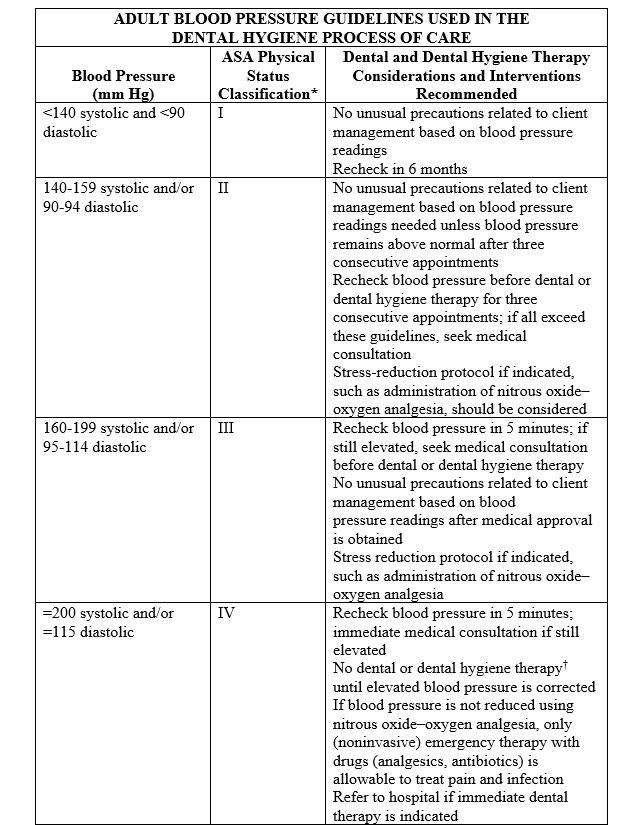
Adapted from Malamed SF: Medical emergencies in the dental office, ed 6, St Louis, 2007, Mosby.
*See Chapter 10 for an explanation of ASA Physical Status Classification.
†When the blood pressure is slightly above the cutoff for category IV and when anxiety is present, the use of inhalation sedation may diminish the blood pressure (via the elimination of stress) below the 200/115 level. The patient should be advised that if the nitrous oxide and oxygen succeeds in decreasing the blood
The client's blood pressure readings taken 10 minutes apart are 120/89.When the client came in last week the blood pressure was 120/80.According to the blood pressure guidelines in the chart,which best describe the recommendations for dental treatment?
A) No medical consultation,treat as usual.
B) Recheck blood pressure for three consecutive appointments.
C) The patient should be referred for a medical consultation after dental treatment.
D) The patient should be referred for a medical consultation before dental treatment.

Question
Question
Question
Question
Question
Question
Question
Question
Question
Question
Question
Adapted from Malamed SF: Medical emergencies in the dental office, ed 6, St Louis, 2007, Mosby.
*See Chapter 10 for an explanation of ASA Physical Status Classification.
†When the blood pressure is slightly above the cutoff for category IV and when anxiety is present, the use of inhalation sedation may diminish the blood pressure (via the elimination of stress) below the 200/115 level. The patient should be advised that if the nitrous oxide and oxygen succeeds in decreasing the blood
The client's blood pressure readings taken 10 minutes apart are 150/116.When the client came in last week the blood pressure was 120/80.According to the blood pressure guidelines in the chart,which best describes the recommendations for dental treatment?
A) No medical consultation;treat as usual.
B) Recheck blood pressure for three consecutive appointments.
C) The patient should be referred for a medical consultation after dental treatment.
D) The patient should be referred for a medical consultation before dental treatment.
Question
Question
Adapted from Malamed SF: Medical emergencies in the dental office, ed 6, St Louis, 2007, Mosby.
*See Chapter 10 for an explanation of ASA Physical Status Classification.
†When the blood pressure is slightly above the cutoff for category IV and when anxiety is present, the use of inhalation sedation may diminish the blood pressure (via the elimination of stress) below the 200/115 level. The patient should be advised that if the nitrous oxide and oxygen succeeds in decreasing the blood
The client's blood pressure readings taken 10 minutes apart are 145/89.When the client came in last week the blood pressure was 120/80.According to the blood pressure guidelines in the chart,which best describe the recommendations for dental treatment?
A) No medical consultation,treat as usual.
B) Recheck blood pressure for three consecutive appointments.
C) The patient should be referred for a medical consultation after dental treatment.
D) The patient should be referred for a medical consultation before dental treatment.
Question

Unlock Deck
Sign up to unlock the cards in this deck!
Unlock Deck
Unlock Deck
1/15

Play

Full screen (f)
Deck 11: Vital Signs
1
Adapted from Malamed SF: Medical emergencies in the dental office, ed 6, St Louis, 2007, Mosby.
*See Chapter 10 for an explanation of ASA Physical Status Classification.
†When the blood pressure is slightly above the cutoff for category IV and when anxiety is present, the use of inhalation sedation may diminish the blood pressure (via the elimination of stress) below the 200/115 level. The patient should be advised that if the nitrous oxide and oxygen succeeds in decreasing the blood
The client's blood pressure readings taken 10 minutes apart are 120/89.When the client came in last week the blood pressure was 120/80.According to the blood pressure guidelines in the chart,which best describe the recommendations for dental treatment?
A) No medical consultation,treat as usual.
B) Recheck blood pressure for three consecutive appointments.
C) The patient should be referred for a medical consultation after dental treatment.
D) The patient should be referred for a medical consultation before dental treatment.
No medical consultation,treat as usual.
2
The pulse rate is determined by palpating the brachial pulse.The blood pressure is obtained by auscultation of the radial pulse.
A) Both statements are true.
B) Both statements are false.
C) The first statement is true,but the second statement is false.
D) The first statement is false,but the second statement is true.
A) Both statements are true.
B) Both statements are false.
C) The first statement is true,but the second statement is false.
D) The first statement is false,but the second statement is true.
Both statements are false.
3
The dental hygienist takes the client's temperature and obtains a reading of 102 F.Which of the following choices would be the most appropriate step for the dental hygienist?
A) Inform the dentist.
B) Reschedule the client.
C) Rule out environmental factors.
D) Proceed with dental hygiene care.
E) Dispense an antipyretic medication.
A) Inform the dentist.
B) Reschedule the client.
C) Rule out environmental factors.
D) Proceed with dental hygiene care.
E) Dispense an antipyretic medication.
Rule out environmental factors.
4
All of the following vital signs are usually recorded as baseline data for the client's first office visit except which one?
A) Pulse
B) Respiration
C) Temperature
D) Blood pressure
A) Pulse
B) Respiration
C) Temperature
D) Blood pressure
Unlock Deck
Unlock for access to all 15 flashcards in this deck.
Unlock Deck
k this deck
5
Which term best describes a very rapid pulse rate?
A) Bradypnea
B) Bradycardia
C) Tachycardia
D) Hyperventilation
A) Bradypnea
B) Bradycardia
C) Tachycardia
D) Hyperventilation
Unlock Deck
Unlock for access to all 15 flashcards in this deck.
Unlock Deck
k this deck
6
A _____ best describes the most accurate reading for the systolic blood pressure.
A) Tapping sound
B) Sharp thump
C) Blowing sound
D) Whooshing sound
A) Tapping sound
B) Sharp thump
C) Blowing sound
D) Whooshing sound
Unlock Deck
Unlock for access to all 15 flashcards in this deck.
Unlock Deck
k this deck
7
Which of the following instruments are used in taking a client's blood pressure?
A) Blood pressure cuff and wristwatch
B) Blood pressure cuff and stethoscope
C) Thermometer and electrocardiogram
D) Sphygmomanometer and wristwatch
A) Blood pressure cuff and wristwatch
B) Blood pressure cuff and stethoscope
C) Thermometer and electrocardiogram
D) Sphygmomanometer and wristwatch
Unlock Deck
Unlock for access to all 15 flashcards in this deck.
Unlock Deck
k this deck
8
The dental hygienist is assessing which of the following when determining the presence of preventricular contractions?
A) Pulse
B) Respiration
C) Temperature
D) Blood pressure
A) Pulse
B) Respiration
C) Temperature
D) Blood pressure
Unlock Deck
Unlock for access to all 15 flashcards in this deck.
Unlock Deck
k this deck
9
All of the following can be indicators of heart disease or high blood pressure except which one?
A) Pulsus alternans
B) Full,bounding pulse
C) Weak,thready pulse
D) Premature ventricular contractions
A) Pulsus alternans
B) Full,bounding pulse
C) Weak,thready pulse
D) Premature ventricular contractions
Unlock Deck
Unlock for access to all 15 flashcards in this deck.
Unlock Deck
k this deck
10
Which of the following best describes the normal respiration rate for adults?
A) 6 to 8 respirations per minute (RPM)
B) 16 to 20 RPM
C) 21 to 25 RPM
D) 26 to 30 RPM
A) 6 to 8 respirations per minute (RPM)
B) 16 to 20 RPM
C) 21 to 25 RPM
D) 26 to 30 RPM
Unlock Deck
Unlock for access to all 15 flashcards in this deck.
Unlock Deck
k this deck
11
An adult client who has a blood pressure reading of 120/80 mm Hg is considered to be prehypertensive.Lifestyle changes and oral medication are recommended for a client who is prehypertensive to aid in lowering the blood pressure.
A) Both statements are true.
B) Both statements are false.
C) The first statement is true,but the second statement is false.
D) The first statement is false,but the second statement is true.
A) Both statements are true.
B) Both statements are false.
C) The first statement is true,but the second statement is false.
D) The first statement is false,but the second statement is true.
Unlock Deck
Unlock for access to all 15 flashcards in this deck.
Unlock Deck
k this deck
12
Adapted from Malamed SF: Medical emergencies in the dental office, ed 6, St Louis, 2007, Mosby.
*See Chapter 10 for an explanation of ASA Physical Status Classification.
†When the blood pressure is slightly above the cutoff for category IV and when anxiety is present, the use of inhalation sedation may diminish the blood pressure (via the elimination of stress) below the 200/115 level. The patient should be advised that if the nitrous oxide and oxygen succeeds in decreasing the blood
The client's blood pressure readings taken 10 minutes apart are 150/116.When the client came in last week the blood pressure was 120/80.According to the blood pressure guidelines in the chart,which best describes the recommendations for dental treatment?
A) No medical consultation;treat as usual.
B) Recheck blood pressure for three consecutive appointments.
C) The patient should be referred for a medical consultation after dental treatment.
D) The patient should be referred for a medical consultation before dental treatment.
Unlock Deck
Unlock for access to all 15 flashcards in this deck.
Unlock Deck
k this deck
13
When blood pressure is taken which reading best describes the minimum pressure occurring in the blood vessels?
A) Systolic
B) Diastolic
C) Auscultatory gap
D) Preventricular contraction
A) Systolic
B) Diastolic
C) Auscultatory gap
D) Preventricular contraction
Unlock Deck
Unlock for access to all 15 flashcards in this deck.
Unlock Deck
k this deck
14
Adapted from Malamed SF: Medical emergencies in the dental office, ed 6, St Louis, 2007, Mosby.
*See Chapter 10 for an explanation of ASA Physical Status Classification.
†When the blood pressure is slightly above the cutoff for category IV and when anxiety is present, the use of inhalation sedation may diminish the blood pressure (via the elimination of stress) below the 200/115 level. The patient should be advised that if the nitrous oxide and oxygen succeeds in decreasing the blood
The client's blood pressure readings taken 10 minutes apart are 145/89.When the client came in last week the blood pressure was 120/80.According to the blood pressure guidelines in the chart,which best describe the recommendations for dental treatment?
A) No medical consultation,treat as usual.
B) Recheck blood pressure for three consecutive appointments.
C) The patient should be referred for a medical consultation after dental treatment.
D) The patient should be referred for a medical consultation before dental treatment.
Unlock Deck
Unlock for access to all 15 flashcards in this deck.
Unlock Deck
k this deck
15
The blood pressure cuff should be placed slightly above (approximately 1 inch)the bend in the elbow (the antecubital fossa).The dental hygienist first determines the blood pressure by inflating the cuff to 250 mm Hg and then uses the stethoscope to determine the systolic and diastolic readings.
A) Both statements are true.
B) Both statements are false.
C) The first statement is true,but the second statement is false.
D) The first statement is false,but the second statement is true.
A) Both statements are true.
B) Both statements are false.
C) The first statement is true,but the second statement is false.
D) The first statement is false,but the second statement is true.
Unlock Deck
Unlock for access to all 15 flashcards in this deck.
Unlock Deck
k this deck
Unlock Deck
Unlock for access to all 15 flashcards in this deck.






