







 Chat with AI

Deck 41: Drugs for Peptic Ulcer Disease
Full screen (f)

Question

Question
Question
Question
Question
Question
Question
Question
Question
Question
Question
Question
Question
Question
Question
Question
Question
Question
Question
Question
Question
Question
Question
The nurse is using this diagram to teach a patient about GERD. Which spot would the nurse identify as the cardiac sphincter? 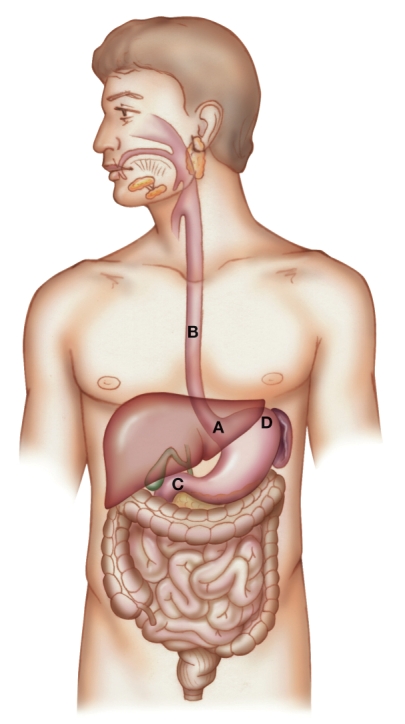
A) A
B) B
C) C
D) D
A) A
B) B
C) C
D) D
Question
Question
Question
Question
Question
Question
Question

Unlock Deck
Sign up to unlock the cards in this deck!
Unlock Deck
Unlock Deck
1/30

Play

Full screen (f)
Deck 41: Drugs for Peptic Ulcer Disease
1
A client who has gastroesophageal reflux disease (GERD) has been taking proton pump inhibitors (PPIs) for many years. The nurse discusses which potential complication of this long-term therapy?
A) Increased risk of anemia
B) Increased risk of osteopenia
C) Increased risk of hypertension
D) Increased risk of intestinal irritation
A) Increased risk of anemia
B) Increased risk of osteopenia
C) Increased risk of hypertension
D) Increased risk of intestinal irritation
Increased risk of osteopenia
2
The physician has ordered bismuth (Pepto-Bismol) for the client with a peptic ulcer who is colonized with H. pylori. The client asks the nurse why he is receiving this drug. What is the best response by the nurse?
A) "Bismuth (Pepto-Bismol) increases stomach acid to help kill bacteria."
B) "Bismuth (Pepto-Bismol) helps prevent the side effects of antibiotics."
C) "Bismuth (Pepto-Bismol) is effective for inhibiting bacterial growth."
D) "Bismuth (Pepto-Bismol) keeps bacteria from sticking in your stomach."
E) "Bismuth (Pepto-Bismol) helps relieve ulcer-related constipation."
A) "Bismuth (Pepto-Bismol) increases stomach acid to help kill bacteria."
B) "Bismuth (Pepto-Bismol) helps prevent the side effects of antibiotics."
C) "Bismuth (Pepto-Bismol) is effective for inhibiting bacterial growth."
D) "Bismuth (Pepto-Bismol) keeps bacteria from sticking in your stomach."
E) "Bismuth (Pepto-Bismol) helps relieve ulcer-related constipation."
"Bismuth (Pepto-Bismol) is effective for inhibiting bacterial growth."
"Bismuth (Pepto-Bismol) keeps bacteria from sticking in your stomach."
"Bismuth (Pepto-Bismol) keeps bacteria from sticking in your stomach."
3
The client receives misoprostol (Cytotec) for treatment of peptic ulcer disease (PUD). The client asks the nurse why he is receiving this medication. What is the best response by the nurse?
A) "It dissolves into a gel and sticks to your ulcer."
B) "It increases mucus production in your stomach."
C) "It inhibits bacterial growth."
D) "It neutralizes stomach acid."
A) "It dissolves into a gel and sticks to your ulcer."
B) "It increases mucus production in your stomach."
C) "It inhibits bacterial growth."
D) "It neutralizes stomach acid."
"It increases mucus production in your stomach."
4
The physician orders misoprostol (Cytotec) for the female client with peptic ulcer disease (PUD). What is a priority question for the nurse to ask the client prior to administration of this medication?
A) "Do you plan on becoming pregnant?"
B) "Are you sexually active?"
C) "Are you pregnant?"
D) "Are your menstrual cycles irregular?"
A) "Do you plan on becoming pregnant?"
B) "Are you sexually active?"
C) "Are you pregnant?"
D) "Are your menstrual cycles irregular?"
Unlock Deck
Unlock for access to all 30 flashcards in this deck.
Unlock Deck
k this deck
5
The client receives esomeprazole (Nexium). He asks the nurse why that medication is better than his cimetidine (Tagamet). What is the best response by the nurse?
A) "It is about the same but a lot cheaper than your cimetidine (Tagamet)."
B) "It decreases acid in your stomach better than cimetidine (Tagamet)."
C) "It is about the same but has fewer side effects than your cimetidine (Tagamet)."
D) "It is not as effective as cimetidine (Tagamet) but kills bacteria better."
A) "It is about the same but a lot cheaper than your cimetidine (Tagamet)."
B) "It decreases acid in your stomach better than cimetidine (Tagamet)."
C) "It is about the same but has fewer side effects than your cimetidine (Tagamet)."
D) "It is not as effective as cimetidine (Tagamet) but kills bacteria better."
Unlock Deck
Unlock for access to all 30 flashcards in this deck.
Unlock Deck
k this deck
6
The nurse completes medication education for the client receiving sucralfate (Carafate). The nurse evaluates that learning has occurred when the client makes which statement?
A) "This works by inhibiting bacterial growth in my stomach."
B) "This works by dissolving into a jelly and sticking to my ulcer."
C) "This works by decreasing the amount of acid in my stomach."
D) "This works by neutralizing the acid in my stomach."
A) "This works by inhibiting bacterial growth in my stomach."
B) "This works by dissolving into a jelly and sticking to my ulcer."
C) "This works by decreasing the amount of acid in my stomach."
D) "This works by neutralizing the acid in my stomach."
Unlock Deck
Unlock for access to all 30 flashcards in this deck.
Unlock Deck
k this deck
7
Peptic ulcer disease is treated primarily with
A) pharmacotherapy.
B) exercise.
C) a combination of lifestyle changes and pharmacotherapy.
D) diet.
A) pharmacotherapy.
B) exercise.
C) a combination of lifestyle changes and pharmacotherapy.
D) diet.
Unlock Deck
Unlock for access to all 30 flashcards in this deck.
Unlock Deck
k this deck
8
The nurse planning medication administration instruction for a client receiving antacids should consider including which information?
A) Antacids can be safely administered with H2-receptor medications.
B) Antacids can be safely administered with antibiotics.
C) Administer antacids at least 2 hours before other oral medications.
D) Lie down for 30 minutes after taking antacids.
A) Antacids can be safely administered with H2-receptor medications.
B) Antacids can be safely administered with antibiotics.
C) Administer antacids at least 2 hours before other oral medications.
D) Lie down for 30 minutes after taking antacids.
Unlock Deck
Unlock for access to all 30 flashcards in this deck.
Unlock Deck
k this deck
9
The nursing instructor teaches the student nurses about intrinsic factor. The instructor evaluates that learning has occurred when the students make which response?
A) "Intrinsic factor is secreted by the chief cells of the stomach."
B) "Intrinsic factor is necessary for absorption of vitamin B6."
C) "Intrinsic factor aids in the secretion of mucus to protect the stomach."
D) "Intrinsic factor is necessary for absorption of vitamin B12."
A) "Intrinsic factor is secreted by the chief cells of the stomach."
B) "Intrinsic factor is necessary for absorption of vitamin B6."
C) "Intrinsic factor aids in the secretion of mucus to protect the stomach."
D) "Intrinsic factor is necessary for absorption of vitamin B12."
Unlock Deck
Unlock for access to all 30 flashcards in this deck.
Unlock Deck
k this deck
10
The client receives H2-receptor antagonists for treatment of peptic ulcer disease (PUD). Which assessment finding should be reported immediately to the physician?
A) The client reports he is constipated.
B) The client reports pain after 24 hours of treatment.
C) The client reports episodes of melena.
D) The client reports he took the antacid Tums with his H2-receptor antagonist.
A) The client reports he is constipated.
B) The client reports pain after 24 hours of treatment.
C) The client reports episodes of melena.
D) The client reports he took the antacid Tums with his H2-receptor antagonist.
Unlock Deck
Unlock for access to all 30 flashcards in this deck.
Unlock Deck
k this deck
11
A client is admitted for treatment of a duodenal ulcer. What will the nurse's admission assessment likely reveal?
A) Nausea and lower right quadrant abdominal pain
B) Burning pain several hours after eating a meal
C) Anorexia and weight loss
D) Low back pain radiating down the left leg
A) Nausea and lower right quadrant abdominal pain
B) Burning pain several hours after eating a meal
C) Anorexia and weight loss
D) Low back pain radiating down the left leg
Unlock Deck
Unlock for access to all 30 flashcards in this deck.
Unlock Deck
k this deck
12
The nurse designs a plan of care for the client with peptic ulcer disease (PUD) who is taking omeprazole (Prilosec) for the management of his illness. What will the best plan by the nurse include?
A) Omeprazole (Prilosec) should not be crushed or chewed.
B) Omeprazole (Prilosec) is best taken with yogurt.
C) Omeprazole (Prilosec) is recommended for long-term treatment of peptic ulcer disease (PUD).
D) Omeprazole (Prilosec) should be administered before meals.
E) Omeprazole (Prilosec) should be administered after meals.
A) Omeprazole (Prilosec) should not be crushed or chewed.
B) Omeprazole (Prilosec) is best taken with yogurt.
C) Omeprazole (Prilosec) is recommended for long-term treatment of peptic ulcer disease (PUD).
D) Omeprazole (Prilosec) should be administered before meals.
E) Omeprazole (Prilosec) should be administered after meals.
Unlock Deck
Unlock for access to all 30 flashcards in this deck.
Unlock Deck
k this deck
13
The physician has ordered combination therapy for the client with peptic ulcer disease (PUD) who tested positive for H. pylori. The nurse plans to do medication education. What will the best plan by the nurse include?
A) Combination therapy has the best outcomes when antibiotics are used with antacids.
B) Combination therapy has the best outcomes when antibiotics are used with proton-pump inhibitors.
C) The use of sucralfate (Carafate) along with antibiotics is the best combination therapy for peptic ulcer disease (PUD).
D) Various antibiotics are used to eradicate the bacteria that are responsible for the development of peptic ulcer disease (PUD).
A) Combination therapy has the best outcomes when antibiotics are used with antacids.
B) Combination therapy has the best outcomes when antibiotics are used with proton-pump inhibitors.
C) The use of sucralfate (Carafate) along with antibiotics is the best combination therapy for peptic ulcer disease (PUD).
D) Various antibiotics are used to eradicate the bacteria that are responsible for the development of peptic ulcer disease (PUD).
Unlock Deck
Unlock for access to all 30 flashcards in this deck.
Unlock Deck
k this deck
14
The pyloric sphincter regulates flow of food into the
A) small intestine.
B) stomach.
C) esophagus.
D) rectum.
A) small intestine.
B) stomach.
C) esophagus.
D) rectum.
Unlock Deck
Unlock for access to all 30 flashcards in this deck.
Unlock Deck
k this deck
15
The nurse has completed education about peptic ulcer disease (PUD) with the client. The nurse evaluates that learning has occurred when the client makes which statement?
A) "I will limit my intake of caffeine products."
B) "I will take ibuprofen (Motrin) for my headaches."
C) "I will drink more milk and limit spicy foods."
D) "I will join a gym and increase my exercise."
A) "I will limit my intake of caffeine products."
B) "I will take ibuprofen (Motrin) for my headaches."
C) "I will drink more milk and limit spicy foods."
D) "I will join a gym and increase my exercise."
Unlock Deck
Unlock for access to all 30 flashcards in this deck.
Unlock Deck
k this deck
16
The nurse is aware that antacids containing aluminum can cause
A) low iron levels.
B) abdominal pain.
C) constipation.
D) indigestion.
A) low iron levels.
B) abdominal pain.
C) constipation.
D) indigestion.
Unlock Deck
Unlock for access to all 30 flashcards in this deck.
Unlock Deck
k this deck
17
An older adult client comes to the emergency department with his wife. He has a history of peptic ulcer disease (PUD) and is currently experiencing confusion and severe headaches. What does the best plan by the nurse include?
A) Ask the client if he has experienced any head injuries recently.
B) Obtain a complete blood count (CBC), chemistry profile, and urine drug screen.
C) Ask the client's wife for a list of medications that the client has taken.
D) Obtain a magnetic resonance imaging (MRI) exam to assess if the client has experienced a stroke.
A) Ask the client if he has experienced any head injuries recently.
B) Obtain a complete blood count (CBC), chemistry profile, and urine drug screen.
C) Ask the client's wife for a list of medications that the client has taken.
D) Obtain a magnetic resonance imaging (MRI) exam to assess if the client has experienced a stroke.
Unlock Deck
Unlock for access to all 30 flashcards in this deck.
Unlock Deck
k this deck
18
An erosion of the mucosal layer of the stomach or duodenum describes a
A) diverticulum.
B) Crohn's lesion.
C) hiatal hernia.
D) Peptic ulcer.
A) diverticulum.
B) Crohn's lesion.
C) hiatal hernia.
D) Peptic ulcer.
Unlock Deck
Unlock for access to all 30 flashcards in this deck.
Unlock Deck
k this deck
19
The nurse is collecting information from a patient who has history of peptic ulcer disease (PUD). The nurse will evaluate that the goals of therapy for PUD have been met when the patient makes which statements?
A) "I was surprised at how quickly my symptoms went away after I started taking the medications and following the lifestyle changes."
B) "My PUD comes back once in a while if I am under a lot of stress."
C) "My previous doctor said my ulcer was completely healed."
D) "I still have to be very careful about what I eat."
E) "As long as I do not lay down for a couple of hours after I eat, I have no problems."
A) "I was surprised at how quickly my symptoms went away after I started taking the medications and following the lifestyle changes."
B) "My PUD comes back once in a while if I am under a lot of stress."
C) "My previous doctor said my ulcer was completely healed."
D) "I still have to be very careful about what I eat."
E) "As long as I do not lay down for a couple of hours after I eat, I have no problems."
Unlock Deck
Unlock for access to all 30 flashcards in this deck.
Unlock Deck
k this deck
20
The primary goal in treatment of gastroesophageal reflux disease is to
A) promote ulcer healing.
B) prevent infection.
C) reduce gastric acid secretions.
D) decrease stomach pain.
A) promote ulcer healing.
B) prevent infection.
C) reduce gastric acid secretions.
D) decrease stomach pain.
Unlock Deck
Unlock for access to all 30 flashcards in this deck.
Unlock Deck
k this deck
21
A patient who has been diagnosed with GERD is reluctant to make suggested lifestyle changes. What information about GERD should the nurse provide?
A) "The damage to your esophagus may result in esophagitis."
B) "Long-term exposure to acid increases risk for esophageal cancer."
C) "Without lifestyle changes, the medications will be totally ineffective."
D) "The lifestyle changes are not so bad if you adopt them one at a time and institute them gradually."
E) "You will have trouble swallowing if you do not treat this condition."
A) "The damage to your esophagus may result in esophagitis."
B) "Long-term exposure to acid increases risk for esophageal cancer."
C) "Without lifestyle changes, the medications will be totally ineffective."
D) "The lifestyle changes are not so bad if you adopt them one at a time and institute them gradually."
E) "You will have trouble swallowing if you do not treat this condition."
Unlock Deck
Unlock for access to all 30 flashcards in this deck.
Unlock Deck
k this deck
22
A client comes to the clinic with report of intermittent epigastric pain that is associated with meals. The nurse would review the client's medical record and assess for the presence of which risk factors for peptic ulcer disease (PUD)?
A) The client reports that his mother and grandfather both had ulcers.
B) The client has type AB blood.
C) The client reports drinking several cups of coffee every morning.
D) The client reports mild to moderate job and family stress.
E) The client tested positive for influenza A.
A) The client reports that his mother and grandfather both had ulcers.
B) The client has type AB blood.
C) The client reports drinking several cups of coffee every morning.
D) The client reports mild to moderate job and family stress.
E) The client tested positive for influenza A.
Unlock Deck
Unlock for access to all 30 flashcards in this deck.
Unlock Deck
k this deck
23
The nurse is using this diagram to teach a patient about GERD. Which spot would the nurse identify as the cardiac sphincter?
A) A
B) B
C) C
D) D
A) A
B) B
C) C
D) D
Unlock Deck
Unlock for access to all 30 flashcards in this deck.
Unlock Deck
k this deck
24
The nurse is presenting community education regarding self-treatment of heartburn with antacids. As part of this discussion, the nurse advises people with which conditions to avoid antacids?
A) People with low calcium levels.
B) Those with diminished renal function.
C) Women who are perimenopausal.
D) People who are on sodium-restricted diets.
E) People with coronary artery disease.
A) People with low calcium levels.
B) Those with diminished renal function.
C) Women who are perimenopausal.
D) People who are on sodium-restricted diets.
E) People with coronary artery disease.
Unlock Deck
Unlock for access to all 30 flashcards in this deck.
Unlock Deck
k this deck
25
The patient being treated for GERD says, "I seem to have so many colds and coughs now." How should the nurse respond to this statement?
A) "Be sure to get your flu shot."
B) "The medicine you are on for GERD changes your gastric pH."
C) "You need to avoid crowds until your GERD is under control."
D) "You may be more susceptible to respiratory infection while taking this medication."
E) "You may be having an allergic reaction to your medicine."
A) "Be sure to get your flu shot."
B) "The medicine you are on for GERD changes your gastric pH."
C) "You need to avoid crowds until your GERD is under control."
D) "You may be more susceptible to respiratory infection while taking this medication."
E) "You may be having an allergic reaction to your medicine."
Unlock Deck
Unlock for access to all 30 flashcards in this deck.
Unlock Deck
k this deck
26
A patient being treated for GERD has increased risk for development of infection with Clostridium difficile. The nurse would include which information in this patient's teaching?
A) Report any episode of diarrhea.
B) Treat diarrhea with over-the-counter antidiarrheal drugs.
C) Increase intake of active culture yogurt.
D) Avoid fatty foods.
E) Increase fluid intake.
A) Report any episode of diarrhea.
B) Treat diarrhea with over-the-counter antidiarrheal drugs.
C) Increase intake of active culture yogurt.
D) Avoid fatty foods.
E) Increase fluid intake.
Unlock Deck
Unlock for access to all 30 flashcards in this deck.
Unlock Deck
k this deck
27
It is suspected that a client has developed peptic ulcer disease (PUD). Which information should the nurse provide this client regarding projected course of treatment?
A) You will be started on an antibiotic.
B) You will be tested for the presence of H. pylori.
C) You may be directed to take Pepto-Bismol along with your other medications.
D) You should plan on taking medication for 4 to 8 weeks.
E) There are some lifestyle changes you can take to make therapy more successful.
A) You will be started on an antibiotic.
B) You will be tested for the presence of H. pylori.
C) You may be directed to take Pepto-Bismol along with your other medications.
D) You should plan on taking medication for 4 to 8 weeks.
E) There are some lifestyle changes you can take to make therapy more successful.
Unlock Deck
Unlock for access to all 30 flashcards in this deck.
Unlock Deck
k this deck
28
The mechanism of action of proton pump inhibitors is to
A) neutralize acid.
B) reduce acid secretion in the stomach.
C) block H2 receptors in the stomach.
D) decrease infection.
A) neutralize acid.
B) reduce acid secretion in the stomach.
C) block H2 receptors in the stomach.
D) decrease infection.
Unlock Deck
Unlock for access to all 30 flashcards in this deck.
Unlock Deck
k this deck
29
A client has been prescribed aluminum hydroxide (AlternaGEL) for the treatment of heartburn. Which information should the nurse plan to teach this client?
A) You should expect this medication to take up to 2 days to start taking effect.
B) Take this medication with a glass of milk.
C) You may notice constipation as an effect of this drug.
D) Take this medication at least 2 hours before or after any other medication you are taking.
E) This medication will reduce the acid your stomach produces.
A) You should expect this medication to take up to 2 days to start taking effect.
B) Take this medication with a glass of milk.
C) You may notice constipation as an effect of this drug.
D) Take this medication at least 2 hours before or after any other medication you are taking.
E) This medication will reduce the acid your stomach produces.
Unlock Deck
Unlock for access to all 30 flashcards in this deck.
Unlock Deck
k this deck
30
A client has been prescribed ranitidine (Zantac). The nurse plans to include which information in the teaching plan for this client?
A) You should experience symptom relief in 10 to 15 minutes after taking this drug.
B) Take this medication after your meal.
C) Take this medication first thing in the morning, before breakfast.
D) This drug will not work as well if you continue smoking.
E) If you experience confusion, discontinue the drug and call for an appointment.
A) You should experience symptom relief in 10 to 15 minutes after taking this drug.
B) Take this medication after your meal.
C) Take this medication first thing in the morning, before breakfast.
D) This drug will not work as well if you continue smoking.
E) If you experience confusion, discontinue the drug and call for an appointment.
Unlock Deck
Unlock for access to all 30 flashcards in this deck.
Unlock Deck
k this deck
Unlock Deck
Unlock for access to all 30 flashcards in this deck.






