







 Chat with AI

Deck 2: Investing and Financing Decisions and the Accounting System
Full screen (f)

Question

Question
Question
Question
Question
Question
Question
Question
Question
Question
Question
Question
The following amounts are reported in the ledger of Bowers Company:  What is the balance in the contributed capital account?
A) $12,000 credit.
B) $8,000 debit.
C) $12,000 debit.
D) $7,000 credit.
What is the balance in the contributed capital account?A) $12,000 credit.
B) $8,000 debit.
C) $12,000 debit.
D) $7,000 credit.
Question
Question
Question
Question
Question
Question
Question
Question
Question
Question
Question
Question
Question
Question
Question
Question
Question
Question
Question
Question
Salida Company paid a note payable of $10,000 (interest had previously been paid). This transaction should be recorded as follows on the payment date. 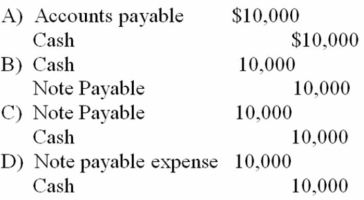
A) Choice A
B) Choice B
C) Choice C
D) Choice D
A) Choice A
B) Choice B
C) Choice C
D) Choice D
Question
Question
Question
Question
Question
Question
Question
Question
Question
For each of the following events, which ones result in an exchange transaction for the O'Brien Company?

Question
Question
Question
Question
Question
Question
Question
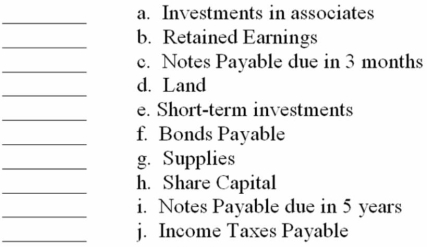
Classify the following statement of financial position accounts for White Goose Linen Co.
Question
Question
Question
Question
Question
Question
Question
Assume a company's January 1, 20A, financial position was: Assets, $40,000 and Liabilities, $15,000. During January 20A, the company completed the following transactions: (a) paid on a note payable, $4,000 (no interest); (b) collected trade receivables, $4,000; (c) paid trade payables, $2,000; and (d) purchased a truck, $1,000 cash, and $8,000 notes payable. What is the company's January 31, 20A, financial position? 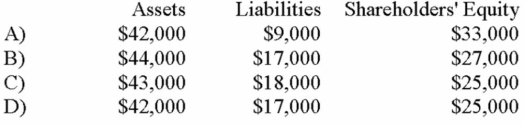
A) Choice A
B) Choice B
C) Choice C
D) Choice D
A) Choice A
B) Choice B
C) Choice C
D) Choice D
Question
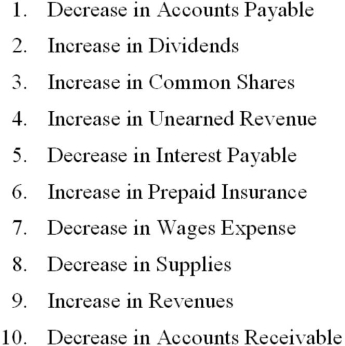
For each item below, indicate whether the account will be debited or credited:
Question
Question
Question
Question
Question
Question
Question
Question
Question
Question
Question
Question
Question
Question
Question
Question
Question
Question
Question
Question
Question
Question
Question
Question

Unlock Deck
Sign up to unlock the cards in this deck!
Unlock Deck
Unlock Deck
1/103

Play

Full screen (f)
Deck 2: Investing and Financing Decisions and the Accounting System
1
The trade payables account has a beginning balance of $1,000 and we purchased $3,000 of inventory on credit during the month. The ending balance was $800. How much did we pay our creditors during the month?
A) $3,000
B) $3,200
C) $4,800
D) $2,800
A) $3,000
B) $3,200
C) $4,800
D) $2,800
B
2
The purchase of an asset on credit
A) has no effect on total assets.
B) increases assets and liabilities.
C) increases assets and shareholders' equity.
D) decreases assets and increases liabilities.
A) has no effect on total assets.
B) increases assets and liabilities.
C) increases assets and shareholders' equity.
D) decreases assets and increases liabilities.
B
3
Which of the following will not result in recording a transaction?
A) Buying equipment and agreeing to pay a note payable and interest at the end of a year.
B) Paying our employees their wages.
C) Selling shares to investors.
D) Signing a contract to have an outside cleaning service clean offices nightly.
A) Buying equipment and agreeing to pay a note payable and interest at the end of a year.
B) Paying our employees their wages.
C) Selling shares to investors.
D) Signing a contract to have an outside cleaning service clean offices nightly.
D
4
Financing activities involve
A) issuing shares.
B) acquiring long-lived assets.
C) lending money.
D) acquiring investments.
A) issuing shares.
B) acquiring long-lived assets.
C) lending money.
D) acquiring investments.
Unlock Deck
Unlock for access to all 103 flashcards in this deck.
Unlock Deck
k this deck
5
Which one of the following represents the expanded basic accounting equation?
A) Assets = Liabilities + Contributed capital + Retained Earnings + Revenues - Expenses - Dividends
B) Assets = Revenues + Expenses - Liabilities
C) Assets - Liabilities - Dividends = Contributed capital + Revenues - Expenses
D) Assets + Liabilities = Dividends + Expenses + Contributed capital + Revenues
A) Assets = Liabilities + Contributed capital + Retained Earnings + Revenues - Expenses - Dividends
B) Assets = Revenues + Expenses - Liabilities
C) Assets - Liabilities - Dividends = Contributed capital + Revenues - Expenses
D) Assets + Liabilities = Dividends + Expenses + Contributed capital + Revenues
Unlock Deck
Unlock for access to all 103 flashcards in this deck.
Unlock Deck
k this deck
6
Borrowing $100,000 of cash from First National Bank, signing a note to be paid, would do which of the following?
A) Increase notes payable by a debit.
B) Decrease cash by a debit.
C) Increase cash by a credit.
D) Increase notes payable by a credit.
A) Increase notes payable by a debit.
B) Decrease cash by a debit.
C) Increase cash by a credit.
D) Increase notes payable by a credit.
Unlock Deck
Unlock for access to all 103 flashcards in this deck.
Unlock Deck
k this deck
7
Which of the following would cause an inflow of cash?
A) Payment of accounts payable.
B) Sale of an asset for cash at less than its book value.
C) Purchase of inventory for debt.
D) Payment of a long-term mortgage.
A) Payment of accounts payable.
B) Sale of an asset for cash at less than its book value.
C) Purchase of inventory for debt.
D) Payment of a long-term mortgage.
Unlock Deck
Unlock for access to all 103 flashcards in this deck.
Unlock Deck
k this deck
8
If total liabilities decreased by $14,000 during a period of time and shareholders' equity increased by $6,000 during the same period, then the amount and direction (increase or decrease) of the period's change in total assets is a(n)
A) $14,000 increase.
B) $20,000 increase.
C) $8,000 decrease.
D) $8,000 increase.
A) $14,000 increase.
B) $20,000 increase.
C) $8,000 decrease.
D) $8,000 increase.
Unlock Deck
Unlock for access to all 103 flashcards in this deck.
Unlock Deck
k this deck
9
Which of the following is not considered an asset?
A) Accounts receivable
B) Equipment
C) Dividends
D) Inventory
A) Accounts receivable
B) Equipment
C) Dividends
D) Inventory
Unlock Deck
Unlock for access to all 103 flashcards in this deck.
Unlock Deck
k this deck
10
Which of the following defines assets?
A) Probable future economic benefits owned by an entity as a result of future transactions.
B) Probable future economic benefits owned by an entity as a result of past transactions.
C) Possible future economic benefits owed by an entity as a result of past transactions.
D) Possible future economic benefits owed by an entity as a result of future transactions.
A) Probable future economic benefits owned by an entity as a result of future transactions.
B) Probable future economic benefits owned by an entity as a result of past transactions.
C) Possible future economic benefits owed by an entity as a result of past transactions.
D) Possible future economic benefits owed by an entity as a result of future transactions.
Unlock Deck
Unlock for access to all 103 flashcards in this deck.
Unlock Deck
k this deck
11
When a company buys equipment for $60,000 and pays for one third in cash and the other two thirds is financed by a note payable, which of the following are the effects on the accounting equation?
A) Equipment increases by $20,000.
B) Cash decreases by $60,000.
C) Total assets increase by $60,000.
D) Liabilities increase by $40,000.
A) Equipment increases by $20,000.
B) Cash decreases by $60,000.
C) Total assets increase by $60,000.
D) Liabilities increase by $40,000.
Unlock Deck
Unlock for access to all 103 flashcards in this deck.
Unlock Deck
k this deck
12
The following amounts are reported in the ledger of Bowers Company: What is the balance in the contributed capital account?
A) $12,000 credit.
B) $8,000 debit.
C) $12,000 debit.
D) $7,000 credit.
What is the balance in the contributed capital account?A) $12,000 credit.
B) $8,000 debit.
C) $12,000 debit.
D) $7,000 credit.
Unlock Deck
Unlock for access to all 103 flashcards in this deck.
Unlock Deck
k this deck
13
Which of the following would be an example of a financing transaction?
A) Purchasing equipment for cash.
B) Buying inventory from a supplier on credit.
C) Buying inventory from a supplier for cash.
D) Selling shares to investors for cash.
A) Purchasing equipment for cash.
B) Buying inventory from a supplier on credit.
C) Buying inventory from a supplier for cash.
D) Selling shares to investors for cash.
Unlock Deck
Unlock for access to all 103 flashcards in this deck.
Unlock Deck
k this deck
14
If Golden Company owed Eye Company $500, where would Golden Company reflect this?
A) Statement of cash flows
B) Income statement.
C) Statement of financial position.
D) Statement of changes in equity.
A) Statement of cash flows
B) Income statement.
C) Statement of financial position.
D) Statement of changes in equity.
Unlock Deck
Unlock for access to all 103 flashcards in this deck.
Unlock Deck
k this deck
15
An accountant has debited an asset account for $500 and credited a revenue account for $1,000. What can be done to complete the recording of the transaction?
A) Credit a different asset account for $500.
B) Debit another asset account for $500.
C) Debit a shareholders' equity account for $500.
D) Nothing further must be done.
A) Credit a different asset account for $500.
B) Debit another asset account for $500.
C) Debit a shareholders' equity account for $500.
D) Nothing further must be done.
Unlock Deck
Unlock for access to all 103 flashcards in this deck.
Unlock Deck
k this deck
16
Liabilities are generally classified on a statement of financial position as
A) current liabilities and non-current liabilities.
B) small liabilities and large liabilities.
C) tangible liabilities and intangible liabilities.
D) present liabilities and future liabilities.
A) current liabilities and non-current liabilities.
B) small liabilities and large liabilities.
C) tangible liabilities and intangible liabilities.
D) present liabilities and future liabilities.
Unlock Deck
Unlock for access to all 103 flashcards in this deck.
Unlock Deck
k this deck
17
The purchase of an asset on credit
A) increases assets and liabilities.
B) has no effect on total assets.
C) increases assets and shareholders' equity.
D) decreases assets and increases liabilities.
A) increases assets and liabilities.
B) has no effect on total assets.
C) increases assets and shareholders' equity.
D) decreases assets and increases liabilities.
Unlock Deck
Unlock for access to all 103 flashcards in this deck.
Unlock Deck
k this deck
18
Jet Corporation was organized on March 1, 20B. Jet Corporation issued shares to each of the six owners who paid in a total of $3,000 cash. On the basis of transaction analysis, the following entry should be recorded in the accounts (dr = debit and cr = credit)
A) Cash (cr), $3,000; Contributed capital (dr), $3,000.
B) Cash (dr), $3,000; Contributed capital (cr), $3,000.
C) Cash (cr), $3,000; Shareholders' equity (dr), $3,000.
D) Cash (dr), $3,000; Revenue (cr), $3,000.
A) Cash (cr), $3,000; Contributed capital (dr), $3,000.
B) Cash (dr), $3,000; Contributed capital (cr), $3,000.
C) Cash (cr), $3,000; Shareholders' equity (dr), $3,000.
D) Cash (dr), $3,000; Revenue (cr), $3,000.
Unlock Deck
Unlock for access to all 103 flashcards in this deck.
Unlock Deck
k this deck
19
The best interpretation of the word credit is the
A) right side of an account.
B) offset side of an account.
C) increase side of an account.
D) decrease side of an account.
A) right side of an account.
B) offset side of an account.
C) increase side of an account.
D) decrease side of an account.
Unlock Deck
Unlock for access to all 103 flashcards in this deck.
Unlock Deck
k this deck
20
Winsome Inc. reports total assets and total liabilities of $225,000 and $100,000, respectively, at the conclusion of its first year of business. The company earned $75,000 during the first year and distributed $30,000 in dividends. What was the corporation's contributed capital?
A) $95,000
B) $125,000
C) $80,000
D) $50,000
A) $95,000
B) $125,000
C) $80,000
D) $50,000
Unlock Deck
Unlock for access to all 103 flashcards in this deck.
Unlock Deck
k this deck
21
Shareholders' equity
A) is equal to liabilities and retained earnings.
B) includes retained earnings and contributed capital.
C) is usually equal to cash on hand.
D) is shown on the income statement.
A) is equal to liabilities and retained earnings.
B) includes retained earnings and contributed capital.
C) is usually equal to cash on hand.
D) is shown on the income statement.
Unlock Deck
Unlock for access to all 103 flashcards in this deck.
Unlock Deck
k this deck
22
Collection of a $600 accounts receivable
A) increases an asset $600; decreases a liability $600.
B) decreases a liability $600; increases shareholders' equity $600.
C) has no effect on total assets.
D) decreases an asset $600; decreases a liability $600.
A) increases an asset $600; decreases a liability $600.
B) decreases a liability $600; increases shareholders' equity $600.
C) has no effect on total assets.
D) decreases an asset $600; decreases a liability $600.
Unlock Deck
Unlock for access to all 103 flashcards in this deck.
Unlock Deck
k this deck
23
When a new business is just starting up, which of the following must be done first?
A) Acquire the assets both long-lived and short-lived so they can operate.
B) Acquire financing from issuance of shares and borrowing from creditors.
C) These activities all occur simultaneously not sequentially.
D) Generate positive cash flow through successful operations.
A) Acquire the assets both long-lived and short-lived so they can operate.
B) Acquire financing from issuance of shares and borrowing from creditors.
C) These activities all occur simultaneously not sequentially.
D) Generate positive cash flow through successful operations.
Unlock Deck
Unlock for access to all 103 flashcards in this deck.
Unlock Deck
k this deck
24
A T account is
A) a way of depicting the basic form of an account.
B) is the actual account form used in real accounting systems.
C) a special account used instead of a trial balance.
D) a special account used instead of a journal.
A) a way of depicting the basic form of an account.
B) is the actual account form used in real accounting systems.
C) a special account used instead of a trial balance.
D) a special account used instead of a journal.
Unlock Deck
Unlock for access to all 103 flashcards in this deck.
Unlock Deck
k this deck
25
It is assumed that the activities of Petro Canada Corporation can be distinguished from those of Imperial Oil Limited because of the
A) Unit-of-measure assumption.
B) Periodicity assumption.
C) Continuity assumption.
D) Separate-entity assumption.
A) Unit-of-measure assumption.
B) Periodicity assumption.
C) Continuity assumption.
D) Separate-entity assumption.
Unlock Deck
Unlock for access to all 103 flashcards in this deck.
Unlock Deck
k this deck
26
Dow Construction Company reports a net use of cash for investing activities of $1.2 million and a net source of cash provided by financing of $.8 million. What was the effect on the cash balance?
A) To cause the balance to decrease by $.4 million.
B) To cause the balance to increase by $.8 million.
C) To cause the balance to increase by $.4 million.
D) Undeterminable because the beginning cash balance was not given.
A) To cause the balance to decrease by $.4 million.
B) To cause the balance to increase by $.8 million.
C) To cause the balance to increase by $.4 million.
D) Undeterminable because the beginning cash balance was not given.
Unlock Deck
Unlock for access to all 103 flashcards in this deck.
Unlock Deck
k this deck
27
The continuity assumption is inappropriate when
A) liquidation appears likely.
B) fair values are higher than costs.
C) the business is organized as a proprietorship.
D) the business is just starting up.
A) liquidation appears likely.
B) fair values are higher than costs.
C) the business is organized as a proprietorship.
D) the business is just starting up.
Unlock Deck
Unlock for access to all 103 flashcards in this deck.
Unlock Deck
k this deck
28
In the first month of operations, the total of the debit entries to the cash account amounted to $1,900 and the total of the credit entries to the cash account amounted to $1,500. The cash account has a
A) $400 debit balance.
B) $500 credit balance.
C) $900 debit balance.
D) $400 credit balance.
A) $400 debit balance.
B) $500 credit balance.
C) $900 debit balance.
D) $400 credit balance.
Unlock Deck
Unlock for access to all 103 flashcards in this deck.
Unlock Deck
k this deck
29
Which of the following transactions will cause both the left and right side of the equation to increase?
A) We collect cash from a customer who owed us money
B) We borrow money from the bank
C) We pay a supplier for inventory we previously bought on account
D) We purchase equipment for cash
A) We collect cash from a customer who owed us money
B) We borrow money from the bank
C) We pay a supplier for inventory we previously bought on account
D) We purchase equipment for cash
Unlock Deck
Unlock for access to all 103 flashcards in this deck.
Unlock Deck
k this deck
30
Which of the following defines shareholders' equity?
A) Probable debts or obligations of an entity as a result of past transactions which will be paid with assets or services.
B) Assets plus liabilities.
C) The financing provided by the owners and the operations of a business.
D) Probable future economic benefits owned by an entity as a result of past transactions.
A) Probable debts or obligations of an entity as a result of past transactions which will be paid with assets or services.
B) Assets plus liabilities.
C) The financing provided by the owners and the operations of a business.
D) Probable future economic benefits owned by an entity as a result of past transactions.
Unlock Deck
Unlock for access to all 103 flashcards in this deck.
Unlock Deck
k this deck
31
On a classified balance sheet, prepaid expenses are classified as
A) a long-term investment.
B) a current asset.
C) property, plant, and equipment.
D) a current liability.
A) a long-term investment.
B) a current asset.
C) property, plant, and equipment.
D) a current liability.
Unlock Deck
Unlock for access to all 103 flashcards in this deck.
Unlock Deck
k this deck
32
Salida Company paid a note payable of $10,000 (interest had previously been paid). This transaction should be recorded as follows on the payment date.
A) Choice A
B) Choice B
C) Choice C
D) Choice D
A) Choice A
B) Choice B
C) Choice C
D) Choice D
Unlock Deck
Unlock for access to all 103 flashcards in this deck.
Unlock Deck
k this deck
33
If total liabilities increased by $25,000 and shareholders' equity increased by $5,000 during a period of time, then total assets must change by what amount and direction during that same period?
A) $20,000 increase
B) $25,000 increase
C) $30,000 increase
D) $20,000 decrease
A) $20,000 increase
B) $25,000 increase
C) $30,000 increase
D) $20,000 decrease
Unlock Deck
Unlock for access to all 103 flashcards in this deck.
Unlock Deck
k this deck
34
Which of the following defines liabilities?
A) Probable debts or obligations of an entity as a result of future transactions which will be paid with assets or services.
B) Possible debts or obligations of an entity as a result of future transactions which will be paid with assets or services.
C) Possible debts or obligations of an entity as a result of past transactions which will be paid with assets or services.
D) Probable debts or obligations of an entity as a result of past transactions which will be paid with assets or services.
A) Probable debts or obligations of an entity as a result of future transactions which will be paid with assets or services.
B) Possible debts or obligations of an entity as a result of future transactions which will be paid with assets or services.
C) Possible debts or obligations of an entity as a result of past transactions which will be paid with assets or services.
D) Probable debts or obligations of an entity as a result of past transactions which will be paid with assets or services.
Unlock Deck
Unlock for access to all 103 flashcards in this deck.
Unlock Deck
k this deck
35
Abe Cox is the sole owner and manager of Cox Auto Repair Shop. In 20A, Cox purchased a new automobile for personal use and continued to use an old truck in the business. Which of the following fundamentals prevents Cox from recording the cost of the new automobile as an asset to the business?
A) Full disclosure.
B) Revenue principle.
C) Separate-entity assumption.
D) Historical cost principle.
A) Full disclosure.
B) Revenue principle.
C) Separate-entity assumption.
D) Historical cost principle.
Unlock Deck
Unlock for access to all 103 flashcards in this deck.
Unlock Deck
k this deck
36
Which of the following is least likely to have a liability called Deferred Revenue?
A) an insurance company
B) a magazine subscription company
C) a retailer
D) a university or college
A) an insurance company
B) a magazine subscription company
C) a retailer
D) a university or college
Unlock Deck
Unlock for access to all 103 flashcards in this deck.
Unlock Deck
k this deck
37
The collection of a trade receivable from a customer would do which of the following?
A) Decrease shareholders' equity.
B) Not affect liabilities.
C) Increase liabilities.
D) Decrease liabilities.
A) Decrease shareholders' equity.
B) Not affect liabilities.
C) Increase liabilities.
D) Decrease liabilities.
Unlock Deck
Unlock for access to all 103 flashcards in this deck.
Unlock Deck
k this deck
38
Which of the following liability accounts is usually not satisfied by payment of cash?
A) Taxes payable.
B) Trade payables.
C) Unearned revenues.
D) Short-term borrowings.
A) Taxes payable.
B) Trade payables.
C) Unearned revenues.
D) Short-term borrowings.
Unlock Deck
Unlock for access to all 103 flashcards in this deck.
Unlock Deck
k this deck
39
The main objective of financial reporting is to:
A) Provide information that will be used by a company's managers for product pricing decisions.
B) Compare a company's performance with its competitors.
C) Provide information that is useful to individuals making investment and credit decisions.
D) Meet the needs of all potential users.
A) Provide information that will be used by a company's managers for product pricing decisions.
B) Compare a company's performance with its competitors.
C) Provide information that is useful to individuals making investment and credit decisions.
D) Meet the needs of all potential users.
Unlock Deck
Unlock for access to all 103 flashcards in this deck.
Unlock Deck
k this deck
40
Where would we report changes in shareholders' equity caused by operating activities?
A) In a liability account.
B) In a contributed capital account.
C) In an asset account.
D) In the retained earnings account.
A) In a liability account.
B) In a contributed capital account.
C) In an asset account.
D) In the retained earnings account.
Unlock Deck
Unlock for access to all 103 flashcards in this deck.
Unlock Deck
k this deck
41
For each of the following events, which ones result in an exchange transaction for the O'Brien Company?
Unlock Deck
Unlock for access to all 103 flashcards in this deck.
Unlock Deck
k this deck
42
Assets normally show
A) credit balances.
B) debit and credit balances.
C) debit or credit balances.
D) debit balances.
A) credit balances.
B) debit and credit balances.
C) debit or credit balances.
D) debit balances.
Unlock Deck
Unlock for access to all 103 flashcards in this deck.
Unlock Deck
k this deck
43
Which one of the following is not a qualitative characteristic of useful accounting information?
A) Relevance
B) Materiality
C) Comparability
D) Faithful representation
A) Relevance
B) Materiality
C) Comparability
D) Faithful representation
Unlock Deck
Unlock for access to all 103 flashcards in this deck.
Unlock Deck
k this deck
44
When a business owner invests cash in the business, the investment causes a liability to increase.
Unlock Deck
Unlock for access to all 103 flashcards in this deck.
Unlock Deck
k this deck
45
Match the terminology with the description by entering the proper letter in the space to the left.
A. Credits
B. Share Capital
C. Cost principle
D. Transaction
E. Debits
F. Liability
G. Statement of financial position
H. Primary objective of external financial reporting
I. Separate-entity assumption
J. Retained earnings
K. As at December 31, 20A
L. For the period ended December 31, 20A
M. None of the above is correct
1. Increase assets and decreases shareholders'' equity.
2. An exchange between an entity and another party.
____ 3. Normal balances for liabilities.
____ 4. To provide useful economic information about a business to help external parties make sound financial decisions.
5. Accounting assumption that requires assets to be recorded at their cash equivalent cost.
____ 6. Cumulative earnings that have not been distributed to the owners.
____ 7. A debt owed by the entity.
____ 8. Statement of financial position.
9. Account for a business separate from its owners.
10. Dating of the statement of financial position (20A).
A. Credits
B. Share Capital
C. Cost principle
D. Transaction
E. Debits
F. Liability
G. Statement of financial position
H. Primary objective of external financial reporting
I. Separate-entity assumption
J. Retained earnings
K. As at December 31, 20A
L. For the period ended December 31, 20A
M. None of the above is correct
1. Increase assets and decreases shareholders'' equity.
2. An exchange between an entity and another party.
____ 3. Normal balances for liabilities.
____ 4. To provide useful economic information about a business to help external parties make sound financial decisions.
5. Accounting assumption that requires assets to be recorded at their cash equivalent cost.
____ 6. Cumulative earnings that have not been distributed to the owners.
____ 7. A debt owed by the entity.
____ 8. Statement of financial position.
9. Account for a business separate from its owners.
10. Dating of the statement of financial position (20A).
Unlock Deck
Unlock for access to all 103 flashcards in this deck.
Unlock Deck
k this deck
46
Normally, asset accounts will have credit balances and liability accounts will have debit balances.
Unlock Deck
Unlock for access to all 103 flashcards in this deck.
Unlock Deck
k this deck
47
Qualitative characteristics of accounting information are not part of the conceptual framework of accounting.
Unlock Deck
Unlock for access to all 103 flashcards in this deck.
Unlock Deck
k this deck
48
Classify the following statement of financial position accounts for White Goose Linen Co.
Unlock Deck
Unlock for access to all 103 flashcards in this deck.
Unlock Deck
k this deck
49
The payment of a liability
A) increases assets and decreases liabilities.
B) decreases assets and shareholders' equity.
C) decreases assets and increases liabilities.
D) decreases assets and liabilities.
A) increases assets and decreases liabilities.
B) decreases assets and shareholders' equity.
C) decreases assets and increases liabilities.
D) decreases assets and liabilities.
Unlock Deck
Unlock for access to all 103 flashcards in this deck.
Unlock Deck
k this deck
50
A T-account is an accounting method of expressing the effects of a single transaction in a debits-equal-credits format.
Unlock Deck
Unlock for access to all 103 flashcards in this deck.
Unlock Deck
k this deck
51
Investing activities include
A) obtaining cash from creditors.
B) obtaining capital from owners.
C) repaying money previously borrowed.
D) collecting the principal on loans made.
A) obtaining cash from creditors.
B) obtaining capital from owners.
C) repaying money previously borrowed.
D) collecting the principal on loans made.
Unlock Deck
Unlock for access to all 103 flashcards in this deck.
Unlock Deck
k this deck
52
The basic system of recording transactions has withstood the test of time, and has been in use for more than 500 years.
Unlock Deck
Unlock for access to all 103 flashcards in this deck.
Unlock Deck
k this deck
53
The objective of transaction analysis is to determine the economic effects of each transaction in terms of the accounting model.
Unlock Deck
Unlock for access to all 103 flashcards in this deck.
Unlock Deck
k this deck
54
Accounting systems should record
A) all economic events.
B) items of interest to the shareholders.
C) only events that involve cash.
D) events that result in a change in assets, liabilities, or shareholders' equity items.
A) all economic events.
B) items of interest to the shareholders.
C) only events that involve cash.
D) events that result in a change in assets, liabilities, or shareholders' equity items.
Unlock Deck
Unlock for access to all 103 flashcards in this deck.
Unlock Deck
k this deck
55
Assume a company's January 1, 20A, financial position was: Assets, $40,000 and Liabilities, $15,000. During January 20A, the company completed the following transactions: (a) paid on a note payable, $4,000 (no interest); (b) collected trade receivables, $4,000; (c) paid trade payables, $2,000; and (d) purchased a truck, $1,000 cash, and $8,000 notes payable. What is the company's January 31, 20A, financial position?
A) Choice A
B) Choice B
C) Choice C
D) Choice D
A) Choice A
B) Choice B
C) Choice C
D) Choice D
Unlock Deck
Unlock for access to all 103 flashcards in this deck.
Unlock Deck
k this deck
56
For each item below, indicate whether the account will be debited or credited:
Unlock Deck
Unlock for access to all 103 flashcards in this deck.
Unlock Deck
k this deck
57
When recording transactions in T-account format, we must add an additional step to the transaction analysis process. Which of the following is the additional step?
A) Determine if the affected accounts are increased or decreased by the transaction.
B) The accounting equation must remain in balance after each transaction.
C) We must have equal debits and credits once the entry is recorded in the accounts.
D) Determine what accounts and elements in the equation are affected by the transaction.
A) Determine if the affected accounts are increased or decreased by the transaction.
B) The accounting equation must remain in balance after each transaction.
C) We must have equal debits and credits once the entry is recorded in the accounts.
D) Determine what accounts and elements in the equation are affected by the transaction.
Unlock Deck
Unlock for access to all 103 flashcards in this deck.
Unlock Deck
k this deck
58
If you trade your computer plus cash for a new car, the cost of the new car is equal to the cash paid plus the market value of the computer.
Unlock Deck
Unlock for access to all 103 flashcards in this deck.
Unlock Deck
k this deck
59
A weakness of the current ratio is
A) that it can be expressed as a percentage, as a rate, or as a proportion.
B) that it is rarely used by sophisticated analysts.
C) the difficulty of the calculation.
D) that it doesn't take into account the composition of the current assets.
A) that it can be expressed as a percentage, as a rate, or as a proportion.
B) that it is rarely used by sophisticated analysts.
C) the difficulty of the calculation.
D) that it doesn't take into account the composition of the current assets.
Unlock Deck
Unlock for access to all 103 flashcards in this deck.
Unlock Deck
k this deck
60
The classification and normal balance of the dividend account is
A) a liability with a credit balance.
B) revenue with a credit balance.
C) shareholders' equity with a debit balance.
D) an expense with a debit balance.
A) a liability with a credit balance.
B) revenue with a credit balance.
C) shareholders' equity with a debit balance.
D) an expense with a debit balance.
Unlock Deck
Unlock for access to all 103 flashcards in this deck.
Unlock Deck
k this deck
61
The sale of land for cash would be classified as a cash inflow from an investing activity.
Unlock Deck
Unlock for access to all 103 flashcards in this deck.
Unlock Deck
k this deck
62
If the correct accounts have been identified and the appropriate direction of the effect on each account has been determined, then the equation should remain in balance.
Unlock Deck
Unlock for access to all 103 flashcards in this deck.
Unlock Deck
k this deck
63
Transactions have a dual economic effect on the fundamental accounting model.
Unlock Deck
Unlock for access to all 103 flashcards in this deck.
Unlock Deck
k this deck
64
Long-term investments appear in the property, plant, and equipment section of the balance sheet.
Unlock Deck
Unlock for access to all 103 flashcards in this deck.
Unlock Deck
k this deck
65
Recording the borrowing of cash with a note payable increases shareholders' equity.
Unlock Deck
Unlock for access to all 103 flashcards in this deck.
Unlock Deck
k this deck
66
A T-account shows total debits of $25,000 and total credits of $22,000; therefore, it has a
$3,000 credit balance.
$3,000 credit balance.
Unlock Deck
Unlock for access to all 103 flashcards in this deck.
Unlock Deck
k this deck
67
"Debit" is the designation for the left side of an account, and "credit" is the designation for the right side of an account.
Unlock Deck
Unlock for access to all 103 flashcards in this deck.
Unlock Deck
k this deck
68
Faithful representation means information must be free from material error, neutral and complete.
Unlock Deck
Unlock for access to all 103 flashcards in this deck.
Unlock Deck
k this deck
69
Debit and credit can be interpreted to mean "bad" and "good," respectively.
Unlock Deck
Unlock for access to all 103 flashcards in this deck.
Unlock Deck
k this deck
70
Usually when a short-term, interest-bearing note payable is paid on its maturity date, an asset is credited and a liability is debited.
Unlock Deck
Unlock for access to all 103 flashcards in this deck.
Unlock Deck
k this deck
71
The activity from the balance sheet to be presented in the financing activities section of the cash flow statement is based on an analysis of shareholders' equity only.
Unlock Deck
Unlock for access to all 103 flashcards in this deck.
Unlock Deck
k this deck
72
Three of the four basic assumptions that underlie accounting measurement and reporting relate to the statement of financial position.
Unlock Deck
Unlock for access to all 103 flashcards in this deck.
Unlock Deck
k this deck
73
By themselves, journal entries do not provide the balances in accounts.
Unlock Deck
Unlock for access to all 103 flashcards in this deck.
Unlock Deck
k this deck
74
The unit-of-measure assumption states that financial information is reported in the national monetary unit.
Unlock Deck
Unlock for access to all 103 flashcards in this deck.
Unlock Deck
k this deck
75
Cash and supplies are both classified as current assets.
Unlock Deck
Unlock for access to all 103 flashcards in this deck.
Unlock Deck
k this deck
76
If a company has assets of $60,000 and shareholders' equity of $30,000, then its liabilities must be $90,000.
Unlock Deck
Unlock for access to all 103 flashcards in this deck.
Unlock Deck
k this deck
77
The amount shown on the statement of financial position as shareholders' equity represents the current market value of the owners' residual claim against the company.
Unlock Deck
Unlock for access to all 103 flashcards in this deck.
Unlock Deck
k this deck
78
Calculating financial ratios can give clues to underlying conditions that may not be noticed by examining each financial statement item separately.
Unlock Deck
Unlock for access to all 103 flashcards in this deck.
Unlock Deck
k this deck
79
In its simplest form, a T account consists of three parts: (1) its title, (2) a left or debit side and (3) a right or credit side.
Unlock Deck
Unlock for access to all 103 flashcards in this deck.
Unlock Deck
k this deck
80
Liability accounts are reported on the statement of financial position.
Unlock Deck
Unlock for access to all 103 flashcards in this deck.
Unlock Deck
k this deck
Unlock Deck
Unlock for access to all 103 flashcards in this deck.






