







 Chat with AI

Deck 20: Accounting for Pensions and Postretirement Benefits
Full screen (f)

Question

Question
Question
Question
Question
Question
Question
Question
Question
Question
Question
Question
Question
Question
Question
Question
Question
Question
Question
Question
Question
Question
Question
Which of the following items should be included in pension expense calculated by an employer who sponsors a defined-benefit pension plan for its employees? 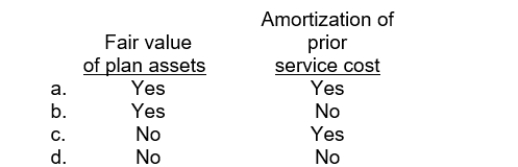
Question
Question
Question
Question
Question
Question
Question
Question
Question
Question
Question
Question
Question
Question
Question
Question
Question
Question
Question
Question
Question
Question
Question
Question
Question
Question
Question
Question
Question
Question
Question
The actuarial gains or losses that result from changes in the projected benefit obligation are called 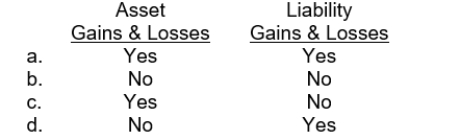
Question
Question
Question
Question
The fair value of pension plan assets is used to determine the corridor and to calculate the expected return on plan assets. 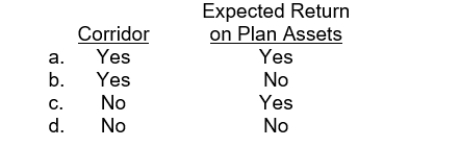
Question
Question
Question
Use the following information for questions 77 and 78.
On January 1, 2015, Newlin Co. has the following balances: The settlement rate is 10%. Other data related to the pension plan for 2015 are:
-The fair value of plan assets at December 31, 2015 is
A) $2,337,000.
B) $2,100,000.
C) $2,202,000.
D) $2,065,000.
On January 1, 2015, Newlin Co. has the following balances:
The settlement rate is 10%. Other data related to the pension plan for 2015 are: -The fair value of plan assets at December 31, 2015 is
A) $2,337,000.
B) $2,100,000.
C) $2,202,000.
D) $2,065,000.
Question
Use the following information for questions 68 through 70.
The following information for Cooper Enterprises is given below: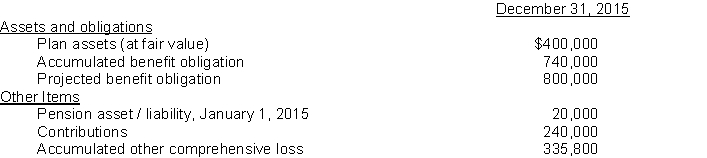 There were no actuarial gains or losses at January 1, 2015. The average remaining service life of employees is 10 years.
What is the pension expense that Cooper Enterprises should report for 2015?
A) $304,200
B) $440,000
C) $240,000
D) $335,800
The following information for Cooper Enterprises is given below:
There were no actuarial gains or losses at January 1, 2015. The average remaining service life of employees is 10 years.What is the pension expense that Cooper Enterprises should report for 2015?
A) $304,200
B) $440,000
C) $240,000
D) $335,800
Question
Question
Question
Use the following information for questions 77 and 78.
On January 1, 2015, Newlin Co. has the following balances: The settlement rate is 10%. Other data related to the pension plan for 2015 are:
-The balance of the projected benefit obligation at December 31, 2015 is
A) $2,490,000.
B) $2,355,000.
C) $2,340,000.
D) $2,310,000.
On January 1, 2015, Newlin Co. has the following balances:
The settlement rate is 10%. Other data related to the pension plan for 2015 are: -The balance of the projected benefit obligation at December 31, 2015 is
A) $2,490,000.
B) $2,355,000.
C) $2,340,000.
D) $2,310,000.
Question
Hubbard, Inc. received the following information from its pension plan trustee concerning the operation of the company's defined-benefit pension plan for the year ended December 31, 2015.  The service cost component of pension expense for 2015 is $890,000 and the amortization of prior service cost due to an increase in benefits is $180,000. The settlement rate is 10% and the expected rate of return is 8%. What is the amount of pension expense for 2015?
A) $1,766,000
B) $1,730,000
C) $1,658,000
D) $1,490,000
The service cost component of pension expense for 2015 is $890,000 and the amortization of prior service cost due to an increase in benefits is $180,000. The settlement rate is 10% and the expected rate of return is 8%. What is the amount of pension expense for 2015?A) $1,766,000
B) $1,730,000
C) $1,658,000
D) $1,490,000
Question
Use the following information for questions 74 through 76.
The following data are for the pension plan for the employees of Lockett Company.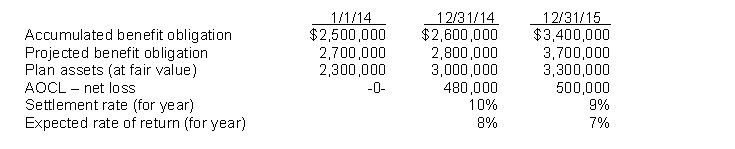 Lockett's contribution was $420,000 in 2015 and benefits paid were $375,000. Lockett
estimates that the average remaining service life is 15 years.
The actual return on plan assets in 2015 was
A) $300,000.
B) $255,000.
C) $200,000.
D) $155,000.
The following data are for the pension plan for the employees of Lockett Company.
Lockett's contribution was $420,000 in 2015 and benefits paid were $375,000. Lockettestimates that the average remaining service life is 15 years.
The actual return on plan assets in 2015 was
A) $300,000.
B) $255,000.
C) $200,000.
D) $155,000.
Question
Use the following information for questions 74 through 76.
The following data are for the pension plan for the employees of Lockett Company. Lockett's contribution was $420,000 in 2015 and benefits paid were $375,000. Lockett
estimates that the average remaining service life is 15 years.
Assume that the actual return on plan assets in 2015 was $265,000. The unexpected gain on plan assets in 2015 was
A) $32,000.
B) $55,000.
C) $35,000.
D) $34,000.
The following data are for the pension plan for the employees of Lockett Company.
Lockett's contribution was $420,000 in 2015 and benefits paid were $375,000. Lockettestimates that the average remaining service life is 15 years.
Assume that the actual return on plan assets in 2015 was $265,000. The unexpected gain on plan assets in 2015 was
A) $32,000.
B) $55,000.
C) $35,000.
D) $34,000.
Question
Question
Use the following information for questions 74 through 76.
The following data are for the pension plan for the employees of Lockett Company. Lockett's contribution was $420,000 in 2015 and benefits paid were $375,000. Lockett
estimates that the average remaining service life is 15 years.
The corridor for 2015 was $300,000. The amount of AOCI-net loss amortized in 2015 was
A) $33,333.
B) $32,000.
C) $14,000.
D) $12,000.
The following data are for the pension plan for the employees of Lockett Company.
Lockett's contribution was $420,000 in 2015 and benefits paid were $375,000. Lockettestimates that the average remaining service life is 15 years.
The corridor for 2015 was $300,000. The amount of AOCI-net loss amortized in 2015 was
A) $33,333.
B) $32,000.
C) $14,000.
D) $12,000.
Question
Question
Use the following information for questions 68 through 70.
The following information for Cooper Enterprises is given below: There were no actuarial gains or losses at January 1, 2015. The average remaining service life of employees is 10 years.
The amortization of Other Comprehensive Loss for 2016 is:
A) $0
B) $25,580
C) $46,000
D) $33,580
The following information for Cooper Enterprises is given below:
There were no actuarial gains or losses at January 1, 2015. The average remaining service life of employees is 10 years.The amortization of Other Comprehensive Loss for 2016 is:
A) $0
B) $25,580
C) $46,000
D) $33,580
Question
Use the following information for questions 68 through 70.
The following information for Cooper Enterprises is given below: There were no actuarial gains or losses at January 1, 2015. The average remaining service life of employees is 10 years.
What is the amount that Cooper Enterprises should report as its pension liability on its balance sheet as of December 31, 2015?
A) $400,000
B) $60,000
C) $740,000
D) $800,000
The following information for Cooper Enterprises is given below:
There were no actuarial gains or losses at January 1, 2015. The average remaining service life of employees is 10 years.What is the amount that Cooper Enterprises should report as its pension liability on its balance sheet as of December 31, 2015?
A) $400,000
B) $60,000
C) $740,000
D) $800,000
Question
Use the following information for questions 80 through 84.
The following information relates to the pension plan for the employees of Turner Co.: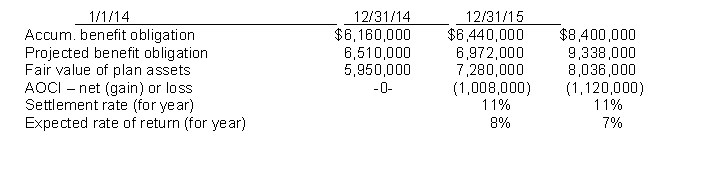 Turner estimates that the average remaining service life is 16 years. Turner's contribution was $882,000 in 2015 and benefits paid were $658,000.
The interest cost for 2015 is
A) $627,480.
B) $708,400.
C) $766,920.
D) $1,027,180.
The following information relates to the pension plan for the employees of Turner Co.:
Turner estimates that the average remaining service life is 16 years. Turner's contribution was $882,000 in 2015 and benefits paid were $658,000.The interest cost for 2015 is
A) $627,480.
B) $708,400.
C) $766,920.
D) $1,027,180.
Question
Question
Barton, Inc. received the following information from its pension plan trustee concerning the operation of the company's defined-benefit pension plan for the year ended December 31, 2015.  The service cost component of pension expense for 2015 is $450,000 and the amortization of prior service cost due to an increase in benefits is $60,000. The settlement rate is 10% and the expected rate of return is 9%. What is the amount of pension expense for 2015?
A) $450,000
B) $612,000
C) $621,000
D) $522,000
The service cost component of pension expense for 2015 is $450,000 and the amortization of prior service cost due to an increase in benefits is $60,000. The settlement rate is 10% and the expected rate of return is 9%. What is the amount of pension expense for 2015?A) $450,000
B) $612,000
C) $621,000
D) $522,000
Question
Question
Question
Question

Unlock Deck
Sign up to unlock the cards in this deck!
Unlock Deck
Unlock Deck
1/138

Play

Full screen (f)
Deck 20: Accounting for Pensions and Postretirement Benefits
1
Companies recognize the accumulated benefit obligation in their accounts and in their financial statements.
False
2
The Pension Asset / Liability account balance equals the difference between the projected benefit obligation and the fair value of pension plan assets.
True
3
Qualified pension plans permit deductibility of the employer's contributions to the pension fund.
True
4
The unexpected gains and losses from changes in the projected benefit obligation are called asset gains and losses.
Unlock Deck
Unlock for access to all 138 flashcards in this deck.
Unlock Deck
k this deck
5
The difference between the expected return and the actual return is referred to as the unexpected gain or loss.
Unlock Deck
Unlock for access to all 138 flashcards in this deck.
Unlock Deck
k this deck
6
When a company amends its defined benefit plan, and recognizes prior service, the projected benefit obligation is increased to recognize this additional liability.
Unlock Deck
Unlock for access to all 138 flashcards in this deck.
Unlock Deck
k this deck
7
Benefits under a pension plan can include the retiree, the retiree's spouse, and other dependents.
Unlock Deck
Unlock for access to all 138 flashcards in this deck.
Unlock Deck
k this deck
8
The accumulated benefit obligation bases the deferred compensation amount on both vested and nonvested service using future salary levels.
Unlock Deck
Unlock for access to all 138 flashcards in this deck.
Unlock Deck
k this deck
9
A pension plan is contributory when the employer makes payments to a funding agency.
Unlock Deck
Unlock for access to all 138 flashcards in this deck.
Unlock Deck
k this deck
10
Companies must disclose a reconciliation of how the projected benefit obligation and the fair value of plan assets changed during the year either in their financial statements or in the notes.
Unlock Deck
Unlock for access to all 138 flashcards in this deck.
Unlock Deck
k this deck
11
Service cost is the expense caused by the increase in the accumulated benefit obligation because of employees' service during the current year.
Unlock Deck
Unlock for access to all 138 flashcards in this deck.
Unlock Deck
k this deck
12
An employer does not have to report a liability on its balance sheet in a defined-benefit plan.
Unlock Deck
Unlock for access to all 138 flashcards in this deck.
Unlock Deck
k this deck
13
The FASB makes it mandatory to use only the years-of-service method for amortization of prior service cost.
Unlock Deck
Unlock for access to all 138 flashcards in this deck.
Unlock Deck
k this deck
14
If the Accumulated Other Comprehensive Income (G/L) account is less than the corridor, the net gains and losses are subject to amortization.
Unlock Deck
Unlock for access to all 138 flashcards in this deck.
Unlock Deck
k this deck
15
Companies should recognize the entire increase in projected benefit obligation due to a plan initiation or amendment as pension expense in the year of amendment.
Unlock Deck
Unlock for access to all 138 flashcards in this deck.
Unlock Deck
k this deck
16
Employers are at risk with defined-benefit plans because they must contribute enough to meet the cost of benefits that the plan defines.
Unlock Deck
Unlock for access to all 138 flashcards in this deck.
Unlock Deck
k this deck
17
The Accumulated Other Comprehensive Income (G/L) account is amortized only if it exceeds 10 percent of the larger of the beginning balances of the projected benefit obligation or the market-related plan assets value.
Unlock Deck
Unlock for access to all 138 flashcards in this deck.
Unlock Deck
k this deck
18
The interest component of pension expense in the current period is computed by multiplying the settlement rate by the beginning balance of the projected benefit obligation.
Unlock Deck
Unlock for access to all 138 flashcards in this deck.
Unlock Deck
k this deck
19
Companies compute the vested benefit obligation using only vested benefits, at current salary levels.
Unlock Deck
Unlock for access to all 138 flashcards in this deck.
Unlock Deck
k this deck
20
Companies report Accumulated Other Comprehensive Income (PSC) as a liability on the balance sheet.
Unlock Deck
Unlock for access to all 138 flashcards in this deck.
Unlock Deck
k this deck
21
Differing measures of the pension obligation can be based on
A) all years of service-both vested and nonvested-using current salary levels.
B) only the vested benefits using current salary levels.
C) both vested and nonvested service using future salaries.
D) All of these answers are correct.
A) all years of service-both vested and nonvested-using current salary levels.
B) only the vested benefits using current salary levels.
C) both vested and nonvested service using future salaries.
D) All of these answers are correct.
Unlock Deck
Unlock for access to all 138 flashcards in this deck.
Unlock Deck
k this deck
22
In computing the service cost component of pension expense, the FASB concluded that
A) the accumulated benefit obligation provides a more realistic measure of the pension obligation on a going concern basis.
B) a company should employ an actuarial funding method to report pension expense that best reflects the cost of benefits to employees.
C) the projected benefit obligation using future compensation levels provides a realistic measure of present pension obligation and expense.
D) All of these answers are correct.
A) the accumulated benefit obligation provides a more realistic measure of the pension obligation on a going concern basis.
B) a company should employ an actuarial funding method to report pension expense that best reflects the cost of benefits to employees.
C) the projected benefit obligation using future compensation levels provides a realistic measure of present pension obligation and expense.
D) All of these answers are correct.
Unlock Deck
Unlock for access to all 138 flashcards in this deck.
Unlock Deck
k this deck
23
Which of the following items should be included in pension expense calculated by an employer who sponsors a defined-benefit pension plan for its employees?
Unlock Deck
Unlock for access to all 138 flashcards in this deck.
Unlock Deck
k this deck
24
In all pension plans, the accounting include all the following except
A) measuring the amount of pension obligation.
B) disclosing the status and effects of the plan in the financial statements.
C) allocating the cost of the plan to the proper periods.
D) determining the level of individual premiums.
A) measuring the amount of pension obligation.
B) disclosing the status and effects of the plan in the financial statements.
C) allocating the cost of the plan to the proper periods.
D) determining the level of individual premiums.
Unlock Deck
Unlock for access to all 138 flashcards in this deck.
Unlock Deck
k this deck
25
Alternative methods exist for the measurement of the pension obligation (liability). Which measure requires the use of future salaries in its computation?
A) Vested benefit obligation
B) Accumulated benefit obligation
C) Projected benefit obligation
D) Restructured benefit obligation
A) Vested benefit obligation
B) Accumulated benefit obligation
C) Projected benefit obligation
D) Restructured benefit obligation
Unlock Deck
Unlock for access to all 138 flashcards in this deck.
Unlock Deck
k this deck
26
Which of the following is not a characteristic of a defined-contribution pension plan?
A) The employer's contribution each period is based on a formula.
B) The benefits to be received by employees are determined by an employee's highest compensation level defined by the terms of the plan.
C) The accounting for a defined-contribution plan is straightforward and uncomplicated.
D) The benefit of gain or the risk of loss from the assets contributed to the pension fund is borne by the employee.
A) The employer's contribution each period is based on a formula.
B) The benefits to be received by employees are determined by an employee's highest compensation level defined by the terms of the plan.
C) The accounting for a defined-contribution plan is straightforward and uncomplicated.
D) The benefit of gain or the risk of loss from the assets contributed to the pension fund is borne by the employee.
Unlock Deck
Unlock for access to all 138 flashcards in this deck.
Unlock Deck
k this deck
27
In a defined-benefit plan, the process of funding refers to
A) determining the projected benefit obligation.
B) determining the accumulated benefit obligation.
C) making the periodic contributions to a funding agency to ensure that funds are available to meet retirees' claims.
D) determining the amount that might be reported for pension expense.
A) determining the projected benefit obligation.
B) determining the accumulated benefit obligation.
C) making the periodic contributions to a funding agency to ensure that funds are available to meet retirees' claims.
D) determining the amount that might be reported for pension expense.
Unlock Deck
Unlock for access to all 138 flashcards in this deck.
Unlock Deck
k this deck
28
One component of pension expense is actual return on plan assets. Plan assets include
A) assets that a company holds to earn a reasonable return, generally at minimum risk.
B) plan assets still under the control of the company.
C) only assets reported on the balance sheet of the employer as prepaid pension cost.
D) None of these answers are correct.
A) assets that a company holds to earn a reasonable return, generally at minimum risk.
B) plan assets still under the control of the company.
C) only assets reported on the balance sheet of the employer as prepaid pension cost.
D) None of these answers are correct.
Unlock Deck
Unlock for access to all 138 flashcards in this deck.
Unlock Deck
k this deck
29
In determining the present value of the prospective benefits (often referred to as the projected benefit obligation), which of the following are considered by the actuary?
A) Retirement and mortality rate.
B) Interest rates.
C) Benefit provisions of the plan.
D) All of these are considered.
A) Retirement and mortality rate.
B) Interest rates.
C) Benefit provisions of the plan.
D) All of these are considered.
Unlock Deck
Unlock for access to all 138 flashcards in this deck.
Unlock Deck
k this deck
30
The actual return on plan assets
A) is equal to the change in the fair value of the plan assets during the year.
B) includes interest, dividends, and changes in the fair value of the fund assets.
C) is equal to the expected rate of return times the fair value of the plan assets at the beginning of the period.
D) All of these answers are correct.
A) is equal to the change in the fair value of the plan assets during the year.
B) includes interest, dividends, and changes in the fair value of the fund assets.
C) is equal to the expected rate of return times the fair value of the plan assets at the beginning of the period.
D) All of these answers are correct.
Unlock Deck
Unlock for access to all 138 flashcards in this deck.
Unlock Deck
k this deck
31
In accounting for a defined-benefit pension plan
A) an appropriate funding pattern must be established to ensure that enough monies will be available at retirement to meet the benefits promised.
B) the employer's responsibility is simply to make a contribution each year based on the formula established in the plan.
C) the expense recognized each period is equal to the cash contribution.
D) the liability is determined based upon known variables that reflect future salary levels promised to employees.
A) an appropriate funding pattern must be established to ensure that enough monies will be available at retirement to meet the benefits promised.
B) the employer's responsibility is simply to make a contribution each year based on the formula established in the plan.
C) the expense recognized each period is equal to the cash contribution.
D) the liability is determined based upon known variables that reflect future salary levels promised to employees.
Unlock Deck
Unlock for access to all 138 flashcards in this deck.
Unlock Deck
k this deck
32
Vested benefits
A) usually require a certain minimum number of years of service.
B) are those that the employee is entitled to receive even if fired.
C) are not contingent upon additional service under the plan.
D) are defined by all of these answers.
A) usually require a certain minimum number of years of service.
B) are those that the employee is entitled to receive even if fired.
C) are not contingent upon additional service under the plan.
D) are defined by all of these answers.
Unlock Deck
Unlock for access to all 138 flashcards in this deck.
Unlock Deck
k this deck
33
The accumulated benefit obligation measures
A) the pension obligation on the basis of the plan formula applied to years of service to date and based on existing salary levels.
B) the pension obligation on the basis of the plan formula applied to years of service to date and based on future salary levels.
C) the level cost that will be sufficient, together with interest to provide the total benefits at retirement.
D) the shortest possible period for funding to maximize the tax deduction.
A) the pension obligation on the basis of the plan formula applied to years of service to date and based on existing salary levels.
B) the pension obligation on the basis of the plan formula applied to years of service to date and based on future salary levels.
C) the level cost that will be sufficient, together with interest to provide the total benefits at retirement.
D) the shortest possible period for funding to maximize the tax deduction.
Unlock Deck
Unlock for access to all 138 flashcards in this deck.
Unlock Deck
k this deck
34
The interest on the projected benefit obligation component of pension expense
A) reflects the incremental borrowing rate of the employer.
B) reflects the rates at which pension benefits could be effectively settled.
C) is the same as the expected return on plan assets.
D) may be stated implicitly or explicitly when reported.
A) reflects the incremental borrowing rate of the employer.
B) reflects the rates at which pension benefits could be effectively settled.
C) is the same as the expected return on plan assets.
D) may be stated implicitly or explicitly when reported.
Unlock Deck
Unlock for access to all 138 flashcards in this deck.
Unlock Deck
k this deck
35
In a defined-contribution plan, a formula is used that
A) defines the benefits that the employee will receive at the time of retirement.
B) ensures that pension expense and the cash funding amount will be different.
C) requires an employer to contribute a certain sum each period based on the formula.
D) ensures that employers are at risk to make sure funds are available at retirement.
A) defines the benefits that the employee will receive at the time of retirement.
B) ensures that pension expense and the cash funding amount will be different.
C) requires an employer to contribute a certain sum each period based on the formula.
D) ensures that employers are at risk to make sure funds are available at retirement.
Unlock Deck
Unlock for access to all 138 flashcards in this deck.
Unlock Deck
k this deck
36
The projected benefit obligation is the measure of pension obligation that
A) is required to be used for reporting the service cost component of pension expense.
B) requires pension expense to be determined solely on the basis of the plan formula applied to years of service to date and based on existing salary levels.
C) requires the longest possible period for funding to maximize the tax deduction.
D) is not sanctioned under generally accepted accounting principles for reporting the service cost component of pension expense.
A) is required to be used for reporting the service cost component of pension expense.
B) requires pension expense to be determined solely on the basis of the plan formula applied to years of service to date and based on existing salary levels.
C) requires the longest possible period for funding to maximize the tax deduction.
D) is not sanctioned under generally accepted accounting principles for reporting the service cost component of pension expense.
Unlock Deck
Unlock for access to all 138 flashcards in this deck.
Unlock Deck
k this deck
37
The computation of pension expense includes all the following except
A) service cost component measured using current salary levels.
B) interest on projected benefit obligation.
C) expected return on plan assets.
D) All of these are included in the computation.
A) service cost component measured using current salary levels.
B) interest on projected benefit obligation.
C) expected return on plan assets.
D) All of these are included in the computation.
Unlock Deck
Unlock for access to all 138 flashcards in this deck.
Unlock Deck
k this deck
38
The relationship between the amount funded and the amount reported for pension expense is as follows:
A) pension expense must equal the amount funded.
B) pension expense will be less than the amount funded.
C) pension expense will be more than the amount funded.
D) pension expense may be greater than, equal to, or less than the amount funded.
A) pension expense must equal the amount funded.
B) pension expense will be less than the amount funded.
C) pension expense will be more than the amount funded.
D) pension expense may be greater than, equal to, or less than the amount funded.
Unlock Deck
Unlock for access to all 138 flashcards in this deck.
Unlock Deck
k this deck
39
In a defined-benefit plan, a formula is used that
A) requires that the benefit of gain or the risk of loss from the assets contributed to the pension plan be borne by the employee.
B) defines the benefits that the employee will receive at the time of retirement.
C) requires that pension expense and the cash funding amount be the same.
D) defines the contribution the employer is to make; no promise is made concerning the ultimate benefits to be paid out to the employees.
A) requires that the benefit of gain or the risk of loss from the assets contributed to the pension plan be borne by the employee.
B) defines the benefits that the employee will receive at the time of retirement.
C) requires that pension expense and the cash funding amount be the same.
D) defines the contribution the employer is to make; no promise is made concerning the ultimate benefits to be paid out to the employees.
Unlock Deck
Unlock for access to all 138 flashcards in this deck.
Unlock Deck
k this deck
40
In accounting for a pension plan, any difference between the pension cost charged to expense and the payments into the fund should be reported as
A) an offset to the liability for prior service cost.
B) pension asset/liability.
C) as other comprehensive income (G/L)
D) as accumulated other comprehensive income (PSC).
A) an offset to the liability for prior service cost.
B) pension asset/liability.
C) as other comprehensive income (G/L)
D) as accumulated other comprehensive income (PSC).
Unlock Deck
Unlock for access to all 138 flashcards in this deck.
Unlock Deck
k this deck
41
A postretirement asset is computed as the excess of the
A) expected postretirement benefit obligation over the fair value of plan assets.
B) accumulated postretirement benefit obligation over the fair value of plan assets.
C) fair value of plan assets over the accumulated postretirement benefit obligation.
D) accumulated postretirement benefit obligation over the fair value of plan assets, but not vice versa.
A) expected postretirement benefit obligation over the fair value of plan assets.
B) accumulated postretirement benefit obligation over the fair value of plan assets.
C) fair value of plan assets over the accumulated postretirement benefit obligation.
D) accumulated postretirement benefit obligation over the fair value of plan assets, but not vice versa.
Unlock Deck
Unlock for access to all 138 flashcards in this deck.
Unlock Deck
k this deck
42
A corporation has a defined-benefit plan. A pension liability will result at the end of the year if the
A) projected benefit obligation exceeds the fair value of the plan assets.
B) fair value of the plan assets exceeds the projected benefit obligation.
C) amount of employer contributions exceeds the pension expense.
D) amount of pension expense exceeds the amount of employer contributions.
A) projected benefit obligation exceeds the fair value of the plan assets.
B) fair value of the plan assets exceeds the projected benefit obligation.
C) amount of employer contributions exceeds the pension expense.
D) amount of pension expense exceeds the amount of employer contributions.
Unlock Deck
Unlock for access to all 138 flashcards in this deck.
Unlock Deck
k this deck
43
Which of the following disclosures of postretirement benefits would not be required by professional pronouncements?
A) Postretirement expense for the period
B) A schedule showing changes in postretirement benefits and plan assets during the year
C) The amount of the EPBO
D) The assumptions and rates used in computing the EPBO and APBO
A) Postretirement expense for the period
B) A schedule showing changes in postretirement benefits and plan assets during the year
C) The amount of the EPBO
D) The assumptions and rates used in computing the EPBO and APBO
Unlock Deck
Unlock for access to all 138 flashcards in this deck.
Unlock Deck
k this deck
44
Gains and losses that relate to the computation of pension expense should be
A) recorded currently as an adjustment to pension expense in the period incurred.
B) recorded currently and in the future by applying the corridor method which provides the amount to be amortized.
C) amortized over a 15-year period.
D) recorded only if a loss is determined.
A) recorded currently as an adjustment to pension expense in the period incurred.
B) recorded currently and in the future by applying the corridor method which provides the amount to be amortized.
C) amortized over a 15-year period.
D) recorded only if a loss is determined.
Unlock Deck
Unlock for access to all 138 flashcards in this deck.
Unlock Deck
k this deck
45
Whenever a defined-benefit plan is amended and credit is given to employees for years of service provided before the date of amendment
A) both the accumulated benefit obligation and the projected benefit obligation are usually greater than before.
B) both the accumulated benefit obligation and the projected benefit obligation are usually less than before.
C) the expense and the liability should be recognized at the time of the plan change.
D) the expense should be recognized immediately, but the liability may be deferred until a reasonable basis for its determination has been identified.
A) both the accumulated benefit obligation and the projected benefit obligation are usually greater than before.
B) both the accumulated benefit obligation and the projected benefit obligation are usually less than before.
C) the expense and the liability should be recognized at the time of the plan change.
D) the expense should be recognized immediately, but the liability may be deferred until a reasonable basis for its determination has been identified.
Unlock Deck
Unlock for access to all 138 flashcards in this deck.
Unlock Deck
k this deck
46
A pension fund gain or loss that is caused by a plant closing should be
A) recognized immediately as a gain or loss on the plant closing.
B) spread over the current year and future years.
C) charged or credited to the current pension expense.
D) recognized as a prior period adjustment.
A) recognized immediately as a gain or loss on the plant closing.
B) spread over the current year and future years.
C) charged or credited to the current pension expense.
D) recognized as a prior period adjustment.
Unlock Deck
Unlock for access to all 138 flashcards in this deck.
Unlock Deck
k this deck
47
Which of the following is true of pension termination?
A) Companies can terminate a pension plan whenever they wish to do so.
B) Terminating a pension plan is illegal in U.S.
C) A company must start a new defined benefit plan after it eliminates the old one.
D) FASB requires recognition in earnings of a gain or loss when a pension obligation is settled.
A) Companies can terminate a pension plan whenever they wish to do so.
B) Terminating a pension plan is illegal in U.S.
C) A company must start a new defined benefit plan after it eliminates the old one.
D) FASB requires recognition in earnings of a gain or loss when a pension obligation is settled.
Unlock Deck
Unlock for access to all 138 flashcards in this deck.
Unlock Deck
k this deck
48
Which of the following is true of healthcare benefits?
A) Healthcare benefit plans are generally not funded.
B) Healthcare benefits are payable monthly.
C) Variables in healthcare benefits are generally predictable.
D) The benefits are well-defined in healthcare benefits.
A) Healthcare benefit plans are generally not funded.
B) Healthcare benefits are payable monthly.
C) Variables in healthcare benefits are generally predictable.
D) The benefits are well-defined in healthcare benefits.
Unlock Deck
Unlock for access to all 138 flashcards in this deck.
Unlock Deck
k this deck
49
The main purpose of the Pension Benefit Guaranty Corporation is to
A) require minimum funding of pensions.
B) require plan administrators to publish a comprehensive description and summary of their plans.
C) administer terminated plans and to impose liens on the employer's assets for certain unfunded pension liabilities.
D) All of these answers are correct.
A) require minimum funding of pensions.
B) require plan administrators to publish a comprehensive description and summary of their plans.
C) administer terminated plans and to impose liens on the employer's assets for certain unfunded pension liabilities.
D) All of these answers are correct.
Unlock Deck
Unlock for access to all 138 flashcards in this deck.
Unlock Deck
k this deck
50
Which of the following disclosures of pension plan information would not normally be required?
A) The major components of pension expense
B) The amount of prior service cost changed or credited in previous years.
C) The funded status of the plan and the amounts recognized in the financial statements
D) The rates used in measuring the benefit amounts
A) The major components of pension expense
B) The amount of prior service cost changed or credited in previous years.
C) The funded status of the plan and the amounts recognized in the financial statements
D) The rates used in measuring the benefit amounts
Unlock Deck
Unlock for access to all 138 flashcards in this deck.
Unlock Deck
k this deck
51
A pension asset is reported when
A) the accumulated benefit obligation exceeds the fair value of pension plan assets.
B) the accumulated benefit obligation exceeds the fair value of pension plan assets, but a prior service cost exists.
C) pension plan assets at fair value exceed the accumulated benefit obligation.
D) pension plan assets at fair value exceed the projected benefit obligation.
A) the accumulated benefit obligation exceeds the fair value of pension plan assets.
B) the accumulated benefit obligation exceeds the fair value of pension plan assets, but a prior service cost exists.
C) pension plan assets at fair value exceed the accumulated benefit obligation.
D) pension plan assets at fair value exceed the projected benefit obligation.
Unlock Deck
Unlock for access to all 138 flashcards in this deck.
Unlock Deck
k this deck
52
Gains or losses can represent changes in
A) EPBO or the fair value of pension plan assets.
B) EPBO or the book value of pension plan assets.
C) APBO or the fair value of pension plan assets.
D) APBO or the book value of pension plan assets.
A) EPBO or the fair value of pension plan assets.
B) EPBO or the book value of pension plan assets.
C) APBO or the fair value of pension plan assets.
D) APBO or the book value of pension plan assets.
Unlock Deck
Unlock for access to all 138 flashcards in this deck.
Unlock Deck
k this deck
53
According to the FASB, recognition of a liability is required when the projected benefit obligation exceeds the fair value of plan assets. Conversely, when the fair value of plan assets exceeds the projected benefit obligation, the Board
A) requires recognition of an asset.
B) requires recognition of an asset if the excess fair value of plan assets exceeds the corridor amount.
C) recommends recognition of an asset but does not require such recognition.
D) does not permit recognition of an asset.
A) requires recognition of an asset.
B) requires recognition of an asset if the excess fair value of plan assets exceeds the corridor amount.
C) recommends recognition of an asset but does not require such recognition.
D) does not permit recognition of an asset.
Unlock Deck
Unlock for access to all 138 flashcards in this deck.
Unlock Deck
k this deck
54
The actuarial gains or losses that result from changes in the projected benefit obligation are called
Unlock Deck
Unlock for access to all 138 flashcards in this deck.
Unlock Deck
k this deck
55
When a company amends a pension plan, for accounting purposes, prior service costs should be
A) treated as a prior period adjustment because no future periods are benefited.
B) amortized in accordance with procedures used for income tax purposes.
C) recorded in other comprehensive income (PSC).
D) reported as an expense in the period the plan is amended.
A) treated as a prior period adjustment because no future periods are benefited.
B) amortized in accordance with procedures used for income tax purposes.
C) recorded in other comprehensive income (PSC).
D) reported as an expense in the period the plan is amended.
Unlock Deck
Unlock for access to all 138 flashcards in this deck.
Unlock Deck
k this deck
56
Which of the following statements is true about postretirement health care benefits?
A) They are generally funded.
B) The benefits are well-defined and level in dollar amount.
C) The beneficiary is the retiree, spouse, and other dependents.
D) The benefit is payable monthly.
A) They are generally funded.
B) The benefits are well-defined and level in dollar amount.
C) The beneficiary is the retiree, spouse, and other dependents.
D) The benefit is payable monthly.
Unlock Deck
Unlock for access to all 138 flashcards in this deck.
Unlock Deck
k this deck
57
Prior service cost is amortized on a
A) straight-line basis over the expected future years of service.
B) years-of-service method or on a straight-line basis over the average remaining service life of active employees.
C) straight-line basis over 15 years.
D) straight-line basis over the average remaining service life of active employees or 15 years, whichever is longer.
A) straight-line basis over the expected future years of service.
B) years-of-service method or on a straight-line basis over the average remaining service life of active employees.
C) straight-line basis over 15 years.
D) straight-line basis over the average remaining service life of active employees or 15 years, whichever is longer.
Unlock Deck
Unlock for access to all 138 flashcards in this deck.
Unlock Deck
k this deck
58
The fair value of pension plan assets is used to determine the corridor and to calculate the expected return on plan assets.
Unlock Deck
Unlock for access to all 138 flashcards in this deck.
Unlock Deck
k this deck
59
When a company adopts a pension plan, prior service costs should be charged to
A) accumulated other comprehensive income (PSC).
B) operations of prior periods.
C) Other comprehensive income (PSC).
D) retained earnings.
A) accumulated other comprehensive income (PSC).
B) operations of prior periods.
C) Other comprehensive income (PSC).
D) retained earnings.
Unlock Deck
Unlock for access to all 138 flashcards in this deck.
Unlock Deck
k this deck
60
A pension liability is reported when
A) the projected benefit obligation exceeds the fair value of pension plan assets.
B) the accumulated benefit obligation is less than the fair value of pension plan assets.
C) the pension expense reported for the period is greater than the funding amount for the same period.
D) accumulated other comprehensive income exceeds the fair value of pension plan assets.
A) the projected benefit obligation exceeds the fair value of pension plan assets.
B) the accumulated benefit obligation is less than the fair value of pension plan assets.
C) the pension expense reported for the period is greater than the funding amount for the same period.
D) accumulated other comprehensive income exceeds the fair value of pension plan assets.
Unlock Deck
Unlock for access to all 138 flashcards in this deck.
Unlock Deck
k this deck
61
Use the following information for questions 77 and 78.
On January 1, 2015, Newlin Co. has the following balances: The settlement rate is 10%. Other data related to the pension plan for 2015 are:
-The fair value of plan assets at December 31, 2015 is
A) $2,337,000.
B) $2,100,000.
C) $2,202,000.
D) $2,065,000.
On January 1, 2015, Newlin Co. has the following balances:
The settlement rate is 10%. Other data related to the pension plan for 2015 are: -The fair value of plan assets at December 31, 2015 is
A) $2,337,000.
B) $2,100,000.
C) $2,202,000.
D) $2,065,000.
Unlock Deck
Unlock for access to all 138 flashcards in this deck.
Unlock Deck
k this deck
62
Use the following information for questions 68 through 70.
The following information for Cooper Enterprises is given below: There were no actuarial gains or losses at January 1, 2015. The average remaining service life of employees is 10 years.
What is the pension expense that Cooper Enterprises should report for 2015?
A) $304,200
B) $440,000
C) $240,000
D) $335,800
The following information for Cooper Enterprises is given below:
There were no actuarial gains or losses at January 1, 2015. The average remaining service life of employees is 10 years.What is the pension expense that Cooper Enterprises should report for 2015?
A) $304,200
B) $440,000
C) $240,000
D) $335,800
Unlock Deck
Unlock for access to all 138 flashcards in this deck.
Unlock Deck
k this deck
63
Which of the following statements about the expected postretirement benefit obligation (EPBO) is not correct?
A) The EPBO is an actuarial present value.
B) The EPBO is recorded in the accounts.
C) The EPBO is used in measuring periodic expense.
D) All of these are correct.
A) The EPBO is an actuarial present value.
B) The EPBO is recorded in the accounts.
C) The EPBO is used in measuring periodic expense.
D) All of these are correct.
Unlock Deck
Unlock for access to all 138 flashcards in this deck.
Unlock Deck
k this deck
64
Presented below is pension information for Green Company for the year 2015: The amount of pension expense to be reported for 2015 is
A) $113,000.
B) $89,000.
C) $60,000.
D) $65,000.
A) $113,000.
B) $89,000.
C) $60,000.
D) $65,000.
Unlock Deck
Unlock for access to all 138 flashcards in this deck.
Unlock Deck
k this deck
65
Use the following information for questions 77 and 78.
On January 1, 2015, Newlin Co. has the following balances: The settlement rate is 10%. Other data related to the pension plan for 2015 are:
-The balance of the projected benefit obligation at December 31, 2015 is
A) $2,490,000.
B) $2,355,000.
C) $2,340,000.
D) $2,310,000.
On January 1, 2015, Newlin Co. has the following balances:
The settlement rate is 10%. Other data related to the pension plan for 2015 are: -The balance of the projected benefit obligation at December 31, 2015 is
A) $2,490,000.
B) $2,355,000.
C) $2,340,000.
D) $2,310,000.
Unlock Deck
Unlock for access to all 138 flashcards in this deck.
Unlock Deck
k this deck
66
Hubbard, Inc. received the following information from its pension plan trustee concerning the operation of the company's defined-benefit pension plan for the year ended December 31, 2015. The service cost component of pension expense for 2015 is $890,000 and the amortization of prior service cost due to an increase in benefits is $180,000. The settlement rate is 10% and the expected rate of return is 8%. What is the amount of pension expense for 2015?
A) $1,766,000
B) $1,730,000
C) $1,658,000
D) $1,490,000
The service cost component of pension expense for 2015 is $890,000 and the amortization of prior service cost due to an increase in benefits is $180,000. The settlement rate is 10% and the expected rate of return is 8%. What is the amount of pension expense for 2015?A) $1,766,000
B) $1,730,000
C) $1,658,000
D) $1,490,000
Unlock Deck
Unlock for access to all 138 flashcards in this deck.
Unlock Deck
k this deck
67
Use the following information for questions 74 through 76.
The following data are for the pension plan for the employees of Lockett Company. Lockett's contribution was $420,000 in 2015 and benefits paid were $375,000. Lockett
estimates that the average remaining service life is 15 years.
The actual return on plan assets in 2015 was
A) $300,000.
B) $255,000.
C) $200,000.
D) $155,000.
The following data are for the pension plan for the employees of Lockett Company.
Lockett's contribution was $420,000 in 2015 and benefits paid were $375,000. Lockettestimates that the average remaining service life is 15 years.
The actual return on plan assets in 2015 was
A) $300,000.
B) $255,000.
C) $200,000.
D) $155,000.
Unlock Deck
Unlock for access to all 138 flashcards in this deck.
Unlock Deck
k this deck
68
Use the following information for questions 74 through 76.
The following data are for the pension plan for the employees of Lockett Company. Lockett's contribution was $420,000 in 2015 and benefits paid were $375,000. Lockett
estimates that the average remaining service life is 15 years.
Assume that the actual return on plan assets in 2015 was $265,000. The unexpected gain on plan assets in 2015 was
A) $32,000.
B) $55,000.
C) $35,000.
D) $34,000.
The following data are for the pension plan for the employees of Lockett Company.
Lockett's contribution was $420,000 in 2015 and benefits paid were $375,000. Lockettestimates that the average remaining service life is 15 years.
Assume that the actual return on plan assets in 2015 was $265,000. The unexpected gain on plan assets in 2015 was
A) $32,000.
B) $55,000.
C) $35,000.
D) $34,000.
Unlock Deck
Unlock for access to all 138 flashcards in this deck.
Unlock Deck
k this deck
69
Which of the following statements about the recognition of a prior service cost related to a postretirement obligation is correct?
A) The prior service amount is recognized in the income statement in the current period.
B) The prior service cost is recognized in the income statement net of tax.
C) Restatement of previously issued annual financial statements is required.
D) The prior service cost amount affects comprehensive income in the current period.
A) The prior service amount is recognized in the income statement in the current period.
B) The prior service cost is recognized in the income statement net of tax.
C) Restatement of previously issued annual financial statements is required.
D) The prior service cost amount affects comprehensive income in the current period.
Unlock Deck
Unlock for access to all 138 flashcards in this deck.
Unlock Deck
k this deck
70
Use the following information for questions 74 through 76.
The following data are for the pension plan for the employees of Lockett Company. Lockett's contribution was $420,000 in 2015 and benefits paid were $375,000. Lockett
estimates that the average remaining service life is 15 years.
The corridor for 2015 was $300,000. The amount of AOCI-net loss amortized in 2015 was
A) $33,333.
B) $32,000.
C) $14,000.
D) $12,000.
The following data are for the pension plan for the employees of Lockett Company.
Lockett's contribution was $420,000 in 2015 and benefits paid were $375,000. Lockettestimates that the average remaining service life is 15 years.
The corridor for 2015 was $300,000. The amount of AOCI-net loss amortized in 2015 was
A) $33,333.
B) $32,000.
C) $14,000.
D) $12,000.
Unlock Deck
Unlock for access to all 138 flashcards in this deck.
Unlock Deck
k this deck
71
Presented below is information related to Jensen Inc. pension plan for 2015. What amount should be reported for pension expense in 2015?
A) $1,485,000
B) $1,455,000
C) $1,635,000
D) $1,275,000
A) $1,485,000
B) $1,455,000
C) $1,635,000
D) $1,275,000
Unlock Deck
Unlock for access to all 138 flashcards in this deck.
Unlock Deck
k this deck
72
Use the following information for questions 68 through 70.
The following information for Cooper Enterprises is given below: There were no actuarial gains or losses at January 1, 2015. The average remaining service life of employees is 10 years.
The amortization of Other Comprehensive Loss for 2016 is:
A) $0
B) $25,580
C) $46,000
D) $33,580
The following information for Cooper Enterprises is given below:
There were no actuarial gains or losses at January 1, 2015. The average remaining service life of employees is 10 years.The amortization of Other Comprehensive Loss for 2016 is:
A) $0
B) $25,580
C) $46,000
D) $33,580
Unlock Deck
Unlock for access to all 138 flashcards in this deck.
Unlock Deck
k this deck
73
Use the following information for questions 68 through 70.
The following information for Cooper Enterprises is given below: There were no actuarial gains or losses at January 1, 2015. The average remaining service life of employees is 10 years.
What is the amount that Cooper Enterprises should report as its pension liability on its balance sheet as of December 31, 2015?
A) $400,000
B) $60,000
C) $740,000
D) $800,000
The following information for Cooper Enterprises is given below:
There were no actuarial gains or losses at January 1, 2015. The average remaining service life of employees is 10 years.What is the amount that Cooper Enterprises should report as its pension liability on its balance sheet as of December 31, 2015?
A) $400,000
B) $60,000
C) $740,000
D) $800,000
Unlock Deck
Unlock for access to all 138 flashcards in this deck.
Unlock Deck
k this deck
74
Use the following information for questions 80 through 84.
The following information relates to the pension plan for the employees of Turner Co.: Turner estimates that the average remaining service life is 16 years. Turner's contribution was $882,000 in 2015 and benefits paid were $658,000.
The interest cost for 2015 is
A) $627,480.
B) $708,400.
C) $766,920.
D) $1,027,180.
The following information relates to the pension plan for the employees of Turner Co.:
Turner estimates that the average remaining service life is 16 years. Turner's contribution was $882,000 in 2015 and benefits paid were $658,000.The interest cost for 2015 is
A) $627,480.
B) $708,400.
C) $766,920.
D) $1,027,180.
Unlock Deck
Unlock for access to all 138 flashcards in this deck.
Unlock Deck
k this deck
75
Which of the following is recognized in the accounts and in the financial statements?
A) Accumulated postretirement benefit obligation
B) Postretirement asset / liability
C) Expected postretirement benefit obligation
D) All of these answers are correct.
A) Accumulated postretirement benefit obligation
B) Postretirement asset / liability
C) Expected postretirement benefit obligation
D) All of these answers are correct.
Unlock Deck
Unlock for access to all 138 flashcards in this deck.
Unlock Deck
k this deck
76
Barton, Inc. received the following information from its pension plan trustee concerning the operation of the company's defined-benefit pension plan for the year ended December 31, 2015. The service cost component of pension expense for 2015 is $450,000 and the amortization of prior service cost due to an increase in benefits is $60,000. The settlement rate is 10% and the expected rate of return is 9%. What is the amount of pension expense for 2015?
A) $450,000
B) $612,000
C) $621,000
D) $522,000
The service cost component of pension expense for 2015 is $450,000 and the amortization of prior service cost due to an increase in benefits is $60,000. The settlement rate is 10% and the expected rate of return is 9%. What is the amount of pension expense for 2015?A) $450,000
B) $612,000
C) $621,000
D) $522,000
Unlock Deck
Unlock for access to all 138 flashcards in this deck.
Unlock Deck
k this deck
77
The following information is related to the pension plan of Long, Inc. for 2015. Pension expense for 2015 is
A) $1,245,000.
B) $1,215,000.
C) $1,080,000.
D) $1,050,000.
A) $1,245,000.
B) $1,215,000.
C) $1,080,000.
D) $1,050,000.
Unlock Deck
Unlock for access to all 138 flashcards in this deck.
Unlock Deck
k this deck
78
Presented below is pension information related to Woods, Inc. for the year 2015: The amount of pension expense to be reported for 2015 is
A) $118,000.
B) $154,000.
C) $172,000.
D) $130,000.
A) $118,000.
B) $154,000.
C) $172,000.
D) $130,000.
Unlock Deck
Unlock for access to all 138 flashcards in this deck.
Unlock Deck
k this deck
79
Kraft, Inc. sponsors a defined-benefit pension plan. The following data relates to the operation of the plan for the year 2015. The expected return on plan assets and the settlement rate were both 10%. The amount of pension expense reported for 2015 is
A) $230,000.
B) $290,000.
C) $310,000.
D) $470,000.
A) $230,000.
B) $290,000.
C) $310,000.
D) $470,000.
Unlock Deck
Unlock for access to all 138 flashcards in this deck.
Unlock Deck
k this deck
80
Rathke, Inc. has a defined-benefit pension plan covering its 50 employees. Rathke agrees to amend its pension benefits. As a result, the projected benefit obligation increased by $2,400,000. Rathke determined that all its employees are expected to receive benefits under the plan over the next 5 years. In addition, 20% are expected to retire or quit each year. Assuming that Rathke uses the years-of-service method of amortization for prior service cost, the amount reported as amortization of prior service cost in year one after the amendment is
A) $480,000.
B) $800,000.
C) $240,000.
D) $640,000.
A) $480,000.
B) $800,000.
C) $240,000.
D) $640,000.
Unlock Deck
Unlock for access to all 138 flashcards in this deck.
Unlock Deck
k this deck
Unlock Deck
Unlock for access to all 138 flashcards in this deck.






