







 Chat with AI

Deck 16: Dilutive Securities and Earnings Per Share
Full screen (f)

Question

Question
Question
Question
Question
Question
Question
Question
Question
Question
Question
Question
Question
Question
Question
Question
Question
Question
Question
Question
Question
Question
Question
Question
Question
Question
Question
Question
Question
Question
Question
Question
Question
Question
Question
Question
Question
Question
The distribution of stock rights to existing common stockholders will increase paid-in capital at the 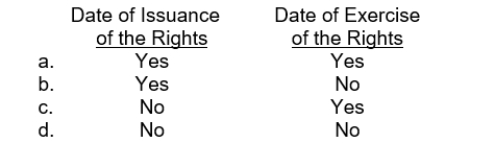
Question
Question
Question
Question
Question
Question
Question
Question
Question
Question
Question
Question
Question
Question
Question
On April 7, 2014, Kegin Corporation sold a $4,000,000, twenty-year, 8 percent bond issue for $4,240,000. Each $1,000 bond has two detachable warrants, each of which permits the purchase of one share of the corporation's common stock for $30. The stock has a par value of $25 per share. Immediately after the sale of the bonds, the corporation's securities had the following market values:  What accounts should Kegin credit to record the sale of the bonds?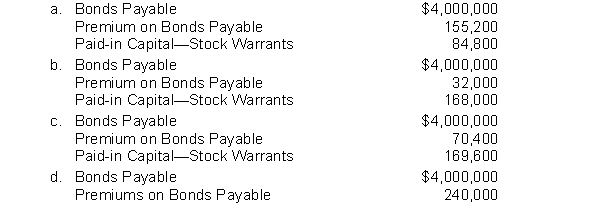
What accounts should Kegin credit to record the sale of the bonds? Question
Question
On July 4, 2014, Chen Company issued for $8,400,000 a total of 80,000 shares of $100 par value, 7% noncumulative preferred stock along with one detachable warrant for each share issued. Each warrant contains a right to purchase one share of Chen $10 par value common stock for $15 per share. The stock without the warrants would normally sell for $8,200,000. The market price of the rights on July 1, 2014, was $2.50 per right. On October 31, 2014, when the market price of the common stock was $19 per share and the market value of the rights was $3.00 per right, 32,000 rights were exercised. As a result of the exercise of the 32,000 rights and the issuance of the related common stock, what journal entry would Chen make? 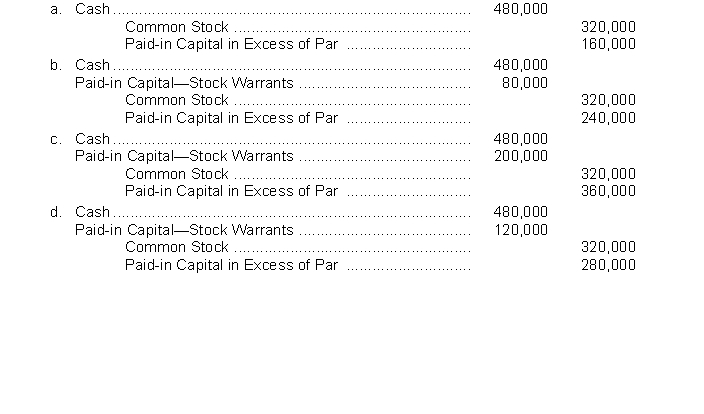
Question
Question
Question
Question
Question
Question
Question
On January 1, 2014, Sharp Corp. granted an employee an option to purchase 12,000 shares of Sharp's $5 par value common stock at $20 per share. The Black-Scholes option pricing model determines total compensation expense to be $280,000. The option became exercisable on December 31, 2015, after the employee completed two years of service. The market prices of Sharp's stock were as follows:  For 2015, should recognize compensation expense under the fair value method of
A) $180,000.
B) $60,000.
C) $140,000.
D) $0.
For 2015, should recognize compensation expense under the fair value method ofA) $180,000.
B) $60,000.
C) $140,000.
D) $0.
Question
On July 1, 2014, Ellison Company granted Sam Wine, an employee, an option to buy 1,000 shares of Ellison Co. stock for $30 per share, the option exercisable for 5 years from date of grant. Using a fair value option pricing model, total compensation expense is determined to be $4,500. Wine exercised his option on October 1, 2014 and sold his 1,000 shares on December 1, 2014. Quoted market prices of Ellison Co. stock in 2014 were:  The service period is for three years beginning January 1, 2014. As a result of the option granted to Wine, using the fair value method, Ellison should recognize compensation expense on its books in the amount of
A) $4,500.
B) $1,500.
C) $1,125.
D) $0.
The service period is for three years beginning January 1, 2014. As a result of the option granted to Wine, using the fair value method, Ellison should recognize compensation expense on its books in the amount ofA) $4,500.
B) $1,500.
C) $1,125.
D) $0.
Question
Question
Question
On January 1, 2015 Reese Company granted Jack Buchanan, an employee, an option to buy 300 shares of Reese Co. stock for $40 per share, the option exercisable for 5 years from date of grant. Using a fair value option pricing model, total compensation expense is determined to be $3,600. Buchanan exercised his option on September 1, 2015, and sold his 100 shares on December 1, 2015. Quoted market prices of Reese Co. stock during 2015 were:  The service period is for two years beginning January 1, 2015. As a result of the option granted to Buchanan, using the fair value method, Reese should recognize compensation expense for 2015 on its books in the amount of
A) $0.
B) $1,800.
C) $3,600
D) $4,200
The service period is for two years beginning January 1, 2015. As a result of the option granted to Buchanan, using the fair value method, Reese should recognize compensation expense for 2015 on its books in the amount ofA) $0.
B) $1,800.
C) $3,600
D) $4,200
Question
Question
On January 1, 2014, Trent Company granted Dick Williams, an employee, an option to buy 400 shares of Trent Co. stock for $30 per share, the option exercisable for 5 years from date of grant. Using a fair value option pricing model, total compensation expense is determined to be $3,600. Williams exercised his option on September 1, 2014, and sold his 400 shares on December 1, 2014. Quoted market prices of Trent Co. stock during 2014 were:  The service period is for two years beginning January 1, 2014. As a result of the option granted to Williams, using the fair value method, Trent should recognize compensation expense for 2014 on its books in the amount of
A) $4,000.
B) $3,600.
C) $1,800.
D) $0.
The service period is for two years beginning January 1, 2014. As a result of the option granted to Williams, using the fair value method, Trent should recognize compensation expense for 2014 on its books in the amount ofA) $4,000.
B) $3,600.
C) $1,800.
D) $0.
Question
Use the following information for questions 75 through 77.
On January 1, 2014, Korsak, Inc. established a stock appreciation rights plan for its executives. It entitled them to receive cash at any time during the next four years for the difference between the market price of its common stock and a pre-established price of $20 on 100,000 SARs. Current market prices of the stock are as follows: Compensation expense relating to the plan is to be recorded over a four-year period beginning January 1, 2014.
On December 31, 2016, 25,000 SARs are exercised by executives. What amount of compensation expense should Korsak recognize for the year ended December 31, 2016?
A) $475,000
B) $325,000
C) $975,000
D) $130,000
On January 1, 2014, Korsak, Inc. established a stock appreciation rights plan for its executives. It entitled them to receive cash at any time during the next four years for the difference between the market price of its common stock and a pre-established price of $20 on 100,000 SARs. Current market prices of the stock are as follows:
Compensation expense relating to the plan is to be recorded over a four-year period beginning January 1, 2014.On December 31, 2016, 25,000 SARs are exercised by executives. What amount of compensation expense should Korsak recognize for the year ended December 31, 2016?
A) $475,000
B) $325,000
C) $975,000
D) $130,000
Question
Question
Question
Question
Use the following information for questions 75 through 77.
On January 1, 2014, Korsak, Inc. established a stock appreciation rights plan for its executives. It entitled them to receive cash at any time during the next four years for the difference between the market price of its common stock and a pre-established price of $20 on 100,000 SARs. Current market prices of the stock are as follows: Compensation expense relating to the plan is to be recorded over a four-year period beginning January 1, 2014.
What amount of compensation expense should Korsak recognize for the year ended December 31, 2014?
A) $ 300,000
B) $ 450,000
C) $ 375,000
D) $1,800,000
On January 1, 2014, Korsak, Inc. established a stock appreciation rights plan for its executives. It entitled them to receive cash at any time during the next four years for the difference between the market price of its common stock and a pre-established price of $20 on 100,000 SARs. Current market prices of the stock are as follows:
Compensation expense relating to the plan is to be recorded over a four-year period beginning January 1, 2014.What amount of compensation expense should Korsak recognize for the year ended December 31, 2014?
A) $ 300,000
B) $ 450,000
C) $ 375,000
D) $1,800,000
Question
In order to retain certain key executives, Jensen Corporation granted them incentive stock options on December 31, 2014. 90,000 options were granted at an option price of $35 per share. Market prices of the stock were as follows:  The options were granted as compensation for executives' services to be rendered over a two-year period beginning January 1, 2015. The Black-Scholes option pricing model determines total compensation expense to be $900,000. What amount of compensation expense should Jensen recognize as a result of this plan for the year endedDecember 31, 2015 under the fair value method?
A) $450,000.
B) $900,000.
C) $990,000.
D) $3,150,000.
The options were granted as compensation for executives' services to be rendered over a two-year period beginning January 1, 2015. The Black-Scholes option pricing model determines total compensation expense to be $900,000. What amount of compensation expense should Jensen recognize as a result of this plan for the year endedDecember 31, 2015 under the fair value method?A) $450,000.
B) $900,000.
C) $990,000.
D) $3,150,000.
Question
Use the following information for questions 75 through 77.
On January 1, 2014, Korsak, Inc. established a stock appreciation rights plan for its executives. It entitled them to receive cash at any time during the next four years for the difference between the market price of its common stock and a pre-established price of $20 on 100,000 SARs. Current market prices of the stock are as follows: Compensation expense relating to the plan is to be recorded over a four-year period beginning January 1, 2014.
What amount of compensation expense should Korsak recognize for the year ended December 31, 2015?
A) $0
B) $50,000
C) $500,000
D) $250,000
On January 1, 2014, Korsak, Inc. established a stock appreciation rights plan for its executives. It entitled them to receive cash at any time during the next four years for the difference between the market price of its common stock and a pre-established price of $20 on 100,000 SARs. Current market prices of the stock are as follows:
Compensation expense relating to the plan is to be recorded over a four-year period beginning January 1, 2014.What amount of compensation expense should Korsak recognize for the year ended December 31, 2015?
A) $0
B) $50,000
C) $500,000
D) $250,000
Question
On January 1, 2015, Evans Company granted Tim Telfer, an employee, an option to buy 3,000 shares of Evans Co. stock for $25 per share, the option exercisable for 5 years from date of grant. Using a fair value option pricing model, total compensation expense is determined to be $22,500. Telfer exercised his option on September 1, 2015, and sold his 1,000 shares on December 1, 2015. Quoted market prices of Evans Co. stock during 2015 were  The service period is for three years beginning January 1, 2015. As a result of the option granted to Telfer, using the fair value method, Evans should recognize compensation expense for 2015 on its books in the amount of
A) $27,000.
B) $22,500.
C) $ 7,500.
D) $ 4,500.
The service period is for three years beginning January 1, 2015. As a result of the option granted to Telfer, using the fair value method, Evans should recognize compensation expense for 2015 on its books in the amount ofA) $27,000.
B) $22,500.
C) $ 7,500.
D) $ 4,500.
Question
In order to retain certain key executives, Smiley Corporation granted them incentive stock options on December 31, 2013. 120,000 options were granted at an option price of $35per share. Market prices of the stock were as follows:  The options were granted as compensation for executives' services to be rendered over a two-year period beginning January 1, 2014. The Black-Scholes option pricing model determines total compensation expense to be $1,200,000. What amount of compensation expense should Smiley recognize as a result of this plan for the year ended December 31, 2014 under the fair value method?
A) $2,100,000.
B) $1,320,000.
C) $1,200,000.
D) $ 600,000.
The options were granted as compensation for executives' services to be rendered over a two-year period beginning January 1, 2014. The Black-Scholes option pricing model determines total compensation expense to be $1,200,000. What amount of compensation expense should Smiley recognize as a result of this plan for the year ended December 31, 2014 under the fair value method?A) $2,100,000.
B) $1,320,000.
C) $1,200,000.
D) $ 600,000.
Question
Question
Question

Unlock Deck
Sign up to unlock the cards in this deck!
Unlock Deck
Unlock Deck
1/160

Play

Full screen (f)
Deck 16: Dilutive Securities and Earnings Per Share
1
Companies recognize the gain or loss on retiring convertible debt as an extraordinary item.
False
2
If an employee fails to exercise a stock option before its expiration date, the company should decrease compensation expense.
False
3
Under the fair value method, companies compute total compensation expense based on the fair value of options on the date of exercise.
False
4
When stock dividends or stock splits occur, companies must restate the shares outstand-ing after the stock dividend or split, in order to compute the weighted-average number of shares.
Unlock Deck
Unlock for access to all 160 flashcards in this deck.
Unlock Deck
k this deck
5
The intrinsic value of a stock option is the difference between the market price of the stock and the exercise price of the options at the grant date.
Unlock Deck
Unlock for access to all 160 flashcards in this deck.
Unlock Deck
k this deck
6
A company should report per share amounts for income before extraordinary items, but not for income from continuing operations.
Unlock Deck
Unlock for access to all 160 flashcards in this deck.
Unlock Deck
k this deck
7
A company should allocate the proceeds from the sale of debt with detachable stock warrants between the two securities based on their market values.
Unlock Deck
Unlock for access to all 160 flashcards in this deck.
Unlock Deck
k this deck
8
If preferred stock is cumulative and no dividends are declared, the company subtracts the current year preferred dividend in computing earnings per share.
Unlock Deck
Unlock for access to all 160 flashcards in this deck.
Unlock Deck
k this deck
9
If a stock dividend occurs after year-end, but before issuing the financial statements, a company must restate the weighted-average number of shares outstanding for the year.
Unlock Deck
Unlock for access to all 160 flashcards in this deck.
Unlock Deck
k this deck
10
The recording of convertible bonds at the date of issue is the same as the recording of straight debt issues.
Unlock Deck
Unlock for access to all 160 flashcards in this deck.
Unlock Deck
k this deck
11
In a contingent issue agreement, the contingent shares are considered outstanding for computing diluted EPS when the earnings or market price level is met by the end of the year.
Unlock Deck
Unlock for access to all 160 flashcards in this deck.
Unlock Deck
k this deck
12
Preferred dividends are subtracted from net income but not income before extraordinary items in computing earnings per share.
Unlock Deck
Unlock for access to all 160 flashcards in this deck.
Unlock Deck
k this deck
13
Companies recognize a gain or loss when stockholders exercise convertible preferred stock.
Unlock Deck
Unlock for access to all 160 flashcards in this deck.
Unlock Deck
k this deck
14
If an employee forfeits a stock option because of failure to satisfy a service requirement, the company should record paid-in capital from expired options.
Unlock Deck
Unlock for access to all 160 flashcards in this deck.
Unlock Deck
k this deck
15
The FASB states that when an issuer makes an additional payment to encourage conversion, the payment should be reported as an expense.
Unlock Deck
Unlock for access to all 160 flashcards in this deck.
Unlock Deck
k this deck
16
The market value method is used to account for the exercise of convertible preferred stock.
Unlock Deck
Unlock for access to all 160 flashcards in this deck.
Unlock Deck
k this deck
17
The service period in stock option plans is the time between the grant date and the vesting date.
Unlock Deck
Unlock for access to all 160 flashcards in this deck.
Unlock Deck
k this deck
18
When a company has a complex capital structure, it must report both basic and diluted earnings per share.
Unlock Deck
Unlock for access to all 160 flashcards in this deck.
Unlock Deck
k this deck
19
Nondetachable warrants, as with detachable warrants, require an allocation of the proceeds between the bonds and the warrants.
Unlock Deck
Unlock for access to all 160 flashcards in this deck.
Unlock Deck
k this deck
20
In computing diluted earnings per share, stock options are considered dilutive when their option price is greater than the market price.
Unlock Deck
Unlock for access to all 160 flashcards in this deck.
Unlock Deck
k this deck
21
Under the intrinsic value method, compensation expense resulting from an incentive stock option is
A) not recognized if the market price does not exceed the option price at the date of grant.
B) recognized in the period of the grant.
C) allocated to the periods benefited by the employee's required service.
D) recognized in the period of exercise.
A) not recognized if the market price does not exceed the option price at the date of grant.
B) recognized in the period of the grant.
C) allocated to the periods benefited by the employee's required service.
D) recognized in the period of exercise.
Unlock Deck
Unlock for access to all 160 flashcards in this deck.
Unlock Deck
k this deck
22
The conversion of bonds is most commonly recorded by the
A) incremental method.
B) proportional method.
C) market value method.
D) book value method.
A) incremental method.
B) proportional method.
C) market value method.
D) book value method.
Unlock Deck
Unlock for access to all 160 flashcards in this deck.
Unlock Deck
k this deck
23
When the cash proceeds from a bond issued with detachable stock warrants exceed the sum of the par value of the bonds and the fair market value of the warrants, the excess should be credited to
A) additional paid-in capital from stock warrants.
B) retained earnings.
C) a liability account.
D) premium on bonds payable.
A) additional paid-in capital from stock warrants.
B) retained earnings.
C) a liability account.
D) premium on bonds payable.
Unlock Deck
Unlock for access to all 160 flashcards in this deck.
Unlock Deck
k this deck
24
The conversion of preferred stock is recorded by the
A) incremental method.
B) book value method.
C) market value method.
D) par value method.
A) incremental method.
B) book value method.
C) market value method.
D) par value method.
Unlock Deck
Unlock for access to all 160 flashcards in this deck.
Unlock Deck
k this deck
25
A corporation issues bonds with detachable warrants. The amount to be recorded as paid-in capital is preferably
A) zero.
B) calculated by the excess of the proceeds over the face amount of the bonds.
C) equal to the market value of the warrants.
D) based on the relative market values of the two securities involved.
A) zero.
B) calculated by the excess of the proceeds over the face amount of the bonds.
C) equal to the market value of the warrants.
D) based on the relative market values of the two securities involved.
Unlock Deck
Unlock for access to all 160 flashcards in this deck.
Unlock Deck
k this deck
26
Compensation expense resulting from a compensatory stock option plan is generally
A) recognized in the period of exercise.
B) recognized in the period of the grant.
C) allocated to the periods benefited by the employee's required service.
D) allocated over the periods of the employee's service life to retirement.
A) recognized in the period of exercise.
B) recognized in the period of the grant.
C) allocated to the periods benefited by the employee's required service.
D) allocated over the periods of the employee's service life to retirement.
Unlock Deck
Unlock for access to all 160 flashcards in this deck.
Unlock Deck
k this deck
27
The date on which to measure the compensation element in a stock option granted to a corporate employee ordinarily is the date on which the employee
A) is granted the option.
B) has performed all conditions precedent to exercising the option.
C) may first exercise the option.
D) the option.
A) is granted the option.
B) has performed all conditions precedent to exercising the option.
C) may first exercise the option.
D) the option.
Unlock Deck
Unlock for access to all 160 flashcards in this deck.
Unlock Deck
k this deck
28
Which of the following is an advantage of a restricted-stock plan?
A) It creates new job opportunities in a company.
B) It never becomes completely worthless.
C) It increases the market price of the stock.
C) It increases the profit of a company.
A) It creates new job opportunities in a company.
B) It never becomes completely worthless.
C) It increases the market price of the stock.
C) It increases the profit of a company.
Unlock Deck
Unlock for access to all 160 flashcards in this deck.
Unlock Deck
k this deck
29
Corporations issue convertible debt for two main reasons. One is the desire to raise equity capital that, assuming conversion, will arise when the original debt is converted. The other is
A) the ease with which convertible debt is sold even if the company has a poor credit rating.
B) the fact that equity capital has issue costs that convertible debt does not.
C) that many corporations can obtain debt financing at lower rates.
D) that convertible bonds will always sell at a premium.
A) the ease with which convertible debt is sold even if the company has a poor credit rating.
B) the fact that equity capital has issue costs that convertible debt does not.
C) that many corporations can obtain debt financing at lower rates.
D) that convertible bonds will always sell at a premium.
Unlock Deck
Unlock for access to all 160 flashcards in this deck.
Unlock Deck
k this deck
30
Convertible bonds
A) have priority over other indebtedness.
B) are usually secured by a first or second mortgage.
C) pay interest only in the event earnings are sufficient to cover the interest.
D) may be exchanged for equity securities.
A) have priority over other indebtedness.
B) are usually secured by a first or second mortgage.
C) pay interest only in the event earnings are sufficient to cover the interest.
D) may be exchanged for equity securities.
Unlock Deck
Unlock for access to all 160 flashcards in this deck.
Unlock Deck
k this deck
31
The conversion of preferred stock into common stock requires that any excess of the par value of the common shares issued over the carrying amount of the preferred being converted should be
A) reflected currently in income, but not as an extraordinary item.
B) reflected currently in income as an extraordinary item.
C) treated as a prior period adjustment.
D) treated as a direct reduction of retained earnings.
A) reflected currently in income, but not as an extraordinary item.
B) reflected currently in income as an extraordinary item.
C) treated as a prior period adjustment.
D) treated as a direct reduction of retained earnings.
Unlock Deck
Unlock for access to all 160 flashcards in this deck.
Unlock Deck
k this deck
32
When convertible debt is retired by the issuer, any material difference between the cash acquisition price and the carrying amount of the debt should be
A) reflected currently in income, but not as an extraordinary item.
B) reflected currently in income as an extraordinary item.
C) treated as a prior period adjustment.
D) treated as an adjustment of additional paid-in capital.
A) reflected currently in income, but not as an extraordinary item.
B) reflected currently in income as an extraordinary item.
C) treated as a prior period adjustment.
D) treated as an adjustment of additional paid-in capital.
Unlock Deck
Unlock for access to all 160 flashcards in this deck.
Unlock Deck
k this deck
33
Which of the following is not a characteristic of a noncompensatory stock option plan?
A) Substantially all full-time employees may participate on an equitable basis.
B) The plan offers no substantive option feature.
C) Unlimited time period permitted for exercise of an option as long as the holder is still employed by the company.
D) Discount from the market price of the stock no greater than would be reasonable in an offer of stock to stockholders or others.
A) Substantially all full-time employees may participate on an equitable basis.
B) The plan offers no substantive option feature.
C) Unlimited time period permitted for exercise of an option as long as the holder is still employed by the company.
D) Discount from the market price of the stock no greater than would be reasonable in an offer of stock to stockholders or others.
Unlock Deck
Unlock for access to all 160 flashcards in this deck.
Unlock Deck
k this deck
34
Which of the following is not a characteristic of a noncompensatory stock purchase plan?
A) It is open to almost all full-time employees.
B) The discount from market price is small.
C) The plan offers no substantive option feature.
D) All of these are characteristics.
A) It is open to almost all full-time employees.
B) The discount from market price is small.
C) The plan offers no substantive option feature.
D) All of these are characteristics.
Unlock Deck
Unlock for access to all 160 flashcards in this deck.
Unlock Deck
k this deck
35
For stock appreciation rights, the measurement date for computing compensation is the date
A) the rights mature.
B) the stock's price reaches a predetermined amount.
C) of grant.
D) of exercise.
A) the rights mature.
B) the stock's price reaches a predetermined amount.
C) of grant.
D) of exercise.
Unlock Deck
Unlock for access to all 160 flashcards in this deck.
Unlock Deck
k this deck
36
If a company offers additional considerations to convertible bondholders in order to encourage conversion, it is called a(an):
A) forced conversion.
B) sweetener.
C) additional conversion.
D) end conversion.
A) forced conversion.
B) sweetener.
C) additional conversion.
D) end conversion.
Unlock Deck
Unlock for access to all 160 flashcards in this deck.
Unlock Deck
k this deck
37
Proceeds from an issue of debt securities having stock warrants should not be allocated between debt and equity features when
A) the market value of the warrants is not readily available.
B) exercise of the warrants within the next few fiscal periods seems remote.
C) the allocation would result in a discount on the debt security.
D) the warrants issued with the debt securities are nondetachable.
A) the market value of the warrants is not readily available.
B) exercise of the warrants within the next few fiscal periods seems remote.
C) the allocation would result in a discount on the debt security.
D) the warrants issued with the debt securities are nondetachable.
Unlock Deck
Unlock for access to all 160 flashcards in this deck.
Unlock Deck
k this deck
38
The distribution of stock rights to existing common stockholders will increase paid-in capital at the
Unlock Deck
Unlock for access to all 160 flashcards in this deck.
Unlock Deck
k this deck
39
Stock warrants outstanding should be classified as
A) liabilities.
B) reductions of capital contributed in excess of par value.
C) assets.
D) None of these answers are correct.
A) liabilities.
B) reductions of capital contributed in excess of par value.
C) assets.
D) None of these answers are correct.
Unlock Deck
Unlock for access to all 160 flashcards in this deck.
Unlock Deck
k this deck
40
The major difference between convertible debt and stock warrants is that upon exercise of the warrants
A) the stock is held by the company for a defined period of time before they are issued to the warrant holder.
B) the holder has to pay a certain amount of cash to obtain the shares.
C) the stock involved is restricted and can only be sold by the recipient after a set period of time.
D) no paid-in capital in excess of par can be a part of the transaction.
A) the stock is held by the company for a defined period of time before they are issued to the warrant holder.
B) the holder has to pay a certain amount of cash to obtain the shares.
C) the stock involved is restricted and can only be sold by the recipient after a set period of time.
D) no paid-in capital in excess of par can be a part of the transaction.
Unlock Deck
Unlock for access to all 160 flashcards in this deck.
Unlock Deck
k this deck
41
Litke Corporation issued at a premium of $5,000 a $100,000 bond issue convertible into 2,000 shares of common stock (par value $20). At the time of the conversion, the unamortized premium is $2,000, the market value of the bonds is $110,000, and the stock is quoted on the market at $60 per share. If the bonds are converted into common, what is the amount of paid-in capital in excess of par to be recorded on the conversion of the bonds?
A) $65,000
B) $62,000
C) $72,000
D) $60,000
A) $65,000
B) $62,000
C) $72,000
D) $60,000
Unlock Deck
Unlock for access to all 160 flashcards in this deck.
Unlock Deck
k this deck
42
On December 1, 2014, Lester Company issued at 103, five hundred of its 9%, $1,000 bonds. Attached to each bond was one detachable stock warrant entitling the holder to purchase 10 shares of Lester's common stock. On December 1, 2014, the market value of the bonds, without the stock warrants, was 95, and the market value of each stock purchase warrant was $50. The amount of the proceeds from the issuance that should be accounted for as the initial carrying value of the bonds payable would be
A) $484,100.
B) $489,250.
C) $500,000.
D) $515,000.
A) $484,100.
B) $489,250.
C) $500,000.
D) $515,000.
Unlock Deck
Unlock for access to all 160 flashcards in this deck.
Unlock Deck
k this deck
43
Use the following information for questions 55 and 56.
On May 1, 2014, Payne Co. issued $900,000 of 7% bonds at 103, which are due on April 30, 2024. Twenty detachable stock warrants entitling the holder to purchase for $40 one share of Payne's common stock, $15 par value, were attached to each $1,000 bond. The bonds without the warrants would sell at 96. On May 1, 2014, the fair value of Payne's common stock was $35 per share and of the warrants was $2.
On May 1, 2014, Payne should credit Paid-in Capital from Stock Warrants for
A) $34,560.
B) $36,000.
C) $37,080.
D) $63,000.
On May 1, 2014, Payne Co. issued $900,000 of 7% bonds at 103, which are due on April 30, 2024. Twenty detachable stock warrants entitling the holder to purchase for $40 one share of Payne's common stock, $15 par value, were attached to each $1,000 bond. The bonds without the warrants would sell at 96. On May 1, 2014, the fair value of Payne's common stock was $35 per share and of the warrants was $2.
On May 1, 2014, Payne should credit Paid-in Capital from Stock Warrants for
A) $34,560.
B) $36,000.
C) $37,080.
D) $63,000.
Unlock Deck
Unlock for access to all 160 flashcards in this deck.
Unlock Deck
k this deck
44
Use the following information for questions 46 through 48.
Chang Corporation issued $4,000,000 of 9%, ten-year convertible bonds on July 1, 2014 at 96.1 plus accrued interest. The bonds were dated April 1, 2014 with interest payable April 1 and October 1. Bond discount is amortized semiannually on a straight-line basis. On April 1, 2015, $800,000 of these bonds were converted into 500 shares of $20 par value common stock. Accrued interest was paid in cash at the time of conversion.
What should be the amount of the unamortized bond discount on April 1, 2015 relating to the bonds converted?
A) $31,200.
B) $28,800.
C) $15,600.
D) $29,600.
Chang Corporation issued $4,000,000 of 9%, ten-year convertible bonds on July 1, 2014 at 96.1 plus accrued interest. The bonds were dated April 1, 2014 with interest payable April 1 and October 1. Bond discount is amortized semiannually on a straight-line basis. On April 1, 2015, $800,000 of these bonds were converted into 500 shares of $20 par value common stock. Accrued interest was paid in cash at the time of conversion.
What should be the amount of the unamortized bond discount on April 1, 2015 relating to the bonds converted?
A) $31,200.
B) $28,800.
C) $15,600.
D) $29,600.
Unlock Deck
Unlock for access to all 160 flashcards in this deck.
Unlock Deck
k this deck
45
Morgan Corporation had two issues of securities outstanding: common stock and an 8% convertible bond issue in the face amount of $12,000,000. Interest payment dates of the bond issue are June 30th and December 31st. The conversion clause in the bond indenture entitles the bondholders to receive forty shares of $20 par value common stock in exchange for each $1,000 bond. On June 30, 2014, the holders of $1,800,000 face value bonds exercised the conversion privilege. The market price of the bonds on that date was $1,100 per bond and the market price of the common stock was $35. The total unamortized bond discount at the date of conversion was $750,000. In applying the book value method, what amount should Morgan credit to the account "paid-in capital in excess of par," as a result of this conversion?
A) $ 247,500.
B) $ 120,000.
C) $1,080,000.
D) $ 540,000.
A) $ 247,500.
B) $ 120,000.
C) $1,080,000.
D) $ 540,000.
Unlock Deck
Unlock for access to all 160 flashcards in this deck.
Unlock Deck
k this deck
46
Use the following information for questions 46 through 48.
Chang Corporation issued $4,000,000 of 9%, ten-year convertible bonds on July 1, 2014 at 96.1 plus accrued interest. The bonds were dated April 1, 2014 with interest payable April 1 and October 1. Bond discount is amortized semiannually on a straight-line basis. On April 1, 2015, $800,000 of these bonds were converted into 500 shares of $20 par value common stock. Accrued interest was paid in cash at the time of conversion.
What was the effective interest rate on the bonds when they were issued?
A) 9%
B) Above 9%
C) Below 9%
D) Cannot determine from the information given.
Chang Corporation issued $4,000,000 of 9%, ten-year convertible bonds on July 1, 2014 at 96.1 plus accrued interest. The bonds were dated April 1, 2014 with interest payable April 1 and October 1. Bond discount is amortized semiannually on a straight-line basis. On April 1, 2015, $800,000 of these bonds were converted into 500 shares of $20 par value common stock. Accrued interest was paid in cash at the time of conversion.
What was the effective interest rate on the bonds when they were issued?
A) 9%
B) Above 9%
C) Below 9%
D) Cannot determine from the information given.
Unlock Deck
Unlock for access to all 160 flashcards in this deck.
Unlock Deck
k this deck
47
Fogel Co. has $3,000,000 of 8% convertible bonds outstanding. Each $1,000 bond is convertible into 30 shares of $30 par value common stock. The bonds pay interest on January 31 and July 31. On July 31, 2014, the holders of $960,000 bonds exercised the conversion privilege. On that date the market price of the bonds was 105 and the market price of the common stock was $36. The total unamortized bond premium at the date of conversion was $210,000. Fogel should record, as a result of this conversion, a
A) credit of $163,200 to Paid-in Capital in Excess of Par.
B) credit of $144,000 to Paid-in Capital in Excess of Par.
C) credit of $67,200 to Premium on Bonds Payable.
D) loss of $9,600.
A) credit of $163,200 to Paid-in Capital in Excess of Par.
B) credit of $144,000 to Paid-in Capital in Excess of Par.
C) credit of $67,200 to Premium on Bonds Payable.
D) loss of $9,600.
Unlock Deck
Unlock for access to all 160 flashcards in this deck.
Unlock Deck
k this deck
48
An executive pays no taxes at the time of exercise in a(an)
A) stock appreciation rights plan.
B) incentive stock option plan.
C) nonqualified stock option plan.
D) Taxes would be paid in all of these.
A) stock appreciation rights plan.
B) incentive stock option plan.
C) nonqualified stock option plan.
D) Taxes would be paid in all of these.
Unlock Deck
Unlock for access to all 160 flashcards in this deck.
Unlock Deck
k this deck
49
Vernon Corporation offered detachable 5-year warrants to buy one share of common stock (par value $5) at $20 (at a time when the stock was selling for $32). The price paid for 6,000, $1,000 bonds with the warrants attached was $615,000. The market price of the Vernon bonds without the warrants was $540,000, and the market price of the warrants without the bonds was $60,000. What amount should be allocated to the warrants?
A) $60,000
B) $61,500
C) $72,000
D) $75,000
A) $60,000
B) $61,500
C) $72,000
D) $75,000
Unlock Deck
Unlock for access to all 160 flashcards in this deck.
Unlock Deck
k this deck
50
On July 1, 2014, an interest payment date, $90,000 of Parks Co. bonds were converted into 1,800 shares of Parks Co. common stock each having a par value of $45 and a market value of $54. There is $3,600 unamortized discount on the bonds. Using the book value method, Parks would record
A) no change in paid-in capital in excess of par.
B) a $5,400 increase in paid-in capital in excess of par.
C) a $10,800 increase in paid-in capital in excess of par.
D) a $7,200 increase in paid-in capital in excess of par.
A) no change in paid-in capital in excess of par.
B) a $5,400 increase in paid-in capital in excess of par.
C) a $10,800 increase in paid-in capital in excess of par.
D) a $7,200 increase in paid-in capital in excess of par.
Unlock Deck
Unlock for access to all 160 flashcards in this deck.
Unlock Deck
k this deck
51
Use the following information for questions 55 and 56.
On May 1, 2014, Payne Co. issued $900,000 of 7% bonds at 103, which are due on April 30, 2024. Twenty detachable stock warrants entitling the holder to purchase for $40 one share of Payne's common stock, $15 par value, were attached to each $1,000 bond. The bonds without the warrants would sell at 96. On May 1, 2014, the fair value of Payne's common stock was $35 per share and of the warrants was $2.
On May 1, 2014, Payne should record the bonds with a
A) discount of $36,000.
B) discount of $10,080.
C) discount of $ 9,000.
D) premium of $27,000.
On May 1, 2014, Payne Co. issued $900,000 of 7% bonds at 103, which are due on April 30, 2024. Twenty detachable stock warrants entitling the holder to purchase for $40 one share of Payne's common stock, $15 par value, were attached to each $1,000 bond. The bonds without the warrants would sell at 96. On May 1, 2014, the fair value of Payne's common stock was $35 per share and of the warrants was $2.
On May 1, 2014, Payne should record the bonds with a
A) discount of $36,000.
B) discount of $10,080.
C) discount of $ 9,000.
D) premium of $27,000.
Unlock Deck
Unlock for access to all 160 flashcards in this deck.
Unlock Deck
k this deck
52
A company estimates the fair value of SARs, using an option-pricing model, for
A) share-based equity awards.
B) share-based liability awards.
C) both equity awards and liability awards.
D) neither equity awards or liability awards.
A) share-based equity awards.
B) share-based liability awards.
C) both equity awards and liability awards.
D) neither equity awards or liability awards.
Unlock Deck
Unlock for access to all 160 flashcards in this deck.
Unlock Deck
k this deck
53
On April 7, 2014, Kegin Corporation sold a $4,000,000, twenty-year, 8 percent bond issue for $4,240,000. Each $1,000 bond has two detachable warrants, each of which permits the purchase of one share of the corporation's common stock for $30. The stock has a par value of $25 per share. Immediately after the sale of the bonds, the corporation's securities had the following market values: What accounts should Kegin credit to record the sale of the bonds?
What accounts should Kegin credit to record the sale of the bonds? Unlock Deck
Unlock for access to all 160 flashcards in this deck.
Unlock Deck
k this deck
54
In 2014, Eklund, Inc., issued for $103 per share, 70,000 shares of $100 par value convertible preferred stock. One share of preferred stock can be converted into three shares of Eklund's $25 par value common stock at the option of the preferred stockholder. In August 2015, all of the preferred stock was converted into common stock. The market value of the common stock at the date of the conversion was $30 per share. What total amount should be credited to additional paid-in capital from common stock as a result of the conversion of the preferred stock into common stock?
A) $1,190,000.
B) $ 910,000.
C) $1,750,000.
D) $1,960,000.
A) $1,190,000.
B) $ 910,000.
C) $1,750,000.
D) $1,960,000.
Unlock Deck
Unlock for access to all 160 flashcards in this deck.
Unlock Deck
k this deck
55
On July 4, 2014, Chen Company issued for $8,400,000 a total of 80,000 shares of $100 par value, 7% noncumulative preferred stock along with one detachable warrant for each share issued. Each warrant contains a right to purchase one share of Chen $10 par value common stock for $15 per share. The stock without the warrants would normally sell for $8,200,000. The market price of the rights on July 1, 2014, was $2.50 per right. On October 31, 2014, when the market price of the common stock was $19 per share and the market value of the rights was $3.00 per right, 32,000 rights were exercised. As a result of the exercise of the 32,000 rights and the issuance of the related common stock, what journal entry would Chen make?
Unlock Deck
Unlock for access to all 160 flashcards in this deck.
Unlock Deck
k this deck
56
Use the following information for questions 46 through 48.
Chang Corporation issued $4,000,000 of 9%, ten-year convertible bonds on July 1, 2014 at 96.1 plus accrued interest. The bonds were dated April 1, 2014 with interest payable April 1 and October 1. Bond discount is amortized semiannually on a straight-line basis. On April 1, 2015, $800,000 of these bonds were converted into 500 shares of $20 par value common stock. Accrued interest was paid in cash at the time of conversion.
If "interest payable" were credited when the bonds were issued, what should be the amount of the debit to "interest expense" on October 1, 2014?
A) $ 86,000.
B) $ 90,000.
C) $ 94,000.
D) $180,000.
Chang Corporation issued $4,000,000 of 9%, ten-year convertible bonds on July 1, 2014 at 96.1 plus accrued interest. The bonds were dated April 1, 2014 with interest payable April 1 and October 1. Bond discount is amortized semiannually on a straight-line basis. On April 1, 2015, $800,000 of these bonds were converted into 500 shares of $20 par value common stock. Accrued interest was paid in cash at the time of conversion.
If "interest payable" were credited when the bonds were issued, what should be the amount of the debit to "interest expense" on October 1, 2014?
A) $ 86,000.
B) $ 90,000.
C) $ 94,000.
D) $180,000.
Unlock Deck
Unlock for access to all 160 flashcards in this deck.
Unlock Deck
k this deck
57
Use the following information for questions 59 and 60.
On May 1, 2014, Marly Co. issued $1,500,000 of 7% bonds at 103, which are due on April 30, 2024. Twenty detachable stock warrants entitling the holder to purchase for $40 one share of Marly's common stock, $15 par value, were attached to each $1,000 bond. The bonds without the warrants would sell at 96. On May 1, 2014, the fair value of Marly's common stock was $35 per share and of the warrants was $2.
On May 1, 2014, Marly should credit Paid-in Capital from Stock Warrants for
A) $105,000
B) $ 61,800
C) $ 60,000
D) $ 57,600
On May 1, 2014, Marly Co. issued $1,500,000 of 7% bonds at 103, which are due on April 30, 2024. Twenty detachable stock warrants entitling the holder to purchase for $40 one share of Marly's common stock, $15 par value, were attached to each $1,000 bond. The bonds without the warrants would sell at 96. On May 1, 2014, the fair value of Marly's common stock was $35 per share and of the warrants was $2.
On May 1, 2014, Marly should credit Paid-in Capital from Stock Warrants for
A) $105,000
B) $ 61,800
C) $ 60,000
D) $ 57,600
Unlock Deck
Unlock for access to all 160 flashcards in this deck.
Unlock Deck
k this deck
58
On March 1, 2014, Ruiz Corporation issued $1,500,000 of 8% nonconvertible bonds at 104, which are due on February 28, 2034. In addition, each $1,000 bond was issued with 25 detachable stock warrants, each of which entitled the bondholder to purchase for $50 one share of Ruiz common stock, par value $25. The bonds without the warrants would normally sell at 95. On March 1, 2014, the fair value of Ruiz's common stock was $40 per share and the fair value of the warrants was $2.00. What amount should Ruiz record on March 1, 2014 as paid-in capital from stock warrants?
A) $55,200
B) $63,900
C) $78,000
D) $75,000
A) $55,200
B) $63,900
C) $78,000
D) $75,000
Unlock Deck
Unlock for access to all 160 flashcards in this deck.
Unlock Deck
k this deck
59
Use the following information for questions 59 and 60.
On May 1, 2014, Marly Co. issued $1,500,000 of 7% bonds at 103, which are due on April 30, 2024. Twenty detachable stock warrants entitling the holder to purchase for $40 one share of Marly's common stock, $15 par value, were attached to each $1,000 bond. The bonds without the warrants would sell at 96. On May 1, 2014, the fair value of Marly's common stock was $35 per share and of the warrants was $2.
On May 1, 2014, Marly should record the bonds with a
A) discount of $60,000.
B) discount of $15,000.
C) discount of $16,800.
D) premium of $45,000.
On May 1, 2014, Marly Co. issued $1,500,000 of 7% bonds at 103, which are due on April 30, 2024. Twenty detachable stock warrants entitling the holder to purchase for $40 one share of Marly's common stock, $15 par value, were attached to each $1,000 bond. The bonds without the warrants would sell at 96. On May 1, 2014, the fair value of Marly's common stock was $35 per share and of the warrants was $2.
On May 1, 2014, Marly should record the bonds with a
A) discount of $60,000.
B) discount of $15,000.
C) discount of $16,800.
D) premium of $45,000.
Unlock Deck
Unlock for access to all 160 flashcards in this deck.
Unlock Deck
k this deck
60
During 2014, Gordon Company issued at 104 four hundred, $1,000 bonds due in ten years. One detachable stock warrant entitling the holder to purchase 15 shares of Gordon's common stock was attached to each bond. At the date of issuance, the market value of the bonds, without the stock warrants, was quoted at 96. The market value of each detachable warrant was quoted at $40. What amount, if any, of the proceeds from the issuance should be accounted for as part of Gordon's stockholders' equity?
A) $0
B) $16,000
C) $16,640
D) $15,808
A) $0
B) $16,000
C) $16,640
D) $15,808
Unlock Deck
Unlock for access to all 160 flashcards in this deck.
Unlock Deck
k this deck
61
On December 31, 2014, Gonzalez Company granted some of its executives options to purchase 150,000 shares of the company's $10 par common stock at an option price of $50 per share. The Black-Scholes option pricing model determines total compensation expense to be $1,125,000. The options become exercisable on January 1, 2015, and represent compensation for executives' services over a three-year period beginning January 1, 2015. At December 31, 2015 none of the executives had exercised their options. What is the impact on Gonzalez's net income for the year ended December 31, 2015 as a result of this transaction under the fair value method?
A) $ 375,000 increase.
B) $1,125,000 decrease.
C) $ 375,000 decrease.
D) $0.
A) $ 375,000 increase.
B) $1,125,000 decrease.
C) $ 375,000 decrease.
D) $0.
Unlock Deck
Unlock for access to all 160 flashcards in this deck.
Unlock Deck
k this deck
62
On January 1, 2014, Sharp Corp. granted an employee an option to purchase 12,000 shares of Sharp's $5 par value common stock at $20 per share. The Black-Scholes option pricing model determines total compensation expense to be $280,000. The option became exercisable on December 31, 2015, after the employee completed two years of service. The market prices of Sharp's stock were as follows: For 2015, should recognize compensation expense under the fair value method of
A) $180,000.
B) $60,000.
C) $140,000.
D) $0.
For 2015, should recognize compensation expense under the fair value method ofA) $180,000.
B) $60,000.
C) $140,000.
D) $0.
Unlock Deck
Unlock for access to all 160 flashcards in this deck.
Unlock Deck
k this deck
63
On July 1, 2014, Ellison Company granted Sam Wine, an employee, an option to buy 1,000 shares of Ellison Co. stock for $30 per share, the option exercisable for 5 years from date of grant. Using a fair value option pricing model, total compensation expense is determined to be $4,500. Wine exercised his option on October 1, 2014 and sold his 1,000 shares on December 1, 2014. Quoted market prices of Ellison Co. stock in 2014 were: The service period is for three years beginning January 1, 2014. As a result of the option granted to Wine, using the fair value method, Ellison should recognize compensation expense on its books in the amount of
A) $4,500.
B) $1,500.
C) $1,125.
D) $0.
The service period is for three years beginning January 1, 2014. As a result of the option granted to Wine, using the fair value method, Ellison should recognize compensation expense on its books in the amount ofA) $4,500.
B) $1,500.
C) $1,125.
D) $0.
Unlock Deck
Unlock for access to all 160 flashcards in this deck.
Unlock Deck
k this deck
64
Weiser Corp. on January 1, 2012, granted stock options for 40,000 shares of its $10 par value common stock to its key employees. The market price of the common stock on that date was $23 per share and the option price was $20. The Black-Scholes option pricing model determines total compensation expense to be $420,000. The options are exercisable beginning January 1, 2015, provided those key employees are still in Weiser's employ at the time the options are exercised. The options expire on January 1, 2016.On January 1, 2015, when the market price of the stock was $29 per share, all 40,000 options were exercised. The amount of compensation expense Weiser should record for 2015 under the fair value method is
A) $0.
B) $70,000.
C) $140,000.
D) $210,000.
A) $0.
B) $70,000.
C) $140,000.
D) $210,000.
Unlock Deck
Unlock for access to all 160 flashcards in this deck.
Unlock Deck
k this deck
65
On January 1, 2015, Ritter Company granted stock options to officers and key employees for the purchase of 15,000 shares of the company's $1 par common stock at $20 per share as additional compensation for services to be rendered over the next three years. The options are exercisable during a five-year period beginning January 1, 2018 by grantees still employed by Ritter. The Black-Scholes option pricing model determines total compensation expense to be $135,000. The market price of common stock was $26 per share at the date of grant. The journal entry to record the compensation expense related to these options for 2015 would include a credit to the Paid-in Capital-Stock Options account for
A) $0.
B) $27,000.
C) $30,000.
D) $45,000.
A) $0.
B) $27,000.
C) $30,000.
D) $45,000.
Unlock Deck
Unlock for access to all 160 flashcards in this deck.
Unlock Deck
k this deck
66
On January 1, 2015 Reese Company granted Jack Buchanan, an employee, an option to buy 300 shares of Reese Co. stock for $40 per share, the option exercisable for 5 years from date of grant. Using a fair value option pricing model, total compensation expense is determined to be $3,600. Buchanan exercised his option on September 1, 2015, and sold his 100 shares on December 1, 2015. Quoted market prices of Reese Co. stock during 2015 were: The service period is for two years beginning January 1, 2015. As a result of the option granted to Buchanan, using the fair value method, Reese should recognize compensation expense for 2015 on its books in the amount of
A) $0.
B) $1,800.
C) $3,600
D) $4,200
The service period is for two years beginning January 1, 2015. As a result of the option granted to Buchanan, using the fair value method, Reese should recognize compensation expense for 2015 on its books in the amount ofA) $0.
B) $1,800.
C) $3,600
D) $4,200
Unlock Deck
Unlock for access to all 160 flashcards in this deck.
Unlock Deck
k this deck
67
On December 31, 2014, Houser Company granted some of its executives options to purchase 90,000 shares of the company's $50 par common stock at an option price of $60 per share. The Black-Scholes option pricing model determines total compensation expense to be $1,800,000. The options become exercisable on January 1, 2015, and represent compensation for executives' past and future services over a three-year period beginning January 1, 2015. What is the impact on Houser's total stockholders' equity for the year ended December 31, 2014, as a result of this transaction under the fair value method?
A) $1,800,000 decrease
B) $600,000 decrease
C) $0
D) $600,000 increase
A) $1,800,000 decrease
B) $600,000 decrease
C) $0
D) $600,000 increase
Unlock Deck
Unlock for access to all 160 flashcards in this deck.
Unlock Deck
k this deck
68
On January 1, 2014, Trent Company granted Dick Williams, an employee, an option to buy 400 shares of Trent Co. stock for $30 per share, the option exercisable for 5 years from date of grant. Using a fair value option pricing model, total compensation expense is determined to be $3,600. Williams exercised his option on September 1, 2014, and sold his 400 shares on December 1, 2014. Quoted market prices of Trent Co. stock during 2014 were: The service period is for two years beginning January 1, 2014. As a result of the option granted to Williams, using the fair value method, Trent should recognize compensation expense for 2014 on its books in the amount of
A) $4,000.
B) $3,600.
C) $1,800.
D) $0.
The service period is for two years beginning January 1, 2014. As a result of the option granted to Williams, using the fair value method, Trent should recognize compensation expense for 2014 on its books in the amount ofA) $4,000.
B) $3,600.
C) $1,800.
D) $0.
Unlock Deck
Unlock for access to all 160 flashcards in this deck.
Unlock Deck
k this deck
69
Use the following information for questions 75 through 77.
On January 1, 2014, Korsak, Inc. established a stock appreciation rights plan for its executives. It entitled them to receive cash at any time during the next four years for the difference between the market price of its common stock and a pre-established price of $20 on 100,000 SARs. Current market prices of the stock are as follows: Compensation expense relating to the plan is to be recorded over a four-year period beginning January 1, 2014.
On December 31, 2016, 25,000 SARs are exercised by executives. What amount of compensation expense should Korsak recognize for the year ended December 31, 2016?
A) $475,000
B) $325,000
C) $975,000
D) $130,000
On January 1, 2014, Korsak, Inc. established a stock appreciation rights plan for its executives. It entitled them to receive cash at any time during the next four years for the difference between the market price of its common stock and a pre-established price of $20 on 100,000 SARs. Current market prices of the stock are as follows:
Compensation expense relating to the plan is to be recorded over a four-year period beginning January 1, 2014.On December 31, 2016, 25,000 SARs are exercised by executives. What amount of compensation expense should Korsak recognize for the year ended December 31, 2016?
A) $475,000
B) $325,000
C) $975,000
D) $130,000
Unlock Deck
Unlock for access to all 160 flashcards in this deck.
Unlock Deck
k this deck
70
On June 30, 2014, Norman Corporation granted compensatory stock options for 50,000 shares of its $20 par value common stock to certain of its key employees. The market price of the common stock on that date was $36 per share and the option price was $30. The Black-Scholes option pricing model determines total compensation expense to be $600,000. The options are exercisable beginning January 1, 2015, provided those key employees are still in Norman's employ at the time the options are exercised. The options expire on June 30, 2016.On January 4, 2015, when the market price of the stock was $42 per share, all 50,000 options were exercised. What should be the amount of compensation expense recorded by Norman Corporation for the calendar year 2014 using the fair value method?
A) $0.
B) $240,000.
C) $300,000.
D) $600,000.
A) $0.
B) $240,000.
C) $300,000.
D) $600,000.
Unlock Deck
Unlock for access to all 160 flashcards in this deck.
Unlock Deck
k this deck
71
On June 30, 2014, Yang Corporation granted compensatory stock options for 25,000 shares of its $24 par value common stock to certain of its key employees. The market price of the common stock on that date was $31 per share and the option price was $28. Using a fair value option pricing model, total compensation expense is determined to be $80,000. The options are exercisable beginning January 1, 2016, providing those key employees are still in the employ of the company at the time the options are exercised. The options expire on June 30, 2017.On January 4, 2016, when the market price of the stock was $36 per share, all options for the 25,000 shares were exercised. The service period is for two years beginning January 1, 2014. Using the fair value method, what should be the amount of compensation expense recorded by Yang Corporation for these options on December 31, 2014?
A) $80,000
B) $40,000
C) $18,750
D) $0
A) $80,000
B) $40,000
C) $18,750
D) $0
Unlock Deck
Unlock for access to all 160 flashcards in this deck.
Unlock Deck
k this deck
72
Lang Co. issued bonds with detachable common stock warrants. Only the warrants had a known market value. The sum of the fair value of the warrants and the face amount of the bonds exceeds the cash proceeds. This excess is reported as
A) Discount on Bonds Payable.
B) Premium on Bonds Payable.
C) Common Stock Subscribed.
D) Paid-in Capital in Excess of Par-Stock Warrants.
A) Discount on Bonds Payable.
B) Premium on Bonds Payable.
C) Common Stock Subscribed.
D) Paid-in Capital in Excess of Par-Stock Warrants.
Unlock Deck
Unlock for access to all 160 flashcards in this deck.
Unlock Deck
k this deck
73
Use the following information for questions 75 through 77.
On January 1, 2014, Korsak, Inc. established a stock appreciation rights plan for its executives. It entitled them to receive cash at any time during the next four years for the difference between the market price of its common stock and a pre-established price of $20 on 100,000 SARs. Current market prices of the stock are as follows: Compensation expense relating to the plan is to be recorded over a four-year period beginning January 1, 2014.
What amount of compensation expense should Korsak recognize for the year ended December 31, 2014?
A) $ 300,000
B) $ 450,000
C) $ 375,000
D) $1,800,000
On January 1, 2014, Korsak, Inc. established a stock appreciation rights plan for its executives. It entitled them to receive cash at any time during the next four years for the difference between the market price of its common stock and a pre-established price of $20 on 100,000 SARs. Current market prices of the stock are as follows:
Compensation expense relating to the plan is to be recorded over a four-year period beginning January 1, 2014.What amount of compensation expense should Korsak recognize for the year ended December 31, 2014?
A) $ 300,000
B) $ 450,000
C) $ 375,000
D) $1,800,000
Unlock Deck
Unlock for access to all 160 flashcards in this deck.
Unlock Deck
k this deck
74
In order to retain certain key executives, Jensen Corporation granted them incentive stock options on December 31, 2014. 90,000 options were granted at an option price of $35 per share. Market prices of the stock were as follows: The options were granted as compensation for executives' services to be rendered over a two-year period beginning January 1, 2015. The Black-Scholes option pricing model determines total compensation expense to be $900,000. What amount of compensation expense should Jensen recognize as a result of this plan for the year endedDecember 31, 2015 under the fair value method?
A) $450,000.
B) $900,000.
C) $990,000.
D) $3,150,000.
The options were granted as compensation for executives' services to be rendered over a two-year period beginning January 1, 2015. The Black-Scholes option pricing model determines total compensation expense to be $900,000. What amount of compensation expense should Jensen recognize as a result of this plan for the year endedDecember 31, 2015 under the fair value method?A) $450,000.
B) $900,000.
C) $990,000.
D) $3,150,000.
Unlock Deck
Unlock for access to all 160 flashcards in this deck.
Unlock Deck
k this deck
75
Use the following information for questions 75 through 77.
On January 1, 2014, Korsak, Inc. established a stock appreciation rights plan for its executives. It entitled them to receive cash at any time during the next four years for the difference between the market price of its common stock and a pre-established price of $20 on 100,000 SARs. Current market prices of the stock are as follows: Compensation expense relating to the plan is to be recorded over a four-year period beginning January 1, 2014.
What amount of compensation expense should Korsak recognize for the year ended December 31, 2015?
A) $0
B) $50,000
C) $500,000
D) $250,000
On January 1, 2014, Korsak, Inc. established a stock appreciation rights plan for its executives. It entitled them to receive cash at any time during the next four years for the difference between the market price of its common stock and a pre-established price of $20 on 100,000 SARs. Current market prices of the stock are as follows:
Compensation expense relating to the plan is to be recorded over a four-year period beginning January 1, 2014.What amount of compensation expense should Korsak recognize for the year ended December 31, 2015?
A) $0
B) $50,000
C) $500,000
D) $250,000
Unlock Deck
Unlock for access to all 160 flashcards in this deck.
Unlock Deck
k this deck
76
On January 1, 2015, Evans Company granted Tim Telfer, an employee, an option to buy 3,000 shares of Evans Co. stock for $25 per share, the option exercisable for 5 years from date of grant. Using a fair value option pricing model, total compensation expense is determined to be $22,500. Telfer exercised his option on September 1, 2015, and sold his 1,000 shares on December 1, 2015. Quoted market prices of Evans Co. stock during 2015 were The service period is for three years beginning January 1, 2015. As a result of the option granted to Telfer, using the fair value method, Evans should recognize compensation expense for 2015 on its books in the amount of
A) $27,000.
B) $22,500.
C) $ 7,500.
D) $ 4,500.
The service period is for three years beginning January 1, 2015. As a result of the option granted to Telfer, using the fair value method, Evans should recognize compensation expense for 2015 on its books in the amount ofA) $27,000.
B) $22,500.
C) $ 7,500.
D) $ 4,500.
Unlock Deck
Unlock for access to all 160 flashcards in this deck.
Unlock Deck
k this deck
77
In order to retain certain key executives, Smiley Corporation granted them incentive stock options on December 31, 2013. 120,000 options were granted at an option price of $35per share. Market prices of the stock were as follows: The options were granted as compensation for executives' services to be rendered over a two-year period beginning January 1, 2014. The Black-Scholes option pricing model determines total compensation expense to be $1,200,000. What amount of compensation expense should Smiley recognize as a result of this plan for the year ended December 31, 2014 under the fair value method?
A) $2,100,000.
B) $1,320,000.
C) $1,200,000.
D) $ 600,000.
The options were granted as compensation for executives' services to be rendered over a two-year period beginning January 1, 2014. The Black-Scholes option pricing model determines total compensation expense to be $1,200,000. What amount of compensation expense should Smiley recognize as a result of this plan for the year ended December 31, 2014 under the fair value method?A) $2,100,000.
B) $1,320,000.
C) $1,200,000.
D) $ 600,000.
Unlock Deck
Unlock for access to all 160 flashcards in this deck.
Unlock Deck
k this deck
78
Grant, Inc. had 60,000 shares of treasury stock ($10 par value) at December 31, 2014, which it acquired at $11 per share. On June 4, 2015, Grant issued 30,000 treasury shares to employees who exercised options under Grant's employee stock option plan. The market value per share was $13 at December 31, 2014, $15 at June 4, 2015, and $18 at December 31, 2015. The stock options had been granted for $12 per share. The cost method is used. What is the balance of the treasury stock on Grant's balance sheet at December 31, 2015?
A) $210,000.
B) $270,000.
C) $330,000.
D) $360,000.
A) $210,000.
B) $270,000.
C) $330,000.
D) $360,000.
Unlock Deck
Unlock for access to all 160 flashcards in this deck.
Unlock Deck
k this deck
79
On December 31, 2014, Kessler Company granted some of its executives options to purchase 45,000 shares of the company's $10 par common stock at an option price of $50 per share. The options become exercisable on January 1, 2015, and represent compensation for executives' services over a three-year period beginning January 1, 2015. The Black-Scholes option pricing model determines total compensation expense to be $270,000. At December 31, 2015, none of the executives had exercised their options. What is the impact on Kessler's net income for the year ended December 31, 2015 as a result of this transaction under the fair value method?
A) $90,000 increase
B) $0
C) $90,000 decrease
D) $270,000 decrease
A) $90,000 increase
B) $0
C) $90,000 decrease
D) $270,000 decrease
Unlock Deck
Unlock for access to all 160 flashcards in this deck.
Unlock Deck
k this deck
80
On January 2, 2014, Farr Co. issued 10-year convertible bonds at 105. During 2014, these bonds were converted into common stock having an aggregate par value equal to the total face amount of the bonds. At conversion, the market price of Farr's common stock was 50 percent above its par value. On January 2, 2014, cash proceeds from the issuance of the convertible bonds should be reported as
A) paid-in capital for the entire proceeds.
B) paid-in capital for the portion of the proceeds attributable to the conversion feature and as a liability for the balance.
C) a liability for the face amount of the bonds and paid-in capital for the premium over the face amount.
D) a liability for the entire proceeds.
A) paid-in capital for the entire proceeds.
B) paid-in capital for the portion of the proceeds attributable to the conversion feature and as a liability for the balance.
C) a liability for the face amount of the bonds and paid-in capital for the premium over the face amount.
D) a liability for the entire proceeds.
Unlock Deck
Unlock for access to all 160 flashcards in this deck.
Unlock Deck
k this deck
Unlock Deck
Unlock for access to all 160 flashcards in this deck.






