







 Chat with AI

Deck 8: Supply in a Competitive Market
Full screen (f)

Question
Use the following to answer question:
Figure 8.5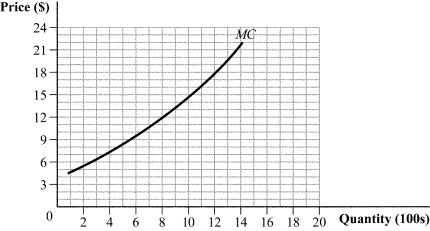
(Figure 8.5) The graph shows a firm's marginal cost curve. This firm operates in a perfectly competitive industry with market demand and supply curves given by Qd = 100 - 8P and QS = -20 + 2P, where Q is measured in millions of units. Based on the figure, how many units of output will the firm produce at the equilibrium price?
A) 1,100
B) 800
C) 1,200
D) 400
Figure 8.5
(Figure 8.5) The graph shows a firm's marginal cost curve. This firm operates in a perfectly competitive industry with market demand and supply curves given by Qd = 100 - 8P and QS = -20 + 2P, where Q is measured in millions of units. Based on the figure, how many units of output will the firm produce at the equilibrium price?
A) 1,100
B) 800
C) 1,200
D) 400

Question
Use the following to answer question:
Table 8.1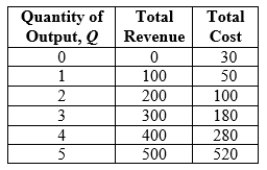
(Table 8.1) The level of output where marginal revenue equals marginal cost is:
A)3)
B)5)
C)2)
D) 4.
Table 8.1
(Table 8.1) The level of output where marginal revenue equals marginal cost is:
A)3)
B)5)
C)2)
D) 4.
Question
Use the following to answer question:
Figure 8.7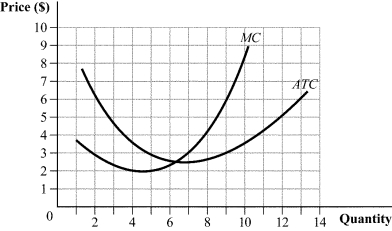
(Figure 8.7) If the market price is $6, this perfectly competitive firm will earn profits of:
A) $27.
B) $54.
C) $18.
D) $78.
Figure 8.7
(Figure 8.7) If the market price is $6, this perfectly competitive firm will earn profits of:
A) $27.
B) $54.
C) $18.
D) $78.
Question
Question
Use the following to answer question:
Figure 8.2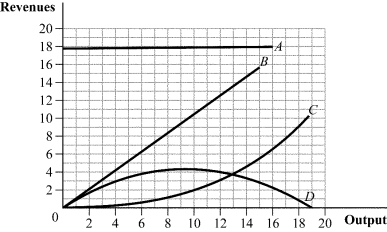
(Figure 8.2) The total revenue curve for a perfectly competitive firm is represented by curve:
A) A.
B) B.
C) C.
D) D.
Figure 8.2
(Figure 8.2) The total revenue curve for a perfectly competitive firm is represented by curve:
A) A.
B) B.
C) C.
D) D.
Question
Question
Use the following to answer question:
Table 8.2
(Table 8.2) Suppose that both firms are producing 100 units of output. If the firms want to increase profit, firm A should produce _____ output and firm B should produce _____ output.
A) less; more
B) less; less
C) more; more
D) more; less
Table 8.2
(Table 8.2) Suppose that both firms are producing 100 units of output. If the firms want to increase profit, firm A should produce _____ output and firm B should produce _____ output.
A) less; more
B) less; less
C) more; more
D) more; less
Question
Question
Question
Which of the following characteristics relate(s) to perfect competition? 
A) I and II
B) II and III
C) II
D) III
A) I and II
B) II and III
C) II
D) III
Question
Use the following to answer question:
Figure 8.6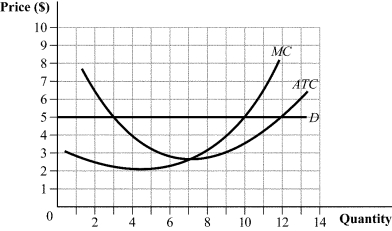
(Figure 8.6) This firm maximizes profit by producing _____ units of output.
A) 3
B) 7
C) 10
D) 12
Figure 8.6
(Figure 8.6) This firm maximizes profit by producing _____ units of output.
A) 3
B) 7
C) 10
D) 12
Question
Use the following to answer question:
Figure 8.10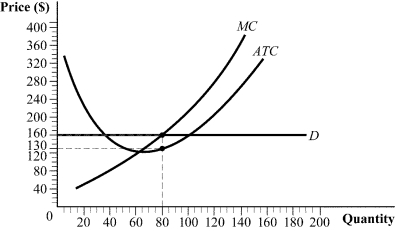
(Figure 8.10) Economic profit for this firm can be calculated as:
A) (160 - 130) × 80.
B) (160 × 80) - 30.
C) 80 - 30.
D) (160 - 30) × 80.
Figure 8.10
(Figure 8.10) Economic profit for this firm can be calculated as:
A) (160 - 130) × 80.
B) (160 × 80) - 30.
C) 80 - 30.
D) (160 - 30) × 80.
Question
Use the following to answer question:
Figure 8.3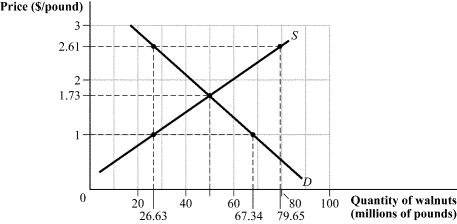
(Figure 8.3) The graph depicts the perfectly competitive market for walnuts. Which of the following statements is (are) TRUE?
A) I, II, and III
B) II
C) II and III
D) I
Figure 8.3
(Figure 8.3) The graph depicts the perfectly competitive market for walnuts. Which of the following statements is (are) TRUE?
A) I, II, and III
B) II
C) II and III
D) I
Question
Question
Use the following to answer question:
Figure 8.4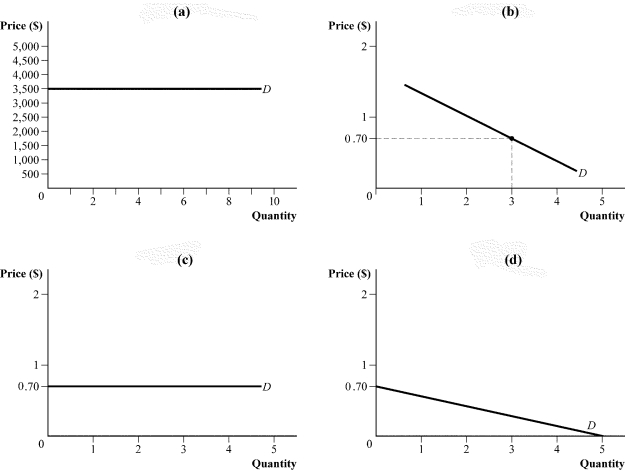
(Figure 8.4) In a perfectly competitive market with 5,000 firms, the equilibrium price and quantity are $0.70 and 3.0 million units. The demand curve facing a firm in this market is represented by:
A) panel a.
B) panel b.
C) panel c.
D) panel d.
Figure 8.4
(Figure 8.4) In a perfectly competitive market with 5,000 firms, the equilibrium price and quantity are $0.70 and 3.0 million units. The demand curve facing a firm in this market is represented by:
A) panel a.
B) panel b.
C) panel c.
D) panel d.
Question
Use the following to answer question:
Figure 8.9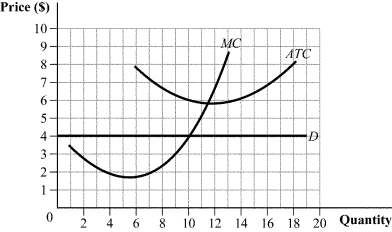
(Figure 8.9) At the profit-maximizing output level, this firm earns profit of:
A) -$60.
B) $48.
C) $60.
D) -$20.
Figure 8.9
(Figure 8.9) At the profit-maximizing output level, this firm earns profit of:
A) -$60.
B) $48.
C) $60.
D) -$20.
Question
Use the following to answer question:
Figure 8.8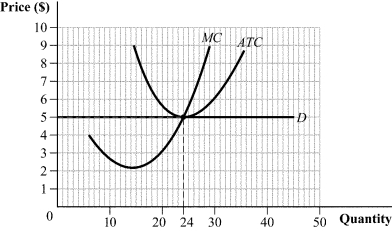
(Figure 8.8) Which of the following statements is (are) TRUE?
A) I
B) II and III
C) II
D) I and III
Figure 8.8
(Figure 8.8) Which of the following statements is (are) TRUE?
A) I
B) II and III
C) II
D) I and III
Question
Question
Which of the following statements is (are) TRUE of price-taking firms? 
A) II and III
B) I, II, III, and IV
C) I
D) II and IV
A) II and III
B) I, II, III, and IV
C) I
D) II and IV
Question
Use the following to answer question:
Figure 8.1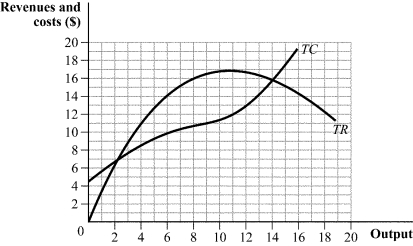
(Figure 8.1) Which of the following statements is (are) TRUE?
A) II and III
B) III
C) I
D) I and II
Figure 8.1
(Figure 8.1) Which of the following statements is (are) TRUE?
A) II and III
B) III
C) I
D) I and II
Question
Question
Which of the following statements is (are) TRUE? 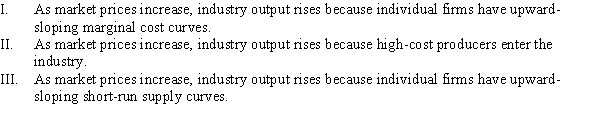
A) I, II, and III
B) II and III
C) III
D) II
A) I, II, and III
B) II and III
C) III
D) II
Question
Question
Use the following to answer question:
Figure 8.16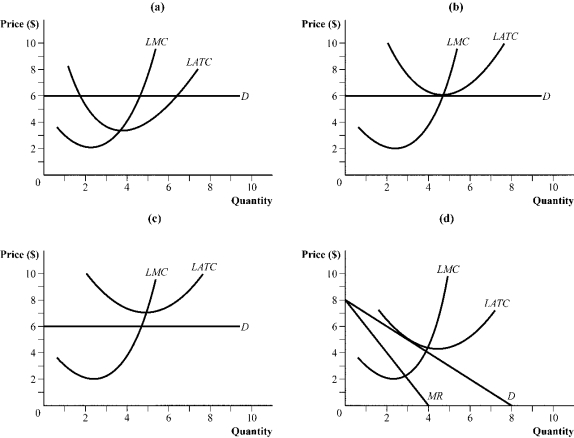
(Figure 8.16) Which panel shows a representative firm (operating in a perfectly competitive industry) in a long-run equilibrium?
A) panel a
B) panel b
C) panel c
D) panel d
Figure 8.16
(Figure 8.16) Which panel shows a representative firm (operating in a perfectly competitive industry) in a long-run equilibrium?
A) panel a
B) panel b
C) panel c
D) panel d
Question
Question
Question
Use the following to answer question:
Figure 8.15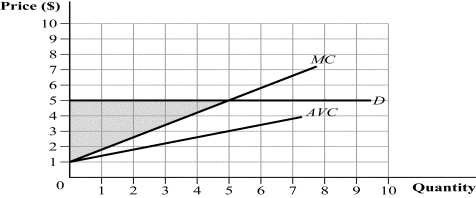
(Figure 8.15) Which of the following statements is (are) TRUE?
A) I, II, and III
B) II
C) I and III
D) III
Figure 8.15
(Figure 8.15) Which of the following statements is (are) TRUE?
A) I, II, and III
B) II
C) I and III
D) III
Question
Question
Question
Use the following to answer question:
Figure 8.12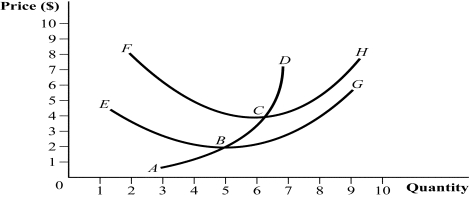
(Figure 8.12) The perfectly competitive firm's short-run supply curve is represented by points:
A) B, C, and D.
B) A, B, C, and D.
C) E, B, C, and D.
D) B, C, and H.
Figure 8.12
(Figure 8.12) The perfectly competitive firm's short-run supply curve is represented by points:
A) B, C, and D.
B) A, B, C, and D.
C) E, B, C, and D.
D) B, C, and H.
Question
Question
With which of the following scenarios should a perfectly competitive firm shut down in the short run? 
A) II
B) III
C) II and III
D) I and III
A) II
B) III
C) II and III
D) I and III
Question
Question
Use the following to answer question:
Figure 8.13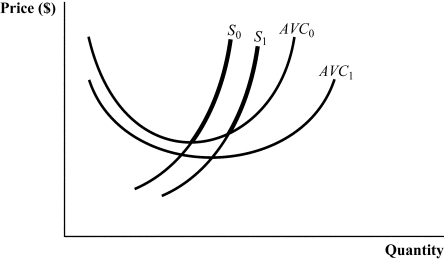
(Figure 8.13) What could have caused the supply and average variable cost curves to shift outward?
A) a decrease in average fixed costs
B) a decrease in wages
C) an increase in input prices
D) an increase in rental payments or property taxes
Figure 8.13
(Figure 8.13) What could have caused the supply and average variable cost curves to shift outward?
A) a decrease in average fixed costs
B) a decrease in wages
C) an increase in input prices
D) an increase in rental payments or property taxes
Question
Use the following to answer question:
Figure 8.11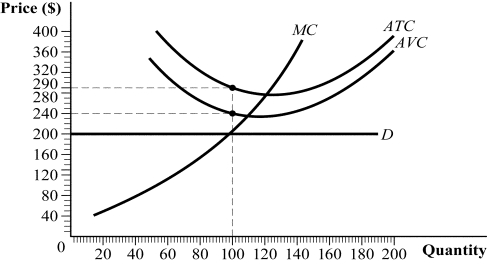
(Figure 8.11) If this firm operates, it earns a profit of _____, but if it shuts down, it earns a profit of _____.
A) $4,000; $0
B) -$9,000; -$5,000
C) -$5,000; -$9,000
D) -$2,500; -$4,000
Figure 8.11
(Figure 8.11) If this firm operates, it earns a profit of _____, but if it shuts down, it earns a profit of _____.
A) $4,000; $0
B) -$9,000; -$5,000
C) -$5,000; -$9,000
D) -$2,500; -$4,000
Question
Question
Question
Use the following to answer question:
Figure 8.14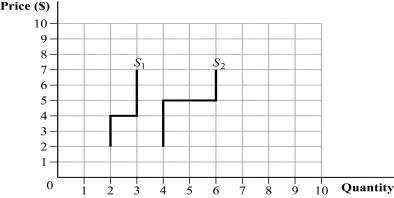
(Figure 8.14) In this perfectly competitive industry, there are 100 firms with a short-run supply curve represented by S1 and 50 firms with a short-run supply curve represented by S2. At a market price of $4.50, industry output is:
A)700.
B)250.
C) 1,050.
D) 500.
Figure 8.14
(Figure 8.14) In this perfectly competitive industry, there are 100 firms with a short-run supply curve represented by S1 and 50 firms with a short-run supply curve represented by S2. At a market price of $4.50, industry output is:
A)700.
B)250.
C) 1,050.
D) 500.
Question
Question
Question
Which of the following statements is (are) TRUE? 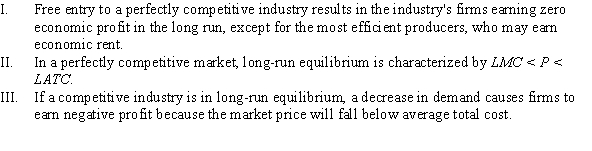
A) I, II, and III
B) II and III
C) I and III
D) I
A) I, II, and III
B) II and III
C) I and III
D) I
Question
(Graph) 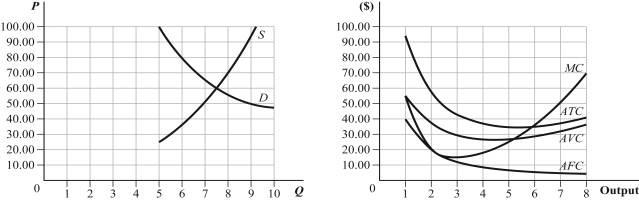 Using the nearby graphs, indicate the short-run equilibrium in this market and calculate any associated profits.
Using the nearby graphs, indicate the short-run equilibrium in this market and calculate any associated profits. Question
Answer the following questions. 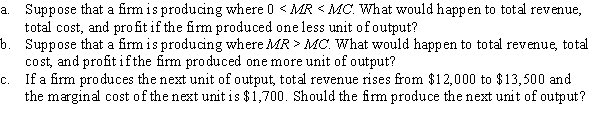
Question
Suppose that each firm in a perfectly competitive market has a short-run total cost of TC = 75 + 500Q - 5Q2 + 0.5Q3, where MC = 500 - 10Q + 1.5Q2. 
Question
Question
Use the following to answer question:
Figure 8.18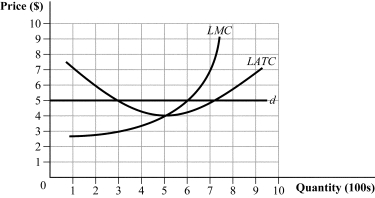
(Figure 8.18) Which of the following statements is (are) TRUE?
A) I, II, III, and IV
B) III and IV
C) I and II
D) III
Figure 8.18
(Figure 8.18) Which of the following statements is (are) TRUE?
A) I, II, III, and IV
B) III and IV
C) I and II
D) III
Question
Use the following to answer question:
Figure 8.20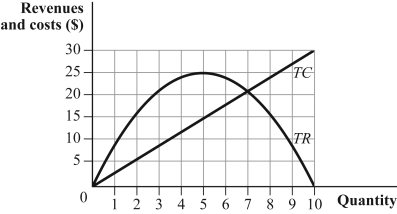
(Figure 8.20) What is TRUE about the slopes of the total revenue and total cost curves at the firm's profit-maximizing output level? What is the actual slope of the total revenue curve at the profit-maximizing output level? What is the firm's marginal cost at the profit-maximizing output level?
Figure 8.20
(Figure 8.20) What is TRUE about the slopes of the total revenue and total cost curves at the firm's profit-maximizing output level? What is the actual slope of the total revenue curve at the profit-maximizing output level? What is the firm's marginal cost at the profit-maximizing output level?
Question
Use the following to answer question:
Figure 8.19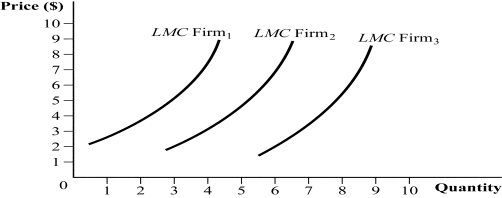
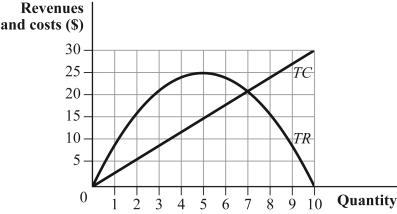
(Figure 8.19) The graph represents three perfectly competitive firms. Which of the following statements is (are) TRUE?
A) II
B) III
C) II and III
D) I
Figure 8.19
(Figure 8.19) The graph represents three perfectly competitive firms. Which of the following statements is (are) TRUE?
A) II
B) III
C) II and III
D) I
Question
Question
Answer the following questions. 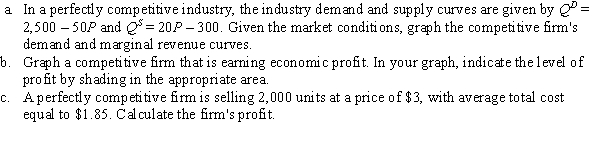
Question
Question
Question
Use the following to answer question:
Figure 8.17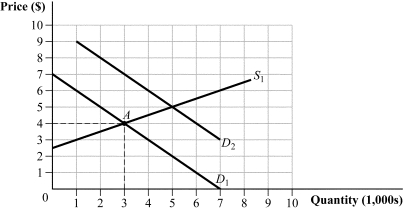
(Figure 8.17) Initially, the constant-cost industry was in long-run equilibrium at point A when the demand for the good increased to D2. How much output will be produced in the long run as a result of the demand increase?
A) 3,000
B) 5,000
C) 6,000
D) 7,000
Figure 8.17
(Figure 8.17) Initially, the constant-cost industry was in long-run equilibrium at point A when the demand for the good increased to D2. How much output will be produced in the long run as a result of the demand increase?
A) 3,000
B) 5,000
C) 6,000
D) 7,000
Question
A March 25, 2010, article at SunSentinel.com reported, "Strawberry farmers in Florida are facing such a sharp collapse in prices for their berries that many are deciding to simply leave huge tracts of the berries to rot in the fields. . . . Wholesale prices that were $17 to $19 for a flat of eight containers have now fallen to $5 to $6 a flat." 
Question
Question
Use the following to answer question:
Figure 8.21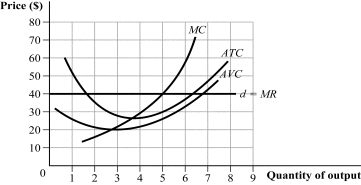
(Figure 8.21) Answer each of the following questions.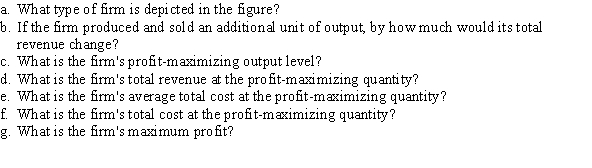
Figure 8.21
(Figure 8.21) Answer each of the following questions.
Question
Complete the following table and identify the quantity that maximizes profit. 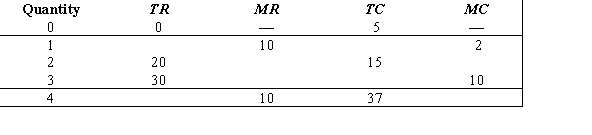
Question
Question
Suppose that there are 1,000 firms in a perfectly competitive industry, each with a short-run total cost curve given by TC = 800 + 8Q + 0.1Q2 and marginal cost curve given by MC = 8 + 0.2Q. 
Question
Complete the following table, choosing from this list: one, few, identical, some, unique, differentiated, identical or differentiated, many, none. Some words may be used more than once. 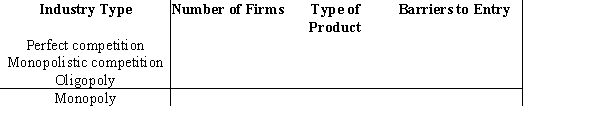
Question
Answer the following questions. 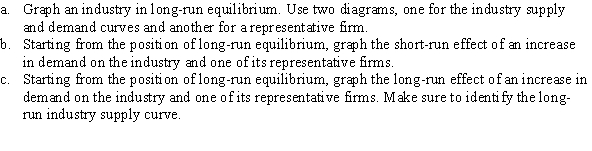
Question
A perfectly competitive industry consists of 50 East Coast firms and 80 West Coast firms. Each of the East Coast firms has a short-run supply curve of QE = 20P, and each of the West Coast firms has a short-run supply curve of QW = 30P. 
Question
Use the following to answer question:
Figure 8.26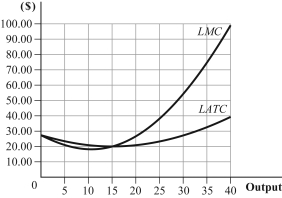
(Figure 8.26) The graph shows a perfectly competitive industry in long-run equilibrium. The price is _____. If technology lowers production costs by an average of 50%, the new long-run equilibrium price will be _____.
Figure 8.26
(Figure 8.26) The graph shows a perfectly competitive industry in long-run equilibrium. The price is _____. If technology lowers production costs by an average of 50%, the new long-run equilibrium price will be _____.
Question
Question
Question
Question
Question
Question
Use the following to answer question:
Figure 8.23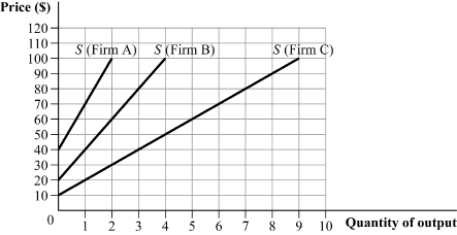
(Figure 8.23) For simplicity, assume that there are only three firms in a perfectly competitive industry; their short-run supply curves are depicted in the graph. Complete the following table.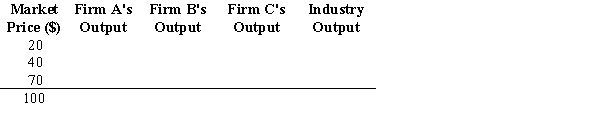
Figure 8.23
(Figure 8.23) For simplicity, assume that there are only three firms in a perfectly competitive industry; their short-run supply curves are depicted in the graph. Complete the following table.
Question
A perfectly competitive industry consists of many identical firms, each with a long-run average total cost of LATC = 800 - 10Q + 0.1Q2 and long-run marginal cost of LMC = 800 - 20Q + 0.3Q2. 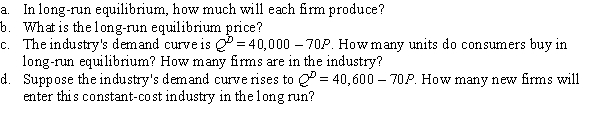
Question
Question
Use the following to answer question:
Figure 8.24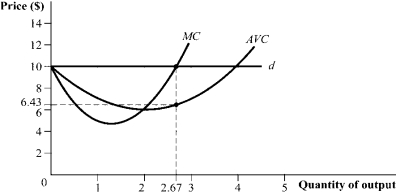
(Figure 8.24) Answer the following questions.
Figure 8.24
(Figure 8.24) Answer the following questions.
Question
Question
Question
Question
Use the following to answer question:
Figure 8.22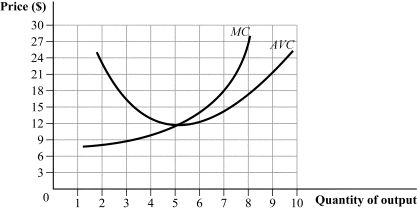
(Figure 8.22) Answer the following questions:

Figure 8.22
(Figure 8.22) Answer the following questions:
Question
Suppose that a perfectly competitive firm's AVC curve is given by AVC = WQ, and its marginal cost curve is given by MC = 2WQ, where W is the wage rate. 
Question
Use the following to answer question:
Figure 8.25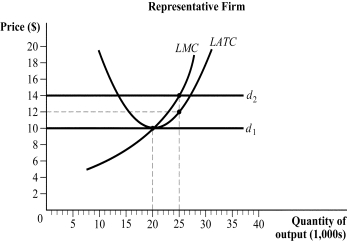
(Figure 8.25) Answer the following questions.
Figure 8.25
(Figure 8.25) Answer the following questions.
Question
Question

Unlock Deck
Sign up to unlock the cards in this deck!
Unlock Deck
Unlock Deck
1/93

Play

Full screen (f)
Deck 8: Supply in a Competitive Market
1
Use the following to answer question:
Figure 8.5
(Figure 8.5) The graph shows a firm's marginal cost curve. This firm operates in a perfectly competitive industry with market demand and supply curves given by Qd = 100 - 8P and QS = -20 + 2P, where Q is measured in millions of units. Based on the figure, how many units of output will the firm produce at the equilibrium price?
A) 1,100
B) 800
C) 1,200
D) 400
Figure 8.5
(Figure 8.5) The graph shows a firm's marginal cost curve. This firm operates in a perfectly competitive industry with market demand and supply curves given by Qd = 100 - 8P and QS = -20 + 2P, where Q is measured in millions of units. Based on the figure, how many units of output will the firm produce at the equilibrium price?
A) 1,100
B) 800
C) 1,200
D) 400
B
2
Use the following to answer question:
Table 8.1
(Table 8.1) The level of output where marginal revenue equals marginal cost is:
A)3)
B)5)
C)2)
D) 4.
Table 8.1
(Table 8.1) The level of output where marginal revenue equals marginal cost is:
A)3)
B)5)
C)2)
D) 4.
D
3
Use the following to answer question:
Figure 8.7
(Figure 8.7) If the market price is $6, this perfectly competitive firm will earn profits of:
A) $27.
B) $54.
C) $18.
D) $78.
Figure 8.7
(Figure 8.7) If the market price is $6, this perfectly competitive firm will earn profits of:
A) $27.
B) $54.
C) $18.
D) $78.
A
4
To maximize profits, a firm should produce where:
A) MR = MC.
B) TR/Q = TC/Q.
C) P = AVC.
D) ATC < P < AVC.
A) MR = MC.
B) TR/Q = TC/Q.
C) P = AVC.
D) ATC < P < AVC.
Unlock Deck
Unlock for access to all 93 flashcards in this deck.
Unlock Deck
k this deck
5
Use the following to answer question:
Figure 8.2
(Figure 8.2) The total revenue curve for a perfectly competitive firm is represented by curve:
A) A.
B) B.
C) C.
D) D.
Figure 8.2
(Figure 8.2) The total revenue curve for a perfectly competitive firm is represented by curve:
A) A.
B) B.
C) C.
D) D.
Unlock Deck
Unlock for access to all 93 flashcards in this deck.
Unlock Deck
k this deck
6
A firm should _____ output whenever MR exceeds MC because _____.
A) reduce; revenues will rise by more than costs, increasing the firm's profit
B) reduce; total revenues exceed total costs
C) expand; revenues will rise by more than costs, increasing the firm's profit
D) not change; selling more output will increase marginal revenue by less than marginal cost
A) reduce; revenues will rise by more than costs, increasing the firm's profit
B) reduce; total revenues exceed total costs
C) expand; revenues will rise by more than costs, increasing the firm's profit
D) not change; selling more output will increase marginal revenue by less than marginal cost
Unlock Deck
Unlock for access to all 93 flashcards in this deck.
Unlock Deck
k this deck
7
Use the following to answer question:
Table 8.2
(Table 8.2) Suppose that both firms are producing 100 units of output. If the firms want to increase profit, firm A should produce _____ output and firm B should produce _____ output.
A) less; more
B) less; less
C) more; more
D) more; less
Table 8.2
(Table 8.2) Suppose that both firms are producing 100 units of output. If the firms want to increase profit, firm A should produce _____ output and firm B should produce _____ output.
A) less; more
B) less; less
C) more; more
D) more; less
Unlock Deck
Unlock for access to all 93 flashcards in this deck.
Unlock Deck
k this deck
8
Why is the type of product sold in an industry an important characteristic?
A) A firm that can differentiate its product from that of rivals may be able to charge a higher price for a superior product.
B) A firm that sells intangible goods is usually considered a monopoly.
C) Expensive products are usually sold by perfectly competitive firms.
D) Service industries cannot differentiate their products, which makes it easy for new firms to enter the industry.
A) A firm that can differentiate its product from that of rivals may be able to charge a higher price for a superior product.
B) A firm that sells intangible goods is usually considered a monopoly.
C) Expensive products are usually sold by perfectly competitive firms.
D) Service industries cannot differentiate their products, which makes it easy for new firms to enter the industry.
Unlock Deck
Unlock for access to all 93 flashcards in this deck.
Unlock Deck
k this deck
9
Economists assume that firms maximize:
A) the difference between marginal revenue and marginal cost.
B) TR = PQ.
C) = TR - TC.
D) P - ATC, the profit per unit of output.
A) the difference between marginal revenue and marginal cost.
B) TR = PQ.
C) = TR - TC.
D) P - ATC, the profit per unit of output.
Unlock Deck
Unlock for access to all 93 flashcards in this deck.
Unlock Deck
k this deck
10
Which of the following characteristics relate(s) to perfect competition?
A) I and II
B) II and III
C) II
D) III
A) I and II
B) II and III
C) II
D) III
Unlock Deck
Unlock for access to all 93 flashcards in this deck.
Unlock Deck
k this deck
11
Use the following to answer question:
Figure 8.6
(Figure 8.6) This firm maximizes profit by producing _____ units of output.
A) 3
B) 7
C) 10
D) 12
Figure 8.6
(Figure 8.6) This firm maximizes profit by producing _____ units of output.
A) 3
B) 7
C) 10
D) 12
Unlock Deck
Unlock for access to all 93 flashcards in this deck.
Unlock Deck
k this deck
12
Use the following to answer question:
Figure 8.10
(Figure 8.10) Economic profit for this firm can be calculated as:
A) (160 - 130) × 80.
B) (160 × 80) - 30.
C) 80 - 30.
D) (160 - 30) × 80.
Figure 8.10
(Figure 8.10) Economic profit for this firm can be calculated as:
A) (160 - 130) × 80.
B) (160 × 80) - 30.
C) 80 - 30.
D) (160 - 30) × 80.
Unlock Deck
Unlock for access to all 93 flashcards in this deck.
Unlock Deck
k this deck
13
Use the following to answer question:
Figure 8.3
(Figure 8.3) The graph depicts the perfectly competitive market for walnuts. Which of the following statements is (are) TRUE?
A) I, II, and III
B) II
C) II and III
D) I
Figure 8.3
(Figure 8.3) The graph depicts the perfectly competitive market for walnuts. Which of the following statements is (are) TRUE?
A) I, II, and III
B) II
C) II and III
D) I
Unlock Deck
Unlock for access to all 93 flashcards in this deck.
Unlock Deck
k this deck
14
The idea that firms pursue actions to maximize profits is:
A) generally rejected by economists in favor of the idea that firms maximize revenues.
B) a reasonable assumption, because firms that do not maximize profits will see their market share drain away to their profit-maximizing rivals.
C) easier to accomplish when management has little oversight from shareholders and boards of directors.
D) refuted by evidence that firms engage in goodwill advertising and other charitable activities.
A) generally rejected by economists in favor of the idea that firms maximize revenues.
B) a reasonable assumption, because firms that do not maximize profits will see their market share drain away to their profit-maximizing rivals.
C) easier to accomplish when management has little oversight from shareholders and boards of directors.
D) refuted by evidence that firms engage in goodwill advertising and other charitable activities.
Unlock Deck
Unlock for access to all 93 flashcards in this deck.
Unlock Deck
k this deck
15
Use the following to answer question:
Figure 8.4
(Figure 8.4) In a perfectly competitive market with 5,000 firms, the equilibrium price and quantity are $0.70 and 3.0 million units. The demand curve facing a firm in this market is represented by:
A) panel a.
B) panel b.
C) panel c.
D) panel d.
Figure 8.4
(Figure 8.4) In a perfectly competitive market with 5,000 firms, the equilibrium price and quantity are $0.70 and 3.0 million units. The demand curve facing a firm in this market is represented by:
A) panel a.
B) panel b.
C) panel c.
D) panel d.
Unlock Deck
Unlock for access to all 93 flashcards in this deck.
Unlock Deck
k this deck
16
Use the following to answer question:
Figure 8.9
(Figure 8.9) At the profit-maximizing output level, this firm earns profit of:
A) -$60.
B) $48.
C) $60.
D) -$20.
Figure 8.9
(Figure 8.9) At the profit-maximizing output level, this firm earns profit of:
A) -$60.
B) $48.
C) $60.
D) -$20.
Unlock Deck
Unlock for access to all 93 flashcards in this deck.
Unlock Deck
k this deck
17
Use the following to answer question:
Figure 8.8
(Figure 8.8) Which of the following statements is (are) TRUE?
A) I
B) II and III
C) II
D) I and III
Figure 8.8
(Figure 8.8) Which of the following statements is (are) TRUE?
A) I
B) II and III
C) II
D) I and III
Unlock Deck
Unlock for access to all 93 flashcards in this deck.
Unlock Deck
k this deck
18
In the market for lock washers, a perfectly competitive market, the current equilibrium price is $5 per box. Washer King, one of the many producers of washers, has a daily short-run total cost given by TC = 190 + 0.20Q + 0.0025Q2, where Q measures boxes of washers. Washer King's corresponding marginal cost is MC = 0.20 + 0.005Q. How many boxes of washers should Washer King produce per day to maximize profit?
A) 280
B) 960
C) 1,450
D) 2,125
A) 280
B) 960
C) 1,450
D) 2,125
Unlock Deck
Unlock for access to all 93 flashcards in this deck.
Unlock Deck
k this deck
19
Which of the following statements is (are) TRUE of price-taking firms?
A) II and III
B) I, II, III, and IV
C) I
D) II and IV
A) II and III
B) I, II, III, and IV
C) I
D) II and IV
Unlock Deck
Unlock for access to all 93 flashcards in this deck.
Unlock Deck
k this deck
20
Use the following to answer question:
Figure 8.1
(Figure 8.1) Which of the following statements is (are) TRUE?
A) II and III
B) III
C) I
D) I and II
Figure 8.1
(Figure 8.1) Which of the following statements is (are) TRUE?
A) II and III
B) III
C) I
D) I and II
Unlock Deck
Unlock for access to all 93 flashcards in this deck.
Unlock Deck
k this deck
21
Suppose a perfectly competitive industry has 300 firms, and the short-run supply curve for each firm is given by Q = 2P. What is the short-run industry supply curve?
A) QS = 150P
B) QS = 600
C) QS = 600P
D) QS = 300 + 2P
A) QS = 150P
B) QS = 600
C) QS = 600P
D) QS = 300 + 2P
Unlock Deck
Unlock for access to all 93 flashcards in this deck.
Unlock Deck
k this deck
22
Which of the following statements is (are) TRUE?
A) I, II, and III
B) II and III
C) III
D) II
A) I, II, and III
B) II and III
C) III
D) II
Unlock Deck
Unlock for access to all 93 flashcards in this deck.
Unlock Deck
k this deck
23
In a perfectly competitive market with 50 firms, output is zero at prices less than $20. At prices of $20 to $29.99, each firm will produce 1 unit of output. At any price of $30 or more, each firm will produce 3 units of output. At a price of $27, the industry produces _____ units, and at a price of $35, the industry produces _____units.
A) 16.67; 50
B) 50; 150
C) 30; 75
D) 9; 45
A) 16.67; 50
B) 50; 150
C) 30; 75
D) 9; 45
Unlock Deck
Unlock for access to all 93 flashcards in this deck.
Unlock Deck
k this deck
24
Use the following to answer question:
Figure 8.16
(Figure 8.16) Which panel shows a representative firm (operating in a perfectly competitive industry) in a long-run equilibrium?
A) panel a
B) panel b
C) panel c
D) panel d
Figure 8.16
(Figure 8.16) Which panel shows a representative firm (operating in a perfectly competitive industry) in a long-run equilibrium?
A) panel a
B) panel b
C) panel c
D) panel d
Unlock Deck
Unlock for access to all 93 flashcards in this deck.
Unlock Deck
k this deck
25
In a perfectly competitive market with 2,000 firms, output is zero at prices less than $10. At prices of $10 to $19.99, each firm will produce 100 units of output. At any price of $20 or more, each firm will produce 300 units of output. As this industry expands output, however, prices of the key inputs to production increase substantially. The total industry output at a market price of $33 is:
A) between 200,000 and 800,000.
B) 600,000 or less.
C) greater than 600,000.
D) 800,000.
A) between 200,000 and 800,000.
B) 600,000 or less.
C) greater than 600,000.
D) 800,000.
Unlock Deck
Unlock for access to all 93 flashcards in this deck.
Unlock Deck
k this deck
26
In a perfectly competitive industry, the equilibrium price is $56 and the minimum average total cost of the industry's firms is $40. If this is a constant-cost industry, we can expect that in the long run, firms will _____ the market, shifting the industry's short-run supply curve _____.
A) enter; outward until the minimum average total cost rises to $56.
B) enter; outward until the new equilibrium price is $40.
C) enter; inward until firms are making positive profit.
D) exit; inward until firms are breaking even.
A) enter; outward until the minimum average total cost rises to $56.
B) enter; outward until the new equilibrium price is $40.
C) enter; inward until firms are making positive profit.
D) exit; inward until firms are breaking even.
Unlock Deck
Unlock for access to all 93 flashcards in this deck.
Unlock Deck
k this deck
27
Use the following to answer question:
Figure 8.15
(Figure 8.15) Which of the following statements is (are) TRUE?
A) I, II, and III
B) II
C) I and III
D) III
Figure 8.15
(Figure 8.15) Which of the following statements is (are) TRUE?
A) I, II, and III
B) II
C) I and III
D) III
Unlock Deck
Unlock for access to all 93 flashcards in this deck.
Unlock Deck
k this deck
28
A firm's short-run total cost is TC = 10,100 + 7,700Q - 100Q2 + Q3/3, and its marginal cost is MC = 7,700 - 200Q + Q2. What is the firm's shutdown price?
A) $45
B) $200
C) $1,100
D) $18
A) $45
B) $200
C) $1,100
D) $18
Unlock Deck
Unlock for access to all 93 flashcards in this deck.
Unlock Deck
k this deck
29
The perfectly competitive firm's short-run supply curve is:
A) the portion of its marginal cost curve that lies above average variable cost.
B) the portion of its marginal cost curve that lies above average total cost.
C) its average variable cost curve, which lies above marginal revenue.
D) its average total cost curve, which lies above marginal revenue.
A) the portion of its marginal cost curve that lies above average variable cost.
B) the portion of its marginal cost curve that lies above average total cost.
C) its average variable cost curve, which lies above marginal revenue.
D) its average total cost curve, which lies above marginal revenue.
Unlock Deck
Unlock for access to all 93 flashcards in this deck.
Unlock Deck
k this deck
30
Use the following to answer question:
Figure 8.12
(Figure 8.12) The perfectly competitive firm's short-run supply curve is represented by points:
A) B, C, and D.
B) A, B, C, and D.
C) E, B, C, and D.
D) B, C, and H.
Figure 8.12
(Figure 8.12) The perfectly competitive firm's short-run supply curve is represented by points:
A) B, C, and D.
B) A, B, C, and D.
C) E, B, C, and D.
D) B, C, and H.
Unlock Deck
Unlock for access to all 93 flashcards in this deck.
Unlock Deck
k this deck
31
A street vendor's annual license fee was recently increased by the city. The street vendor's:
A) marginal cost curve will shift out, along with her average variable cost curve.
B) marginal cost curve will shift in, along with her average variable cost curve.
C) marginal and average variable cost curves will not be affected.
D) total variable cost curve will rotate upward.
A) marginal cost curve will shift out, along with her average variable cost curve.
B) marginal cost curve will shift in, along with her average variable cost curve.
C) marginal and average variable cost curves will not be affected.
D) total variable cost curve will rotate upward.
Unlock Deck
Unlock for access to all 93 flashcards in this deck.
Unlock Deck
k this deck
32
With which of the following scenarios should a perfectly competitive firm shut down in the short run?
A) II
B) III
C) II and III
D) I and III
A) II
B) III
C) II and III
D) I and III
Unlock Deck
Unlock for access to all 93 flashcards in this deck.
Unlock Deck
k this deck
33
A perfectly competitive firm maximizes profit by producing 500 units of output, selling each unit for $10. The firm's average variable cost is $7 and average fixed cost is $2. What is the firm's producer surplus?
A) $500
B) $1,500
C) $1,000
D) $1
A) $500
B) $1,500
C) $1,000
D) $1
Unlock Deck
Unlock for access to all 93 flashcards in this deck.
Unlock Deck
k this deck
34
Use the following to answer question:
Figure 8.13
(Figure 8.13) What could have caused the supply and average variable cost curves to shift outward?
A) a decrease in average fixed costs
B) a decrease in wages
C) an increase in input prices
D) an increase in rental payments or property taxes
Figure 8.13
(Figure 8.13) What could have caused the supply and average variable cost curves to shift outward?
A) a decrease in average fixed costs
B) a decrease in wages
C) an increase in input prices
D) an increase in rental payments or property taxes
Unlock Deck
Unlock for access to all 93 flashcards in this deck.
Unlock Deck
k this deck
35
Use the following to answer question:
Figure 8.11
(Figure 8.11) If this firm operates, it earns a profit of _____, but if it shuts down, it earns a profit of _____.
A) $4,000; $0
B) -$9,000; -$5,000
C) -$5,000; -$9,000
D) -$2,500; -$4,000
Figure 8.11
(Figure 8.11) If this firm operates, it earns a profit of _____, but if it shuts down, it earns a profit of _____.
A) $4,000; $0
B) -$9,000; -$5,000
C) -$5,000; -$9,000
D) -$2,500; -$4,000
Unlock Deck
Unlock for access to all 93 flashcards in this deck.
Unlock Deck
k this deck
36
Pitch (a sticky black substance made from petroleum) is a key input in the production of clay targets. If the price of pitch falls, clay target manufacturers will encounter a(n) _____ shift of their marginal cost curve and a(n)_____ shift of their average variable cost.
A) inward; inward
B) outward; outward
C) inward; outward
D) outward; inward
A) inward; inward
B) outward; outward
C) inward; outward
D) outward; inward
Unlock Deck
Unlock for access to all 93 flashcards in this deck.
Unlock Deck
k this deck
37
A perfectly competitive industry has 100 high-cost producers, each with a short-run supply curve given by QH = 16P, and 100 low-cost producers, each with a short-run supply curve given by QL = 24P. The industry demand curve is given by Qd = 100,000 - 1,000P. At market equilibrium, industry producer surplus is:
A) $800,000.
B) $20,000.
C) $4,000.
D) $1.2 million.
A) $800,000.
B) $20,000.
C) $4,000.
D) $1.2 million.
Unlock Deck
Unlock for access to all 93 flashcards in this deck.
Unlock Deck
k this deck
38
Use the following to answer question:
Figure 8.14
(Figure 8.14) In this perfectly competitive industry, there are 100 firms with a short-run supply curve represented by S1 and 50 firms with a short-run supply curve represented by S2. At a market price of $4.50, industry output is:
A)700.
B)250.
C) 1,050.
D) 500.
Figure 8.14
(Figure 8.14) In this perfectly competitive industry, there are 100 firms with a short-run supply curve represented by S1 and 50 firms with a short-run supply curve represented by S2. At a market price of $4.50, industry output is:
A)700.
B)250.
C) 1,050.
D) 500.
Unlock Deck
Unlock for access to all 93 flashcards in this deck.
Unlock Deck
k this deck
39
Stu owns an ice cream parlor that is usually closed during the winter. This winter, however, Stu is considering opening his business in February instead of March. If Stu opens his store in February, he will earn total revenue of $4,000 for the month, incurring variable costs of $3,500 and fixed costs of $1,500. If the store remains closed during February, Stu will earn no revenues and incur fixed costs of $1,500. Stu should:
A) stay closed in February because he will lose $1,000 if he opens.
B) stay closed in February because the $500 of operating profit is insufficient to cover the $1,500 of fixed costs.
C) open in February because the $4,000 of total revenue exceeds the $1,500 of fixed costs.
D) open in February because the $4,000 of total revenue exceeds the $3,500 of variable costs.
A) stay closed in February because he will lose $1,000 if he opens.
B) stay closed in February because the $500 of operating profit is insufficient to cover the $1,500 of fixed costs.
C) open in February because the $4,000 of total revenue exceeds the $1,500 of fixed costs.
D) open in February because the $4,000 of total revenue exceeds the $3,500 of variable costs.
Unlock Deck
Unlock for access to all 93 flashcards in this deck.
Unlock Deck
k this deck
40
Suppose the market for relay switches is considered perfectly competitive and is in equilibrium at a price of $5,000 per pallet of relay switches. Callahan Relay produces relay switches at an average total cost given by ATC = and marginal cost given by MC = 2Q, where Q measures pallets of relay switches. If Callahan Relay maximizes profit, how much profit will it earn?
A) $125,000
B) $88,000
C) $2.5 million
D) $4.75 million
A) $125,000
B) $88,000
C) $2.5 million
D) $4.75 million
Unlock Deck
Unlock for access to all 93 flashcards in this deck.
Unlock Deck
k this deck
41
Which of the following statements is (are) TRUE?
A) I, II, and III
B) II and III
C) I and III
D) I
A) I, II, and III
B) II and III
C) I and III
D) I
Unlock Deck
Unlock for access to all 93 flashcards in this deck.
Unlock Deck
k this deck
42
(Graph) Using the nearby graphs, indicate the short-run equilibrium in this market and calculate any associated profits.
Using the nearby graphs, indicate the short-run equilibrium in this market and calculate any associated profits. Unlock Deck
Unlock for access to all 93 flashcards in this deck.
Unlock Deck
k this deck
43
Answer the following questions.
Unlock Deck
Unlock for access to all 93 flashcards in this deck.
Unlock Deck
k this deck
44
Suppose that each firm in a perfectly competitive market has a short-run total cost of TC = 75 + 500Q - 5Q2 + 0.5Q3, where MC = 500 - 10Q + 1.5Q2.
Unlock Deck
Unlock for access to all 93 flashcards in this deck.
Unlock Deck
k this deck
45
Suppose that a firm is earning a 12% return on capital in a perfectly competitive industry, and the market return outside the industry is 9.5%. Which of the following statements is (are) TRUE?
A) In the short run, the firm is making a below-market return of 2.5%.
B) In the short run, the firm is making a negative return on capital of 2.5%.
C) In the long run, the firm's return on capital will be 0%.
D) In the long run, the firm's return on capital will be 9.5%.
A) In the short run, the firm is making a below-market return of 2.5%.
B) In the short run, the firm is making a negative return on capital of 2.5%.
C) In the long run, the firm's return on capital will be 0%.
D) In the long run, the firm's return on capital will be 9.5%.
Unlock Deck
Unlock for access to all 93 flashcards in this deck.
Unlock Deck
k this deck
46
Use the following to answer question:
Figure 8.18
(Figure 8.18) Which of the following statements is (are) TRUE?
A) I, II, III, and IV
B) III and IV
C) I and II
D) III
Figure 8.18
(Figure 8.18) Which of the following statements is (are) TRUE?
A) I, II, III, and IV
B) III and IV
C) I and II
D) III
Unlock Deck
Unlock for access to all 93 flashcards in this deck.
Unlock Deck
k this deck
47
Use the following to answer question:
Figure 8.20
(Figure 8.20) What is TRUE about the slopes of the total revenue and total cost curves at the firm's profit-maximizing output level? What is the actual slope of the total revenue curve at the profit-maximizing output level? What is the firm's marginal cost at the profit-maximizing output level?
Figure 8.20
(Figure 8.20) What is TRUE about the slopes of the total revenue and total cost curves at the firm's profit-maximizing output level? What is the actual slope of the total revenue curve at the profit-maximizing output level? What is the firm's marginal cost at the profit-maximizing output level?
Unlock Deck
Unlock for access to all 93 flashcards in this deck.
Unlock Deck
k this deck
48
Use the following to answer question:
Figure 8.19
(Figure 8.19) The graph represents three perfectly competitive firms. Which of the following statements is (are) TRUE?
A) II
B) III
C) II and III
D) I
Figure 8.19
(Figure 8.19) The graph represents three perfectly competitive firms. Which of the following statements is (are) TRUE?
A) II
B) III
C) II and III
D) I
Unlock Deck
Unlock for access to all 93 flashcards in this deck.
Unlock Deck
k this deck
49
In a perfectly competitive market, each firm has a long-run total cost given by LTC = 100Q - 10Q2 + 1/3Q3 and long-run marginal cost curve given by LMC = 100 - 20Q + Q2. What is the market's long-run equilibrium price?
A) $8.50
B) $33
C) $70
D) $25
A) $8.50
B) $33
C) $70
D) $25
Unlock Deck
Unlock for access to all 93 flashcards in this deck.
Unlock Deck
k this deck
50
Answer the following questions.
Unlock Deck
Unlock for access to all 93 flashcards in this deck.
Unlock Deck
k this deck
51
Suppose the long-run equilibrium price in a perfectly competitive market is $100. When demand increases, if it is a(n) _____ industry, the long-run equilibrium price will _____ to reflect a _____ long-run average total cost.
A) decreasing-cost; rise; lower
B) increasing-cost; rise; lower
C) decreasing-cost; fall; lower
D) increasing-cost; fall; higher
A) decreasing-cost; rise; lower
B) increasing-cost; rise; lower
C) decreasing-cost; fall; lower
D) increasing-cost; fall; higher
Unlock Deck
Unlock for access to all 93 flashcards in this deck.
Unlock Deck
k this deck
52
In a perfectly competitive industry, the long-run equilibrium price is $12. If a technological innovation lowers production costs, the long-run equilibrium price will:
A) fall below $12.
B) initially fall but then return to $12.
C) initially rise but then return to $12.
D) rise above $12.
A) fall below $12.
B) initially fall but then return to $12.
C) initially rise but then return to $12.
D) rise above $12.
Unlock Deck
Unlock for access to all 93 flashcards in this deck.
Unlock Deck
k this deck
53
Use the following to answer question:
Figure 8.17
(Figure 8.17) Initially, the constant-cost industry was in long-run equilibrium at point A when the demand for the good increased to D2. How much output will be produced in the long run as a result of the demand increase?
A) 3,000
B) 5,000
C) 6,000
D) 7,000
Figure 8.17
(Figure 8.17) Initially, the constant-cost industry was in long-run equilibrium at point A when the demand for the good increased to D2. How much output will be produced in the long run as a result of the demand increase?
A) 3,000
B) 5,000
C) 6,000
D) 7,000
Unlock Deck
Unlock for access to all 93 flashcards in this deck.
Unlock Deck
k this deck
54
A March 25, 2010, article at SunSentinel.com reported, "Strawberry farmers in Florida are facing such a sharp collapse in prices for their berries that many are deciding to simply leave huge tracts of the berries to rot in the fields. . . . Wholesale prices that were $17 to $19 for a flat of eight containers have now fallen to $5 to $6 a flat."
Unlock Deck
Unlock for access to all 93 flashcards in this deck.
Unlock Deck
k this deck
55
In a perfectly competitive industry, there are two types of firms: low-cost producers and high-cost producers. The minimum average total cost of the high-cost producers is $150. The low-cost producers have a long-run total cost curve given by LTC = 150Q - 15Q2 + 0.4Q3, where LMC = 150 - 30Q + 1.2Q2. How much economic rent does the low-cost producer earn?
A) $3,125
B) $14,000
C) $710
D) $45,000
A) $3,125
B) $14,000
C) $710
D) $45,000
Unlock Deck
Unlock for access to all 93 flashcards in this deck.
Unlock Deck
k this deck
56
Use the following to answer question:
Figure 8.21
(Figure 8.21) Answer each of the following questions.
Figure 8.21
(Figure 8.21) Answer each of the following questions.
Unlock Deck
Unlock for access to all 93 flashcards in this deck.
Unlock Deck
k this deck
57
Complete the following table and identify the quantity that maximizes profit.
Unlock Deck
Unlock for access to all 93 flashcards in this deck.
Unlock Deck
k this deck
58
Suppose the market for sprouts is in long-run equilibrium. In the short run, what will happen if an E. coli outbreak reduces the demand for sprouts?
A) The marginal cost curve will shift downward for each producer, leaving prices unchanged.
B) The market price of sprouts will fall, causing each firm to produce fewer sprouts.
C) Existing firms will expand output to make up for the decrease in demand.
D) The marginal cost curve will shift upward for each producer, causing prices to rise and profits to fall.
A) The marginal cost curve will shift downward for each producer, leaving prices unchanged.
B) The market price of sprouts will fall, causing each firm to produce fewer sprouts.
C) Existing firms will expand output to make up for the decrease in demand.
D) The marginal cost curve will shift upward for each producer, causing prices to rise and profits to fall.
Unlock Deck
Unlock for access to all 93 flashcards in this deck.
Unlock Deck
k this deck
59
Suppose that there are 1,000 firms in a perfectly competitive industry, each with a short-run total cost curve given by TC = 800 + 8Q + 0.1Q2 and marginal cost curve given by MC = 8 + 0.2Q.
Unlock Deck
Unlock for access to all 93 flashcards in this deck.
Unlock Deck
k this deck
60
Complete the following table, choosing from this list: one, few, identical, some, unique, differentiated, identical or differentiated, many, none. Some words may be used more than once.
Unlock Deck
Unlock for access to all 93 flashcards in this deck.
Unlock Deck
k this deck
61
Answer the following questions.
Unlock Deck
Unlock for access to all 93 flashcards in this deck.
Unlock Deck
k this deck
62
A perfectly competitive industry consists of 50 East Coast firms and 80 West Coast firms. Each of the East Coast firms has a short-run supply curve of QE = 20P, and each of the West Coast firms has a short-run supply curve of QW = 30P.
Unlock Deck
Unlock for access to all 93 flashcards in this deck.
Unlock Deck
k this deck
63
Use the following to answer question:
Figure 8.26
(Figure 8.26) The graph shows a perfectly competitive industry in long-run equilibrium. The price is _____. If technology lowers production costs by an average of 50%, the new long-run equilibrium price will be _____.
Figure 8.26
(Figure 8.26) The graph shows a perfectly competitive industry in long-run equilibrium. The price is _____. If technology lowers production costs by an average of 50%, the new long-run equilibrium price will be _____.
Unlock Deck
Unlock for access to all 93 flashcards in this deck.
Unlock Deck
k this deck
64
In the lemonade stand industry, Lucy is representative of a low-cost provider and Charlie is representative of a high-cost provider. The minimum average total cost of the high-cost producers is $5. The low-cost producers have a long-run total cost curve given by LTC = 5Q -1.5Q2 + 0.33Q3, where LMC = 5 - 3Q + Q2. How much economic rent does the low-cost producer, such as Lucy, earn?
Unlock Deck
Unlock for access to all 93 flashcards in this deck.
Unlock Deck
k this deck
65
A perfectly competitive industry consists of 500 identical firms, each with a short-run supply curve given by Qs = -20 + 15P. What is the equation for the industry's short-run supply curve?
Unlock Deck
Unlock for access to all 93 flashcards in this deck.
Unlock Deck
k this deck
66
Under free entry and exit, to find the quantity where ATC is minimized, the firm can:
A) set marginal cost equal to average total cost and solve for Q.
B) take the first-order condition of average total cost with respect to Q and solve for Q.
C) Either A or B.
D) Neither A nor B.
A) set marginal cost equal to average total cost and solve for Q.
B) take the first-order condition of average total cost with respect to Q and solve for Q.
C) Either A or B.
D) Neither A nor B.
Unlock Deck
Unlock for access to all 93 flashcards in this deck.
Unlock Deck
k this deck
67
Marginal cost can be calculated as:
A) the derivative of total cost with respect to quantity.
B) the derivative of variable cost with respect to quantity.
C) Either A or B.
D) Neither A nor B.
A) the derivative of total cost with respect to quantity.
B) the derivative of variable cost with respect to quantity.
C) Either A or B.
D) Neither A nor B.
Unlock Deck
Unlock for access to all 93 flashcards in this deck.
Unlock Deck
k this deck
68
A perfectly competitive industry in long-run equilibrium comprises 200 identical firms. In one of the firms, the workers unionize and receive a 20% wage increase. What happens to the unionized firm in the short run and the long run? Supplement your answer with a graph.
Unlock Deck
Unlock for access to all 93 flashcards in this deck.
Unlock Deck
k this deck
69
Use the following to answer question:
Figure 8.23
(Figure 8.23) For simplicity, assume that there are only three firms in a perfectly competitive industry; their short-run supply curves are depicted in the graph. Complete the following table.
Figure 8.23
(Figure 8.23) For simplicity, assume that there are only three firms in a perfectly competitive industry; their short-run supply curves are depicted in the graph. Complete the following table.
Unlock Deck
Unlock for access to all 93 flashcards in this deck.
Unlock Deck
k this deck
70
A perfectly competitive industry consists of many identical firms, each with a long-run average total cost of LATC = 800 - 10Q + 0.1Q2 and long-run marginal cost of LMC = 800 - 20Q + 0.3Q2.
Unlock Deck
Unlock for access to all 93 flashcards in this deck.
Unlock Deck
k this deck
71
If the long-run total cost curve for each firm is given by TC = 60Q - 70Q2 + 4Q3, in the long run, the marginal cost is:
A) 60 - 70Q + 4Q2.
B) 60 - 140Q + 12Q2.
C) 60Q - 70Q2 + 4Q3.
D) -70Q2 + 4Q3.
A) 60 - 70Q + 4Q2.
B) 60 - 140Q + 12Q2.
C) 60Q - 70Q2 + 4Q3.
D) -70Q2 + 4Q3.
Unlock Deck
Unlock for access to all 93 flashcards in this deck.
Unlock Deck
k this deck
72
Use the following to answer question:
Figure 8.24
(Figure 8.24) Answer the following questions.
Figure 8.24
(Figure 8.24) Answer the following questions.
Unlock Deck
Unlock for access to all 93 flashcards in this deck.
Unlock Deck
k this deck
73
If the long-run total cost curve for each firm is given by TC = 1,000 + 100Q - 10Q2 + Q3, in the long run, the marginal cost is:
A) 1,000.
B) 100Q - 10Q2 + Q3.
C) 1,000/Q + 100 - 10Q + Q2.
D) 100 - 20Q + 3Q2.
A) 1,000.
B) 100Q - 10Q2 + Q3.
C) 1,000/Q + 100 - 10Q + Q2.
D) 100 - 20Q + 3Q2.
Unlock Deck
Unlock for access to all 93 flashcards in this deck.
Unlock Deck
k this deck
74
Suppose that the long-run total cost curve for each firm is given by TC = 1,000 + 100Q - 10Q2 + Q3. Also suppose there is free entry and exit. To find the quantity where ATC is minimized, solve the following equation for Q:
A) 100 - 20Q + 3Q2 = 1,000 + 100Q - 10Q2 + Q3.
B) 100 - 20Q + 3Q2 = 100 - 10Q + Q2.
C) 100 - 20Q + 3Q2 = 1,000/Q + 100 - 10Q + Q2.
D) 100 - 20Q + 3Q2 = 1,000(Q + 100 - 10Q + Q2).
A) 100 - 20Q + 3Q2 = 1,000 + 100Q - 10Q2 + Q3.
B) 100 - 20Q + 3Q2 = 100 - 10Q + Q2.
C) 100 - 20Q + 3Q2 = 1,000/Q + 100 - 10Q + Q2.
D) 100 - 20Q + 3Q2 = 1,000(Q + 100 - 10Q + Q2).
Unlock Deck
Unlock for access to all 93 flashcards in this deck.
Unlock Deck
k this deck
75
Explain what will happen in each of the following scenarios in a long run constant cost competitive industry.
a. The market price is $50 and firms are earning positive profits.
b. The market price is $25 and firms are earning zero profits.
c. The market price is $15 and firms are earning negative profits.
a. The market price is $50 and firms are earning positive profits.
b. The market price is $25 and firms are earning zero profits.
c. The market price is $15 and firms are earning negative profits.
Unlock Deck
Unlock for access to all 93 flashcards in this deck.
Unlock Deck
k this deck
76
Use the following to answer question:
Figure 8.22
(Figure 8.22) Answer the following questions:
Figure 8.22
(Figure 8.22) Answer the following questions:
Unlock Deck
Unlock for access to all 93 flashcards in this deck.
Unlock Deck
k this deck
77
Suppose that a perfectly competitive firm's AVC curve is given by AVC = WQ, and its marginal cost curve is given by MC = 2WQ, where W is the wage rate.
Unlock Deck
Unlock for access to all 93 flashcards in this deck.
Unlock Deck
k this deck
78
Use the following to answer question:
Figure 8.25
(Figure 8.25) Answer the following questions.
Figure 8.25
(Figure 8.25) Answer the following questions.
Unlock Deck
Unlock for access to all 93 flashcards in this deck.
Unlock Deck
k this deck
79
If the long-run total cost curve for each firm is given by TC = 500Q - 20Q2 + Q3, where Q is the quantity of the product, in the long run, the marginal cost is:
A) 500Q - 20Q2 + Q3.
B) 500 - 40Q + 3Q2.
C) 500 - 20Q + Q2.
D) -20Q2 + Q3.
A) 500Q - 20Q2 + Q3.
B) 500 - 40Q + 3Q2.
C) 500 - 20Q + Q2.
D) -20Q2 + Q3.
Unlock Deck
Unlock for access to all 93 flashcards in this deck.
Unlock Deck
k this deck
80
Suppose that the long-run total cost curve for each firm is given by TC = 500Q - 20Q2 + Q3, where Q is the quantity of the product. Also suppose there is free entry and exit. To find the quantity where ATC is minimized, the firm would need to solve the following equation for Q:
A) 500 - 40Q + 3Q2 = 500Q - 20Q2 + Q3.
B) 500 - 40Q + 3Q2 = 500 - 20Q + Q2.
C) 500Q - 20Q2 + Q3 = 500 - 20Q + Q2.
D) It would be impossible to do this without more information.
A) 500 - 40Q + 3Q2 = 500Q - 20Q2 + Q3.
B) 500 - 40Q + 3Q2 = 500 - 20Q + Q2.
C) 500Q - 20Q2 + Q3 = 500 - 20Q + Q2.
D) It would be impossible to do this without more information.
Unlock Deck
Unlock for access to all 93 flashcards in this deck.
Unlock Deck
k this deck
Unlock Deck
Unlock for access to all 93 flashcards in this deck.






