







 Chat with AI

Deck 10: Market Power and Pricing Strategies
Full screen (f)

Question

Question
Question
Question
Use the following to answer questions 6-7:
Figure 10.1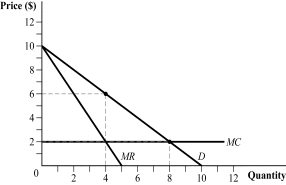
(Figure 10.1) Producer surplus under monopoly and under perfect price discrimination are _____ and _____, respectively.
A) $16; $32
B) $24; $48
C) $8; $12
D) $32; $12
Figure 10.1
(Figure 10.1) Producer surplus under monopoly and under perfect price discrimination are _____ and _____, respectively.
A) $16; $32
B) $24; $48
C) $8; $12
D) $32; $12
Question
Question
Question
Question
Use the following to answer question:
Table 10.1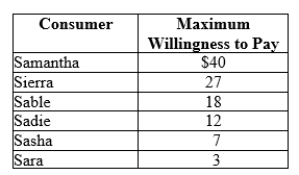
(Table 10.1) The table shows each consumer's maximum willingness to pay for a monthly subscription to MLB.TV. Each consumer is interested in purchasing a single subscription per month. The marginal cost of a subscription is $10. If MLB.TV can practice first-degree price discrimination, how much producer surplus will it earn from these consumers?
A) $97
B) $40
C) $57
D) $107
Table 10.1
(Table 10.1) The table shows each consumer's maximum willingness to pay for a monthly subscription to MLB.TV. Each consumer is interested in purchasing a single subscription per month. The marginal cost of a subscription is $10. If MLB.TV can practice first-degree price discrimination, how much producer surplus will it earn from these consumers?
A) $97
B) $40
C) $57
D) $107
Question
Question
Use the following to answer questions 6-7:
Figure 10.1
(Figure 10.1) The deadweight losses under monopoly and perfect price discrimination are _____ and _____, respectively.
A) $16; $0
B) $8; $16
C) $0; $32
D) $8; $0
Figure 10.1
(Figure 10.1) The deadweight losses under monopoly and perfect price discrimination are _____ and _____, respectively.
A) $16; $0
B) $8; $16
C) $0; $32
D) $8; $0
Question
Use the following to answer question:
Figure 10.3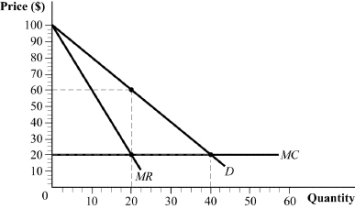
(Figure 10.3) Producer surplus using perfect price discrimination is _____ greater than under perfect competition and _____ greater than under monopoly.
A) $800; $400
B) $1,600; $800
C) $3,200; $1,600
D) $4,800; $3,200
Figure 10.3
(Figure 10.3) Producer surplus using perfect price discrimination is _____ greater than under perfect competition and _____ greater than under monopoly.
A) $800; $400
B) $1,600; $800
C) $3,200; $1,600
D) $4,800; $3,200
Question
Use the following to answer questions 16-17:
Figure 10.4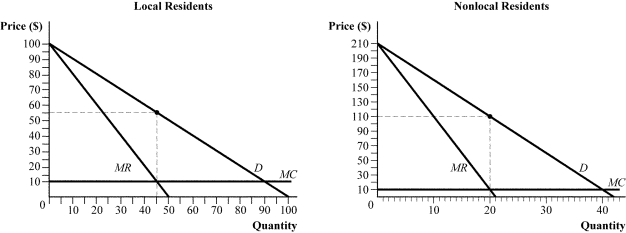
(Figure 10.4) If the firm can segment the market by residence, it will earn producer surplus of:
A) $2,680.
B) $4,025.
C) $2,012.50.
D) $1,800.50.
Figure 10.4
(Figure 10.4) If the firm can segment the market by residence, it will earn producer surplus of:
A) $2,680.
B) $4,025.
C) $2,012.50.
D) $1,800.50.
Question
Which of the following requirements is necessary to practice price discrimination? 
A) II, III, and IV
B) I, II, and III
C) I and II
D) III and IV
A) II, III, and IV
B) I, II, and III
C) I and II
D) III and IV
Question
Question
Question
Question
Use the following to answer question:
Figure 10.2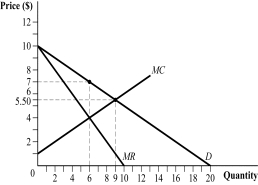
(Figure 10.2) Which of the following statements is (are) TRUE?
A) I, II, and III
B) I and III
C) II
D) II and III
Figure 10.2
(Figure 10.2) Which of the following statements is (are) TRUE?
A) I, II, and III
B) I and III
C) II
D) II and III
Question
Question
Question
Question
Question
A firm practicing third-degree price discrimination may: 
A) II
B) I and II
C) I
D) I, II, and III
A) II
B) I and II
C) I
D) I, II, and III
Question
Use the following to answer question:
Table 10.4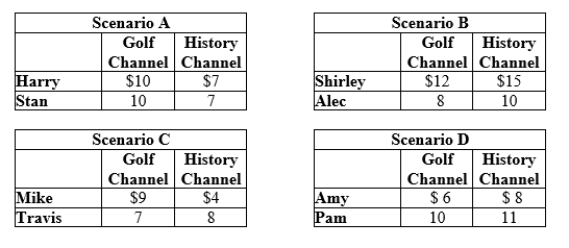
(Table 10.4) The table shows consumer valuations (maximum willingness to pay per month) for two cable television networks. In which of the scenarios would a cable television company have an increase in producer surplus from using a bundling strategy as opposed to selling channel access separately?
A) Scenario A
B) Scenario B
C) Scenario C
D) Scenario D
Table 10.4
(Table 10.4) The table shows consumer valuations (maximum willingness to pay per month) for two cable television networks. In which of the scenarios would a cable television company have an increase in producer surplus from using a bundling strategy as opposed to selling channel access separately?
A) Scenario A
B) Scenario B
C) Scenario C
D) Scenario D
Question
Use the following to answer question:
Table 10.7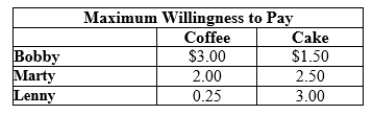
(Table 10.7) Assume that the marginal cost of coffee is $0.50 and the marginal cost of cake is $0.50. Which pricing scheme leads to the highest producer surplus?
A) $3.25 for coffee and cake
B) $1.50 for cake and $2.00 for coffee
C) $3.75 for both coffee and cake or $2.50 for cake and $2.50 for coffee
D) $5.00 for both coffee and cake or $2.75 for cake and $2.75 for coffee
Table 10.7
(Table 10.7) Assume that the marginal cost of coffee is $0.50 and the marginal cost of cake is $0.50. Which pricing scheme leads to the highest producer surplus?
A) $3.25 for coffee and cake
B) $1.50 for cake and $2.00 for coffee
C) $3.75 for both coffee and cake or $2.50 for cake and $2.50 for coffee
D) $5.00 for both coffee and cake or $2.75 for cake and $2.75 for coffee
Question
Question
Question
Use the following to answer question:
Figure 10.6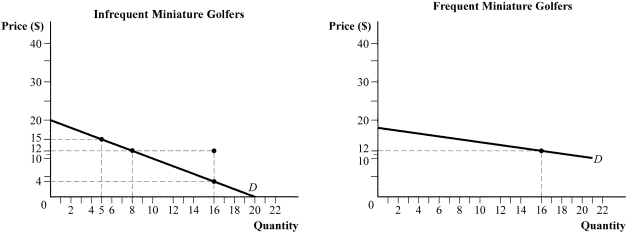
(Figure 10.6) Little Pinehurst Miniature Golf has two types of customers: infrequent players and frequent players. Using a strategy of second-degree price discrimination, Little Pinehurst offers customers the choice of paying $15 per round of miniature golf or $12 per round for a package of 16 rounds. The pricing scheme is _____ for infrequent players but is _____ for frequent players.
A) incentive-compatible; not incentive-compatible
B) not incentive-compatible; not incentive-compatible
C) not incentive-compatible; incentive-compatible
D) incentive-compatible; incentive-compatible
Figure 10.6
(Figure 10.6) Little Pinehurst Miniature Golf has two types of customers: infrequent players and frequent players. Using a strategy of second-degree price discrimination, Little Pinehurst offers customers the choice of paying $15 per round of miniature golf or $12 per round for a package of 16 rounds. The pricing scheme is _____ for infrequent players but is _____ for frequent players.
A) incentive-compatible; not incentive-compatible
B) not incentive-compatible; not incentive-compatible
C) not incentive-compatible; incentive-compatible
D) incentive-compatible; incentive-compatible
Question
Use the following to answer question:
Table 10.2
(Table 10.2) Suppose that Honda prices the Pilot 4WD LX at $30,000 and the Pilot 4WD Touring at $40,000. Are these prices incentive-compatible?
A) No, the less price-sensitive consumer receives more consumer surplus from the LX version.
B) Yes, each consumer type receives the highest consumer surplus from buying the car designed for its group.
C) No, the highly price-sensitive consumer receives more consumer surplus from the LX version.
D) Yes, each consumer type receives the lowest consumer surplus from buying the car designed for its group.
Table 10.2
(Table 10.2) Suppose that Honda prices the Pilot 4WD LX at $30,000 and the Pilot 4WD Touring at $40,000. Are these prices incentive-compatible?
A) No, the less price-sensitive consumer receives more consumer surplus from the LX version.
B) Yes, each consumer type receives the highest consumer surplus from buying the car designed for its group.
C) No, the highly price-sensitive consumer receives more consumer surplus from the LX version.
D) Yes, each consumer type receives the lowest consumer surplus from buying the car designed for its group.
Question
Use the following to answer question:
Table 10.5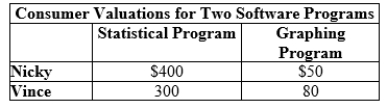
(Table 10.5) Assume that the marginal cost of producing software is zero. If the firm priced and sold each program separately, it would earn total revenues of _____, while a pure bundling strategy would generate the firm total revenues of _____.
A) $450; $900
B) $380; $450
C) $700; $760
D) $600; $660
Table 10.5
(Table 10.5) Assume that the marginal cost of producing software is zero. If the firm priced and sold each program separately, it would earn total revenues of _____, while a pure bundling strategy would generate the firm total revenues of _____.
A) $450; $900
B) $380; $450
C) $700; $760
D) $600; $660
Question
Question
Question
Use the following to answer question:
Figure 10.5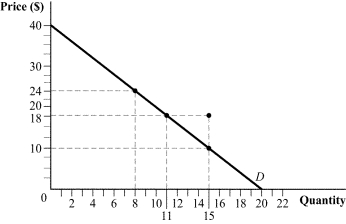
(Figure 10.5) Suppose that a firm offers customers either (1) the ability to buy any quantity they desire for $24 per unit or (2) a price of $18 per unit for 15 or more units. Consumer surplus under the quantity discount is _____ than under the $24-per-unit pricing scheme, so the plan to charge these types of consumers a price of $24 per unit is _____ compatible.
A) $64 more; incentive
B) $32 less; not incentive
C) $53 less; incentive
D) $41 more; not incentive
Figure 10.5
(Figure 10.5) Suppose that a firm offers customers either (1) the ability to buy any quantity they desire for $24 per unit or (2) a price of $18 per unit for 15 or more units. Consumer surplus under the quantity discount is _____ than under the $24-per-unit pricing scheme, so the plan to charge these types of consumers a price of $24 per unit is _____ compatible.
A) $64 more; incentive
B) $32 less; not incentive
C) $53 less; incentive
D) $41 more; not incentive
Question
Use the following to answer question:
Table 10.3
(Table 10.3) Suppose that Fender is trying to practice indirect price discrimination through versioning. It plans to offer the cheaper American Standard version of its guitar for consumers who are highly price-sensitive and the more expensive American Deluxe version to those who are not. To be incentive-compatible Fender should charge _____ for the American Standard and _____ for the American Deluxe.
A) $800; $1,599
B) $900; $1,001
C) $999; $1,499
D) $1,119; $1,750
Table 10.3
(Table 10.3) Suppose that Fender is trying to practice indirect price discrimination through versioning. It plans to offer the cheaper American Standard version of its guitar for consumers who are highly price-sensitive and the more expensive American Deluxe version to those who are not. To be incentive-compatible Fender should charge _____ for the American Standard and _____ for the American Deluxe.
A) $800; $1,599
B) $900; $1,001
C) $999; $1,499
D) $1,119; $1,750
Question
Question
Use the following to answer question:
Table 10.6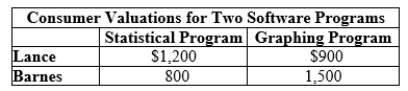
(Table 10.6) Assume that the marginal cost of producing software is zero. The most profitable bundling strategy would be to sell the statistical and graphical programs together for:
A) $2,000.
B) $2,100.
C) $2,200.
D) $2,300.
Table 10.6
(Table 10.6) Assume that the marginal cost of producing software is zero. The most profitable bundling strategy would be to sell the statistical and graphical programs together for:
A) $2,000.
B) $2,100.
C) $2,200.
D) $2,300.
Question
Question
Use the following to answer question:
Figure 10.7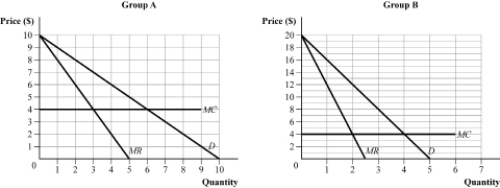
(Figure 10.7) Suppose a firm has two types of customers but cannot tell which type of buyer the customer is before a purchase is made. If the firm wanted to use quantity discounting, it should charge _____ per unit for any quantity purchased or _____.
A) $12; $4 per unit for 4 or more units
B) $12; $7 for 3 or more units, but the pricing scheme would not be incentive-compatible for Type B customers
C) $7; $4 for 2 or more units, but the pricing scheme would not be incentive-compatible for Type A customers
D) $8.50; $4 for 3 or more units
Figure 10.7
(Figure 10.7) Suppose a firm has two types of customers but cannot tell which type of buyer the customer is before a purchase is made. If the firm wanted to use quantity discounting, it should charge _____ per unit for any quantity purchased or _____.
A) $12; $4 per unit for 4 or more units
B) $12; $7 for 3 or more units, but the pricing scheme would not be incentive-compatible for Type B customers
C) $7; $4 for 2 or more units, but the pricing scheme would not be incentive-compatible for Type A customers
D) $8.50; $4 for 3 or more units
Question
Question
Question
To practice indirect or second-degree price discrimination, a firm must have: 
A) I and II
B) I, II, and III
C) II and III
D) I and III
A) I and II
B) I, II, and III
C) II and III
D) I and III
Question
Question
Use the following to answer questions 44-45:
Figure 10.9
(Figure 10.9) This firm is using block pricing, charging $35 each for the first 5 units, $25 each for units 6 and 7, and $15 for each unit beyond 7. What is the firm's producer surplus?
A) $80
B) $140
C) $100
D) $165
Figure 10.9
(Figure 10.9) This firm is using block pricing, charging $35 each for the first 5 units, $25 each for units 6 and 7, and $15 for each unit beyond 7. What is the firm's producer surplus?
A) $80
B) $140
C) $100
D) $165
Question
Answer the following questions.  Table 10.10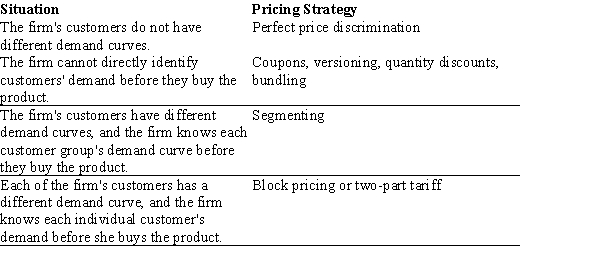
Table 10.10 Question
Use the following to answer question:
Table 10.9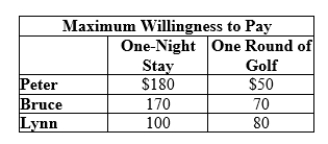
(Table 10.9) The marginal cost of a one-night stay and one round of golf are $50 and $10, respectively. Which of the following statements is (are) TRUE?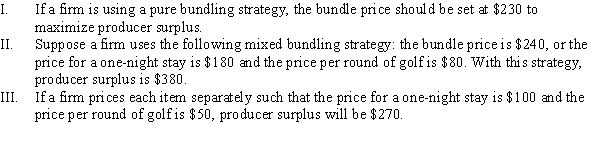
A) I, II, and III
B) II and III
C) I and III
D) I
Table 10.9
(Table 10.9) The marginal cost of a one-night stay and one round of golf are $50 and $10, respectively. Which of the following statements is (are) TRUE?
A) I, II, and III
B) II and III
C) I and III
D) I
Question
This graph represents a monopolist. Suppose the monopolist decides to practice perfect price discrimination. What will be the change in producer surplus as a result of this decision? 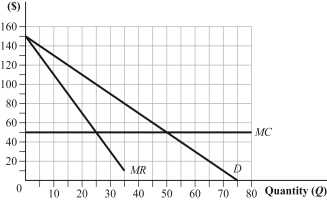
Question
Question
Use the following to answer question:
Figure 10.12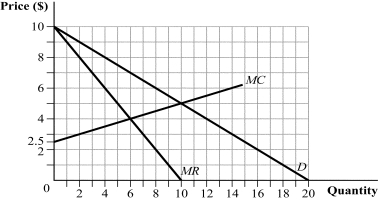
(Figure 10.12) Complete the following table.
Figure 10.12
(Figure 10.12) Complete the following table.
Question
Use the following to answer question:
Table 10.8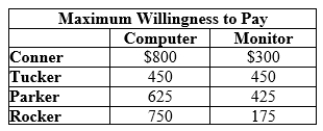
(Table 10.8) Assume that the marginal cost of a computer is $500 and the marginal cost of a monitor is $200. Suppose that a mixed bundling strategy sets price for a computer and a monitor at $1,000 or $725 per computer and $425 per monitor. How much producer surplus is earned by this strategy?
A) $1,050
B) $880
C) $1,250
D) $975
Table 10.8
(Table 10.8) Assume that the marginal cost of a computer is $500 and the marginal cost of a monitor is $200. Suppose that a mixed bundling strategy sets price for a computer and a monitor at $1,000 or $725 per computer and $425 per monitor. How much producer surplus is earned by this strategy?
A) $1,050
B) $880
C) $1,250
D) $975
Question
Use the following to answer question:
Figure 10.10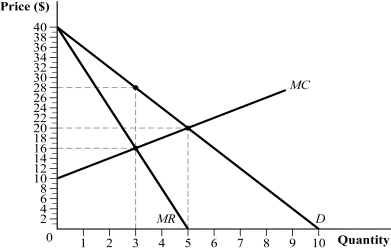
(Figure 10.10) Which of the following statements is (are) TRUE?
A) I, II, and III
B) I and II
C) II and III
D) II
Figure 10.10
(Figure 10.10) Which of the following statements is (are) TRUE?
A) I, II, and III
B) I and II
C) II and III
D) II
Question
Question
Question
Use the following to answer question:
Figure 10.11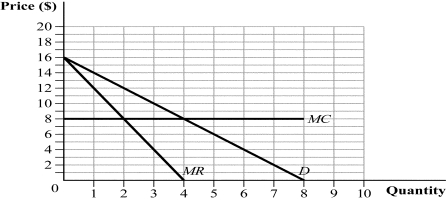
(Figure 10.11) If a firm uses a two-part tariff pricing strategy, the entrance fee is _____ and the per-unit price is _____.
A) $12; $8
B) $8; $12
C) $16; $8
D) $8; $16
Figure 10.11
(Figure 10.11) If a firm uses a two-part tariff pricing strategy, the entrance fee is _____ and the per-unit price is _____.
A) $12; $8
B) $8; $12
C) $16; $8
D) $8; $16
Question
Use the following to answer question:
Table 10.11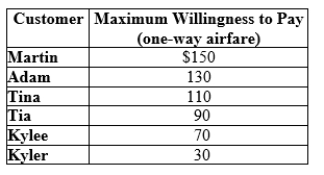
(Table 10.11) Suppose that the marginal cost of a one-way airfare is $30.
Table 10.11
(Table 10.11) Suppose that the marginal cost of a one-way airfare is $30.
Question
Question
Use the following to answer question:
Figure 10.13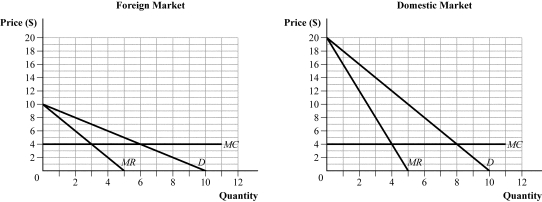
(Figure 10.13) A pharmaceutical company sells its pills in foreign and domestic markets.
Figure 10.13
(Figure 10.13) A pharmaceutical company sells its pills in foreign and domestic markets.
Question
A movie theater faces the following hourly inverse demand curves:
Seniors: PS = 12 - 0.5Q
Adults: Pa = 19 - Q
The marginal cost is constant at $1.
Seniors: PS = 12 - 0.5Q
Adults: Pa = 19 - Q
The marginal cost is constant at $1.
Question
Use the following to answer question:
Figure 10.8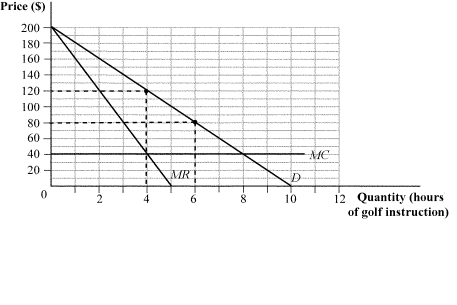
(Figure 10.8) If the golf instructor set a single price to maximize profit, she would earn producer surplus of _____. If she set a price of $120 an hour for the first four hours of instruction and $80 an hour for each hour of instruction beyond four hours, she would earn producer surplus of _____.
A) $480; $960
B) $320; $400
C) $500; $800
D) $80; $120
Figure 10.8
(Figure 10.8) If the golf instructor set a single price to maximize profit, she would earn producer surplus of _____. If she set a price of $120 an hour for the first four hours of instruction and $80 an hour for each hour of instruction beyond four hours, she would earn producer surplus of _____.
A) $480; $960
B) $320; $400
C) $500; $800
D) $80; $120
Question
A firm faces the demand curve Q = 20 - 0.8P and marginal cost MC = 2.5Q. 
Question
Question
Assume a monopolist can prevent resale of its product and it has complete information about each one of its customers. Even though each customer has a different demand curve, the seller can identify each customer's demand curve before a purchase takes place. It faces the inverse market demand of P = 160 - 10Q with marginal cost of MC = 10 + 5Q. Identify the type of price discrimination the monopolist should employ and complete this table: 
Question
Question
Use the following to answer question:
Table 10.13
(Table 10.13) The table shows consumer valuations for two versions of the Camaro. Select a price for the coupe and ZL1 such that the budget consumer prefers to purchase the coupe and the luxury consumer prefers the ZL1.
Table 10.13
(Table 10.13) The table shows consumer valuations for two versions of the Camaro. Select a price for the coupe and ZL1 such that the budget consumer prefers to purchase the coupe and the luxury consumer prefers the ZL1.
Question
Question
Use the following to answer question:
Figure 10.15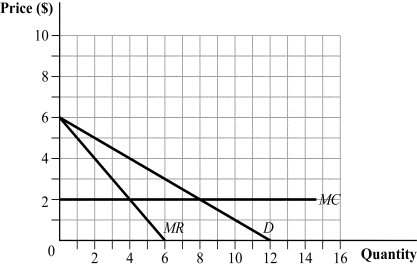
(Figure 10.15) Answer the following questions.
Figure 10.15
(Figure 10.15) Answer the following questions.
Question
A sand and gravel company sells pea gravel. It faces two types of customers with the following inverse demand curves:
Type A: P = 3.5 - 0.002Q
Type B: P = 3 - 0.001Q
where Q measures bags of pea gravel and P is the price per bag. The marginal cost is $0.50.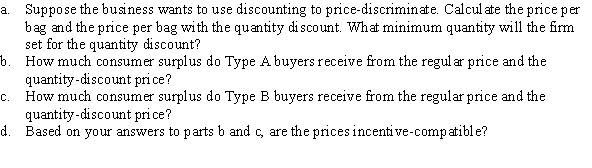
Type A: P = 3.5 - 0.002Q
Type B: P = 3 - 0.001Q
where Q measures bags of pea gravel and P is the price per bag. The marginal cost is $0.50.
Question
Use the following to answer question:
Table 10.14
(Table 10.14) The table shows customer valuations for different lawn services. The marginal cost of lawn cutting is $400 and the marginal cost of fertilizing is $200.
Table 10.14
(Table 10.14) The table shows customer valuations for different lawn services. The marginal cost of lawn cutting is $400 and the marginal cost of fertilizing is $200.
Question
Question
Use the following to answer question:
Figure 10.14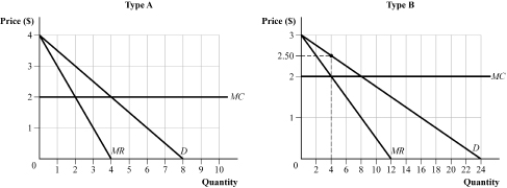
(Figure 10.14) Suppose a firm plans to use indirect price discrimination through quantity discounts. The firm cannot identify which customers are Type A or Type B before the purchase, so the firm would like to offer a regular-price plan and a quantity discount plan to suit the customers' personal price sensitivity.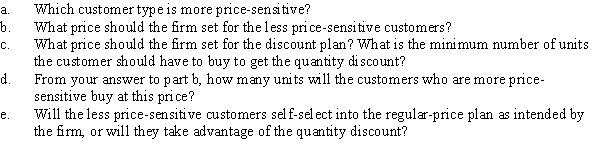
Figure 10.14
(Figure 10.14) Suppose a firm plans to use indirect price discrimination through quantity discounts. The firm cannot identify which customers are Type A or Type B before the purchase, so the firm would like to offer a regular-price plan and a quantity discount plan to suit the customers' personal price sensitivity.
Question
Question
Use the following to answer question:
Table 10.15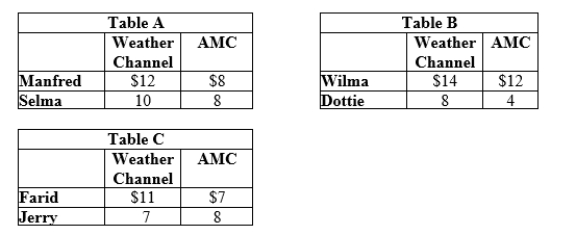
(Table 10.15) Tables A, B, and C show the consumers' willingness to pay for two cable television networks. Assume that the marginal cost of providing either channel is zero.


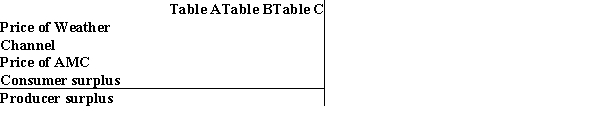

Table 10.15
(Table 10.15) Tables A, B, and C show the consumers' willingness to pay for two cable television networks. Assume that the marginal cost of providing either channel is zero.
Question
Use the following to answer question:
Table 10.12
(Table 10.12) The table shows consumer valuations for two types of Callaway golf shoes.
Table 10.12
(Table 10.12) The table shows consumer valuations for two types of Callaway golf shoes.
Question
Use the following to answer question:
Table 10.16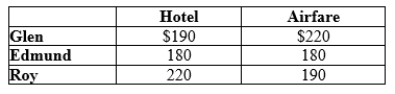
(Table 10.16) The table shows the consumer's willingness to pay for a hotel stay and airfare. Assume that marginal cost is zero for both goods.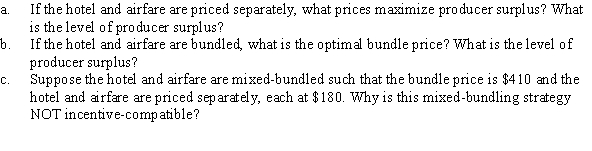
Table 10.16
(Table 10.16) The table shows the consumer's willingness to pay for a hotel stay and airfare. Assume that marginal cost is zero for both goods.
Question
Question
Question
Disney World charges $140 for one round of golf from morning until 2:00 P.M. and $60 for one round of golf from 2:00 P.M. until closing. Suppose the marginal cost of one round is $20. 
Question
Suppose a firm faces the inverse demand curve P = 100 - Q. Marginal cost is constant at $10. 
Question
Question
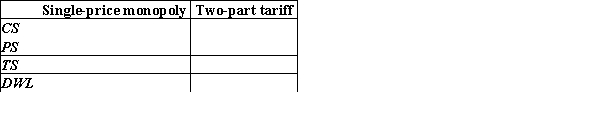
This graph represents demand at an amusement park. Park management is trying to decide between acting as a single price monopolist and employing a two-part tariff scheme. Complete the following table. 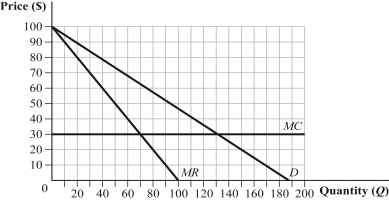
Question
A firm faces the demand curve Q = 6 - P, and its marginal cost is constant at $2. 
Question
This table shows the maximum willingness to pay for three consumers of lemonade and hot dogs. The marginal cost of both products is $0.25. A pure bundling strategy would charge _____for 1 lemonade and 1 hot dog. 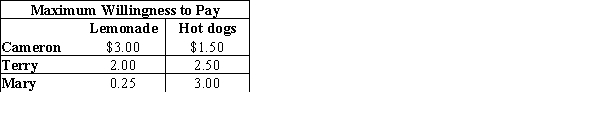

Unlock Deck
Sign up to unlock the cards in this deck!
Unlock Deck
Unlock Deck
1/100

Play

Full screen (f)
Deck 10: Market Power and Pricing Strategies
1
Hersheypark in Pennsylvania mentions the following offer on its Web page: "A military discount is available at Hersheypark during the regular summer operating schedule off of the Regular, Junior and Senior One Day admission. This discount is available to active duty military, reserves, retired military personnel, and members of the National Guard." This is _____ price discrimination.
A) first-degree
B) second-degree
C) segmenting or third-degree
D) perfect
A) first-degree
B) second-degree
C) segmenting or third-degree
D) perfect
C
2
Price discrimination is the practice of charging:
A) different prices for different goods.
B) different prices to different customers for the same good.
C) high prices for products with high marginal costs and low prices for products with low marginal costs.
D) the same price for different goods in different regions.
A) different prices for different goods.
B) different prices to different customers for the same good.
C) high prices for products with high marginal costs and low prices for products with low marginal costs.
D) the same price for different goods in different regions.
B
3
If a firm has market power but cannot prevent its customers from reselling the product, the firm will:
A) produce a quantity of output at which marginal revenue equals marginal cost.
B) produce a quantity of output at which price equals marginal cost.
C) engage in second-degree price discrimination.
D) engage in first-degree price discrimination.
A) produce a quantity of output at which marginal revenue equals marginal cost.
B) produce a quantity of output at which price equals marginal cost.
C) engage in second-degree price discrimination.
D) engage in first-degree price discrimination.
A
4
Use the following to answer questions 6-7:
Figure 10.1
(Figure 10.1) Producer surplus under monopoly and under perfect price discrimination are _____ and _____, respectively.
A) $16; $32
B) $24; $48
C) $8; $12
D) $32; $12
Figure 10.1
(Figure 10.1) Producer surplus under monopoly and under perfect price discrimination are _____ and _____, respectively.
A) $16; $32
B) $24; $48
C) $8; $12
D) $32; $12
Unlock Deck
Unlock for access to all 100 flashcards in this deck.
Unlock Deck
k this deck
5
A rock-climbing school faces two demand curves. The demand by local residents is Q = 400 - 0.5P, and the demand by others is Q = 500 - 0.5P. The marginal cost of serving either local or nonlocal residents is constant at $100. If the rock-climbing school cannot practice third-degree price discrimination and must charge a single price to all customers, it will charge:
A) $400.
B) $375.
C) $800.
D) $500.
A) $400.
B) $375.
C) $800.
D) $500.
Unlock Deck
Unlock for access to all 100 flashcards in this deck.
Unlock Deck
k this deck
6
Price discrimination is motivated by the firm's desire to:
A) penalize customers who do not match the racial or ethnic profile of the firm.
B) reduce the deadweight loss attributable to monopoly pricing.
C) effect social justice through long-run sustainable pricing strategies that benefit all community stakeholders.
D) increase producer surplus.
A) penalize customers who do not match the racial or ethnic profile of the firm.
B) reduce the deadweight loss attributable to monopoly pricing.
C) effect social justice through long-run sustainable pricing strategies that benefit all community stakeholders.
D) increase producer surplus.
Unlock Deck
Unlock for access to all 100 flashcards in this deck.
Unlock Deck
k this deck
7
Sparkling Water Co. has determined that for Michigan residents the price elasticity of demand for a case of its purified water is -3.0, while the price elasticity of demand for Florida residents is -2.5. Assume that the marginal cost is constant at $8. What price per case should Sparkling Water Co. charge Michigan and Florida customers?
A) Customers in Michigan and Florida should be charged $16.
B) Michigan customers should be charged $11.94 and Florida customers charged $13.33.
C) Michigan customers should be charged $10 and Florida customers charged $14.
D) Customers in Michigan and Florida should be charged $13.33.
A) Customers in Michigan and Florida should be charged $16.
B) Michigan customers should be charged $11.94 and Florida customers charged $13.33.
C) Michigan customers should be charged $10 and Florida customers charged $14.
D) Customers in Michigan and Florida should be charged $13.33.
Unlock Deck
Unlock for access to all 100 flashcards in this deck.
Unlock Deck
k this deck
8
Use the following to answer question:
Table 10.1
(Table 10.1) The table shows each consumer's maximum willingness to pay for a monthly subscription to MLB.TV. Each consumer is interested in purchasing a single subscription per month. The marginal cost of a subscription is $10. If MLB.TV can practice first-degree price discrimination, how much producer surplus will it earn from these consumers?
A) $97
B) $40
C) $57
D) $107
Table 10.1
(Table 10.1) The table shows each consumer's maximum willingness to pay for a monthly subscription to MLB.TV. Each consumer is interested in purchasing a single subscription per month. The marginal cost of a subscription is $10. If MLB.TV can practice first-degree price discrimination, how much producer surplus will it earn from these consumers?
A) $97
B) $40
C) $57
D) $107
Unlock Deck
Unlock for access to all 100 flashcards in this deck.
Unlock Deck
k this deck
9
(Figure 10.4) If the firm cannot practice third-degree price discrimination and must charge a single profit-maximizing price, it will earn producer surplus of approximately:
A) $3,521.05.
B) $2,990.
C) $980.
D) $4,555.20.
A) $3,521.05.
B) $2,990.
C) $980.
D) $4,555.20.
Unlock Deck
Unlock for access to all 100 flashcards in this deck.
Unlock Deck
k this deck
10
Use the following to answer questions 6-7:
Figure 10.1
(Figure 10.1) The deadweight losses under monopoly and perfect price discrimination are _____ and _____, respectively.
A) $16; $0
B) $8; $16
C) $0; $32
D) $8; $0
Figure 10.1
(Figure 10.1) The deadweight losses under monopoly and perfect price discrimination are _____ and _____, respectively.
A) $16; $0
B) $8; $16
C) $0; $32
D) $8; $0
Unlock Deck
Unlock for access to all 100 flashcards in this deck.
Unlock Deck
k this deck
11
Use the following to answer question:
Figure 10.3
(Figure 10.3) Producer surplus using perfect price discrimination is _____ greater than under perfect competition and _____ greater than under monopoly.
A) $800; $400
B) $1,600; $800
C) $3,200; $1,600
D) $4,800; $3,200
Figure 10.3
(Figure 10.3) Producer surplus using perfect price discrimination is _____ greater than under perfect competition and _____ greater than under monopoly.
A) $800; $400
B) $1,600; $800
C) $3,200; $1,600
D) $4,800; $3,200
Unlock Deck
Unlock for access to all 100 flashcards in this deck.
Unlock Deck
k this deck
12
Use the following to answer questions 16-17:
Figure 10.4
(Figure 10.4) If the firm can segment the market by residence, it will earn producer surplus of:
A) $2,680.
B) $4,025.
C) $2,012.50.
D) $1,800.50.
Figure 10.4
(Figure 10.4) If the firm can segment the market by residence, it will earn producer surplus of:
A) $2,680.
B) $4,025.
C) $2,012.50.
D) $1,800.50.
Unlock Deck
Unlock for access to all 100 flashcards in this deck.
Unlock Deck
k this deck
13
Which of the following requirements is necessary to practice price discrimination?
A) II, III, and IV
B) I, II, and III
C) I and II
D) III and IV
A) II, III, and IV
B) I, II, and III
C) I and II
D) III and IV
Unlock Deck
Unlock for access to all 100 flashcards in this deck.
Unlock Deck
k this deck
14
If a firm practices first-degree price discrimination, the firm must:
A) have customers with identical demand curves.
B) have complete information about each customer's unique demand curve before the customer buys the product.
C) be able to identify each customer's demand curve after the customer buys the product.
D) lack market power but know how its customers differ by their willingness to pay for the product.
A) have customers with identical demand curves.
B) have complete information about each customer's unique demand curve before the customer buys the product.
C) be able to identify each customer's demand curve after the customer buys the product.
D) lack market power but know how its customers differ by their willingness to pay for the product.
Unlock Deck
Unlock for access to all 100 flashcards in this deck.
Unlock Deck
k this deck
15
A firm with market power has the inverse demand curve P = 90 - 1.5Q and marginal cost curve MC = 10 + Q. If the firm decides to practice perfect price discrimination, its profit-maximizing output level will:
A) increase from 14 to 28 units.
B) decrease from 24 to 12 units.
C) increase from 20 to 32 units.
D) decrease from 28 to 14 units.
A) increase from 14 to 28 units.
B) decrease from 24 to 12 units.
C) increase from 20 to 32 units.
D) decrease from 28 to 14 units.
Unlock Deck
Unlock for access to all 100 flashcards in this deck.
Unlock Deck
k this deck
16
A firm with market power has the inverse demand curve P = 90 - 1.5Q and the marginal cost curve MC = 10 + Q. If the firm decides to practice perfect price discrimination, its producer surplus will:
A) decrease from $750 to $550.
B) increase from $800 to $1,280.
C) increase from $400 to $840.
D) decrease from $1,600 to $880.
A) decrease from $750 to $550.
B) increase from $800 to $1,280.
C) increase from $400 to $840.
D) decrease from $1,600 to $880.
Unlock Deck
Unlock for access to all 100 flashcards in this deck.
Unlock Deck
k this deck
17
Use the following to answer question:
Figure 10.2
(Figure 10.2) Which of the following statements is (are) TRUE?
A) I, II, and III
B) I and III
C) II
D) II and III
Figure 10.2
(Figure 10.2) Which of the following statements is (are) TRUE?
A) I, II, and III
B) I and III
C) II
D) II and III
Unlock Deck
Unlock for access to all 100 flashcards in this deck.
Unlock Deck
k this deck
18
The inverse demand curve for a firm with market power is P = 60 - Q, and its marginal cost is given by MC = 2Q. If the firm decides to practice first-degree price discrimination, the deadweight loss will:
A) decrease from $37.50 to $0.
B) decrease from $45 to $15.
C) increase from $0 to $65.
D) increase from $30 to $45.
A) decrease from $37.50 to $0.
B) decrease from $45 to $15.
C) increase from $0 to $65.
D) increase from $30 to $45.
Unlock Deck
Unlock for access to all 100 flashcards in this deck.
Unlock Deck
k this deck
19
A firm with market power has the inverse demand curve P = 160 - 4Q and the marginal cost curve MC = 8Q. If the firm decides to practice perfect price discrimination, consumer surplus will:
A) increase from $40 to $60.
B) increase from $120 to $200.
C) decrease from $80 to $20.
D) decrease from $200 to $0.
A) increase from $40 to $60.
B) increase from $120 to $200.
C) decrease from $80 to $20.
D) decrease from $200 to $0.
Unlock Deck
Unlock for access to all 100 flashcards in this deck.
Unlock Deck
k this deck
20
A rock-climbing school faces two demand curves. The demand by local residents is Q = 400 - 0.5P, and the demand by others is Q = 500 - 0.5P. The marginal cost of serving either local residents or others is constant at $100. If the rock-climbing school practices third-degree price discrimination, it will charge local residents and others a price of _____ and _____, respectively.
A) $400; $800
B) $450; $550
C) $600; $650
D) $275: $325
A) $400; $800
B) $450; $550
C) $600; $650
D) $275: $325
Unlock Deck
Unlock for access to all 100 flashcards in this deck.
Unlock Deck
k this deck
21
The Hagerstown Suns, a Minor League Baseball team, sells a single game-day ticket for $9. If you buy the 35-game ticket package, the price per ticket falls to $8.34. The Hagerstown Suns is using:
A) second-degree price discrimination in the form of quantity discounts.
B) third-degree price discrimination.
C) first-degree price discrimination.
D) a strategy of bundling.
A) second-degree price discrimination in the form of quantity discounts.
B) third-degree price discrimination.
C) first-degree price discrimination.
D) a strategy of bundling.
Unlock Deck
Unlock for access to all 100 flashcards in this deck.
Unlock Deck
k this deck
22
A firm practicing third-degree price discrimination may:
A) II
B) I and II
C) I
D) I, II, and III
A) II
B) I and II
C) I
D) I, II, and III
Unlock Deck
Unlock for access to all 100 flashcards in this deck.
Unlock Deck
k this deck
23
Use the following to answer question:
Table 10.4
(Table 10.4) The table shows consumer valuations (maximum willingness to pay per month) for two cable television networks. In which of the scenarios would a cable television company have an increase in producer surplus from using a bundling strategy as opposed to selling channel access separately?
A) Scenario A
B) Scenario B
C) Scenario C
D) Scenario D
Table 10.4
(Table 10.4) The table shows consumer valuations (maximum willingness to pay per month) for two cable television networks. In which of the scenarios would a cable television company have an increase in producer surplus from using a bundling strategy as opposed to selling channel access separately?
A) Scenario A
B) Scenario B
C) Scenario C
D) Scenario D
Unlock Deck
Unlock for access to all 100 flashcards in this deck.
Unlock Deck
k this deck
24
Use the following to answer question:
Table 10.7
(Table 10.7) Assume that the marginal cost of coffee is $0.50 and the marginal cost of cake is $0.50. Which pricing scheme leads to the highest producer surplus?
A) $3.25 for coffee and cake
B) $1.50 for cake and $2.00 for coffee
C) $3.75 for both coffee and cake or $2.50 for cake and $2.50 for coffee
D) $5.00 for both coffee and cake or $2.75 for cake and $2.75 for coffee
Table 10.7
(Table 10.7) Assume that the marginal cost of coffee is $0.50 and the marginal cost of cake is $0.50. Which pricing scheme leads to the highest producer surplus?
A) $3.25 for coffee and cake
B) $1.50 for cake and $2.00 for coffee
C) $3.75 for both coffee and cake or $2.50 for cake and $2.50 for coffee
D) $5.00 for both coffee and cake or $2.75 for cake and $2.75 for coffee
Unlock Deck
Unlock for access to all 100 flashcards in this deck.
Unlock Deck
k this deck
25
For price discrimination via coupons to be successful, it must be TRUE that:
A) shoppers who use coupons have more elastic demand than shoppers who do not.
B) shoppers who use coupons have more inelastic demand than shoppers who do not.
C) there is a negative correlation between coupon use and the consumer's willingness to shop for price.
D) firms can directly identify which consumers are the most price sensitive before purchase of the good.
A) shoppers who use coupons have more elastic demand than shoppers who do not.
B) shoppers who use coupons have more inelastic demand than shoppers who do not.
C) there is a negative correlation between coupon use and the consumer's willingness to shop for price.
D) firms can directly identify which consumers are the most price sensitive before purchase of the good.
Unlock Deck
Unlock for access to all 100 flashcards in this deck.
Unlock Deck
k this deck
26
A profit-maximizing skeet club segments its market. It charges juniors $4 per round based on their price elasticity of demand of -2.0. Its adult shooters have a price elasticity of demand of -1.4. The marginal cost per round does not vary by the shooter's age. What price does the skeet club charge adult shooters?
A) $7
B) $8
C) $6
D) $5.75
A) $7
B) $8
C) $6
D) $5.75
Unlock Deck
Unlock for access to all 100 flashcards in this deck.
Unlock Deck
k this deck
27
Use the following to answer question:
Figure 10.6
(Figure 10.6) Little Pinehurst Miniature Golf has two types of customers: infrequent players and frequent players. Using a strategy of second-degree price discrimination, Little Pinehurst offers customers the choice of paying $15 per round of miniature golf or $12 per round for a package of 16 rounds. The pricing scheme is _____ for infrequent players but is _____ for frequent players.
A) incentive-compatible; not incentive-compatible
B) not incentive-compatible; not incentive-compatible
C) not incentive-compatible; incentive-compatible
D) incentive-compatible; incentive-compatible
Figure 10.6
(Figure 10.6) Little Pinehurst Miniature Golf has two types of customers: infrequent players and frequent players. Using a strategy of second-degree price discrimination, Little Pinehurst offers customers the choice of paying $15 per round of miniature golf or $12 per round for a package of 16 rounds. The pricing scheme is _____ for infrequent players but is _____ for frequent players.
A) incentive-compatible; not incentive-compatible
B) not incentive-compatible; not incentive-compatible
C) not incentive-compatible; incentive-compatible
D) incentive-compatible; incentive-compatible
Unlock Deck
Unlock for access to all 100 flashcards in this deck.
Unlock Deck
k this deck
28
Use the following to answer question:
Table 10.2
(Table 10.2) Suppose that Honda prices the Pilot 4WD LX at $30,000 and the Pilot 4WD Touring at $40,000. Are these prices incentive-compatible?
A) No, the less price-sensitive consumer receives more consumer surplus from the LX version.
B) Yes, each consumer type receives the highest consumer surplus from buying the car designed for its group.
C) No, the highly price-sensitive consumer receives more consumer surplus from the LX version.
D) Yes, each consumer type receives the lowest consumer surplus from buying the car designed for its group.
Table 10.2
(Table 10.2) Suppose that Honda prices the Pilot 4WD LX at $30,000 and the Pilot 4WD Touring at $40,000. Are these prices incentive-compatible?
A) No, the less price-sensitive consumer receives more consumer surplus from the LX version.
B) Yes, each consumer type receives the highest consumer surplus from buying the car designed for its group.
C) No, the highly price-sensitive consumer receives more consumer surplus from the LX version.
D) Yes, each consumer type receives the lowest consumer surplus from buying the car designed for its group.
Unlock Deck
Unlock for access to all 100 flashcards in this deck.
Unlock Deck
k this deck
29
Use the following to answer question:
Table 10.5
(Table 10.5) Assume that the marginal cost of producing software is zero. If the firm priced and sold each program separately, it would earn total revenues of _____, while a pure bundling strategy would generate the firm total revenues of _____.
A) $450; $900
B) $380; $450
C) $700; $760
D) $600; $660
Table 10.5
(Table 10.5) Assume that the marginal cost of producing software is zero. If the firm priced and sold each program separately, it would earn total revenues of _____, while a pure bundling strategy would generate the firm total revenues of _____.
A) $450; $900
B) $380; $450
C) $700; $760
D) $600; $660
Unlock Deck
Unlock for access to all 100 flashcards in this deck.
Unlock Deck
k this deck
30
The purchase price for Stata version 12 (statistical software used by many economists) is $895. For users of Stata version 11, the price to upgrade to version 12 is $395. Which of the following statements is (are) TRUE?
A) Stata is using a two-part tariff strategy.
B) Stata is segmenting its market by past purchasing behavior.
C) Stata is practicing first-degree price discrimination by charging different groups different prices.
D) The current users of Stata are less price-sensitive than possible future users.
A) Stata is using a two-part tariff strategy.
B) Stata is segmenting its market by past purchasing behavior.
C) Stata is practicing first-degree price discrimination by charging different groups different prices.
D) The current users of Stata are less price-sensitive than possible future users.
Unlock Deck
Unlock for access to all 100 flashcards in this deck.
Unlock Deck
k this deck
31
Suppose a firm has two types of customers but cannot tell which type of buyer a customer is before a purchase is made. One group has an inverse demand of P = 100 - 10Q; another has an inverse demand curve of P = 110 - 22.5Q. The marginal cost of production is constant at $20. If the firm wanted to use quantity discounting, it should charge _____ per unit for any quantity purchased or _____ or more units.
A) $65; $60 for 4
B) $50; $40 for 8
C) $25; $20 for 2
D) $85; $75 for 6
A) $65; $60 for 4
B) $50; $40 for 8
C) $25; $20 for 2
D) $85; $75 for 6
Unlock Deck
Unlock for access to all 100 flashcards in this deck.
Unlock Deck
k this deck
32
Use the following to answer question:
Figure 10.5
(Figure 10.5) Suppose that a firm offers customers either (1) the ability to buy any quantity they desire for $24 per unit or (2) a price of $18 per unit for 15 or more units. Consumer surplus under the quantity discount is _____ than under the $24-per-unit pricing scheme, so the plan to charge these types of consumers a price of $24 per unit is _____ compatible.
A) $64 more; incentive
B) $32 less; not incentive
C) $53 less; incentive
D) $41 more; not incentive
Figure 10.5
(Figure 10.5) Suppose that a firm offers customers either (1) the ability to buy any quantity they desire for $24 per unit or (2) a price of $18 per unit for 15 or more units. Consumer surplus under the quantity discount is _____ than under the $24-per-unit pricing scheme, so the plan to charge these types of consumers a price of $24 per unit is _____ compatible.
A) $64 more; incentive
B) $32 less; not incentive
C) $53 less; incentive
D) $41 more; not incentive
Unlock Deck
Unlock for access to all 100 flashcards in this deck.
Unlock Deck
k this deck
33
Use the following to answer question:
Table 10.3
(Table 10.3) Suppose that Fender is trying to practice indirect price discrimination through versioning. It plans to offer the cheaper American Standard version of its guitar for consumers who are highly price-sensitive and the more expensive American Deluxe version to those who are not. To be incentive-compatible Fender should charge _____ for the American Standard and _____ for the American Deluxe.
A) $800; $1,599
B) $900; $1,001
C) $999; $1,499
D) $1,119; $1,750
Table 10.3
(Table 10.3) Suppose that Fender is trying to practice indirect price discrimination through versioning. It plans to offer the cheaper American Standard version of its guitar for consumers who are highly price-sensitive and the more expensive American Deluxe version to those who are not. To be incentive-compatible Fender should charge _____ for the American Standard and _____ for the American Deluxe.
A) $800; $1,599
B) $900; $1,001
C) $999; $1,499
D) $1,119; $1,750
Unlock Deck
Unlock for access to all 100 flashcards in this deck.
Unlock Deck
k this deck
34
Owners of a bowling alley have determined that the price elasticity of demand for bowling by seniors is -3.0, while the price elasticity of demand for others is -1.8. How much more should others be charged than seniors?
A) 67%
B) 50%
C) 60%
D) 25%
A) 67%
B) 50%
C) 60%
D) 25%
Unlock Deck
Unlock for access to all 100 flashcards in this deck.
Unlock Deck
k this deck
35
Use the following to answer question:
Table 10.6
(Table 10.6) Assume that the marginal cost of producing software is zero. The most profitable bundling strategy would be to sell the statistical and graphical programs together for:
A) $2,000.
B) $2,100.
C) $2,200.
D) $2,300.
Table 10.6
(Table 10.6) Assume that the marginal cost of producing software is zero. The most profitable bundling strategy would be to sell the statistical and graphical programs together for:
A) $2,000.
B) $2,100.
C) $2,200.
D) $2,300.
Unlock Deck
Unlock for access to all 100 flashcards in this deck.
Unlock Deck
k this deck
36
Versioning is a form of _____ price discrimination because _____.
A) first-degree; the firm can identify its customers' types of demand curves before they buy, allowing the firm to select the profit-maximizing version of the product
B) second-degree; the firm cannot identify its customers' types of demand curves before they buy, so the firm produces various versions of the product in hopes that customers will self-select the appropriate product
C) perfect; each customer buys a unique version of the product that is priced to eliminate all consumer surplus
D) third-degree; the firm can directly determine which customers should buy which version of the product before the sale is made
A) first-degree; the firm can identify its customers' types of demand curves before they buy, allowing the firm to select the profit-maximizing version of the product
B) second-degree; the firm cannot identify its customers' types of demand curves before they buy, so the firm produces various versions of the product in hopes that customers will self-select the appropriate product
C) perfect; each customer buys a unique version of the product that is priced to eliminate all consumer surplus
D) third-degree; the firm can directly determine which customers should buy which version of the product before the sale is made
Unlock Deck
Unlock for access to all 100 flashcards in this deck.
Unlock Deck
k this deck
37
Use the following to answer question:
Figure 10.7
(Figure 10.7) Suppose a firm has two types of customers but cannot tell which type of buyer the customer is before a purchase is made. If the firm wanted to use quantity discounting, it should charge _____ per unit for any quantity purchased or _____.
A) $12; $4 per unit for 4 or more units
B) $12; $7 for 3 or more units, but the pricing scheme would not be incentive-compatible for Type B customers
C) $7; $4 for 2 or more units, but the pricing scheme would not be incentive-compatible for Type A customers
D) $8.50; $4 for 3 or more units
Figure 10.7
(Figure 10.7) Suppose a firm has two types of customers but cannot tell which type of buyer the customer is before a purchase is made. If the firm wanted to use quantity discounting, it should charge _____ per unit for any quantity purchased or _____.
A) $12; $4 per unit for 4 or more units
B) $12; $7 for 3 or more units, but the pricing scheme would not be incentive-compatible for Type B customers
C) $7; $4 for 2 or more units, but the pricing scheme would not be incentive-compatible for Type A customers
D) $8.50; $4 for 3 or more units
Unlock Deck
Unlock for access to all 100 flashcards in this deck.
Unlock Deck
k this deck
38
The practice of bundling necessitates that a firm:
A) have market power, prevent arbitrage, and sell two products in which consumers' demand for one product is negatively correlated with their demand for the other product.
B) have market power and sell two products in which consumers' demand for one product is positively correlated with their demand for the other product.
C) ignore arbitrage and sell two products in which consumers' demand for one product is negatively correlated with their demand for the other product.
D) set price equal to marginal cost for each consumer whose demand can be identified after the purchase of the product.
A) have market power, prevent arbitrage, and sell two products in which consumers' demand for one product is negatively correlated with their demand for the other product.
B) have market power and sell two products in which consumers' demand for one product is positively correlated with their demand for the other product.
C) ignore arbitrage and sell two products in which consumers' demand for one product is negatively correlated with their demand for the other product.
D) set price equal to marginal cost for each consumer whose demand can be identified after the purchase of the product.
Unlock Deck
Unlock for access to all 100 flashcards in this deck.
Unlock Deck
k this deck
39
Which of the following is an example of bundling?
A) A shoe store doesn't sell shoes for just one foot; it sells shoes for the left foot and right foot packaged together.
B) An automobile manufacturer includes Michelin tires on its new cars.
C) A $95 ticket to the Magic Kingdom gives you entrance to the park and free access to all the rides.
D) HP includes a toner cartridge with the purchase of a new laser printer.
A) A shoe store doesn't sell shoes for just one foot; it sells shoes for the left foot and right foot packaged together.
B) An automobile manufacturer includes Michelin tires on its new cars.
C) A $95 ticket to the Magic Kingdom gives you entrance to the park and free access to all the rides.
D) HP includes a toner cartridge with the purchase of a new laser printer.
Unlock Deck
Unlock for access to all 100 flashcards in this deck.
Unlock Deck
k this deck
40
To practice indirect or second-degree price discrimination, a firm must have:
A) I and II
B) I, II, and III
C) II and III
D) I and III
A) I and II
B) I, II, and III
C) II and III
D) I and III
Unlock Deck
Unlock for access to all 100 flashcards in this deck.
Unlock Deck
k this deck
41
The price elasticity of demand for coffee by adults and by seniors is -2.3 and -3.6, respectively. In percentage terms, how much is seniors' coffee discounted from the price of adults' coffee?
Unlock Deck
Unlock for access to all 100 flashcards in this deck.
Unlock Deck
k this deck
42
Use the following to answer questions 44-45:
Figure 10.9
(Figure 10.9) This firm is using block pricing, charging $35 each for the first 5 units, $25 each for units 6 and 7, and $15 for each unit beyond 7. What is the firm's producer surplus?
A) $80
B) $140
C) $100
D) $165
Figure 10.9
(Figure 10.9) This firm is using block pricing, charging $35 each for the first 5 units, $25 each for units 6 and 7, and $15 for each unit beyond 7. What is the firm's producer surplus?
A) $80
B) $140
C) $100
D) $165
Unlock Deck
Unlock for access to all 100 flashcards in this deck.
Unlock Deck
k this deck
43
Answer the following questions. Table 10.10
Table 10.10 Unlock Deck
Unlock for access to all 100 flashcards in this deck.
Unlock Deck
k this deck
44
Use the following to answer question:
Table 10.9
(Table 10.9) The marginal cost of a one-night stay and one round of golf are $50 and $10, respectively. Which of the following statements is (are) TRUE?
A) I, II, and III
B) II and III
C) I and III
D) I
Table 10.9
(Table 10.9) The marginal cost of a one-night stay and one round of golf are $50 and $10, respectively. Which of the following statements is (are) TRUE?
A) I, II, and III
B) II and III
C) I and III
D) I
Unlock Deck
Unlock for access to all 100 flashcards in this deck.
Unlock Deck
k this deck
45
This graph represents a monopolist. Suppose the monopolist decides to practice perfect price discrimination. What will be the change in producer surplus as a result of this decision?
Unlock Deck
Unlock for access to all 100 flashcards in this deck.
Unlock Deck
k this deck
46
(Figure 10.9) Consumer surplus under single-price monopoly and under block pricing are _____ and _____, respectively.
A) $62.50; $82.50
B) $62.50; $40
C) $80; $120
D) $80; $112.50
A) $62.50; $82.50
B) $62.50; $40
C) $80; $120
D) $80; $112.50
Unlock Deck
Unlock for access to all 100 flashcards in this deck.
Unlock Deck
k this deck
47
Use the following to answer question:
Figure 10.12
(Figure 10.12) Complete the following table.
Figure 10.12
(Figure 10.12) Complete the following table.
Unlock Deck
Unlock for access to all 100 flashcards in this deck.
Unlock Deck
k this deck
48
Use the following to answer question:
Table 10.8
(Table 10.8) Assume that the marginal cost of a computer is $500 and the marginal cost of a monitor is $200. Suppose that a mixed bundling strategy sets price for a computer and a monitor at $1,000 or $725 per computer and $425 per monitor. How much producer surplus is earned by this strategy?
A) $1,050
B) $880
C) $1,250
D) $975
Table 10.8
(Table 10.8) Assume that the marginal cost of a computer is $500 and the marginal cost of a monitor is $200. Suppose that a mixed bundling strategy sets price for a computer and a monitor at $1,000 or $725 per computer and $425 per monitor. How much producer surplus is earned by this strategy?
A) $1,050
B) $880
C) $1,250
D) $975
Unlock Deck
Unlock for access to all 100 flashcards in this deck.
Unlock Deck
k this deck
49
Use the following to answer question:
Figure 10.10
(Figure 10.10) Which of the following statements is (are) TRUE?
A) I, II, and III
B) I and II
C) II and III
D) II
Figure 10.10
(Figure 10.10) Which of the following statements is (are) TRUE?
A) I, II, and III
B) I and II
C) II and III
D) II
Unlock Deck
Unlock for access to all 100 flashcards in this deck.
Unlock Deck
k this deck
50
An amusement park's customers have the demand curve for park rides given by Q = 11 - 0.5P, where P is the price per ride and Q is the number of rides. The marginal cost is $4. If the amusement park uses a two-part tariff, the park's entrance fee is _____, and its price per ride is _____.
A) $81; $4
B) $100; $11
C) $40; $4
D) $22; $2
A) $81; $4
B) $100; $11
C) $40; $4
D) $22; $2
Unlock Deck
Unlock for access to all 100 flashcards in this deck.
Unlock Deck
k this deck
51
A firm with market power faces a linear demand curve. With perfect price discrimination, it is producing 1,000 units of output and earning producer surplus of $5,000. Marginal cost is constant at $10. If the firm cannot price-discriminate, how much producer surplus will it earn?
Unlock Deck
Unlock for access to all 100 flashcards in this deck.
Unlock Deck
k this deck
52
Use the following to answer question:
Figure 10.11
(Figure 10.11) If a firm uses a two-part tariff pricing strategy, the entrance fee is _____ and the per-unit price is _____.
A) $12; $8
B) $8; $12
C) $16; $8
D) $8; $16
Figure 10.11
(Figure 10.11) If a firm uses a two-part tariff pricing strategy, the entrance fee is _____ and the per-unit price is _____.
A) $12; $8
B) $8; $12
C) $16; $8
D) $8; $16
Unlock Deck
Unlock for access to all 100 flashcards in this deck.
Unlock Deck
k this deck
53
Use the following to answer question:
Table 10.11
(Table 10.11) Suppose that the marginal cost of a one-way airfare is $30.
Table 10.11
(Table 10.11) Suppose that the marginal cost of a one-way airfare is $30.
Unlock Deck
Unlock for access to all 100 flashcards in this deck.
Unlock Deck
k this deck
54
Suppose that a night club's customers all have the same inverse demand curve for drinks, P = 5 - Q, where P is the price per drink and Q is the number of drinks. The marginal cost of a drink is $1. With a two-part tariff pricing strategy, how much do customers pay to get into the nightclub?
A) $5
B) $10
C) $8
D) $6
A) $5
B) $10
C) $8
D) $6
Unlock Deck
Unlock for access to all 100 flashcards in this deck.
Unlock Deck
k this deck
55
Use the following to answer question:
Figure 10.13
(Figure 10.13) A pharmaceutical company sells its pills in foreign and domestic markets.
Figure 10.13
(Figure 10.13) A pharmaceutical company sells its pills in foreign and domestic markets.
Unlock Deck
Unlock for access to all 100 flashcards in this deck.
Unlock Deck
k this deck
56
A movie theater faces the following hourly inverse demand curves:
Seniors: PS = 12 - 0.5Q
Adults: Pa = 19 - Q
The marginal cost is constant at $1.
Seniors: PS = 12 - 0.5Q
Adults: Pa = 19 - Q
The marginal cost is constant at $1.
Unlock Deck
Unlock for access to all 100 flashcards in this deck.
Unlock Deck
k this deck
57
Use the following to answer question:
Figure 10.8
(Figure 10.8) If the golf instructor set a single price to maximize profit, she would earn producer surplus of _____. If she set a price of $120 an hour for the first four hours of instruction and $80 an hour for each hour of instruction beyond four hours, she would earn producer surplus of _____.
A) $480; $960
B) $320; $400
C) $500; $800
D) $80; $120
Figure 10.8
(Figure 10.8) If the golf instructor set a single price to maximize profit, she would earn producer surplus of _____. If she set a price of $120 an hour for the first four hours of instruction and $80 an hour for each hour of instruction beyond four hours, she would earn producer surplus of _____.
A) $480; $960
B) $320; $400
C) $500; $800
D) $80; $120
Unlock Deck
Unlock for access to all 100 flashcards in this deck.
Unlock Deck
k this deck
58
A firm faces the demand curve Q = 20 - 0.8P and marginal cost MC = 2.5Q.
Unlock Deck
Unlock for access to all 100 flashcards in this deck.
Unlock Deck
k this deck
59
A warehouse club has customers with identical demand curves: Q = 100 - 5P, where Q is the annual number of merchandise units and P is the price per merchandise unit. The marginal cost of a merchandise unit is $10. If the warehouse club uses a two-part tariff strategy, it will earn producer surplus of _____ per customer.
A) $1,060
B) $75
C) $450
D) $250
A) $1,060
B) $75
C) $450
D) $250
Unlock Deck
Unlock for access to all 100 flashcards in this deck.
Unlock Deck
k this deck
60
Assume a monopolist can prevent resale of its product and it has complete information about each one of its customers. Even though each customer has a different demand curve, the seller can identify each customer's demand curve before a purchase takes place. It faces the inverse market demand of P = 160 - 10Q with marginal cost of MC = 10 + 5Q. Identify the type of price discrimination the monopolist should employ and complete this table:
Unlock Deck
Unlock for access to all 100 flashcards in this deck.
Unlock Deck
k this deck
61
Trick or Treat Candy Company has lots of customers, some of whom have an inverse demand of P = 160 - 10Q, while another group of customers has an inverse demand curve of P = 120 - 5Q. Unfortunately, the owner, Hazel, does not know which customers are which until they buy. She knows that her marginal costs are constant at $25 and that she would like to use quantity discounting. Advise her as to the prices she should set.
Unlock Deck
Unlock for access to all 100 flashcards in this deck.
Unlock Deck
k this deck
62
Use the following to answer question:
Table 10.13
(Table 10.13) The table shows consumer valuations for two versions of the Camaro. Select a price for the coupe and ZL1 such that the budget consumer prefers to purchase the coupe and the luxury consumer prefers the ZL1.
Table 10.13
(Table 10.13) The table shows consumer valuations for two versions of the Camaro. Select a price for the coupe and ZL1 such that the budget consumer prefers to purchase the coupe and the luxury consumer prefers the ZL1.
Unlock Deck
Unlock for access to all 100 flashcards in this deck.
Unlock Deck
k this deck
63
A monopolist would like to practice third-degree price discrimination. Its first group of customers is represented by the demand equation QD1 = 10 - P1. The second group is represented by the demand equation QD2 = 10 - 2P2. Assume marginal costs of $4 in both markets. Compare the profit the monopolist would make as a single-price monopolist to what it would earn with third-degree price discrimination. Based on your calculations, does it make sense for this monopolist to price-discriminate?
Unlock Deck
Unlock for access to all 100 flashcards in this deck.
Unlock Deck
k this deck
64
Use the following to answer question:
Figure 10.15
(Figure 10.15) Answer the following questions.
Figure 10.15
(Figure 10.15) Answer the following questions.
Unlock Deck
Unlock for access to all 100 flashcards in this deck.
Unlock Deck
k this deck
65
A sand and gravel company sells pea gravel. It faces two types of customers with the following inverse demand curves:
Type A: P = 3.5 - 0.002Q
Type B: P = 3 - 0.001Q
where Q measures bags of pea gravel and P is the price per bag. The marginal cost is $0.50.
Type A: P = 3.5 - 0.002Q
Type B: P = 3 - 0.001Q
where Q measures bags of pea gravel and P is the price per bag. The marginal cost is $0.50.
Unlock Deck
Unlock for access to all 100 flashcards in this deck.
Unlock Deck
k this deck
66
Use the following to answer question:
Table 10.14
(Table 10.14) The table shows customer valuations for different lawn services. The marginal cost of lawn cutting is $400 and the marginal cost of fertilizing is $200.
Table 10.14
(Table 10.14) The table shows customer valuations for different lawn services. The marginal cost of lawn cutting is $400 and the marginal cost of fertilizing is $200.
Unlock Deck
Unlock for access to all 100 flashcards in this deck.
Unlock Deck
k this deck
67
A pizza monopolist employing third-degree price discrimination charges students $10 per pizza and everyone else $15 per pizza. Students must show their ID before they can get the discount. The marginal cost of this monopolist is $5 whether or not the customer is a student. The elasticity of demand for the students is _____ and for everyone else it is _____.
Unlock Deck
Unlock for access to all 100 flashcards in this deck.
Unlock Deck
k this deck
68
Use the following to answer question:
Figure 10.14
(Figure 10.14) Suppose a firm plans to use indirect price discrimination through quantity discounts. The firm cannot identify which customers are Type A or Type B before the purchase, so the firm would like to offer a regular-price plan and a quantity discount plan to suit the customers' personal price sensitivity.
Figure 10.14
(Figure 10.14) Suppose a firm plans to use indirect price discrimination through quantity discounts. The firm cannot identify which customers are Type A or Type B before the purchase, so the firm would like to offer a regular-price plan and a quantity discount plan to suit the customers' personal price sensitivity.
Unlock Deck
Unlock for access to all 100 flashcards in this deck.
Unlock Deck
k this deck
69
A monopolist serves market A with an inverse demand curve of P = 12 - Q. The marginal cost is constant at $2. Suppose the monopolist uses a two-part tariff pricing. What price does the monopolist set? What is the entrance fee? What is the deadweight loss? What is consumer surplus?
Unlock Deck
Unlock for access to all 100 flashcards in this deck.
Unlock Deck
k this deck
70
Use the following to answer question:
Table 10.15
(Table 10.15) Tables A, B, and C show the consumers' willingness to pay for two cable television networks. Assume that the marginal cost of providing either channel is zero.
Table 10.15
(Table 10.15) Tables A, B, and C show the consumers' willingness to pay for two cable television networks. Assume that the marginal cost of providing either channel is zero.
Unlock Deck
Unlock for access to all 100 flashcards in this deck.
Unlock Deck
k this deck
71
Use the following to answer question:
Table 10.12
(Table 10.12) The table shows consumer valuations for two types of Callaway golf shoes.
Table 10.12
(Table 10.12) The table shows consumer valuations for two types of Callaway golf shoes.
Unlock Deck
Unlock for access to all 100 flashcards in this deck.
Unlock Deck
k this deck
72
Use the following to answer question:
Table 10.16
(Table 10.16) The table shows the consumer's willingness to pay for a hotel stay and airfare. Assume that marginal cost is zero for both goods.
Table 10.16
(Table 10.16) The table shows the consumer's willingness to pay for a hotel stay and airfare. Assume that marginal cost is zero for both goods.
Unlock Deck
Unlock for access to all 100 flashcards in this deck.
Unlock Deck
k this deck
73
A pizza monopolist employing third-degree price discrimination has general customers with an elasticity of demand equal to -1.6 and student customers with an elasticity of demand of -3.45. Students must show their ID before they can get the discount. The marginal cost of this monopolist is $5 whether or not the customer is a student. What should the percentage price discount for students be?
Unlock Deck
Unlock for access to all 100 flashcards in this deck.
Unlock Deck
k this deck
74
Trick or Treat Candy Company has lots of customers, some of whom have an inverse demand of P = 160 - 10Q, while others have an inverse demand curve of P = 120 - 5Q. Unfortunately, the owner, Hazel, does not know which customers are which until they buy. She knows that her marginal costs are constant at $25 and that she would like to use quantity discounting. Is this price scheme incentive-compatible? If more than 9.5 units are purchased, the price per unit will be $72.50; otherwise, $92.50 per unit.
Unlock Deck
Unlock for access to all 100 flashcards in this deck.
Unlock Deck
k this deck
75
Disney World charges $140 for one round of golf from morning until 2:00 P.M. and $60 for one round of golf from 2:00 P.M. until closing. Suppose the marginal cost of one round is $20.
Unlock Deck
Unlock for access to all 100 flashcards in this deck.
Unlock Deck
k this deck
76
Suppose a firm faces the inverse demand curve P = 100 - Q. Marginal cost is constant at $10.
Unlock Deck
Unlock for access to all 100 flashcards in this deck.
Unlock Deck
k this deck
77
Across Country Ski Tours has determined that the price elasticity of demand for customers who don't own their own equipment is -2, while the price elasticity of demand of those who do own their own equipment is -5. Assume that the marginal cost is constant at $10. If the firm can practice third-degree price discrimination, what prices should Across Country Ski Tours charge its customers?
Unlock Deck
Unlock for access to all 100 flashcards in this deck.
Unlock Deck
k this deck
78
This graph represents demand at an amusement park. Park management is trying to decide between acting as a single price monopolist and employing a two-part tariff scheme. Complete the following table.
Unlock Deck
Unlock for access to all 100 flashcards in this deck.
Unlock Deck
k this deck
79
A firm faces the demand curve Q = 6 - P, and its marginal cost is constant at $2.
Unlock Deck
Unlock for access to all 100 flashcards in this deck.
Unlock Deck
k this deck
80
This table shows the maximum willingness to pay for three consumers of lemonade and hot dogs. The marginal cost of both products is $0.25. A pure bundling strategy would charge _____for 1 lemonade and 1 hot dog.
Unlock Deck
Unlock for access to all 100 flashcards in this deck.
Unlock Deck
k this deck
Unlock Deck
Unlock for access to all 100 flashcards in this deck.






