







 Chat with AI

Deck 24: Geometrical Optics
Full screen (f)

Question
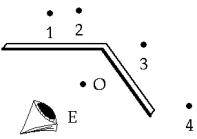 Two plane mirrors make an angle of 120º as shown. An object is placed at O. When the eye is placed at E, it will observe images formed at
A) 1 and 2.
B) 2 and 3.
C) 3 and 4.
D) 1 and 4.
E) 1 and 3.

Question
Question
Question
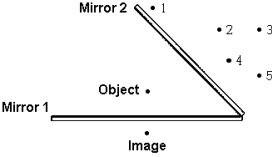 An object is placed between two mirrors set at an angle to each other. The location of the image of the object in mirror 1 is shown in the figure. The location of the image of that image in mirror 2 is at
A) 1.
B) 2.
C) 3.
D) 4.
E) 5.
Question
Question
Question
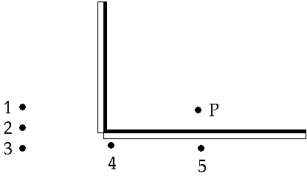 A point object P is placed before two mirrors at right angles as shown. Images of the object are formed only at positions
A) 1, 2, and 3.
B) 2, 3, and 4.
C) 3, 4, and 5.
D) 2 and 4.
E) 1, 3, and 5.
Question
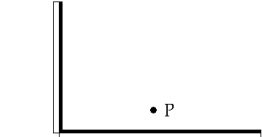 A point object P is placed before two mirrors at right angles as shown. How many total number of images will be formed due to reflections from these mirrors?
A) 1
B) 2
C) 3
D) 4
E) 5
Question
Question
Question
Question
Question
Question
Question
Question
Question
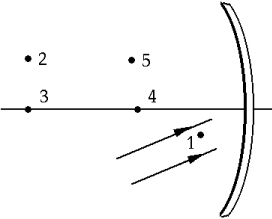 Two parallel rays are incident on a concave spherical mirror whose center of curvature is at 3. After being reflected, the two rays cross at point
A) 1.
B) 2.
C) 3.
D) 4.
E) 5.
Question
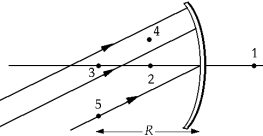 The parallel rays incident on the surface of the concave spherical mirror in the figure converge to a point at
A) 1.
B) 2.
C) 3.
D) 4.
E) 5.
Question
Question
Question
Question
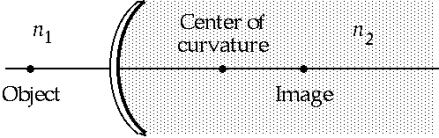 Which of the following statements about the figure is correct when the index of refraction n2 is greater than n1?
A) The object distance is greater than the image distance.
B) The image distance may be positive or negative.
C) The radius of curvature is negative.
D) The magnitude of the magnification is less than one.
E) The object distance is positive.
Question
Question
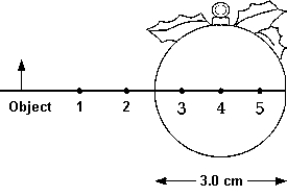 An object is located 3 cm from the surface of a silvered spherical glass Christmas tree ornament that is 3 cm in diameter. The image forms at
A) 1.
B) 2.
C) 3.
D) 4.
E) 5.
Question
Question
Question
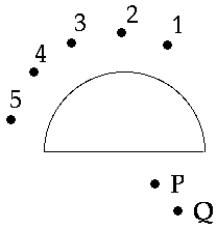 Half-round slabs of glass or plastic are often used to trace rays. Pins are placed at points P and Q. For an observer to see the images of the pins in line, she should place her eye at point
A) 1.
B) 2.
C) 3.
D) 4.
E) 5.
Question
Question
Question
Question
Question
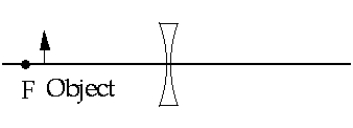 When a real object is placed just inside the focal point F of a diverging lens, the image is
A) virtual, erect, and diminished.
B) real, inverted, and enlarged.
C) real, inverted, and diminished.
D) virtual, erect, and enlarged.
E) virtual, inverted, and diminished.
Question
Question
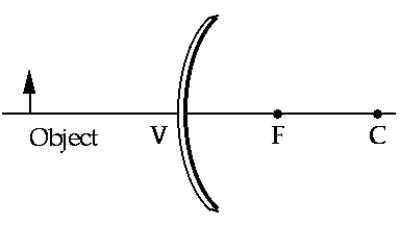 The image of an object, placed in front of a spherical convex mirror as shown, forms between
A) O and V and is magnified.
B) V and F and is magnified.
C) V and F and is diminished.
D) F and C and is diminished.
E) F and C and is magnified.
Question
Question
Question
Question
Question
Question
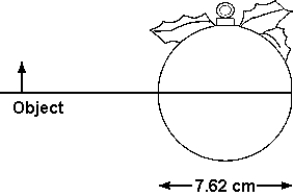 An object is located 7.62 cm from the surface of a silvered spherical glass Christmas tree ornament that is 7.62 cm in diameter. The image distance is approximately
A) 1.52 cm.
B) -1.52 cm.
C) 4.24 cm.
D) -4.24 cm.
E) infinity because no image is formed.
Question
Question
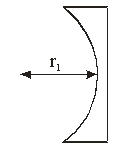 A plano-concave lens has r1 = 15 cm and is constructed of a material with refractive index of 1.5. The focal length of the lens is
A) "-15 cm."
B) "15 cm."
C) "-30 cm."
D) "30 cm."
E) "None of these is correct."
Question
Question
Question
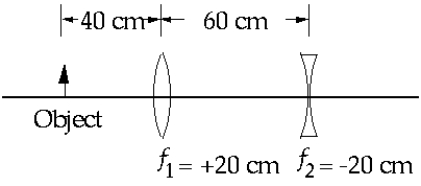 Two lenses, one with a focal length f1 = +20 cm and the other with a focal length f2 = -20 cm, are on the same axis and 60 cm apart as shown. A real object is 40 cm to the left of the first lens, as shown. The final image formed by this two-lens combination is
A) real and 10 cm from the negative lens.
B) virtual and 10 cm from the negative lens.
C) at infinity.
D) virtual and 20 cm from the negative lens.
E) None of these is correct.
Question
Question
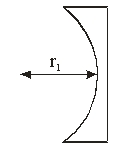 An object is placed in front of a plano-concave lens at r1/2. The image produced by the lens is
A) inverted, real, and reduced in size.
B) inverted, virtual, and enlarged in size.
C) upright, virtual, and reduced in size.
D) upright, virtual, and enlarged in size.
E) upright, real, and enlarged in size.
Question
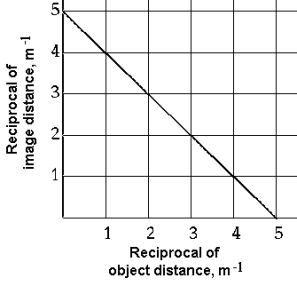 The graph shows the reciprocal of the image distance plotted against the reciprocal of the object distance for a certain lens. From this graph it can be seen that this lens has a focal length of
A) 0.20 m.
B) 1.0 m.
C) 4.0 m.
D) 0.25 m.
E) -1.0 m.
Question
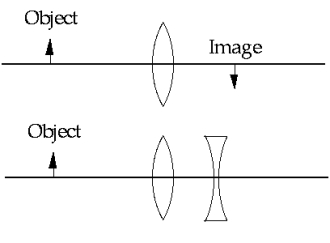 A real image is formed by a converging lens. If a weak diverging lens is placed between the converging lens and the image, where is the new image located?
A) between the object and the converging lens
B) farther from the converging lens than the original image
C) closer to the converging lens than the original image
D) at the original image position
E) It might be either between the object and the converging lens or to the right of the diverging lens.
Question
Question
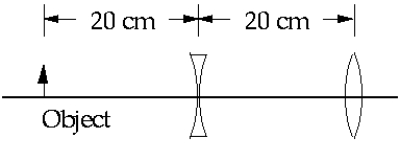 A lens with a negative focal length of -10.0 cm is on the same axis as a lens with a positive focal length of +20.0 cm as illustrated. The distance between the lenses is 20.0 cm. A real object 3.00 cm high is placed 20.0 cm to the left of the first lens. After the light has passed through both lenses, the final image is
A) 3.0 cm high and virtual.
B) 1.0 cm high and virtual.
C) 1.0 cm high and real.
D) 3.0 cm high and real.
E) None of these is correct.
Question
Question
Question
Question
Question
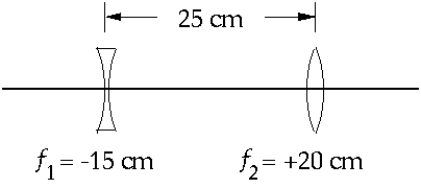 A lens with a negative focal length of f1= -15 cm is 25 cm from a lens with a positive focal length of f2= +20 cm on the same axis. Parallel light from the left is incident on the first lens. The final image formed by this two-lens system is
A) real and 40 cm from the positive lens.
B) virtual and 20 cm from the positive lens.
C) real and 20 cm from the positive lens.
D) real and 13 cm from the positive lens.
E) None of these is correct.
Question
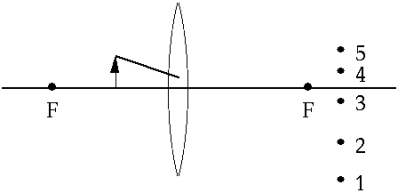 An object is shown to the left of a converging lens of focal length f. A ray of light leaves the object and enters the lens. After this ray of light passes through the lens, it will go through point
A) 1.
B) 2.
C) 3.
D) 4.
E) 5.
Question
Question
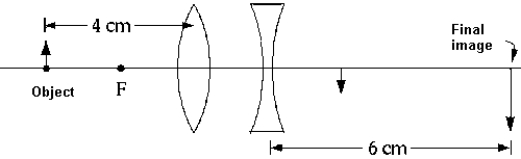 An object placed 4 cm to the left of a lens with positive focal length f1 = +2 cm produces an image 4 cm to the right of the lens. A diverging lens, focal length f2, is now placed at the focal point of the first lens, as shown, and produces a final image 6 cm to the right of lens f2. The focal length f2 is
A) -1.5 cm.
B) -3.0 cm.
C) -6.0 cm.
D) 10 cm.
E) -2.0 cm.
Question
Question
Question
Question
Question
Question
Question
Question
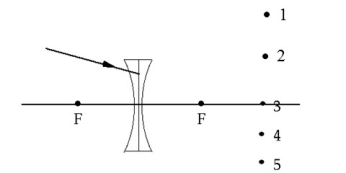 When the ray in the diagram is continued through the diverging lens, it passes through point
A) 1.
B) 2.
C) 3.
D) 4.
E) 5.
Question
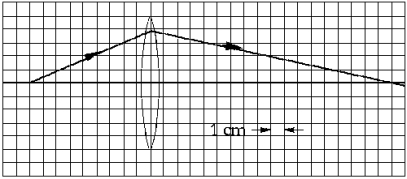 A ray of light is shown as it passes through a positive thin lens. If the grids are 1.0 cm apart on the figure, this lens has a focal length of
A) 18 cm.
B) 12 cm.
C) 9.0 cm.
D) 6.0 cm.
E) 3.0 cm.
Question
Question
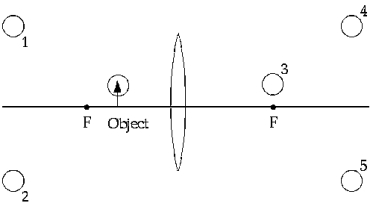 The image of the encircled point on the object formed in the positive lens is at which circle?
A) 1
B) 2
C) 3
D) 4
E) 5
Question
 The image of the object formed by the diverging lens is located at point
A) 1.
B) 2.
C) 3.
D) 4.
E) 5.
Question
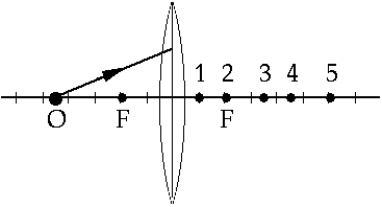 A ray of light leaves point O and passes through a thin lens with a positive focal length. It crosses the principal axis at point
A) 1.
B) 2.
C) 3.
D) 4.
E) 5.
Question
Question
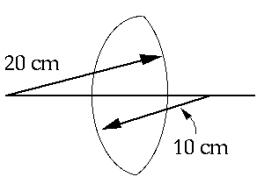 A lens is made of glass of index of refraction 1.60. If both the surfaces are convex and the radii of curvatures are 10 cm and 20 cm, the focal length of the lens in air is
A) 11.1 cm.
B) -11.1 cm.
C) 25 cm.
D) 33.3 cm.
E) -33.3 cm.
Question
Question
Question
Question
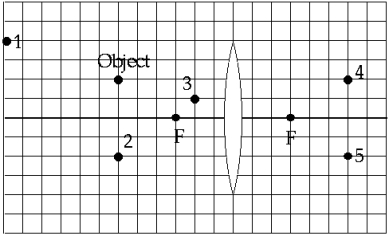 The image produced by the converging lens is at point
A) 1.
B) 2.
C) 3.
D) 4.
E) 5.
Question
Question
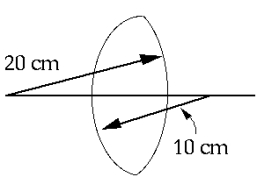 A lens is made of glass of refractive index 1.50. If both the surfaces are convex and the radii of curvatures are 10 cm and 20 cm, then the focal length of this lens is
A) 4.45 cm.
B) 13.3 cm.
C) -13.3 cm.
D) 40 cm.
E) -40 cm.

Unlock Deck
Sign up to unlock the cards in this deck!
Unlock Deck
Unlock Deck
1/120

Play

Full screen (f)
Deck 24: Geometrical Optics
1
Two plane mirrors make an angle of 120º as shown. An object is placed at O. When the eye is placed at E, it will observe images formed atA) 1 and 2.
B) 2 and 3.
C) 3 and 4.
D) 1 and 4.
E) 1 and 3.
2 and 3.
2
A concave spherical mirror has a radius of curvature of 50 cm. The image of an object located 35 cm in front of the mirror is
A) real, inverted, magnified 2.5 times, and 87.5 cm from the mirror.
B) real, erect, magnified 2.5 times, and 87.5 cm from the mirror.
C) virtual, erect, magnified 3.3 times, and 117 cm from the mirror.
D) real, inverted, magnified 3.3 times, and 117 cm from the mirror.
E) real, inverted, diminished 0.42 times, and 14.6 cm from the mirror.
A) real, inverted, magnified 2.5 times, and 87.5 cm from the mirror.
B) real, erect, magnified 2.5 times, and 87.5 cm from the mirror.
C) virtual, erect, magnified 3.3 times, and 117 cm from the mirror.
D) real, inverted, magnified 3.3 times, and 117 cm from the mirror.
E) real, inverted, diminished 0.42 times, and 14.6 cm from the mirror.
real, inverted, magnified 2.5 times, and 87.5 cm from the mirror.
3
What is the minimum height of a plane mirror in which a standing woman can see her entire body reflected?
A) It must equal her height.
B) It depends on how far from the mirror the woman stands.
C) It depends on the focal length of the mirror.
D) It must be one-half her height.
E) It depends on the image distance.
A) It must equal her height.
B) It depends on how far from the mirror the woman stands.
C) It depends on the focal length of the mirror.
D) It must be one-half her height.
E) It depends on the image distance.
It must be one-half her height.
4
An object is placed between two mirrors set at an angle to each other. The location of the image of the object in mirror 1 is shown in the figure. The location of the image of that image in mirror 2 is atA) 1.
B) 2.
C) 3.
D) 4.
E) 5.
Unlock Deck
Unlock for access to all 120 flashcards in this deck.
Unlock Deck
k this deck
5
A concave spherical mirror can produce which one of the following type of image?
A) virtual, inverted, and magnified
B) real, erect, and magnified
C) diminished, erect, and virtual
D) magnified, erect, and virtual
E) diminished, real, and erect
A) virtual, inverted, and magnified
B) real, erect, and magnified
C) diminished, erect, and virtual
D) magnified, erect, and virtual
E) diminished, real, and erect
Unlock Deck
Unlock for access to all 120 flashcards in this deck.
Unlock Deck
k this deck
6
When an object is closer to a concave mirror than the mirror's focal point, the
A) magnification is less than one.
B) image is formed between the object and the mirror.
C) magnification is equal to one.
D) image distance is negative.
E) image is inverted.
A) magnification is less than one.
B) image is formed between the object and the mirror.
C) magnification is equal to one.
D) image distance is negative.
E) image is inverted.
Unlock Deck
Unlock for access to all 120 flashcards in this deck.
Unlock Deck
k this deck
7
A point object P is placed before two mirrors at right angles as shown. Images of the object are formed only at positionsA) 1, 2, and 3.
B) 2, 3, and 4.
C) 3, 4, and 5.
D) 2 and 4.
E) 1, 3, and 5.
Unlock Deck
Unlock for access to all 120 flashcards in this deck.
Unlock Deck
k this deck
8
A point object P is placed before two mirrors at right angles as shown. How many total number of images will be formed due to reflections from these mirrors?A) 1
B) 2
C) 3
D) 4
E) 5
Unlock Deck
Unlock for access to all 120 flashcards in this deck.
Unlock Deck
k this deck
9
A person of height H stands in front of a vertical plane mirror that is only half of her height. In the reflected image, this person will be able to see
A) from her head to toe.
B) only from her head to her waist.
C) only from her waist to her toes.
D) only one half of her body.
E) no image at all.
A) from her head to toe.
B) only from her head to her waist.
C) only from her waist to her toes.
D) only one half of her body.
E) no image at all.
Unlock Deck
Unlock for access to all 120 flashcards in this deck.
Unlock Deck
k this deck
10
An object is placed 10 inches in front of a concave mirror that has a radius of curvature of 8 inches. The image is located
A) 4.75 inches in front of the mirror.
B) 4.75 inches behind the mirror.
C) 3 inches behind the mirror.
D) 6.67 inches behind the mirror.
E) 6.67 inches in front of the mirror.
A) 4.75 inches in front of the mirror.
B) 4.75 inches behind the mirror.
C) 3 inches behind the mirror.
D) 6.67 inches behind the mirror.
E) 6.67 inches in front of the mirror.
Unlock Deck
Unlock for access to all 120 flashcards in this deck.
Unlock Deck
k this deck
11
Two plane mirrors are a distance 2d apart and parallel to one another. An object is placed at the midpoint between the two mirrors. After two reflections on each mirror, how far will be the image from the mirror with the last, i.e., the fourth, reflection?
A) d
B) 3d
C) 5d
D) 7d
E) 9d
A) d
B) 3d
C) 5d
D) 7d
E) 9d
Unlock Deck
Unlock for access to all 120 flashcards in this deck.
Unlock Deck
k this deck
12
The image of an object located 10 cm from a concave spherical mirror of radius 10 cm is
A) real, inverted, and magnified.
B) real, inverted, and diminished.
C) real, inverted, and the same size.
D) virtual, erect, and magnified.
E) virtual, erect, and diminished.
A) real, inverted, and magnified.
B) real, inverted, and diminished.
C) real, inverted, and the same size.
D) virtual, erect, and magnified.
E) virtual, erect, and diminished.
Unlock Deck
Unlock for access to all 120 flashcards in this deck.
Unlock Deck
k this deck
13
The technical name for the type of image formed by a single plane mirror is
A) a real image.
B) an inverted image.
C) an enlarged image.
D) a focal image.
E) a virtual image.
A) a real image.
B) an inverted image.
C) an enlarged image.
D) a focal image.
E) a virtual image.
Unlock Deck
Unlock for access to all 120 flashcards in this deck.
Unlock Deck
k this deck
14
An object 0.50 cm high is 5.0 cm from a concave spherical mirror of focal length 20 cm. How high is the image and is it erect or inverted?
A) 0.40 cm, inverted
B) 0.67 cm, erect
C) 0.50 cm, inverted
D) 0.67 cm, inverted
E) 0.40 cm, erect
A) 0.40 cm, inverted
B) 0.67 cm, erect
C) 0.50 cm, inverted
D) 0.67 cm, inverted
E) 0.40 cm, erect
Unlock Deck
Unlock for access to all 120 flashcards in this deck.
Unlock Deck
k this deck
15
When you look at the image reflected from two plane mirrors placed at 90º, the image
A) is real.
B) is inverted.
C) does not change handiness.
D) is compressed in the vertical direction.
E) None of the above statements is true.
A) is real.
B) is inverted.
C) does not change handiness.
D) is compressed in the vertical direction.
E) None of the above statements is true.
Unlock Deck
Unlock for access to all 120 flashcards in this deck.
Unlock Deck
k this deck
16
Two plane mirrors are arranged so that the reflecting surfaces face each other and are parallel. The mirrors are located at x = -2 m and x = 2 m. An object is located at x = 1 m. The second image from the left mirror is located at
A) "-4 m."
B) "-5 m."
C) "-6 m."
D) "-8 m."
E) "none of the above."
A) "-4 m."
B) "-5 m."
C) "-6 m."
D) "-8 m."
E) "none of the above."
Unlock Deck
Unlock for access to all 120 flashcards in this deck.
Unlock Deck
k this deck
17
Two parallel rays are incident on a concave spherical mirror whose center of curvature is at 3. After being reflected, the two rays cross at pointA) 1.
B) 2.
C) 3.
D) 4.
E) 5.
Unlock Deck
Unlock for access to all 120 flashcards in this deck.
Unlock Deck
k this deck
18
The parallel rays incident on the surface of the concave spherical mirror in the figure converge to a point atA) 1.
B) 2.
C) 3.
D) 4.
E) 5.
Unlock Deck
Unlock for access to all 120 flashcards in this deck.
Unlock Deck
k this deck
19
Two parallel mirrors are a distance d apart. An object is placed 1.0 inch in front of the right-hand mirror. After 5 reflections, with the first reflection from the right-hand mirror, an image is located 17 inches behind the right-hand mirror. Calculate the distance between the mirrors.
A) 5.3 in.
B) 3.2 in.
C) 6.0 in.
D) 4.0 in.
E) 3.6 in.
A) 5.3 in.
B) 3.2 in.
C) 6.0 in.
D) 4.0 in.
E) 3.6 in.
Unlock Deck
Unlock for access to all 120 flashcards in this deck.
Unlock Deck
k this deck
20
When an object is farther from a concave mirror than twice the mirror's focal length, the
A) magnification is less than one.
B) image is inverted.
C) image distance is less than the object distance.
D) image is real.
E) All of these are correct.
A) magnification is less than one.
B) image is inverted.
C) image distance is less than the object distance.
D) image is real.
E) All of these are correct.
Unlock Deck
Unlock for access to all 120 flashcards in this deck.
Unlock Deck
k this deck
21
An object is placed 4.24 cm in front of a concave mirror that has a radius of curvature of 20.3 cm. The image is located
A) 12.1 cm in front of the mirror.
B) 12.1 cm behind the mirror.
C) 7.62 cm behind the mirror.
D) 16.9 cm behind the mirror.
E) 7.28 cm behind the mirror.
A) 12.1 cm in front of the mirror.
B) 12.1 cm behind the mirror.
C) 7.62 cm behind the mirror.
D) 16.9 cm behind the mirror.
E) 7.28 cm behind the mirror.
Unlock Deck
Unlock for access to all 120 flashcards in this deck.
Unlock Deck
k this deck
22
Which of the following statements about the figure is correct when the index of refraction n2 is greater than n1?A) The object distance is greater than the image distance.
B) The image distance may be positive or negative.
C) The radius of curvature is negative.
D) The magnitude of the magnification is less than one.
E) The object distance is positive.
Unlock Deck
Unlock for access to all 120 flashcards in this deck.
Unlock Deck
k this deck
23
A circular coin is 33.3 cm from a concave spherical mirror. Assume the coin is on the optical axis.) The image of the coin is produced 10.0 cm from the mirror and on the same side as its real position. If the coin is moved to a position 23.3 cm from the mirror, calculate how far from the mirror the new image is.
A) 13.7 cm
B) 10.0 cm
C) 15.1 cm
D) 8.35 cm
E) 11.5 cm
A) 13.7 cm
B) 10.0 cm
C) 15.1 cm
D) 8.35 cm
E) 11.5 cm
Unlock Deck
Unlock for access to all 120 flashcards in this deck.
Unlock Deck
k this deck
24
An object is located 3 cm from the surface of a silvered spherical glass Christmas tree ornament that is 3 cm in diameter. The image forms atA) 1.
B) 2.
C) 3.
D) 4.
E) 5.
Unlock Deck
Unlock for access to all 120 flashcards in this deck.
Unlock Deck
k this deck
25
A circular coin is 33.3 cm from a concave spherical mirror. Assume the coin is on the optical axis.) The image of the coin is produced 23.3 cm toward the mirror from its real position. Calculate the focal length of the mirror.
A) 15.4 cm
B) 7.69 cm
C) 13.7 cm
D) 27.4 cm
E) 10.0 cm
A) 15.4 cm
B) 7.69 cm
C) 13.7 cm
D) 27.4 cm
E) 10.0 cm
Unlock Deck
Unlock for access to all 120 flashcards in this deck.
Unlock Deck
k this deck
26
A real object in front of a concave spherical mirror can produce an image that is
A) virtual, inverted, and magnified.
B) real, erect, and magnified.
C) virtual, erect and diminished.
D) virtual, erect and magnified.
E) real, erect and diminished.
A) virtual, inverted, and magnified.
B) real, erect, and magnified.
C) virtual, erect and diminished.
D) virtual, erect and magnified.
E) real, erect and diminished.
Unlock Deck
Unlock for access to all 120 flashcards in this deck.
Unlock Deck
k this deck
27
Half-round slabs of glass or plastic are often used to trace rays. Pins are placed at points P and Q. For an observer to see the images of the pins in line, she should place her eye at pointA) 1.
B) 2.
C) 3.
D) 4.
E) 5.
Unlock Deck
Unlock for access to all 120 flashcards in this deck.
Unlock Deck
k this deck
28
An object 25 cm from a convex mirror is observed to produce an image 13.6 cm behind the mirror. What is the focal length of the mirror?
A) 8.8 cm
B) -8.8 cm
C) 30 cm
D) -30 cm
E) -60 cm
A) 8.8 cm
B) -8.8 cm
C) 30 cm
D) -30 cm
E) -60 cm
Unlock Deck
Unlock for access to all 120 flashcards in this deck.
Unlock Deck
k this deck
29
When an object is farther from a convex mirror than the mirror's focal point, the
A) magnification is less than one.
B) image distance is greater than the object distance.
C) magnification is equal to one.
D) image is real.
E) image is inverted.
A) magnification is less than one.
B) image distance is greater than the object distance.
C) magnification is equal to one.
D) image is real.
E) image is inverted.
Unlock Deck
Unlock for access to all 120 flashcards in this deck.
Unlock Deck
k this deck
30
A convenience store clerk observes a shopper 4 m in front of a convex mirror. The image of the shopper is located 1.5 m behind the mirror. The focal length of the mirror is
A) "-2.5 m."
B) "-2.4 m."
C) "-0.67 m."
D) "-1.1 m."
E) "none of the above."
A) "-2.5 m."
B) "-2.4 m."
C) "-0.67 m."
D) "-1.1 m."
E) "none of the above."
Unlock Deck
Unlock for access to all 120 flashcards in this deck.
Unlock Deck
k this deck
31
A lens has a positive focal length f. The only way to get a magnification of -1 is to
A) place a real object at the focal point.
B) place a real object at a distance 2f from the lens.
C) place a virtual object at a distance 2f from the lens.
D) Magnifications can never be negative.
E) None of these is correct.
A) place a real object at the focal point.
B) place a real object at a distance 2f from the lens.
C) place a virtual object at a distance 2f from the lens.
D) Magnifications can never be negative.
E) None of these is correct.
Unlock Deck
Unlock for access to all 120 flashcards in this deck.
Unlock Deck
k this deck
32
When a real object is placed just inside the focal point F of a diverging lens, the image isA) virtual, erect, and diminished.
B) real, inverted, and enlarged.
C) real, inverted, and diminished.
D) virtual, erect, and enlarged.
E) virtual, inverted, and diminished.
Unlock Deck
Unlock for access to all 120 flashcards in this deck.
Unlock Deck
k this deck
33
An object is placed between 2f and infinity in front of a concave mirror of focal length f. The image is located
A) behind the mirror, between 2f and the mirror.
B) behind the mirror, between 2f and infinity.
C) in front of the mirror, between the mirror and f.
D) in front of the mirror, between f and the center of curvature.
E) in front of the mirror, between the center of curvature and infinity.
A) behind the mirror, between 2f and the mirror.
B) behind the mirror, between 2f and infinity.
C) in front of the mirror, between the mirror and f.
D) in front of the mirror, between f and the center of curvature.
E) in front of the mirror, between the center of curvature and infinity.
Unlock Deck
Unlock for access to all 120 flashcards in this deck.
Unlock Deck
k this deck
34
The image of an object, placed in front of a spherical convex mirror as shown, forms betweenA) O and V and is magnified.
B) V and F and is magnified.
C) V and F and is diminished.
D) F and C and is diminished.
E) F and C and is magnified.
Unlock Deck
Unlock for access to all 120 flashcards in this deck.
Unlock Deck
k this deck
35
When an object is closer to a convex mirror than the mirror's focal point, the
A) magnification is less than one.
B) image distance is greater than the object distance.
C) magnification is equal to one.
D) image is real.
E) image is inverted.
A) magnification is less than one.
B) image distance is greater than the object distance.
C) magnification is equal to one.
D) image is real.
E) image is inverted.
Unlock Deck
Unlock for access to all 120 flashcards in this deck.
Unlock Deck
k this deck
36
The lens of a slide projector has a focal length of +12.0 cm. A slide 12.6 cm to the left of the lens forms the object for the lens. The screen should be placed
A) 25 cm to the left of the lens.
B) 25 cm to the right of the lens.
C) 250 cm to the left of the lens.
D) 250 cm to the right of the lens.
E) 390 cm to the right of the lens.
A) 25 cm to the left of the lens.
B) 25 cm to the right of the lens.
C) 250 cm to the left of the lens.
D) 250 cm to the right of the lens.
E) 390 cm to the right of the lens.
Unlock Deck
Unlock for access to all 120 flashcards in this deck.
Unlock Deck
k this deck
37
A real object in front of a convex spherical mirror can produce an image that is
A) virtual, inverted, and magnified.
B) real, erect, and magnified.
C) virtual, erect and diminished.
D) virtual, erect and magnified.
E) real, erect and diminished.
A) virtual, inverted, and magnified.
B) real, erect, and magnified.
C) virtual, erect and diminished.
D) virtual, erect and magnified.
E) real, erect and diminished.
Unlock Deck
Unlock for access to all 120 flashcards in this deck.
Unlock Deck
k this deck
38
How far must a man's face be located in front of a concave spherical shaving mirror of radius 120 cm for him to see an erect image of his face 4 times its real size?
A) -75 cm
B) 45 cm
C) 75 cm
D) 90 cm
E) 150 cm
A) -75 cm
B) 45 cm
C) 75 cm
D) 90 cm
E) 150 cm
Unlock Deck
Unlock for access to all 120 flashcards in this deck.
Unlock Deck
k this deck
39
Dentists often use concave mirrors to see better. In order for the mirror to produce an enlarged image of a tooth, the tooth must be placed
A) at the focal point of the mirror.
B) further than the focal point of the mirror.
C) closer than the focal point of the mirror.
D) at any distance.
E) Concave mirrors cannot produce an enlarged image.
A) at the focal point of the mirror.
B) further than the focal point of the mirror.
C) closer than the focal point of the mirror.
D) at any distance.
E) Concave mirrors cannot produce an enlarged image.
Unlock Deck
Unlock for access to all 120 flashcards in this deck.
Unlock Deck
k this deck
40
An object is located 7.62 cm from the surface of a silvered spherical glass Christmas tree ornament that is 7.62 cm in diameter. The image distance is approximatelyA) 1.52 cm.
B) -1.52 cm.
C) 4.24 cm.
D) -4.24 cm.
E) infinity because no image is formed.
Unlock Deck
Unlock for access to all 120 flashcards in this deck.
Unlock Deck
k this deck
41
Which of the following statements is false?
A) The image produced by a diverging lens is always virtual, upright, and reduced in size.
B) The image produced by a converging lens can be virtual, upright, and magnified in size.
C) The image produced by a converging lens can never be virtual, upright, and reduced in size.
D) To produce a real image, an object has to be placed further away than the focal point of a converging lens.
E) The image produced by a converging lens cannot be real, inverted, and reduced in size.
A) The image produced by a diverging lens is always virtual, upright, and reduced in size.
B) The image produced by a converging lens can be virtual, upright, and magnified in size.
C) The image produced by a converging lens can never be virtual, upright, and reduced in size.
D) To produce a real image, an object has to be placed further away than the focal point of a converging lens.
E) The image produced by a converging lens cannot be real, inverted, and reduced in size.
Unlock Deck
Unlock for access to all 120 flashcards in this deck.
Unlock Deck
k this deck
42
A plano-concave lens has r1 = 15 cm and is constructed of a material with refractive index of 1.5. The focal length of the lens isA) "-15 cm."
B) "15 cm."
C) "-30 cm."
D) "30 cm."
E) "None of these is correct."
Unlock Deck
Unlock for access to all 120 flashcards in this deck.
Unlock Deck
k this deck
43
To project an image onto a screen using a lens,
A) the lens must be diverging and the object must be farther from the lens than the focal length.
B) the lens must be converging and the object must be between the focal point and the lens.
C) the lens must be diverging and the object must be closer to the lens than the focal length.
D) the lens must be converging and the object must be farther from the lens than the focal length.
E) the lens must be diverging and the object must be very far away.
A) the lens must be diverging and the object must be farther from the lens than the focal length.
B) the lens must be converging and the object must be between the focal point and the lens.
C) the lens must be diverging and the object must be closer to the lens than the focal length.
D) the lens must be converging and the object must be farther from the lens than the focal length.
E) the lens must be diverging and the object must be very far away.
Unlock Deck
Unlock for access to all 120 flashcards in this deck.
Unlock Deck
k this deck
44
A thin converging lens made of crown glass n = 1.517) is flat on one side and has a radius of curvature of 50 cm on the other side. An object is placed 45.0 cm to the left of this lens. Where is the image located?
A) 120 cm to the right of the lens
B) 31 cm to the left of the lens
C) 31 cm to the right of the lens
D) 84 cm to the right of the lens
E) 84 cm to the left of the lens
A) 120 cm to the right of the lens
B) 31 cm to the left of the lens
C) 31 cm to the right of the lens
D) 84 cm to the right of the lens
E) 84 cm to the left of the lens
Unlock Deck
Unlock for access to all 120 flashcards in this deck.
Unlock Deck
k this deck
45
Two lenses, one with a focal length f1 = +20 cm and the other with a focal length f2 = -20 cm, are on the same axis and 60 cm apart as shown. A real object is 40 cm to the left of the first lens, as shown. The final image formed by this two-lens combination isA) real and 10 cm from the negative lens.
B) virtual and 10 cm from the negative lens.
C) at infinity.
D) virtual and 20 cm from the negative lens.
E) None of these is correct.
Unlock Deck
Unlock for access to all 120 flashcards in this deck.
Unlock Deck
k this deck
46
A real object is 42.1 cm from a lens that has a negative focal length of 25.6 cm. The object is 2.45 mm high. The height and orientation of the image are
A) 3.8 mm and inverted.
B) 0.93 mm and erect.
C) 6.4 mm and erect.
D) 0.38 mm and erect.
E) None of these is correct.
A) 3.8 mm and inverted.
B) 0.93 mm and erect.
C) 6.4 mm and erect.
D) 0.38 mm and erect.
E) None of these is correct.
Unlock Deck
Unlock for access to all 120 flashcards in this deck.
Unlock Deck
k this deck
47
An object is placed in front of a plano-concave lens at r1/2. The image produced by the lens isA) inverted, real, and reduced in size.
B) inverted, virtual, and enlarged in size.
C) upright, virtual, and reduced in size.
D) upright, virtual, and enlarged in size.
E) upright, real, and enlarged in size.
Unlock Deck
Unlock for access to all 120 flashcards in this deck.
Unlock Deck
k this deck
48
The graph shows the reciprocal of the image distance plotted against the reciprocal of the object distance for a certain lens. From this graph it can be seen that this lens has a focal length ofA) 0.20 m.
B) 1.0 m.
C) 4.0 m.
D) 0.25 m.
E) -1.0 m.
Unlock Deck
Unlock for access to all 120 flashcards in this deck.
Unlock Deck
k this deck
49
A real image is formed by a converging lens. If a weak diverging lens is placed between the converging lens and the image, where is the new image located?A) between the object and the converging lens
B) farther from the converging lens than the original image
C) closer to the converging lens than the original image
D) at the original image position
E) It might be either between the object and the converging lens or to the right of the diverging lens.
Unlock Deck
Unlock for access to all 120 flashcards in this deck.
Unlock Deck
k this deck
50
A real object is 42 cm from a lens with a negative focal length f = -21 cm. The image is
A) real and 14 cm from the lens.
B) real and 42 cm from the lens.
C) virtual and 42 cm from the lens.
D) virtual and 21 cm from the lens.
E) virtual and 14 cm from the lens.
A) real and 14 cm from the lens.
B) real and 42 cm from the lens.
C) virtual and 42 cm from the lens.
D) virtual and 21 cm from the lens.
E) virtual and 14 cm from the lens.
Unlock Deck
Unlock for access to all 120 flashcards in this deck.
Unlock Deck
k this deck
51
A lens with a negative focal length of -10.0 cm is on the same axis as a lens with a positive focal length of +20.0 cm as illustrated. The distance between the lenses is 20.0 cm. A real object 3.00 cm high is placed 20.0 cm to the left of the first lens. After the light has passed through both lenses, the final image isA) 3.0 cm high and virtual.
B) 1.0 cm high and virtual.
C) 1.0 cm high and real.
D) 3.0 cm high and real.
E) None of these is correct.
Unlock Deck
Unlock for access to all 120 flashcards in this deck.
Unlock Deck
k this deck
52
A lens with a positive focal length f2 = +40 cm is placed 20 cm behind a lens with a negative focal length f1 = -80 cm. An object is placed 240 cm in front of the lens f1. The final image distance relative to lens f2 is
A) -40 cm.
B) 56 cm.
C) -56 cm.
D) 80 cm.
E) -80 cm.
A) -40 cm.
B) 56 cm.
C) -56 cm.
D) 80 cm.
E) -80 cm.
Unlock Deck
Unlock for access to all 120 flashcards in this deck.
Unlock Deck
k this deck
53
A real object is 30 cm from a lens that has a negative focal length f = -20 cm. The image is
A) virtual and 30 cm from the lens.
B) real and 12 cm from the lens.
C) virtual and 12 cm from the lens.
D) real and 20 cm from the lens.
E) None of these is correct.
A) virtual and 30 cm from the lens.
B) real and 12 cm from the lens.
C) virtual and 12 cm from the lens.
D) real and 20 cm from the lens.
E) None of these is correct.
Unlock Deck
Unlock for access to all 120 flashcards in this deck.
Unlock Deck
k this deck
54
A lens has a positive focal length f. The image is the same size as the object when
A) the object is at the focal point.
B) the image is on the opposite side of the lens from the object and is the same distance from the lens as the object.
C) the image is on the same side of the lens as the object and is the same distance from the lens as the object.
D) The image can never be the same size as the object.
E) None of these is correct.
A) the object is at the focal point.
B) the image is on the opposite side of the lens from the object and is the same distance from the lens as the object.
C) the image is on the same side of the lens as the object and is the same distance from the lens as the object.
D) The image can never be the same size as the object.
E) None of these is correct.
Unlock Deck
Unlock for access to all 120 flashcards in this deck.
Unlock Deck
k this deck
55
A lens forms an erect image of a real object. The image is twice the size of the object and appears to be 40 cm from the lens. Determine the power of the lens in diopters D).
A) There is not sufficient information.
B) -2.5 D
C) +2.5 D
D) +7.5 D
E) None of these is correct.
A) There is not sufficient information.
B) -2.5 D
C) +2.5 D
D) +7.5 D
E) None of these is correct.
Unlock Deck
Unlock for access to all 120 flashcards in this deck.
Unlock Deck
k this deck
56
A lens with a negative focal length of f1= -15 cm is 25 cm from a lens with a positive focal length of f2= +20 cm on the same axis. Parallel light from the left is incident on the first lens. The final image formed by this two-lens system isA) real and 40 cm from the positive lens.
B) virtual and 20 cm from the positive lens.
C) real and 20 cm from the positive lens.
D) real and 13 cm from the positive lens.
E) None of these is correct.
Unlock Deck
Unlock for access to all 120 flashcards in this deck.
Unlock Deck
k this deck
57
An object is shown to the left of a converging lens of focal length f. A ray of light leaves the object and enters the lens. After this ray of light passes through the lens, it will go through pointA) 1.
B) 2.
C) 3.
D) 4.
E) 5.
Unlock Deck
Unlock for access to all 120 flashcards in this deck.
Unlock Deck
k this deck
58
An object 2 cm high is placed 20 cm from a thin convex lens that has a focal length of 10 cm. Which of the following statements describes the image formed?
A) It is 2 cm high.
B) It is 20 cm from the lens.
C) It is inverted.
D) It is real.
E) All of these are correct.
A) It is 2 cm high.
B) It is 20 cm from the lens.
C) It is inverted.
D) It is real.
E) All of these are correct.
Unlock Deck
Unlock for access to all 120 flashcards in this deck.
Unlock Deck
k this deck
59
An object placed 4 cm to the left of a lens with positive focal length f1 = +2 cm produces an image 4 cm to the right of the lens. A diverging lens, focal length f2, is now placed at the focal point of the first lens, as shown, and produces a final image 6 cm to the right of lens f2. The focal length f2 isA) -1.5 cm.
B) -3.0 cm.
C) -6.0 cm.
D) 10 cm.
E) -2.0 cm.
Unlock Deck
Unlock for access to all 120 flashcards in this deck.
Unlock Deck
k this deck
60
An object is located 3 cm in front of a converging lens of focal length 2 cm. A diverging lens of -6 cm focal length is placed 3 cm on the other side of the converging lens. What is the final image distance with respect to the diverging lens?
A) ∞
B) 2 cm
C) -2 cm
D) 6 cm
E) -6 cm
A) ∞
B) 2 cm
C) -2 cm
D) 6 cm
E) -6 cm
Unlock Deck
Unlock for access to all 120 flashcards in this deck.
Unlock Deck
k this deck
61
A lens of flint glass index of refraction of 1.60) has a concave surface with radius 12 cm and a convex surface with radius 10 cm, respectively. The focal length of this lens is
A) 100 cm,
B) -100 cm,
C) 9.1 cm,
D) -9.1 cm,
E) 14.5 cm,
A) 100 cm,
B) -100 cm,
C) 9.1 cm,
D) -9.1 cm,
E) 14.5 cm,
Unlock Deck
Unlock for access to all 120 flashcards in this deck.
Unlock Deck
k this deck
62
An object is placed 200 cm from a screen. When a converging lens is placed between the object and screen at a distance of 160 cm from the object, an image is formed on the screen. Without moving the object or screen, an image can also be formed on the screen when the distance from the object to the lens is
A) 8 cm.
B) 16 cm.
C) 20 cm.
D) 32 cm.
E) 40 cm.
A) 8 cm.
B) 16 cm.
C) 20 cm.
D) 32 cm.
E) 40 cm.
Unlock Deck
Unlock for access to all 120 flashcards in this deck.
Unlock Deck
k this deck
63
The objective of a certain lens system is a double-convex lens of 10.2 cm focal length; the eyepiece is a lens of 15.2 cm focal length and is placed 25.4 cm behind the objective. When an object is 30.5 cm in front of the objective, how far is the image from the eyepiece?
A) 44.2 cm
B) 29.9 cm
C) 5.08 cm
D) 22.1 cm
E) 61.0 cm
A) 44.2 cm
B) 29.9 cm
C) 5.08 cm
D) 22.1 cm
E) 61.0 cm
Unlock Deck
Unlock for access to all 120 flashcards in this deck.
Unlock Deck
k this deck
64
A converging lens and a screen are so arranged that an image of the sun falls on the screen. The distance from the lens to the screen is
A) the focal length.
B) the object distance.
C) the magnifying power.
D) one-half the radius of curvature of one of the lens faces.
E) the average radius of curvature of the two lens faces.
A) the focal length.
B) the object distance.
C) the magnifying power.
D) one-half the radius of curvature of one of the lens faces.
E) the average radius of curvature of the two lens faces.
Unlock Deck
Unlock for access to all 120 flashcards in this deck.
Unlock Deck
k this deck
65
To locate the position of an image formed by a lens using ray tracing, one needs to
A) have rays coming from multiple points of the object and find an intersect point.
B) have rays coming from one point of the object and find an intersect point.
C) have a ray going parallel to the axis.
D) have a ray pass through the edge of the lens without bending.
E) None of the above will give the location of the image.
A) have rays coming from multiple points of the object and find an intersect point.
B) have rays coming from one point of the object and find an intersect point.
C) have a ray going parallel to the axis.
D) have a ray pass through the edge of the lens without bending.
E) None of the above will give the location of the image.
Unlock Deck
Unlock for access to all 120 flashcards in this deck.
Unlock Deck
k this deck
66
In order for a lens to produce a real image, the light rays from the object
A) must actually be focused at the image location.
B) come to a stop at the image location.
C) appear to be focused at the image location.
D) must first travel in a straight line parallel to the axis.
E) will always be focused at the image location.
A) must actually be focused at the image location.
B) come to a stop at the image location.
C) appear to be focused at the image location.
D) must first travel in a straight line parallel to the axis.
E) will always be focused at the image location.
Unlock Deck
Unlock for access to all 120 flashcards in this deck.
Unlock Deck
k this deck
67
When the ray in the diagram is continued through the diverging lens, it passes through pointA) 1.
B) 2.
C) 3.
D) 4.
E) 5.
Unlock Deck
Unlock for access to all 120 flashcards in this deck.
Unlock Deck
k this deck
68
A ray of light is shown as it passes through a positive thin lens. If the grids are 1.0 cm apart on the figure, this lens has a focal length ofA) 18 cm.
B) 12 cm.
C) 9.0 cm.
D) 6.0 cm.
E) 3.0 cm.
Unlock Deck
Unlock for access to all 120 flashcards in this deck.
Unlock Deck
k this deck
69
The focal length of a converging lens that projects the image of a lamp, magnified 4 times, onto a screen 3.05 m from the lamp is approximately
A) 11.6 cm.
B) 48.8 cm.
C) -11.6 cm.
D) 2.04 m.
E) 19.2 cm.
A) 11.6 cm.
B) 48.8 cm.
C) -11.6 cm.
D) 2.04 m.
E) 19.2 cm.
Unlock Deck
Unlock for access to all 120 flashcards in this deck.
Unlock Deck
k this deck
70
The image of the encircled point on the object formed in the positive lens is at which circle?A) 1
B) 2
C) 3
D) 4
E) 5
Unlock Deck
Unlock for access to all 120 flashcards in this deck.
Unlock Deck
k this deck
71
The image of the object formed by the diverging lens is located at pointA) 1.
B) 2.
C) 3.
D) 4.
E) 5.
Unlock Deck
Unlock for access to all 120 flashcards in this deck.
Unlock Deck
k this deck
72
A ray of light leaves point O and passes through a thin lens with a positive focal length. It crosses the principal axis at pointA) 1.
B) 2.
C) 3.
D) 4.
E) 5.
Unlock Deck
Unlock for access to all 120 flashcards in this deck.
Unlock Deck
k this deck
73
An object 5.0 cm tall is placed 15 cm in front of a converging lens of focal length 30 cm. The final image is
A) real, upright, and magnified.
B) real, inverted, and magnified
C) virtual, upright, and magnified.
D) real, inverted, and reduced.
E) virtual, inverted, and magnified.
A) real, upright, and magnified.
B) real, inverted, and magnified
C) virtual, upright, and magnified.
D) real, inverted, and reduced.
E) virtual, inverted, and magnified.
Unlock Deck
Unlock for access to all 120 flashcards in this deck.
Unlock Deck
k this deck
74
A lens is made of glass of index of refraction 1.60. If both the surfaces are convex and the radii of curvatures are 10 cm and 20 cm, the focal length of the lens in air isA) 11.1 cm.
B) -11.1 cm.
C) 25 cm.
D) 33.3 cm.
E) -33.3 cm.
Unlock Deck
Unlock for access to all 120 flashcards in this deck.
Unlock Deck
k this deck
75
An object 5.0 cm tall is placed 15 cm in front of a converging lens of focal length 30 cm. The final image size is
A) 2.5 cm.
B) 3.3 cm.
C) 5.0 cm.
D) 7.5 cm.
E) 10 cm.
A) 2.5 cm.
B) 3.3 cm.
C) 5.0 cm.
D) 7.5 cm.
E) 10 cm.
Unlock Deck
Unlock for access to all 120 flashcards in this deck.
Unlock Deck
k this deck
76
A concave diverging) lens can produce an image that is
A) virtual, inverted, and magnified.
B) real, erect, and magnified.
C) virtual, erect and diminished.
D) virtual, erect, and magnified.
E) real, erect, and diminished.
A) virtual, inverted, and magnified.
B) real, erect, and magnified.
C) virtual, erect and diminished.
D) virtual, erect, and magnified.
E) real, erect, and diminished.
Unlock Deck
Unlock for access to all 120 flashcards in this deck.
Unlock Deck
k this deck
77
The optical path for visible light in a lens is
A) the same as the geometrical path.
B) equal for all portion of the lens that it passes through.
C) the same as the optical path for ultraviolet.
D) independent of the material of which the lens is constructed.
E) is increased when the index of refraction is increased.
A) the same as the geometrical path.
B) equal for all portion of the lens that it passes through.
C) the same as the optical path for ultraviolet.
D) independent of the material of which the lens is constructed.
E) is increased when the index of refraction is increased.
Unlock Deck
Unlock for access to all 120 flashcards in this deck.
Unlock Deck
k this deck
78
The image produced by the converging lens is at pointA) 1.
B) 2.
C) 3.
D) 4.
E) 5.
Unlock Deck
Unlock for access to all 120 flashcards in this deck.
Unlock Deck
k this deck
79
An object is located 4 cm from a converging lens of focal length 3 cm. The magnitude of the magnification of the image is
A) 3.
B) 4.
C) 9.
D) 12.
E) 16.
A) 3.
B) 4.
C) 9.
D) 12.
E) 16.
Unlock Deck
Unlock for access to all 120 flashcards in this deck.
Unlock Deck
k this deck
80
A lens is made of glass of refractive index 1.50. If both the surfaces are convex and the radii of curvatures are 10 cm and 20 cm, then the focal length of this lens isA) 4.45 cm.
B) 13.3 cm.
C) -13.3 cm.
D) 40 cm.
E) -40 cm.
Unlock Deck
Unlock for access to all 120 flashcards in this deck.
Unlock Deck
k this deck
Unlock Deck
Unlock for access to all 120 flashcards in this deck.






