







 Chat with AI

Deck 18: Electric Charges in Motion
Full screen (f)

Question

Question
Question
Question
Question
Question
Question
Question
Question
Question
Question
Question
Question
Question
Question
Question
Question
Question
Question
Question
Question
Question
Question
Question
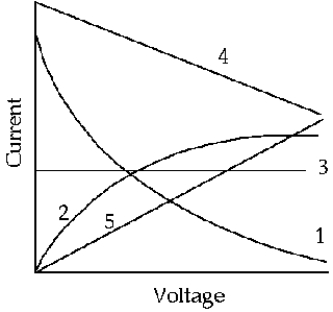 The curve that best illustrates the relation between the current in a ohmic conductor and the potential difference between its terminals is
A) 1.
B) 2.
C) 3.
D) 4.
E) 5.
Question
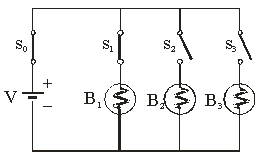 Three identical lightbulbs are connected in parallel to a constant voltage power supply. Initially, switch S1 is closed and the other two switches open. When the other two switches, S2 and S3, are closed, the brightness of the first light bulb B1
A) will be less.
B) will be unchanged.
C) will be more.
D) will depend on how long the switches are on.
E) cannot be predicted without knowledge of V and resistance.
Question
Question
Question
Question
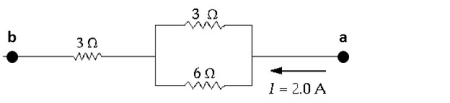 In the portion of the circuit shown, the potential difference between points a and b is
A) 10 V.
B) 2.0 V.
C) 24 V.
D) 12 V.
E) 6.0 V.
Question
Question
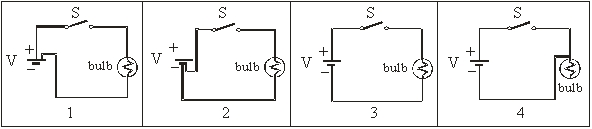 The diagrams are schematic of a battery connected to a lightbulb with a switch. When the switch is closed, which lightbulb will come on?
A) 1
B) 2
C) 3
D) 4
E) all of them
Question
Question
Question
Question
Question
Question
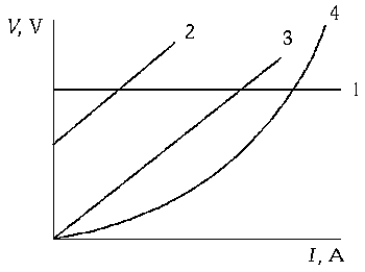 The curves on the graph represent the current versus the potential difference for various conductors. The conductor whose behavior is described by Ohm's law is
A) 1.
B) 2.
C) 3.
D) 4.
E) None of these is correct.
Question
 If a current of 2.0 A is flowing from point a to point b, the potential difference between the points is
A) 6.0 V.
B) 8.0 V.
C) 14 V.
D) 20 V.
E) 22 V.
Question
Question
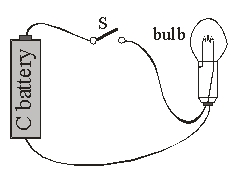 Which of the schematic below best represents the circuit above?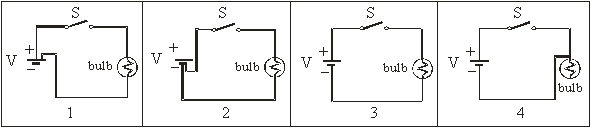
A) 1
B) 2
C) 3
D) 4
E) none of them
Question
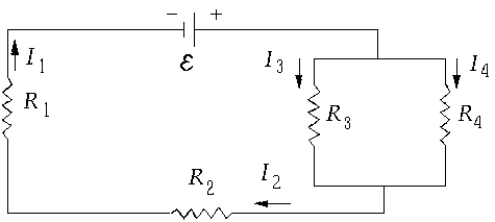 Which of the following relations among the quantities in the figure is generally correct?
A) I1R1 = I2R2
B) I3R3 = I4R4
C) I1R1 = I4R4
D) I3R4 = I4R3
E) I1R1 + I2R2 = ε
Question
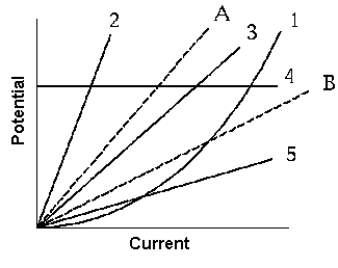 The dashed lines represent graphs of the potential as a function of the current for two resistors A and B, respectively. The curve that might reasonably represent a graph of the data taken when the resistors are connected in series is
A) 1.
B) 2.
C) 3.
D) 4.
E) 5.
Question
Question
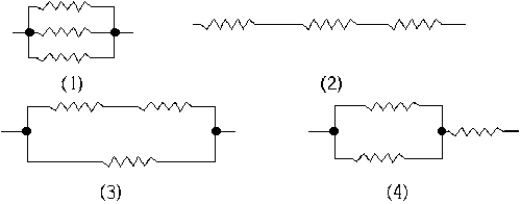 You want to use three resistors in a circuit. If each of them has a resistance of 3 Ω, the configuration that will give you an equivalent resistance of 1 Ω is
A) 1.
B) 2.
C) 3.
D) 4.
E) None of these is correct.
Question
Question
Question
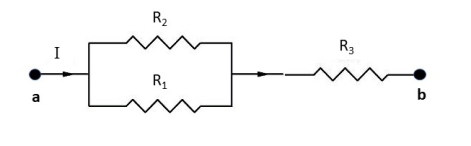 In the diagram above, the voltage difference between a and b is 6V. If R1 = 25 Ω, R3 = 45 Ω, and I = 0.095 A, then find R2.
A) 55 Ω
B) 45 Ω
C) 78 Ω
D) 66 Ω
E) 83 Ω
Question
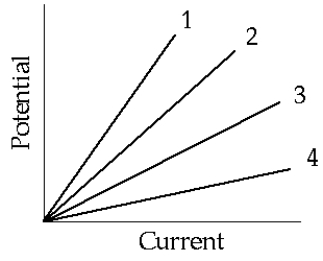 In a laboratory experiment, two unequal resistors are connected individually, then in series, and then in parallel to a group of batteries. Four sets of observations are made of the potential differences, and the corresponding total currents and curves are plotted as shown. The curve that represents the larger of the two resistors is
A) 1.
B) 2.
C) 3.
D) 4.
E) None of these is correct.
Question
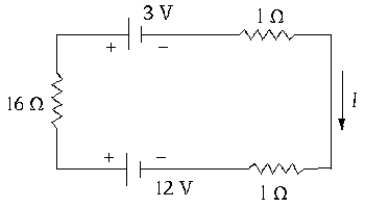 What is the current through the circuit in the figure?
A) +0.83 A
B) -0.50 A
C) +0.50 A
D) +0.55 A
E) -0.92 A
Question
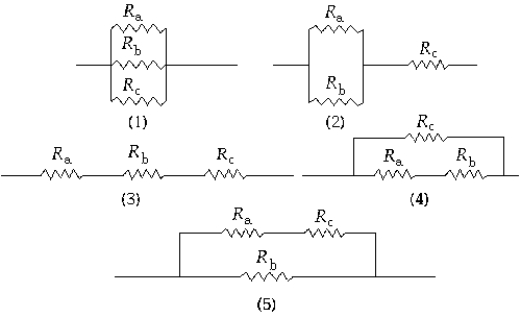 If three resistors in the various configurations shown are placed in a simple circuit, the configuration in which all three resistors carry the same current is
A) 1.
B) 2.
C) 3.
D) 4.
E) 5.
Question
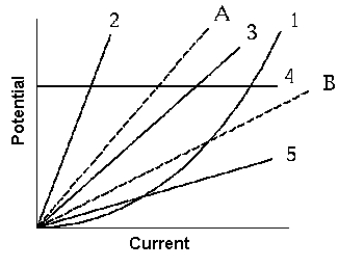 The dashed lines represent graphs of the potential difference as a function of the current flowing through two resistors A and B, respectively. The curve that might reasonably represent a graph of the data taken when the resistors are connected in parallel is
A) 1.
B) 2.
C) 3.
D) 4.
E) 5.
Question
Question
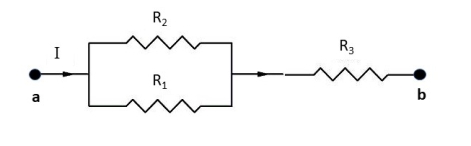 In the diagram above, the voltage difference between a and b is 6 V. If R1 = 25 Ω, R3 = 45 Ω, and I = 0.095 A, then find the current flowing through R2.
A) 0.026 A
B) 0.015 A
C) 0.037 A
D) 0.080 A
E) 0.070 A
Question
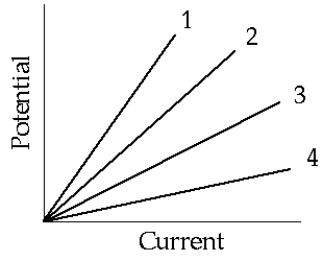 In a laboratory experiment, two unequal resistors are connected individually, then in series, and then in parallel to a group of batteries. Four sets of observations are made of the potential differences, and the corresponding total currents and curves are plotted as shown. The curve that represents the series connection of the two resistors is
A) 1.
B) 2.
C) 3.
D) 4.
E) None of these is correct.
Question
Question
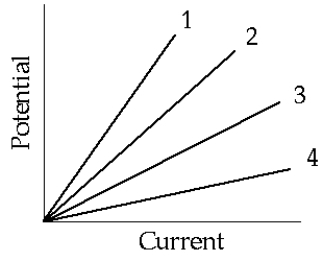 In a laboratory experiment, two unequal resistors are connected individually, then in series, and then in parallel to a group of batteries. Four sets of observations are made of the potential differences, and the corresponding total currents and curves are plotted as shown. The curve that represents the parallel connection of the two resistors is
A) 1.
B) 2.
C) 3.
D) 4.
E) None of these is correct.
Question
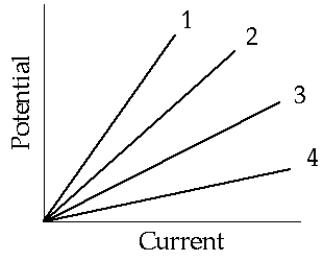 In a laboratory experiment, two unequal resistors are connected individually, then in series, and then in parallel to a group of batteries. Four sets of observations are made of the potential differences, and the corresponding total currents and curves are plotted as shown. The curve that represents the smaller of the two resistors is
A) 1.
B) 2.
C) 3.
D) 4.
E) None of these is correct.
Question
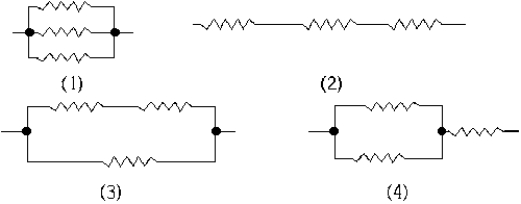 You want to use three resistors in a circuit. If each of them has a resistance of 2 Ω, the configuration that will give you an equivalent resistance of 3 Ω is
A) 1.
B) 2.
C) 3.
D) 4.
E) None of these is correct.
Question
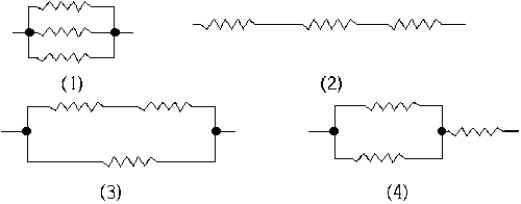 You want to use three resistors in a circuit. If each of them has a resistance of 3 Ω, the configuration that will give you an equivalent resistance of 2 Ω is
A) 1.
B) 2.
C) 3.
D) 4.
E) None of these is correct.
Question
Question
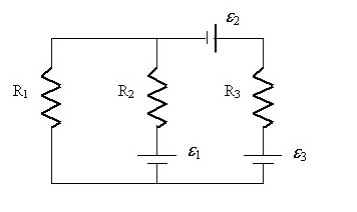 In the above circuit, ε1 = 9 V, ε2 = 6 V, and ε3 = 6 V. Also R1 = 25 Ω, R2 = 125 Ω, and R3 = 55 Ω. Find the current flowing through R3.
A) 0.60 A
B) 0.072 A
C) 0.68 A
D) 0.36 A
E) 0.020 A
Question
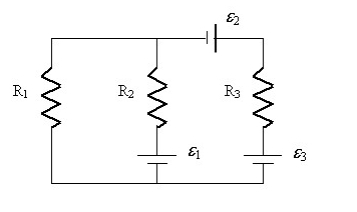 In the above circuit, ε1 = 9 V, ε2 = 6 V, and ε3 = 6 V. Also R1 = 25 Ω, R2 = 125 Ω, and R3 = 55 Ω. Find the current flowing through R1.
A) 0.60 A
B) 0.072 A
C) 0.68 A
D) 0.044 A
E) 0.16 A
Question
Question
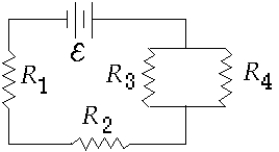 The circuit in the figure contains a battery with emf ε and four resistors connected as shown. Let the currents in these resistances be designated by I1, I2, I3, I4, respectively. Which of the following equations is correct?
A) I1 = I2
B) I2 = I3
C) I3 = I4
D) I1 = I4
E) I1 = I2 + I3
Question
Question
Question
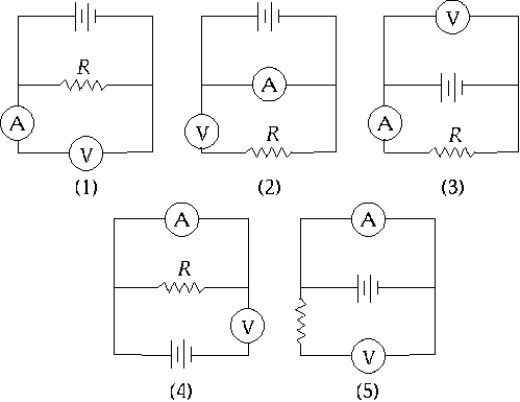 The circuit in which the voltmeter
  , a voltage measuring device and the ammeter
  , a current measuring device, are correctly arranged to determine the value of the unknown resistance R is
A) 1).
B) 2).
C) 3).
D) 4).
E) 5).
Question
Question
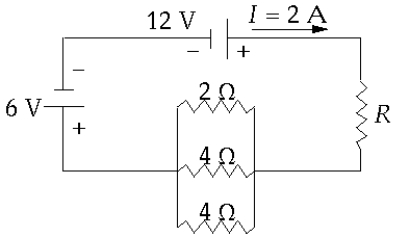 The resistance of the unknown resistor R) is
A) 0.6 Ω.
B) 2 Ω.
C) 3 Ω.
D) 5 Ω.
E) 8 Ω.
Question
Question
Question
Question
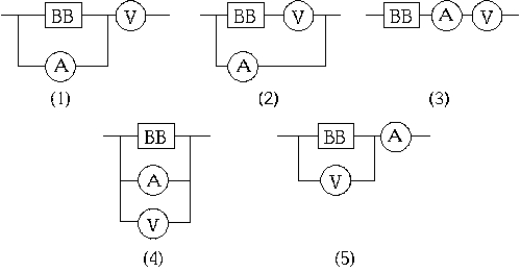 The current through and the potential difference across a black box BB is measured by which of the given current measuring device ammeter
  and voltage measuring device voltmeter
  configurations?
A) 1).
B) 2).
C) 3).
D) 4).
E) 5).
Question
Question
Question
 In the above circuit, ε1 = 9 V, ε2 = 6 V, and ε3 = 6 V. Also R1 = 25 Ω, R2 = 125 Ω, and R3 = 55 Ω. Find the current flowing through R2.
A) 0.60 A
B) 0.063 A
C) 0.68 A
D) 0.36 A
E) 0.16 A
Question
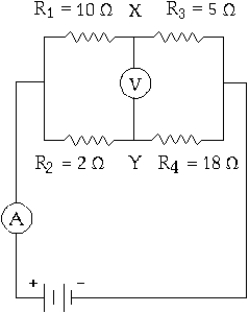 When the ammeter
  , used to measure current, reads 7 A, the voltmeter
  , used to measure potential difference between two points X and Y, reads
A) 2.8 V with Y at the higher potential.
B) 2.8 V with X at the higher potential.
C) 34 V with Y at the higher potential.
D) 34 V with X at the higher potential.
E) 60 V with X at the higher potential.
Question
Question
Question

Unlock Deck
Sign up to unlock the cards in this deck!
Unlock Deck
Unlock Deck
1/129

Play

Full screen (f)
Deck 18: Electric Charges in Motion
1
Two copper wires have the same volume, but wire 2 is 10% longer than wire 1. The ratio of the resistances of the two wires R2/R1 is
A) 1.2.
B) 1.1.
C) 0.82.
D) 0.91.
E) 1.0.
A) 1.2.
B) 1.1.
C) 0.82.
D) 0.91.
E) 1.0.
1.2.
2
You want to use a metal bar as a resistor. Its dimensions are 2 by 4 by 10 units. To get the largest resistance from this bar, you should attach leads to the two opposite sides that have the dimensions of
A) 2 by 4 units.
B) 2 by 10 units.
C) 4 by 10 units.
D) any number of units because all connections give the same resistance.
E) None of these is correct.
A) 2 by 4 units.
B) 2 by 10 units.
C) 4 by 10 units.
D) any number of units because all connections give the same resistance.
E) None of these is correct.
2 by 4 units.
3
For copper, ρ = 8.93 g/cm3 and M = 63.5 g/mol. Assuming one free electron per copper atom, what is the drift velocity of electrons in a copper wire of radius 0.435 mm carrying a current of 5 A?
A) 5.43 × 10⁻⁴ m/s
B) 2.11 × 10⁻⁴ m/s
C) 4.67 × 10⁻⁴ m/s
D) 6.21 × 10⁻⁴ m/s
E) 8.37 × 10⁻⁴ m/s
A) 5.43 × 10⁻⁴ m/s
B) 2.11 × 10⁻⁴ m/s
C) 4.67 × 10⁻⁴ m/s
D) 6.21 × 10⁻⁴ m/s
E) 8.37 × 10⁻⁴ m/s
6.21 × 10⁻⁴ m/s
4
Two copper wires have the same volume, but wire 2 is 20% longer than wire 1. The ratio of the resistances of the two wires R2/R1 is
A) 1.2.
B) 0.83.
C) 1.1.
D) 0.91.
E) 1.4.
A) 1.2.
B) 0.83.
C) 1.1.
D) 0.91.
E) 1.4.
Unlock Deck
Unlock for access to all 129 flashcards in this deck.
Unlock Deck
k this deck
5
If 4.7 × 10¹⁶ electrons pass a particular point in a wire every second, what is the current in the wire?
A) 4.7 mA
B) 7.5 A
C) 2.9 A
D) 7.5 mA
E) 0.29 A
A) 4.7 mA
B) 7.5 A
C) 2.9 A
D) 7.5 mA
E) 0.29 A
Unlock Deck
Unlock for access to all 129 flashcards in this deck.
Unlock Deck
k this deck
6
In a certain particle accelerator, a current of 800 μA is carried by a 6.00-MeV proton beam that has a radius of 1.50 mm. The mass of a proton is 1.67 × 10⁻²⁷ kg. How many protons per unit volume are in this beam?
A) 3.24 × 10¹³ protons/m3
B) 7.76 × 10¹³ protons/m3
C) 1.57 × 10¹³ protons/m3
D) 2.09 × 10¹³ protons/m3
E) 4.34 × 10¹³ protons/m3
A) 3.24 × 10¹³ protons/m3
B) 7.76 × 10¹³ protons/m3
C) 1.57 × 10¹³ protons/m3
D) 2.09 × 10¹³ protons/m3
E) 4.34 × 10¹³ protons/m3
Unlock Deck
Unlock for access to all 129 flashcards in this deck.
Unlock Deck
k this deck
7
For copper, ρ = 8.93 g/cm3 and M = 63.5 g/mol. Assuming one free electron per copper atom, what is the drift velocity of electrons in a copper wire of radius 0.625 mm carrying a current of 3 A?
A) 3.54 × 10⁻⁴ m/s
B) 1.80 × 10⁻⁴ m/s
C) 4.26 × 10⁻⁴ m/s
D) 7.52 × 10⁻⁴ m/s
E) 2.46 × 10⁻⁴ m/s
A) 3.54 × 10⁻⁴ m/s
B) 1.80 × 10⁻⁴ m/s
C) 4.26 × 10⁻⁴ m/s
D) 7.52 × 10⁻⁴ m/s
E) 2.46 × 10⁻⁴ m/s
Unlock Deck
Unlock for access to all 129 flashcards in this deck.
Unlock Deck
k this deck
8
A wire of length L = 5.0 m and uniform diameter has an electric field of E = 4.0 V/m throughout the wire. The potential difference across the wire is
A) 1.25 V.
B) 0.80 V.
C) 20.0 V.
D) 3.20 V.
E) zero.
A) 1.25 V.
B) 0.80 V.
C) 20.0 V.
D) 3.20 V.
E) zero.
Unlock Deck
Unlock for access to all 129 flashcards in this deck.
Unlock Deck
k this deck
9
In a certain particle accelerator, a current of 300 μA is carried by a 4.00-MeV proton beam that has a radius of 1.30 mm. The mass of a proton is 1.67 × 10⁻²⁷ kg. What is the number of protons per unit volume in this beam?
A) 3.64 × 10¹³ protons/m3
B) 2.76 × 10¹³ protons/m3
C) 1.28 × 10¹³ protons/m3
D) 5.98 × 10¹³ protons/m3
E) 4.17 × 10¹³ protons/m3
A) 3.64 × 10¹³ protons/m3
B) 2.76 × 10¹³ protons/m3
C) 1.28 × 10¹³ protons/m3
D) 5.98 × 10¹³ protons/m3
E) 4.17 × 10¹³ protons/m3
Unlock Deck
Unlock for access to all 129 flashcards in this deck.
Unlock Deck
k this deck
10
Which of the following statements is false?
A) An electric field is needed to produce an electric current.
B) A potential difference between two points is needed to produce an electric current.
C) For a steady current to flow in a wire, the wire must be part of a closed circuit.
D) The electric field is constant along all parts of the circuit when a steady current is flowing.
E) The electric current in a wire is proportional to the drift velocity of the charges.
A) An electric field is needed to produce an electric current.
B) A potential difference between two points is needed to produce an electric current.
C) For a steady current to flow in a wire, the wire must be part of a closed circuit.
D) The electric field is constant along all parts of the circuit when a steady current is flowing.
E) The electric current in a wire is proportional to the drift velocity of the charges.
Unlock Deck
Unlock for access to all 129 flashcards in this deck.
Unlock Deck
k this deck
11
The drift velocity of an electron in a wire varies
A) directly with the number of charge carriers per unit volume.
B) directly with the cross-sectional area of the conducting wire.
C) directly with the charge carried by it.
D) directly with the current flowing in the conducting wire.
E) inversely with the current flowing in the conducting wire.
A) directly with the number of charge carriers per unit volume.
B) directly with the cross-sectional area of the conducting wire.
C) directly with the charge carried by it.
D) directly with the current flowing in the conducting wire.
E) inversely with the current flowing in the conducting wire.
Unlock Deck
Unlock for access to all 129 flashcards in this deck.
Unlock Deck
k this deck
12
Which of the following statements is false?
A) When there is no electric field in a wire, the free electrons move in random directions with speeds of the order of 106 m/s.
B) By convention, electrons move in the direction opposite to the direction of current.
C) In the absence of an electric field, the average velocity of the electrons in a wire is very large.
D) The drift velocity of electrons in a typical metal is very small.
E) The motion of the free electrons in a metal is similar to that of the molecules of a gas.
A) When there is no electric field in a wire, the free electrons move in random directions with speeds of the order of 106 m/s.
B) By convention, electrons move in the direction opposite to the direction of current.
C) In the absence of an electric field, the average velocity of the electrons in a wire is very large.
D) The drift velocity of electrons in a typical metal is very small.
E) The motion of the free electrons in a metal is similar to that of the molecules of a gas.
Unlock Deck
Unlock for access to all 129 flashcards in this deck.
Unlock Deck
k this deck
13
A potential difference V = 25 V is applied across a wire of length L = 10.0 m and uniform diameter. The electric field throughout the wire is
A) 250 V/m.
B) 2.5 V/m.
C) 0.4 V/m.
D) 0.25 V/m.
E) zero.
A) 250 V/m.
B) 2.5 V/m.
C) 0.4 V/m.
D) 0.25 V/m.
E) zero.
Unlock Deck
Unlock for access to all 129 flashcards in this deck.
Unlock Deck
k this deck
14
A potential difference of 120 V produces a current of 8.0 A in the heating element of a toaster. What is the resistance of this heating element while the toaster is carrying this current?
A) 6.7 × 10⁻² Ω
B) 15 Ω
C) 0.96 kΩ
D) 67 Ω
E) 30 Ω
A) 6.7 × 10⁻² Ω
B) 15 Ω
C) 0.96 kΩ
D) 67 Ω
E) 30 Ω
Unlock Deck
Unlock for access to all 129 flashcards in this deck.
Unlock Deck
k this deck
15
In a certain particle accelerator, a current of 800 μA is carried by a 6.00-MeV proton beam that has a radius of 1.50 mm. The mass of a proton is 1.67 × 10⁻²⁷ kg. If the beam hits a target, how many protons hit the target in 5 s?
A) 2.50 × 10¹⁶
B) 6.78 × 10¹⁶
C) 5.68 × 10¹⁶
D) 1.37 × 10¹⁶
E) 3.71 × 10¹⁶
A) 2.50 × 10¹⁶
B) 6.78 × 10¹⁶
C) 5.68 × 10¹⁶
D) 1.37 × 10¹⁶
E) 3.71 × 10¹⁶
Unlock Deck
Unlock for access to all 129 flashcards in this deck.
Unlock Deck
k this deck
16
A 10-gauge copper wire diameter = 2.588 mm, ρ = 1.7 × 10⁻⁸ Ω · m) has a total resistance of 0.32 Ω. How long is the wire?
A) 4.0 × 10² m
B) 1.6 km
C) 99 m
D) 31 m
E) 65 m
A) 4.0 × 10² m
B) 1.6 km
C) 99 m
D) 31 m
E) 65 m
Unlock Deck
Unlock for access to all 129 flashcards in this deck.
Unlock Deck
k this deck
17
In a certain particle accelerator, a current of 300 μA is carried by a 4.00-MeV proton beam that has a radius of 1.30 mm. The mass of a proton is 1.67 × 10⁻²⁷ kg. If the beam hits a target, how many protons hit the target in 3 s?
A) 1.55 × 10¹⁵
B) 8.64 × 10¹⁵
C) 3.42 × 10¹⁵
D) 4.29 × 10¹⁵
E) None of these is correct.
A) 1.55 × 10¹⁵
B) 8.64 × 10¹⁵
C) 3.42 × 10¹⁵
D) 4.29 × 10¹⁵
E) None of these is correct.
Unlock Deck
Unlock for access to all 129 flashcards in this deck.
Unlock Deck
k this deck
18
The resistivity of any given metal
A) depends on its temperature.
B) varies linearly with temperature.
C) is the proportionality constant between the resistance, R, and the ratio of the length, L, to the cross-sectional area, A, of a wire made of the metal.
D) has units of ohm-meter.
E) is described by all of the above.
A) depends on its temperature.
B) varies linearly with temperature.
C) is the proportionality constant between the resistance, R, and the ratio of the length, L, to the cross-sectional area, A, of a wire made of the metal.
D) has units of ohm-meter.
E) is described by all of the above.
Unlock Deck
Unlock for access to all 129 flashcards in this deck.
Unlock Deck
k this deck
19
You want to use a metal bar as a resistor. Its dimensions are 2 by 4 by 10 units. To get the smallest resistance from this bar, you should attach leads to the two opposite sides that have the dimensions of
A) 2 by 4 units.
B) 2 by 10 units.
C) 4 by 10 units.
D) any number of units because all connections give the same resistance.
E) None of these is correct.
A) 2 by 4 units.
B) 2 by 10 units.
C) 4 by 10 units.
D) any number of units because all connections give the same resistance.
E) None of these is correct.
Unlock Deck
Unlock for access to all 129 flashcards in this deck.
Unlock Deck
k this deck
20
The seemingly instantaneous propagation of electric current in a wire when a switch is closed can be understood in terms of
A) the propagation of an electric field down the wire with nearly the speed of light.
B) the acquisition of the drift velocities of the free electrons almost immediately.
C) a very large number of charges slowly drifting down the wire.
D) the replacement of charge flowing out of the wire at one end by charge entering the wire at the other end.
E) all of the above.
A) the propagation of an electric field down the wire with nearly the speed of light.
B) the acquisition of the drift velocities of the free electrons almost immediately.
C) a very large number of charges slowly drifting down the wire.
D) the replacement of charge flowing out of the wire at one end by charge entering the wire at the other end.
E) all of the above.
Unlock Deck
Unlock for access to all 129 flashcards in this deck.
Unlock Deck
k this deck
21
Two resistors R1 and R2 are connected in parallel, and this combination is connected in series with a third resistor R3. If R1 = 5.0 Ω, R2 = 2.0 Ω, and R3 = 6.0 Ω, what is the equivalent resistance of this combination?
A) 0.3 Ω
B) 3.2 Ω
C) 6.7 Ω
D) 7.4 Ω
E) 13 Ω
A) 0.3 Ω
B) 3.2 Ω
C) 6.7 Ω
D) 7.4 Ω
E) 13 Ω
Unlock Deck
Unlock for access to all 129 flashcards in this deck.
Unlock Deck
k this deck
22
You can pay a lot of money for fancy connecting cables between your audio/video equipment components. Some of the more expensive ones use silver wire rather than copper. Calculate the difference in resistance between a silver and a copper cable with the same 12-gauge wire with diameter of 2.05 mm and length of 3 m hence total length = 6m). Use ρCu = 1.7 × 10⁻⁸ Ω/m and ρAg = 1.6 × 10⁻⁸ Ω/m. Unfortunately, or fortunately, there are many other factors that go into making an interconnect cable than simple resistance considerations.)
A) 4.1 × 10⁻³ Ω
B) 1.8 × 10⁻³ Ω
C) 2.9 × 10⁻² Ω
D) 9.0 × 10⁻⁴ Ω
E) 3.1 × 10⁻² Ω
A) 4.1 × 10⁻³ Ω
B) 1.8 × 10⁻³ Ω
C) 2.9 × 10⁻² Ω
D) 9.0 × 10⁻⁴ Ω
E) 3.1 × 10⁻² Ω
Unlock Deck
Unlock for access to all 129 flashcards in this deck.
Unlock Deck
k this deck
23
29 mm 16-gauge). Calculate the length of hollow cable that would give the same resistance as 1 m of 12-gauge solid cable.
A) 0.402 m
B) 2.48 m
C) 0.833 m
D) 1.44 m
E) 1.20 m
A) 0.402 m
B) 2.48 m
C) 0.833 m
D) 1.44 m
E) 1.20 m
Unlock Deck
Unlock for access to all 129 flashcards in this deck.
Unlock Deck
k this deck
24
The curve that best illustrates the relation between the current in a ohmic conductor and the potential difference between its terminals isA) 1.
B) 2.
C) 3.
D) 4.
E) 5.
Unlock Deck
Unlock for access to all 129 flashcards in this deck.
Unlock Deck
k this deck
25
Three identical lightbulbs are connected in parallel to a constant voltage power supply. Initially, switch S1 is closed and the other two switches open. When the other two switches, S2 and S3, are closed, the brightness of the first light bulb B1A) will be less.
B) will be unchanged.
C) will be more.
D) will depend on how long the switches are on.
E) cannot be predicted without knowledge of V and resistance.
Unlock Deck
Unlock for access to all 129 flashcards in this deck.
Unlock Deck
k this deck
26
A wire of length L and resistance R is now drawn out by pulling such that its new resistance is 15R. What is its new length? Assume the density remains constant.)
A) 1.50 L
B) 6.67 × 10⁻¹ L
C) 2.25 L
D) 3.87 L
E) 2.58 × 10⁻¹ L
A) 1.50 L
B) 6.67 × 10⁻¹ L
C) 2.25 L
D) 3.87 L
E) 2.58 × 10⁻¹ L
Unlock Deck
Unlock for access to all 129 flashcards in this deck.
Unlock Deck
k this deck
27
Two resistors are connected in series across a potential difference. If the current carried by resistor A is I, what is the current carried by B?
A) I
B) 2I
C) I/2
D) 4I
E) I/4
A) I
B) 2I
C) I/2
D) 4I
E) I/4
Unlock Deck
Unlock for access to all 129 flashcards in this deck.
Unlock Deck
k this deck
28
A wire of length L and resistance R is cut into 4 equal pieces. If the 4 pieces are now twisted together to make a wire of length L/4, what is the new resistance of the shorter wire combination?
A) R/16
B) R/4
C) R
D) 4R
E) 16R
A) R/16
B) R/4
C) R
D) 4R
E) 16R
Unlock Deck
Unlock for access to all 129 flashcards in this deck.
Unlock Deck
k this deck
29
In the portion of the circuit shown, the potential difference between points a and b isA) 10 V.
B) 2.0 V.
C) 24 V.
D) 12 V.
E) 6.0 V.
Unlock Deck
Unlock for access to all 129 flashcards in this deck.
Unlock Deck
k this deck
30
Consider a conductor for which R = the resistance in ohms,
Ρ = the resistivity,
A = the cross-sectional area in m2, and
L = the length in meters.Which of the following is an expression for ρ?
A) RL/A
B) RLA
C) R/LA)
D) LA/R
E) AR/L
Ρ = the resistivity,
A = the cross-sectional area in m2, and
L = the length in meters.Which of the following is an expression for ρ?
A) RL/A
B) RLA
C) R/LA)
D) LA/R
E) AR/L
Unlock Deck
Unlock for access to all 129 flashcards in this deck.
Unlock Deck
k this deck
31
The diagrams are schematic of a battery connected to a lightbulb with a switch. When the switch is closed, which lightbulb will come on?A) 1
B) 2
C) 3
D) 4
E) all of them
Unlock Deck
Unlock for access to all 129 flashcards in this deck.
Unlock Deck
k this deck
32
A resistor of 2 Ω and another of 3 Ω are connected in parallel, and this combination is joined in series with a 4-Ω resistor across a battery. If the current in the 2-Ω resistor is 2.0 A, the potential drop across the 3-Ω resistor is
A) 2.4 V.
B) 1.2 V.
C) 6.0 V.
D) 4.0 V.
E) 8.0 V.
A) 2.4 V.
B) 1.2 V.
C) 6.0 V.
D) 4.0 V.
E) 8.0 V.
Unlock Deck
Unlock for access to all 129 flashcards in this deck.
Unlock Deck
k this deck
33
A wire of length L, cross-sectional area A, and resistance R is now drawn out by pulling such that its new resistance is 25R. What is its new cross-sectional area? Assume the density remains constant.)
A) 1.00 × 10⁻¹ A
B) 6.67 × 10⁻¹ A
C) 4.00 × 10⁻¹ A
D) 2.50 × 10⁻¹ A
E) 2.00 × 10⁻¹ A
A) 1.00 × 10⁻¹ A
B) 6.67 × 10⁻¹ A
C) 4.00 × 10⁻¹ A
D) 2.50 × 10⁻¹ A
E) 2.00 × 10⁻¹ A
Unlock Deck
Unlock for access to all 129 flashcards in this deck.
Unlock Deck
k this deck
34
Since you cannot afford expensive cable to hook up between your loudspeaker and music amplifier, you try some common 14-gauge diameter = 1.628 mm) copper wire. If the total length of the wire there and back) used for each speaker to amplifier hookup was 10 m, then calculate the resistance in the wire for one channel ρCu = 1.7 × 10⁻⁸ Ω/m).
A) 2.6 × 10⁻² Ω
B) 2.0 × 10⁻² Ω
C) 4.1 × 10⁻³ Ω
D) 8.2 × 10⁻² Ω
E) 1.6 × 10⁻¹ Ω
A) 2.6 × 10⁻² Ω
B) 2.0 × 10⁻² Ω
C) 4.1 × 10⁻³ Ω
D) 8.2 × 10⁻² Ω
E) 1.6 × 10⁻¹ Ω
Unlock Deck
Unlock for access to all 129 flashcards in this deck.
Unlock Deck
k this deck
35
A wire of length L and resistance R is now drawn out by pulling such that its new length is 1.5L. What is its new resistance? Assume the density remains constant.)
A) 1.00 R
B) 1.50 R
C) 2.25 R
D) 5.06 R
E) 4.44 × 10⁻¹ R
A) 1.00 R
B) 1.50 R
C) 2.25 R
D) 5.06 R
E) 4.44 × 10⁻¹ R
Unlock Deck
Unlock for access to all 129 flashcards in this deck.
Unlock Deck
k this deck
36
A wire 10 m long with a diameter of 1.0 mm has a resistance of 5.0 Ω. The resistance of a second wire made of the same material, but 3.0 m long with a diameter of 4.0 mm, is approximately
A) 0.38 Ω.
B) 0.094 Ω.
C) 0.75 Ω.
D) 1.7 Ω.
E) 0.27 kΩ.
A) 0.38 Ω.
B) 0.094 Ω.
C) 0.75 Ω.
D) 1.7 Ω.
E) 0.27 kΩ.
Unlock Deck
Unlock for access to all 129 flashcards in this deck.
Unlock Deck
k this deck
37
The curves on the graph represent the current versus the potential difference for various conductors. The conductor whose behavior is described by Ohm's law isA) 1.
B) 2.
C) 3.
D) 4.
E) None of these is correct.
Unlock Deck
Unlock for access to all 129 flashcards in this deck.
Unlock Deck
k this deck
38
If a current of 2.0 A is flowing from point a to point b, the potential difference between the points isA) 6.0 V.
B) 8.0 V.
C) 14 V.
D) 20 V.
E) 22 V.
Unlock Deck
Unlock for access to all 129 flashcards in this deck.
Unlock Deck
k this deck
39
When two resistors are connected in series, the equivalent resistance is Rs = 10 Ω. When they are connected in parallel, the equivalent resistance is Rp = 2.4 Ω. What are the values of the two resistances?
A) 4.0 Ω and 6.0 Ω
B) 5.0 Ω for both
C) 1.0 Ω and 1.4 Ω
D) 1.2 Ω for both
E) 2.5 Ω and 7.5 Ω
A) 4.0 Ω and 6.0 Ω
B) 5.0 Ω for both
C) 1.0 Ω and 1.4 Ω
D) 1.2 Ω for both
E) 2.5 Ω and 7.5 Ω
Unlock Deck
Unlock for access to all 129 flashcards in this deck.
Unlock Deck
k this deck
40
Which of the schematic below best represents the circuit above? A) 1
B) 2
C) 3
D) 4
E) none of them
Unlock Deck
Unlock for access to all 129 flashcards in this deck.
Unlock Deck
k this deck
41
Which of the following relations among the quantities in the figure is generally correct?A) I1R1 = I2R2
B) I3R3 = I4R4
C) I1R1 = I4R4
D) I3R4 = I4R3
E) I1R1 + I2R2 = ε
Unlock Deck
Unlock for access to all 129 flashcards in this deck.
Unlock Deck
k this deck
42
The dashed lines represent graphs of the potential as a function of the current for two resistors A and B, respectively. The curve that might reasonably represent a graph of the data taken when the resistors are connected in series isA) 1.
B) 2.
C) 3.
D) 4.
E) 5.
Unlock Deck
Unlock for access to all 129 flashcards in this deck.
Unlock Deck
k this deck
43
In a parallel circuit,
A) the current is the same in every branch.
B) the potential drop is the sum of those in all branches.
C) the potential drop is the same for each element of the parallel circuit.
D) the heat generated is the same in all branches.
E) the resistance is the sum of the resistances of the branches.
A) the current is the same in every branch.
B) the potential drop is the sum of those in all branches.
C) the potential drop is the same for each element of the parallel circuit.
D) the heat generated is the same in all branches.
E) the resistance is the sum of the resistances of the branches.
Unlock Deck
Unlock for access to all 129 flashcards in this deck.
Unlock Deck
k this deck
44
You want to use three resistors in a circuit. If each of them has a resistance of 3 Ω, the configuration that will give you an equivalent resistance of 1 Ω isA) 1.
B) 2.
C) 3.
D) 4.
E) None of these is correct.
Unlock Deck
Unlock for access to all 129 flashcards in this deck.
Unlock Deck
k this deck
45
When two identical resistors are connected in parallel, the equivalent resistance, compared with that of the same two resistors connected in series, is
A) exactly the same.
B) twice as great.
C) one-half as much.
D) four times as great.
E) one-fourth as much.
A) exactly the same.
B) twice as great.
C) one-half as much.
D) four times as great.
E) one-fourth as much.
Unlock Deck
Unlock for access to all 129 flashcards in this deck.
Unlock Deck
k this deck
46
If two elements of a circuit are in parallel, they must have the same
A) charge.
B) potential difference across them.
C) resistance.
D) potential difference across them and the same charge.
E) current.
A) charge.
B) potential difference across them.
C) resistance.
D) potential difference across them and the same charge.
E) current.
Unlock Deck
Unlock for access to all 129 flashcards in this deck.
Unlock Deck
k this deck
47
In the diagram above, the voltage difference between a and b is 6V. If R1 = 25 Ω, R3 = 45 Ω, and I = 0.095 A, then find R2.A) 55 Ω
B) 45 Ω
C) 78 Ω
D) 66 Ω
E) 83 Ω
Unlock Deck
Unlock for access to all 129 flashcards in this deck.
Unlock Deck
k this deck
48
In a laboratory experiment, two unequal resistors are connected individually, then in series, and then in parallel to a group of batteries. Four sets of observations are made of the potential differences, and the corresponding total currents and curves are plotted as shown. The curve that represents the larger of the two resistors isA) 1.
B) 2.
C) 3.
D) 4.
E) None of these is correct.
Unlock Deck
Unlock for access to all 129 flashcards in this deck.
Unlock Deck
k this deck
49
What is the current through the circuit in the figure?A) +0.83 A
B) -0.50 A
C) +0.50 A
D) +0.55 A
E) -0.92 A
Unlock Deck
Unlock for access to all 129 flashcards in this deck.
Unlock Deck
k this deck
50
If three resistors in the various configurations shown are placed in a simple circuit, the configuration in which all three resistors carry the same current isA) 1.
B) 2.
C) 3.
D) 4.
E) 5.
Unlock Deck
Unlock for access to all 129 flashcards in this deck.
Unlock Deck
k this deck
51
The dashed lines represent graphs of the potential difference as a function of the current flowing through two resistors A and B, respectively. The curve that might reasonably represent a graph of the data taken when the resistors are connected in parallel isA) 1.
B) 2.
C) 3.
D) 4.
E) 5.
Unlock Deck
Unlock for access to all 129 flashcards in this deck.
Unlock Deck
k this deck
52
You connect two identical resistors in series across supply lines maintained at a constant potential difference. When you later connect them in parallel across the same supply lines, the total current furnished by the supply lines, compared with the former current, is
A) exactly the same.
B) twice as great.
C) one-half as much.
D) four times as great.
E) one-fourth as much.
A) exactly the same.
B) twice as great.
C) one-half as much.
D) four times as great.
E) one-fourth as much.
Unlock Deck
Unlock for access to all 129 flashcards in this deck.
Unlock Deck
k this deck
53
In the diagram above, the voltage difference between a and b is 6 V. If R1 = 25 Ω, R3 = 45 Ω, and I = 0.095 A, then find the current flowing through R2.A) 0.026 A
B) 0.015 A
C) 0.037 A
D) 0.080 A
E) 0.070 A
Unlock Deck
Unlock for access to all 129 flashcards in this deck.
Unlock Deck
k this deck
54
In a laboratory experiment, two unequal resistors are connected individually, then in series, and then in parallel to a group of batteries. Four sets of observations are made of the potential differences, and the corresponding total currents and curves are plotted as shown. The curve that represents the series connection of the two resistors isA) 1.
B) 2.
C) 3.
D) 4.
E) None of these is correct.
Unlock Deck
Unlock for access to all 129 flashcards in this deck.
Unlock Deck
k this deck
55
The conservation of charge in an electric circuit is closely related to which of the following?
A) Ohm's law
B) Kirchhoff's junction rule
C) Kirchhoff's loop rule
D) Newton's laws
E) Ampère's law
A) Ohm's law
B) Kirchhoff's junction rule
C) Kirchhoff's loop rule
D) Newton's laws
E) Ampère's law
Unlock Deck
Unlock for access to all 129 flashcards in this deck.
Unlock Deck
k this deck
56
In a laboratory experiment, two unequal resistors are connected individually, then in series, and then in parallel to a group of batteries. Four sets of observations are made of the potential differences, and the corresponding total currents and curves are plotted as shown. The curve that represents the parallel connection of the two resistors isA) 1.
B) 2.
C) 3.
D) 4.
E) None of these is correct.
Unlock Deck
Unlock for access to all 129 flashcards in this deck.
Unlock Deck
k this deck
57
In a laboratory experiment, two unequal resistors are connected individually, then in series, and then in parallel to a group of batteries. Four sets of observations are made of the potential differences, and the corresponding total currents and curves are plotted as shown. The curve that represents the smaller of the two resistors isA) 1.
B) 2.
C) 3.
D) 4.
E) None of these is correct.
Unlock Deck
Unlock for access to all 129 flashcards in this deck.
Unlock Deck
k this deck
58
You want to use three resistors in a circuit. If each of them has a resistance of 2 Ω, the configuration that will give you an equivalent resistance of 3 Ω isA) 1.
B) 2.
C) 3.
D) 4.
E) None of these is correct.
Unlock Deck
Unlock for access to all 129 flashcards in this deck.
Unlock Deck
k this deck
59
You want to use three resistors in a circuit. If each of them has a resistance of 3 Ω, the configuration that will give you an equivalent resistance of 2 Ω isA) 1.
B) 2.
C) 3.
D) 4.
E) None of these is correct.
Unlock Deck
Unlock for access to all 129 flashcards in this deck.
Unlock Deck
k this deck
60
The conservation of energy in an electric circuit is closely related to which of the following?
A) Ohm's law
B) Kirchhoff's junction rule
C) Kirchhoff's loop rule
D) Newton's laws
E) Ampère's law
A) Ohm's law
B) Kirchhoff's junction rule
C) Kirchhoff's loop rule
D) Newton's laws
E) Ampère's law
Unlock Deck
Unlock for access to all 129 flashcards in this deck.
Unlock Deck
k this deck
61
In the above circuit, ε1 = 9 V, ε2 = 6 V, and ε3 = 6 V. Also R1 = 25 Ω, R2 = 125 Ω, and R3 = 55 Ω. Find the current flowing through R3.A) 0.60 A
B) 0.072 A
C) 0.68 A
D) 0.36 A
E) 0.020 A
Unlock Deck
Unlock for access to all 129 flashcards in this deck.
Unlock Deck
k this deck
62
In the above circuit, ε1 = 9 V, ε2 = 6 V, and ε3 = 6 V. Also R1 = 25 Ω, R2 = 125 Ω, and R3 = 55 Ω. Find the current flowing through R1.A) 0.60 A
B) 0.072 A
C) 0.68 A
D) 0.044 A
E) 0.16 A
Unlock Deck
Unlock for access to all 129 flashcards in this deck.
Unlock Deck
k this deck
63
A galvanometer has an internal resistance of 200 Ω and requires a current of 5.0 mA for full-scale deflection. What resistance should be connected in series with this galvanometer to make a voltmeter that reads 25 V at full-scale deflection?
A) 2.4 kΩ
B) 4.8 kΩ
C) 5.0 kΩ
D) 5.2 kΩ
E) 9.6 kΩ
A) 2.4 kΩ
B) 4.8 kΩ
C) 5.0 kΩ
D) 5.2 kΩ
E) 9.6 kΩ
Unlock Deck
Unlock for access to all 129 flashcards in this deck.
Unlock Deck
k this deck
64
The circuit in the figure contains a battery with emf ε and four resistors connected as shown. Let the currents in these resistances be designated by I1, I2, I3, I4, respectively. Which of the following equations is correct?A) I1 = I2
B) I2 = I3
C) I3 = I4
D) I1 = I4
E) I1 = I2 + I3
Unlock Deck
Unlock for access to all 129 flashcards in this deck.
Unlock Deck
k this deck
65
A 12-V battery has an internal resistance of 0.20 Ω. If the battery is being charged by a current of 30 A, the magnitude of the potential difference between its terminals is
A) 18 V.
B) 6.0 V.
C) 42 V.
D) 0.
E) 12 V.
A) 18 V.
B) 6.0 V.
C) 42 V.
D) 0.
E) 12 V.
Unlock Deck
Unlock for access to all 129 flashcards in this deck.
Unlock Deck
k this deck
66
Which of these five terms is most unlike the others?
A) electromotive force
B) voltage
C) potential difference
D) current
E) electric potential
A) electromotive force
B) voltage
C) potential difference
D) current
E) electric potential
Unlock Deck
Unlock for access to all 129 flashcards in this deck.
Unlock Deck
k this deck
67
The circuit in which the voltmeter , a voltage measuring device and the ammeter , a current measuring device, are correctly arranged to determine the value of the unknown resistance R isA) 1).
B) 2).
C) 3).
D) 4).
E) 5).
Unlock Deck
Unlock for access to all 129 flashcards in this deck.
Unlock Deck
k this deck
68
If electric energy costs 10 cents per kilowatt-hour, how many cents does it cost to keep a 660-W toaster in steady operation for 30 min?
A) 15 cents
B) 12 cents
C) 6.9 cents
D) 3.3 cents
E) 1.7 cents
A) 15 cents
B) 12 cents
C) 6.9 cents
D) 3.3 cents
E) 1.7 cents
Unlock Deck
Unlock for access to all 129 flashcards in this deck.
Unlock Deck
k this deck
69
The resistance of the unknown resistor R) isA) 0.6 Ω.
B) 2 Ω.
C) 3 Ω.
D) 5 Ω.
E) 8 Ω.
Unlock Deck
Unlock for access to all 129 flashcards in this deck.
Unlock Deck
k this deck
70
Which of the following statements is true concerning an ideal ammeter and an ideal voltmeter that are used to measure current and voltage, respectively?
A) Both have infinite resistance.
B) Both have zero resistance.
C) The ammeter has zero resistance, and the voltmeter has infinite resistance.
D) The ammeter has infinite resistance, and the voltmeter has zero resistance.
E) Both have equal, finite resistances.
A) Both have infinite resistance.
B) Both have zero resistance.
C) The ammeter has zero resistance, and the voltmeter has infinite resistance.
D) The ammeter has infinite resistance, and the voltmeter has zero resistance.
E) Both have equal, finite resistances.
Unlock Deck
Unlock for access to all 129 flashcards in this deck.
Unlock Deck
k this deck
71
A sensitive galvanometer has a resistance of 180 Ω and requires 2.40 μA of current to produce a full-scale deflection. The series resistance needed to construct a voltmeter that gives full-scale deflection for a potential difference of 10.0 V is approximately
A) 4.17 MΩ.
B) 180 Ω.
C) 1.80 kΩ.
D) 8.33 MΩ.
E) 2.08 MΩ.
A) 4.17 MΩ.
B) 180 Ω.
C) 1.80 kΩ.
D) 8.33 MΩ.
E) 2.08 MΩ.
Unlock Deck
Unlock for access to all 129 flashcards in this deck.
Unlock Deck
k this deck
72
A galvanometer has an internal resistance of 200 Ω and requires a current of 5.0 mA for full-scale deflection. What resistance should be connected in parallel with this galvanometer to make an ammeter that reads 10 A at full-scale deflection?
A) 0.10 Ω
B) 4.0 × 10⁵ Ω
C) 400 Ω
D) 0.20 Ω
E) 2.0 Ω
A) 0.10 Ω
B) 4.0 × 10⁵ Ω
C) 400 Ω
D) 0.20 Ω
E) 2.0 Ω
Unlock Deck
Unlock for access to all 129 flashcards in this deck.
Unlock Deck
k this deck
73
The current through and the potential difference across a black box BB is measured by which of the given current measuring device ammeter and voltage measuring device voltmeter configurations?A) 1).
B) 2).
C) 3).
D) 4).
E) 5).
Unlock Deck
Unlock for access to all 129 flashcards in this deck.
Unlock Deck
k this deck
74
An energy-efficient lightbulb uses 15 W of power for an equivalent light output of a 60 W incandescent lightbulb. How much energy is saved each month by using the energy-efficient lightbulb instead of the incandescent lightbulb for 4 hours a day? Assume that there are 30 days in one month.
A) 5.4 kW·hr
B) 1.35 kW·hr
C) 21.6 kW·hr
D) 1.8 kW·hr
E) 7.2 kW·hr
A) 5.4 kW·hr
B) 1.35 kW·hr
C) 21.6 kW·hr
D) 1.8 kW·hr
E) 7.2 kW·hr
Unlock Deck
Unlock for access to all 129 flashcards in this deck.
Unlock Deck
k this deck
75
An immersion heater of negligible mass draws a current of 7.5 A from a source with a potential difference of 120 V. The heater is in 0.950 m3 of water. The initial temperature of the water is 12.5ºC. How much time does it take to increase the temperature of the water to 27.5ºC? Neglect any heat loss. One calorie is equivalent to 4.18 J.
A) 4.7 × 10⁴ s
B) 3.3 × 10⁴ s
C) 1.1 × 10⁴ s
D) 1.6 × 10⁴ s
E) None of these is correct.
A) 4.7 × 10⁴ s
B) 3.3 × 10⁴ s
C) 1.1 × 10⁴ s
D) 1.6 × 10⁴ s
E) None of these is correct.
Unlock Deck
Unlock for access to all 129 flashcards in this deck.
Unlock Deck
k this deck
76
In the above circuit, ε1 = 9 V, ε2 = 6 V, and ε3 = 6 V. Also R1 = 25 Ω, R2 = 125 Ω, and R3 = 55 Ω. Find the current flowing through R2.A) 0.60 A
B) 0.063 A
C) 0.68 A
D) 0.36 A
E) 0.16 A
Unlock Deck
Unlock for access to all 129 flashcards in this deck.
Unlock Deck
k this deck
77
When the ammeter , used to measure current, reads 7 A, the voltmeter , used to measure potential difference between two points X and Y, readsA) 2.8 V with Y at the higher potential.
B) 2.8 V with X at the higher potential.
C) 34 V with Y at the higher potential.
D) 34 V with X at the higher potential.
E) 60 V with X at the higher potential.
Unlock Deck
Unlock for access to all 129 flashcards in this deck.
Unlock Deck
k this deck
78
A sensitive galvanometer has a resistance of 180 Ω and requires 2.4 μA of current to produce a full-scale deflection. The shunt resistance needed to construct an ammeter that gives full-scale deflection for a current of 1.0 mA is approximately
A) 4.5 Ω.
B) 0.43 Ω.
C) 0.22 Ω.
D) 0.86 Ω.
E) 1.72 Ω.
A) 4.5 Ω.
B) 0.43 Ω.
C) 0.22 Ω.
D) 0.86 Ω.
E) 1.72 Ω.
Unlock Deck
Unlock for access to all 129 flashcards in this deck.
Unlock Deck
k this deck
79
An energy-efficient light bulb uses 15 W of power for an equivalent light output of a 60 W incandescent lightbulb. How much money do you save each month by using the energy-efficient lightbulb instead of the incandescent lightbulb for 6 hours a day? Assume that 1 kW·hr costs 14 cents and there are 30 days in one month.
A) $0.39
B) $0.76
C) $1.51
D) $0.57
E) $1.13
A) $0.39
B) $0.76
C) $1.51
D) $0.57
E) $1.13
Unlock Deck
Unlock for access to all 129 flashcards in this deck.
Unlock Deck
k this deck
80
You want to measure the current through and the voltage across a resistor. How should you connect the ammeter, to measure current, andvoltmeter, to measure voltage, to the resistor?
A) Connect both meters in parallel.
B) Connect both meters in series.
C) You should connect the ammeter in parallel and the voltmeter in series.
D) You should connect the ammeter in series and the voltmeter in parallel.
E) It does not matter how you connect the meters to the resistor.
A) Connect both meters in parallel.
B) Connect both meters in series.
C) You should connect the ammeter in parallel and the voltmeter in series.
D) You should connect the ammeter in series and the voltmeter in parallel.
E) It does not matter how you connect the meters to the resistor.
Unlock Deck
Unlock for access to all 129 flashcards in this deck.
Unlock Deck
k this deck
Unlock Deck
Unlock for access to all 129 flashcards in this deck.






