







 Chat with AI

Deck 40: Digestion and Human Nutrition
Full screen (f)

Question

Question
Question
Question
Question
Use the above figure to answer questions
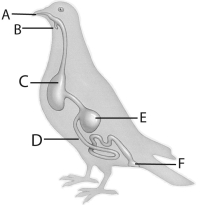
The grinding organ listed above "E" is called the
A)mouth.
B)crop.
C)gizzard.
D)secreting portion of stomach.
E)cloaca.
The grinding organ listed above "E" is called the
A)mouth.
B)crop.
C)gizzard.
D)secreting portion of stomach.
E)cloaca.
Question
Question
Question
Question
Use the above figure to answer questions
The pre-digestive organ listed above "C" is called the
A)mouth.
B)crop.
C)gizzard.
D)secreting portion of stomach.
E)cloaca.
The pre-digestive organ listed above "C" is called the
A)mouth.
B)crop.
C)gizzard.
D)secreting portion of stomach.
E)cloaca.
Question
Question
Question
Question
Use the above figure to answer questions
The organ responsible for excretion of both urine and feces "F" is called the
A)mouth.
B)crop.
C)gizzard.
D)secreting portion of stomach.
E)cloaca.
The organ responsible for excretion of both urine and feces "F" is called the
A)mouth.
B)crop.
C)gizzard.
D)secreting portion of stomach.
E)cloaca.
Question
Question
Question
Question
Question
Question
Question
Question
Question
Use the above figure to answer questions
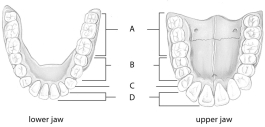
The teeth designated by the letter "D" in the above figure are called
A)canines.
B)premolars.
C)incisors.
D)molars.
E)none of these.
The teeth designated by the letter "D" in the above figure are called
A)canines.
B)premolars.
C)incisors.
D)molars.
E)none of these.
Question
Question
Question
Question
Question
Question
Question
Question
Use the above figure to answer questions
The teeth designated by the letter "B" in the above figure are called
A)canines.
B)premolars.
C)incisors.
D)molars.
E)all of these.
The teeth designated by the letter "B" in the above figure are called
A)canines.
B)premolars.
C)incisors.
D)molars.
E)all of these.
Question
Question
Question
Use the above figure to answer questions
The teeth designated by the letter "A" in the above figure are called
A)canines.
B)premolars.
C)incisors.
D)molars.
E)none of these.
The teeth designated by the letter "A" in the above figure are called
A)canines.
B)premolars.
C)incisors.
D)molars.
E)none of these.
Question
Question
Use the above figure to answer questions
The teeth designated by the letter "C" in the above figure are called
A)canines.
B)premolars.
C)incisors.
D)molars.
E)all of these.
The teeth designated by the letter "C" in the above figure are called
A)canines.
B)premolars.
C)incisors.
D)molars.
E)all of these.
Question
Question
Question
Question
Question
Question
Question
Question
Question
Question
Question
Question
Question
Question

Unlock Deck
Sign up to unlock the cards in this deck!
Unlock Deck
Unlock Deck
1/49

Play

Full screen (f)
Deck 40: Digestion and Human Nutrition
1
Which of the following is (are) true regarding gastric bypass surgery?
A)It is an unusually safe surgical procedure.
B)It is known to stimulate the production of leptin.
C)It may inhibit the production of ghrelin.
D)It causes food to bypass the stomach and go directly to the small intestine.
E)None of these are true.
A)It is an unusually safe surgical procedure.
B)It is known to stimulate the production of leptin.
C)It may inhibit the production of ghrelin.
D)It causes food to bypass the stomach and go directly to the small intestine.
E)None of these are true.
C
2
All animals convert food nutrients to
A)carbohydrates.
B)lipids.
C)proteins.
D)nucleic acids.
E)all of these.
A)carbohydrates.
B)lipids.
C)proteins.
D)nucleic acids.
E)all of these.
E
3
Immediately after a meal, the concentration of glucose in the blood tends to increase due specifically to what digestive system task?
A)mechanical processing
B)secretion
C)digestion
D)absorption
E)elimination
A)mechanical processing
B)secretion
C)digestion
D)absorption
E)elimination
D
4
The muscular digestive organ in which food is ground into small bits in birds is the
A)intestine.
B)gizzard.
C)crop.
D)stomach.
E)cloaca.
A)intestine.
B)gizzard.
C)crop.
D)stomach.
E)cloaca.
Unlock Deck
Unlock for access to all 49 flashcards in this deck.
Unlock Deck
k this deck
5
Use the above figure to answer questions
The grinding organ listed above "E" is called the
A)mouth.
B)crop.
C)gizzard.
D)secreting portion of stomach.
E)cloaca.
The grinding organ listed above "E" is called the
A)mouth.
B)crop.
C)gizzard.
D)secreting portion of stomach.
E)cloaca.
Unlock Deck
Unlock for access to all 49 flashcards in this deck.
Unlock Deck
k this deck
6
Which of the following possess an incomplete digestive system?
A)annelids
B)flatworms
C)mollusks
D)arthropods
E)echinoderms
A)annelids
B)flatworms
C)mollusks
D)arthropods
E)echinoderms
Unlock Deck
Unlock for access to all 49 flashcards in this deck.
Unlock Deck
k this deck
7
Some cells of the stomach and brain produce which of the following hormones when the stomach is empty?
A)leptin
B)ghrelin
C)gastric juice
D)pancreatic hormones
E)cholecystokinin
A)leptin
B)ghrelin
C)gastric juice
D)pancreatic hormones
E)cholecystokinin
Unlock Deck
Unlock for access to all 49 flashcards in this deck.
Unlock Deck
k this deck
8
Chewing
A)breaks food down into smaller pieces.
B)physically and mechanically breaks up the food.
C)increases the surface area of food exposed to digestive enzymes.
D)mixes some enzymes with the food.
E)does all of these.
A)breaks food down into smaller pieces.
B)physically and mechanically breaks up the food.
C)increases the surface area of food exposed to digestive enzymes.
D)mixes some enzymes with the food.
E)does all of these.
Unlock Deck
Unlock for access to all 49 flashcards in this deck.
Unlock Deck
k this deck
9
Use the above figure to answer questions
The pre-digestive organ listed above "C" is called the
A)mouth.
B)crop.
C)gizzard.
D)secreting portion of stomach.
E)cloaca.
The pre-digestive organ listed above "C" is called the
A)mouth.
B)crop.
C)gizzard.
D)secreting portion of stomach.
E)cloaca.
Unlock Deck
Unlock for access to all 49 flashcards in this deck.
Unlock Deck
k this deck
10
Which of the following statements about digestion in ruminants is false?
A)Ruminant animals have symbiotic bacteria to aid in the digestion of their food.
B)It takes longer to digest plant material than meat.
C)Chewing results in mechanically breaking down food and exposing more cellulose to digestive enzymes.
D)Ruminants have a smaller range of foods in their diet than do humans.
E)Pronghorn antelopes and other herbivores have a single but disproportionately large stomach.
A)Ruminant animals have symbiotic bacteria to aid in the digestion of their food.
B)It takes longer to digest plant material than meat.
C)Chewing results in mechanically breaking down food and exposing more cellulose to digestive enzymes.
D)Ruminants have a smaller range of foods in their diet than do humans.
E)Pronghorn antelopes and other herbivores have a single but disproportionately large stomach.
Unlock Deck
Unlock for access to all 49 flashcards in this deck.
Unlock Deck
k this deck
11
Adipose cells secrete __________, a(n) __________ that acts on the __________ to help control appetite.
A)ghrelin; enzyme; stomach
B)leptin; enzyme; brain
C)leptin; hormone; brain
D)ghrelin; hormone; stomach
E)ghrelin; hormone; brain
A)ghrelin; enzyme; stomach
B)leptin; enzyme; brain
C)leptin; hormone; brain
D)ghrelin; hormone; stomach
E)ghrelin; hormone; brain
Unlock Deck
Unlock for access to all 49 flashcards in this deck.
Unlock Deck
k this deck
12
What is the organ in animals without teeth such as earthworms and birds that accomplishes the same action as teeth?
A)beak
B)pharynx
C)gizzard
D)cloaca
E)crop
A)beak
B)pharynx
C)gizzard
D)cloaca
E)crop
Unlock Deck
Unlock for access to all 49 flashcards in this deck.
Unlock Deck
k this deck
13
Use the above figure to answer questions
The organ responsible for excretion of both urine and feces "F" is called the
A)mouth.
B)crop.
C)gizzard.
D)secreting portion of stomach.
E)cloaca.
The organ responsible for excretion of both urine and feces "F" is called the
A)mouth.
B)crop.
C)gizzard.
D)secreting portion of stomach.
E)cloaca.
Unlock Deck
Unlock for access to all 49 flashcards in this deck.
Unlock Deck
k this deck
14
Ruminants need special enzymes to digest
A)starch.
B)proteins.
C)cellulose.
D)lignin.
E)glycogen.
A)starch.
B)proteins.
C)cellulose.
D)lignin.
E)glycogen.
Unlock Deck
Unlock for access to all 49 flashcards in this deck.
Unlock Deck
k this deck
15
The large crowns of pronghorn molars are an adaptation to
A)the size of their jaws.
B)the type of food that they eat.
C)the soft texture of their food.
D)the high acid content of their mouths.
E)none of these.
A)the size of their jaws.
B)the type of food that they eat.
C)the soft texture of their food.
D)the high acid content of their mouths.
E)none of these.
Unlock Deck
Unlock for access to all 49 flashcards in this deck.
Unlock Deck
k this deck
16
The production of gastric juice is an example of what digestive system task?
A)mechanical processing
B)secretion
C)digestion
D)absorption
E)elimination
A)mechanical processing
B)secretion
C)digestion
D)absorption
E)elimination
Unlock Deck
Unlock for access to all 49 flashcards in this deck.
Unlock Deck
k this deck
17
__________ percent of American adults are overweight or obese.
A)30
B)40
C)50
D)60
E)70
A)30
B)40
C)50
D)60
E)70
Unlock Deck
Unlock for access to all 49 flashcards in this deck.
Unlock Deck
k this deck
18
Earthworms and birds have a crop that is modified for
A)digestion of cellulose.
B)food storage.
C)mechanical breakdown of food.
D)digestion of fats.
E)storage and elimination of undigested food.
A)digestion of cellulose.
B)food storage.
C)mechanical breakdown of food.
D)digestion of fats.
E)storage and elimination of undigested food.
Unlock Deck
Unlock for access to all 49 flashcards in this deck.
Unlock Deck
k this deck
19
Well-fed individuals who remain hungry are likely producing excessive amounts of
A)leptin.
B)ghrelin.
C)gastric juice.
D)pancreatic hormones.
E)cholecystokinin.
A)leptin.
B)ghrelin.
C)gastric juice.
D)pancreatic hormones.
E)cholecystokinin.
Unlock Deck
Unlock for access to all 49 flashcards in this deck.
Unlock Deck
k this deck
20
Which of the following is NOT true regarding an incomplete digestive system?
A)Food enters a saclike gut.
B)Food and wastes pass through the same opening.
C)Food is only partially digested in this system; therefore, fecal material is good fertilizer.
D)This system favors regional specialization.
E)There is two-way traffic of materials in this system.
A)Food enters a saclike gut.
B)Food and wastes pass through the same opening.
C)Food is only partially digested in this system; therefore, fecal material is good fertilizer.
D)This system favors regional specialization.
E)There is two-way traffic of materials in this system.
Unlock Deck
Unlock for access to all 49 flashcards in this deck.
Unlock Deck
k this deck
21
Digestion of protein begins in the
A)mouth.
B)esophagus.
C)stomach.
D)duodenum.
E)jejunum.
A)mouth.
B)esophagus.
C)stomach.
D)duodenum.
E)jejunum.
Unlock Deck
Unlock for access to all 49 flashcards in this deck.
Unlock Deck
k this deck
22
Use the above figure to answer questions
The teeth designated by the letter "D" in the above figure are called
A)canines.
B)premolars.
C)incisors.
D)molars.
E)none of these.
The teeth designated by the letter "D" in the above figure are called
A)canines.
B)premolars.
C)incisors.
D)molars.
E)none of these.
Unlock Deck
Unlock for access to all 49 flashcards in this deck.
Unlock Deck
k this deck
23
Sphincters
A)are circular muscles.
B)prevent backflow.
C)are smooth muscles.
D)are found at the entrance and exit of the stomach.
E)include all of these.
A)are circular muscles.
B)prevent backflow.
C)are smooth muscles.
D)are found at the entrance and exit of the stomach.
E)include all of these.
Unlock Deck
Unlock for access to all 49 flashcards in this deck.
Unlock Deck
k this deck
24
High stomach acidity
A)creates ideal conditions for carbohydrate digestion.
B)promotes emulsification of fats.
C)favors protein digestion.
D)blocks the release of histamine, thereby favoring production of peptic ulcers.
E)converts lipases into their active forms.
A)creates ideal conditions for carbohydrate digestion.
B)promotes emulsification of fats.
C)favors protein digestion.
D)blocks the release of histamine, thereby favoring production of peptic ulcers.
E)converts lipases into their active forms.
Unlock Deck
Unlock for access to all 49 flashcards in this deck.
Unlock Deck
k this deck
25
Which of the following is NOT a secretion of the stomach?
A)pepsinogen
B)mucus
C)gastrin
D)hydrochloric acid
E)lipase
A)pepsinogen
B)mucus
C)gastrin
D)hydrochloric acid
E)lipase
Unlock Deck
Unlock for access to all 49 flashcards in this deck.
Unlock Deck
k this deck
26
Grinding of food is a function of the
A)incisors.
B)canines.
C)premolars.
D)molars.
E)molars and premolars
A)incisors.
B)canines.
C)premolars.
D)molars.
E)molars and premolars
Unlock Deck
Unlock for access to all 49 flashcards in this deck.
Unlock Deck
k this deck
27
The digestion of __________ begins in the mouth.
A)carbohydrates
B)proteins
C)lipids
D)nucleic acids
E)none of these
A)carbohydrates
B)proteins
C)lipids
D)nucleic acids
E)none of these
Unlock Deck
Unlock for access to all 49 flashcards in this deck.
Unlock Deck
k this deck
28
Which of the following is not a function of the stomach?
A)holding food
B)mixing in digestive enzymes
C)controlling the time food stays in the stomach
D)controlling the absorption of nutrients from food
E)all of these are correct
A)holding food
B)mixing in digestive enzymes
C)controlling the time food stays in the stomach
D)controlling the absorption of nutrients from food
E)all of these are correct
Unlock Deck
Unlock for access to all 49 flashcards in this deck.
Unlock Deck
k this deck
29
Which of the following is NOT an accessory organ of the human digestive system?
A)salivary gland
B)esophagus
C)pancreas
D)gallbladder
E)liver
A)salivary gland
B)esophagus
C)pancreas
D)gallbladder
E)liver
Unlock Deck
Unlock for access to all 49 flashcards in this deck.
Unlock Deck
k this deck
30
Use the above figure to answer questions
The teeth designated by the letter "B" in the above figure are called
A)canines.
B)premolars.
C)incisors.
D)molars.
E)all of these.
The teeth designated by the letter "B" in the above figure are called
A)canines.
B)premolars.
C)incisors.
D)molars.
E)all of these.
Unlock Deck
Unlock for access to all 49 flashcards in this deck.
Unlock Deck
k this deck
31
Which of the following enzymes does NOT digest proteins?
A)trypsin
B)chymotrypsin
C)aminopeptidase
D)pepsin
E)lipase
A)trypsin
B)chymotrypsin
C)aminopeptidase
D)pepsin
E)lipase
Unlock Deck
Unlock for access to all 49 flashcards in this deck.
Unlock Deck
k this deck
32
Stomach motility
A)decreases following a heavy meal.
B)controls the amount of material leaving via the pyloric sphincter.
C)is unaffected by emotional state or external environmental factors.
D)may be retarded when stretch receptors on the stomach wall are activated.
E)is increased by hormones released in response to high stomach acidity.
A)decreases following a heavy meal.
B)controls the amount of material leaving via the pyloric sphincter.
C)is unaffected by emotional state or external environmental factors.
D)may be retarded when stretch receptors on the stomach wall are activated.
E)is increased by hormones released in response to high stomach acidity.
Unlock Deck
Unlock for access to all 49 flashcards in this deck.
Unlock Deck
k this deck
33
Use the above figure to answer questions
The teeth designated by the letter "A" in the above figure are called
A)canines.
B)premolars.
C)incisors.
D)molars.
E)none of these.
The teeth designated by the letter "A" in the above figure are called
A)canines.
B)premolars.
C)incisors.
D)molars.
E)none of these.
Unlock Deck
Unlock for access to all 49 flashcards in this deck.
Unlock Deck
k this deck
34
Motility is the only digestive task of the
A)mouth.
B)esophagus.
C)stomach.
D)duodenum.
E)jejunum.
A)mouth.
B)esophagus.
C)stomach.
D)duodenum.
E)jejunum.
Unlock Deck
Unlock for access to all 49 flashcards in this deck.
Unlock Deck
k this deck
35
Use the above figure to answer questions
The teeth designated by the letter "C" in the above figure are called
A)canines.
B)premolars.
C)incisors.
D)molars.
E)all of these.
The teeth designated by the letter "C" in the above figure are called
A)canines.
B)premolars.
C)incisors.
D)molars.
E)all of these.
Unlock Deck
Unlock for access to all 49 flashcards in this deck.
Unlock Deck
k this deck
36
Which of the following organs of the human digestive system does NOT produce any secretions associated with digestion?
A)stomach
B)liver
C)esophagus
D)pancreas
E)salivary gland
A)stomach
B)liver
C)esophagus
D)pancreas
E)salivary gland
Unlock Deck
Unlock for access to all 49 flashcards in this deck.
Unlock Deck
k this deck
37
Moistening and lubrication of food occurs in the human
A)mouth.
B)esophagus.
C)stomach.
D)duodenum.
E)jejunum.
A)mouth.
B)esophagus.
C)stomach.
D)duodenum.
E)jejunum.
Unlock Deck
Unlock for access to all 49 flashcards in this deck.
Unlock Deck
k this deck
38
"Descending" is a term associated with the
A)mouth.
B)esophagus.
C)stomach.
D)small intestine.
E)large intestine.
A)mouth.
B)esophagus.
C)stomach.
D)small intestine.
E)large intestine.
Unlock Deck
Unlock for access to all 49 flashcards in this deck.
Unlock Deck
k this deck
39
Which of the following enzymes digests fats?
A)aminopeptidase
B)disaccharidases
C)amylase
D)lipase
E)trypsin
A)aminopeptidase
B)disaccharidases
C)amylase
D)lipase
E)trypsin
Unlock Deck
Unlock for access to all 49 flashcards in this deck.
Unlock Deck
k this deck
40
The softened ball of food (bolus) formed in the mouth contains all of the following EXCEPT
A)water.
B)amylase enzyme.
C)mucins.
D)lipase.
E)undigested food.
A)water.
B)amylase enzyme.
C)mucins.
D)lipase.
E)undigested food.
Unlock Deck
Unlock for access to all 49 flashcards in this deck.
Unlock Deck
k this deck
41
The first part of the small intestine is the
A)duodenum.
B)ileum.
C)pylorus.
D)cecum.
E)jejunum.
A)duodenum.
B)ileum.
C)pylorus.
D)cecum.
E)jejunum.
Unlock Deck
Unlock for access to all 49 flashcards in this deck.
Unlock Deck
k this deck
42
The acid released in the stomach is
A)carbonic acid.
B)hydrochloric acid.
C)nitric acid.
D)sulfuric acid.
E)phosphoric acid.
A)carbonic acid.
B)hydrochloric acid.
C)nitric acid.
D)sulfuric acid.
E)phosphoric acid.
Unlock Deck
Unlock for access to all 49 flashcards in this deck.
Unlock Deck
k this deck
43
Which of the following is NOT a hormone?
A)gastrin
B)secretin
C)mucin
D)cholecystokinin
E)leptin
A)gastrin
B)secretin
C)mucin
D)cholecystokinin
E)leptin
Unlock Deck
Unlock for access to all 49 flashcards in this deck.
Unlock Deck
k this deck
44
Which of the following is NOT found in bile?
A)salts
B)cholesterol
C)pigments
D)digestive enzymes
E)lipids
A)salts
B)cholesterol
C)pigments
D)digestive enzymes
E)lipids
Unlock Deck
Unlock for access to all 49 flashcards in this deck.
Unlock Deck
k this deck
45
Which of the following is NOT an active form of an enzyme?
A)trypsin
B)amylase
C)pepsin
D)pepsinogen
E)chymotrypsin
A)trypsin
B)amylase
C)pepsin
D)pepsinogen
E)chymotrypsin
Unlock Deck
Unlock for access to all 49 flashcards in this deck.
Unlock Deck
k this deck
46
Concerning the role of the pancreas in digestion,
A)no digestion occurs in the pancreas.
B)endocrine cells secrete bicarbonate, which helps neutralize highly acidic chyme.
C)endocrine cells release enzymes that break down carbohydrates, fats, proteins, and nucleic acids in the small intestine.
D)exocrine tissue produces insulin and glucagon, which help regulate the metabolism of sugar.
E)all of these are true.
A)no digestion occurs in the pancreas.
B)endocrine cells secrete bicarbonate, which helps neutralize highly acidic chyme.
C)endocrine cells release enzymes that break down carbohydrates, fats, proteins, and nucleic acids in the small intestine.
D)exocrine tissue produces insulin and glucagon, which help regulate the metabolism of sugar.
E)all of these are true.
Unlock Deck
Unlock for access to all 49 flashcards in this deck.
Unlock Deck
k this deck
47
All of the following are in some way involved with protein digestion EXCEPT
A)chymotrypsin.
B)amylase.
C)aminopeptidase.
D)pepsin.
E)trypsin.
A)chymotrypsin.
B)amylase.
C)aminopeptidase.
D)pepsin.
E)trypsin.
Unlock Deck
Unlock for access to all 49 flashcards in this deck.
Unlock Deck
k this deck
48
Ducts from the pancreas enter the
A)stomach.
B)colon.
C)duodenum.
D)jejunum.
E)ileum.
A)stomach.
B)colon.
C)duodenum.
D)jejunum.
E)ileum.
Unlock Deck
Unlock for access to all 49 flashcards in this deck.
Unlock Deck
k this deck
49
Which of the following factors does NOT stimulate the stomach to pass on its contents to the small intestine?
A)stress
B)stimulation of mechanoreceptors in the stomach wall following a large meal
C)reduced fat or acid content of chyme in the duodenum
D)elation and relaxation
E)all of these
A)stress
B)stimulation of mechanoreceptors in the stomach wall following a large meal
C)reduced fat or acid content of chyme in the duodenum
D)elation and relaxation
E)all of these
Unlock Deck
Unlock for access to all 49 flashcards in this deck.
Unlock Deck
k this deck
Unlock Deck
Unlock for access to all 49 flashcards in this deck.






