







 Chat with AI

Deck 6: Microbial Growth
Full screen (f)

Question

Question
Question
Figure 6.1
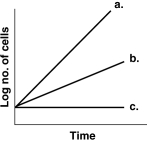
Micrococci are facultative halophiles. In Figure 6.1, which line best depicts the growth of M. luteus
In a nutrient medium containing 7.5% NaCl?
A) a
B) b
C) c
Micrococci are facultative halophiles. In Figure 6.1, which line best depicts the growth of M. luteus
In a nutrient medium containing 7.5% NaCl?
A) a
B) b
C) c
Question
Question
Question
Figure 6.1
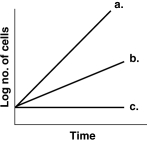
In Figure 6.1, which line best depicts a catalase- negative cell incubated aerobically?
A) a
B) b
C) c
In Figure 6.1, which line best depicts a catalase- negative cell incubated aerobically?
A) a
B) b
C) c
Question
Figure 6.2

In Figure 6.2, which section shows a growth phase where the number of cells dying equals the number of cells dividing?
A) a
B) b
C) c
D) d
E) a and c
In Figure 6.2, which section shows a growth phase where the number of cells dying equals the number of cells dividing?
A) a
B) b
C) c
D) d
E) a and c
Question
Question
Question
Question
Question
Figure 6.1
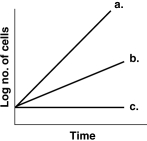
In Figure 6.1, which line best depicts a mesophile with an optimum temperature of 35°C incubated at 40°C?
A) a
B) b
C) c
In Figure 6.1, which line best depicts a mesophile with an optimum temperature of 35°C incubated at 40°C?
A) a
B) b
C) c
Question
Question
Question
Question
Question
Figure 6.1
In Figure 6.1, which line best depicts a psychrotroph incubated at 0°C?
A) a
B) b
C) c
In Figure 6.1, which line best depicts a psychrotroph incubated at 0°C?
A) a
B) b
C) c
Question
Question
Question
Question
Question
Figure 6.1

In Figure 6.1, which line shows the growth of an obligate aerobe incubated anaerobically?
A) a
B) b
C) c
In Figure 6.1, which line shows the growth of an obligate aerobe incubated anaerobically?
A) a
B) b
C) c
Question
Question
Question
Figure 6.3
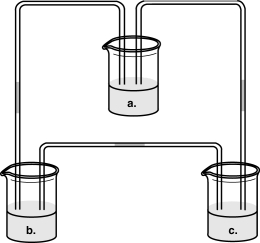
Figure 6.3 shows three containers of water connected by tubes. A selectively permeable membrane divides each tube. Solutes are added to each container to give final concentrations of 5% NaCl in a; 10% NaCl in b; and 5% sucrose in c. When the experiment is first set up, the initial movement of water will be
A) a to c; c to b; c to a.
B) a to b; c to b; c to a.
C) a to b; b to c; c to a.
D) b to a; b to c; c to a.
E) a to c; b to c; c to a.
Figure 6.3 shows three containers of water connected by tubes. A selectively permeable membrane divides each tube. Solutes are added to each container to give final concentrations of 5% NaCl in a; 10% NaCl in b; and 5% sucrose in c. When the experiment is first set up, the initial movement of water will be
A) a to c; c to b; c to a.
B) a to b; c to b; c to a.
C) a to b; b to c; c to a.
D) b to a; b to c; c to a.
E) a to c; b to c; c to a.
Question
Question
Figure 6.1
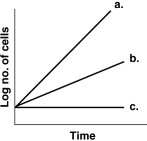
In Figure 6.1, which line best depicts a facultative anaerobe in the absence of O₂?
A) a
B) b
C) c
In Figure 6.1, which line best depicts a facultative anaerobe in the absence of O₂?
A) a
B) b
C) c
Question
Question
Figure 6.1
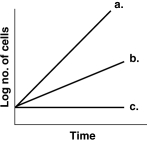
In Figure 6.1 ,which line best depicts an obligate anaerobe in the presence of O₂?
A) a
B) b
C) c
In Figure 6.1 ,which line best depicts an obligate anaerobe in the presence of O₂?
A) a
B) b
C) c
Question
Figure 6.1
In Figure 6.1, which line best illustrates the growth of a facultative anaerobe incubated aerobically?
A) a
B) b
C) c
In Figure 6.1, which line best illustrates the growth of a facultative anaerobe incubated aerobically?
A) a
B) b
C) c
Question
Question
Question
Question
Figure 6.1
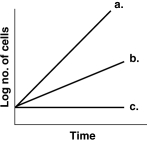
In Figure 6.1, which line best illustrates a mesophile at 5°C above its optimum temperature?
A) a
B) b
C) c
In Figure 6.1, which line best illustrates a mesophile at 5°C above its optimum temperature?
A) a
B) b
C) c
Question
Question
Figure 6.1
In Figure 6.1, which line best depicts a psychrophile incubated at room temperature?
A) a
B) b
C) c
In Figure 6.1, which line best depicts a psychrophile incubated at room temperature?
A) a
B) b
C) c
Question
Figure 6.1

In Figure 6.1, which line best depicts Neisseria gonorrhoeae when growing inside the human body?
A) a
B) b
C) c
In Figure 6.1, which line best depicts Neisseria gonorrhoeae when growing inside the human body?
A) a
B) b
C) c
Question
Question
Question
Question
Figure 6.2
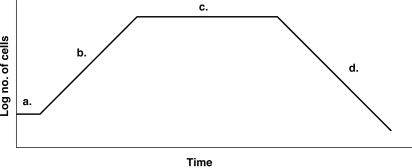
In Figure 6.2, which sections of the graph illustrate a logarithmic change in cell numbers?
A) b and d
B) c and d
C) a and b
D) a and c
E) b only
In Figure 6.2, which sections of the graph illustrate a logarithmic change in cell numbers?
A) b and d
B) c and d
C) a and b
D) a and c
E) b only
Question

Unlock Deck
Sign up to unlock the cards in this deck!
Unlock Deck
Unlock Deck
1/42

Play

Full screen (f)
Deck 6: Microbial Growth
1
Which of the following is not used to determine metabolic activity?
A) Turbidity.
B) Acid production from fermentation.
C) CO2 produced from the Krebs cycle.
D) Decreased dissolved oxygen.
E) NO2- produced from the electron transport chain.
A) Turbidity.
B) Acid production from fermentation.
C) CO2 produced from the Krebs cycle.
D) Decreased dissolved oxygen.
E) NO2- produced from the electron transport chain.
Turbidity.
2
Which of the following is the best definition of generation time?
A) The time it takes for nuclear division.
B) The length of time it takes for lag phase.
C) The duration of log phase.
D) The length of time it takes for a cell to divide.
E) The minimum rate of doubling.
A) The time it takes for nuclear division.
B) The length of time it takes for lag phase.
C) The duration of log phase.
D) The length of time it takes for a cell to divide.
E) The minimum rate of doubling.
D
3
Figure 6.1
Micrococci are facultative halophiles. In Figure 6.1, which line best depicts the growth of M. luteus
In a nutrient medium containing 7.5% NaCl?
A) a
B) b
C) c
Micrococci are facultative halophiles. In Figure 6.1, which line best depicts the growth of M. luteus
In a nutrient medium containing 7.5% NaCl?
A) a
B) b
C) c
B
4
All of the following are direct methods to measure microbial growth except
A) MPN.
B) Direct microscopic count.
C) Standard plate count.
D) Metabolic activity.
E) Filtration.
A) MPN.
B) Direct microscopic count.
C) Standard plate count.
D) Metabolic activity.
E) Filtration.
Unlock Deck
Unlock for access to all 42 flashcards in this deck.
Unlock Deck
k this deck
5
A culture medium consisting of agar, human blood, and beef heart is a
A) Chemically defined medium.
B) Reducing medium.
C) Selective medium.
D) Complex medium.
E) Differential medium.
A) Chemically defined medium.
B) Reducing medium.
C) Selective medium.
D) Complex medium.
E) Differential medium.
Unlock Deck
Unlock for access to all 42 flashcards in this deck.
Unlock Deck
k this deck
6
Figure 6.1
In Figure 6.1, which line best depicts a catalase- negative cell incubated aerobically?
A) a
B) b
C) c
In Figure 6.1, which line best depicts a catalase- negative cell incubated aerobically?
A) a
B) b
C) c
Unlock Deck
Unlock for access to all 42 flashcards in this deck.
Unlock Deck
k this deck
7
Figure 6.2
In Figure 6.2, which section shows a growth phase where the number of cells dying equals the number of cells dividing?
A) a
B) b
C) c
D) d
E) a and c
In Figure 6.2, which section shows a growth phase where the number of cells dying equals the number of cells dividing?
A) a
B) b
C) c
D) d
E) a and c
Unlock Deck
Unlock for access to all 42 flashcards in this deck.
Unlock Deck
k this deck
8
Which group of microorganisms is most likely to spoil a freshwater trout preserved with salt?
A) Thermophiles
B) Anaerobes
C) Halophiles
D) Psychrophiles
E) None of the above
A) Thermophiles
B) Anaerobes
C) Halophiles
D) Psychrophiles
E) None of the above
Unlock Deck
Unlock for access to all 42 flashcards in this deck.
Unlock Deck
k this deck
9
Assume you inoculated 100 cells into 100 ml nutrient broth. You then inoculated 100 cells of the same species into 200 ml nutrient broth. After incubation for 24 hr, you should have
A) More cells in the 200 ml.
B) More cells in the 100 ml.
C) The same number of cells in both.
A) More cells in the 200 ml.
B) More cells in the 100 ml.
C) The same number of cells in both.
Unlock Deck
Unlock for access to all 42 flashcards in this deck.
Unlock Deck
k this deck
10
An experiment began with 4 cells and ended with 128 cells. How many generations did the cells go through?
A) 4
B) 64
C) 6
D) 5
E) 32
A) 4
B) 64
C) 6
D) 5
E) 32
Unlock Deck
Unlock for access to all 42 flashcards in this deck.
Unlock Deck
k this deck
11
Which enzyme catalyzes the reaction: H?O?+?H+ ??H?O?
A) Superoxide dismutase
B) Oxidase
C) Peroxidase
D) Catalase
E) None of the above
A) Superoxide dismutase
B) Oxidase
C) Peroxidase
D) Catalase
E) None of the above
Unlock Deck
Unlock for access to all 42 flashcards in this deck.
Unlock Deck
k this deck
12
Figure 6.1
In Figure 6.1, which line best depicts a mesophile with an optimum temperature of 35°C incubated at 40°C?
A) a
B) b
C) c
In Figure 6.1, which line best depicts a mesophile with an optimum temperature of 35°C incubated at 40°C?
A) a
B) b
C) c
Unlock Deck
Unlock for access to all 42 flashcards in this deck.
Unlock Deck
k this deck
13
Which of the following is an example of a metabolic activity that could be used to measure microbial growth?
A) Standard plate count
B) Direct microscopic count
C) Glucose consumption
D) MPN
E) Turbidity
A) Standard plate count
B) Direct microscopic count
C) Glucose consumption
D) MPN
E) Turbidity
Unlock Deck
Unlock for access to all 42 flashcards in this deck.
Unlock Deck
k this deck
14
Which organism produces catalase and superoxide dismutase?
A) Aerobe
B) Obligate anaerobe
C) Aerotolerant anaerobe
A) Aerobe
B) Obligate anaerobe
C) Aerotolerant anaerobe
Unlock Deck
Unlock for access to all 42 flashcards in this deck.
Unlock Deck
k this deck
15
The source of nutrients in nutrient agar is
A) Peptone and beef extract.
B) Nutrient.
C) Agar.
D) Peptone and NaCl.
E) All of the above.
A) Peptone and beef extract.
B) Nutrient.
C) Agar.
D) Peptone and NaCl.
E) All of the above.
Unlock Deck
Unlock for access to all 42 flashcards in this deck.
Unlock Deck
k this deck
16
Producers in the hydrothermal vents on the ocean floor use CO? for their carbon source and what for energy?
A) Organic molecules
B) Sulfide
C) Carbon dioxide
D) Light
E) None of the above
A) Organic molecules
B) Sulfide
C) Carbon dioxide
D) Light
E) None of the above
Unlock Deck
Unlock for access to all 42 flashcards in this deck.
Unlock Deck
k this deck
17
Figure 6.1
In Figure 6.1, which line best depicts a psychrotroph incubated at 0°C?
A) a
B) b
C) c
In Figure 6.1, which line best depicts a psychrotroph incubated at 0°C?
A) a
B) b
C) c
Unlock Deck
Unlock for access to all 42 flashcards in this deck.
Unlock Deck
k this deck
18
Three cells with generation times of 30 minutes are inoculated into a culture medium. How many cells are there after 5 hours?
A) 16
B) 48
C) 3 × 210
D) 1024
E) 243
A) 16
B) 48
C) 3 × 210
D) 1024
E) 243
Unlock Deck
Unlock for access to all 42 flashcards in this deck.
Unlock Deck
k this deck
19
Which organism is killed by atmospheric O₂?
A) Obligate anaerobe
B) Aerotolerant anaerobe
C) Aerobe
A) Obligate anaerobe
B) Aerotolerant anaerobe
C) Aerobe
Unlock Deck
Unlock for access to all 42 flashcards in this deck.
Unlock Deck
k this deck
20
The addition of which of the following to a culture medium will neutralize acids?
A) pH
B) Heat
C) Sugars
D) Carbon
E) Buffers
A) pH
B) Heat
C) Sugars
D) Carbon
E) Buffers
Unlock Deck
Unlock for access to all 42 flashcards in this deck.
Unlock Deck
k this deck
21
Which enzyme catalyzes the reaction: 2H?O? ?2H?O + O??
A) Catalase
B) Peroxidase
C) Oxidase
D) Superoxide dismutase
E) None of the above
A) Catalase
B) Peroxidase
C) Oxidase
D) Superoxide dismutase
E) None of the above
Unlock Deck
Unlock for access to all 42 flashcards in this deck.
Unlock Deck
k this deck
22
Figure 6.1
In Figure 6.1, which line shows the growth of an obligate aerobe incubated anaerobically?
A) a
B) b
C) c
In Figure 6.1, which line shows the growth of an obligate aerobe incubated anaerobically?
A) a
B) b
C) c
Unlock Deck
Unlock for access to all 42 flashcards in this deck.
Unlock Deck
k this deck
23
Which of the following is not a disadvantage of the direct microscopic count?
A) No incubation time.
B) Large number of cells is required.
C) Sample volume is unknown.
D) Enumerates dead cells.
E) Some organisms are motile.
A) No incubation time.
B) Large number of cells is required.
C) Sample volume is unknown.
D) Enumerates dead cells.
E) Some organisms are motile.
Unlock Deck
Unlock for access to all 42 flashcards in this deck.
Unlock Deck
k this deck
24
Thirty- six colonies grew in nutrient agar from 1.0 ml of undiluted sample in a standard plate count. How many cells were in the original sample?
A) 9
B) 4
C) 72
D) 36
E) 18
A) 9
B) 4
C) 72
D) 36
E) 18
Unlock Deck
Unlock for access to all 42 flashcards in this deck.
Unlock Deck
k this deck
25
Figure 6.3
Figure 6.3 shows three containers of water connected by tubes. A selectively permeable membrane divides each tube. Solutes are added to each container to give final concentrations of 5% NaCl in a; 10% NaCl in b; and 5% sucrose in c. When the experiment is first set up, the initial movement of water will be
A) a to c; c to b; c to a.
B) a to b; c to b; c to a.
C) a to b; b to c; c to a.
D) b to a; b to c; c to a.
E) a to c; b to c; c to a.
Figure 6.3 shows three containers of water connected by tubes. A selectively permeable membrane divides each tube. Solutes are added to each container to give final concentrations of 5% NaCl in a; 10% NaCl in b; and 5% sucrose in c. When the experiment is first set up, the initial movement of water will be
A) a to c; c to b; c to a.
B) a to b; c to b; c to a.
C) a to b; b to c; c to a.
D) b to a; b to c; c to a.
E) a to c; b to c; c to a.
Unlock Deck
Unlock for access to all 42 flashcards in this deck.
Unlock Deck
k this deck
26
The term facultative anaerobe refers to an organism that
A) Is killed by oxygen.
B) Doesn't use oxygen but tolerates it.
C) Uses oxygen or grows without oxygen.
D) Prefers to grow without oxygen.
E) Requires less oxygen than is present in air.
A) Is killed by oxygen.
B) Doesn't use oxygen but tolerates it.
C) Uses oxygen or grows without oxygen.
D) Prefers to grow without oxygen.
E) Requires less oxygen than is present in air.
Unlock Deck
Unlock for access to all 42 flashcards in this deck.
Unlock Deck
k this deck
27
Figure 6.1
In Figure 6.1, which line best depicts a facultative anaerobe in the absence of O₂?
A) a
B) b
C) c
In Figure 6.1, which line best depicts a facultative anaerobe in the absence of O₂?
A) a
B) b
C) c
Unlock Deck
Unlock for access to all 42 flashcards in this deck.
Unlock Deck
k this deck
28
Table 6.1
Below are three different culture media.
-In Table 6.1, which medium (media) is (are) chemically defined?
A) A
B) B
C) A and B
D) A and C
E) None of the above
Below are three different culture media.
-In Table 6.1, which medium (media) is (are) chemically defined?
A) A
B) B
C) A and B
D) A and C
E) None of the above
Unlock Deck
Unlock for access to all 42 flashcards in this deck.
Unlock Deck
k this deck
29
Figure 6.1
In Figure 6.1 ,which line best depicts an obligate anaerobe in the presence of O₂?
A) a
B) b
C) c
In Figure 6.1 ,which line best depicts an obligate anaerobe in the presence of O₂?
A) a
B) b
C) c
Unlock Deck
Unlock for access to all 42 flashcards in this deck.
Unlock Deck
k this deck
30
Figure 6.1
In Figure 6.1, which line best illustrates the growth of a facultative anaerobe incubated aerobically?
A) a
B) b
C) c
In Figure 6.1, which line best illustrates the growth of a facultative anaerobe incubated aerobically?
A) a
B) b
C) c
Unlock Deck
Unlock for access to all 42 flashcards in this deck.
Unlock Deck
k this deck
31
Which of the following is not a disadvantage of the standard plate count?
A) Cells may form aggregates.
B) Requires incubation time.
C) Chemical and physical requirements are determined by media and incubation.
D) Determines viable cells.
E) None of the above.
A) Cells may form aggregates.
B) Requires incubation time.
C) Chemical and physical requirements are determined by media and incubation.
D) Determines viable cells.
E) None of the above.
Unlock Deck
Unlock for access to all 42 flashcards in this deck.
Unlock Deck
k this deck
32
Table 6.1
Below are three different culture media.
-In Table, 6.1, in which medium would an autotroph grow?
A) A
B) B
C) A and B
D) A and C
E) None of the above
Below are three different culture media.
-In Table, 6.1, in which medium would an autotroph grow?
A) A
B) B
C) A and B
D) A and C
E) None of the above
Unlock Deck
Unlock for access to all 42 flashcards in this deck.
Unlock Deck
k this deck
33
Table 6.2
The following data show growth of two bacteria on different media.
-The data in Table 6.2 indicate that S. aureus is a(n)
A) Facultative anaerobe.
B) Facultative halophile.
C) Halophile.
D) Aerobe.
E) Mesophile.
The following data show growth of two bacteria on different media.
-The data in Table 6.2 indicate that S. aureus is a(n)
A) Facultative anaerobe.
B) Facultative halophile.
C) Halophile.
D) Aerobe.
E) Mesophile.
Unlock Deck
Unlock for access to all 42 flashcards in this deck.
Unlock Deck
k this deck
34
Figure 6.1
In Figure 6.1, which line best illustrates a mesophile at 5°C above its optimum temperature?
A) a
B) b
C) c
In Figure 6.1, which line best illustrates a mesophile at 5°C above its optimum temperature?
A) a
B) b
C) c
Unlock Deck
Unlock for access to all 42 flashcards in this deck.
Unlock Deck
k this deck
35
During which growth phase will gram- positive bacteria be most susceptible to penicillin?
A) Log phase
B) Stationary phase
C) Lag phase
D) Death phase
E) The culture is equally susceptible during all phases.
A) Log phase
B) Stationary phase
C) Lag phase
D) Death phase
E) The culture is equally susceptible during all phases.
Unlock Deck
Unlock for access to all 42 flashcards in this deck.
Unlock Deck
k this deck
36
Figure 6.1
In Figure 6.1, which line best depicts a psychrophile incubated at room temperature?
A) a
B) b
C) c
In Figure 6.1, which line best depicts a psychrophile incubated at room temperature?
A) a
B) b
C) c
Unlock Deck
Unlock for access to all 42 flashcards in this deck.
Unlock Deck
k this deck
37
Figure 6.1
In Figure 6.1, which line best depicts Neisseria gonorrhoeae when growing inside the human body?
A) a
B) b
C) c
In Figure 6.1, which line best depicts Neisseria gonorrhoeae when growing inside the human body?
A) a
B) b
C) c
Unlock Deck
Unlock for access to all 42 flashcards in this deck.
Unlock Deck
k this deck
38
Which of the following pairs is mismatched?
A) Psychrotroph - growth at 0°C
B) Thermophile - growth at 37°C
C) Psychrophile - growth at 15°C
D) Mesophile - growth at 25°C
E) None of the above
A) Psychrotroph - growth at 0°C
B) Thermophile - growth at 37°C
C) Psychrophile - growth at 15°C
D) Mesophile - growth at 25°C
E) None of the above
Unlock Deck
Unlock for access to all 42 flashcards in this deck.
Unlock Deck
k this deck
39
A culture medium on which only gram- positive organisms grow and a yellow halo surrounds
Staphylococcus aureus colonies is called a(n)
A) Selective medium.
B) Differential medium.
C) Enrichment culture.
D) B and C.
E) A and B.
Staphylococcus aureus colonies is called a(n)
A) Selective medium.
B) Differential medium.
C) Enrichment culture.
D) B and C.
E) A and B.
Unlock Deck
Unlock for access to all 42 flashcards in this deck.
Unlock Deck
k this deck
40
Most bacteria grow best at pH
A) 5.
B) 7.
C) 14.
D) 9.
E) 1.
A) 5.
B) 7.
C) 14.
D) 9.
E) 1.
Unlock Deck
Unlock for access to all 42 flashcards in this deck.
Unlock Deck
k this deck
41
Figure 6.2
In Figure 6.2, which sections of the graph illustrate a logarithmic change in cell numbers?
A) b and d
B) c and d
C) a and b
D) a and c
E) b only
In Figure 6.2, which sections of the graph illustrate a logarithmic change in cell numbers?
A) b and d
B) c and d
C) a and b
D) a and c
E) b only
Unlock Deck
Unlock for access to all 42 flashcards in this deck.
Unlock Deck
k this deck
42
Salts and sugars work to preserve foods by creating a
A) Hypotonic environment.
B) Lower osmotic pressure.
C) Lower pH.
D) Hypertonic environment.
E) Depletion of nutrients.
A) Hypotonic environment.
B) Lower osmotic pressure.
C) Lower pH.
D) Hypertonic environment.
E) Depletion of nutrients.
Unlock Deck
Unlock for access to all 42 flashcards in this deck.
Unlock Deck
k this deck
Unlock Deck
Unlock for access to all 42 flashcards in this deck.






