







 Chat with AI

Deck 28: Applied and Industrial Microbiology
Full screen (f)

Question

Question
Figure 28.1
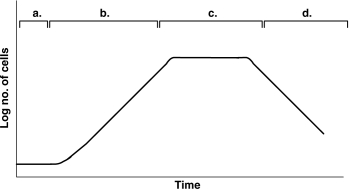
In Figure 28.1, assume that a secondary metabolite is your desired product. When would you be able to obtain it?
A) a
B) b
C) c
D) d
In Figure 28.1, assume that a secondary metabolite is your desired product. When would you be able to obtain it?
A) a
B) b
C) c
D) d
Question
Question
Question
Figure 28.1
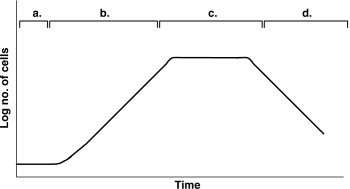
In Figure 28.1, assume you want an enzyme that is not secreted. You would harvest at the end of what time?
A) a
B) b
C) c
D) d
In Figure 28.1, assume you want an enzyme that is not secreted. You would harvest at the end of what time?
A) a
B) b
C) c
D) d
Question
Question
Question
Question
Question
Question
Question
Question
Question
Question
Question
Question
Question
Question
Question
Question
Question
Question
Question
Question
Question
Question
Question
Figure 28.3
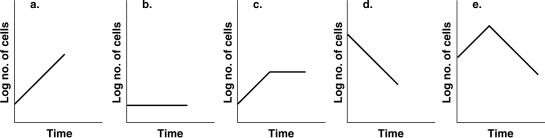
Which of the growth curves in Figure 28.3 will give the highest yield of a secondary metabolite?
A) a
B) b
C) c
D) d
E) e
Which of the growth curves in Figure 28.3 will give the highest yield of a secondary metabolite?
A) a
B) b
C) c
D) d
E) e
Question
Question
Question
Question
Question
Question
Figure 28.2
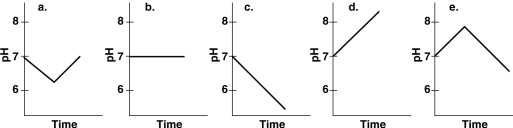
Which of the graphs in Figure 28.2 shows the pH in a culture flask as cells metabolize glucose and then protein?
A) a
B) b
C) c
D) d
E) e
Which of the graphs in Figure 28.2 shows the pH in a culture flask as cells metabolize glucose and then protein?
A) a
B) b
C) c
D) d
E) e
Question
Question
Question
Question
Figure 28.1
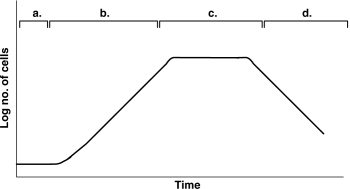
In Figure 28.1, assume that cells are your desired product. When would you harvest cells to maximize your yield?
A) a
B) b
C) c
D) d
In Figure 28.1, assume that cells are your desired product. When would you harvest cells to maximize your yield?
A) a
B) b
C) c
D) d
Question
Question
Figure 28.3
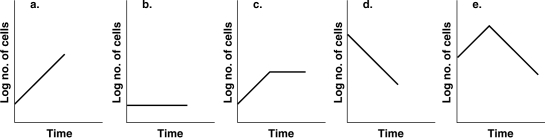
Figure 28.3 shows the growth curves of Acetobacter under different conditions. Which culture would have the highest amount of acetic acid?
A) a
B) b
C) c
D) d
E) e
Figure 28.3 shows the growth curves of Acetobacter under different conditions. Which culture would have the highest amount of acetic acid?
A) a
B) b
C) c
D) d
E) e
Question
Question
Question

Unlock Deck
Sign up to unlock the cards in this deck!
Unlock Deck
Unlock Deck
1/43

Play

Full screen (f)
Deck 28: Applied and Industrial Microbiology
1
Spoilage of canned foods stored at high temperatures, accompanied by gas production, is
A) Thermophilic anaerobic spoilage.
B) Flat sour spoilage.
C) Spoilage by mesophilic bacteria.
D) Caused by acid- tolerant fungi.
E) Putrefactive anaerobic spoilage.
A) Thermophilic anaerobic spoilage.
B) Flat sour spoilage.
C) Spoilage by mesophilic bacteria.
D) Caused by acid- tolerant fungi.
E) Putrefactive anaerobic spoilage.
A
2
Figure 28.1
In Figure 28.1, assume that a secondary metabolite is your desired product. When would you be able to obtain it?
A) a
B) b
C) c
D) d
In Figure 28.1, assume that a secondary metabolite is your desired product. When would you be able to obtain it?
A) a
B) b
C) c
D) d
C
3
All of the following are produced using microbial fermentations except
A) Saccharin.
B) Aspartame.
C) Citric acid.
D) MSG.
E) Riboflavin.
A) Saccharin.
B) Aspartame.
C) Citric acid.
D) MSG.
E) Riboflavin.
A
4
Canning preserves food by
A) Aseptic packaging.
B) Radiation.
C) Heating.
D) Chemicals.
E) All of the above.
A) Aseptic packaging.
B) Radiation.
C) Heating.
D) Chemicals.
E) All of the above.
Unlock Deck
Unlock for access to all 43 flashcards in this deck.
Unlock Deck
k this deck
5
Figure 28.1
In Figure 28.1, assume you want an enzyme that is not secreted. You would harvest at the end of what time?
A) a
B) b
C) c
D) d
In Figure 28.1, assume you want an enzyme that is not secreted. You would harvest at the end of what time?
A) a
B) b
C) c
D) d
Unlock Deck
Unlock for access to all 43 flashcards in this deck.
Unlock Deck
k this deck
6
Assume that you bought a semisoft cheese such as blue cheese and put it in your refrigerator. Three weeks later you cut the cheese and notice the center is now liquid because
A) Fungi have accumulated in the center.
B) Fungal enzymes have made more curd.
C) Lactic acid bacteria have grown in the center.
D) Fungal enzymes have digested the curd.
E) None of the above.
A) Fungi have accumulated in the center.
B) Fungal enzymes have made more curd.
C) Lactic acid bacteria have grown in the center.
D) Fungal enzymes have digested the curd.
E) None of the above.
Unlock Deck
Unlock for access to all 43 flashcards in this deck.
Unlock Deck
k this deck
7
When compared to a flask culture, a bioreactor offers all of the following advantages except
A) Aseptic sampling.
B) Instrumentation for monitoring environmental conditions.
C) Uniform aeration and mixing.
D) Larger culture volumes can be grown.
E) None of the above.
A) Aseptic sampling.
B) Instrumentation for monitoring environmental conditions.
C) Uniform aeration and mixing.
D) Larger culture volumes can be grown.
E) None of the above.
Unlock Deck
Unlock for access to all 43 flashcards in this deck.
Unlock Deck
k this deck
8
Cellulase attached to a membrane filter will
A) Do nothing; it requires a cell.
B) Degrade the membrane.
C) Degrade lactose.
D) Degrade cellulose.
E) None of the above.
A) Do nothing; it requires a cell.
B) Degrade the membrane.
C) Degrade lactose.
D) Degrade cellulose.
E) None of the above.
Unlock Deck
Unlock for access to all 43 flashcards in this deck.
Unlock Deck
k this deck
9
Spoilage due to can leakage after processing is
A) Thermophilic anaerobic spoilage.
B) Flat sour spoilage.
C) Spoilage by mesophilic bacteria.
D) Caused by acid- tolerant fungi.
E) Putrefactive anaerobic spoilage.
A) Thermophilic anaerobic spoilage.
B) Flat sour spoilage.
C) Spoilage by mesophilic bacteria.
D) Caused by acid- tolerant fungi.
E) Putrefactive anaerobic spoilage.
Unlock Deck
Unlock for access to all 43 flashcards in this deck.
Unlock Deck
k this deck
10
Which of the following is an undesirable contaminant in wine- making?
A) Bacillus
B) Clostridium
C) Acetobacter
D) Lactic acid bacteria
E) Saccharomyces (yeast)
A) Bacillus
B) Clostridium
C) Acetobacter
D) Lactic acid bacteria
E) Saccharomyces (yeast)
Unlock Deck
Unlock for access to all 43 flashcards in this deck.
Unlock Deck
k this deck
11
If the lac operon is used as a receptor for the lux operon, the presence of lactose would cause the cell to
A) Produce lactose.
B) Grow better.
C) Emit light.
D) Use light energy.
E) Die.
A) Produce lactose.
B) Grow better.
C) Emit light.
D) Use light energy.
E) Die.
Unlock Deck
Unlock for access to all 43 flashcards in this deck.
Unlock Deck
k this deck
12
Which reaction leads to all the others?
A) Ethanol ?Acetic acid
B) Sucrose ?Ethanol
C) Malic acid ?Lactic acid
D) Carbon dioxide ?Sucrose
E) None of the above
A) Ethanol ?Acetic acid
B) Sucrose ?Ethanol
C) Malic acid ?Lactic acid
D) Carbon dioxide ?Sucrose
E) None of the above
Unlock Deck
Unlock for access to all 43 flashcards in this deck.
Unlock Deck
k this deck
13
Which reaction makes wine less acidic?
A) Sucrose ?Ethanol
B) Malic acid ?Lactic acid
C) Carbon dioxide ?Sucrose
D) Ethanol ?Acetic acid
E) None of the above
A) Sucrose ?Ethanol
B) Malic acid ?Lactic acid
C) Carbon dioxide ?Sucrose
D) Ethanol ?Acetic acid
E) None of the above
Unlock Deck
Unlock for access to all 43 flashcards in this deck.
Unlock Deck
k this deck
14
All of the following are produced using microbial fermentations except
A) Blue cheese.
B) Yogurt.
C) Ice cream.
D) Sour cream.
E) None of the above.
A) Blue cheese.
B) Yogurt.
C) Ice cream.
D) Sour cream.
E) None of the above.
Unlock Deck
Unlock for access to all 43 flashcards in this deck.
Unlock Deck
k this deck
15
Radiation is used for all of the following except
A) Preventing sprouting.
B) Killing Trichinella.
C) Killing insect eggs and larva.
D) Sterilizing food.
E) Foods that cannot be heated.
A) Preventing sprouting.
B) Killing Trichinella.
C) Killing insect eggs and larva.
D) Sterilizing food.
E) Foods that cannot be heated.
Unlock Deck
Unlock for access to all 43 flashcards in this deck.
Unlock Deck
k this deck
16
Fermentation works to preserve foods because of this:
A) Anaerobic environment
B) Anaerobic environment and heat
C) Heat
D) Lethal mutations
E) pH
A) Anaerobic environment
B) Anaerobic environment and heat
C) Heat
D) Lethal mutations
E) pH
Unlock Deck
Unlock for access to all 43 flashcards in this deck.
Unlock Deck
k this deck
17
What will be produced if wine is aerated?
A) CO₂ + H₂O
B) CH4
C) Ethyl alcohol + CO₂
D) Acetic acid
E) None of the above
A) CO₂ + H₂O
B) CH4
C) Ethyl alcohol + CO₂
D) Acetic acid
E) None of the above
Unlock Deck
Unlock for access to all 43 flashcards in this deck.
Unlock Deck
k this deck
18
Radiation and canning are used for all of the following reasons except to
A) Prevent diseases.
B) Prevent spoilage of foods.
C) Sell more food.
D) Prolong the shelf life of foods.
E) All of the above.
A) Prevent diseases.
B) Prevent spoilage of foods.
C) Sell more food.
D) Prolong the shelf life of foods.
E) All of the above.
Unlock Deck
Unlock for access to all 43 flashcards in this deck.
Unlock Deck
k this deck
19
Radiation works to preserve foods because of this:
A) Anaerobic environment
B) Anaerobic environment and heat
C) Heat
D) Lethal mutations
E) pH
A) Anaerobic environment
B) Anaerobic environment and heat
C) Heat
D) Lethal mutations
E) pH
Unlock Deck
Unlock for access to all 43 flashcards in this deck.
Unlock Deck
k this deck
20
Microorganisms themselves are commercial products. Which of the following microbes is available in retail stores?
A) Saccharomyces
B) Lactobacillus
C) Rhizobium
D) Bacillus thuringiensis
E) All of the above
A) Saccharomyces
B) Lactobacillus
C) Rhizobium
D) Bacillus thuringiensis
E) All of the above
Unlock Deck
Unlock for access to all 43 flashcards in this deck.
Unlock Deck
k this deck
21
You are growing Bacillus subtilis in a bioreactor and notice that the growth rate has slowed and the pH has decreased. What could you do?
A) Add peptides.
B) Add glucose.
C) Add lactose.
D) Add oxygen.
E) None of the above.
A) Add peptides.
B) Add glucose.
C) Add lactose.
D) Add oxygen.
E) None of the above.
Unlock Deck
Unlock for access to all 43 flashcards in this deck.
Unlock Deck
k this deck
22
All of the following are industrial products produced by microbes except
A) Amino acids in food supplements.
B) Uranium.
C) Industrial enzymes.
D) Antibiotics.
E) Vitamin B12 and riboflavin.
A) Amino acids in food supplements.
B) Uranium.
C) Industrial enzymes.
D) Antibiotics.
E) Vitamin B12 and riboflavin.
Unlock Deck
Unlock for access to all 43 flashcards in this deck.
Unlock Deck
k this deck
23
Which of the following pairs is mismatched?
A) Penicillium - blue cheese
B) Acetobacter - vinegar
C) Propionibacterium - Swiss cheese
D) Bacillus - hard cheese
E) Streptococcus - yogurt
A) Penicillium - blue cheese
B) Acetobacter - vinegar
C) Propionibacterium - Swiss cheese
D) Bacillus - hard cheese
E) Streptococcus - yogurt
Unlock Deck
Unlock for access to all 43 flashcards in this deck.
Unlock Deck
k this deck
24
Canning works to preserve foods because of this:
A) Anaerobic environment
B) Anaerobic environment and heat
C) Heat
D) Lethal mutations
E) pH
A) Anaerobic environment
B) Anaerobic environment and heat
C) Heat
D) Lethal mutations
E) pH
Unlock Deck
Unlock for access to all 43 flashcards in this deck.
Unlock Deck
k this deck
25
You are growing Bacillus subtilis in a bioreactor and notice that the growth rate has slowed and the pH has decreased. You suspect the bacteria are
A) Using the Krebs cycle.
B) Using proteins.
C) Fermenting.
D) Photosynthesizing.
E) None of the above.
A) Using the Krebs cycle.
B) Using proteins.
C) Fermenting.
D) Photosynthesizing.
E) None of the above.
Unlock Deck
Unlock for access to all 43 flashcards in this deck.
Unlock Deck
k this deck
26
All of the following are industrial enzymes made by microbial fermentations except
A) Cellulases.
B) Glucose isomerase.
C) Proteases.
D) Rennin.
E) None of the above.
A) Cellulases.
B) Glucose isomerase.
C) Proteases.
D) Rennin.
E) None of the above.
Unlock Deck
Unlock for access to all 43 flashcards in this deck.
Unlock Deck
k this deck
27
Which of the following food additives is not produced by microorganisms?
A) Citric acid
B) Glutamic acid
C) Protease
D) Amylase
E) Sodium nitrate
A) Citric acid
B) Glutamic acid
C) Protease
D) Amylase
E) Sodium nitrate
Unlock Deck
Unlock for access to all 43 flashcards in this deck.
Unlock Deck
k this deck
28
Figure 28.3
Which of the growth curves in Figure 28.3 will give the highest yield of a secondary metabolite?
A) a
B) b
C) c
D) d
E) e
Which of the growth curves in Figure 28.3 will give the highest yield of a secondary metabolite?
A) a
B) b
C) c
D) d
E) e
Unlock Deck
Unlock for access to all 43 flashcards in this deck.
Unlock Deck
k this deck
29
Aseptic packaging works to preserve foods because of this:
A) Anaerobic environment
B) Anaerobic environment and heat
C) Heat
D) Lethal mutations
E) pH
A) Anaerobic environment
B) Anaerobic environment and heat
C) Heat
D) Lethal mutations
E) pH
Unlock Deck
Unlock for access to all 43 flashcards in this deck.
Unlock Deck
k this deck
30
Spoilage of canned foods due to inadequate processing, not accompanied by gas production, is
A) Thermophilic anaerobic spoilage.
B) Flat sour spoilage.
C) Spoilage by mesophilic bacteria.
D) Caused by acid- tolerant fungi.
E) Putrefactive anaerobic spoilage.
A) Thermophilic anaerobic spoilage.
B) Flat sour spoilage.
C) Spoilage by mesophilic bacteria.
D) Caused by acid- tolerant fungi.
E) Putrefactive anaerobic spoilage.
Unlock Deck
Unlock for access to all 43 flashcards in this deck.
Unlock Deck
k this deck
31
Your friend says he had stored a semisoft cheese (blue cheese) in his refrigerator for three weeks. He asks you why the outer "skin" of the cheese is so much thicker than it was when he originally purchased the cheese. You tell him that
A) Fungal enzymes have made more curd.
B) Fungal enzymes have digested the curd.
C) Fungi have been growing.
D) Lactic acid bacteria have grown on the outside.
E) None of the above.
A) Fungal enzymes have made more curd.
B) Fungal enzymes have digested the curd.
C) Fungi have been growing.
D) Lactic acid bacteria have grown on the outside.
E) None of the above.
Unlock Deck
Unlock for access to all 43 flashcards in this deck.
Unlock Deck
k this deck
32
Ethanol for automobile fuel is produced from corn by
A) The Krebs cycle.
B) Fermentation.
C) Anaerobic respiration.
D) Oxidation.
E) None of the above.
A) The Krebs cycle.
B) Fermentation.
C) Anaerobic respiration.
D) Oxidation.
E) None of the above.
Unlock Deck
Unlock for access to all 43 flashcards in this deck.
Unlock Deck
k this deck
33
Microbial products can be improved by
A) Mutating existing strains.
B) Isolating new strains.
C) Genetically engineering strains.
D) Modifying culture conditions.
E) All of the above.
A) Mutating existing strains.
B) Isolating new strains.
C) Genetically engineering strains.
D) Modifying culture conditions.
E) All of the above.
Unlock Deck
Unlock for access to all 43 flashcards in this deck.
Unlock Deck
k this deck
34
Figure 28.2
Which of the graphs in Figure 28.2 shows the pH in a culture flask as cells metabolize glucose and then protein?
A) a
B) b
C) c
D) d
E) e
Which of the graphs in Figure 28.2 shows the pH in a culture flask as cells metabolize glucose and then protein?
A) a
B) b
C) c
D) d
E) e
Unlock Deck
Unlock for access to all 43 flashcards in this deck.
Unlock Deck
k this deck
35
Wine is made from fruit juices by
A) Anaerobic fungal growth.
B) Bacterial production of CO₂.
C) The addition of sugar.
D) The addition of alcohol.
E) Malting.
A) Anaerobic fungal growth.
B) Bacterial production of CO₂.
C) The addition of sugar.
D) The addition of alcohol.
E) Malting.
Unlock Deck
Unlock for access to all 43 flashcards in this deck.
Unlock Deck
k this deck
36
Commercial sterilization differs from true sterilization in that commercial sterilization
A) May result in the survival of fungal spores.
B) May result in the survival of thermophiles.
C) Kills only bacteria.
D) Employs a higher temperature.
E) Kills all microorganisms.
A) May result in the survival of fungal spores.
B) May result in the survival of thermophiles.
C) Kills only bacteria.
D) Employs a higher temperature.
E) Kills all microorganisms.
Unlock Deck
Unlock for access to all 43 flashcards in this deck.
Unlock Deck
k this deck
37
The following steps are required for making cheese. What is the second step?
A) Inoculate with lactic acid bacteria
B) Enzymatic coagulation of milk
C) Separate curds and whey
D) Fermentation of curd
E) Press curd
A) Inoculate with lactic acid bacteria
B) Enzymatic coagulation of milk
C) Separate curds and whey
D) Fermentation of curd
E) Press curd
Unlock Deck
Unlock for access to all 43 flashcards in this deck.
Unlock Deck
k this deck
38
Figure 28.1
In Figure 28.1, assume that cells are your desired product. When would you harvest cells to maximize your yield?
A) a
B) b
C) c
D) d
In Figure 28.1, assume that cells are your desired product. When would you harvest cells to maximize your yield?
A) a
B) b
C) c
D) d
Unlock Deck
Unlock for access to all 43 flashcards in this deck.
Unlock Deck
k this deck
39
Methane made from biomass is produced by
A) Oxidation.
B) Anaerobic respiration.
C) The Krebs cycle.
D) Fermentation.
E) None of the above.
A) Oxidation.
B) Anaerobic respiration.
C) The Krebs cycle.
D) Fermentation.
E) None of the above.
Unlock Deck
Unlock for access to all 43 flashcards in this deck.
Unlock Deck
k this deck
40
Figure 28.3
Figure 28.3 shows the growth curves of Acetobacter under different conditions. Which culture would have the highest amount of acetic acid?
A) a
B) b
C) c
D) d
E) e
Figure 28.3 shows the growth curves of Acetobacter under different conditions. Which culture would have the highest amount of acetic acid?
A) a
B) b
C) c
D) d
E) e
Unlock Deck
Unlock for access to all 43 flashcards in this deck.
Unlock Deck
k this deck
41
Which of the following is not an alternative fuel (energy source) produced by bacteria?
A) Methane
B) Ethyl alcohol
C) Hydrogen
D) Methyl alcohol
E) Lactic acid
A) Methane
B) Ethyl alcohol
C) Hydrogen
D) Methyl alcohol
E) Lactic acid
Unlock Deck
Unlock for access to all 43 flashcards in this deck.
Unlock Deck
k this deck
42
As cheese ages it gets
A) Saltier.
B) More whey.
C) More protein.
D) More acidic.
E) None of the above.
A) Saltier.
B) More whey.
C) More protein.
D) More acidic.
E) None of the above.
Unlock Deck
Unlock for access to all 43 flashcards in this deck.
Unlock Deck
k this deck
43
A product made late in log phase and in stationary phase is called
A) A secondary metabolite.
B) An idiotypic metabolite.
C) Undesirable.
D) Fermentation.
E) None of the above
A) A secondary metabolite.
B) An idiotypic metabolite.
C) Undesirable.
D) Fermentation.
E) None of the above
Unlock Deck
Unlock for access to all 43 flashcards in this deck.
Unlock Deck
k this deck
Unlock Deck
Unlock for access to all 43 flashcards in this deck.






