







 Chat with AI

Deck 1: Economics and Economic Reasoning
Full screen (f)

Question

Question
Question
Question
Question
Question
Question
Question
Question
Question
Question
Question
Question
Question
Question
Question
Question
Question
Question
Question
Question
Question
Question
Question
Question
Question
Question
Question
The table below shows how the marginal benefit of pizza dinners varies for Luigi with the number consumed per month. 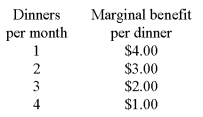 Suppose the price per dinner is $4.99 and accurately reflects the marginal cost of the dinners to Luigi.Assuming that Luigi is rational, he will:
A)not consume any pizza dinners this month.
B)consume one pizza dinner this month.
C)consume two pizza dinners this month.
D)consume three pizza dinners this month.
Suppose the price per dinner is $4.99 and accurately reflects the marginal cost of the dinners to Luigi.Assuming that Luigi is rational, he will:A)not consume any pizza dinners this month.
B)consume one pizza dinner this month.
C)consume two pizza dinners this month.
D)consume three pizza dinners this month.
Question
Question
Question
Question
Question
Question
Question
Question
Question
The table below shows how the marginal benefit of videotape rentals varies for Carol with the number rented per month. 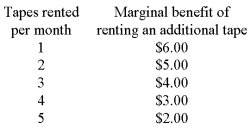 The price of each tape rental is reduced from $2.99 to $1 .99.Assuming that the price of a rental accurately reflects the marginal cost to Carol and that she is rational, she will increase the number of tapes rented per month from:
A)one to two.
B)two to three.
C)three to four.
D)four to five.
The price of each tape rental is reduced from $2.99 to $1 .99.Assuming that the price of a rental accurately reflects the marginal cost to Carol and that she is rational, she will increase the number of tapes rented per month from:A)one to two.
B)two to three.
C)three to four.
D)four to five.
Question
Question
Question
Question
Question
Question
Question
Question
Question
Question
Question
Question
Question
Question
Question
Question
Question
Question
Question
Question
Question
Question
Question
Question
Question
Question
Question
Question
Question
Question
Question
Question
Question
Question
Question
Question
Question
Question
Question
Question
Question
Question
Question

Unlock Deck
Sign up to unlock the cards in this deck!
Unlock Deck
Unlock Deck
1/112

Play

Full screen (f)
Deck 1: Economics and Economic Reasoning
1
Macroeconomics is the study of how individual choices are affected by economic forces.
False
2
The opportunity cost of undertaking an activity includes any sunk cost.
False
3
Scarcity exists because economies cannot produce enough to meet the perceived desires of all individuals.
True
4
The quantity of goods and services available to society:
A)is fixed.
B)depends on human action.
C)is not of economic importance.
D)will always grow to meet individuals' wants and desires.
A)is fixed.
B)depends on human action.
C)is not of economic importance.
D)will always grow to meet individuals' wants and desires.
Unlock Deck
Unlock for access to all 112 flashcards in this deck.
Unlock Deck
k this deck
5
Dorm rooms usually are not allocated by markets.Allocating dorm rooms is:
A)not an economic problem.
B)an economic problem.
C)not affected by economic forces.
D)determined by prices.
A)not an economic problem.
B)an economic problem.
C)not affected by economic forces.
D)determined by prices.
Unlock Deck
Unlock for access to all 112 flashcards in this deck.
Unlock Deck
k this deck
6
According to the text, economics is the study of how:
A)governments allocate resources in the face of constraints.
B)government policies can be used to meet individuals' wants and desires.
C)human beings coordinate their wants and desires.
D)scarce resources are allocated between capitalists and workers.
A)governments allocate resources in the face of constraints.
B)government policies can be used to meet individuals' wants and desires.
C)human beings coordinate their wants and desires.
D)scarce resources are allocated between capitalists and workers.
Unlock Deck
Unlock for access to all 112 flashcards in this deck.
Unlock Deck
k this deck
7
Economic systems:
A)can eliminate scarcity.
B)address the questions what is produced, how it is produced, and for whom it is produced.
C)provide all the goods people want and desire.
D)provide equal distribution of well-being among its participants.
A)can eliminate scarcity.
B)address the questions what is produced, how it is produced, and for whom it is produced.
C)provide all the goods people want and desire.
D)provide equal distribution of well-being among its participants.
Unlock Deck
Unlock for access to all 112 flashcards in this deck.
Unlock Deck
k this deck
8
Which of the following is not one of the three central coordination problems of the economy given in the book?
A)What
B)Whether
C)For whom
D)How
A)What
B)Whether
C)For whom
D)How
Unlock Deck
Unlock for access to all 112 flashcards in this deck.
Unlock Deck
k this deck
9
Social and political forces affect the way in which the invisible hand works.
Unlock Deck
Unlock for access to all 112 flashcards in this deck.
Unlock Deck
k this deck
10
If allocating dorm rooms changes from allocation by lottery to allocation by the market:
A)it becomes an economic problem.
B)it becomes a political problem but not an economic problem.
C)it becomes a social problem but not an economic problem.
D)the allocation problem is still an economic problem.
A)it becomes an economic problem.
B)it becomes a political problem but not an economic problem.
C)it becomes a social problem but not an economic problem.
D)the allocation problem is still an economic problem.
Unlock Deck
Unlock for access to all 112 flashcards in this deck.
Unlock Deck
k this deck
11
The "invisible hand" is the price mechanism that guides people's actions in the market.
Unlock Deck
Unlock for access to all 112 flashcards in this deck.
Unlock Deck
k this deck
12
The answers to an economy's three central economic problems are determined by the interaction of three forces: economic forces, political forces, and social forces.
Unlock Deck
Unlock for access to all 112 flashcards in this deck.
Unlock Deck
k this deck
13
The marginal benefit from consuming another unit of a good:
A)must equal the marginal cost or the unit will not be consumed.
B)must be less than the marginal cost or the unit will not be consumed.
C)equals the increase in total benefits from consuming the unit.
D)equals the total benefit obtained from the consumption of all prior units.
A)must equal the marginal cost or the unit will not be consumed.
B)must be less than the marginal cost or the unit will not be consumed.
C)equals the increase in total benefits from consuming the unit.
D)equals the total benefit obtained from the consumption of all prior units.
Unlock Deck
Unlock for access to all 112 flashcards in this deck.
Unlock Deck
k this deck
14
Deciding what the distribution of income should be is an example of normative economics.
Unlock Deck
Unlock for access to all 112 flashcards in this deck.
Unlock Deck
k this deck
15
Scarcity exists because:
A)individuals cannot solve the three central coordination problems.
B)governments cannot solve the three central coordination problems.
C)the supply of goods is always less than the demand.
D)new wants continue to develop and willingness to meet them is limited.
A)individuals cannot solve the three central coordination problems.
B)governments cannot solve the three central coordination problems.
C)the supply of goods is always less than the demand.
D)new wants continue to develop and willingness to meet them is limited.
Unlock Deck
Unlock for access to all 112 flashcards in this deck.
Unlock Deck
k this deck
16
Say a pill existed that made people selfless.After taking it they were only interested in others, not themselves.Under the coordination definition of economics:
A)no economic problem would exist.
B)there still would be an economic problem.
C)there would be a political problem but not an economic problem.
D)there would be a social problem but not an economic problem.
A)no economic problem would exist.
B)there still would be an economic problem.
C)there would be a political problem but not an economic problem.
D)there would be a social problem but not an economic problem.
Unlock Deck
Unlock for access to all 112 flashcards in this deck.
Unlock Deck
k this deck
17
People can reasonably expect that an economic system will decide all of the following except:
A)what goods to produce
B)how to produce the goods
C)how to assign initial property rights
D)for whom to produce the goods
A)what goods to produce
B)how to produce the goods
C)how to assign initial property rights
D)for whom to produce the goods
Unlock Deck
Unlock for access to all 112 flashcards in this deck.
Unlock Deck
k this deck
18
Microsoft filed a lawsuit against people who sent spam (junk e-mail) and a website owner who hosted spam services.A spokesman for Microsoft said that Microsoft was "trying to change the economics of spam" by increasing the cost of being a spammer.An economist most likely would agree with which statement about Microsoft's actions?
A)A more effective approach would be to educate spammers about the costs they impose on others.
B)A more effective approach would be to appeal to the morals of the spammers and tell them to follow the Golden Rule.
C)Microsoft's approach of trying to change the costs of spamming is the most efficient way to change behavior.
D)Microsoft should not be involved because spamming is just part of the invisible hand at work and should be left alone.
A)A more effective approach would be to educate spammers about the costs they impose on others.
B)A more effective approach would be to appeal to the morals of the spammers and tell them to follow the Golden Rule.
C)Microsoft's approach of trying to change the costs of spamming is the most efficient way to change behavior.
D)Microsoft should not be involved because spamming is just part of the invisible hand at work and should be left alone.
Unlock Deck
Unlock for access to all 112 flashcards in this deck.
Unlock Deck
k this deck
19
Only marginal costs, not sunk costs, affect economic decisions if individuals are rational.
Unlock Deck
Unlock for access to all 112 flashcards in this deck.
Unlock Deck
k this deck
20
The economic decision rule is to undertake an action only when the marginal benefits of that action are greater than its total costs.
Unlock Deck
Unlock for access to all 112 flashcards in this deck.
Unlock Deck
k this deck
21
Your opportunity cost of taking this course is:
A)the tuition you paid for the course.
B)the net benefit of the activity you would have chosen if you had not taken the course.
C)the net benefit of taking this course.
D)the cost of the activity you would have chosen if you had not taken the course.
A)the tuition you paid for the course.
B)the net benefit of the activity you would have chosen if you had not taken the course.
C)the net benefit of taking this course.
D)the cost of the activity you would have chosen if you had not taken the course.
Unlock Deck
Unlock for access to all 112 flashcards in this deck.
Unlock Deck
k this deck
22
The marginal benefit of going to a movie during the week is currently $6 for you.Assume that the $4 price of going to the movies measures its marginal cost.Following the economic decision rule, you will:
A)continue going to movies until the marginal benefit of doing so falls to zero.
B)choose not to go to any movies during the week.
C)continue going to movies until the marginal benefit of doing so falls below.
D)not be able to enjoy a net gain from going to the movies during the week.
A)continue going to movies until the marginal benefit of doing so falls to zero.
B)choose not to go to any movies during the week.
C)continue going to movies until the marginal benefit of doing so falls below.
D)not be able to enjoy a net gain from going to the movies during the week.
Unlock Deck
Unlock for access to all 112 flashcards in this deck.
Unlock Deck
k this deck
23
Alan is sitting in a bar drinking beers that cost $1 each.According to the economic decision rule, Alan will quit drinking when the marginal:
A)benefit to him of an additional beer is less than$1....
B)cost to him of an additional beer is less than the marginal benefit.
C)cost remains at$1....
D)benefit to him of an additional beer is greater than$1....
A)benefit to him of an additional beer is less than$1....
B)cost to him of an additional beer is less than the marginal benefit.
C)cost remains at$1....
D)benefit to him of an additional beer is greater than$1....
Unlock Deck
Unlock for access to all 112 flashcards in this deck.
Unlock Deck
k this deck
24
Economic reasoning would argue that there is an opportunity cost to:
A)all choices.
B)more choices.
C)only choices that involve money.
D)only choices that do not involve money.
A)all choices.
B)more choices.
C)only choices that involve money.
D)only choices that do not involve money.
Unlock Deck
Unlock for access to all 112 flashcards in this deck.
Unlock Deck
k this deck
25
Marginal analysis suggests that you will engage in more of an activity if the:
A)total benefit of the activity is less than the total cost.
B)additional benefit from the activity exceeds the additional cost.
C)total benefit from the activity exceeds the total cost.
D)additional cost of the activity exceeds the additional benefit.
A)total benefit of the activity is less than the total cost.
B)additional benefit from the activity exceeds the additional cost.
C)total benefit from the activity exceeds the total cost.
D)additional cost of the activity exceeds the additional benefit.
Unlock Deck
Unlock for access to all 112 flashcards in this deck.
Unlock Deck
k this deck
26
Chuck offers $140,000 for a house.The seller turns down the offer but says she will sell the house for $144 ,000.However, Chuck refuses to pay the higher price.If Chuck is following the economic decision rule, the marginal benefit of the house to:
A)Chuck must be less than $144,000.
B)Chuck must be greater than $144,000.
C)the seller must be less than $144,000.
D)the seller must be less than $140,000.
A)Chuck must be less than $144,000.
B)Chuck must be greater than $144,000.
C)the seller must be less than $144,000.
D)the seller must be less than $140,000.
Unlock Deck
Unlock for access to all 112 flashcards in this deck.
Unlock Deck
k this deck
27
Mary buys cell-phone services from a company that charges $30 per month.For that $30 she is allowed 600 minutes of free calls and then pays 25 cents per minute for any calls above 600 minutes.Mary has used 300 minutes this month so far.What is her marginal cost per minute of making two more calls lasting 10 minutes each?
A)$2.50
B)25 cents
C)4 cents
D)$0
A)$2.50
B)25 cents
C)4 cents
D)$0
Unlock Deck
Unlock for access to all 112 flashcards in this deck.
Unlock Deck
k this deck
28
The table below shows how the marginal benefit of pizza dinners varies for Luigi with the number consumed per month. Suppose the price per dinner is $4.99 and accurately reflects the marginal cost of the dinners to Luigi.Assuming that Luigi is rational, he will:
A)not consume any pizza dinners this month.
B)consume one pizza dinner this month.
C)consume two pizza dinners this month.
D)consume three pizza dinners this month.
Suppose the price per dinner is $4.99 and accurately reflects the marginal cost of the dinners to Luigi.Assuming that Luigi is rational, he will:A)not consume any pizza dinners this month.
B)consume one pizza dinner this month.
C)consume two pizza dinners this month.
D)consume three pizza dinners this month.
Unlock Deck
Unlock for access to all 112 flashcards in this deck.
Unlock Deck
k this deck
29
Opportunity cost:
A)includes only monetary outlays.
B)is the net benefit forgone by not undertaking the next best alternative.
C)is nonexistent for some choices.
D)is the same as sunk cost.
A)includes only monetary outlays.
B)is the net benefit forgone by not undertaking the next best alternative.
C)is nonexistent for some choices.
D)is the same as sunk cost.
Unlock Deck
Unlock for access to all 112 flashcards in this deck.
Unlock Deck
k this deck
30
The opportunity cost of attending college for one year is best measured by the:
A)benefit received by the student.
B)tuition paid for the year.
C)value of the next-best activity forgone by attending college.
D)total money expenses associated with attending college.
A)benefit received by the student.
B)tuition paid for the year.
C)value of the next-best activity forgone by attending college.
D)total money expenses associated with attending college.
Unlock Deck
Unlock for access to all 112 flashcards in this deck.
Unlock Deck
k this deck
31
The price of a new model of iPod tends to fall significantly a year after it is introduced.Suppose Jane bought an iPod as soon as it was introduced (a year ago) and paid a premium price for it.Now she wants to buy an iPod cover.Which of the following should she consider before buying the new accessory?
A)the price she paid for her iPod, the price of the iPod cover, and the benefit she'll receive from using the iPod cover
B)The price of replacing her iPod, the price of the iPod cover, and the benefit she'll receive from using the iPod cover
C)the price of the iPod cover and the benefit she'll receive from using the iPod cover
D)The price of the iPod cover had she bought it with the iPod, the current price of the iPod cover, and the benefit she'll receive from using the iPod cover
A)the price she paid for her iPod, the price of the iPod cover, and the benefit she'll receive from using the iPod cover
B)The price of replacing her iPod, the price of the iPod cover, and the benefit she'll receive from using the iPod cover
C)the price of the iPod cover and the benefit she'll receive from using the iPod cover
D)The price of the iPod cover had she bought it with the iPod, the current price of the iPod cover, and the benefit she'll receive from using the iPod cover
Unlock Deck
Unlock for access to all 112 flashcards in this deck.
Unlock Deck
k this deck
32
Sunk costs:
A)are essential parts of economic decisions.
B)are irrelevant to economic decisions.
C)should be considered, but only when marginal cost is less than marginal benefit.
D)should be considered only when there is no information about marginal cost and marginal benefit.
A)are essential parts of economic decisions.
B)are irrelevant to economic decisions.
C)should be considered, but only when marginal cost is less than marginal benefit.
D)should be considered only when there is no information about marginal cost and marginal benefit.
Unlock Deck
Unlock for access to all 112 flashcards in this deck.
Unlock Deck
k this deck
33
The marginal cost of consuming another unit of a good:
A)must equal the marginal benefit or the unit will not be consumed.
B)must exceed the marginal benefit or the unit will not be consumed.
C)equals the increase in total cost when another unit is consumed.
D)equals the total cost of consuming all prior units.
A)must equal the marginal benefit or the unit will not be consumed.
B)must exceed the marginal benefit or the unit will not be consumed.
C)equals the increase in total cost when another unit is consumed.
D)equals the total cost of consuming all prior units.
Unlock Deck
Unlock for access to all 112 flashcards in this deck.
Unlock Deck
k this deck
34
Mary buys cell-phone services from a company that charges $30 per month.For that $30 she is allowed 600 minutes of free calls and then pays 10 cents per minute for any calls above 600 minutes.Mary has used 600 minutes this month so far.What is her marginal cost per minute of making additional calls?
A)25 cents
B)10 cents
C)5 cents
D)$0
A)25 cents
B)10 cents
C)5 cents
D)$0
Unlock Deck
Unlock for access to all 112 flashcards in this deck.
Unlock Deck
k this deck
35
Based on scientific nutritional studies, in most countries an income of $1 a day does not provide sufficient food, shelter, and clothing to live.Under these conditions the medical risk of death is high.This statement is:
A)a normative statement.
B)a subjective statement.
C)an art-of-economics statement.
D)a positive statement.
A)a normative statement.
B)a subjective statement.
C)an art-of-economics statement.
D)a positive statement.
Unlock Deck
Unlock for access to all 112 flashcards in this deck.
Unlock Deck
k this deck
36
Which of the following best defines rational behavior?
A)Analyzing the total gains from a decision
B)Improving net gain by pursuing decisions as long as the marginal benefits exceed the marginal costs
C)Seeking to gain by choosing to undertake actions as long as the marginal costs exceed the associated marginal benefits
D)Seeking to maximize total gain regardless of cost
A)Analyzing the total gains from a decision
B)Improving net gain by pursuing decisions as long as the marginal benefits exceed the marginal costs
C)Seeking to gain by choosing to undertake actions as long as the marginal costs exceed the associated marginal benefits
D)Seeking to maximize total gain regardless of cost
Unlock Deck
Unlock for access to all 112 flashcards in this deck.
Unlock Deck
k this deck
37
The table below shows how the marginal benefit of videotape rentals varies for Carol with the number rented per month. The price of each tape rental is reduced from $2.99 to $1 .99.Assuming that the price of a rental accurately reflects the marginal cost to Carol and that she is rational, she will increase the number of tapes rented per month from:
A)one to two.
B)two to three.
C)three to four.
D)four to five.
The price of each tape rental is reduced from $2.99 to $1 .99.Assuming that the price of a rental accurately reflects the marginal cost to Carol and that she is rational, she will increase the number of tapes rented per month from:A)one to two.
B)two to three.
C)three to four.
D)four to five.
Unlock Deck
Unlock for access to all 112 flashcards in this deck.
Unlock Deck
k this deck
38
Brooke and Sandy both attend the same college and have the same expenses for tuition, books, and supplies.However, Brooke is a famous actress who could earn $2 million per year if she were not attending college whereas Sandy could earn $10,000 a year serving hamburgers if he were not attending college.It follows that the opportunity cost of attending college:
A)is the same for both Brooke and Sandy.
B)is greater for Brooke than for Sandy.
C)is greater for Sandy than for Brooke.
D)for Brooke and Sandy cannot be compared.
A)is the same for both Brooke and Sandy.
B)is greater for Brooke than for Sandy.
C)is greater for Sandy than for Brooke.
D)for Brooke and Sandy cannot be compared.
Unlock Deck
Unlock for access to all 112 flashcards in this deck.
Unlock Deck
k this deck
39
Suppose the marginal cost of dating Perry is $30 and the marginal benefit is worth $40 to you.Following economic reasoning, you should:
A)date Perry.
B)not date Perry.
C)determine what your sunk costs are.
D)determine what your total benefits and total costs are.
A)date Perry.
B)not date Perry.
C)determine what your sunk costs are.
D)determine what your total benefits and total costs are.
Unlock Deck
Unlock for access to all 112 flashcards in this deck.
Unlock Deck
k this deck
40
The marginal benefit of another T-shirt this month to Mary is $15.5.5.If the $10 price of a T-shirt reflects its marginal cost to Mary and Mary uses economic reasoning, she:
A)will sell the T-shirts she has to others who are willing to pay$10.0.
B)cannot gain by buying another T-shirt.
C)will buy another T-shirt this month.
D)will not buy a T-shirt this month.
A)will sell the T-shirts she has to others who are willing to pay$10.0.
B)cannot gain by buying another T-shirt.
C)will buy another T-shirt this month.
D)will not buy a T-shirt this month.
Unlock Deck
Unlock for access to all 112 flashcards in this deck.
Unlock Deck
k this deck
41
Antitrust laws are an example of:
A)social forces.
B)political forces.
C)economic forces.
D)the invisible hand.
A)social forces.
B)political forces.
C)economic forces.
D)the invisible hand.
Unlock Deck
Unlock for access to all 112 flashcards in this deck.
Unlock Deck
k this deck
42
The price of computers has fallen each year for the last 30 years.This is probably an example of the working of:
A)economic forces.
B)political forces.
C)social forces.
D)nonmarket forces.
A)economic forces.
B)political forces.
C)social forces.
D)nonmarket forces.
Unlock Deck
Unlock for access to all 112 flashcards in this deck.
Unlock Deck
k this deck
43
Political forces:
A)affect the price mechanism through cultural norms.
B)affect the price mechanism through the legal system.
C)affect the price mechanism through scarcity.
D)do not affect the price mechanism.
A)affect the price mechanism through cultural norms.
B)affect the price mechanism through the legal system.
C)affect the price mechanism through scarcity.
D)do not affect the price mechanism.
Unlock Deck
Unlock for access to all 112 flashcards in this deck.
Unlock Deck
k this deck
44
Microsoft has just taken some senators out to dinner in Paris in a private jet.This is probably an example of an attempt to influence:
A)economic forces.
B)political forces.
C)social forces.
D)the price mechanism.
A)economic forces.
B)political forces.
C)social forces.
D)the price mechanism.
Unlock Deck
Unlock for access to all 112 flashcards in this deck.
Unlock Deck
k this deck
45
A cultural norm is:
A)an economic force.
B)a social force.
C)a political force.
D)a market force.
A)an economic force.
B)a social force.
C)a political force.
D)a market force.
Unlock Deck
Unlock for access to all 112 flashcards in this deck.
Unlock Deck
k this deck
46
Countries such as Brazil, India, and Moldova-well-known sources of donors-have banned buying and selling organs.This legal action comes at the risk of driving the trade underground.What idea from Chapter 1 of the text does this story best illustrate?
A)Legal and social forces can eliminate economic forces.
B)Marginal revenue should equal marginal cost.
C)Economic forces always operate despite legal forces.
D)The invisible hand is not always invisible.
A)Legal and social forces can eliminate economic forces.
B)Marginal revenue should equal marginal cost.
C)Economic forces always operate despite legal forces.
D)The invisible hand is not always invisible.
Unlock Deck
Unlock for access to all 112 flashcards in this deck.
Unlock Deck
k this deck
47
Prostitution is legal in Churchill County, Nevada, but a referendum threatened to close two brothels (prostitution businesses) in that county.What idea from Chapter 1 of the text does this story best illustrate?
A)Sunk costs do not matter in making decisions.
B)Marginal revenue should equal marginal cost
C)Social and political forces sometimes rein in market forces.
D)Microeconomics and macroeconomics are very much interrelated.
A)Sunk costs do not matter in making decisions.
B)Marginal revenue should equal marginal cost
C)Social and political forces sometimes rein in market forces.
D)Microeconomics and macroeconomics are very much interrelated.
Unlock Deck
Unlock for access to all 112 flashcards in this deck.
Unlock Deck
k this deck
48
If it takes you an hour to make a rational decision and the opportunity cost of that hour is $100, you will:
A)always make rational decisions.
B)make rational decisions only if the benefit from doing so exceeds$100.00.00.
C)make rational decisions only if the benefit from doing so is less than$100.00.00.
D)never make rational decisions.
A)always make rational decisions.
B)make rational decisions only if the benefit from doing so exceeds$100.00.00.
C)make rational decisions only if the benefit from doing so is less than$100.00.00.
D)never make rational decisions.
Unlock Deck
Unlock for access to all 112 flashcards in this deck.
Unlock Deck
k this deck
49
An economic force given relatively free rein by society to work through the market is:
A)a market force.
B)a social force.
C)a price mechanism.
D)a political force.
A)a market force.
B)a social force.
C)a price mechanism.
D)a political force.
Unlock Deck
Unlock for access to all 112 flashcards in this deck.
Unlock Deck
k this deck
50
Even though 80,000 individuals in the United States wait for kidney transplants and, for a price, there are many individuals who would be willing to supply a kidney (a healthy person can donate one kidney without any problems), it remains illegal to buy and sell organs in the United States.A market for kidneys does not exist because of:
A)political forces.
B)social forces.
C)economic forces.
D)market forces.
A)political forces.
B)social forces.
C)economic forces.
D)market forces.
Unlock Deck
Unlock for access to all 112 flashcards in this deck.
Unlock Deck
k this deck
51
For a given benefit, a rational person chooses the option that has:
A)the lowest opportunity cost.
B)the highest opportunity cost.
C)the average opportunity cost.
D)no opportunity cost.
A)the lowest opportunity cost.
B)the highest opportunity cost.
C)the average opportunity cost.
D)no opportunity cost.
Unlock Deck
Unlock for access to all 112 flashcards in this deck.
Unlock Deck
k this deck
52
The price mechanism is:
A)not affected by social and political forces.
B)affected by social but not political forces.
C)affected by political but not social forces.
D)affected by both political and social forces.
A)not affected by social and political forces.
B)affected by social but not political forces.
C)affected by political but not social forces.
D)affected by both political and social forces.
Unlock Deck
Unlock for access to all 112 flashcards in this deck.
Unlock Deck
k this deck
53
Economic forces:
A)are a reaction to scarcity.
B)give rise to scarcity.
C)are not related to scarcity.
D)are not related to rationing.
A)are a reaction to scarcity.
B)give rise to scarcity.
C)are not related to scarcity.
D)are not related to rationing.
Unlock Deck
Unlock for access to all 112 flashcards in this deck.
Unlock Deck
k this deck
54
When your wages rise, the:
A)opportunity cost of an hour of work decreases.
B)opportunity cost of an hour of leisure stays the same.
C)cost of working increases.
D)opportunity cost of an hour of leisure increases.
A)opportunity cost of an hour of work decreases.
B)opportunity cost of an hour of leisure stays the same.
C)cost of working increases.
D)opportunity cost of an hour of leisure increases.
Unlock Deck
Unlock for access to all 112 flashcards in this deck.
Unlock Deck
k this deck
55
Social forces:
A)affect the price mechanism through cultural norms.
B)affect the price mechanism but not the legal system.
C)affect the price mechanism through scarcity.
D)do not affect the price mechanism.
A)affect the price mechanism through cultural norms.
B)affect the price mechanism but not the legal system.
C)affect the price mechanism through scarcity.
D)do not affect the price mechanism.
Unlock Deck
Unlock for access to all 112 flashcards in this deck.
Unlock Deck
k this deck
56
More than 10,000 visitors waited up to two hours in line to see the rare flower titan arum at the Cambridge Botanical Gardens.What does this situation illustrate to an economist about rationing?
A)Goods don't have to be rationed by lottery or first-come, first-served.Goods can be rationed by price.
B)When goods are not fully rationed by monetary price, other rationing mechanisms such as waiting arise.
C)When goods are not rationed by monetary price, other rationing mechanisms such as lottery must be introduced.
D)There is no need for rationing if anyone who waits long enough can see the flower.
A)Goods don't have to be rationed by lottery or first-come, first-served.Goods can be rationed by price.
B)When goods are not fully rationed by monetary price, other rationing mechanisms such as waiting arise.
C)When goods are not rationed by monetary price, other rationing mechanisms such as lottery must be introduced.
D)There is no need for rationing if anyone who waits long enough can see the flower.
Unlock Deck
Unlock for access to all 112 flashcards in this deck.
Unlock Deck
k this deck
57
Nepalese villagers sell their kidneys as a way to earn much-needed money.Unfortunately, although the demand for such kidneys in developed economies is high and the medical facilities are available to conduct kidney transplants, the selling and buying of organs is illegal.What idea from Chapter 1 of the text does this situation best illustrate?
A)Sunk costs do not matter in making decisions.
B)Marginal revenue should equal marginal cost.
C)Social and political forces sometimes rein in market forces.
D)Microeconomics and macroeconomics are very much interrelated.
A)Sunk costs do not matter in making decisions.
B)Marginal revenue should equal marginal cost.
C)Social and political forces sometimes rein in market forces.
D)Microeconomics and macroeconomics are very much interrelated.
Unlock Deck
Unlock for access to all 112 flashcards in this deck.
Unlock Deck
k this deck
58
Cockfighting is against the law in New Jersey, resulting in high-priced events held illegally in that state.What idea from Chapter 1 of the text does this story best illustrate?
A)There ain't no such thing as a free lunch.
B)The invisible hand is always invisible.
C)Social and political forces sometimes rein in market forces.
D)Maintaining objectivity is easiest in positive economics.
A)There ain't no such thing as a free lunch.
B)The invisible hand is always invisible.
C)Social and political forces sometimes rein in market forces.
D)Maintaining objectivity is easiest in positive economics.
Unlock Deck
Unlock for access to all 112 flashcards in this deck.
Unlock Deck
k this deck
59
The price mechanism that guides people's actions is called the:
A)invisible market force.
B)invisible hand.
C)invisible handshake.
D)invisible foot.
A)invisible market force.
B)invisible hand.
C)invisible handshake.
D)invisible foot.
Unlock Deck
Unlock for access to all 112 flashcards in this deck.
Unlock Deck
k this deck
60
Applying the concept of opportunity cost to the pollution of a lake, an economist probably would conclude that:
A)all pollution in the lake should be eliminated regardless of cost.
B)no pollution in the lake should be eliminated regardless of benefit.
C)pollution should be eliminated as long as the benefit from a cleanup exceeds the opportunity cost.
D)pollution should be eliminated as long as the opportunity cost of a cleanup exceeds the cost of the resources required for the cleanup.
A)all pollution in the lake should be eliminated regardless of cost.
B)no pollution in the lake should be eliminated regardless of benefit.
C)pollution should be eliminated as long as the benefit from a cleanup exceeds the opportunity cost.
D)pollution should be eliminated as long as the opportunity cost of a cleanup exceeds the cost of the resources required for the cleanup.
Unlock Deck
Unlock for access to all 112 flashcards in this deck.
Unlock Deck
k this deck
61
A natural experiment is:
A)a naturally occurring event that approximates a controlled experiment.
B)not possible given that economists study real-world events.
C)a branch of economics that studies the economy through controlled lab experiments.
D)what all economists do when they develop their models.
A)a naturally occurring event that approximates a controlled experiment.
B)not possible given that economists study real-world events.
C)a branch of economics that studies the economy through controlled lab experiments.
D)what all economists do when they develop their models.
Unlock Deck
Unlock for access to all 112 flashcards in this deck.
Unlock Deck
k this deck
62
The invisible hand theorem comes from:
A)microeconomics.
B)macroeconomics.
C)sociology.
D)political science.
A)microeconomics.
B)macroeconomics.
C)sociology.
D)political science.
Unlock Deck
Unlock for access to all 112 flashcards in this deck.
Unlock Deck
k this deck
63
The statement, "because the invisible hand allocates resources efficiently, economies ought to minimize government interference" is an example of:
A)an economic theorem.
B)an economic precept.
C)a natural experiment.
D)efficiency.
A)an economic theorem.
B)an economic precept.
C)a natural experiment.
D)efficiency.
Unlock Deck
Unlock for access to all 112 flashcards in this deck.
Unlock Deck
k this deck
64
A necessary assumption behind the invisible hand theorem is that:
A)market forces are determined by cultural norms.
B)market forces produce inefficient outcomes.
C)the price mechanism is not constrained by political or social forces.
D)people behave rationally.
A)market forces are determined by cultural norms.
B)market forces produce inefficient outcomes.
C)the price mechanism is not constrained by political or social forces.
D)people behave rationally.
Unlock Deck
Unlock for access to all 112 flashcards in this deck.
Unlock Deck
k this deck
65
Economic forces:
A)are more powerful than social and political forces.
B)are more powerful than social forces but less powerful than political forces.
C)are less powerful than social and political forces.
D)can be more or less powerful than political and social forces depending on the circumstances.
A)are more powerful than social and political forces.
B)are more powerful than social forces but less powerful than political forces.
C)are less powerful than social and political forces.
D)can be more or less powerful than political and social forces depending on the circumstances.
Unlock Deck
Unlock for access to all 112 flashcards in this deck.
Unlock Deck
k this deck
66
Which statement best summarizes the invisible hand theorem?
A)Government policies direct people's selfish desires (tempered by social and economic forces) to the common good.
B)Cultural norms direct people's selfish desires (tempered by political and economic forces) to the common good.
C)Markets direct people's selfish desires (tempered by political and social forces) to the common good.
D)Social, political, and economic forces act against people's selfish desires to promote the common good.
A)Government policies direct people's selfish desires (tempered by social and economic forces) to the common good.
B)Cultural norms direct people's selfish desires (tempered by political and economic forces) to the common good.
C)Markets direct people's selfish desires (tempered by political and social forces) to the common good.
D)Social, political, and economic forces act against people's selfish desires to promote the common good.
Unlock Deck
Unlock for access to all 112 flashcards in this deck.
Unlock Deck
k this deck
67
Economics is primarily:
A)a normative science.
B)an observational science.
C)a laboratory science.
D)a natural science.
A)a normative science.
B)an observational science.
C)a laboratory science.
D)a natural science.
Unlock Deck
Unlock for access to all 112 flashcards in this deck.
Unlock Deck
k this deck
68
Microeconomics and macroeconomics are:
A)not related because they are taught as separate courses.
B)virtually identical, though one is much more difficult than the other.
C)interrelated because what happens in the economy as a whole is based on individual decisions.
D)interrelated because both are taught by the same teacher.
A)not related because they are taught as separate courses.
B)virtually identical, though one is much more difficult than the other.
C)interrelated because what happens in the economy as a whole is based on individual decisions.
D)interrelated because both are taught by the same teacher.
Unlock Deck
Unlock for access to all 112 flashcards in this deck.
Unlock Deck
k this deck
69
A precept is:
A)the application of models combined with judgment.
B)a policy rule that concludes that a particular course of action is preferable.
C)a proposition that is logically true based on the assumptions of a model.
D)a set of equations that define a model.
A)the application of models combined with judgment.
B)a policy rule that concludes that a particular course of action is preferable.
C)a proposition that is logically true based on the assumptions of a model.
D)a set of equations that define a model.
Unlock Deck
Unlock for access to all 112 flashcards in this deck.
Unlock Deck
k this deck
70
A policy rule that concludes that a particular course of action is preferable is known as a(n):
A)precept.
B)theorem.
C)insight.
D)policy.
A)precept.
B)theorem.
C)insight.
D)policy.
Unlock Deck
Unlock for access to all 112 flashcards in this deck.
Unlock Deck
k this deck
71
An economist secures volunteers from her college campus and divides them into two groups that are ushered into different rooms.Both groups are given a test.Those in the first group who score 90 percent or more receive an Apple iPod.Upon exiting the room, those given iPods are offered the choice of receiving $150 in exchange for the iPod.Only a few take the exchange.Those in the second group who score 90 percent are offered either an Apple iPod or $150.50.50.About half the students choose
$150.50.50.The professor uses these data to support a principle known as the endowment effect.The professor is engaging in:
A)experimental economics.
B)natural experiments.
C)the economic decision rule.
D)a market coordination mechanism.
$150.50.50.The professor uses these data to support a principle known as the endowment effect.The professor is engaging in:
A)experimental economics.
B)natural experiments.
C)the economic decision rule.
D)a market coordination mechanism.
Unlock Deck
Unlock for access to all 112 flashcards in this deck.
Unlock Deck
k this deck
72
Many drugs are illegal in the United States.Despite this law, illegal drugs are usually available at a price many times higher than they would be if the drugs weren't illegal.The high price of illegal drugs is an example of:
A)the market affecting political forces.
B)political forces affecting the market.
C)the failure of the market.
D)the failure of political forces.
A)the market affecting political forces.
B)political forces affecting the market.
C)the failure of the market.
D)the failure of political forces.
Unlock Deck
Unlock for access to all 112 flashcards in this deck.
Unlock Deck
k this deck
73
An economic principle:
A)should be used to make every individual decision.
B)generally is stated as a normative statement.
C)can be combined with knowledge of economic institutions to make policy proposals.
D)is an action taken to influence the course of economic events.
A)should be used to make every individual decision.
B)generally is stated as a normative statement.
C)can be combined with knowledge of economic institutions to make policy proposals.
D)is an action taken to influence the course of economic events.
Unlock Deck
Unlock for access to all 112 flashcards in this deck.
Unlock Deck
k this deck
74
New Jersey raises its minimum wage while neighboring Pennsylvania does not.Economists compared the labor market in both states to draw conclusions about the effect of a minimum wage on employment and wages.This is an example of:
A)simulation economics.
B)a natural experiment.
C)an economic principle.
D)the economic decision rule.
A)simulation economics.
B)a natural experiment.
C)an economic principle.
D)the economic decision rule.
Unlock Deck
Unlock for access to all 112 flashcards in this deck.
Unlock Deck
k this deck
75
An economist who is studying the relationship between the money supply, interest rates, and the rate of inflation is engaged in:
A)microeconomic research.
B)macroeconomic research.
C)theoretical research because there are no data on these variables.
D)empirical research because there is no economic theory related to these variables.
A)microeconomic research.
B)macroeconomic research.
C)theoretical research because there are no data on these variables.
D)empirical research because there is no economic theory related to these variables.
Unlock Deck
Unlock for access to all 112 flashcards in this deck.
Unlock Deck
k this deck
76
Experimental economics:
A)includes naturally occurring events that approximates a controlled experiment.
B)is not possible given that economists study real-world events.
C)creates its own data rather than using data from the real world.
D)is what all economists do when they develop their models.
A)includes naturally occurring events that approximates a controlled experiment.
B)is not possible given that economists study real-world events.
C)creates its own data rather than using data from the real world.
D)is what all economists do when they develop their models.
Unlock Deck
Unlock for access to all 112 flashcards in this deck.
Unlock Deck
k this deck
77
An economic model:
A)applies economic theory to understand real-world events.
B)is so abstract that it cannot be applied to real-world events.
C)can be used only to understand free markets.
D)is an action taken to influence the course of economic events.
A)applies economic theory to understand real-world events.
B)is so abstract that it cannot be applied to real-world events.
C)can be used only to understand free markets.
D)is an action taken to influence the course of economic events.
Unlock Deck
Unlock for access to all 112 flashcards in this deck.
Unlock Deck
k this deck
78
Propositions that are logically true based on the assumptions of a model are known as:
A)precepts.
B)theorems.
C)insights.
D)policies.
A)precepts.
B)theorems.
C)insights.
D)policies.
Unlock Deck
Unlock for access to all 112 flashcards in this deck.
Unlock Deck
k this deck
79
The fact that the price of a gallon of milk is likely to be more expensive at a convenience store than at a supermarket is an example of:
A)market forces.
B)political forces.
C)social forces.
D)normative economics.
A)market forces.
B)political forces.
C)social forces.
D)normative economics.
Unlock Deck
Unlock for access to all 112 flashcards in this deck.
Unlock Deck
k this deck
80
A theorem is:
A)the application of models combined with judgment.
B)a policy rule that concludes that a particular course of action is preferable.
C)a proposition that is logically true based on the assumptions of a model.
D)a set of equations that define a model.
A)the application of models combined with judgment.
B)a policy rule that concludes that a particular course of action is preferable.
C)a proposition that is logically true based on the assumptions of a model.
D)a set of equations that define a model.
Unlock Deck
Unlock for access to all 112 flashcards in this deck.
Unlock Deck
k this deck
Unlock Deck
Unlock for access to all 112 flashcards in this deck.






