







 Chat with AI

Deck 16: Conjugation, Resonance, and Dienes
Full screen (f)

Question
Rank the following dienes in order of increasing reactivity in a Diels-Alder reaction, listing the least reactive first. 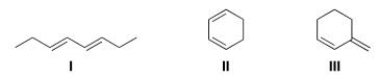
A)I< II < III
B)III < I < II
C)II < I < III
D)I < III < II
A)I< II < III
B)III < I < II
C)II < I < III
D)I < III < II

Question
Question
Rank the following compounds in order of increasing stability, putting the least stable first. 
A)I< II < III
B)III < II < I
C)II < I < III
D)III < I < II
A)I< II < III
B)III < II < I
C)II < I < III
D)III < I < II
Question
Question
Which of the following is (are) conjugated dienes?
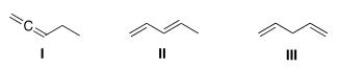
A)Only I
B)Only II
C)Only I and II
D)I, II, and III
A)Only I
B)Only II
C)Only I and II
D)I, II, and III
Question
Question
Which of the following is the least reactive diene in a Diels-Alder reaction?

A)I
B)II
C)III
D)IV
A)I
B)II
C)III
D)IV
Question
Question
What is (are) the major product(s) of the following reaction?
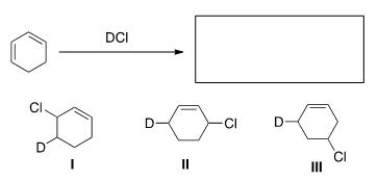
A)Only I
B)Only II
C)Only I and II
D)I, II, and III
A)Only I
B)Only II
C)Only I and II
D)I, II, and III
Question
What is (are) the major product(s) of the following reaction?
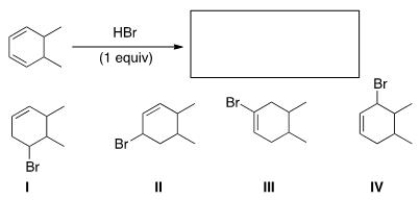
A)Only I
B)Only II and IV
C)Only I and III
D)Only I, II, and III
A)Only I
B)Only II and IV
C)Only I and III
D)Only I, II, and III
Question
Which of the following dienes contain conjugated double bonds?

A)Only I and II
B)Only II and III
C)Only I and III
D)Only II and IV
A)Only I and II
B)Only II and III
C)Only I and III
D)Only II and IV
Question
Question
What is (are) the major product(s) of the following reaction?
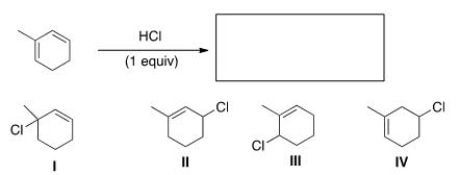
A)Only I
B)Only I and III
C)Only II and IV
D)Only I, II, and III
A)Only I
B)Only I and III
C)Only II and IV
D)Only I, II, and III
Question
Question
Question
Question
Question
Question
What is the hybridization around the indicated carbon atom in the following anion?

A)sp3
B)sp2
C)sp
D)p
A)sp3
B)sp2
C)sp
D)p
Question
Which of the following conjugated dienes represent two conformations?

A)Only I and II
B)Only I and III
C)Only II and III
D)None of the choices
A)Only I and II
B)Only I and III
C)Only II and III
D)None of the choices
Question
Rank the following dienophile in order of increasing reactivity in a Diels-Alder reaction, listing the least reactive first. 
A)I< II < III
B)III < I < II
C)II < I < III
D)III < II < I
A)I< II < III
B)III < I < II
C)II < I < III
D)III < II < I
Question
Which of the following compounds is the least reactive dienophile in a Diels-Alder reaction?

A)I
B)II
C)III
D)IV
A)I
B)II
C)III
D)IV
Question
Which of the following is the most reactive diene in a Diels-Alder reaction?

A)I
B)II
C)III
D)IV
A)I
B)II
C)III
D)IV
Question
What is the major organic product of the following reaction?
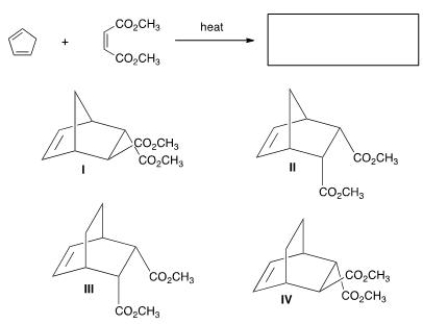
A)I
B)II
C)III
D)IV
A)I
B)II
C)III
D)IV
Question
Why would the compound below not react with a dienophile in a Diels-Alder reaction?

A)The compound is not a conjugated diene.
B)There are no electron withdrawing groups on the compound.
C)There are no electron donating groups on the compound.
D)The compound cannot adopt the s-cis conformation.
A)The compound is not a conjugated diene.
B)There are no electron withdrawing groups on the compound.
C)There are no electron donating groups on the compound.
D)The compound cannot adopt the s-cis conformation.
Question
Question
Question
Which of the following compound absorbs UV light at the longest wavelength?

A)I
B)II
C)III
D)IV
A)I
B)II
C)III
D)IV
Question
Which of the following compounds is the most reactive dienophile in a Diels-Alder reaction?

A)I
B)II
C)III
D)IV
A)I
B)II
C)III
D)IV
Question
Which of the following is an example of a bridged bicyclic system?
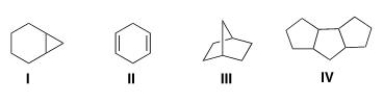
A)I
B)II
C)III
D)IV
A)I
B)II
C)III
D)IV
Question
What is the major organic product of the following reaction?
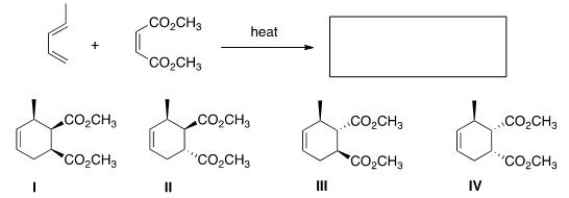
A)I
B)II
C)III
D)IV
A)I
B)II
C)III
D)IV
Question
What is the major organic product of the following reaction?
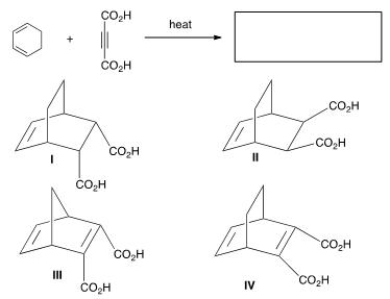
A)I
B)II
C)III
D)IV
A)I
B)II
C)III
D)IV
Question
Which of the following is the least reactive diene in a Diels-Alder reaction?

A)I
B)II
C)III
D)IV
A)I
B)II
C)III
D)IV
Question
What is the major organic product of the following reaction?
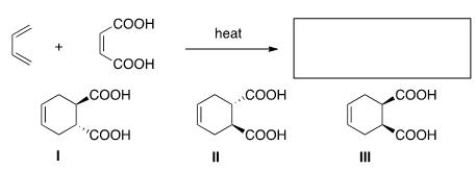
A)Only I
B)Only II
C)Only III
D)Only I and II
A)Only I
B)Only II
C)Only III
D)Only I and II
Question
Which of the following is not a resonance structure of acetic anhydride?

A)I
B)II
C)III
D)IV
A)I
B)II
C)III
D)IV
Question
Rank the following anions from most to least stable, listing the most stable first. 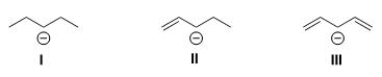
A)I> II > III
B)III > II > I
C)I > III > II
D)III > I > II
A)I> II > III
B)III > II > I
C)I > III > II
D)III > I > II
Question
What diene and dienophile are used in a Diels-Alder reaction to prepare the following compound?
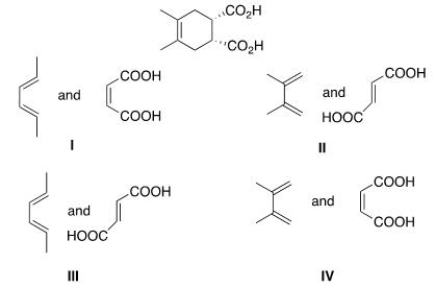
A)I
B)II
C)III
D)IV
A)I
B)II
C)III
D)IV
Question
What is the major organic product of the following reaction?
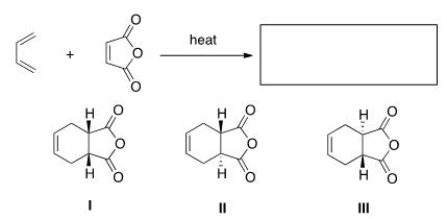
A)Only I
B)Only I and II
C)Only II and III
D)I, II, and III
A)Only I
B)Only I and II
C)Only II and III
D)I, II, and III
Question
What is the major organic product of the following reaction?
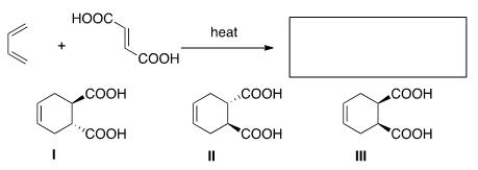
A)Only I
B)Only II
C)Only III
D)Only I and II
A)Only I
B)Only II
C)Only III
D)Only I and II
Question
Which of the following compound absorbs UV light at the longest wavelength?

A)I
B)II
C)III
D)IV
A)I
B)II
C)III
D)IV
Question
Which triene absorbs the longest wavelength of UV light?

A)I
B)II
C)III
D)IV
A)I
B)II
C)III
D)IV
Question
Which triene has the smallest heat of hydrogenation?

A)I
B)II
C)III
D)IV
A)I
B)II
C)III
D)IV
Question
Which triene has the largest heat of hydrogenation?

A)I
B)II
C)III
D)IV
A)I
B)II
C)III
D)IV

Unlock Deck
Sign up to unlock the cards in this deck!
Unlock Deck
Unlock Deck
1/43

Play

Full screen (f)
Deck 16: Conjugation, Resonance, and Dienes
1
Rank the following dienes in order of increasing reactivity in a Diels-Alder reaction, listing the least reactive first.
A)I< II < III
B)III < I < II
C)II < I < III
D)I < III < II
A)I< II < III
B)III < I < II
C)II < I < III
D)I < III < II
III < I < II
2
Which of the following statements about resonance structures is true?
A)The placement of atoms is different.
B)The placement of p bonds is different.
C)The placement of s bonds is different.
D)The placement of nonbonded electrons is the same.
A)The placement of atoms is different.
B)The placement of p bonds is different.
C)The placement of s bonds is different.
D)The placement of nonbonded electrons is the same.
The placement of p bonds is different.
3
Rank the following compounds in order of increasing stability, putting the least stable first.
A)I< II < III
B)III < II < I
C)II < I < III
D)III < I < II
A)I< II < III
B)III < II < I
C)II < I < III
D)III < I < II
I< II < III
4
Which of the following statements about the Diels-Alder reaction is true?
A)The diene can react only when it adopts the s-trans conformation.
B)Electron-withdrawing substituents in the diene increase reaction rate.
C)Electron-donating substituents in the dienophile increase the reaction rate.
D)The stereochemistry of the dienophile is retained in the product.
A)The diene can react only when it adopts the s-trans conformation.
B)Electron-withdrawing substituents in the diene increase reaction rate.
C)Electron-donating substituents in the dienophile increase the reaction rate.
D)The stereochemistry of the dienophile is retained in the product.
Unlock Deck
Unlock for access to all 43 flashcards in this deck.
Unlock Deck
k this deck
5
Which of the following is (are) conjugated dienes?
A)Only I
B)Only II
C)Only I and II
D)I, II, and III
A)Only I
B)Only II
C)Only I and II
D)I, II, and III
Unlock Deck
Unlock for access to all 43 flashcards in this deck.
Unlock Deck
k this deck
6
Which of the following statements about the mechanism of the Diels-Alder reaction is true?
A)Three π bonds break; two σ bonds and one π bond form.
B)Three π bonds break; one σ bond and two π bonds form.
C)Two π bonds break; one σ bond and one π bond form.
D)Two π bonds break; two σ bonds and one π bond form.
A)Three π bonds break; two σ bonds and one π bond form.
B)Three π bonds break; one σ bond and two π bonds form.
C)Two π bonds break; one σ bond and one π bond form.
D)Two π bonds break; two σ bonds and one π bond form.
Unlock Deck
Unlock for access to all 43 flashcards in this deck.
Unlock Deck
k this deck
7
Which of the following is the least reactive diene in a Diels-Alder reaction?
A)I
B)II
C)III
D)IV
A)I
B)II
C)III
D)IV
Unlock Deck
Unlock for access to all 43 flashcards in this deck.
Unlock Deck
k this deck
8
What is the thermodynamic product obtained from the addition of 1 equivalent of HBr to 1,3-butadiene?
A)3-Bromo-1-butene
B)1-Bromo-2-butene
C)2-Bromo-2-butene
D)2-Bromo-1-butene
A)3-Bromo-1-butene
B)1-Bromo-2-butene
C)2-Bromo-2-butene
D)2-Bromo-1-butene
Unlock Deck
Unlock for access to all 43 flashcards in this deck.
Unlock Deck
k this deck
9
What is (are) the major product(s) of the following reaction?
A)Only I
B)Only II
C)Only I and II
D)I, II, and III
A)Only I
B)Only II
C)Only I and II
D)I, II, and III
Unlock Deck
Unlock for access to all 43 flashcards in this deck.
Unlock Deck
k this deck
10
What is (are) the major product(s) of the following reaction?
A)Only I
B)Only II and IV
C)Only I and III
D)Only I, II, and III
A)Only I
B)Only II and IV
C)Only I and III
D)Only I, II, and III
Unlock Deck
Unlock for access to all 43 flashcards in this deck.
Unlock Deck
k this deck
11
Which of the following dienes contain conjugated double bonds?
A)Only I and II
B)Only II and III
C)Only I and III
D)Only II and IV
A)Only I and II
B)Only II and III
C)Only I and III
D)Only II and IV
Unlock Deck
Unlock for access to all 43 flashcards in this deck.
Unlock Deck
k this deck
12
Which of the following is not a product obtained from the addition of 1 equivalent of HBr to (E)-1,3-pentadiene?
A)(E)-4-Bromo-2-pentene
B)(E)-1-Bromo-2-pentene
C)3-Bromo-1-pentene
D)(E)-3-Bromo-2-pentene
A)(E)-4-Bromo-2-pentene
B)(E)-1-Bromo-2-pentene
C)3-Bromo-1-pentene
D)(E)-3-Bromo-2-pentene
Unlock Deck
Unlock for access to all 43 flashcards in this deck.
Unlock Deck
k this deck
13
What is (are) the major product(s) of the following reaction?
A)Only I
B)Only I and III
C)Only II and IV
D)Only I, II, and III
A)Only I
B)Only I and III
C)Only II and IV
D)Only I, II, and III
Unlock Deck
Unlock for access to all 43 flashcards in this deck.
Unlock Deck
k this deck
14
Which of the following is not a feature of the Diels-Alder reaction?
A)They are initiated by peroxides.
B)They form new six-membered rings.
C)Three π bonds break.
D)They are concerted.
A)They are initiated by peroxides.
B)They form new six-membered rings.
C)Three π bonds break.
D)They are concerted.
Unlock Deck
Unlock for access to all 43 flashcards in this deck.
Unlock Deck
k this deck
15
What is the kinetic product obtained from the addition of 1 equivalent of HBr to 1,3-butadiene?
A)3-Bromo-1-butene
B)1-Bromo-2-butene
C)2-Bromo-2-butene
D)2-Bromo-1-butene
A)3-Bromo-1-butene
B)1-Bromo-2-butene
C)2-Bromo-2-butene
D)2-Bromo-1-butene
Unlock Deck
Unlock for access to all 43 flashcards in this deck.
Unlock Deck
k this deck
16
Which of the following is the appropriate term for the mechanism of the addition of HBr to 1,3-dienes?
A)Nucleophilic addition
B)Electrophilic addition
C)Free radical addition
D)Conjugate addition
A)Nucleophilic addition
B)Electrophilic addition
C)Free radical addition
D)Conjugate addition
Unlock Deck
Unlock for access to all 43 flashcards in this deck.
Unlock Deck
k this deck
17
Which of the following statements about kinetic vs.thermodynamic products is true?
A)The product that is formed faster is the thermodynamic product.
B)The kinetic product predominates at low temperature.
C)The product that predominates at equilibrium is the kinetic product.
D)The thermodynamic product is less stable.
A)The product that is formed faster is the thermodynamic product.
B)The kinetic product predominates at low temperature.
C)The product that predominates at equilibrium is the kinetic product.
D)The thermodynamic product is less stable.
Unlock Deck
Unlock for access to all 43 flashcards in this deck.
Unlock Deck
k this deck
18
What is the reactive intermediate in the reaction of 1,3-diene with HBr, resulting in 1,4-addition?
A)Allylic radical
B)Cyclic bromonium
C)Dienophile
D)Allylic carbocation
A)Allylic radical
B)Cyclic bromonium
C)Dienophile
D)Allylic carbocation
Unlock Deck
Unlock for access to all 43 flashcards in this deck.
Unlock Deck
k this deck
19
What is the hybridization around the indicated carbon atom in the following anion?
A)sp3
B)sp2
C)sp
D)p
A)sp3
B)sp2
C)sp
D)p
Unlock Deck
Unlock for access to all 43 flashcards in this deck.
Unlock Deck
k this deck
20
Which of the following conjugated dienes represent two conformations?
A)Only I and II
B)Only I and III
C)Only II and III
D)None of the choices
A)Only I and II
B)Only I and III
C)Only II and III
D)None of the choices
Unlock Deck
Unlock for access to all 43 flashcards in this deck.
Unlock Deck
k this deck
21
Rank the following dienophile in order of increasing reactivity in a Diels-Alder reaction, listing the least reactive first.
A)I< II < III
B)III < I < II
C)II < I < III
D)III < II < I
A)I< II < III
B)III < I < II
C)II < I < III
D)III < II < I
Unlock Deck
Unlock for access to all 43 flashcards in this deck.
Unlock Deck
k this deck
22
Which of the following compounds is the least reactive dienophile in a Diels-Alder reaction?
A)I
B)II
C)III
D)IV
A)I
B)II
C)III
D)IV
Unlock Deck
Unlock for access to all 43 flashcards in this deck.
Unlock Deck
k this deck
23
Which of the following is the most reactive diene in a Diels-Alder reaction?
A)I
B)II
C)III
D)IV
A)I
B)II
C)III
D)IV
Unlock Deck
Unlock for access to all 43 flashcards in this deck.
Unlock Deck
k this deck
24
What is the major organic product of the following reaction?
A)I
B)II
C)III
D)IV
A)I
B)II
C)III
D)IV
Unlock Deck
Unlock for access to all 43 flashcards in this deck.
Unlock Deck
k this deck
25
Why would the compound below not react with a dienophile in a Diels-Alder reaction?
A)The compound is not a conjugated diene.
B)There are no electron withdrawing groups on the compound.
C)There are no electron donating groups on the compound.
D)The compound cannot adopt the s-cis conformation.
A)The compound is not a conjugated diene.
B)There are no electron withdrawing groups on the compound.
C)There are no electron donating groups on the compound.
D)The compound cannot adopt the s-cis conformation.
Unlock Deck
Unlock for access to all 43 flashcards in this deck.
Unlock Deck
k this deck
26
Which of the following electronic transitions is common in the UV spectrum of 1,3-butadiene?
A)sp
B)sp*
C)n p*
D)pp*
A)sp
B)sp*
C)n p*
D)pp*
Unlock Deck
Unlock for access to all 43 flashcards in this deck.
Unlock Deck
k this deck
27
What is the definition of a resonance structure?
A)Compounds with the same molecular formula.
B)Compounds with different carbon frameworks.
C)Structures that differ only in the placement of π and nonbonding electrons.
D)Structures that differ only in the location of bonds.
A)Compounds with the same molecular formula.
B)Compounds with different carbon frameworks.
C)Structures that differ only in the placement of π and nonbonding electrons.
D)Structures that differ only in the location of bonds.
Unlock Deck
Unlock for access to all 43 flashcards in this deck.
Unlock Deck
k this deck
28
Which of the following compound absorbs UV light at the longest wavelength?
A)I
B)II
C)III
D)IV
A)I
B)II
C)III
D)IV
Unlock Deck
Unlock for access to all 43 flashcards in this deck.
Unlock Deck
k this deck
29
Which of the following compounds is the most reactive dienophile in a Diels-Alder reaction?
A)I
B)II
C)III
D)IV
A)I
B)II
C)III
D)IV
Unlock Deck
Unlock for access to all 43 flashcards in this deck.
Unlock Deck
k this deck
30
Which of the following is an example of a bridged bicyclic system?
A)I
B)II
C)III
D)IV
A)I
B)II
C)III
D)IV
Unlock Deck
Unlock for access to all 43 flashcards in this deck.
Unlock Deck
k this deck
31
What is the major organic product of the following reaction?
A)I
B)II
C)III
D)IV
A)I
B)II
C)III
D)IV
Unlock Deck
Unlock for access to all 43 flashcards in this deck.
Unlock Deck
k this deck
32
What is the major organic product of the following reaction?
A)I
B)II
C)III
D)IV
A)I
B)II
C)III
D)IV
Unlock Deck
Unlock for access to all 43 flashcards in this deck.
Unlock Deck
k this deck
33
Which of the following is the least reactive diene in a Diels-Alder reaction?
A)I
B)II
C)III
D)IV
A)I
B)II
C)III
D)IV
Unlock Deck
Unlock for access to all 43 flashcards in this deck.
Unlock Deck
k this deck
34
What is the major organic product of the following reaction?
A)Only I
B)Only II
C)Only III
D)Only I and II
A)Only I
B)Only II
C)Only III
D)Only I and II
Unlock Deck
Unlock for access to all 43 flashcards in this deck.
Unlock Deck
k this deck
35
Which of the following is not a resonance structure of acetic anhydride?
A)I
B)II
C)III
D)IV
A)I
B)II
C)III
D)IV
Unlock Deck
Unlock for access to all 43 flashcards in this deck.
Unlock Deck
k this deck
36
Rank the following anions from most to least stable, listing the most stable first.
A)I> II > III
B)III > II > I
C)I > III > II
D)III > I > II
A)I> II > III
B)III > II > I
C)I > III > II
D)III > I > II
Unlock Deck
Unlock for access to all 43 flashcards in this deck.
Unlock Deck
k this deck
37
What diene and dienophile are used in a Diels-Alder reaction to prepare the following compound?
A)I
B)II
C)III
D)IV
A)I
B)II
C)III
D)IV
Unlock Deck
Unlock for access to all 43 flashcards in this deck.
Unlock Deck
k this deck
38
What is the major organic product of the following reaction?
A)Only I
B)Only I and II
C)Only II and III
D)I, II, and III
A)Only I
B)Only I and II
C)Only II and III
D)I, II, and III
Unlock Deck
Unlock for access to all 43 flashcards in this deck.
Unlock Deck
k this deck
39
What is the major organic product of the following reaction?
A)Only I
B)Only II
C)Only III
D)Only I and II
A)Only I
B)Only II
C)Only III
D)Only I and II
Unlock Deck
Unlock for access to all 43 flashcards in this deck.
Unlock Deck
k this deck
40
Which of the following compound absorbs UV light at the longest wavelength?
A)I
B)II
C)III
D)IV
A)I
B)II
C)III
D)IV
Unlock Deck
Unlock for access to all 43 flashcards in this deck.
Unlock Deck
k this deck
41
Which triene absorbs the longest wavelength of UV light?
A)I
B)II
C)III
D)IV
A)I
B)II
C)III
D)IV
Unlock Deck
Unlock for access to all 43 flashcards in this deck.
Unlock Deck
k this deck
42
Which triene has the smallest heat of hydrogenation?
A)I
B)II
C)III
D)IV
A)I
B)II
C)III
D)IV
Unlock Deck
Unlock for access to all 43 flashcards in this deck.
Unlock Deck
k this deck
43
Which triene has the largest heat of hydrogenation?
A)I
B)II
C)III
D)IV
A)I
B)II
C)III
D)IV
Unlock Deck
Unlock for access to all 43 flashcards in this deck.
Unlock Deck
k this deck
Unlock Deck
Unlock for access to all 43 flashcards in this deck.






