







 Chat with AI

Deck 28: How the Animal Body Defends Itself
Full screen (f)

Question
Is Immunity Antigen-Specific?
The immune response provides a valuable protection against infection because it can remember prior experiences. We develop lifelong immunity to many infectious diseases after one childhood exposure. This long-term immunity is why vaccines work. A key question about immune protection is whether or not it is specific. Does exposure to one pathogen confer immunity to only that one, or is the immunity you acquire a more general response, protecting you from a range of infections?
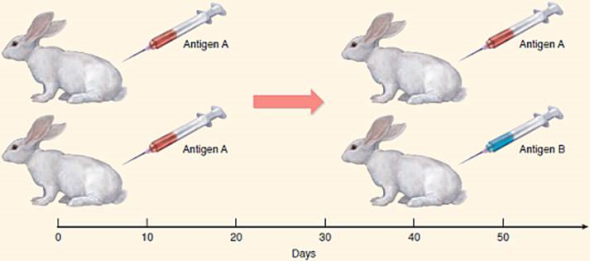
The graph to the right displays the results of an experiment designed to answer this question. A colony of rabbits is immunized once with antigen A, and the level of antibody directed against this antigen monitored in each individual. After 40 days, each rabbit is reinjected, some with antigen A and others with antigen B, and the level of antibody directed against the reinjected antigens is monitored. The red line is typical of results for antigen A, the blue line for antigen B.
Applying Concepts
Reading a Continuous Curve. Does each injection of antigen A result in detectable antibody production? Antigen B?
The immune response provides a valuable protection against infection because it can remember prior experiences. We develop lifelong immunity to many infectious diseases after one childhood exposure. This long-term immunity is why vaccines work. A key question about immune protection is whether or not it is specific. Does exposure to one pathogen confer immunity to only that one, or is the immunity you acquire a more general response, protecting you from a range of infections?
The graph to the right displays the results of an experiment designed to answer this question. A colony of rabbits is immunized once with antigen A, and the level of antibody directed against this antigen monitored in each individual. After 40 days, each rabbit is reinjected, some with antigen A and others with antigen B, and the level of antibody directed against the reinjected antigens is monitored. The red line is typical of results for antigen A, the blue line for antigen B.
Applying Concepts
Reading a Continuous Curve. Does each injection of antigen A result in detectable antibody production? Antigen B?

Question
Is Immunity Antigen-Specific?
The immune response provides a valuable protection against infection because it can remember prior experiences. We develop lifelong immunity to many infectious diseases after one childhood exposure. This long-term immunity is why vaccines work. A key question about immune protection is whether or not it is specific. Does exposure to one pathogen confer immunity to only that one, or is the immunity you acquire a more general response, protecting you from a range of infections?
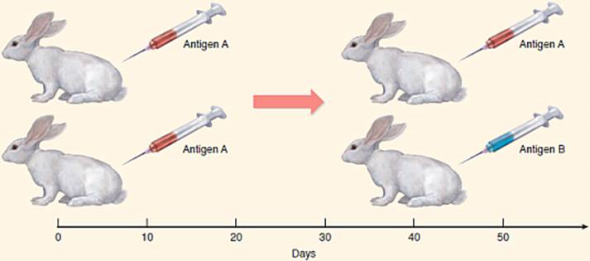
The graph to the right displays the results of an experiment designed to answer this question. A colony of rabbits is immunized once with antigen A, and the level of antibody directed against this antigen monitored in each individual. After 40 days, each rabbit is reinjected, some with antigen A and others with antigen B, and the level of antibody directed against the reinjected antigens is monitored. The red line is typical of results for antigen A, the blue line for antigen B.
Interpreting Data
a. The initial response to antigen A is called the "primary" response, and the second response to antigen A administered 40 days later is called the "secondary" response. Compare the speed of the primary and secondary responses. Which reaches maximal antibody response quicker?
b. Compare the magnitude of the primary and secondary immune responses to antigen A. Are they similar, or is one response of greater magnitude?
The immune response provides a valuable protection against infection because it can remember prior experiences. We develop lifelong immunity to many infectious diseases after one childhood exposure. This long-term immunity is why vaccines work. A key question about immune protection is whether or not it is specific. Does exposure to one pathogen confer immunity to only that one, or is the immunity you acquire a more general response, protecting you from a range of infections?
The graph to the right displays the results of an experiment designed to answer this question. A colony of rabbits is immunized once with antigen A, and the level of antibody directed against this antigen monitored in each individual. After 40 days, each rabbit is reinjected, some with antigen A and others with antigen B, and the level of antibody directed against the reinjected antigens is monitored. The red line is typical of results for antigen A, the blue line for antigen B.
Interpreting Data
a. The initial response to antigen A is called the "primary" response, and the second response to antigen A administered 40 days later is called the "secondary" response. Compare the speed of the primary and secondary responses. Which reaches maximal antibody response quicker?
b. Compare the magnitude of the primary and secondary immune responses to antigen A. Are they similar, or is one response of greater magnitude?
Question
Is Immunity Antigen-Specific?
The immune response provides a valuable protection against infection because it can remember prior experiences. We develop lifelong immunity to many infectious diseases after one childhood exposure. This long-term immunity is why vaccines work. A key question about immune protection is whether or not it is specific. Does exposure to one pathogen confer immunity to only that one, or is the immunity you acquire a more general response, protecting you from a range of infections?
The graph to the right displays the results of an experiment designed to answer this question. A colony of rabbits is immunized once with antigen A, and the level of antibody directed against this antigen monitored in each individual. After 40 days, each rabbit is reinjected, some with antigen A and others with antigen B, and the level of antibody directed against the reinjected antigens is monitored. The red line is typical of results for antigen A, the blue line for antigen B.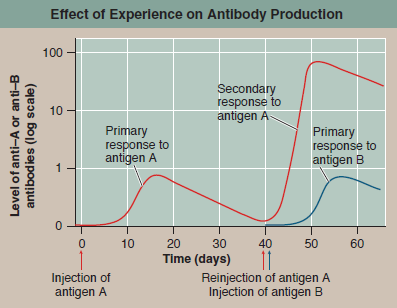

Making Inferences
a. Why is the secondary response induced by a second exposure to antigen A different from the primary response?
b. Is the response to antigen B more similar to the primary or secondary response of antigen A?
The immune response provides a valuable protection against infection because it can remember prior experiences. We develop lifelong immunity to many infectious diseases after one childhood exposure. This long-term immunity is why vaccines work. A key question about immune protection is whether or not it is specific. Does exposure to one pathogen confer immunity to only that one, or is the immunity you acquire a more general response, protecting you from a range of infections?
The graph to the right displays the results of an experiment designed to answer this question. A colony of rabbits is immunized once with antigen A, and the level of antibody directed against this antigen monitored in each individual. After 40 days, each rabbit is reinjected, some with antigen A and others with antigen B, and the level of antibody directed against the reinjected antigens is monitored. The red line is typical of results for antigen A, the blue line for antigen B.
Making Inferences
a. Why is the secondary response induced by a second exposure to antigen A different from the primary response?
b. Is the response to antigen B more similar to the primary or secondary response of antigen A?
Question
Is Immunity Antigen-Specific?
The immune response provides a valuable protection against infection because it can remember prior experiences. We develop lifelong immunity to many infectious diseases after one childhood exposure. This long-term immunity is why vaccines work. A key question about immune protection is whether or not it is specific. Does exposure to one pathogen confer immunity to only that one, or is the immunity you acquire a more general response, protecting you from a range of infections?
The graph to the right displays the results of an experiment designed to answer this question. A colony of rabbits is immunized once with antigen A, and the level of antibody directed against this antigen monitored in each individual. After 40 days, each rabbit is reinjected, some with antigen A and others with antigen B, and the level of antibody directed against the reinjected antigens is monitored. The red line is typical of results for antigen A, the blue line for antigen B.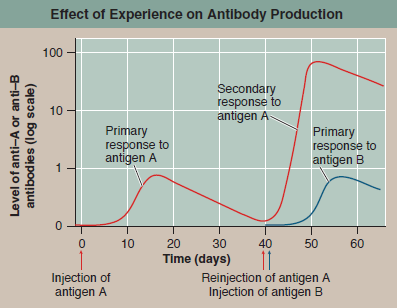
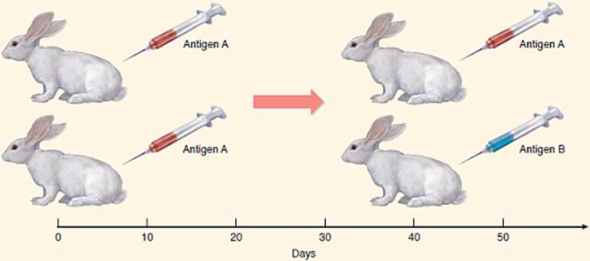
Drawing Conclusions
a. Does the prior exposure to antigen A have any impact on the speed or magnitude of the primary response to antigen B?
b. Is the immune response to these antigens antigen-specific?
The immune response provides a valuable protection against infection because it can remember prior experiences. We develop lifelong immunity to many infectious diseases after one childhood exposure. This long-term immunity is why vaccines work. A key question about immune protection is whether or not it is specific. Does exposure to one pathogen confer immunity to only that one, or is the immunity you acquire a more general response, protecting you from a range of infections?
The graph to the right displays the results of an experiment designed to answer this question. A colony of rabbits is immunized once with antigen A, and the level of antibody directed against this antigen monitored in each individual. After 40 days, each rabbit is reinjected, some with antigen A and others with antigen B, and the level of antibody directed against the reinjected antigens is monitored. The red line is typical of results for antigen A, the blue line for antigen B.
Drawing Conclusions
a. Does the prior exposure to antigen A have any impact on the speed or magnitude of the primary response to antigen B?
b. Is the immune response to these antigens antigen-specific?

Unlock Deck
Sign up to unlock the cards in this deck!
Unlock Deck
Unlock Deck
1/4

Play

Full screen (f)
Deck 28: How the Animal Body Defends Itself
1
Is Immunity Antigen-Specific?
The immune response provides a valuable protection against infection because it can remember prior experiences. We develop lifelong immunity to many infectious diseases after one childhood exposure. This long-term immunity is why vaccines work. A key question about immune protection is whether or not it is specific. Does exposure to one pathogen confer immunity to only that one, or is the immunity you acquire a more general response, protecting you from a range of infections?
The graph to the right displays the results of an experiment designed to answer this question. A colony of rabbits is immunized once with antigen A, and the level of antibody directed against this antigen monitored in each individual. After 40 days, each rabbit is reinjected, some with antigen A and others with antigen B, and the level of antibody directed against the reinjected antigens is monitored. The red line is typical of results for antigen A, the blue line for antigen B.
Applying Concepts
Reading a Continuous Curve. Does each injection of antigen A result in detectable antibody production? Antigen B?
The immune response provides a valuable protection against infection because it can remember prior experiences. We develop lifelong immunity to many infectious diseases after one childhood exposure. This long-term immunity is why vaccines work. A key question about immune protection is whether or not it is specific. Does exposure to one pathogen confer immunity to only that one, or is the immunity you acquire a more general response, protecting you from a range of infections?
The graph to the right displays the results of an experiment designed to answer this question. A colony of rabbits is immunized once with antigen A, and the level of antibody directed against this antigen monitored in each individual. After 40 days, each rabbit is reinjected, some with antigen A and others with antigen B, and the level of antibody directed against the reinjected antigens is monitored. The red line is typical of results for antigen A, the blue line for antigen B.
Applying Concepts
Reading a Continuous Curve. Does each injection of antigen A result in detectable antibody production? Antigen B?
During the first injection both antigen A and antigen B elicit a similar antibody production in the host. A considerable quantum of antibody is produced during the first injection.
Upon reintroduction of antigen A in the host, the antibody production increases manifolds mainly due to the presence and action of the memory T and B cells.
Since antigen B is introduced for the first time, the level of antibody stimulation by it would be far less when compared with the production antibodies that are produced with antigen A is reintroduced.
Upon reintroduction of antigen A in the host, the antibody production increases manifolds mainly due to the presence and action of the memory T and B cells.
Since antigen B is introduced for the first time, the level of antibody stimulation by it would be far less when compared with the production antibodies that are produced with antigen A is reintroduced.
2
Is Immunity Antigen-Specific?
The immune response provides a valuable protection against infection because it can remember prior experiences. We develop lifelong immunity to many infectious diseases after one childhood exposure. This long-term immunity is why vaccines work. A key question about immune protection is whether or not it is specific. Does exposure to one pathogen confer immunity to only that one, or is the immunity you acquire a more general response, protecting you from a range of infections?
The graph to the right displays the results of an experiment designed to answer this question. A colony of rabbits is immunized once with antigen A, and the level of antibody directed against this antigen monitored in each individual. After 40 days, each rabbit is reinjected, some with antigen A and others with antigen B, and the level of antibody directed against the reinjected antigens is monitored. The red line is typical of results for antigen A, the blue line for antigen B.
Interpreting Data
a. The initial response to antigen A is called the "primary" response, and the second response to antigen A administered 40 days later is called the "secondary" response. Compare the speed of the primary and secondary responses. Which reaches maximal antibody response quicker?
b. Compare the magnitude of the primary and secondary immune responses to antigen A. Are they similar, or is one response of greater magnitude?
The immune response provides a valuable protection against infection because it can remember prior experiences. We develop lifelong immunity to many infectious diseases after one childhood exposure. This long-term immunity is why vaccines work. A key question about immune protection is whether or not it is specific. Does exposure to one pathogen confer immunity to only that one, or is the immunity you acquire a more general response, protecting you from a range of infections?
The graph to the right displays the results of an experiment designed to answer this question. A colony of rabbits is immunized once with antigen A, and the level of antibody directed against this antigen monitored in each individual. After 40 days, each rabbit is reinjected, some with antigen A and others with antigen B, and the level of antibody directed against the reinjected antigens is monitored. The red line is typical of results for antigen A, the blue line for antigen B.
Interpreting Data
a. The initial response to antigen A is called the "primary" response, and the second response to antigen A administered 40 days later is called the "secondary" response. Compare the speed of the primary and secondary responses. Which reaches maximal antibody response quicker?
b. Compare the magnitude of the primary and secondary immune responses to antigen A. Are they similar, or is one response of greater magnitude?
The initial response takes time as the antigen should be identified by the receptors of the B cells. It is only by chance that the surface receptors present on the immune cells would identify the antigenic status on the pathogens or antigens. This process is called clonal selection.
Since it is only on probability that the specific B cells are activated that produces specific antibodies, the time taken for the primary immune response is higher. The primary immune response removes the pathogens and also creates memory cells that would be useful in future encounters with the same pathogen.
On the other hand, when the antigen is exposed to the host during the second encounter the memory cells aids in an immediate release of antibodies targeted against the specific antigen. This shows that it is only during the second exposure that the antibody production would be higher.
The magnitude of the secondary immune response is higher on compared to the primary response. This is because of the presence of memory cells, which gets triggered upon exposure to a second time. This aids the memory cells to differentiate to plasma cells that would secrete antibodies. This is the reason for an enhancement of antibody production during the secondary immune response.
Since it is only on probability that the specific B cells are activated that produces specific antibodies, the time taken for the primary immune response is higher. The primary immune response removes the pathogens and also creates memory cells that would be useful in future encounters with the same pathogen.
On the other hand, when the antigen is exposed to the host during the second encounter the memory cells aids in an immediate release of antibodies targeted against the specific antigen. This shows that it is only during the second exposure that the antibody production would be higher.
The magnitude of the secondary immune response is higher on compared to the primary response. This is because of the presence of memory cells, which gets triggered upon exposure to a second time. This aids the memory cells to differentiate to plasma cells that would secrete antibodies. This is the reason for an enhancement of antibody production during the secondary immune response.
3
Is Immunity Antigen-Specific?
The immune response provides a valuable protection against infection because it can remember prior experiences. We develop lifelong immunity to many infectious diseases after one childhood exposure. This long-term immunity is why vaccines work. A key question about immune protection is whether or not it is specific. Does exposure to one pathogen confer immunity to only that one, or is the immunity you acquire a more general response, protecting you from a range of infections?
The graph to the right displays the results of an experiment designed to answer this question. A colony of rabbits is immunized once with antigen A, and the level of antibody directed against this antigen monitored in each individual. After 40 days, each rabbit is reinjected, some with antigen A and others with antigen B, and the level of antibody directed against the reinjected antigens is monitored. The red line is typical of results for antigen A, the blue line for antigen B.
Making Inferences
a. Why is the secondary response induced by a second exposure to antigen A different from the primary response?
b. Is the response to antigen B more similar to the primary or secondary response of antigen A?
The immune response provides a valuable protection against infection because it can remember prior experiences. We develop lifelong immunity to many infectious diseases after one childhood exposure. This long-term immunity is why vaccines work. A key question about immune protection is whether or not it is specific. Does exposure to one pathogen confer immunity to only that one, or is the immunity you acquire a more general response, protecting you from a range of infections?
The graph to the right displays the results of an experiment designed to answer this question. A colony of rabbits is immunized once with antigen A, and the level of antibody directed against this antigen monitored in each individual. After 40 days, each rabbit is reinjected, some with antigen A and others with antigen B, and the level of antibody directed against the reinjected antigens is monitored. The red line is typical of results for antigen A, the blue line for antigen B.
Making Inferences
a. Why is the secondary response induced by a second exposure to antigen A different from the primary response?
b. Is the response to antigen B more similar to the primary or secondary response of antigen A?
The initial response takes time as the antigen should be identified by the receptors of the B cells. It is only by chance that the surface receptors present on the immune cells would identify the antigenic status on the pathogens or antigens. This process is called clonal selection. Since it is only on probability that the specific B cells are activated that produces specific antibodies, the time taken for the primary immune response is higher.
The secondary response on the other hand is induced by the differentiation of the memory cells to plasma cells, which secreted antibodies. The presence of memory cells before first encountering the antigen and during its subsequent encounters forms the major difference in eliciting an immune response.
The response of antibody production to antigen B is more related to the antibody stimulation of the primary response for antigen A. It is only because of the clonal selection process that time taken for the synthesis of antibodies are higher during the primary response on compared to the production of antibodies during the secondary response.
The secondary response on the other hand is induced by the differentiation of the memory cells to plasma cells, which secreted antibodies. The presence of memory cells before first encountering the antigen and during its subsequent encounters forms the major difference in eliciting an immune response.
The response of antibody production to antigen B is more related to the antibody stimulation of the primary response for antigen A. It is only because of the clonal selection process that time taken for the synthesis of antibodies are higher during the primary response on compared to the production of antibodies during the secondary response.
4
Is Immunity Antigen-Specific?
The immune response provides a valuable protection against infection because it can remember prior experiences. We develop lifelong immunity to many infectious diseases after one childhood exposure. This long-term immunity is why vaccines work. A key question about immune protection is whether or not it is specific. Does exposure to one pathogen confer immunity to only that one, or is the immunity you acquire a more general response, protecting you from a range of infections?
The graph to the right displays the results of an experiment designed to answer this question. A colony of rabbits is immunized once with antigen A, and the level of antibody directed against this antigen monitored in each individual. After 40 days, each rabbit is reinjected, some with antigen A and others with antigen B, and the level of antibody directed against the reinjected antigens is monitored. The red line is typical of results for antigen A, the blue line for antigen B.
Drawing Conclusions
a. Does the prior exposure to antigen A have any impact on the speed or magnitude of the primary response to antigen B?
b. Is the immune response to these antigens antigen-specific?
The immune response provides a valuable protection against infection because it can remember prior experiences. We develop lifelong immunity to many infectious diseases after one childhood exposure. This long-term immunity is why vaccines work. A key question about immune protection is whether or not it is specific. Does exposure to one pathogen confer immunity to only that one, or is the immunity you acquire a more general response, protecting you from a range of infections?
The graph to the right displays the results of an experiment designed to answer this question. A colony of rabbits is immunized once with antigen A, and the level of antibody directed against this antigen monitored in each individual. After 40 days, each rabbit is reinjected, some with antigen A and others with antigen B, and the level of antibody directed against the reinjected antigens is monitored. The red line is typical of results for antigen A, the blue line for antigen B.
Drawing Conclusions
a. Does the prior exposure to antigen A have any impact on the speed or magnitude of the primary response to antigen B?
b. Is the immune response to these antigens antigen-specific?
Unlock Deck
Unlock for access to all 4 flashcards in this deck.
Unlock Deck
k this deck
Unlock Deck
Unlock for access to all 4 flashcards in this deck.






