







 Chat with AI

Deck 21: Quality Improvement and Patient Safety
Full screen (f)

Question

Question
Question
Question
Question
Question
Question
Question
Question
Question
Question
Question
Question
Question
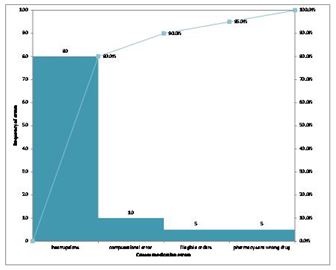
A hospital is concerned that the number of medication errors has increased significantly in the past year. A project revealed four causes of medication errors. The above chart was used to help staff and administration know where to focus efforts to reduce errors. Which process improvement tool is used in this situation?
A)Run chart
B)Pareto chart
C)Flowcharts
D)Cause and effect diagrams
Question
A nurse is asked to "float" to a telemetry floor and is to place a patient on telemetry monitor. The nurse is unfamiliar with placement of EKG leads and would consult which type of chart to learn the correct placement?
A)
B)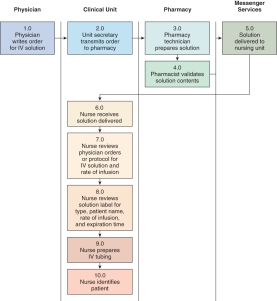
C)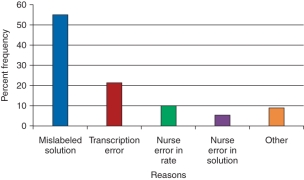
D)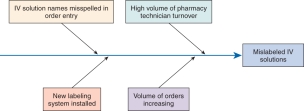
A)
B)
C)
D)
Question
Question
Question
Question
Question
Question
Question

Unlock Deck
Sign up to unlock the cards in this deck!
Unlock Deck
Unlock Deck
1/22

Play

Full screen (f)
Deck 21: Quality Improvement and Patient Safety
1
Regardless of the term used to describe high-quality health care, the focus of quality is:
A) what the consumer needs and wants.
B) economical care.
C) having the greatest technologic advancement.
D) services equally distributed among populations.
A) what the consumer needs and wants.
B) economical care.
C) having the greatest technologic advancement.
D) services equally distributed among populations.
what the consumer needs and wants.
2
A nurse is removing a saturated dressing from an abdominal incision and must cut the tape to remove the dressing. The nurse accidentally cuts the sutures holding the incision, and evisceration occurs. In quality improvement, this incident is best identified as a:
A) root cause.
B) sentinel event.
C) variation in performance.
D) causal factor.
A) root cause.
B) sentinel event.
C) variation in performance.
D) causal factor.
sentinel event.
3
A group of nurses is presenting the importance of high-quality care during a systemwide meeting of medical-surgical nurses. They point out a finding of the Quality Chasm that:
A) being insured has little effect on a person's longevity and the quality of care received.
B) lobbyists for the drug companies are able to gain permission for the use of new drugs within 1 year of their discovery.
C) although a greater number of lawsuits stem from medication errors, more people actually die from human immunodeficiency virus (HIV) and acquired immunodeficiency disease syndrome (AIDS).
D) medication-related errors place a tremendous financial burden on the U.S. health care system.
A) being insured has little effect on a person's longevity and the quality of care received.
B) lobbyists for the drug companies are able to gain permission for the use of new drugs within 1 year of their discovery.
C) although a greater number of lawsuits stem from medication errors, more people actually die from human immunodeficiency virus (HIV) and acquired immunodeficiency disease syndrome (AIDS).
D) medication-related errors place a tremendous financial burden on the U.S. health care system.
medication-related errors place a tremendous financial burden on the U.S. health care system.
4
Patients with heart failure have extended lengths of stay and are often readmitted shortly after they have been discharged. To improve quality of care, a type of "road map" that included all elements of care for this disease and that standardized treatment by guiding daily care was implemented. This road map is referred to as a(n):
A) benchmark.
B) critical pathway.
C) algorithm.
D) case management.
A) benchmark.
B) critical pathway.
C) algorithm.
D) case management.
Unlock Deck
Unlock for access to all 22 flashcards in this deck.
Unlock Deck
k this deck
5
During the night, a patient fell in the bathroom and sustained a hip injury. The patient was very upset because of being unable to attend a granddaughter's wedding in 2 days. The team looked at the process and determined that the patient had been medicated with a narcotic, had urinary urgency so had not taken the time to put on shoes, failed to turn on the light because the door to the hall let in some light, and stumbled over a towel that had been placed to collect water leaks caused by construction that was in progress to replace damaged sinks. Which factor was a special cause variation?
A) Failure to take time to put on shoes due to urgency
B) Unsteady gait due to narcotic administration
C) Poor lighting that led to decreased vision
D) Improper construction that caused the leak and towel placement
A) Failure to take time to put on shoes due to urgency
B) Unsteady gait due to narcotic administration
C) Poor lighting that led to decreased vision
D) Improper construction that caused the leak and towel placement
Unlock Deck
Unlock for access to all 22 flashcards in this deck.
Unlock Deck
k this deck
6
A nurse is preparing to administer a medication by using the vastus lateralis site and is unfamiliar with the process. A step-by-step reference that shows how to complete the process is called a:
A) deployment flowchart.
B) top-down flowchart.
C) Pareto chart.
D) control plot.
A) deployment flowchart.
B) top-down flowchart.
C) Pareto chart.
D) control plot.
Unlock Deck
Unlock for access to all 22 flashcards in this deck.
Unlock Deck
k this deck
7
In differentiating between early efforts of quality assurance and present-day quality improvement efforts, which statement is correct? Quality assurance:
A) had a broad focus.
B) promoted problem-solving by all members of the health care team.
C) was preventive in nature.
D) tended to occur as a reaction to a specific problem.
A) had a broad focus.
B) promoted problem-solving by all members of the health care team.
C) was preventive in nature.
D) tended to occur as a reaction to a specific problem.
Unlock Deck
Unlock for access to all 22 flashcards in this deck.
Unlock Deck
k this deck
8
A patient with complicated diabetes is scheduled for a below the knee amputation at 7 AM. The surgical team adheres to the 2012 National Patient Safety Goals by implementing which protocols? (Select all that apply.)
A) The surgical team asks the patient to verify his/her name, type of surgery, and limb to be removed.
B) Ask each member of the surgical team to provide a copy of licensure and, if applicable, certification to patient and family.
C) The surgical team uses the chart number and name/hospital number to ensure they have the correct patient.
D) Mark the procedure site with "X" and again ask the patient to verify correct site.
E) After arrival in the operating room, perform a "time-out" for final identification of patient and operative site along with agreement of what procedure is scheduled.
A) The surgical team asks the patient to verify his/her name, type of surgery, and limb to be removed.
B) Ask each member of the surgical team to provide a copy of licensure and, if applicable, certification to patient and family.
C) The surgical team uses the chart number and name/hospital number to ensure they have the correct patient.
D) Mark the procedure site with "X" and again ask the patient to verify correct site.
E) After arrival in the operating room, perform a "time-out" for final identification of patient and operative site along with agreement of what procedure is scheduled.
Unlock Deck
Unlock for access to all 22 flashcards in this deck.
Unlock Deck
k this deck
9
A nonprofit organization that distributes to governmental agencies, the public, business, and health care professionals knowledge related to health care for the purpose of improving health is the:
A) Institute for Safe Medication Practices.
B) Institute of Medicine.
C) National Committee for Quality Assurance.
D) The Joint Commission.
A) Institute for Safe Medication Practices.
B) Institute of Medicine.
C) National Committee for Quality Assurance.
D) The Joint Commission.
Unlock Deck
Unlock for access to all 22 flashcards in this deck.
Unlock Deck
k this deck
10
According to the Quality Chasm report:
A) health care providers should be proactive rather than reactive to patient needs.
B) common needs rather than individual preferences should be the priority.
C) medical information should be confined to the primary care provider.
D) specialized providers or case managers should control health care decisions.
A) health care providers should be proactive rather than reactive to patient needs.
B) common needs rather than individual preferences should be the priority.
C) medical information should be confined to the primary care provider.
D) specialized providers or case managers should control health care decisions.
Unlock Deck
Unlock for access to all 22 flashcards in this deck.
Unlock Deck
k this deck
11
The surgical team arrives in the operating room and one member states, "Everyone stop. Let's identify the patient and operative site. Now does anyone have any questions or concerns?" This process is known as:
A) time-out.
B) a critical pathway.
C) special cause variation.
D) lean methodology.
A) time-out.
B) a critical pathway.
C) special cause variation.
D) lean methodology.
Unlock Deck
Unlock for access to all 22 flashcards in this deck.
Unlock Deck
k this deck
12
An organization's emergency preparedness task force meets to discuss how it should react in case of a terrorist attack and develops a disaster evacuation plan that details how each department will assist individuals in reaching safety. This type of diagram is referred to as a:
A) Pareto chart.
B) control chart.
C) top-down flowchart.
D) deployment chart.
A) Pareto chart.
B) control chart.
C) top-down flowchart.
D) deployment chart.
Unlock Deck
Unlock for access to all 22 flashcards in this deck.
Unlock Deck
k this deck
13
A nurse is assisting with the delivery of twins. The first infant is placed on the scale to be weighed. The physician requests an instrument stat. The nurse turns to hand the instrument to the physician, and the infant falls off the scale. When evaluating the incident, the nurse and her manager list contributory factors such as the need for two nurses when multiple births are known, and the location of the scale so far from the delivery field. These nurses are performing a(n):
A) standardization of care.
B) root cause analysis.
C) process variation.
D) analysis of a deployment flowchart.
A) standardization of care.
B) root cause analysis.
C) process variation.
D) analysis of a deployment flowchart.
Unlock Deck
Unlock for access to all 22 flashcards in this deck.
Unlock Deck
k this deck
14
A hospital is concerned that the number of medication errors has increased significantly in the past year. A project revealed four causes of medication errors. The above chart was used to help staff and administration know where to focus efforts to reduce errors. Which process improvement tool is used in this situation?
A)Run chart
B)Pareto chart
C)Flowcharts
D)Cause and effect diagrams
Unlock Deck
Unlock for access to all 22 flashcards in this deck.
Unlock Deck
k this deck
15
A nurse is asked to "float" to a telemetry floor and is to place a patient on telemetry monitor. The nurse is unfamiliar with placement of EKG leads and would consult which type of chart to learn the correct placement?
A)
B)
C)
D)
A)
B)
C)
D)
Unlock Deck
Unlock for access to all 22 flashcards in this deck.
Unlock Deck
k this deck
16
An interdisciplinary team is evaluating the hospital's care of patients admitted with a myocardial infarction (heart attack) compared to national standards. The team analyzes the hospital's clinical indicator, which would be: (Select all that apply.)
A) aspirin order within 24 hours of discharge.
B) patient teaching related to stopping smoking completed prior to discharge.
C) beta blocker administered upon arrival.
D) support of employer to modify stress in workplace.
E) patient's willingness to adhere to a strict cardiac diet after discharge.
A) aspirin order within 24 hours of discharge.
B) patient teaching related to stopping smoking completed prior to discharge.
C) beta blocker administered upon arrival.
D) support of employer to modify stress in workplace.
E) patient's willingness to adhere to a strict cardiac diet after discharge.
Unlock Deck
Unlock for access to all 22 flashcards in this deck.
Unlock Deck
k this deck
17
The staff on a nursing unit notes that patient satisfaction varies from month to month. They plot the degree of patient satisfaction each month for 1 year to determine when the periods of greatest dissatisfaction are occurring. The staff uses which type of graph?
A) Time plot
B) Pareto chart
C) Flowchart
D) Cause-and-effect diagram
A) Time plot
B) Pareto chart
C) Flowchart
D) Cause-and-effect diagram
Unlock Deck
Unlock for access to all 22 flashcards in this deck.
Unlock Deck
k this deck
18
Institute for Healthcare Improvement (IHI) proposed a process for quality improvement with steps known as "PDCA." When explaining the steps to a group of nurses interested in improving the process of medication reconciliation for heart failure patients with high rates of recidivism, the instructor states:
A) P stands for process. Following a top-down flowchart provides the steps for reviewing patient medications taken at home compared to those prescribed during hospitalization.
B) D stand for deviation, which is an alteration in the expected drugs ordered.
C) C is for check if the process for change worked. Was there an improvement in accurate reconciliation? And what was learned? A stands for algorithm, which includes all steps of the process.
D) A stands for algorithm, which includes all steps of the process.
A) P stands for process. Following a top-down flowchart provides the steps for reviewing patient medications taken at home compared to those prescribed during hospitalization.
B) D stand for deviation, which is an alteration in the expected drugs ordered.
C) C is for check if the process for change worked. Was there an improvement in accurate reconciliation? And what was learned? A stands for algorithm, which includes all steps of the process.
D) A stands for algorithm, which includes all steps of the process.
Unlock Deck
Unlock for access to all 22 flashcards in this deck.
Unlock Deck
k this deck
19
The number of IV site infections has more than doubled on a nursing unit. The staff determine common causes include the site is cleaned using inconsistent methods, dressing frequently becomes wet when patient showers, IV tubing is not changed every 48 hours per protocol, and inadequate hand washing of RN prior to insertion. A bar graph demonstrates the frequency in descending order, with 80% of infections being attributed to inadequate hand washing. The quality tool used is a:
A) cause-and-effect diagram.
B) run chart.
C) Pareto chart.
D) flowchart.
A) cause-and-effect diagram.
B) run chart.
C) Pareto chart.
D) flowchart.
Unlock Deck
Unlock for access to all 22 flashcards in this deck.
Unlock Deck
k this deck
20
Each month data on admission assessments that are based on the following standard are entered: "All patients will be assessed by an RN within 2 hours of admission." The target goal for this standard is 97% compliance. Data are displayed on a graph that shows number and time of admission assessments and compliance variation limits. This pictorial representation is a:
A) Pareto chart.
B) control chart.
C) deployment chart.
D) top-down flowchart.
A) Pareto chart.
B) control chart.
C) deployment chart.
D) top-down flowchart.
Unlock Deck
Unlock for access to all 22 flashcards in this deck.
Unlock Deck
k this deck
21
A nurse educator is explaining the differences in early efforts at quality improvement for health care compared to today's quality assurance efforts. She asks participants to move items that related to quality assurance to a list on the right leaving items related to quality improvement on the left. Which items would be moved to the right under "Quality Assurance"? (Select all that apply.)
Quality Improvement Quality Assurance
A) Inspection oriented (detection)
B) Leadership: actively leading quality efforts
C) Problem solving by authority
D) Correction of common causes
E) Responsibility of few people
Quality Improvement Quality Assurance
A) Inspection oriented (detection)
B) Leadership: actively leading quality efforts
C) Problem solving by authority
D) Correction of common causes
E) Responsibility of few people
Unlock Deck
Unlock for access to all 22 flashcards in this deck.
Unlock Deck
k this deck
22
Quality is defined by the ____________.
Unlock Deck
Unlock for access to all 22 flashcards in this deck.
Unlock Deck
k this deck
Unlock Deck
Unlock for access to all 22 flashcards in this deck.






