







 Chat with AI

Deck 12: Crisis Leadership and the Learning Organization
Full screen (f)

Question

Question
Question
Question
Question
Using the letters a through j that accompany the guidelines in Exhibit 12.3, identify which guideline is explained by each statement below.
(Reference Exhibit 12.3)
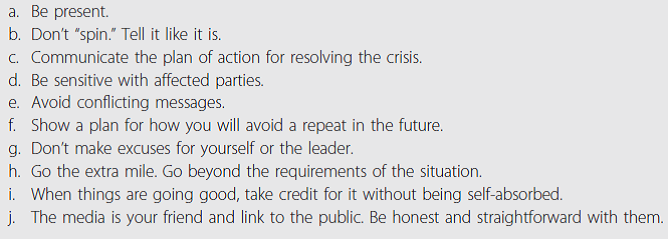
_______ The CEO of a company is on vacation when a crisis breaks out, but refuses to cancel his vacation and return home to deal with the crisis.
(Reference Exhibit 12.3)
_______ The CEO of a company is on vacation when a crisis breaks out, but refuses to cancel his vacation and return home to deal with the crisis.
Question
Question
Question
Question
Question
Question
Using the letters a through j that accompany the guidelines in Exhibit 12.3, identify which guideline is explained by each statement below.
(Reference Exhibit 12.3)
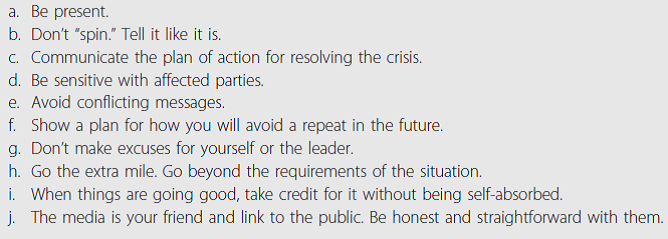
_______ Expect and treat victims and/or family members' emotional outbursts with empathy.
(Reference Exhibit 12.3)
_______ Expect and treat victims and/or family members' emotional outbursts with empathy.
Question
Question
Question
Question
Using the letters a through j that accompany the guidelines in Exhibit 12.3, identify which guideline is explained by each statement below.
(Reference Exhibit 12.3)
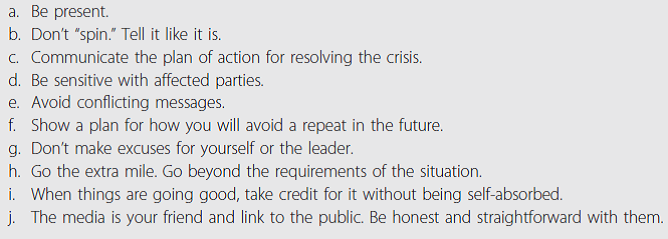
_______After the Concorde crashed, the French authorities along with British Airways immediately grounded all Concorde flights until the designers came up with a fuel tank protection solution.
(Reference Exhibit 12.3)
_______After the Concorde crashed, the French authorities along with British Airways immediately grounded all Concorde flights until the designers came up with a fuel tank protection solution.
Question
Using the letters a through j that accompany the guidelines in Exhibit 12.3, identify which guideline is explained by each statement below.
(Reference Exhibit 12.3)
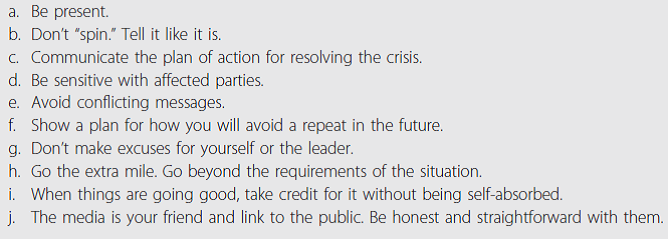
_______ The Public Relations person addresses the media and says something that is later contradicted by the CEO in his own press conference.
(Reference Exhibit 12.3)
_______ The Public Relations person addresses the media and says something that is later contradicted by the CEO in his own press conference.
Question
Question
Question
Question
Using the letters a through j that accompany the guidelines in Exhibit 12.3, identify which guideline is explained by each statement below.
(Reference Exhibit 12.3)
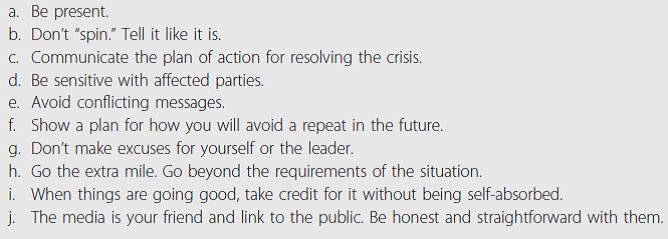
_______ The accident happened because we relied on faulty instruments from our subcontractor who designed the part. Without their error, this would never have happened.
(Reference Exhibit 12.3)
_______ The accident happened because we relied on faulty instruments from our subcontractor who designed the part. Without their error, this would never have happened.
Question
Question
Question
Using the letters a through j that accompany the guidelines in Exhibit 12.3, identify which guideline is explained by each statement below.
(Reference Exhibit 12.3)
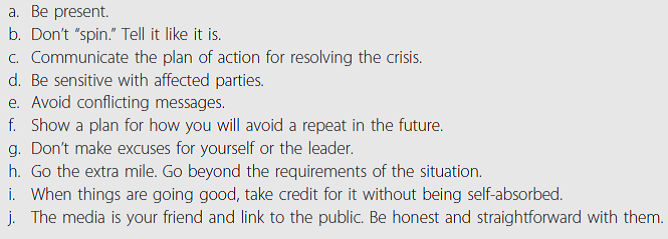
_______ Family or close ones of victims, or those affected, are brought to a central location and provided with services such as counselling, support, and other facilities that might be needed to help them cope.
(Reference Exhibit 12.3)
_______ Family or close ones of victims, or those affected, are brought to a central location and provided with services such as counselling, support, and other facilities that might be needed to help them cope.
Question
Using the letters a through j that accompany the guidelines in Exhibit 12.3, identify which guideline is explained by each statement below.
(Reference Exhibit 12.3)
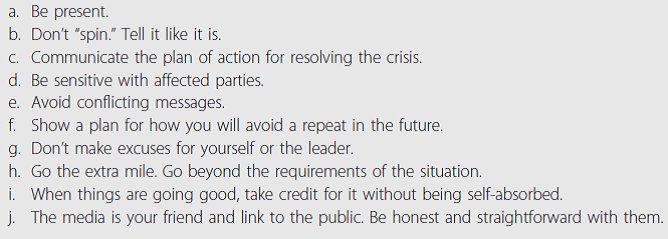
_______ I don't like the press because they tend to overemphasize the negative as if we have never done anything good in this community. From now on, I will only tell them what they need to know.
(Reference Exhibit 12.3)
_______ I don't like the press because they tend to overemphasize the negative as if we have never done anything good in this community. From now on, I will only tell them what they need to know.
Question
Question
Question
Question
Using the letters a through j that accompany the guidelines in Exhibit 12.3, identify which guideline is explained by each statement below.
(Reference Exhibit 12.3)
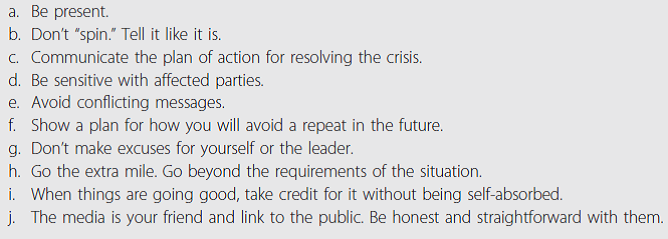
_______ After our post-crisis analysis (managing after a crisis), I realized that we did everything just right to address the crisis despite the criticisms that we received early on from various groups. It is a good thing we did not listen to them; after all what do they know about crisis management?
(Reference Exhibit 12.3)
_______ After our post-crisis analysis (managing after a crisis), I realized that we did everything just right to address the crisis despite the criticisms that we received early on from various groups. It is a good thing we did not listen to them; after all what do they know about crisis management?
Question
Using the letters a through j that accompany the guidelines in Exhibit 12.3, identify which guideline is explained by each statement below.
(Reference Exhibit 12.3)
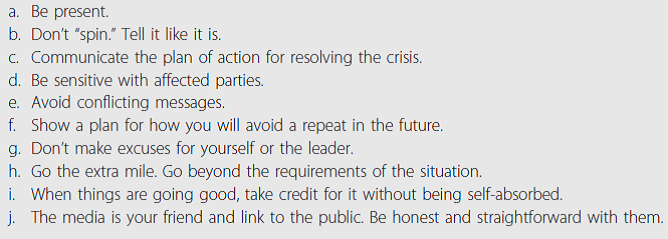
_______ Information is held back or filtered to say only what the leaders or those in charge want you to know about a crisis.
(Reference Exhibit 12.3)
_______ Information is held back or filtered to say only what the leaders or those in charge want you to know about a crisis.
Question
Using the letters a through j that accompany the guidelines in Exhibit 12.3, identify which guideline is explained by each statement below.
(Reference Exhibit 12.3)
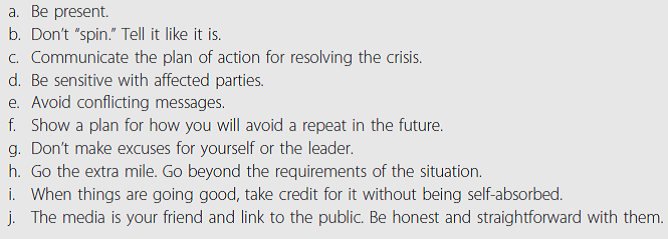
_______ The Principal of a high school where a fatal shooting has just taken place appears before parents to explain what he and the security team are doing in response to the crisis. Many of the parents criticize him afterwards for not having much to say about the incident.
(Reference Exhibit 12.3)
_______ The Principal of a high school where a fatal shooting has just taken place appears before parents to explain what he and the security team are doing in response to the crisis. Many of the parents criticize him afterwards for not having much to say about the incident.

Unlock Deck
Sign up to unlock the cards in this deck!
Unlock Deck
Unlock Deck
1/30

Play

Full screen (f)
Deck 12: Crisis Leadership and the Learning Organization
1
The following critical-thinking questions can be used for class discussion and/or as written assignments to develop communication skills. Be sure to give complete explanations for all questions.
What advice would you give to a leader who wants to improve his or her organization's communications function so that it is more effective during a crisis?
What advice would you give to a leader who wants to improve his or her organization's communications function so that it is more effective during a crisis?
At the time of crisis, an effective communication plan has an important role to play.
The organization's communication functions need to be continuously improved for effectively dealing with the crisis situation. It is explained below:
One can advise the leaders to be prompt and active in taking actions while communicating quickly and effectively with the media person and other key stakeholders.
The leader should enquire the crisis by analyzing the following questions.
1) When it happened?
2) What led it to happen?
3) What are being done to get rid of it?
4) What are the plans going further?
5) What are the steps taken to get the affected parties out of the nightmare?
6) What are the procedures practices in place to handle the situation?
7) The external agencies who could be contacted?
8) The approximate time period in which the crisis situation could be overcome.
The leaders should be empathetic and show strong determination and readiness to overcome the crisis quickly and responsibly. They should keep the workers motivated and strengthen their faith trust in the organization and prevent them from any sort of panic.
On the other hand, they should also designate a team for proper communication and better connectivity with the employees within the organization. They should make provisions for setting up of loud-speakers at the production floor and pave way for the creation of centralized communication center within the organization.
They should also designate a separate team for different purposes such as public relations personnel to deal with media queries and legal personnel to answer queries related to legal affairs.
For quickly coping up with the crisis, the leaders can institutionalize crisis communication system that studies agencies to contact at the time of crisis. The leaders can also check for procedures that need to be followed and which can fix responsibilities on part of each individual related to organization. This communication system shall release few helpline numbers to voice concern of the relatives of the affected parties and remain prompt in answering all possible queries.
With all this in place, the organization would gain respect, loyalty commitment of the various stakeholders which would go a long way in creation of teamwork culture and enhance the employees' sense of oneness with the organization.
The organization's communication functions need to be continuously improved for effectively dealing with the crisis situation. It is explained below:
One can advise the leaders to be prompt and active in taking actions while communicating quickly and effectively with the media person and other key stakeholders.
The leader should enquire the crisis by analyzing the following questions.
1) When it happened?
2) What led it to happen?
3) What are being done to get rid of it?
4) What are the plans going further?
5) What are the steps taken to get the affected parties out of the nightmare?
6) What are the procedures practices in place to handle the situation?
7) The external agencies who could be contacted?
8) The approximate time period in which the crisis situation could be overcome.
The leaders should be empathetic and show strong determination and readiness to overcome the crisis quickly and responsibly. They should keep the workers motivated and strengthen their faith trust in the organization and prevent them from any sort of panic.
On the other hand, they should also designate a team for proper communication and better connectivity with the employees within the organization. They should make provisions for setting up of loud-speakers at the production floor and pave way for the creation of centralized communication center within the organization.
They should also designate a separate team for different purposes such as public relations personnel to deal with media queries and legal personnel to answer queries related to legal affairs.
For quickly coping up with the crisis, the leaders can institutionalize crisis communication system that studies agencies to contact at the time of crisis. The leaders can also check for procedures that need to be followed and which can fix responsibilities on part of each individual related to organization. This communication system shall release few helpline numbers to voice concern of the relatives of the affected parties and remain prompt in answering all possible queries.
With all this in place, the organization would gain respect, loyalty commitment of the various stakeholders which would go a long way in creation of teamwork culture and enhance the employees' sense of oneness with the organization.
2
Identify each statement by its type of organization. Write the appropriate letter in the blank before each item.
A) traditional
B) learning
______With a union, we have clearly defined jobs and are not allowed to do other work.
A) traditional
B) learning
______With a union, we have clearly defined jobs and are not allowed to do other work.
A) Traditional.
It is in the traditional organization that the employees are observed to form union and that each employee is observed to be doing the same work for which they have been hired. The objective of such organization is that employees should become efficient in handling their respective piece of work.
This would not affect the efficiency of the production activity. Employees are discouraged to experiment with new work or learn a new work process from their fellow colleague within the same organization. Thus, the option (b) is not correct.
It is in the traditional organization that the employees are observed to form union and that each employee is observed to be doing the same work for which they have been hired. The objective of such organization is that employees should become efficient in handling their respective piece of work.
This would not affect the efficiency of the production activity. Employees are discouraged to experiment with new work or learn a new work process from their fellow colleague within the same organization. Thus, the option (b) is not correct.
3
What are the main components of a precrisis plan?
The pre-crisis plan is a plan devised by the organization to shows its level of preparedness to deal with the crisis like situation with responsibility and accountability. This may help the organization to reduce the duration of the crisis while keeping the reputation and brand value of the organization intact. The pre-crisis plan helps the organization to make necessary arrangements in the form of early warning devices, risk analysis, and quick response system to tackle the crisis.
There are three important components of pre-crisis plan of organization. They are as follows:
1) Appointment of crisis leader in the organization to lead from front at the time of crisis, coordinating the efforts of the crisis response team to manage and lower the severity of crisis.
With the appointment of crisis leader, the organization tracks the development that takes place in the internal and external environment for possible warning signals of a crisis. It could take necessary step in time and avoid the crisis to arise at the first place. The crisis leader is expected to monitor the complaints and behavior of the customers and employees of the organization. They could review the emerging trends and patterns in the regulatory and competitive environment and report it to the CEO.
2) Setting up of crisis response team in the organization to manage the clients, employees, and media. The crisis response team on the other hand comprises of experts from different departments and external consultants who are adequately trained in crisis management.
3) Assess the risk of crisis that the organization could face in the near future. The third component of pre-crisis plan of the organization is the assessment of the risk that emerges from the crisis like situation. Under this, a crisis team is expected to perform "what-if" scenario analysis to evaluate different kinds of risk that may arise in crisis and determine the magnitude of the impact it would have on the key stakeholders and organization as a whole. Under assessment process, the possible risks are ranked on the basis of its severity and types so that they can be evaluated using SWOT analysis.
There are three important components of pre-crisis plan of organization. They are as follows:
1) Appointment of crisis leader in the organization to lead from front at the time of crisis, coordinating the efforts of the crisis response team to manage and lower the severity of crisis.
With the appointment of crisis leader, the organization tracks the development that takes place in the internal and external environment for possible warning signals of a crisis. It could take necessary step in time and avoid the crisis to arise at the first place. The crisis leader is expected to monitor the complaints and behavior of the customers and employees of the organization. They could review the emerging trends and patterns in the regulatory and competitive environment and report it to the CEO.
2) Setting up of crisis response team in the organization to manage the clients, employees, and media. The crisis response team on the other hand comprises of experts from different departments and external consultants who are adequately trained in crisis management.
3) Assess the risk of crisis that the organization could face in the near future. The third component of pre-crisis plan of the organization is the assessment of the risk that emerges from the crisis like situation. Under this, a crisis team is expected to perform "what-if" scenario analysis to evaluate different kinds of risk that may arise in crisis and determine the magnitude of the impact it would have on the key stakeholders and organization as a whole. Under assessment process, the possible risks are ranked on the basis of its severity and types so that they can be evaluated using SWOT analysis.
4
Identify each statement by its type of organization. Write the appropriate letter in the blank before each item.
A) traditional
B) learning
______ Top-level managers make all the important decisions around here.
A) traditional
B) learning
______ Top-level managers make all the important decisions around here.
Unlock Deck
Unlock for access to all 30 flashcards in this deck.
Unlock Deck
k this deck
5
Using the letters a through j that accompany the guidelines in Exhibit 12.3, identify which guideline is explained by each statement below.
(Reference Exhibit 12.3)
_______ The CEO of a company is on vacation when a crisis breaks out, but refuses to cancel his vacation and return home to deal with the crisis.
(Reference Exhibit 12.3)
_______ The CEO of a company is on vacation when a crisis breaks out, but refuses to cancel his vacation and return home to deal with the crisis.
Unlock Deck
Unlock for access to all 30 flashcards in this deck.
Unlock Deck
k this deck
6
Identify each statement by its type of organization. Write the appropriate letter in the blank before each item.
A) traditional
B) learning
______ In our organization, employees are encouraged to experiment and take risk without fear of punishment when they fail.
A) traditional
B) learning
______ In our organization, employees are encouraged to experiment and take risk without fear of punishment when they fail.
Unlock Deck
Unlock for access to all 30 flashcards in this deck.
Unlock Deck
k this deck
7
The following critical-thinking questions can be used for class discussion and/or as written assignments to develop communication skills. Be sure to give complete explanations for all questions.
How important to an organization is internal (employee) communication during a crisis?
How important to an organization is internal (employee) communication during a crisis?
Unlock Deck
Unlock for access to all 30 flashcards in this deck.
Unlock Deck
k this deck
8
Identify each statement by its type of organization. Write the appropriate letter in the blank before each item.
A) traditional
B) learning
______ There aren't many levels of management in our company.
A) traditional
B) learning
______ There aren't many levels of management in our company.
Unlock Deck
Unlock for access to all 30 flashcards in this deck.
Unlock Deck
k this deck
9
The precrisis response plan requires the appointment of a crisis leader. Describe the responsibilities of this person.
Unlock Deck
Unlock for access to all 30 flashcards in this deck.
Unlock Deck
k this deck
10
Identify each statement by its type of organization. Write the appropriate letter in the blank before each item.a. traditional
B) learning
______ Our organization's structure can be described as flat or horizontal with much decision-making responsibility delegated downward.
B) learning
______ Our organization's structure can be described as flat or horizontal with much decision-making responsibility delegated downward.
Unlock Deck
Unlock for access to all 30 flashcards in this deck.
Unlock Deck
k this deck
11
Using the letters a through j that accompany the guidelines in Exhibit 12.3, identify which guideline is explained by each statement below.
(Reference Exhibit 12.3)
_______ Expect and treat victims and/or family members' emotional outbursts with empathy.
(Reference Exhibit 12.3)
_______ Expect and treat victims and/or family members' emotional outbursts with empathy.
Unlock Deck
Unlock for access to all 30 flashcards in this deck.
Unlock Deck
k this deck
12
The following critical-thinking questions can be used for class discussion and/or as written assignments to develop communication skills. Be sure to give complete explanations for all questions.
What message does it send when the organizational culture encourages employees to view mistakes/problems as opportunities for improvement rather than reasons to blame or punish those involved?
What message does it send when the organizational culture encourages employees to view mistakes/problems as opportunities for improvement rather than reasons to blame or punish those involved?
Unlock Deck
Unlock for access to all 30 flashcards in this deck.
Unlock Deck
k this deck
13
The opening case featured Citigroup, a company that was clearly in crisis mode when its new CEO took over. This end-of-chapter case features Merck, a pharmaceutical company that was doing just fine when it brought in a new CEO. We selected Merck because it operates in an environment where learning and knowledge management are critical for success. Also, unlike the Citigroup case, where a leadership change was triggered by a crisis and poor performance, Merck's change in leadership was the result of an orderly succession plan. Merck's outgoing CEO Richard T. Clark was stepping down after reaching Merck's mandatory retirement age of 65.
Merck is a global healthcare leader that employs 100,000 people worldwide, 42,000 in the United States NJ is part of USMerck operates in more than 140 countries to deliver innovative health solutions. In 2009, Merck spent $41.1 billion to acquire rival drug maker Schering-Plough. This mega merger made the combined company the second-largest healthcare company in the world. Merck's leadership saw a lot of synergistic benefits in the merger. They rationalized that both companies are strong, science-based companies. Both have a common mission-and passion-to improve health and well-being around the world. And both share a long-standing commitment to putting customers first and to being there for people in times of need. Drug research is a high-risk and time-consuming process. Only 1 out of every 5000-10,000 compounds screened becomes an approved drug. It takes an average of 10 to 15 years at an average cost of more than US$1 billion to develop a successful medicine. 120 Therefore, knowledge management and the organizational learning are what a company like Merck is all about.
On November 30, 2010, Merck announced that its Board of Directors had elected Kenneth C. Frazier to be its next chief executive officer (CEO) and president, as well as a member of the board, effective January 1, 2011. Mr. Frazier succeeded Richard T. Clark, who had served as Merck's CEO since 2005, who would continue as chairman of the board.
Mr. Frazier received his bachelor's degree from The Pennsylvania State University and holds a JD from Harvard Law School. Prior to being appointed president, Mr. Frazier served as executive vice president and president, Global Human Health, from 2007 to 2010. Frazier is the first African- American to lead a major U.S. pharmaceutical company. Mr. Frazier grew up in North Philadelphia, where his father raised three children on a janitor's salary after the death of Mr. Frazier's mother when he was 12. Mr. Frazier made his name in Merck as the lawyer who masterminded the company's strategy of defending the pain drug Vioxx. Patients were claiming that the drug was responsible for heart attacks, leading to the deaths of many who had been on the drug. From Wall Street's perspective, Vioxx was nothing short of a crisis. Frazier was the strategist calling the shots, initially deciding to defend the company against thousands of lawsuits by fighting every case separately instead of as a joint action. He eventually structured a $4.85 billion settlement to resolve the remaining lawsuits. Wall Street had expected that Merck would have to pay even more. "He managed the Vioxx litigation extraordinarily well, and there were a lot of doubting Thomases, especially on Wall Street," said Barbara Ryan, an analyst who follows drug companies for Deutsche Bank. Mr. Frazier has maintained that the pillar of Merck's strategy will remain innovation, with a focus on emerging markets led by China and Brazil. "The most important thing is to continue on the strategy" that Mr. Clark established, Mr. Frazier said. 121 Richard Clark, Ken's predecessor, said Frazier demonstrated his leadership skills during the merger of Merck and Schering Plough. "Ken spent time in the field understanding the customer needs of our markets in a way that I hadn't seen done before," Clark said. "It showed you his dedication and enthusiasm."
Speaking on behalf of Merck's Board of Directors, William B. Harrison said, "During the board's succession planning process, it became clear to us that Ken Frazier has the strategic vision, operational experience, and passion to lead Merck. Ken is a proven executive who has played a key role in shaping Merck's business strategy. With his understanding of the global health care environment, the board is confident in Ken's ability to take the helm at Merck and guide the continued implementation of our long-term strategy."
Supporters of Ken Frazier believe he has the strategic breadth and depth to advance Merck's innovative strategy and make it a competitive player in the highly competitive pharmaceutical industry.122 Others, however, are more skeptical. While Frazier's legal experience is extensive, his experience running the operations of a company is limited and may cause doubt for some investors, observed Bowe, an industry expert. "Does leading a big pharma company in a very challenging and changing environment require more operational experience?" Bowe said. "That's the question." 123 This question is raised because Mr. Frazier is not a scientist and his experience at Merck and other places were in the legal department. Only the future will tell!
GO TO THE INTERNET: To learn more about Ken Frazier and Merck, visit www.merck.com.
Support your answers to the following questions with specific information from the case and text or with other information you get from the Web or other sources.
1. In what way(s) has Ken Frazier demonstrated his effectiveness as a crisis leader?
2. Given our discussion on the distinction between a traditional and learning organization, what type of organization is Merck? Support your answer.
3. Mr. Frazier has maintained that the pillar of Merck's strategy will remain innovation. Suggest some ideas he can institute to enhance innovation.
4. Describe the strategy that Ken Frazier has articulated for moving Merck forward.
5. What are some of the supporting factors that the Merck Board of Directors used in making the decision to appoint Ken Frazier Merck's next CEO?
6. Drug research is a high-risk and time-consuming process. What evidence is there to support this assertion?
7. What specific personality and leadership traits does Ken Frazier possess that align with leading a learning- and knowledge-driven organization like Merck?
C UMU L A T I V E C A S E Q U E S T IO N S
8. What is CEO Frazier's source of power? Also, what type of power and influencing tactics has he been using, and is it the appropriate power type? If not, which power type should he be using (Chapter 5)?
9. Chapter 6 discusses communication, coaching, and mentoring as ways to develop the leadership skills of underlings by senior leaders. What is the evidence from the case that Mr. Frazier is a beneficiary of effective mentoring and coaching?
10. Strategic leadership is about having a vision that aligns with future environmental trends and working with and through others to realize it (Chapter 11). What evidences is there that Ken Frazier is an effective strategic leader?
C A S E E X E R C I S E A N D R O L E - P L A Y
Preparation: Put yourself in the position of Ken Frazier. There has been a major incident involving one of Merck's drugs. Patients using the drug have been experiencing some serious side effects. The law suits are beginning to mount. You and the crisis management team are getting ready for a news conference with the media on the crisis. Prepare a list of questions you anticipate the media will be asking and what your response should be. What other preparations do you have to make prior to the news conference?
In-Class Groups: Break into groups of four to six members, and discuss the preparation questions.
Role-Play: Taking turns, one group will represent the crisis management team led by Mr. Frazier. Let another group play the role of the media. They should select no more than three questions from their prepared list to ask. The rest of the class should listen and judge the performance of the Merck crisis management team in addressing the media. Each group should take turns role-playing the media, the Merck crisis management team, or the judges. Each team playing the role of the media should ask a different set of questions, so the same questions are not repeated during each round.
Observer Role: As the rest of the class members watch the role-play, they should judge (1) the opening remarks of the crisis management team-their demeanor, body language, tone, style, and substance; (2) the quality of questions that the media team asked; and (3) the quality of responses given by Mr. Frazier and his team-how honest and truthful they are with their answers. Did Mr. Frazier take a leading role or did he stay in the background and let others do the talking? Use the guidelines for effective crisis communication as the tool to judge Merck's crisis management team performance during the news conference. Look for things that the person playing Mr. Frazier did well or did not do well during the news conference.
Discussion: After the role-plays, the class votes for the crisis management team that did the best job addressing the news media with its opening remarks and responding to questions. The instructor should weigh in with his or her opinion on which team did the best job in the questioning and which team did the best job in responding to the questions. Which team member playing Mr. Frazier did the best job and why? Where did the others fall short?
Merck is a global healthcare leader that employs 100,000 people worldwide, 42,000 in the United States NJ is part of USMerck operates in more than 140 countries to deliver innovative health solutions. In 2009, Merck spent $41.1 billion to acquire rival drug maker Schering-Plough. This mega merger made the combined company the second-largest healthcare company in the world. Merck's leadership saw a lot of synergistic benefits in the merger. They rationalized that both companies are strong, science-based companies. Both have a common mission-and passion-to improve health and well-being around the world. And both share a long-standing commitment to putting customers first and to being there for people in times of need. Drug research is a high-risk and time-consuming process. Only 1 out of every 5000-10,000 compounds screened becomes an approved drug. It takes an average of 10 to 15 years at an average cost of more than US$1 billion to develop a successful medicine. 120 Therefore, knowledge management and the organizational learning are what a company like Merck is all about.
On November 30, 2010, Merck announced that its Board of Directors had elected Kenneth C. Frazier to be its next chief executive officer (CEO) and president, as well as a member of the board, effective January 1, 2011. Mr. Frazier succeeded Richard T. Clark, who had served as Merck's CEO since 2005, who would continue as chairman of the board.
Mr. Frazier received his bachelor's degree from The Pennsylvania State University and holds a JD from Harvard Law School. Prior to being appointed president, Mr. Frazier served as executive vice president and president, Global Human Health, from 2007 to 2010. Frazier is the first African- American to lead a major U.S. pharmaceutical company. Mr. Frazier grew up in North Philadelphia, where his father raised three children on a janitor's salary after the death of Mr. Frazier's mother when he was 12. Mr. Frazier made his name in Merck as the lawyer who masterminded the company's strategy of defending the pain drug Vioxx. Patients were claiming that the drug was responsible for heart attacks, leading to the deaths of many who had been on the drug. From Wall Street's perspective, Vioxx was nothing short of a crisis. Frazier was the strategist calling the shots, initially deciding to defend the company against thousands of lawsuits by fighting every case separately instead of as a joint action. He eventually structured a $4.85 billion settlement to resolve the remaining lawsuits. Wall Street had expected that Merck would have to pay even more. "He managed the Vioxx litigation extraordinarily well, and there were a lot of doubting Thomases, especially on Wall Street," said Barbara Ryan, an analyst who follows drug companies for Deutsche Bank. Mr. Frazier has maintained that the pillar of Merck's strategy will remain innovation, with a focus on emerging markets led by China and Brazil. "The most important thing is to continue on the strategy" that Mr. Clark established, Mr. Frazier said. 121 Richard Clark, Ken's predecessor, said Frazier demonstrated his leadership skills during the merger of Merck and Schering Plough. "Ken spent time in the field understanding the customer needs of our markets in a way that I hadn't seen done before," Clark said. "It showed you his dedication and enthusiasm."
Speaking on behalf of Merck's Board of Directors, William B. Harrison said, "During the board's succession planning process, it became clear to us that Ken Frazier has the strategic vision, operational experience, and passion to lead Merck. Ken is a proven executive who has played a key role in shaping Merck's business strategy. With his understanding of the global health care environment, the board is confident in Ken's ability to take the helm at Merck and guide the continued implementation of our long-term strategy."
Supporters of Ken Frazier believe he has the strategic breadth and depth to advance Merck's innovative strategy and make it a competitive player in the highly competitive pharmaceutical industry.122 Others, however, are more skeptical. While Frazier's legal experience is extensive, his experience running the operations of a company is limited and may cause doubt for some investors, observed Bowe, an industry expert. "Does leading a big pharma company in a very challenging and changing environment require more operational experience?" Bowe said. "That's the question." 123 This question is raised because Mr. Frazier is not a scientist and his experience at Merck and other places were in the legal department. Only the future will tell!
GO TO THE INTERNET: To learn more about Ken Frazier and Merck, visit www.merck.com.
Support your answers to the following questions with specific information from the case and text or with other information you get from the Web or other sources.
1. In what way(s) has Ken Frazier demonstrated his effectiveness as a crisis leader?
2. Given our discussion on the distinction between a traditional and learning organization, what type of organization is Merck? Support your answer.
3. Mr. Frazier has maintained that the pillar of Merck's strategy will remain innovation. Suggest some ideas he can institute to enhance innovation.
4. Describe the strategy that Ken Frazier has articulated for moving Merck forward.
5. What are some of the supporting factors that the Merck Board of Directors used in making the decision to appoint Ken Frazier Merck's next CEO?
6. Drug research is a high-risk and time-consuming process. What evidence is there to support this assertion?
7. What specific personality and leadership traits does Ken Frazier possess that align with leading a learning- and knowledge-driven organization like Merck?
C UMU L A T I V E C A S E Q U E S T IO N S
8. What is CEO Frazier's source of power? Also, what type of power and influencing tactics has he been using, and is it the appropriate power type? If not, which power type should he be using (Chapter 5)?
9. Chapter 6 discusses communication, coaching, and mentoring as ways to develop the leadership skills of underlings by senior leaders. What is the evidence from the case that Mr. Frazier is a beneficiary of effective mentoring and coaching?
10. Strategic leadership is about having a vision that aligns with future environmental trends and working with and through others to realize it (Chapter 11). What evidences is there that Ken Frazier is an effective strategic leader?
C A S E E X E R C I S E A N D R O L E - P L A Y
Preparation: Put yourself in the position of Ken Frazier. There has been a major incident involving one of Merck's drugs. Patients using the drug have been experiencing some serious side effects. The law suits are beginning to mount. You and the crisis management team are getting ready for a news conference with the media on the crisis. Prepare a list of questions you anticipate the media will be asking and what your response should be. What other preparations do you have to make prior to the news conference?
In-Class Groups: Break into groups of four to six members, and discuss the preparation questions.
Role-Play: Taking turns, one group will represent the crisis management team led by Mr. Frazier. Let another group play the role of the media. They should select no more than three questions from their prepared list to ask. The rest of the class should listen and judge the performance of the Merck crisis management team in addressing the media. Each group should take turns role-playing the media, the Merck crisis management team, or the judges. Each team playing the role of the media should ask a different set of questions, so the same questions are not repeated during each round.
Observer Role: As the rest of the class members watch the role-play, they should judge (1) the opening remarks of the crisis management team-their demeanor, body language, tone, style, and substance; (2) the quality of questions that the media team asked; and (3) the quality of responses given by Mr. Frazier and his team-how honest and truthful they are with their answers. Did Mr. Frazier take a leading role or did he stay in the background and let others do the talking? Use the guidelines for effective crisis communication as the tool to judge Merck's crisis management team performance during the news conference. Look for things that the person playing Mr. Frazier did well or did not do well during the news conference.
Discussion: After the role-plays, the class votes for the crisis management team that did the best job addressing the news media with its opening remarks and responding to questions. The instructor should weigh in with his or her opinion on which team did the best job in the questioning and which team did the best job in responding to the questions. Which team member playing Mr. Frazier did the best job and why? Where did the others fall short?
Unlock Deck
Unlock for access to all 30 flashcards in this deck.
Unlock Deck
k this deck
14
The best indicator of an organization's readiness to respond to a crisis is how it rates on five factors. What are these five factors?
Unlock Deck
Unlock for access to all 30 flashcards in this deck.
Unlock Deck
k this deck
15
Using the letters a through j that accompany the guidelines in Exhibit 12.3, identify which guideline is explained by each statement below.
(Reference Exhibit 12.3)
_______After the Concorde crashed, the French authorities along with British Airways immediately grounded all Concorde flights until the designers came up with a fuel tank protection solution.
(Reference Exhibit 12.3)
_______After the Concorde crashed, the French authorities along with British Airways immediately grounded all Concorde flights until the designers came up with a fuel tank protection solution.
Unlock Deck
Unlock for access to all 30 flashcards in this deck.
Unlock Deck
k this deck
16
Using the letters a through j that accompany the guidelines in Exhibit 12.3, identify which guideline is explained by each statement below.
(Reference Exhibit 12.3)
_______ The Public Relations person addresses the media and says something that is later contradicted by the CEO in his own press conference.
(Reference Exhibit 12.3)
_______ The Public Relations person addresses the media and says something that is later contradicted by the CEO in his own press conference.
Unlock Deck
Unlock for access to all 30 flashcards in this deck.
Unlock Deck
k this deck
17
The following critical-thinking questions can be used for class discussion and/or as written assignments to develop communication skills. Be sure to give complete explanations for all questions.
Describe why a senior leader's physical presence is critical during a crisis.
Describe why a senior leader's physical presence is critical during a crisis.
Unlock Deck
Unlock for access to all 30 flashcards in this deck.
Unlock Deck
k this deck
18
What is the appropriate role of an organization's top leadership during a crisis?
Unlock Deck
Unlock for access to all 30 flashcards in this deck.
Unlock Deck
k this deck
19
Strategic crisis leadership is about a leader taking action in three key areas. What are these areas?
Unlock Deck
Unlock for access to all 30 flashcards in this deck.
Unlock Deck
k this deck
20
Using the letters a through j that accompany the guidelines in Exhibit 12.3, identify which guideline is explained by each statement below.
(Reference Exhibit 12.3)
_______ The accident happened because we relied on faulty instruments from our subcontractor who designed the part. Without their error, this would never have happened.
(Reference Exhibit 12.3)
_______ The accident happened because we relied on faulty instruments from our subcontractor who designed the part. Without their error, this would never have happened.
Unlock Deck
Unlock for access to all 30 flashcards in this deck.
Unlock Deck
k this deck
21
Managers today are expected to deal with uncertainty, unexpected events, diversity, and change. They must demonstrate flexibility, foster trust, and engage the hearts and minds of employees. The managers at Second City Theater have a leg up in developing these skills and dealing with these situations because Second City has been doing it for years-on stage. In 1975, owner and executive producer Andrew Alexander started the Second City television series (SCTV) in response to the new trend of television sketch comedy. Later, the company opened the Second City Training Center, an educational center offering classes in improvisation, acting, writing, and other skills. Most recently, Second City opened a corporate communications division, which provides training in the areas of internal communications, external marketing and branding, and learning development. With its focus on human skills, Second City demonstrates all of the qualities of a learning organization. The managers at Second City foster a climate where experimentation and learning are encouraged.
1. Many students of the Second City Training Center are businesspeople looking to gain skills for the corporate context. What skills from the world of improvisational comedy would be valuable to a business manager?
2. What do you think would be the challenges of a manager in a learning organization? Why?
1. Many students of the Second City Training Center are businesspeople looking to gain skills for the corporate context. What skills from the world of improvisational comedy would be valuable to a business manager?
2. What do you think would be the challenges of a manager in a learning organization? Why?
Unlock Deck
Unlock for access to all 30 flashcards in this deck.
Unlock Deck
k this deck
22
What does it mean to say that organizational learning is a multilevel sharing process?
Unlock Deck
Unlock for access to all 30 flashcards in this deck.
Unlock Deck
k this deck
23
Using the letters a through j that accompany the guidelines in Exhibit 12.3, identify which guideline is explained by each statement below.
(Reference Exhibit 12.3)
_______ Family or close ones of victims, or those affected, are brought to a central location and provided with services such as counselling, support, and other facilities that might be needed to help them cope.
(Reference Exhibit 12.3)
_______ Family or close ones of victims, or those affected, are brought to a central location and provided with services such as counselling, support, and other facilities that might be needed to help them cope.
Unlock Deck
Unlock for access to all 30 flashcards in this deck.
Unlock Deck
k this deck
24
Using the letters a through j that accompany the guidelines in Exhibit 12.3, identify which guideline is explained by each statement below.
(Reference Exhibit 12.3)
_______ I don't like the press because they tend to overemphasize the negative as if we have never done anything good in this community. From now on, I will only tell them what they need to know.
(Reference Exhibit 12.3)
_______ I don't like the press because they tend to overemphasize the negative as if we have never done anything good in this community. From now on, I will only tell them what they need to know.
Unlock Deck
Unlock for access to all 30 flashcards in this deck.
Unlock Deck
k this deck
25
The following critical-thinking questions can be used for class discussion and/or as written assignments to develop communication skills. Be sure to give complete explanations for all questions.
What are the purpose and benefits of creating a comprehensive crisis response plan before a crisis happens?
What are the purpose and benefits of creating a comprehensive crisis response plan before a crisis happens?
Unlock Deck
Unlock for access to all 30 flashcards in this deck.
Unlock Deck
k this deck
26
What factors account for the fact that the learning organization is described as more creative and innovative than the traditional organization form?
Unlock Deck
Unlock for access to all 30 flashcards in this deck.
Unlock Deck
k this deck
27
How has the Internet affected the way crises are perceived in our society today?
Unlock Deck
Unlock for access to all 30 flashcards in this deck.
Unlock Deck
k this deck
28
Using the letters a through j that accompany the guidelines in Exhibit 12.3, identify which guideline is explained by each statement below.
(Reference Exhibit 12.3)
_______ After our post-crisis analysis (managing after a crisis), I realized that we did everything just right to address the crisis despite the criticisms that we received early on from various groups. It is a good thing we did not listen to them; after all what do they know about crisis management?
(Reference Exhibit 12.3)
_______ After our post-crisis analysis (managing after a crisis), I realized that we did everything just right to address the crisis despite the criticisms that we received early on from various groups. It is a good thing we did not listen to them; after all what do they know about crisis management?
Unlock Deck
Unlock for access to all 30 flashcards in this deck.
Unlock Deck
k this deck
29
Using the letters a through j that accompany the guidelines in Exhibit 12.3, identify which guideline is explained by each statement below.
(Reference Exhibit 12.3)
_______ Information is held back or filtered to say only what the leaders or those in charge want you to know about a crisis.
(Reference Exhibit 12.3)
_______ Information is held back or filtered to say only what the leaders or those in charge want you to know about a crisis.
Unlock Deck
Unlock for access to all 30 flashcards in this deck.
Unlock Deck
k this deck
30
Using the letters a through j that accompany the guidelines in Exhibit 12.3, identify which guideline is explained by each statement below.
(Reference Exhibit 12.3)
_______ The Principal of a high school where a fatal shooting has just taken place appears before parents to explain what he and the security team are doing in response to the crisis. Many of the parents criticize him afterwards for not having much to say about the incident.
(Reference Exhibit 12.3)
_______ The Principal of a high school where a fatal shooting has just taken place appears before parents to explain what he and the security team are doing in response to the crisis. Many of the parents criticize him afterwards for not having much to say about the incident.
Unlock Deck
Unlock for access to all 30 flashcards in this deck.
Unlock Deck
k this deck
Unlock Deck
Unlock for access to all 30 flashcards in this deck.






