







 Chat with AI

Deck 19: International Finance
Full screen (f)

Question

Question
Question
Question
Use exchange rates listed in Figure 6 of the chapter to answer problems 13 through 16.
F igure 6
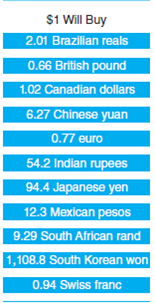
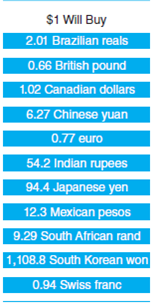
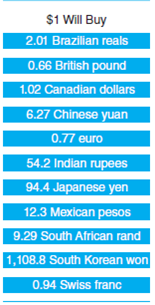
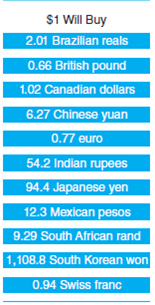
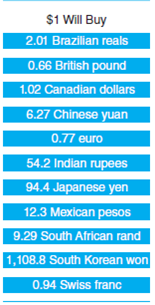
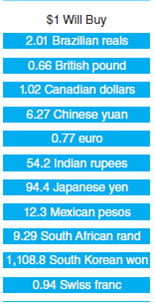
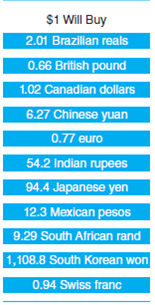
Exchange Rates: Foreign Currency per American Dollar, January 12, 2013
How many Mexican pesos would you get for a dollar? You would get 12.2 pesos. Can you figure out how many dollars (actually how many cents) you would get for a peso? You would get 8.2 cents. Exchange rates fluctuate from minute to minute, and they are usually calibrated to hundredths, or even thousandths of a cent.
Source: The Federal Reserve, www.federalreserve.gov.

How many Indian rupees can we get for 1 Mexican peso?
F igure 6
Exchange Rates: Foreign Currency per American Dollar, January 12, 2013
How many Mexican pesos would you get for a dollar? You would get 12.2 pesos. Can you figure out how many dollars (actually how many cents) you would get for a peso? You would get 8.2 cents. Exchange rates fluctuate from minute to minute, and they are usually calibrated to hundredths, or even thousandths of a cent.
Source: The Federal Reserve, www.federalreserve.gov.
How many Indian rupees can we get for 1 Mexican peso?
Question
Question
Question
Use the exchange rates listed in Figure 6 to find how much it would cost in the currency specified to make the purchases listed in problems 5 through 8.
F igure 6
Exchange Rates: Foreign Currency per American Dollar, January 12, 2013
How many Mexican pesos would you get for a dollar? You would get 12.2 pesos. Can you figure out how many dollars (actually how many cents) you would get for a peso? You would get 8.2 cents. Exchange rates fluctuate from minute to minute, and they are usually calibrated to hundredths, or even thousandths of a cent.
Source: The Federal Reserve, www.federalreserve.gov.
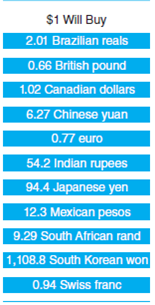
If you could buy a market basket of goods and services in the United States for $1,000 and those same goods and services cost you $1,200 after you converted your dollars into euros: (a) Is the euro undervalued or overvalued relative to the dollar? (b) By what percentage?
F igure 6
Exchange Rates: Foreign Currency per American Dollar, January 12, 2013
How many Mexican pesos would you get for a dollar? You would get 12.2 pesos. Can you figure out how many dollars (actually how many cents) you would get for a peso? You would get 8.2 cents. Exchange rates fluctuate from minute to minute, and they are usually calibrated to hundredths, or even thousandths of a cent.
Source: The Federal Reserve, www.federalreserve.gov.
If you could buy a market basket of goods and services in the United States for $1,000 and those same goods and services cost you $1,200 after you converted your dollars into euros: (a) Is the euro undervalued or overvalued relative to the dollar? (b) By what percentage?
Question
Question
Use the exchange rates listed in Figure 6 of the chapter to find how much it would cost in U.S. dollars and cents to make the purchases listed in problems 1 through 4.
F igure 6
Exchange Rates: Foreign Currency per American Dollar, January 12, 2013
How many Mexican pesos would you get for a dollar? You would get 12.2 pesos. Can you figure out how many dollars (actually how many cents) you would get for a peso? You would get 8.2 cents. Exchange rates fluctuate from minute to minute, and they are usually calibrated to hundredths, or even thousandths of a cent.
Source: The Federal Reserve, www.federalreserve.gov.
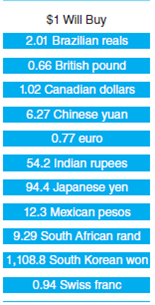
A British book priced at 12 pounds.
F igure 6
Exchange Rates: Foreign Currency per American Dollar, January 12, 2013
How many Mexican pesos would you get for a dollar? You would get 12.2 pesos. Can you figure out how many dollars (actually how many cents) you would get for a peso? You would get 8.2 cents. Exchange rates fluctuate from minute to minute, and they are usually calibrated to hundredths, or even thousandths of a cent.
Source: The Federal Reserve, www.federalreserve.gov.
A British book priced at 12 pounds.
Question
Use the exchange rates listed in Figure 6 to find how much it would cost in the currency specified to make the purchases listed in problems 5 through 8.
F igure 6
Exchange Rates: Foreign Currency per American Dollar, January 12, 2013
How many Mexican pesos would you get for a dollar? You would get 12.2 pesos. Can you figure out how many dollars (actually how many cents) you would get for a peso? You would get 8.2 cents. Exchange rates fluctuate from minute to minute, and they are usually calibrated to hundredths, or even thousandths of a cent.
Source: The Federal Reserve, www.federalreserve.gov.
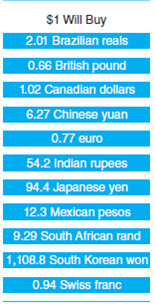
A Cadillac priced at $20,000 is sold in London.
F igure 6
Exchange Rates: Foreign Currency per American Dollar, January 12, 2013
How many Mexican pesos would you get for a dollar? You would get 12.2 pesos. Can you figure out how many dollars (actually how many cents) you would get for a peso? You would get 8.2 cents. Exchange rates fluctuate from minute to minute, and they are usually calibrated to hundredths, or even thousandths of a cent.
Source: The Federal Reserve, www.federalreserve.gov.
A Cadillac priced at $20,000 is sold in London.
Question
Question
Question
Question
Question
Question
Question
Question
Question
Use the exchange rates listed in Figure 6 to find how much it would cost in the currency specified to make the purchases listed in problems 5 through 8.
F igure 6
Exchange Rates: Foreign Currency per American Dollar, January 12, 2013
How many Mexican pesos would you get for a dollar? You would get 12.2 pesos. Can you figure out how many dollars (actually how many cents) you would get for a peso? You would get 8.2 cents. Exchange rates fluctuate from minute to minute, and they are usually calibrated to hundredths, or even thousandths of a cent.
Source: The Federal Reserve, www.federalreserve.gov.
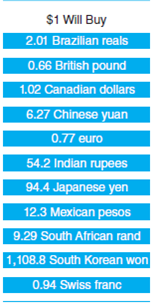
If you could buy a market basket of goods and services in the United States for $10,000 and those same goods and services cost you $7,000 in Russia after you converted your dollars into rubles: (a) Is the ruble undervalued or overvalued relative to the dollar? (b) By what percentage?
F igure 6
Exchange Rates: Foreign Currency per American Dollar, January 12, 2013
How many Mexican pesos would you get for a dollar? You would get 12.2 pesos. Can you figure out how many dollars (actually how many cents) you would get for a peso? You would get 8.2 cents. Exchange rates fluctuate from minute to minute, and they are usually calibrated to hundredths, or even thousandths of a cent.
Source: The Federal Reserve, www.federalreserve.gov.
If you could buy a market basket of goods and services in the United States for $10,000 and those same goods and services cost you $7,000 in Russia after you converted your dollars into rubles: (a) Is the ruble undervalued or overvalued relative to the dollar? (b) By what percentage?
Question
Question
Question
Question
Question
Question
Use the exchange rates listed in Figure 6 of the chapter to find how much it would cost in U.S. dollars and cents to make the purchases listed in problems 1 through 4.
F igure 6
Exchange Rates: Foreign Currency per American Dollar, January 12, 2013
How many Mexican pesos would you get for a dollar? You would get 12.2 pesos. Can you figure out how many dollars (actually how many cents) you would get for a peso? You would get 8.2 cents. Exchange rates fluctuate from minute to minute, and they are usually calibrated to hundredths, or even thousandths of a cent.
Source: The Federal Reserve, www.federalreserve.gov.
A German camera priced at 250 euros.
F igure 6
Exchange Rates: Foreign Currency per American Dollar, January 12, 2013
How many Mexican pesos would you get for a dollar? You would get 12.2 pesos. Can you figure out how many dollars (actually how many cents) you would get for a peso? You would get 8.2 cents. Exchange rates fluctuate from minute to minute, and they are usually calibrated to hundredths, or even thousandths of a cent.
Source: The Federal Reserve, www.federalreserve.gov.
A German camera priced at 250 euros.
Question
Use the exchange rates listed in Figure 6 to find how much it would cost in the currency specified to make the purchases listed in problems 5 through 8.
F igure 6
Exchange Rates: Foreign Currency per American Dollar, January 12, 2013
How many Mexican pesos would you get for a dollar? You would get 12.2 pesos. Can you figure out how many dollars (actually how many cents) you would get for a peso? You would get 8.2 cents. Exchange rates fluctuate from minute to minute, and they are usually calibrated to hundredths, or even thousandths of a cent.
Source: The Federal Reserve, www.federalreserve.gov.
A bottle of Viagra priced at $40 is sold in Berlin.
F igure 6
Exchange Rates: Foreign Currency per American Dollar, January 12, 2013
How many Mexican pesos would you get for a dollar? You would get 12.2 pesos. Can you figure out how many dollars (actually how many cents) you would get for a peso? You would get 8.2 cents. Exchange rates fluctuate from minute to minute, and they are usually calibrated to hundredths, or even thousandths of a cent.
Source: The Federal Reserve, www.federalreserve.gov.
A bottle of Viagra priced at $40 is sold in Berlin.
Question
Question
Question
Question
Question
Use exchange rates listed in Figure 6 of the chapter to answer problems 13 through 16.
F igure 6
Exchange Rates: Foreign Currency per American Dollar, January 12, 2013
How many Mexican pesos would you get for a dollar? You would get 12.2 pesos. Can you figure out how many dollars (actually how many cents) you would get for a peso? You would get 8.2 cents. Exchange rates fluctuate from minute to minute, and they are usually calibrated to hundredths, or even thousandths of a cent.
Source: The Federal Reserve, www.federalreserve.gov.
How many South African rand can we get for 1 Canadian dollar?
F igure 6
Exchange Rates: Foreign Currency per American Dollar, January 12, 2013
How many Mexican pesos would you get for a dollar? You would get 12.2 pesos. Can you figure out how many dollars (actually how many cents) you would get for a peso? You would get 8.2 cents. Exchange rates fluctuate from minute to minute, and they are usually calibrated to hundredths, or even thousandths of a cent.
Source: The Federal Reserve, www.federalreserve.gov.
How many South African rand can we get for 1 Canadian dollar?
Question
Question
Question
Question
Question
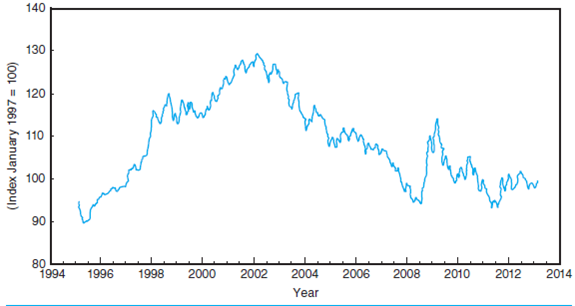
Practical Application: Anne Hilbert has been hired by a Washington think tank to predict the trend over the next decade in the weighted average exchange value of the U.S. dollar. Its record from 1994 through early 2013 is shown in Figure 5; she needs to provide evidence to back up her conclusion.
F igure 5
Trade Weighted U.S. Dollar Index* 1995-2013
*Averages of daily figures. A weighted average of the foreign exchange value of the U.S. dollar against the currencies of a broad group of major U.S. trading partners. Broad currency index includes the Euro Area, Canada, Japan, Mexico, China, United Kingdom, Taiwan, Korea, Singapore, Hong Kong, Malaysia, Brazil, Switzerland, Thailand, Philippines, Australia, Indonesia, India, Israel, Saudi Arabia, Russia, Sweden, Argentina, Venezuela, Chile, and Colombia.
Source: http://research.stlouis.org/fred2/series/TWEXB.
F igure 5
Trade Weighted U.S. Dollar Index* 1995-2013
*Averages of daily figures. A weighted average of the foreign exchange value of the U.S. dollar against the currencies of a broad group of major U.S. trading partners. Broad currency index includes the Euro Area, Canada, Japan, Mexico, China, United Kingdom, Taiwan, Korea, Singapore, Hong Kong, Malaysia, Brazil, Switzerland, Thailand, Philippines, Australia, Indonesia, India, Israel, Saudi Arabia, Russia, Sweden, Argentina, Venezuela, Chile, and Colombia.
Source: http://research.stlouis.org/fred2/series/TWEXB.
Question
Question
Question
Question
Question
Question
Question
Use the exchange rates listed in Figure 6 of the chapter to find how much it would cost in U.S. dollars and cents to make the purchases listed in problems 1 through 4.
F igure 6
Exchange Rates: Foreign Currency per American Dollar, January 12, 2013
How many Mexican pesos would you get for a dollar? You would get 12.2 pesos. Can you figure out how many dollars (actually how many cents) you would get for a peso? You would get 8.2 cents. Exchange rates fluctuate from minute to minute, and they are usually calibrated to hundredths, or even thousandths of a cent.
Source: The Federal Reserve, www.federalreserve.gov.
A Toyota Corolla priced at 1.4 million yen.
F igure 6
Exchange Rates: Foreign Currency per American Dollar, January 12, 2013
How many Mexican pesos would you get for a dollar? You would get 12.2 pesos. Can you figure out how many dollars (actually how many cents) you would get for a peso? You would get 8.2 cents. Exchange rates fluctuate from minute to minute, and they are usually calibrated to hundredths, or even thousandths of a cent.
Source: The Federal Reserve, www.federalreserve.gov.
A Toyota Corolla priced at 1.4 million yen.
Question
Use the exchange rates listed in Figure 6 to find how much it would cost in the currency specified to make the purchases listed in problems 5 through 8.
F igure 6
Exchange Rates: Foreign Currency per American Dollar, January 12, 2013
How many Mexican pesos would you get for a dollar? You would get 12.2 pesos. Can you figure out how many dollars (actually how many cents) you would get for a peso? You would get 8.2 cents. Exchange rates fluctuate from minute to minute, and they are usually calibrated to hundredths, or even thousandths of a cent.
Source: The Federal Reserve, www.federalreserve.gov.
A DVD priced at $10 is sold in Mexico City.
F igure 6
Exchange Rates: Foreign Currency per American Dollar, January 12, 2013
How many Mexican pesos would you get for a dollar? You would get 12.2 pesos. Can you figure out how many dollars (actually how many cents) you would get for a peso? You would get 8.2 cents. Exchange rates fluctuate from minute to minute, and they are usually calibrated to hundredths, or even thousandths of a cent.
Source: The Federal Reserve, www.federalreserve.gov.
A DVD priced at $10 is sold in Mexico City.
Question
Use the exchange rates listed in Figure 6 to find how much it would cost in the currency specified to make the purchases listed in problems 5 through 8.
F igure 6
Exchange Rates: Foreign Currency per American Dollar, January 12, 2013
How many Mexican pesos would you get for a dollar? You would get 12.2 pesos. Can you figure out how many dollars (actually how many cents) you would get for a peso? You would get 8.2 cents. Exchange rates fluctuate from minute to minute, and they are usually calibrated to hundredths, or even thousandths of a cent.
Source: The Federal Reserve, www.federalreserve.gov.
A country had exports of $100 billion, imports of $90 billion, net transfers from abroad of - $10 billion, and - $5 billion of net income from foreign investments. What is the country's current account balance?
F igure 6
Exchange Rates: Foreign Currency per American Dollar, January 12, 2013
How many Mexican pesos would you get for a dollar? You would get 12.2 pesos. Can you figure out how many dollars (actually how many cents) you would get for a peso? You would get 8.2 cents. Exchange rates fluctuate from minute to minute, and they are usually calibrated to hundredths, or even thousandths of a cent.
Source: The Federal Reserve, www.federalreserve.gov.
A country had exports of $100 billion, imports of $90 billion, net transfers from abroad of - $10 billion, and - $5 billion of net income from foreign investments. What is the country's current account balance?
Question
Use exchange rates listed in Figure 6 of the chapter to answer problems 13 through 16.
F igure 6
Exchange Rates: Foreign Currency per American Dollar, January 12, 2013
How many Mexican pesos would you get for a dollar? You would get 12.2 pesos. Can you figure out how many dollars (actually how many cents) you would get for a peso? You would get 8.2 cents. Exchange rates fluctuate from minute to minute, and they are usually calibrated to hundredths, or even thousandths of a cent.
Source: The Federal Reserve, www.federalreserve.gov.
How many Canadian dollars can we get for 1 South African rand?
F igure 6
Exchange Rates: Foreign Currency per American Dollar, January 12, 2013
How many Mexican pesos would you get for a dollar? You would get 12.2 pesos. Can you figure out how many dollars (actually how many cents) you would get for a peso? You would get 8.2 cents. Exchange rates fluctuate from minute to minute, and they are usually calibrated to hundredths, or even thousandths of a cent.
Source: The Federal Reserve, www.federalreserve.gov.
How many Canadian dollars can we get for 1 South African rand?
Question
Question
Question
Question
Question
Question
Question
Question
Question
Question
Question
Question
Question
Question
Question
Use exchange rates listed in Figure 6 of the chapter to answer problems 13 through 16.
F igure 6
Exchange Rates: Foreign Currency per American Dollar, January 12, 2013
How many Mexican pesos would you get for a dollar? You would get 12.2 pesos. Can you figure out how many dollars (actually how many cents) you would get for a peso? You would get 8.2 cents. Exchange rates fluctuate from minute to minute, and they are usually calibrated to hundredths, or even thousandths of a cent.
Source: The Federal Reserve, www.federalreserve.gov.
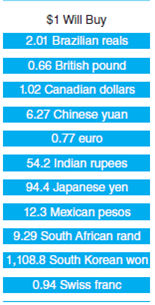
How many Mexican pesos can we get for 1 Indian rupee?
F igure 6
Exchange Rates: Foreign Currency per American Dollar, January 12, 2013
How many Mexican pesos would you get for a dollar? You would get 12.2 pesos. Can you figure out how many dollars (actually how many cents) you would get for a peso? You would get 8.2 cents. Exchange rates fluctuate from minute to minute, and they are usually calibrated to hundredths, or even thousandths of a cent.
Source: The Federal Reserve, www.federalreserve.gov.
How many Mexican pesos can we get for 1 Indian rupee?
Question
Question
Use the exchange rates listed in Figure 6 of the chapter to find how much it would cost in U.S. dollars and cents to make the purchases listed in problems 1 through 4.
F igure 6
Exchange Rates: Foreign Currency per American Dollar, January 12, 2013
How many Mexican pesos would you get for a dollar? You would get 12.2 pesos. Can you figure out how many dollars (actually how many cents) you would get for a peso? You would get 8.2 cents. Exchange rates fluctuate from minute to minute, and they are usually calibrated to hundredths, or even thousandths of a cent.
Source: The Federal Reserve, www.federalreserve.gov.
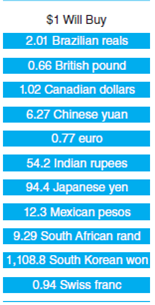
A carton of Canadian paper priced at $9 Canadian.
F igure 6
Exchange Rates: Foreign Currency per American Dollar, January 12, 2013
How many Mexican pesos would you get for a dollar? You would get 12.2 pesos. Can you figure out how many dollars (actually how many cents) you would get for a peso? You would get 8.2 cents. Exchange rates fluctuate from minute to minute, and they are usually calibrated to hundredths, or even thousandths of a cent.
Source: The Federal Reserve, www.federalreserve.gov.
A carton of Canadian paper priced at $9 Canadian.
Question
Use the exchange rates listed in Figure 6 to find how much it would cost in the currency specified to make the purchases listed in problems 5 through 8.
F igure 6
Exchange Rates: Foreign Currency per American Dollar, January 12, 2013
How many Mexican pesos would you get for a dollar? You would get 12.2 pesos. Can you figure out how many dollars (actually how many cents) you would get for a peso? You would get 8.2 cents. Exchange rates fluctuate from minute to minute, and they are usually calibrated to hundredths, or even thousandths of a cent.
Source: The Federal Reserve, www.federalreserve.gov.
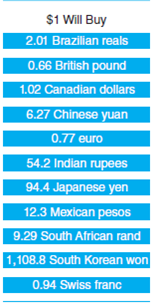
Windows Vista priced at $100 is sold in China.
F igure 6
Exchange Rates: Foreign Currency per American Dollar, January 12, 2013
How many Mexican pesos would you get for a dollar? You would get 12.2 pesos. Can you figure out how many dollars (actually how many cents) you would get for a peso? You would get 8.2 cents. Exchange rates fluctuate from minute to minute, and they are usually calibrated to hundredths, or even thousandths of a cent.
Source: The Federal Reserve, www.federalreserve.gov.
Windows Vista priced at $100 is sold in China.
Question
Use the exchange rates listed in Figure 6 to find how much it would cost in the currency specified to make the purchases listed in problems 5 through 8.
F igure 6
Exchange Rates: Foreign Currency per American Dollar, January 12, 2013
How many Mexican pesos would you get for a dollar? You would get 12.2 pesos. Can you figure out how many dollars (actually how many cents) you would get for a peso? You would get 8.2 cents. Exchange rates fluctuate from minute to minute, and they are usually calibrated to hundredths, or even thousandths of a cent.
Source: The Federal Reserve, www.federalreserve.gov.
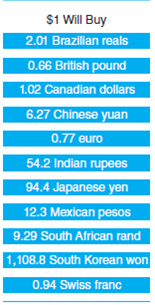
Brazil ran a current account deficit of $55 billion. What is its balance on the capital account?
F igure 6
Exchange Rates: Foreign Currency per American Dollar, January 12, 2013
How many Mexican pesos would you get for a dollar? You would get 12.2 pesos. Can you figure out how many dollars (actually how many cents) you would get for a peso? You would get 8.2 cents. Exchange rates fluctuate from minute to minute, and they are usually calibrated to hundredths, or even thousandths of a cent.
Source: The Federal Reserve, www.federalreserve.gov.
Brazil ran a current account deficit of $55 billion. What is its balance on the capital account?
Question
Question
Question
Question
Question
Question
Question

Unlock Deck
Sign up to unlock the cards in this deck!
Unlock Deck
Unlock Deck
1/72

Play

Full screen (f)
Deck 19: International Finance
1
The basis for international finance is the exchange of ______________.
The basis for international finance is required to be stated.
International finance is monetary interactions between difference countries. Since different countries have different national currencies, such international monetary interactions are possible because these national currencies can be exchanged in the foreign exchange market.
Therefore, the basis for international finance is the exchange of national currencies in the foreign exchange market.
International finance is monetary interactions between difference countries. Since different countries have different national currencies, such international monetary interactions are possible because these national currencies can be exchanged in the foreign exchange market.
Therefore, the basis for international finance is the exchange of national currencies in the foreign exchange market.
2
Under the gold standard, if country K's price level declines, its imports will ____________ and its exports will ____________.
Country K is on the gold standard. It is required to be stated what would happen if this country's price level declines.
If the price level of a country that is on the gold standard declines, then, country's goods become cheaper for both domestic buyers and foreigners. This means Country K's domestic buyers will import fewer goods from other countries and the foreigners will buy more goods from country K, therefore country K's imports will decline and exports will rise.
If the price level of a country that is on the gold standard declines, then, country's goods become cheaper for both domestic buyers and foreigners. This means Country K's domestic buyers will import fewer goods from other countries and the foreigners will buy more goods from country K, therefore country K's imports will decline and exports will rise.
3
Circle the letter that corresponds to the best answer. Today international finance is based on _________.
A) the gold standard
B) mainly a relatively free-floating exchange rate system
C) fixed rates of exchange
A) the gold standard
B) mainly a relatively free-floating exchange rate system
C) fixed rates of exchange
Exchange rate are determined by the intersection of demand and supply of currency. There are three types of exchange rate system: the gold standard, free floating exchange rate system and fixed rates of exchange.
Due to the fear of fluctuations most of countries has fixed exchange rates until 1973. After the failure of this currieries were allowed to float freely.
Currently international finance is based on mainly a relative free-floating exchange rate system.
Hence, option a, and c are incorrect.
free-floating exchange rate system consider as the best possible exchange rate regime as it automatically adjust to economic circumstances.
Hence,
 is correct.
Due to the fear of fluctuations most of countries has fixed exchange rates until 1973. After the failure of this currieries were allowed to float freely.
Currently international finance is based on mainly a relative free-floating exchange rate system.
Hence, option a, and c are incorrect.
free-floating exchange rate system consider as the best possible exchange rate regime as it automatically adjust to economic circumstances.
Hence,
is correct. 4
Use exchange rates listed in Figure 6 of the chapter to answer problems 13 through 16.
F igure 6
Exchange Rates: Foreign Currency per American Dollar, January 12, 2013
How many Mexican pesos would you get for a dollar? You would get 12.2 pesos. Can you figure out how many dollars (actually how many cents) you would get for a peso? You would get 8.2 cents. Exchange rates fluctuate from minute to minute, and they are usually calibrated to hundredths, or even thousandths of a cent.
Source: The Federal Reserve, www.federalreserve.gov.
How many Indian rupees can we get for 1 Mexican peso?
F igure 6
Exchange Rates: Foreign Currency per American Dollar, January 12, 2013
How many Mexican pesos would you get for a dollar? You would get 12.2 pesos. Can you figure out how many dollars (actually how many cents) you would get for a peso? You would get 8.2 cents. Exchange rates fluctuate from minute to minute, and they are usually calibrated to hundredths, or even thousandths of a cent.
Source: The Federal Reserve, www.federalreserve.gov.
How many Indian rupees can we get for 1 Mexican peso?
Unlock Deck
Unlock for access to all 72 flashcards in this deck.
Unlock Deck
k this deck
5
Circle the letter that corresponds to the best answer. Which statement is the most accurate?
A) The American empire, like the Romans, the Spanish, and the British before us, uses its military might to force other nations to provide us with low-cost goods.
B) No one would ever suggest that there is such a thing as an American empire.
C) We have become very dependent on our trading partners, who have been willing to accept U.S. dollars to finance our trade deficits.
D) Although our international trade position has deteriorated in recent years, we can continue on this course indefinitely.
A) The American empire, like the Romans, the Spanish, and the British before us, uses its military might to force other nations to provide us with low-cost goods.
B) No one would ever suggest that there is such a thing as an American empire.
C) We have become very dependent on our trading partners, who have been willing to accept U.S. dollars to finance our trade deficits.
D) Although our international trade position has deteriorated in recent years, we can continue on this course indefinitely.
Unlock Deck
Unlock for access to all 72 flashcards in this deck.
Unlock Deck
k this deck
6
Circle the letter that corresponds to the best answer. Which statement is the most accurate?
A) As a percentage of GDP, the United States has the highest current account surplus of any nation.
B) As a percentage of GDP, the United States has the highest current account deficit of any nation.
C) Our current account deficit has been rising for the last 10 years.
D) Our current account deficit indefinitely cannot be sustained.
A) As a percentage of GDP, the United States has the highest current account surplus of any nation.
B) As a percentage of GDP, the United States has the highest current account deficit of any nation.
C) Our current account deficit has been rising for the last 10 years.
D) Our current account deficit indefinitely cannot be sustained.
Unlock Deck
Unlock for access to all 72 flashcards in this deck.
Unlock Deck
k this deck
7
Use the exchange rates listed in Figure 6 to find how much it would cost in the currency specified to make the purchases listed in problems 5 through 8.
F igure 6
Exchange Rates: Foreign Currency per American Dollar, January 12, 2013
How many Mexican pesos would you get for a dollar? You would get 12.2 pesos. Can you figure out how many dollars (actually how many cents) you would get for a peso? You would get 8.2 cents. Exchange rates fluctuate from minute to minute, and they are usually calibrated to hundredths, or even thousandths of a cent.
Source: The Federal Reserve, www.federalreserve.gov.
If you could buy a market basket of goods and services in the United States for $1,000 and those same goods and services cost you $1,200 after you converted your dollars into euros: (a) Is the euro undervalued or overvalued relative to the dollar? (b) By what percentage?
F igure 6
Exchange Rates: Foreign Currency per American Dollar, January 12, 2013
How many Mexican pesos would you get for a dollar? You would get 12.2 pesos. Can you figure out how many dollars (actually how many cents) you would get for a peso? You would get 8.2 cents. Exchange rates fluctuate from minute to minute, and they are usually calibrated to hundredths, or even thousandths of a cent.
Source: The Federal Reserve, www.federalreserve.gov.
If you could buy a market basket of goods and services in the United States for $1,000 and those same goods and services cost you $1,200 after you converted your dollars into euros: (a) Is the euro undervalued or overvalued relative to the dollar? (b) By what percentage?
Unlock Deck
Unlock for access to all 72 flashcards in this deck.
Unlock Deck
k this deck
8
Circle the letter that corresponds to the best answer. Today currency exchange rates are set mainly by __________.
A) the International Monetary Fund
B) the U.S. Treasury
C) bilateral agreements between trading nations
D) supply and demand
A) the International Monetary Fund
B) the U.S. Treasury
C) bilateral agreements between trading nations
D) supply and demand
Unlock Deck
Unlock for access to all 72 flashcards in this deck.
Unlock Deck
k this deck
9
Use the exchange rates listed in Figure 6 of the chapter to find how much it would cost in U.S. dollars and cents to make the purchases listed in problems 1 through 4.
F igure 6
Exchange Rates: Foreign Currency per American Dollar, January 12, 2013
How many Mexican pesos would you get for a dollar? You would get 12.2 pesos. Can you figure out how many dollars (actually how many cents) you would get for a peso? You would get 8.2 cents. Exchange rates fluctuate from minute to minute, and they are usually calibrated to hundredths, or even thousandths of a cent.
Source: The Federal Reserve, www.federalreserve.gov.
A British book priced at 12 pounds.
F igure 6
Exchange Rates: Foreign Currency per American Dollar, January 12, 2013
How many Mexican pesos would you get for a dollar? You would get 12.2 pesos. Can you figure out how many dollars (actually how many cents) you would get for a peso? You would get 8.2 cents. Exchange rates fluctuate from minute to minute, and they are usually calibrated to hundredths, or even thousandths of a cent.
Source: The Federal Reserve, www.federalreserve.gov.
A British book priced at 12 pounds.
Unlock Deck
Unlock for access to all 72 flashcards in this deck.
Unlock Deck
k this deck
10
Use the exchange rates listed in Figure 6 to find how much it would cost in the currency specified to make the purchases listed in problems 5 through 8.
F igure 6
Exchange Rates: Foreign Currency per American Dollar, January 12, 2013
How many Mexican pesos would you get for a dollar? You would get 12.2 pesos. Can you figure out how many dollars (actually how many cents) you would get for a peso? You would get 8.2 cents. Exchange rates fluctuate from minute to minute, and they are usually calibrated to hundredths, or even thousandths of a cent.
Source: The Federal Reserve, www.federalreserve.gov.
A Cadillac priced at $20,000 is sold in London.
F igure 6
Exchange Rates: Foreign Currency per American Dollar, January 12, 2013
How many Mexican pesos would you get for a dollar? You would get 12.2 pesos. Can you figure out how many dollars (actually how many cents) you would get for a peso? You would get 8.2 cents. Exchange rates fluctuate from minute to minute, and they are usually calibrated to hundredths, or even thousandths of a cent.
Source: The Federal Reserve, www.federalreserve.gov.
A Cadillac priced at $20,000 is sold in London.
Unlock Deck
Unlock for access to all 72 flashcards in this deck.
Unlock Deck
k this deck
11
Who demands Japanese yen? Who supplies yen?
Unlock Deck
Unlock for access to all 72 flashcards in this deck.
Unlock Deck
k this deck
12
Circle the letter that corresponds to the best answer. The most important influence on the exchange rate between two countries is ________.
A) the relative price levels of the two countries
B) the relative growth rates of the two countries
C) the relative level of interest rates in both countries
D) the relative wage rates of both countries
A) the relative price levels of the two countries
B) the relative growth rates of the two countries
C) the relative level of interest rates in both countries
D) the relative wage rates of both countries
Unlock Deck
Unlock for access to all 72 flashcards in this deck.
Unlock Deck
k this deck
13
Why does the dollar fluctuate with other currencies?
Unlock Deck
Unlock for access to all 72 flashcards in this deck.
Unlock Deck
k this deck
14
If the dollar depreciates relative to the Japanese yen, will the Sony DVD player you wanted become more or less expensive? What effect will this have on the number of Sony DVD players that Americans buy?
Unlock Deck
Unlock for access to all 72 flashcards in this deck.
Unlock Deck
k this deck
15
Circle the letter that corresponds to the best answer. The international gold standard worked well until ___________.
A) World War I
B) 1940
C) 1968
D) 1975
A) World War I
B) 1940
C) 1968
D) 1975
Unlock Deck
Unlock for access to all 72 flashcards in this deck.
Unlock Deck
k this deck
16
Circle the letter that corresponds to the best answer. Devaluation would tend to _________.
A) make the devaluating country's goods cheaper
B) make the devaluating country's goods more expensive
C) have no effect on the value of the devaluating country's goods
A) make the devaluating country's goods cheaper
B) make the devaluating country's goods more expensive
C) have no effect on the value of the devaluating country's goods
Unlock Deck
Unlock for access to all 72 flashcards in this deck.
Unlock Deck
k this deck
17
A nation is on the gold standard when it ________________.
Unlock Deck
Unlock for access to all 72 flashcards in this deck.
Unlock Deck
k this deck
18
Today exchange rates are set by _____________ and _______________.
Unlock Deck
Unlock for access to all 72 flashcards in this deck.
Unlock Deck
k this deck
19
Use the exchange rates listed in Figure 6 to find how much it would cost in the currency specified to make the purchases listed in problems 5 through 8.
F igure 6
Exchange Rates: Foreign Currency per American Dollar, January 12, 2013
How many Mexican pesos would you get for a dollar? You would get 12.2 pesos. Can you figure out how many dollars (actually how many cents) you would get for a peso? You would get 8.2 cents. Exchange rates fluctuate from minute to minute, and they are usually calibrated to hundredths, or even thousandths of a cent.
Source: The Federal Reserve, www.federalreserve.gov.
If you could buy a market basket of goods and services in the United States for $10,000 and those same goods and services cost you $7,000 in Russia after you converted your dollars into rubles: (a) Is the ruble undervalued or overvalued relative to the dollar? (b) By what percentage?
F igure 6
Exchange Rates: Foreign Currency per American Dollar, January 12, 2013
How many Mexican pesos would you get for a dollar? You would get 12.2 pesos. Can you figure out how many dollars (actually how many cents) you would get for a peso? You would get 8.2 cents. Exchange rates fluctuate from minute to minute, and they are usually calibrated to hundredths, or even thousandths of a cent.
Source: The Federal Reserve, www.federalreserve.gov.
If you could buy a market basket of goods and services in the United States for $10,000 and those same goods and services cost you $7,000 in Russia after you converted your dollars into rubles: (a) Is the ruble undervalued or overvalued relative to the dollar? (b) By what percentage?
Unlock Deck
Unlock for access to all 72 flashcards in this deck.
Unlock Deck
k this deck
20
Circle the letter that corresponds to the best answer. Which statement is the most accurate?
A) Since the euro was introduced it has lost almost half its value.
B) The euro has facilitated trade among the members of the euro zone.
C) The euro is now the world's most important reserve currency.
D) The euro circulates as currency in most of the countries of the world.
A) Since the euro was introduced it has lost almost half its value.
B) The euro has facilitated trade among the members of the euro zone.
C) The euro is now the world's most important reserve currency.
D) The euro circulates as currency in most of the countries of the world.
Unlock Deck
Unlock for access to all 72 flashcards in this deck.
Unlock Deck
k this deck
21
Circle the letter that corresponds to the best answer. During the 1980s and 1990s, _________.
A) both American investment abroad and foreign investment in the United States increased
B) both American investment abroad and foreign investment in the United States decreased
C) American investment abroad increased and foreign investment in the United States de creased
D) American investment abroad decreased and foreign investment in the United States in creased
A) both American investment abroad and foreign investment in the United States increased
B) both American investment abroad and foreign investment in the United States decreased
C) American investment abroad increased and foreign investment in the United States de creased
D) American investment abroad decreased and foreign investment in the United States in creased
Unlock Deck
Unlock for access to all 72 flashcards in this deck.
Unlock Deck
k this deck
22
Circle the letter that corresponds to the best answer. An American importer of Italian shoes would pay in __________.
A) dollars
B) gold
C) euros
D) lira
A) dollars
B) gold
C) euros
D) lira
Unlock Deck
Unlock for access to all 72 flashcards in this deck.
Unlock Deck
k this deck
23
Practical Application: Foreigners are buying up hundreds of billions of dollars a year in American assets. In what ways should this be a matter of concern to Americans?
Unlock Deck
Unlock for access to all 72 flashcards in this deck.
Unlock Deck
k this deck
24
Circle the letter that corresponds to the best answer. The main reason why we are the world's largest debtor nation is _________.
A) our military spending
B) our trade deficit
C) inflation
D) high taxes
A) our military spending
B) our trade deficit
C) inflation
D) high taxes
Unlock Deck
Unlock for access to all 72 flashcards in this deck.
Unlock Deck
k this deck
25
Use the exchange rates listed in Figure 6 of the chapter to find how much it would cost in U.S. dollars and cents to make the purchases listed in problems 1 through 4.
F igure 6
Exchange Rates: Foreign Currency per American Dollar, January 12, 2013
How many Mexican pesos would you get for a dollar? You would get 12.2 pesos. Can you figure out how many dollars (actually how many cents) you would get for a peso? You would get 8.2 cents. Exchange rates fluctuate from minute to minute, and they are usually calibrated to hundredths, or even thousandths of a cent.
Source: The Federal Reserve, www.federalreserve.gov.
A German camera priced at 250 euros.
F igure 6
Exchange Rates: Foreign Currency per American Dollar, January 12, 2013
How many Mexican pesos would you get for a dollar? You would get 12.2 pesos. Can you figure out how many dollars (actually how many cents) you would get for a peso? You would get 8.2 cents. Exchange rates fluctuate from minute to minute, and they are usually calibrated to hundredths, or even thousandths of a cent.
Source: The Federal Reserve, www.federalreserve.gov.
A German camera priced at 250 euros.
Unlock Deck
Unlock for access to all 72 flashcards in this deck.
Unlock Deck
k this deck
26
Use the exchange rates listed in Figure 6 to find how much it would cost in the currency specified to make the purchases listed in problems 5 through 8.
F igure 6
Exchange Rates: Foreign Currency per American Dollar, January 12, 2013
How many Mexican pesos would you get for a dollar? You would get 12.2 pesos. Can you figure out how many dollars (actually how many cents) you would get for a peso? You would get 8.2 cents. Exchange rates fluctuate from minute to minute, and they are usually calibrated to hundredths, or even thousandths of a cent.
Source: The Federal Reserve, www.federalreserve.gov.
A bottle of Viagra priced at $40 is sold in Berlin.
F igure 6
Exchange Rates: Foreign Currency per American Dollar, January 12, 2013
How many Mexican pesos would you get for a dollar? You would get 12.2 pesos. Can you figure out how many dollars (actually how many cents) you would get for a peso? You would get 8.2 cents. Exchange rates fluctuate from minute to minute, and they are usually calibrated to hundredths, or even thousandths of a cent.
Source: The Federal Reserve, www.federalreserve.gov.
A bottle of Viagra priced at $40 is sold in Berlin.
Unlock Deck
Unlock for access to all 72 flashcards in this deck.
Unlock Deck
k this deck
27
Circle the letter that corresponds to the best answer. If we were on an international gold standard, _________.
A) inflations would be eliminated
B) recessions would be eliminated
C) trade deficits and surpluses would be eliminated
D) no nation would ever have to devaluate its currency
A) inflations would be eliminated
B) recessions would be eliminated
C) trade deficits and surpluses would be eliminated
D) no nation would ever have to devaluate its currency
Unlock Deck
Unlock for access to all 72 flashcards in this deck.
Unlock Deck
k this deck
28
Circle the letter that corresponds to the best answer. Which statement is the most accurate?
A) Since our current account deficit is matched by our capital account surplus, we have no problem with respect to our international transactions.
B) Foreigners invest all the dollars they receive from our capital account deficit to buy American assets.
C) Our current account deficits are declining and should disappear before the year 2020.
D) A declining dollar makes foreign investment in dollar-denominated assets much less attractive to foreigners.
A) Since our current account deficit is matched by our capital account surplus, we have no problem with respect to our international transactions.
B) Foreigners invest all the dollars they receive from our capital account deficit to buy American assets.
C) Our current account deficits are declining and should disappear before the year 2020.
D) A declining dollar makes foreign investment in dollar-denominated assets much less attractive to foreigners.
Unlock Deck
Unlock for access to all 72 flashcards in this deck.
Unlock Deck
k this deck
29
How did the United States go from being the world's largest creditor nation to the world's largest debtor?
Unlock Deck
Unlock for access to all 72 flashcards in this deck.
Unlock Deck
k this deck
30
Explain why a currency depreciation leads to an improvement in a nation's balance of trade.
Unlock Deck
Unlock for access to all 72 flashcards in this deck.
Unlock Deck
k this deck
31
Use exchange rates listed in Figure 6 of the chapter to answer problems 13 through 16.
F igure 6
Exchange Rates: Foreign Currency per American Dollar, January 12, 2013
How many Mexican pesos would you get for a dollar? You would get 12.2 pesos. Can you figure out how many dollars (actually how many cents) you would get for a peso? You would get 8.2 cents. Exchange rates fluctuate from minute to minute, and they are usually calibrated to hundredths, or even thousandths of a cent.
Source: The Federal Reserve, www.federalreserve.gov.
How many South African rand can we get for 1 Canadian dollar?
F igure 6
Exchange Rates: Foreign Currency per American Dollar, January 12, 2013
How many Mexican pesos would you get for a dollar? You would get 12.2 pesos. Can you figure out how many dollars (actually how many cents) you would get for a peso? You would get 8.2 cents. Exchange rates fluctuate from minute to minute, and they are usually calibrated to hundredths, or even thousandths of a cent.
Source: The Federal Reserve, www.federalreserve.gov.
How many South African rand can we get for 1 Canadian dollar?
Unlock Deck
Unlock for access to all 72 flashcards in this deck.
Unlock Deck
k this deck
32
Circle the letter that corresponds to the best answer. Which statement is the most accurate?
A) There is no basis for the claim that the United States is living beyond its means.
B) Our current account deficit is not a serious problem.
C) Our trade deficit is a major economic problem.
D) Since 2002 the dollar has been rising against most major currencies.
A) There is no basis for the claim that the United States is living beyond its means.
B) Our current account deficit is not a serious problem.
C) Our trade deficit is a major economic problem.
D) Since 2002 the dollar has been rising against most major currencies.
Unlock Deck
Unlock for access to all 72 flashcards in this deck.
Unlock Deck
k this deck
33
The entire flow of U.S. dollars and foreign currencies into and out of the country constitutes our ____________.
Unlock Deck
Unlock for access to all 72 flashcards in this deck.
Unlock Deck
k this deck
34
To be on the gold standard, a nation must maintain a fixed ratio between its gold stock and ____________.
Unlock Deck
Unlock for access to all 72 flashcards in this deck.
Unlock Deck
k this deck
35
If Tim Matray wanted to buy wine from a French merchant, he would pay her with ________________.
Unlock Deck
Unlock for access to all 72 flashcards in this deck.
Unlock Deck
k this deck
36
Practical Application: Anne Hilbert has been hired by a Washington think tank to predict the trend over the next decade in the weighted average exchange value of the U.S. dollar. Its record from 1994 through early 2013 is shown in Figure 5; she needs to provide evidence to back up her conclusion.
F igure 5
Trade Weighted U.S. Dollar Index* 1995-2013
*Averages of daily figures. A weighted average of the foreign exchange value of the U.S. dollar against the currencies of a broad group of major U.S. trading partners. Broad currency index includes the Euro Area, Canada, Japan, Mexico, China, United Kingdom, Taiwan, Korea, Singapore, Hong Kong, Malaysia, Brazil, Switzerland, Thailand, Philippines, Australia, Indonesia, India, Israel, Saudi Arabia, Russia, Sweden, Argentina, Venezuela, Chile, and Colombia.
Source: http://research.stlouis.org/fred2/series/TWEXB.
F igure 5
Trade Weighted U.S. Dollar Index* 1995-2013
*Averages of daily figures. A weighted average of the foreign exchange value of the U.S. dollar against the currencies of a broad group of major U.S. trading partners. Broad currency index includes the Euro Area, Canada, Japan, Mexico, China, United Kingdom, Taiwan, Korea, Singapore, Hong Kong, Malaysia, Brazil, Switzerland, Thailand, Philippines, Australia, Indonesia, India, Israel, Saudi Arabia, Russia, Sweden, Argentina, Venezuela, Chile, and Colombia.
Source: http://research.stlouis.org/fred2/series/TWEXB.
Unlock Deck
Unlock for access to all 72 flashcards in this deck.
Unlock Deck
k this deck
37
Circle the letter that corresponds to the best answer. If you were going to spend time in Italy, France, and Germany, you would be paying for things with __________.
A) lira, francs, and marks
B) dollars
C) euros
D) gold
A) lira, francs, and marks
B) dollars
C) euros
D) gold
Unlock Deck
Unlock for access to all 72 flashcards in this deck.
Unlock Deck
k this deck
38
Circle the letter that corresponds to the best answer. We became a debtor nation in ________.
A) 1975
B) 1980
C) 1985
D) 1990
A) 1975
B) 1980
C) 1985
D) 1990
Unlock Deck
Unlock for access to all 72 flashcards in this deck.
Unlock Deck
k this deck
39
Circle the letter that corresponds to the best answer. The world's leading debtor nation is ___________.
A) Argentina
B) Brazil
C) Mexico
D) the United States
A) Argentina
B) Brazil
C) Mexico
D) the United States
Unlock Deck
Unlock for access to all 72 flashcards in this deck.
Unlock Deck
k this deck
40
Circle the letter that corresponds to the best answer. The total of our current and capital accounts __________.
A) will always be zero
B) will always be negative
C) will always be positive
D) may be positive or negative
A) will always be zero
B) will always be negative
C) will always be positive
D) may be positive or negative
Unlock Deck
Unlock for access to all 72 flashcards in this deck.
Unlock Deck
k this deck
41
Circle the letter that corresponds to the best answer. Which statement is false?
A) The gold standard will work only when the gold supply increases as quickly as the world's need for money.
B) The gold standard will work only if all nations agree to devaluate their currencies simultaneously.
C) The gold standard will work only if participating nations are willing to accept periodic inflation.
D) The gold standard will work only if participating nations are willing to accept periodic unemployment.
A) The gold standard will work only when the gold supply increases as quickly as the world's need for money.
B) The gold standard will work only if all nations agree to devaluate their currencies simultaneously.
C) The gold standard will work only if participating nations are willing to accept periodic inflation.
D) The gold standard will work only if participating nations are willing to accept periodic unemployment.
Unlock Deck
Unlock for access to all 72 flashcards in this deck.
Unlock Deck
k this deck
42
Circle the letter that corresponds to the best answer. Which statement is the most accurate?
A) Our balance on the current account is negative.
B) Since our balance of payments is always zero, there is little to worry about.
C) The income Americans receive from their foreign investments is much greater than the income foreigners receive for their American investments.
D) Because our imports are much greater than our exports, the federal government is forced to make up the difference.
A) Our balance on the current account is negative.
B) Since our balance of payments is always zero, there is little to worry about.
C) The income Americans receive from their foreign investments is much greater than the income foreigners receive for their American investments.
D) Because our imports are much greater than our exports, the federal government is forced to make up the difference.
Unlock Deck
Unlock for access to all 72 flashcards in this deck.
Unlock Deck
k this deck
43
Use the exchange rates listed in Figure 6 of the chapter to find how much it would cost in U.S. dollars and cents to make the purchases listed in problems 1 through 4.
F igure 6
Exchange Rates: Foreign Currency per American Dollar, January 12, 2013
How many Mexican pesos would you get for a dollar? You would get 12.2 pesos. Can you figure out how many dollars (actually how many cents) you would get for a peso? You would get 8.2 cents. Exchange rates fluctuate from minute to minute, and they are usually calibrated to hundredths, or even thousandths of a cent.
Source: The Federal Reserve, www.federalreserve.gov.
A Toyota Corolla priced at 1.4 million yen.
F igure 6
Exchange Rates: Foreign Currency per American Dollar, January 12, 2013
How many Mexican pesos would you get for a dollar? You would get 12.2 pesos. Can you figure out how many dollars (actually how many cents) you would get for a peso? You would get 8.2 cents. Exchange rates fluctuate from minute to minute, and they are usually calibrated to hundredths, or even thousandths of a cent.
Source: The Federal Reserve, www.federalreserve.gov.
A Toyota Corolla priced at 1.4 million yen.
Unlock Deck
Unlock for access to all 72 flashcards in this deck.
Unlock Deck
k this deck
44
Use the exchange rates listed in Figure 6 to find how much it would cost in the currency specified to make the purchases listed in problems 5 through 8.
F igure 6
Exchange Rates: Foreign Currency per American Dollar, January 12, 2013
How many Mexican pesos would you get for a dollar? You would get 12.2 pesos. Can you figure out how many dollars (actually how many cents) you would get for a peso? You would get 8.2 cents. Exchange rates fluctuate from minute to minute, and they are usually calibrated to hundredths, or even thousandths of a cent.
Source: The Federal Reserve, www.federalreserve.gov.
A DVD priced at $10 is sold in Mexico City.
F igure 6
Exchange Rates: Foreign Currency per American Dollar, January 12, 2013
How many Mexican pesos would you get for a dollar? You would get 12.2 pesos. Can you figure out how many dollars (actually how many cents) you would get for a peso? You would get 8.2 cents. Exchange rates fluctuate from minute to minute, and they are usually calibrated to hundredths, or even thousandths of a cent.
Source: The Federal Reserve, www.federalreserve.gov.
A DVD priced at $10 is sold in Mexico City.
Unlock Deck
Unlock for access to all 72 flashcards in this deck.
Unlock Deck
k this deck
45
Use the exchange rates listed in Figure 6 to find how much it would cost in the currency specified to make the purchases listed in problems 5 through 8.
F igure 6
Exchange Rates: Foreign Currency per American Dollar, January 12, 2013
How many Mexican pesos would you get for a dollar? You would get 12.2 pesos. Can you figure out how many dollars (actually how many cents) you would get for a peso? You would get 8.2 cents. Exchange rates fluctuate from minute to minute, and they are usually calibrated to hundredths, or even thousandths of a cent.
Source: The Federal Reserve, www.federalreserve.gov.
A country had exports of $100 billion, imports of $90 billion, net transfers from abroad of - $10 billion, and - $5 billion of net income from foreign investments. What is the country's current account balance?
F igure 6
Exchange Rates: Foreign Currency per American Dollar, January 12, 2013
How many Mexican pesos would you get for a dollar? You would get 12.2 pesos. Can you figure out how many dollars (actually how many cents) you would get for a peso? You would get 8.2 cents. Exchange rates fluctuate from minute to minute, and they are usually calibrated to hundredths, or even thousandths of a cent.
Source: The Federal Reserve, www.federalreserve.gov.
A country had exports of $100 billion, imports of $90 billion, net transfers from abroad of - $10 billion, and - $5 billion of net income from foreign investments. What is the country's current account balance?
Unlock Deck
Unlock for access to all 72 flashcards in this deck.
Unlock Deck
k this deck
46
Use exchange rates listed in Figure 6 of the chapter to answer problems 13 through 16.
F igure 6
Exchange Rates: Foreign Currency per American Dollar, January 12, 2013
How many Mexican pesos would you get for a dollar? You would get 12.2 pesos. Can you figure out how many dollars (actually how many cents) you would get for a peso? You would get 8.2 cents. Exchange rates fluctuate from minute to minute, and they are usually calibrated to hundredths, or even thousandths of a cent.
Source: The Federal Reserve, www.federalreserve.gov.
How many Canadian dollars can we get for 1 South African rand?
F igure 6
Exchange Rates: Foreign Currency per American Dollar, January 12, 2013
How many Mexican pesos would you get for a dollar? You would get 12.2 pesos. Can you figure out how many dollars (actually how many cents) you would get for a peso? You would get 8.2 cents. Exchange rates fluctuate from minute to minute, and they are usually calibrated to hundredths, or even thousandths of a cent.
Source: The Federal Reserve, www.federalreserve.gov.
How many Canadian dollars can we get for 1 South African rand?
Unlock Deck
Unlock for access to all 72 flashcards in this deck.
Unlock Deck
k this deck
47
Circle the letter that corresponds to the best answer. Suppose the world was on the gold standard. If Peru ran persistent trade deficits, ________.
A) Peru would be able to continue doing so with no consequences
B) Peru's money stock would decline, its prices would fall, and its trade deficit disappear
C) Peru would soon suffer from inflation
D) Peru would raise tariffs and prohibit the shipment of gold from the country
A) Peru would be able to continue doing so with no consequences
B) Peru's money stock would decline, its prices would fall, and its trade deficit disappear
C) Peru would soon suffer from inflation
D) Peru would raise tariffs and prohibit the shipment of gold from the country
Unlock Deck
Unlock for access to all 72 flashcards in this deck.
Unlock Deck
k this deck
48
What is meant by our balance of payments? Explain what current account and capital account are.
Unlock Deck
Unlock for access to all 72 flashcards in this deck.
Unlock Deck
k this deck
49
Can there be a deficit on current account and a deficit on capital account at the same time? Explain.
Unlock Deck
Unlock for access to all 72 flashcards in this deck.
Unlock Deck
k this deck
50
What is a foreign exchange rate? Provide a few examples.
Unlock Deck
Unlock for access to all 72 flashcards in this deck.
Unlock Deck
k this deck
51
Web Activity: Jennifer Saxton bought a microwave oven made in China for $200. How much would she have paid in Chinese yuan? Go to www.x-rates.com/calculator.html.
Unlock Deck
Unlock for access to all 72 flashcards in this deck.
Unlock Deck
k this deck
52
Circle the letter that corresponds to the best answer. According to the Big Mac index, _________.
A) the U.S. dollar is too highly valued relative to virtually all other currencies
B) the U.S. dollar is valued too low relative to virtually all other currencies
C) you will be able to buy a Big Mac much more cheaply in China or Russia than in the United States
D) you will have to pay much more for a Big Mac in China or Russia than you would in the United States
A) the U.S. dollar is too highly valued relative to virtually all other currencies
B) the U.S. dollar is valued too low relative to virtually all other currencies
C) you will be able to buy a Big Mac much more cheaply in China or Russia than in the United States
D) you will have to pay much more for a Big Mac in China or Russia than you would in the United States
Unlock Deck
Unlock for access to all 72 flashcards in this deck.
Unlock Deck
k this deck
53
Most all the dollars that foreigners have earned from trading with the United States have been _________ in the form of ________________.
Unlock Deck
Unlock for access to all 72 flashcards in this deck.
Unlock Deck
k this deck
54
Under the gold standard, if country J imports more than it exports, it has to ship ____________ to the trading partners with whom it has trade deficits. This will depress country J's ___________, and its price level will ___________.
Unlock Deck
Unlock for access to all 72 flashcards in this deck.
Unlock Deck
k this deck
55
The main difference between our being a debtor nation in the 19th century and our being a debtor nation since the early 1980s was that in the 19 th century we ran up a debt by buying ___________ goods; since the early 1980s we have run up a debt buying ______________ goods.
Unlock Deck
Unlock for access to all 72 flashcards in this deck.
Unlock Deck
k this deck
56
Circle the letter that corresponds to the best answer. The gold exchange standard was in effect from ___________.
A) 1900 to 1944
B) 1944 to 1973
C) 1955 to 1980
D) 1973 to the present
A) 1900 to 1944
B) 1944 to 1973
C) 1955 to 1980
D) 1973 to the present
Unlock Deck
Unlock for access to all 72 flashcards in this deck.
Unlock Deck
k this deck
57
Circle the letter that corresponds to the best answer. Which statement is the most accurate? In early 2013 there was strong evidence that the _________.
A) yuan and yen were overvalued against the dollar
B) yuan and yen were undervalued against the dollar
C) yuan was undervalued against the yen
D) yen was undervalued against the yuan
A) yuan and yen were overvalued against the dollar
B) yuan and yen were undervalued against the dollar
C) yuan was undervalued against the yen
D) yen was undervalued against the yuan
Unlock Deck
Unlock for access to all 72 flashcards in this deck.
Unlock Deck
k this deck
58
Circle the letter that corresponds to the best answer. In 2011 our net foreign debt was over $ _________ trillion.
A) 2
B) 4
C) 6
D) 8
E) 10
A) 2
B) 4
C) 6
D) 8
E) 10
Unlock Deck
Unlock for access to all 72 flashcards in this deck.
Unlock Deck
k this deck
59
Circle the letter that corresponds to the best answer. Which statement is true?
A) Foreigners own most of the assets in the United States.
B) We own more assets in foreign countries than foreigners own in the United States.
C) Foreigners are driving up interest rates in the United States.
D) None of the above.
A) Foreigners own most of the assets in the United States.
B) We own more assets in foreign countries than foreigners own in the United States.
C) Foreigners are driving up interest rates in the United States.
D) None of the above.
Unlock Deck
Unlock for access to all 72 flashcards in this deck.
Unlock Deck
k this deck
60
Circle the letter that corresponds to the best answer. Statement 1. We have been running large balance of payments deficits in recent years. Statement 2. The most widely used currency in the world is the euro.
A) Statement 1 is true and statement 2 is false.
B) Statement 2 is true and statement 1 is false.
C) Both statements are true.
D) Both statements are false.
A) Statement 1 is true and statement 2 is false.
B) Statement 2 is true and statement 1 is false.
C) Both statements are true.
D) Both statements are false.
Unlock Deck
Unlock for access to all 72 flashcards in this deck.
Unlock Deck
k this deck
61
Use exchange rates listed in Figure 6 of the chapter to answer problems 13 through 16.
F igure 6
Exchange Rates: Foreign Currency per American Dollar, January 12, 2013
How many Mexican pesos would you get for a dollar? You would get 12.2 pesos. Can you figure out how many dollars (actually how many cents) you would get for a peso? You would get 8.2 cents. Exchange rates fluctuate from minute to minute, and they are usually calibrated to hundredths, or even thousandths of a cent.
Source: The Federal Reserve, www.federalreserve.gov.
How many Mexican pesos can we get for 1 Indian rupee?
F igure 6
Exchange Rates: Foreign Currency per American Dollar, January 12, 2013
How many Mexican pesos would you get for a dollar? You would get 12.2 pesos. Can you figure out how many dollars (actually how many cents) you would get for a peso? You would get 8.2 cents. Exchange rates fluctuate from minute to minute, and they are usually calibrated to hundredths, or even thousandths of a cent.
Source: The Federal Reserve, www.federalreserve.gov.
How many Mexican pesos can we get for 1 Indian rupee?
Unlock Deck
Unlock for access to all 72 flashcards in this deck.
Unlock Deck
k this deck
62
Circle the letter that corresponds to the best answer. Running mounting current account deficits is analogous to __________.
A) running up debt on a credit card
B) taking money out of one pocket and putting it in another
C) owing money to ourselves
D) borrowing money that never has to be repaid
A) running up debt on a credit card
B) taking money out of one pocket and putting it in another
C) owing money to ourselves
D) borrowing money that never has to be repaid
Unlock Deck
Unlock for access to all 72 flashcards in this deck.
Unlock Deck
k this deck
63
Use the exchange rates listed in Figure 6 of the chapter to find how much it would cost in U.S. dollars and cents to make the purchases listed in problems 1 through 4.
F igure 6
Exchange Rates: Foreign Currency per American Dollar, January 12, 2013
How many Mexican pesos would you get for a dollar? You would get 12.2 pesos. Can you figure out how many dollars (actually how many cents) you would get for a peso? You would get 8.2 cents. Exchange rates fluctuate from minute to minute, and they are usually calibrated to hundredths, or even thousandths of a cent.
Source: The Federal Reserve, www.federalreserve.gov.
A carton of Canadian paper priced at $9 Canadian.
F igure 6
Exchange Rates: Foreign Currency per American Dollar, January 12, 2013
How many Mexican pesos would you get for a dollar? You would get 12.2 pesos. Can you figure out how many dollars (actually how many cents) you would get for a peso? You would get 8.2 cents. Exchange rates fluctuate from minute to minute, and they are usually calibrated to hundredths, or even thousandths of a cent.
Source: The Federal Reserve, www.federalreserve.gov.
A carton of Canadian paper priced at $9 Canadian.
Unlock Deck
Unlock for access to all 72 flashcards in this deck.
Unlock Deck
k this deck
64
Use the exchange rates listed in Figure 6 to find how much it would cost in the currency specified to make the purchases listed in problems 5 through 8.
F igure 6
Exchange Rates: Foreign Currency per American Dollar, January 12, 2013
How many Mexican pesos would you get for a dollar? You would get 12.2 pesos. Can you figure out how many dollars (actually how many cents) you would get for a peso? You would get 8.2 cents. Exchange rates fluctuate from minute to minute, and they are usually calibrated to hundredths, or even thousandths of a cent.
Source: The Federal Reserve, www.federalreserve.gov.
Windows Vista priced at $100 is sold in China.
F igure 6
Exchange Rates: Foreign Currency per American Dollar, January 12, 2013
How many Mexican pesos would you get for a dollar? You would get 12.2 pesos. Can you figure out how many dollars (actually how many cents) you would get for a peso? You would get 8.2 cents. Exchange rates fluctuate from minute to minute, and they are usually calibrated to hundredths, or even thousandths of a cent.
Source: The Federal Reserve, www.federalreserve.gov.
Windows Vista priced at $100 is sold in China.
Unlock Deck
Unlock for access to all 72 flashcards in this deck.
Unlock Deck
k this deck
65
Use the exchange rates listed in Figure 6 to find how much it would cost in the currency specified to make the purchases listed in problems 5 through 8.
F igure 6
Exchange Rates: Foreign Currency per American Dollar, January 12, 2013
How many Mexican pesos would you get for a dollar? You would get 12.2 pesos. Can you figure out how many dollars (actually how many cents) you would get for a peso? You would get 8.2 cents. Exchange rates fluctuate from minute to minute, and they are usually calibrated to hundredths, or even thousandths of a cent.
Source: The Federal Reserve, www.federalreserve.gov.
Brazil ran a current account deficit of $55 billion. What is its balance on the capital account?
F igure 6
Exchange Rates: Foreign Currency per American Dollar, January 12, 2013
How many Mexican pesos would you get for a dollar? You would get 12.2 pesos. Can you figure out how many dollars (actually how many cents) you would get for a peso? You would get 8.2 cents. Exchange rates fluctuate from minute to minute, and they are usually calibrated to hundredths, or even thousandths of a cent.
Source: The Federal Reserve, www.federalreserve.gov.
Brazil ran a current account deficit of $55 billion. What is its balance on the capital account?
Unlock Deck
Unlock for access to all 72 flashcards in this deck.
Unlock Deck
k this deck
66
Web Activity: Melissa Larmon bought a German camera for 300 euros. How much would she have paid in U.S. dollars? Go to www.x-rates.com/calculator.html.
Unlock Deck
Unlock for access to all 72 flashcards in this deck.
Unlock Deck
k this deck
67
Circle the letter that corresponds to the best answer. If a Japanese DVD player priced at 12,000 yen can be purchased for $60, the exchange rate is __________.
A) 200 yen per dollar
B) 20 yen per dollar
C) 20 dollars per yen
D) 200 dollars per yen
E) none of the above
A) 200 yen per dollar
B) 20 yen per dollar
C) 20 dollars per yen
D) 200 dollars per yen
E) none of the above
Unlock Deck
Unlock for access to all 72 flashcards in this deck.
Unlock Deck
k this deck
68
What is the gold standard? How does it work?
Unlock Deck
Unlock for access to all 72 flashcards in this deck.
Unlock Deck
k this deck
69
For several months before your vacation trip to Germany you find that the exchange rate for the dollar has increased relative to the euro. Are you pleased or saddened? Explain.
Unlock Deck
Unlock for access to all 72 flashcards in this deck.
Unlock Deck
k this deck
70
How is the exchange rate determined in a freely floating rate system?
Unlock Deck
Unlock for access to all 72 flashcards in this deck.
Unlock Deck
k this deck
71
Circle the letter that corresponds to the best answer. The United States began to consistently run current account deficits since _____________.
A) 1961
B) 1975
C) 1981
D) 1991
E) 2001
A) 1961
B) 1975
C) 1981
D) 1991
E) 2001
Unlock Deck
Unlock for access to all 72 flashcards in this deck.
Unlock Deck
k this deck
72
Circle the letter that corresponds to the best answer. Suppose that last month the U.S. dollar was trading on the foreign-exchange market at 0.85 euro per dollar, and today the U.S. dollar is trading at 0.88 euro per dollar. Explain what has happened.
A) The dollar has depreciated and the euro has appreciated.
B) The euro has depreciated and the dollar has appreciated.
C) Both the euro and the dollar have appreciated.
D) Neither the euro nor the dollar have depreciated.
A) The dollar has depreciated and the euro has appreciated.
B) The euro has depreciated and the dollar has appreciated.
C) Both the euro and the dollar have appreciated.
D) Neither the euro nor the dollar have depreciated.
Unlock Deck
Unlock for access to all 72 flashcards in this deck.
Unlock Deck
k this deck
Unlock Deck
Unlock for access to all 72 flashcards in this deck.






