







 Chat with AI

Deck 18: Income Inequality and Poverty
Full screen (f)

Question

Question
Below are hypothetical production possibilities tables for New Zealand and Spain. Each country can produce apples and plums.
New Zealand's Production Possibilities Table (Millions of Bushels)
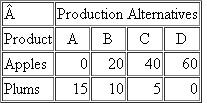
Spain's Production Possibilities Table (Millions of Bushels)
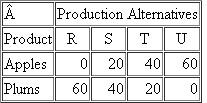
Referring to the tables, answer the following:
a. What is each country's cost ratio of producing plums and apples
b. Which nation should specialize in which product
c. Suppose the optimal product mixes before specialization and trade are alternative B in New Zealand and alternative S in Spain and the actual terms of trade are 1 plum for 2 apples. What will be the gains from specialization and trade
New Zealand's Production Possibilities Table (Millions of Bushels)
Spain's Production Possibilities Table (Millions of Bushels)
Referring to the tables, answer the following:
a. What is each country's cost ratio of producing plums and apples
b. Which nation should specialize in which product
c. Suppose the optimal product mixes before specialization and trade are alternative B in New Zealand and alternative S in Spain and the actual terms of trade are 1 plum for 2 apples. What will be the gains from specialization and trade
Question
The following are production possibilities tables for South Korea and the United States. Assume that before specialization and trade the optimal product mix for South Korea is alternative B and for the United States is alternative U.2
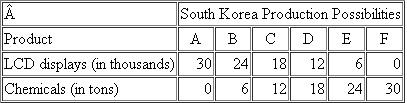
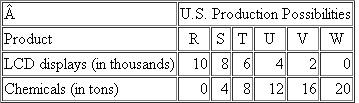
a. Are comparative-cost conditions such that the two areas should specialize If so, which product should each produce
b. What is the total gain in LCD displays and chemical output that would result from such specialization
c. What are the limits of the terms of trade Suppose actual terms of trade are 1 unit of LCD displays for

units of chemicals and that 4 units of LCD displays are exchanged for 6 units of chemicals. What are the gains from specialization and trade for each nation
d. Explain why this illustration allows you to conclude that specialization according to comparative advantage results in a more efficient use of world resources.
a. Are comparative-cost conditions such that the two areas should specialize If so, which product should each produce
b. What is the total gain in LCD displays and chemical output that would result from such specialization
c. What are the limits of the terms of trade Suppose actual terms of trade are 1 unit of LCD displays for
units of chemicals and that 4 units of LCD displays are exchanged for 6 units of chemicals. What are the gains from specialization and trade for each nation
d. Explain why this illustration allows you to conclude that specialization according to comparative advantage results in a more efficient use of world resources.
Question
Question
Question
Question
Question
Question
Question
Question
Question

Unlock Deck
Sign up to unlock the cards in this deck!
Unlock Deck
Unlock Deck
1/12

Play

Full screen (f)
Deck 18: Income Inequality and Poverty
1
Quantitatively, how important is international trade to the United States relative to its importance to other nations What country is the United States' most important trading partner, quantitatively With what country does the United States have the largest current trade deficit
Quantitatively, the importance of trade to the United States is more than it is to any other countries. The U.S. has the highest combined volume of exports and imports. It also is third in value of exports traded, after China and Germany.
The United States' most important trading partner, in terms of numbers, is Canada. Almost 20 percent of exported goods from the U.S. were to Canada in 2009, and 15 percent of imported goods came from Canada that year as well.
The U.S. has the largest trade deficit with China. A trade deficit occurs when the value of imports exceed the value of exports. In 2009, the U.S. had a $220 billion trade deficit with China.
The United States' most important trading partner, in terms of numbers, is Canada. Almost 20 percent of exported goods from the U.S. were to Canada in 2009, and 15 percent of imported goods came from Canada that year as well.
The U.S. has the largest trade deficit with China. A trade deficit occurs when the value of imports exceed the value of exports. In 2009, the U.S. had a $220 billion trade deficit with China.
2
Below are hypothetical production possibilities tables for New Zealand and Spain. Each country can produce apples and plums.
New Zealand's Production Possibilities Table (Millions of Bushels)
Spain's Production Possibilities Table (Millions of Bushels)
Referring to the tables, answer the following:
a. What is each country's cost ratio of producing plums and apples
b. Which nation should specialize in which product
c. Suppose the optimal product mixes before specialization and trade are alternative B in New Zealand and alternative S in Spain and the actual terms of trade are 1 plum for 2 apples. What will be the gains from specialization and trade
New Zealand's Production Possibilities Table (Millions of Bushels)
Spain's Production Possibilities Table (Millions of Bushels)
Referring to the tables, answer the following:
a. What is each country's cost ratio of producing plums and apples
b. Which nation should specialize in which product
c. Suppose the optimal product mixes before specialization and trade are alternative B in New Zealand and alternative S in Spain and the actual terms of trade are 1 plum for 2 apples. What will be the gains from specialization and trade
Below are the hypothetical production possibilities tables for New Zealand and Spain. Each country can produce apples and plums.
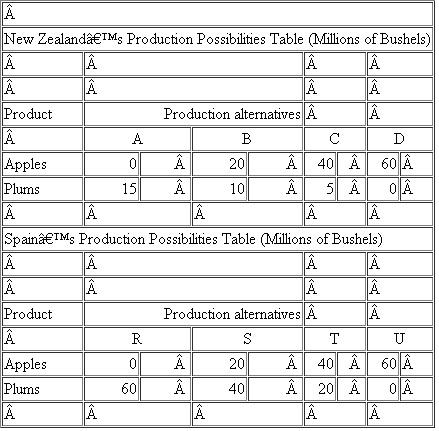 Referring to the tables, answer the following:
a. What is each country's cost ratio of producing plums and apples
b.Which nation should specialize in which product
c. Suppose the optimal product mixes before specialization and trade are alternative B in New Zealand and alternative S in Spain and the actual terms of trade are 1 plum for 2 apples. What would be gains from specialization and trade
(a)New Zealand's cost ratio is 1 plum = 4 apples (or 1 apple = 1/4 plum). Spain's cost ratio is 1 plum = 1 apple (or 1 apple = 1 plum).
(b) New Zealand should specialize in apples, Spain in plums.
(c) Total production before specialization and trade: 40 apples (20 + 20) and 50 plums (10 + 40). After specialization and trade: 60 apples and 60 plums. Gain = 20 apples and 10 plums.
Referring to the tables, answer the following:a. What is each country's cost ratio of producing plums and apples
b.Which nation should specialize in which product
c. Suppose the optimal product mixes before specialization and trade are alternative B in New Zealand and alternative S in Spain and the actual terms of trade are 1 plum for 2 apples. What would be gains from specialization and trade
(a)New Zealand's cost ratio is 1 plum = 4 apples (or 1 apple = 1/4 plum). Spain's cost ratio is 1 plum = 1 apple (or 1 apple = 1 plum).
(b) New Zealand should specialize in apples, Spain in plums.
(c) Total production before specialization and trade: 40 apples (20 + 20) and 50 plums (10 + 40). After specialization and trade: 60 apples and 60 plums. Gain = 20 apples and 10 plums.
3
The following are production possibilities tables for South Korea and the United States. Assume that before specialization and trade the optimal product mix for South Korea is alternative B and for the United States is alternative U.2
a. Are comparative-cost conditions such that the two areas should specialize If so, which product should each produce
b. What is the total gain in LCD displays and chemical output that would result from such specialization
c. What are the limits of the terms of trade Suppose actual terms of trade are 1 unit of LCD displays for
units of chemicals and that 4 units of LCD displays are exchanged for 6 units of chemicals. What are the gains from specialization and trade for each nation
d. Explain why this illustration allows you to conclude that specialization according to comparative advantage results in a more efficient use of world resources.
a. Are comparative-cost conditions such that the two areas should specialize If so, which product should each produce
b. What is the total gain in LCD displays and chemical output that would result from such specialization
c. What are the limits of the terms of trade Suppose actual terms of trade are 1 unit of LCD displays for
units of chemicals and that 4 units of LCD displays are exchanged for 6 units of chemicals. What are the gains from specialization and trade for each nation
d. Explain why this illustration allows you to conclude that specialization according to comparative advantage results in a more efficient use of world resources.
The following are production possibilities tables for South Korea and the United States. Assume that before specialization and trade the optimal product mix for South Korea is alternative B and for the United States alternative U. LO2
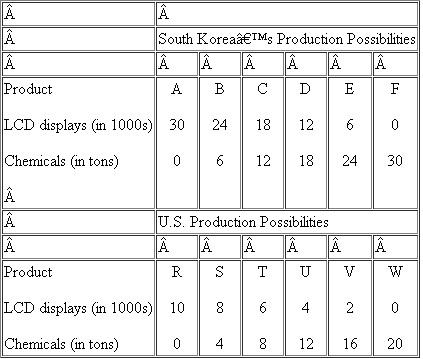 a. Are comparative-cost conditions such that the two areas should specialize If so, what product should each produce
b. What is the total gain in LCD displays and chemical output that would result from such specialization
c. What are the limits of the terms of trade Suppose actual terms of trade are 1 unit of LCD displays for 1½ units of chemicals and that 4 units of LCD displays are exchanged for 6 units of chemicals. What are the gains from specialization and trade for each nation
d. Explain why this illustration allows you to conclude that specialization according to comparative advantage results in more efficient use of world resources.
(a) Yes, because the opportunity cost of LCD displays is less (1L = 1C) in South Korea than in the United States (1L = 2C). South Korea should produce LCD displays and the United States should produce chemicals.
(b) If they specialize, the United States can produce 20 tons of chemicals and South Korea can produce 30,000 LCD displays. Before specialization South Korea produced alternative B and the United States alternative U for a total of 28,000 LCD displays (24,000 + 4,000) and 18 tons of chemicals (6 tons + 12 tons). The gain is 2,000 LCD displays and 2 tons of chemicals.
(c) The limits of the terms of trade are determined by the comparative cost conditions in each country before trade: 1L = 1C in South Korea and 1L = 2C in the United States. The terms of trade must be somewhere between these two ratios for trade to occur.
If the terms of trade are 1L = 1-1/2C, South Korea would end up with 26,000 LCD displays (= 30,000 - 4,000) and 6 tons of chemicals. The United States would have 4,000 LCD displays and 14 tons of chemicals (= 20 - 6). South Korea has gained 2,000 LCD displays. The United States has gained 2 tons of chemicals.
(d) By specializing in the production of goods according to who can produce a good the cheapest (in comparative terms), total world output is maximized. Consistent with the concept of productive efficiency, the world economy is getting more (and in this case maximum) output out of a fixed set of resources.
a. Are comparative-cost conditions such that the two areas should specialize If so, what product should each produce b. What is the total gain in LCD displays and chemical output that would result from such specialization
c. What are the limits of the terms of trade Suppose actual terms of trade are 1 unit of LCD displays for 1½ units of chemicals and that 4 units of LCD displays are exchanged for 6 units of chemicals. What are the gains from specialization and trade for each nation
d. Explain why this illustration allows you to conclude that specialization according to comparative advantage results in more efficient use of world resources.
(a) Yes, because the opportunity cost of LCD displays is less (1L = 1C) in South Korea than in the United States (1L = 2C). South Korea should produce LCD displays and the United States should produce chemicals.
(b) If they specialize, the United States can produce 20 tons of chemicals and South Korea can produce 30,000 LCD displays. Before specialization South Korea produced alternative B and the United States alternative U for a total of 28,000 LCD displays (24,000 + 4,000) and 18 tons of chemicals (6 tons + 12 tons). The gain is 2,000 LCD displays and 2 tons of chemicals.
(c) The limits of the terms of trade are determined by the comparative cost conditions in each country before trade: 1L = 1C in South Korea and 1L = 2C in the United States. The terms of trade must be somewhere between these two ratios for trade to occur.
If the terms of trade are 1L = 1-1/2C, South Korea would end up with 26,000 LCD displays (= 30,000 - 4,000) and 6 tons of chemicals. The United States would have 4,000 LCD displays and 14 tons of chemicals (= 20 - 6). South Korea has gained 2,000 LCD displays. The United States has gained 2 tons of chemicals.
(d) By specializing in the production of goods according to who can produce a good the cheapest (in comparative terms), total world output is maximized. Consistent with the concept of productive efficiency, the world economy is getting more (and in this case maximum) output out of a fixed set of resources.
4
What effect do rising costs (rather than constant costs) have on the extent of specialization and trade Explain.
Unlock Deck
Unlock for access to all 12 flashcards in this deck.
Unlock Deck
k this deck
5
What is offshoring of white-collar service jobs, and how does it relate to international trade Why has it recently increased Why do you think more than half of all offshored jobs have gone to India Give an example (other than that in the textbook) of how offshoring can eliminate some U.S. jobs while creating other U.S. jobs.
Unlock Deck
Unlock for access to all 12 flashcards in this deck.
Unlock Deck
k this deck
6
Explain why the U.S. demand for Mexican pesos is downward-sloping and the supply of pesos to Americans is upward-sloping. Indicate whether each of the following would cause the Mexican peso to appreciate or depreciate: LO3
a. The United States unilaterally reduces tariffs on Mexican products.
b. Mexico encounters severe inflation.
c. Deteriorating political relations reduce American tourism in Mexico.
d. The U.S. economy moves into a severe recession.
e. The United States engages in a high-interest-rate monetary policy.
f. Mexican products become more fashionable to U.S. consumers.
g. The Mexican government encourages U.S. firms to invest in Mexican oil fields.
a. The United States unilaterally reduces tariffs on Mexican products.
b. Mexico encounters severe inflation.
c. Deteriorating political relations reduce American tourism in Mexico.
d. The U.S. economy moves into a severe recession.
e. The United States engages in a high-interest-rate monetary policy.
f. Mexican products become more fashionable to U.S. consumers.
g. The Mexican government encourages U.S. firms to invest in Mexican oil fields.
Unlock Deck
Unlock for access to all 12 flashcards in this deck.
Unlock Deck
k this deck
7
Explain why you agree or disagree with the following statements:
a. A country that grows faster than its major trading partners can expect the international value of its currency to depreciate.
b. A nation whose interest rate is rising more rapidly than interest rates in other nations can expect the international value of its currency to appreciate.
c. A country's currency will appreciate if its inflation rate is less than that of the rest of the world.
a. A country that grows faster than its major trading partners can expect the international value of its currency to depreciate.
b. A nation whose interest rate is rising more rapidly than interest rates in other nations can expect the international value of its currency to appreciate.
c. A country's currency will appreciate if its inflation rate is less than that of the rest of the world.
Unlock Deck
Unlock for access to all 12 flashcards in this deck.
Unlock Deck
k this deck
8
If the European euro were to depreciate relative to the U.S. dollar in the foreign exchange market, would it be easier or harder for the French to sell their wine in the United States Suppose you were planning a trip to Paris. How would depreciation of the euro change the dollar cost of your trip
Unlock Deck
Unlock for access to all 12 flashcards in this deck.
Unlock Deck
k this deck
9
What measures do governments take to promote exports and restrict imports Who benefits and who loses from protectionist policies What is the net outcome for society
Unlock Deck
Unlock for access to all 12 flashcards in this deck.
Unlock Deck
k this deck
10
Speculate as to why some U.S. firms strongly support trade liberalization while other U.S. firms favor protectionism. Speculate as to why some U.S. labor unions strongly support trade liberalization while other U.S. labor unions strongly oppose it.
Unlock Deck
Unlock for access to all 12 flashcards in this deck.
Unlock Deck
k this deck
11
Explain: "Free-trade zones such as the EU and NAFTA lead a double life: They can promote free trade among members, but they pose serious trade obstacles for nonmembers." Do you think the net effects of trade blocs are good or bad for world trade Why How do the efforts of the WTO relate to these trade blocs
Unlock Deck
Unlock for access to all 12 flashcards in this deck.
Unlock Deck
k this deck
12
What is the WTO, and how does it affect international trade How many nations belong to the WTO (Update the number given in this book at www.wto.org.) Is the Doha Round (or Doha Agenda) still in progress, or has it been concluded with an agreement (again, use the WTO Website) If the former, when and where was the latest ministerial meeting If the latter, what are the main features of the agreement
Unlock Deck
Unlock for access to all 12 flashcards in this deck.
Unlock Deck
k this deck
Unlock Deck
Unlock for access to all 12 flashcards in this deck.






