







 Chat with AI

Deck 18: Income Distribution and Poverty
Full screen (f)

Question

Question
Question
Assume Bolivia and Chile use the same amount of resources to produce tin and copper. Figure 2 represents their production possibilities curves.
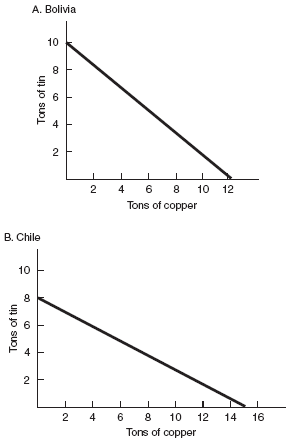
F igure 2
Bolivia has a comparative advantage in the production of which metal?
F igure 2
Bolivia has a comparative advantage in the production of which metal?
Question
Question
Brazil is better at producing ____ than at producing ____.
Argentina is better at producing ____ than at producing ____.
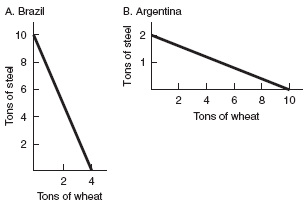
F igure 1
Argentina is better at producing ____ than at producing ____.
F igure 1
Question
Question
Assume Bolivia and Chile use the same amount of resources to produce tin and copper. Figure 2 represents their production possibilities curves.
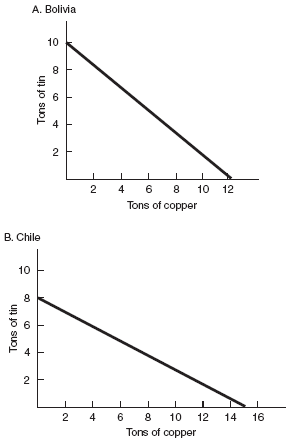
Chile has a comparative advantage in the production of which metal?
F igure 2
Chile has a comparative advantage in the production of which metal?
F igure 2
Question
Question
If 1 ton of steel could be traded for 1 ton of wheat, Brazil would trade its ____ for Argentina's ____.
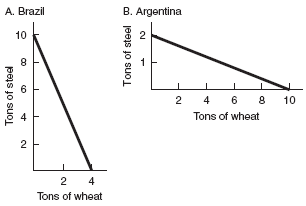
F igure 1
F igure 1
Question
Question
Assume Bolivia and Chile use the same amount of resources to produce tin and copper. Figure 2 represents their production possibilities curves.
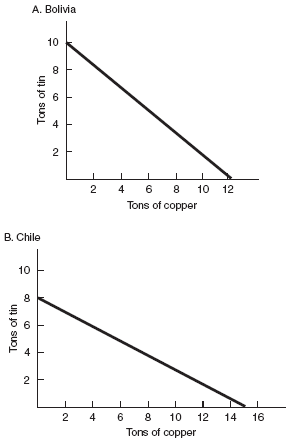
F igure 2
Bolivia will trade ____ for ____.
F igure 2
Bolivia will trade ____ for ____.
Question
Question
Question
Question
Assume Bolivia and Chile use the same amount of resources to produce tin and copper. Figure 2 represents their production possibilities curves.
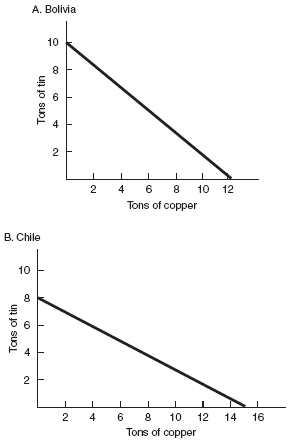
F igure 2
Chile will trade ____ for ____.
F igure 2
Chile will trade ____ for ____.
Question
Question
Question
Question
Question
Question
Question
Question
Question
Question
Question
Question
Question
Question
Question
Question
Question
Question
Question
Question
Question
Question
Question
Question
Question
Question
Question
Question
Question
Question
Question
Question

Unlock Deck
Sign up to unlock the cards in this deck!
Unlock Deck
Unlock Deck
1/47

Play

Full screen (f)
Deck 18: Income Distribution and Poverty
1
The basis for international trade is ____.
International trade:
The international trade refers to the activity of economic transaction like buying and selling of goods and services between two or more nation at the period of time.
A basis for international trade is that a nation can import goods and services at a lower cost compared to the cost it was produced domestically.
Specialization is the basis for international trade.
Therefore, the correct answer is

The international trade refers to the activity of economic transaction like buying and selling of goods and services between two or more nation at the period of time.
A basis for international trade is that a nation can import goods and services at a lower cost compared to the cost it was produced domestically.
Specialization is the basis for international trade.
Therefore, the correct answer is
2
Our balance of trade ____.
A) has always been positive
B) turned negative in the mid-1970s
C) turned negative in the mid-1980s
D) has always been negative
A) has always been positive
B) turned negative in the mid-1970s
C) turned negative in the mid-1980s
D) has always been negative
Balance of Trade:
A country can be said to have balance of trade when the country's value of exports are equal to the value of imports.
The balance of trade of a country shows various current and capital nature receipts and payments made during a year.
Balance of trade was positive until 1970s in the 20 th century. It has turned negative in the mid-1970s.
Hence, the options (a), (c) and (d) are not correct.
Therefore, the correct option is

A country can be said to have balance of trade when the country's value of exports are equal to the value of imports.
The balance of trade of a country shows various current and capital nature receipts and payments made during a year.
Balance of trade was positive until 1970s in the 20 th century. It has turned negative in the mid-1970s.
Hence, the options (a), (c) and (d) are not correct.
Therefore, the correct option is
3
Assume Bolivia and Chile use the same amount of resources to produce tin and copper. Figure 2 represents their production possibilities curves.
F igure 2
Bolivia has a comparative advantage in the production of which metal?
F igure 2
Bolivia has a comparative advantage in the production of which metal?
The opportunity cost is the cost of next best alternative or the cost of missed opportunity.
Comparative advantage tells the ability of one country to produce goods at a lower opportunity cost as compared to other countries. For a beneficial trade, countries should produce those products in which they have a comparative advantage for their national welfare. The benefit that one country accrues from trade is called gains from trade.
Country B
Country B can produce either 10 tons of tin or 12 tons of copper.
Hence, the opportunity cost of 1 ton of tin is
 Similarly, opportunity cost of 1 ton of copper is
 Country C
Country C can produce either 8 tons of tin or 15 tons of copper.
Hence, the opportunity cost of 1 ton of tin is
 Similarly, opportunity cost of 1 ton of copper is
 Since, the opportunity cost of 1 ton of tin is lower in Country B.
Hence, Country B has comparative advantage in production of
 .
.
Comparative advantage tells the ability of one country to produce goods at a lower opportunity cost as compared to other countries. For a beneficial trade, countries should produce those products in which they have a comparative advantage for their national welfare. The benefit that one country accrues from trade is called gains from trade.
Country B
Country B can produce either 10 tons of tin or 12 tons of copper.
Hence, the opportunity cost of 1 ton of tin is
Similarly, opportunity cost of 1 ton of copper is Country C Country C can produce either 8 tons of tin or 15 tons of copper.
Hence, the opportunity cost of 1 ton of tin is
Similarly, opportunity cost of 1 ton of copper is Since, the opportunity cost of 1 ton of tin is lower in Country B.Hence, Country B has comparative advantage in production of
. 4
Explain what comparative advantage is. Make up an example to illustrate this concept.
Unlock Deck
Unlock for access to all 47 flashcards in this deck.
Unlock Deck
k this deck
5
Brazil is better at producing ____ than at producing ____.
Argentina is better at producing ____ than at producing ____.
F igure 1
Argentina is better at producing ____ than at producing ____.
F igure 1
Unlock Deck
Unlock for access to all 47 flashcards in this deck.
Unlock Deck
k this deck
6
Which makes the most sense economically?
A) Individual self-sufficiency
B) National self-sufficiency
C) National specialization
D) None of these
A) Individual self-sufficiency
B) National self-sufficiency
C) National specialization
D) None of these
Unlock Deck
Unlock for access to all 47 flashcards in this deck.
Unlock Deck
k this deck
7
Assume Bolivia and Chile use the same amount of resources to produce tin and copper. Figure 2 represents their production possibilities curves.
Chile has a comparative advantage in the production of which metal?
F igure 2
Chile has a comparative advantage in the production of which metal?
F igure 2
Unlock Deck
Unlock for access to all 47 flashcards in this deck.
Unlock Deck
k this deck
8
What is wrong with having tariffs and quotas? Which is the lesser of the two evils, and why?
Unlock Deck
Unlock for access to all 47 flashcards in this deck.
Unlock Deck
k this deck
9
If 1 ton of steel could be traded for 1 ton of wheat, Brazil would trade its ____ for Argentina's ____.
F igure 1
F igure 1
Unlock Deck
Unlock for access to all 47 flashcards in this deck.
Unlock Deck
k this deck
10
Which statement do you agree with?
A) There are several problems causing our huge trade deficit; there are no easy solutions to these problems.
B) We could quickly eliminate our trade deficit by raising tariffs.
C) The main reason we have a large trade deficit is that foreigners refuse to buy American goods and services.
D) The main reason for our large trade deficit is our relatively low rate of economic growth.
A) There are several problems causing our huge trade deficit; there are no easy solutions to these problems.
B) We could quickly eliminate our trade deficit by raising tariffs.
C) The main reason we have a large trade deficit is that foreigners refuse to buy American goods and services.
D) The main reason for our large trade deficit is our relatively low rate of economic growth.
Unlock Deck
Unlock for access to all 47 flashcards in this deck.
Unlock Deck
k this deck
11
Assume Bolivia and Chile use the same amount of resources to produce tin and copper. Figure 2 represents their production possibilities curves.
F igure 2
Bolivia will trade ____ for ____.
F igure 2
Bolivia will trade ____ for ____.
Unlock Deck
Unlock for access to all 47 flashcards in this deck.
Unlock Deck
k this deck
12
Explain why globalization is good for the United States. What are the drawbacks of globalization for our economy?
Unlock Deck
Unlock for access to all 47 flashcards in this deck.
Unlock Deck
k this deck
13
____ is the country with which we have the largest trade imbalance.
Unlock Deck
Unlock for access to all 47 flashcards in this deck.
Unlock Deck
k this deck
14
The Chinese economic expansion since the early 1980s and the Japanese economic expansion from the late 1940s through the 1980s were ____.
A) virtually identical
B) both dependent on the American market
C) based in the economic principles of Karl Marx
D) based on closing their domestic markets to American goods and services
A) virtually identical
B) both dependent on the American market
C) based in the economic principles of Karl Marx
D) based on closing their domestic markets to American goods and services
Unlock Deck
Unlock for access to all 47 flashcards in this deck.
Unlock Deck
k this deck
15
Assume Bolivia and Chile use the same amount of resources to produce tin and copper. Figure 2 represents their production possibilities curves.
F igure 2
Chile will trade ____ for ____.
F igure 2
Chile will trade ____ for ____.
Unlock Deck
Unlock for access to all 47 flashcards in this deck.
Unlock Deck
k this deck
16
What would you suggest we do to reduce our trade deficit?
Unlock Deck
Unlock for access to all 47 flashcards in this deck.
Unlock Deck
k this deck
17
It would greatly reduce our trade deficit the most if we could curb our import of ____.
Unlock Deck
Unlock for access to all 47 flashcards in this deck.
Unlock Deck
k this deck
18
Which statement is false?
A) No nation will engage in trade with another nation unless it will gain by that trade.
B) The terms of trade will fall somewhere between the domestic exchange equations of the two trading nations.
C) Most economists advocate free trade.
D) None of these statements is false.
A) No nation will engage in trade with another nation unless it will gain by that trade.
B) The terms of trade will fall somewhere between the domestic exchange equations of the two trading nations.
C) Most economists advocate free trade.
D) None of these statements is false.
Unlock Deck
Unlock for access to all 47 flashcards in this deck.
Unlock Deck
k this deck
19
We run huge trade imbalances with two countries. Explain the cause of the imbalances.
Unlock Deck
Unlock for access to all 47 flashcards in this deck.
Unlock Deck
k this deck
20
Our trade deficit in 2007 was $ ____.
Unlock Deck
Unlock for access to all 47 flashcards in this deck.
Unlock Deck
k this deck
21
Our largest trade deficit is with ____.
A) Japan
B) Canada
C) China
D) Mexico
E) Germany
A) Japan
B) Canada
C) China
D) Mexico
E) Germany
Unlock Deck
Unlock for access to all 47 flashcards in this deck.
Unlock Deck
k this deck
22
Should we be worried about our trade deficit? Explain why or why not.
Unlock Deck
Unlock for access to all 47 flashcards in this deck.
Unlock Deck
k this deck
23
If our trade deficit with China and Japan were 0, our total trade deficit would be reduced by almost ____ percent.
Unlock Deck
Unlock for access to all 47 flashcards in this deck.
Unlock Deck
k this deck
24
Which one of the following does NOT contribute to our huge trade deficit?
A) Our failing educational system
B) Our high defense spending
C) Our high saving rate
D) Our huge oil imports
A) Our failing educational system
B) Our high defense spending
C) Our high saving rate
D) Our huge oil imports
Unlock Deck
Unlock for access to all 47 flashcards in this deck.
Unlock Deck
k this deck
25
What is the economist's case for free trade?
Unlock Deck
Unlock for access to all 47 flashcards in this deck.
Unlock Deck
k this deck
26
The law of comparative advantage states that total output is greatest when each product is made by the country that has the ____.
Unlock Deck
Unlock for access to all 47 flashcards in this deck.
Unlock Deck
k this deck
27
The least applicable argument for protecting American industry from foreign competition would be the ____ argument.
A) national security
B) infant industry
C) low-wage
D) employment
A) national security
B) infant industry
C) low-wage
D) employment
Unlock Deck
Unlock for access to all 47 flashcards in this deck.
Unlock Deck
k this deck
28
Practical Application: Can you think of any valid reason for tariff protection? Try to make a case for it.
Unlock Deck
Unlock for access to all 47 flashcards in this deck.
Unlock Deck
k this deck
29
A tariff is a tax on ____; a quota is a limit on ____.
Unlock Deck
Unlock for access to all 47 flashcards in this deck.
Unlock Deck
k this deck
30
Imports would be lowered by ____.
A) tariffs only
B) import quotas only
C) both tariffs and import quotas
D) neither tariffs nor import quotas
A) tariffs only
B) import quotas only
C) both tariffs and import quotas
D) neither tariffs nor import quotas
Unlock Deck
Unlock for access to all 47 flashcards in this deck.
Unlock Deck
k this deck
31
____ was the last year in which we ran a trade surplus.
Unlock Deck
Unlock for access to all 47 flashcards in this deck.
Unlock Deck
k this deck
32
Of these three choices-tariffs, quotas, and free trade-economists like ____ the most and ____ the least.
A) tariffs, quotas
B) tariffs, free trade
C) free trade, tariffs
D) free trade, quotas
E) quotas, free trade
F) quotas, tariffs
A) tariffs, quotas
B) tariffs, free trade
C) free trade, tariffs
D) free trade, quotas
E) quotas, free trade
F) quotas, tariffs
Unlock Deck
Unlock for access to all 47 flashcards in this deck.
Unlock Deck
k this deck
33
Our biggest annual trade deficit in our history was more than ____ billion.
A) $300
B) $400
C) $500
D) $600
E) $700
A) $300
B) $400
C) $500
D) $600
E) $700
Unlock Deck
Unlock for access to all 47 flashcards in this deck.
Unlock Deck
k this deck
34
Which country regularly counterfeits American goods and services, a practice which costs American industry over $200 billion a year?
A) Mexico
B) Canada
C) China
D) Japan
A) Mexico
B) Canada
C) China
D) Japan
Unlock Deck
Unlock for access to all 47 flashcards in this deck.
Unlock Deck
k this deck
35
Which would be the most accurate statement with respect to our chemical industry?
A) It is on the decline and now contributes to our balance of trade deficit.
B) It is large and growing.
C) It generally provides a trade surplus of about $20 billion a year.
D) It will almost completely disappear by the year 2015.
A) It is on the decline and now contributes to our balance of trade deficit.
B) It is large and growing.
C) It generally provides a trade surplus of about $20 billion a year.
D) It will almost completely disappear by the year 2015.
Unlock Deck
Unlock for access to all 47 flashcards in this deck.
Unlock Deck
k this deck
36
Each of the following would reduce our trade deficit except ____.
A) increasing saving
B) cutting defense spending
C) increasing investment
D) raising interest rates
A) increasing saving
B) cutting defense spending
C) increasing investment
D) raising interest rates
Unlock Deck
Unlock for access to all 47 flashcards in this deck.
Unlock Deck
k this deck
37
Our trade deficit with China in 2007 was ____.
A) under $100 billion
B) between $100 billion and $150 billion
C) between $150 billion and $200 billion
D) over $200 billion
A) under $100 billion
B) between $100 billion and $150 billion
C) between $150 billion and $200 billion
D) over $200 billion
Unlock Deck
Unlock for access to all 47 flashcards in this deck.
Unlock Deck
k this deck
38
Statement 1: Our trade deficit with China is larger than our trade deficit with Japan.
Statement 2: Americans pay lower taxes on gasoline than do the citizens of most of the nations in Western Europe.
A) Statement 1 is true, and statement 2 is false.
B) Statement 2 is true, and statement 1 is false.
C) Both statements are true.
D) Both statements are false.
Statement 2: Americans pay lower taxes on gasoline than do the citizens of most of the nations in Western Europe.
A) Statement 1 is true, and statement 2 is false.
B) Statement 2 is true, and statement 1 is false.
C) Both statements are true.
D) Both statements are false.
Unlock Deck
Unlock for access to all 47 flashcards in this deck.
Unlock Deck
k this deck
39
Of the following, our imports of ____ contribute most to our trade deficit.
A) oil
B) clothing
C) textiles
D) consumer electronics
A) oil
B) clothing
C) textiles
D) consumer electronics
Unlock Deck
Unlock for access to all 47 flashcards in this deck.
Unlock Deck
k this deck
40
Which of the following would best describe our trading relationship with China five years from now?
A) Our trade deficit will be higher and we will be importing a higher proportion of "low-skill" products.
B) Our trade deficit will be higher and we will be importing a higher proportion of "high-skill" products.
C) Our trade deficit will be lower and we will be importing a higher proportion of "low-skill" products.
D) Our trade deficit will be lower and we will be importing a higher proportion of "high-skill" products.
A) Our trade deficit will be higher and we will be importing a higher proportion of "low-skill" products.
B) Our trade deficit will be higher and we will be importing a higher proportion of "high-skill" products.
C) Our trade deficit will be lower and we will be importing a higher proportion of "low-skill" products.
D) Our trade deficit will be lower and we will be importing a higher proportion of "high-skill" products.
Unlock Deck
Unlock for access to all 47 flashcards in this deck.
Unlock Deck
k this deck
41
Which statement is the most accurate?
A) Globalization has made some people winners and others losers.
B) Globalization has been good for everyone involved.
C) Globalization has been bad for everyone involved.
D) Virtually all economists believe that globalization has almost no downside.
A) Globalization has made some people winners and others losers.
B) Globalization has been good for everyone involved.
C) Globalization has been bad for everyone involved.
D) Virtually all economists believe that globalization has almost no downside.
Unlock Deck
Unlock for access to all 47 flashcards in this deck.
Unlock Deck
k this deck
42
Which statement is true about how globalization has affected American workers?
A) The only jobs that have been lost or will be lost are blue-collar factory jobs.
B) Most workers who have lost their jobs because of globalization have ended up in better paying jobs.
C) Until now a relatively high proportion of Americans perform high-skill, well paying jobs, while a relatively high proportion of Chinese perform low-skill, poorly paying jobs.
D) Globalization cannot be considered a threat to the livelihoods of highly-skilled, well paid American workers.
A) The only jobs that have been lost or will be lost are blue-collar factory jobs.
B) Most workers who have lost their jobs because of globalization have ended up in better paying jobs.
C) Until now a relatively high proportion of Americans perform high-skill, well paying jobs, while a relatively high proportion of Chinese perform low-skill, poorly paying jobs.
D) Globalization cannot be considered a threat to the livelihoods of highly-skilled, well paid American workers.
Unlock Deck
Unlock for access to all 47 flashcards in this deck.
Unlock Deck
k this deck
43
Which is the most accurate statement?
A) The United States can be described as a purely free trading nation.
B) The United States is one of the most protectionist nations in the world.
C) The rich nations provide hundreds of billions of dollars in agricultural subsidies to the poorer nations.
D) The United States provides smaller agricultural subsidies than does Japan and the European Union.
A) The United States can be described as a purely free trading nation.
B) The United States is one of the most protectionist nations in the world.
C) The rich nations provide hundreds of billions of dollars in agricultural subsidies to the poorer nations.
D) The United States provides smaller agricultural subsidies than does Japan and the European Union.
Unlock Deck
Unlock for access to all 47 flashcards in this deck.
Unlock Deck
k this deck
44
Which statement is true?
A) Comparative advantage is not necessary for trade to take place, but absolute advantage is.
B) Absolute advantage is not necessary for trade to take place, but comparative advantage is.
C) Both absolute and comparative advantage are necessary for trade to take place.
D) Neither absolute nor comparative advantage are necessary for trade to take place.
A) Comparative advantage is not necessary for trade to take place, but absolute advantage is.
B) Absolute advantage is not necessary for trade to take place, but comparative advantage is.
C) Both absolute and comparative advantage are necessary for trade to take place.
D) Neither absolute nor comparative advantage are necessary for trade to take place.
Unlock Deck
Unlock for access to all 47 flashcards in this deck.
Unlock Deck
k this deck
45
Which statement is true?
A) There are basically no arguments that can be made on behalf of trade protection.
B) The arguments for trade protection are more valid than the arguments for free trade.
C) The United States has had a record of fully supporting free trade since the early 20th century.
D) Much of what we import has been produced by "sweatshop labor."
A) There are basically no arguments that can be made on behalf of trade protection.
B) The arguments for trade protection are more valid than the arguments for free trade.
C) The United States has had a record of fully supporting free trade since the early 20th century.
D) Much of what we import has been produced by "sweatshop labor."
Unlock Deck
Unlock for access to all 47 flashcards in this deck.
Unlock Deck
k this deck
46
In order for trade between two countries to take place, ____.
A) absolute advantage is necessary
B) comparative advantage is necessary
C) both absolute and comparative advantage are necessary
D) neither absolute nor comparative advantage is necessary
A) absolute advantage is necessary
B) comparative advantage is necessary
C) both absolute and comparative advantage are necessary
D) neither absolute nor comparative advantage is necessary
Unlock Deck
Unlock for access to all 47 flashcards in this deck.
Unlock Deck
k this deck
47
Which of the following is the most accurate statement?
A) Americans are very willing to buy domestically produced goods, even if they are more expensive than imported goods.
B) We import more foreign goods than we did 40 years ago, but merchandise imports are still about the same percentage of our GDP.
C) In the decades following World War II, the Japanese consumer has strongly favored domestically manufactured goods over imports.
D) France paid a high economic price when many Americans switched from french fries to freedom fries.
A) Americans are very willing to buy domestically produced goods, even if they are more expensive than imported goods.
B) We import more foreign goods than we did 40 years ago, but merchandise imports are still about the same percentage of our GDP.
C) In the decades following World War II, the Japanese consumer has strongly favored domestically manufactured goods over imports.
D) France paid a high economic price when many Americans switched from french fries to freedom fries.
Unlock Deck
Unlock for access to all 47 flashcards in this deck.
Unlock Deck
k this deck
Unlock Deck
Unlock for access to all 47 flashcards in this deck.






