







 Chat with AI

Deck 9: Application: International Trade
Full screen (f)

Question

Question
Question
Question
Question
Question
Question
Question
Question
Question
Question
Question
Question
Question
Question
Question
Question
Question
Question
Question
Question
Question
Question
Question
Question
Question
Question
Question
Question
Question
Question
Question
Question
Question
Question
Question
Question
Question
Question
Question
Question
Question
Graph 9-2
This graph refers to the market for saddles in Argentina.

According Graph 9-2, the quantity of saddles exported from Argentina is:
A) Q0 minus Q1
B) Q2 minus Q1
C) Q2 minus Q0
D) Q0
This graph refers to the market for saddles in Argentina.
According Graph 9-2, the quantity of saddles exported from Argentina is:
A) Q0 minus Q1
B) Q2 minus Q1
C) Q2 minus Q0
D) Q0
Question
Graph 9-1
This graph refers to the market for beef in Japan.
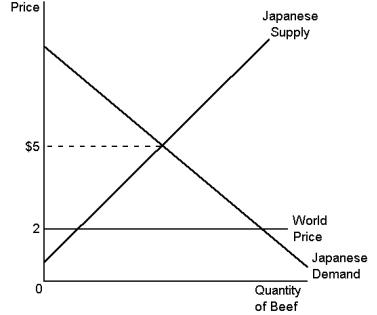
According to Graph 9-1, if trade in beef is allowed, Japan:
A) will become an importer of beef
B) will become an exporter of beef
C) could become either an importer of beef or an exporter of beef
D) will neither import nor export beef
This graph refers to the market for beef in Japan.
According to Graph 9-1, if trade in beef is allowed, Japan:
A) will become an importer of beef
B) will become an exporter of beef
C) could become either an importer of beef or an exporter of beef
D) will neither import nor export beef
Question
Question
Graph 9-3
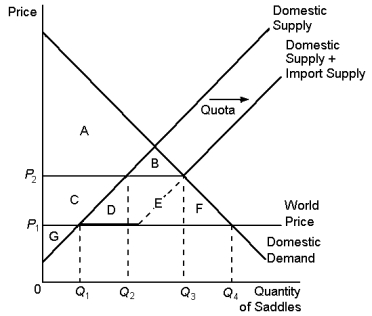
In Graph 9-3, after the quota, imports would be equal to:
A) Q4 minus Q1
B) Q3 minus Q2
C) Q3 minus Q1
D) Q2 minus Q1
In Graph 9-3, after the quota, imports would be equal to:
A) Q4 minus Q1
B) Q3 minus Q2
C) Q3 minus Q1
D) Q2 minus Q1
Question
Graph 9-3
In Graph 9-3, the free-trade price and quantity demanded would be:
A) P1, Q1
B) P1, Q4
C) P2, Q2
D) P2, Q3
In Graph 9-3, the free-trade price and quantity demanded would be:
A) P1, Q1
B) P1, Q4
C) P2, Q2
D) P2, Q3
Question
Graph 9-1
This graph refers to the market for beef in Japan.
According to Graph 9-1, if trade in beef is allowed, Japanese beef:
A) consumers and Japanese beef producers will gain
B) consumers and Japanese beef producers will lose
C) consumers will gain, and Japanese beef producers will lose
D) producers will gain, and Japanese beef consumers will lose
This graph refers to the market for beef in Japan.
According to Graph 9-1, if trade in beef is allowed, Japanese beef:
A) consumers and Japanese beef producers will gain
B) consumers and Japanese beef producers will lose
C) consumers will gain, and Japanese beef producers will lose
D) producers will gain, and Japanese beef consumers will lose
Question
Graph 9-1
This graph refers to the market for beef in Japan.
Which one of the According to Graph 9-1, if trade in beef is allowed, Japanese:
A) consumer surplus will increase and producer surplus will decrease
B) consumer surplus will decrease and producer surplus will increase
C) producer surplus and consumer surplus will increase
D) producer surplus and consumer surplus will be unaffected
This graph refers to the market for beef in Japan.
Which one of the According to Graph 9-1, if trade in beef is allowed, Japanese:
A) consumer surplus will increase and producer surplus will decrease
B) consumer surplus will decrease and producer surplus will increase
C) producer surplus and consumer surplus will increase
D) producer surplus and consumer surplus will be unaffected
Question
Graph 9-1
This graph refers to the market for beef in Japan.
According to Graph 9-1, if the world price rose to $6 and trade in beef is allowed, the price of beef in Japan will be:
A) $5 per pound
B) $2 per pound
C) between $2 per pound and $5 per pound
D) $6 per pound
This graph refers to the market for beef in Japan.
According to Graph 9-1, if the world price rose to $6 and trade in beef is allowed, the price of beef in Japan will be:
A) $5 per pound
B) $2 per pound
C) between $2 per pound and $5 per pound
D) $6 per pound
Question
Graph 9-3
In Graph 9-3, the equilibrium price and quantity after the quota would be:
A) P1, Q1
B) P1, Q4
C) P2, Q2
D) P2, Q3
In Graph 9-3, the equilibrium price and quantity after the quota would be:
A) P1, Q1
B) P1, Q4
C) P2, Q2
D) P2, Q3
Question
Graph 9-2
This graph refers to the market for saddles in Argentina.
According to Graph 9-2, the equilibrium price and the equilibrium quantity of saddles in Argentina before trade would be:
A) P1, Q2
B) P1, Q1
C) P0, Q0
D) P0, Q1
This graph refers to the market for saddles in Argentina.
According to Graph 9-2, the equilibrium price and the equilibrium quantity of saddles in Argentina before trade would be:
A) P1, Q2
B) P1, Q1
C) P0, Q0
D) P0, Q1
Question
Question
Question
Question
Question
Graph 9-2
This graph refers to the market for saddles in Argentina.
According to Graph 9-2, the price and quantity demanded of saddles in Argentina after trade would be:
A) P1, Q2
B) P1, Q1
C) P0, Q0
D) P0, Q1
This graph refers to the market for saddles in Argentina.
According to Graph 9-2, the price and quantity demanded of saddles in Argentina after trade would be:
A) P1, Q2
B) P1, Q1
C) P0, Q0
D) P0, Q1
Question
Question
Question
Question
Question
Graph 9-5
This graph refers to the market for oil in Spain.
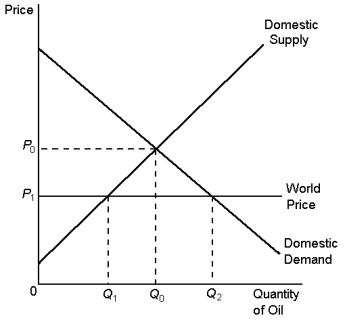
According to Graph 9-5, the price and quantity of oil in Spain before trade would be:
A) P0, Q0
B) P1, Q1
C) P1, Q2
D) P1, Q0
This graph refers to the market for oil in Spain.
According to Graph 9-5, the price and quantity of oil in Spain before trade would be:
A) P0, Q0
B) P1, Q1
C) P1, Q2
D) P1, Q0
Question
Graph 9-3
In Graph 9-3, area G represents:
A) consumer surplus under free trade
B) producer surplus under free trade
C) a surplus for import licence holders
D) producer surplus before trade
In Graph 9-3, area G represents:
A) consumer surplus under free trade
B) producer surplus under free trade
C) a surplus for import licence holders
D) producer surplus before trade
Question
Graph 9-6
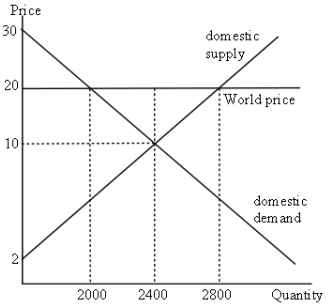
According to Graph 9-6, producer surplus before trade would be:
A) $8000
B) $9600
C) $16 000
D) $19 200
According to Graph 9-6, producer surplus before trade would be:
A) $8000
B) $9600
C) $16 000
D) $19 200
Question
Graph 9-4
This graph refers to the market for kiwifruit in New Zealand.
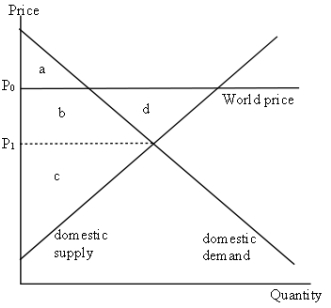
According to Graph 9-4, consumer surplus in New Zealand after the trade in kiwifruit is:
A) a
B) a + b
C) a + b + c
D) c
This graph refers to the market for kiwifruit in New Zealand.
According to Graph 9-4, consumer surplus in New Zealand after the trade in kiwifruit is:
A) a
B) a + b
C) a + b + c
D) c
Question
Graph 9-6
According to Graph 9-6, the price and domestic quantity demanded after trade would be:
A) $20, 2000
B) $20, 2800
C) $10, 2000
D) $10, 2800
According to Graph 9-6, the price and domestic quantity demanded after trade would be:
A) $20, 2000
B) $20, 2800
C) $10, 2000
D) $10, 2800
Question
Graph 9-4
This graph refers to the market for kiwifruit in New Zealand.
According to Graph 9-4, the change in total surplus in New Zealand because of the trade in kiwifruit is:
A) a
B) b
C) c
D) d
This graph refers to the market for kiwifruit in New Zealand.
According to Graph 9-4, the change in total surplus in New Zealand because of the trade in kiwifruit is:
A) a
B) b
C) c
D) d
Question
Graph 9-5
This graph refers to the market for oil in Spain.
According to Graph 9-5, the price of oil and the quantity demanded in Spain after trade would be:
A) P1, Q1
B) P1, Q2
C) P1, Q0
D) P0, Q0
This graph refers to the market for oil in Spain.
According to Graph 9-5, the price of oil and the quantity demanded in Spain after trade would be:
A) P1, Q1
B) P1, Q2
C) P1, Q0
D) P0, Q0
Question
Graph 9-6
According to Graph 9-6, equilibrium price and quantity before trade would be:
A) $20, 2000
B) $20, 2400
C) $10, 2000
D) $10, 2400
According to Graph 9-6, equilibrium price and quantity before trade would be:
A) $20, 2000
B) $20, 2400
C) $10, 2000
D) $10, 2400
Question
Graph 9-6
According to Graph 9-6, domestic production and domestic consumption after trade would be:
A) 2400, 2000
B) 2800, 2000
C) 2000, 2400
D) 2000, 2800
According to Graph 9-6, domestic production and domestic consumption after trade would be:
A) 2400, 2000
B) 2800, 2000
C) 2000, 2400
D) 2000, 2800
Question
Graph 9-6
According to Graph 9-6, consumer surplus before trade would be:
A) $20 000
B) $24 000
C) $40 000
D) $48 000
According to Graph 9-6, consumer surplus before trade would be:
A) $20 000
B) $24 000
C) $40 000
D) $48 000
Question
Graph 9-4
This graph refers to the market for kiwifruit in New Zealand.
According to Graph 9-4, total surplus in New Zealand after the trade in kiwifruit is:
A) a + b
B) a + b + c
C) a + b + c + d
D) b + c + d
This graph refers to the market for kiwifruit in New Zealand.
According to Graph 9-4, total surplus in New Zealand after the trade in kiwifruit is:
A) a + b
B) a + b + c
C) a + b + c + d
D) b + c + d
Question
Graph 9-5
This graph refers to the market for oil in Spain.
According to Graph 9-5, the quantity of oil imported into Spain is:
A) Q0
B) Q1
C) Q2
D) Q2 minus Q1
This graph refers to the market for oil in Spain.
According to Graph 9-5, the quantity of oil imported into Spain is:
A) Q0
B) Q1
C) Q2
D) Q2 minus Q1
Question
Graph 9-6
According to Graph 9-6, how many units of this product would be exported after trade is allowed?
A) 400
B) 800
C) 2400
D) 2800
According to Graph 9-6, how many units of this product would be exported after trade is allowed?
A) 400
B) 800
C) 2400
D) 2800
Question
Graph 9-4
This graph refers to the market for kiwifruit in New Zealand.
According to Graph 9-4, total surplus in New Zealand before the trade in kiwifruit is:
A) a + b
B) a + b + c
C) a + b + c + d
D) b + c + d
This graph refers to the market for kiwifruit in New Zealand.
According to Graph 9-4, total surplus in New Zealand before the trade in kiwifruit is:
A) a + b
B) a + b + c
C) a + b + c + d
D) b + c + d
Question
Graph 9-4
This graph refers to the market for kiwifruit in New Zealand.
According to Graph 9-4, producer surplus in New Zealand after trade is:
A) a
B) a + b
C) c + b + d
D) c
This graph refers to the market for kiwifruit in New Zealand.
According to Graph 9-4, producer surplus in New Zealand after trade is:
A) a
B) a + b
C) c + b + d
D) c
Question
Graph 9-4
This graph refers to the market for kiwifruit in New Zealand.
According to Graph 9-4, consumer surplus in New Zealand before trade the trade in kiwifruit is:
A) a
B) a + b
C) a + b + d
D) c
This graph refers to the market for kiwifruit in New Zealand.
According to Graph 9-4, consumer surplus in New Zealand before trade the trade in kiwifruit is:
A) a
B) a + b
C) a + b + d
D) c
Question
Graph 9-3
In Graph 9-3, after the quota, deadweight loss would be equal to:
A) E
B) B
C) D + F
D) B + D + E + F
In Graph 9-3, after the quota, deadweight loss would be equal to:
A) E
B) B
C) D + F
D) B + D + E + F
Question
Graph 9-6
According to Graph 9-6, consumer surplus after trade would be:
A) $10 000
B) $12 000
C) $20 000
D) $24 000
According to Graph 9-6, consumer surplus after trade would be:
A) $10 000
B) $12 000
C) $20 000
D) $24 000
Question
Graph 9-4
This graph refers to the market for kiwifruit in New Zealand.
According to Graph 9-4, producer surplus in New Zealand before trade is:
A) a
B) a + b
C) c + b + d
D) c
This graph refers to the market for kiwifruit in New Zealand.
According to Graph 9-4, producer surplus in New Zealand before trade is:
A) a
B) a + b
C) c + b + d
D) c
Question
Graph 9-6
According to Graph 9-6, producer surplus after trade would be:
A) $21 600
B) $25 200
C) $43 200
D) $50 400
According to Graph 9-6, producer surplus after trade would be:
A) $21 600
B) $25 200
C) $43 200
D) $50 400

Unlock Deck
Sign up to unlock the cards in this deck!
Unlock Deck
Unlock Deck
1/119

Play

Full screen (f)
Deck 9: Application: International Trade
1
If a small country imposes a tariff on an imported good, domestic sellers will gain producer surplus, the government will gain tariff revenue and domestic consumers will gain consumer surplus.
False
2
If a tariff is placed on clocks, the price of both domestic and imported clocks will rise by the amount of the tariff.
True
3
If Peru exports coffee to the rest of the world, Peruvian consumers of coffee are worse off as a result of trade, but Peruvian producers of coffee are better off.
True
4
Suppose that Australia imposes a tariff on imported computer chips. If the increase in producer surplus is $100 million, the increase in tariff revenue is $200 million and the reduction in consumer surplus is $500 million, then the deadweight loss of the tariff is $200 million.
Unlock Deck
Unlock for access to all 119 flashcards in this deck.
Unlock Deck
k this deck
5
Without free trade, the import price of a good must be equal to the export price of a good.
Unlock Deck
Unlock for access to all 119 flashcards in this deck.
Unlock Deck
k this deck
6
Trade among nations is ultimately based on absolute advantage.
Unlock Deck
Unlock for access to all 119 flashcards in this deck.
Unlock Deck
k this deck
7
Suppose that Tonga, a small country, imports apples at the world price of $4 per kilogram. If Tonga imposes a tariff of $1 per kilogram on imported apples, the price of apples in Tonga will increase, but by less than $1, ceteris paribus.
Unlock Deck
Unlock for access to all 119 flashcards in this deck.
Unlock Deck
k this deck
8
Tariffs cause deadweight loss because they move the price of an imported product closer to the equilibrium price without trade, thus reducing the gains from trade.
Unlock Deck
Unlock for access to all 119 flashcards in this deck.
Unlock Deck
k this deck
9
If Colombia exports coffee to the rest of the world, Colombian coffee sellers benefit from higher producer surplus. Colombian coffee buyers are worse off because of lower consumer surplus, but total surplus in Colombia increases because of trade.
Unlock Deck
Unlock for access to all 119 flashcards in this deck.
Unlock Deck
k this deck
10
In general, importing will always increase the wellbeing of a country if the world price of a good is lower than the domestic price.
Unlock Deck
Unlock for access to all 119 flashcards in this deck.
Unlock Deck
k this deck
11
One of the important outcomes of international trade is that countries specialise in the output of things they are best at.
Unlock Deck
Unlock for access to all 119 flashcards in this deck.
Unlock Deck
k this deck
12
An import quota increases domestic producer surplus and the surplus of import licence holders, reduces domestic consumer surplus, and creates deadweight loss.
Unlock Deck
Unlock for access to all 119 flashcards in this deck.
Unlock Deck
k this deck
13
The decrease in total surplus that results from a tariff or quota is called the gains from trade.
Unlock Deck
Unlock for access to all 119 flashcards in this deck.
Unlock Deck
k this deck
14
If the domestic price of a good is low relative to the world price, the country has a comparative advantage in producing that good.
Unlock Deck
Unlock for access to all 119 flashcards in this deck.
Unlock Deck
k this deck
15
Import quotas increase the domestic price of the product to at least the world price.
Unlock Deck
Unlock for access to all 119 flashcards in this deck.
Unlock Deck
k this deck
16
If Australia imports toys from other countries, this means the world price of toys is lower than the Australian price of toys.
Unlock Deck
Unlock for access to all 119 flashcards in this deck.
Unlock Deck
k this deck
17
Import quotas and tariffs both cause the quantity of imports to fall.
Unlock Deck
Unlock for access to all 119 flashcards in this deck.
Unlock Deck
k this deck
18
Suppose France imposes a tariff on imported US computers. The tariff will raise the price of computers and will make both French producers and consumers of computers worse off.
Unlock Deck
Unlock for access to all 119 flashcards in this deck.
Unlock Deck
k this deck
19
In general, if a country allows trade and becomes an importer of a good, domestic producers of the good are worse off, domestic consumers of the good are better off, but the economic wellbeing of the country increases.
Unlock Deck
Unlock for access to all 119 flashcards in this deck.
Unlock Deck
k this deck
20
A country is likely to import a good if its domestic price is high, relative to the world price.
Unlock Deck
Unlock for access to all 119 flashcards in this deck.
Unlock Deck
k this deck
21
Free trade causes job losses in industries in which a country does not have a comparative advantage but it also causes job gains in industries in which the country has a comparative advantage.
Unlock Deck
Unlock for access to all 119 flashcards in this deck.
Unlock Deck
k this deck
22
In practice, it has proven to be extraordinarily difficult for governments to pick the right infant industries to protect.
Unlock Deck
Unlock for access to all 119 flashcards in this deck.
Unlock Deck
k this deck
23
When goods that are produced in China are sold to Australia, the goods are:
A) exported by Australia and imported by China
B) imported by Australia and exported by China
C) exported by Australia and exported by China
D) imported by Australia and imported by China
A) exported by Australia and imported by China
B) imported by Australia and exported by China
C) exported by Australia and exported by China
D) imported by Australia and imported by China
Unlock Deck
Unlock for access to all 119 flashcards in this deck.
Unlock Deck
k this deck
24
Sometimes countries suffer a net loss of jobs due to free trade, because they do not have a comparative advantage in producing anything.
Unlock Deck
Unlock for access to all 119 flashcards in this deck.
Unlock Deck
k this deck
25
The main justification for imposing restrictions on free international trade is:
A) to protect foreign producers
B) to support foreign consumers
C) to protect domestic producers
D) to support domestic consumers
A) to protect foreign producers
B) to support foreign consumers
C) to protect domestic producers
D) to support domestic consumers
Unlock Deck
Unlock for access to all 119 flashcards in this deck.
Unlock Deck
k this deck
26
When Ford and General Motors import automobile parts from Mexico at prices below those they must pay in the US:
A) workers who assemble Ford and General Motors vehicles become worse off
B) US consumers, taken as a group, become worse off
C) Mexican consumers, taken as a group, become worse off
D) American companies that manufacture automobile parts become worse off
A) workers who assemble Ford and General Motors vehicles become worse off
B) US consumers, taken as a group, become worse off
C) Mexican consumers, taken as a group, become worse off
D) American companies that manufacture automobile parts become worse off
Unlock Deck
Unlock for access to all 119 flashcards in this deck.
Unlock Deck
k this deck
27
The Closer Economic Relations agreement between New Zealand and Australia is designed to ensure both Australia and New Zealand can exercise their own comparative advantage.
Unlock Deck
Unlock for access to all 119 flashcards in this deck.
Unlock Deck
k this deck
28
If a country allows trade and the price of a good falls as a result:
A) the domestic price is higher than the world price and the country will import the good
B) the domestic price is lower than the world price and the country will import the good
C) the domestic price is higher than the world price and the country will export the good
D) the domestic price is lower than the world price and the country will export the good
A) the domestic price is higher than the world price and the country will import the good
B) the domestic price is lower than the world price and the country will import the good
C) the domestic price is higher than the world price and the country will export the good
D) the domestic price is lower than the world price and the country will export the good
Unlock Deck
Unlock for access to all 119 flashcards in this deck.
Unlock Deck
k this deck
29
Australia should always be a net exporter of wheat.
Unlock Deck
Unlock for access to all 119 flashcards in this deck.
Unlock Deck
k this deck
30
A quota can potentially cause an even larger deadweight loss than a tariff.
Unlock Deck
Unlock for access to all 119 flashcards in this deck.
Unlock Deck
k this deck
31
A country is deemed to have a comparative advantage in a product if:
A) the world price is lower than its domestic price
B) the world price is higher than its domestic price
C) the world price is equal to its domestic price
D) none of the above
A) the world price is lower than its domestic price
B) the world price is higher than its domestic price
C) the world price is equal to its domestic price
D) none of the above
Unlock Deck
Unlock for access to all 119 flashcards in this deck.
Unlock Deck
k this deck
32
Indonesia and Australia engage in international trade because:
A) Indonesia has absolute advantage over Australia in producing all goods
B) both Indonesia and Australia have absolute advantage in producing some goods
C) both Indonesia and Australia have comparative advantage in producing some goods
D) Australia has comparative advantage over Indonesia in producing all goods
A) Indonesia has absolute advantage over Australia in producing all goods
B) both Indonesia and Australia have absolute advantage in producing some goods
C) both Indonesia and Australia have comparative advantage in producing some goods
D) Australia has comparative advantage over Indonesia in producing all goods
Unlock Deck
Unlock for access to all 119 flashcards in this deck.
Unlock Deck
k this deck
33
Benefits from free trade include increased variety of goods and increased competition.
Unlock Deck
Unlock for access to all 119 flashcards in this deck.
Unlock Deck
k this deck
34
A multilateral approach to free trade has the potential to increase the gains from trade more than a unilateral approach does, because the multilateral approach can reduce trade restrictions abroad as well as at home.
Unlock Deck
Unlock for access to all 119 flashcards in this deck.
Unlock Deck
k this deck
35
Economists like the infant industry argument because it is easy to implement in practice.
Unlock Deck
Unlock for access to all 119 flashcards in this deck.
Unlock Deck
k this deck
36
If a country allows trade and the domestic price of a good is lower than the world price:
A) the country will become an exporter of the good.
B) the country will become an importer of the good
C) the country will neither export nor import the good
D) additional information about demand is needed to determine whether the country will export or import the good
A) the country will become an exporter of the good.
B) the country will become an importer of the good
C) the country will neither export nor import the good
D) additional information about demand is needed to determine whether the country will export or import the good
Unlock Deck
Unlock for access to all 119 flashcards in this deck.
Unlock Deck
k this deck
37
If country A produces all goods at a cheaper price than country B, country B will specialise in producing the goods for which it has comparative advantage.
Unlock Deck
Unlock for access to all 119 flashcards in this deck.
Unlock Deck
k this deck
38
If an import tariff is imposed on a good produced exclusively for export, the tariff will reduce the quantity of the good produced.
Unlock Deck
Unlock for access to all 119 flashcards in this deck.
Unlock Deck
k this deck
39
If Japan subsidised the production of rice and then exported the rice to Australia at artificially low prices, then the Australian economy would be worse off.
Unlock Deck
Unlock for access to all 119 flashcards in this deck.
Unlock Deck
k this deck
40
Many economists oppose the infant industry argument because it is difficult to remove.
Unlock Deck
Unlock for access to all 119 flashcards in this deck.
Unlock Deck
k this deck
41
If France has a comparative advantage in producing cheese and it allows trade:
A) everyone in the country benefits
B) everyone in the country loses
C) the gains of the producers exceed the losses of the consumers
D) the losses of the consumers exceed the gains of the producers
A) everyone in the country benefits
B) everyone in the country loses
C) the gains of the producers exceed the losses of the consumers
D) the losses of the consumers exceed the gains of the producers
Unlock Deck
Unlock for access to all 119 flashcards in this deck.
Unlock Deck
k this deck
42
Graph 9-2
This graph refers to the market for saddles in Argentina.
According Graph 9-2, the quantity of saddles exported from Argentina is:
A) Q0 minus Q1
B) Q2 minus Q1
C) Q2 minus Q0
D) Q0
This graph refers to the market for saddles in Argentina.
According Graph 9-2, the quantity of saddles exported from Argentina is:
A) Q0 minus Q1
B) Q2 minus Q1
C) Q2 minus Q0
D) Q0
Unlock Deck
Unlock for access to all 119 flashcards in this deck.
Unlock Deck
k this deck
43
Graph 9-1
This graph refers to the market for beef in Japan.
According to Graph 9-1, if trade in beef is allowed, Japan:
A) will become an importer of beef
B) will become an exporter of beef
C) could become either an importer of beef or an exporter of beef
D) will neither import nor export beef
This graph refers to the market for beef in Japan.
According to Graph 9-1, if trade in beef is allowed, Japan:
A) will become an importer of beef
B) will become an exporter of beef
C) could become either an importer of beef or an exporter of beef
D) will neither import nor export beef
Unlock Deck
Unlock for access to all 119 flashcards in this deck.
Unlock Deck
k this deck
44
When a country allows trade and becomes an exporter of a good:
A) both domestic producers and domestic consumers are better off
B) domestic producers are better off and domestic consumers are worse off
C) domestic producers are worse off and domestic consumers are better off
D) both domestic producers and domestic consumers are worse off
A) both domestic producers and domestic consumers are better off
B) domestic producers are better off and domestic consumers are worse off
C) domestic producers are worse off and domestic consumers are better off
D) both domestic producers and domestic consumers are worse off
Unlock Deck
Unlock for access to all 119 flashcards in this deck.
Unlock Deck
k this deck
45
Graph 9-3
In Graph 9-3, after the quota, imports would be equal to:
A) Q4 minus Q1
B) Q3 minus Q2
C) Q3 minus Q1
D) Q2 minus Q1
In Graph 9-3, after the quota, imports would be equal to:
A) Q4 minus Q1
B) Q3 minus Q2
C) Q3 minus Q1
D) Q2 minus Q1
Unlock Deck
Unlock for access to all 119 flashcards in this deck.
Unlock Deck
k this deck
46
Graph 9-3
In Graph 9-3, the free-trade price and quantity demanded would be:
A) P1, Q1
B) P1, Q4
C) P2, Q2
D) P2, Q3
In Graph 9-3, the free-trade price and quantity demanded would be:
A) P1, Q1
B) P1, Q4
C) P2, Q2
D) P2, Q3
Unlock Deck
Unlock for access to all 119 flashcards in this deck.
Unlock Deck
k this deck
47
Graph 9-1
This graph refers to the market for beef in Japan.
According to Graph 9-1, if trade in beef is allowed, Japanese beef:
A) consumers and Japanese beef producers will gain
B) consumers and Japanese beef producers will lose
C) consumers will gain, and Japanese beef producers will lose
D) producers will gain, and Japanese beef consumers will lose
This graph refers to the market for beef in Japan.
According to Graph 9-1, if trade in beef is allowed, Japanese beef:
A) consumers and Japanese beef producers will gain
B) consumers and Japanese beef producers will lose
C) consumers will gain, and Japanese beef producers will lose
D) producers will gain, and Japanese beef consumers will lose
Unlock Deck
Unlock for access to all 119 flashcards in this deck.
Unlock Deck
k this deck
48
Graph 9-1
This graph refers to the market for beef in Japan.
Which one of the According to Graph 9-1, if trade in beef is allowed, Japanese:
A) consumer surplus will increase and producer surplus will decrease
B) consumer surplus will decrease and producer surplus will increase
C) producer surplus and consumer surplus will increase
D) producer surplus and consumer surplus will be unaffected
This graph refers to the market for beef in Japan.
Which one of the According to Graph 9-1, if trade in beef is allowed, Japanese:
A) consumer surplus will increase and producer surplus will decrease
B) consumer surplus will decrease and producer surplus will increase
C) producer surplus and consumer surplus will increase
D) producer surplus and consumer surplus will be unaffected
Unlock Deck
Unlock for access to all 119 flashcards in this deck.
Unlock Deck
k this deck
49
Graph 9-1
This graph refers to the market for beef in Japan.
According to Graph 9-1, if the world price rose to $6 and trade in beef is allowed, the price of beef in Japan will be:
A) $5 per pound
B) $2 per pound
C) between $2 per pound and $5 per pound
D) $6 per pound
This graph refers to the market for beef in Japan.
According to Graph 9-1, if the world price rose to $6 and trade in beef is allowed, the price of beef in Japan will be:
A) $5 per pound
B) $2 per pound
C) between $2 per pound and $5 per pound
D) $6 per pound
Unlock Deck
Unlock for access to all 119 flashcards in this deck.
Unlock Deck
k this deck
50
Graph 9-3
In Graph 9-3, the equilibrium price and quantity after the quota would be:
A) P1, Q1
B) P1, Q4
C) P2, Q2
D) P2, Q3
In Graph 9-3, the equilibrium price and quantity after the quota would be:
A) P1, Q1
B) P1, Q4
C) P2, Q2
D) P2, Q3
Unlock Deck
Unlock for access to all 119 flashcards in this deck.
Unlock Deck
k this deck
51
Graph 9-2
This graph refers to the market for saddles in Argentina.
According to Graph 9-2, the equilibrium price and the equilibrium quantity of saddles in Argentina before trade would be:
A) P1, Q2
B) P1, Q1
C) P0, Q0
D) P0, Q1
This graph refers to the market for saddles in Argentina.
According to Graph 9-2, the equilibrium price and the equilibrium quantity of saddles in Argentina before trade would be:
A) P1, Q2
B) P1, Q1
C) P0, Q0
D) P0, Q1
Unlock Deck
Unlock for access to all 119 flashcards in this deck.
Unlock Deck
k this deck
52
Suppose a country becomes more open to trade and imports increase. This means that:
A) everyone in the country benefits from trade
B) the losses of the losers is less than the gains of the winners
C) the losses of the losers exceed the gains of the winners
D) everyone in the country loses from the trade
A) everyone in the country benefits from trade
B) the losses of the losers is less than the gains of the winners
C) the losses of the losers exceed the gains of the winners
D) everyone in the country loses from the trade
Unlock Deck
Unlock for access to all 119 flashcards in this deck.
Unlock Deck
k this deck
53
When a country allows trade and becomes an importer of a good, which of the following is NOT true?
A) the gains of domestic consumers exceed the losses of domestic producers
B) the losses of domestic producers exceed the gains of domestic consumers
C) the price paid by domestic consumers of the good decreases
D) the price received by domestic producers of the good decreases
A) the gains of domestic consumers exceed the losses of domestic producers
B) the losses of domestic producers exceed the gains of domestic consumers
C) the price paid by domestic consumers of the good decreases
D) the price received by domestic producers of the good decreases
Unlock Deck
Unlock for access to all 119 flashcards in this deck.
Unlock Deck
k this deck
54
A tariff and an import quota will both:
A) increase the quantity of imports and raise domestic price
B) increase the quantity of imports and lower domestic price
C) reduce the quantity of imports and raise domestic price
D) reduce the quantity of imports and lower domestic price
A) increase the quantity of imports and raise domestic price
B) increase the quantity of imports and lower domestic price
C) reduce the quantity of imports and raise domestic price
D) reduce the quantity of imports and lower domestic price
Unlock Deck
Unlock for access to all 119 flashcards in this deck.
Unlock Deck
k this deck
55
The world price is:
A) the price that arises in the world market through supply and demand
B) the lowest price for which a producer will supply a good
C) the price at which a domestic producer will sell a good in an economy without trade
D) the price that gives the domestic market a comparative advantage
A) the price that arises in the world market through supply and demand
B) the lowest price for which a producer will supply a good
C) the price at which a domestic producer will sell a good in an economy without trade
D) the price that gives the domestic market a comparative advantage
Unlock Deck
Unlock for access to all 119 flashcards in this deck.
Unlock Deck
k this deck
56
Graph 9-2
This graph refers to the market for saddles in Argentina.
According to Graph 9-2, the price and quantity demanded of saddles in Argentina after trade would be:
A) P1, Q2
B) P1, Q1
C) P0, Q0
D) P0, Q1
This graph refers to the market for saddles in Argentina.
According to Graph 9-2, the price and quantity demanded of saddles in Argentina after trade would be:
A) P1, Q2
B) P1, Q1
C) P0, Q0
D) P0, Q1
Unlock Deck
Unlock for access to all 119 flashcards in this deck.
Unlock Deck
k this deck
57
When a quota is imposed on a market, the:
A) supply curve (above the world price) shifts to the right by the amount of the quota
B) supply curve (above the world price) shifts to the left by the amount of the quota
C) demand curve (above the world price) shifts to the right by the amount of the quota
D) demand curve (above the world price) shifts to the left by the amount of the quota
A) supply curve (above the world price) shifts to the right by the amount of the quota
B) supply curve (above the world price) shifts to the left by the amount of the quota
C) demand curve (above the world price) shifts to the right by the amount of the quota
D) demand curve (above the world price) shifts to the left by the amount of the quota
Unlock Deck
Unlock for access to all 119 flashcards in this deck.
Unlock Deck
k this deck
58
When a country allows trade and becomes an exporter of a good, consumer surplus:
A) and producer surplus will increase
B) and producer surplus will decrease
C) will increase and producer surplus will decrease
D) will decrease and producer surplus will increase
A) and producer surplus will increase
B) and producer surplus will decrease
C) will increase and producer surplus will decrease
D) will decrease and producer surplus will increase
Unlock Deck
Unlock for access to all 119 flashcards in this deck.
Unlock Deck
k this deck
59
A quota is:
A) a type of tax imposed on imports
B) a physical limit on the quantity of internationally traded goods
C) a physical limit on the tax level on internationally traded goods
D) a tool to encourage imports into a country
A) a type of tax imposed on imports
B) a physical limit on the quantity of internationally traded goods
C) a physical limit on the tax level on internationally traded goods
D) a tool to encourage imports into a country
Unlock Deck
Unlock for access to all 119 flashcards in this deck.
Unlock Deck
k this deck
60
When a country allows free trade:
A) the domestic price will be greater than the world price
B) the domestic price will be lower than the world price
C) the domestic price will equal the world price
D) it does not matter what the world price is, the domestic price is the prevailing price
A) the domestic price will be greater than the world price
B) the domestic price will be lower than the world price
C) the domestic price will equal the world price
D) it does not matter what the world price is, the domestic price is the prevailing price
Unlock Deck
Unlock for access to all 119 flashcards in this deck.
Unlock Deck
k this deck
61
Graph 9-5
This graph refers to the market for oil in Spain.
According to Graph 9-5, the price and quantity of oil in Spain before trade would be:
A) P0, Q0
B) P1, Q1
C) P1, Q2
D) P1, Q0
This graph refers to the market for oil in Spain.
According to Graph 9-5, the price and quantity of oil in Spain before trade would be:
A) P0, Q0
B) P1, Q1
C) P1, Q2
D) P1, Q0
Unlock Deck
Unlock for access to all 119 flashcards in this deck.
Unlock Deck
k this deck
62
Graph 9-3
In Graph 9-3, area G represents:
A) consumer surplus under free trade
B) producer surplus under free trade
C) a surplus for import licence holders
D) producer surplus before trade
In Graph 9-3, area G represents:
A) consumer surplus under free trade
B) producer surplus under free trade
C) a surplus for import licence holders
D) producer surplus before trade
Unlock Deck
Unlock for access to all 119 flashcards in this deck.
Unlock Deck
k this deck
63
Graph 9-6
According to Graph 9-6, producer surplus before trade would be:
A) $8000
B) $9600
C) $16 000
D) $19 200
According to Graph 9-6, producer surplus before trade would be:
A) $8000
B) $9600
C) $16 000
D) $19 200
Unlock Deck
Unlock for access to all 119 flashcards in this deck.
Unlock Deck
k this deck
64
Graph 9-4
This graph refers to the market for kiwifruit in New Zealand.
According to Graph 9-4, consumer surplus in New Zealand after the trade in kiwifruit is:
A) a
B) a + b
C) a + b + c
D) c
This graph refers to the market for kiwifruit in New Zealand.
According to Graph 9-4, consumer surplus in New Zealand after the trade in kiwifruit is:
A) a
B) a + b
C) a + b + c
D) c
Unlock Deck
Unlock for access to all 119 flashcards in this deck.
Unlock Deck
k this deck
65
Graph 9-6
According to Graph 9-6, the price and domestic quantity demanded after trade would be:
A) $20, 2000
B) $20, 2800
C) $10, 2000
D) $10, 2800
According to Graph 9-6, the price and domestic quantity demanded after trade would be:
A) $20, 2000
B) $20, 2800
C) $10, 2000
D) $10, 2800
Unlock Deck
Unlock for access to all 119 flashcards in this deck.
Unlock Deck
k this deck
66
Graph 9-4
This graph refers to the market for kiwifruit in New Zealand.
According to Graph 9-4, the change in total surplus in New Zealand because of the trade in kiwifruit is:
A) a
B) b
C) c
D) d
This graph refers to the market for kiwifruit in New Zealand.
According to Graph 9-4, the change in total surplus in New Zealand because of the trade in kiwifruit is:
A) a
B) b
C) c
D) d
Unlock Deck
Unlock for access to all 119 flashcards in this deck.
Unlock Deck
k this deck
67
Graph 9-5
This graph refers to the market for oil in Spain.
According to Graph 9-5, the price of oil and the quantity demanded in Spain after trade would be:
A) P1, Q1
B) P1, Q2
C) P1, Q0
D) P0, Q0
This graph refers to the market for oil in Spain.
According to Graph 9-5, the price of oil and the quantity demanded in Spain after trade would be:
A) P1, Q1
B) P1, Q2
C) P1, Q0
D) P0, Q0
Unlock Deck
Unlock for access to all 119 flashcards in this deck.
Unlock Deck
k this deck
68
Graph 9-6
According to Graph 9-6, equilibrium price and quantity before trade would be:
A) $20, 2000
B) $20, 2400
C) $10, 2000
D) $10, 2400
According to Graph 9-6, equilibrium price and quantity before trade would be:
A) $20, 2000
B) $20, 2400
C) $10, 2000
D) $10, 2400
Unlock Deck
Unlock for access to all 119 flashcards in this deck.
Unlock Deck
k this deck
69
Graph 9-6
According to Graph 9-6, domestic production and domestic consumption after trade would be:
A) 2400, 2000
B) 2800, 2000
C) 2000, 2400
D) 2000, 2800
According to Graph 9-6, domestic production and domestic consumption after trade would be:
A) 2400, 2000
B) 2800, 2000
C) 2000, 2400
D) 2000, 2800
Unlock Deck
Unlock for access to all 119 flashcards in this deck.
Unlock Deck
k this deck
70
Graph 9-6
According to Graph 9-6, consumer surplus before trade would be:
A) $20 000
B) $24 000
C) $40 000
D) $48 000
According to Graph 9-6, consumer surplus before trade would be:
A) $20 000
B) $24 000
C) $40 000
D) $48 000
Unlock Deck
Unlock for access to all 119 flashcards in this deck.
Unlock Deck
k this deck
71
Graph 9-4
This graph refers to the market for kiwifruit in New Zealand.
According to Graph 9-4, total surplus in New Zealand after the trade in kiwifruit is:
A) a + b
B) a + b + c
C) a + b + c + d
D) b + c + d
This graph refers to the market for kiwifruit in New Zealand.
According to Graph 9-4, total surplus in New Zealand after the trade in kiwifruit is:
A) a + b
B) a + b + c
C) a + b + c + d
D) b + c + d
Unlock Deck
Unlock for access to all 119 flashcards in this deck.
Unlock Deck
k this deck
72
Graph 9-5
This graph refers to the market for oil in Spain.
According to Graph 9-5, the quantity of oil imported into Spain is:
A) Q0
B) Q1
C) Q2
D) Q2 minus Q1
This graph refers to the market for oil in Spain.
According to Graph 9-5, the quantity of oil imported into Spain is:
A) Q0
B) Q1
C) Q2
D) Q2 minus Q1
Unlock Deck
Unlock for access to all 119 flashcards in this deck.
Unlock Deck
k this deck
73
Graph 9-6
According to Graph 9-6, how many units of this product would be exported after trade is allowed?
A) 400
B) 800
C) 2400
D) 2800
According to Graph 9-6, how many units of this product would be exported after trade is allowed?
A) 400
B) 800
C) 2400
D) 2800
Unlock Deck
Unlock for access to all 119 flashcards in this deck.
Unlock Deck
k this deck
74
Graph 9-4
This graph refers to the market for kiwifruit in New Zealand.
According to Graph 9-4, total surplus in New Zealand before the trade in kiwifruit is:
A) a + b
B) a + b + c
C) a + b + c + d
D) b + c + d
This graph refers to the market for kiwifruit in New Zealand.
According to Graph 9-4, total surplus in New Zealand before the trade in kiwifruit is:
A) a + b
B) a + b + c
C) a + b + c + d
D) b + c + d
Unlock Deck
Unlock for access to all 119 flashcards in this deck.
Unlock Deck
k this deck
75
Graph 9-4
This graph refers to the market for kiwifruit in New Zealand.
According to Graph 9-4, producer surplus in New Zealand after trade is:
A) a
B) a + b
C) c + b + d
D) c
This graph refers to the market for kiwifruit in New Zealand.
According to Graph 9-4, producer surplus in New Zealand after trade is:
A) a
B) a + b
C) c + b + d
D) c
Unlock Deck
Unlock for access to all 119 flashcards in this deck.
Unlock Deck
k this deck
76
Graph 9-4
This graph refers to the market for kiwifruit in New Zealand.
According to Graph 9-4, consumer surplus in New Zealand before trade the trade in kiwifruit is:
A) a
B) a + b
C) a + b + d
D) c
This graph refers to the market for kiwifruit in New Zealand.
According to Graph 9-4, consumer surplus in New Zealand before trade the trade in kiwifruit is:
A) a
B) a + b
C) a + b + d
D) c
Unlock Deck
Unlock for access to all 119 flashcards in this deck.
Unlock Deck
k this deck
77
Graph 9-3
In Graph 9-3, after the quota, deadweight loss would be equal to:
A) E
B) B
C) D + F
D) B + D + E + F
In Graph 9-3, after the quota, deadweight loss would be equal to:
A) E
B) B
C) D + F
D) B + D + E + F
Unlock Deck
Unlock for access to all 119 flashcards in this deck.
Unlock Deck
k this deck
78
Graph 9-6
According to Graph 9-6, consumer surplus after trade would be:
A) $10 000
B) $12 000
C) $20 000
D) $24 000
According to Graph 9-6, consumer surplus after trade would be:
A) $10 000
B) $12 000
C) $20 000
D) $24 000
Unlock Deck
Unlock for access to all 119 flashcards in this deck.
Unlock Deck
k this deck
79
Graph 9-4
This graph refers to the market for kiwifruit in New Zealand.
According to Graph 9-4, producer surplus in New Zealand before trade is:
A) a
B) a + b
C) c + b + d
D) c
This graph refers to the market for kiwifruit in New Zealand.
According to Graph 9-4, producer surplus in New Zealand before trade is:
A) a
B) a + b
C) c + b + d
D) c
Unlock Deck
Unlock for access to all 119 flashcards in this deck.
Unlock Deck
k this deck
80
Graph 9-6
According to Graph 9-6, producer surplus after trade would be:
A) $21 600
B) $25 200
C) $43 200
D) $50 400
According to Graph 9-6, producer surplus after trade would be:
A) $21 600
B) $25 200
C) $43 200
D) $50 400
Unlock Deck
Unlock for access to all 119 flashcards in this deck.
Unlock Deck
k this deck
Unlock Deck
Unlock for access to all 119 flashcards in this deck.






