







 Chat with AI

Deck 22: Ecosystem Metabolism I: Primary Production
Full screen (f)

Question

Question
Question
Question
Is it possible to have more than one limiting factor for primary production at any given time? flow ran we interpret the synergy between two nutrients like nitrogen and phosphorus as shown for example in Figure 22.22 if we accept Liebig's law of the minimum?
Reference Figure: 22.22
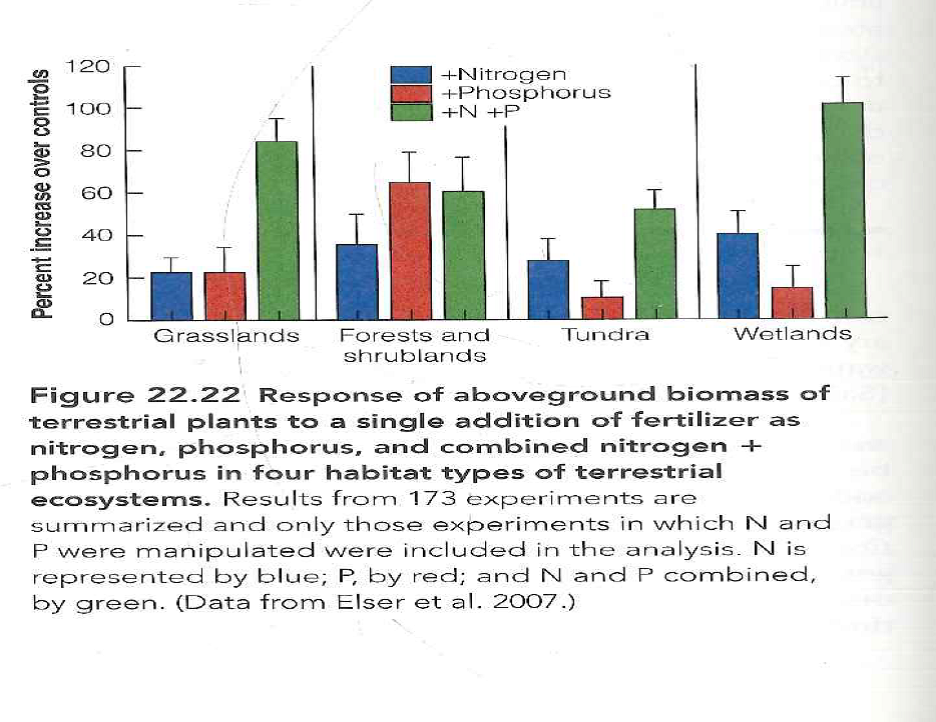
Reference Figure: 22.22
Question
Question
Question
Question
Question
Question
Question

Unlock Deck
Sign up to unlock the cards in this deck!
Unlock Deck
Unlock Deck
1/11

Play

Full screen (f)
Deck 22: Ecosystem Metabolism I: Primary Production
1
In discussing the effect of light on primary productivity in the ocean, Nielsen and Jensen (1957, p. 108) state:
It is thus quite likely dial a permanent reduction of the light intensity at the surface (to, e.g., 50 percent of its normal value without the other factors being affected-a rather improbable condition in Nature) in the long run would have very little influence on the organic productivity as measured per surface area.
How could this possibly be true?
It is thus quite likely dial a permanent reduction of the light intensity at the surface (to, e.g., 50 percent of its normal value without the other factors being affected-a rather improbable condition in Nature) in the long run would have very little influence on the organic productivity as measured per surface area.
How could this possibly be true?
According to research conducted by Nielsen and Jensen, the light that reaches the surface of the sea normally varies in accordance with weather and season. The light may be considered as a limiting factor as the reduced light that reaches the surface definitely reduces the organic productivity per area. Hence, all the factors that affect organic productivity should be regarded as complex. If one of these factors, such as light, is changed permanently, a new equilibrium is established.
If the light that falls on the surface is reduced by about one-third, it is suggested that the photosynthesis rate will be the same on the surface as it is in the depth of 24 m. The decrease in light intensity by one-third causes an increase in photosynthetic rate by almost 50%.
The reduction in photosynthesis (per unit volume) is evident on only dark days, such as those when there is rainfall the whole day. Below a specific unit area, the photosynthesis rate is affected more by weather conditions. Hence, the permanent reduction in the intensity of light will have little influence on organic productivity.
If the light that falls on the surface is reduced by about one-third, it is suggested that the photosynthesis rate will be the same on the surface as it is in the depth of 24 m. The decrease in light intensity by one-third causes an increase in photosynthetic rate by almost 50%.
The reduction in photosynthesis (per unit volume) is evident on only dark days, such as those when there is rainfall the whole day. Below a specific unit area, the photosynthesis rate is affected more by weather conditions. Hence, the permanent reduction in the intensity of light will have little influence on organic productivity.
2
Even though the concentration of inorganic phosphate in the water of the North Atlantic Ocean is only about 50% of that found in the other oceans, the North Atlantic is more productive than most of the other oceans. How can one reconcile these observations if nutrients limit primary productivity in the oceans?
Unlock Deck
Unlock for access to all 11 flashcards in this deck.
Unlock Deck
k this deck
3
The discovery that iron was a primary factor limiting primary production in large areas of the ocean caused the oceanographer John Martin to say in the late 1980s that "Give me a half tanker of iron, and I will give you an ice age." List the causal links that could make this prediction come true, and read the evaluation by Buesseler et al. (2004) that suggests this prediction could not possibly be correct.
In the ocean, dissolved iron is present in very minimal amount. Iron is most prevalent in the growth of phytoplanktons. Phytoplankton uses light energy by the process of photosynthesis to absorb carbon dioxide. When the phytoplankton dies, it is not necessary that  releases in the atmosphere. However, when other plants die, the
  is released in the atmosphere.
It is the tendency of phytoplankton to sink down to the bottom of the sea once they die and hence also moves down with them and can remain there for thousands of years. The words of john Martin which meant that large iron in sea will give rise to ice age practically meant that increased iron in sea will cause phytoplankton population to increase as well which means that more phytoplankton will absorb more carbon dioxide.
This will cause decrease in global warming which might disturb the climatic conditions on planet, in other words, it might bring ice age back. The main motto for the study conducted by Buesseler et al. in the year 2004 was to analyze the effect of iron input and its effect on carbon in Deep Ocean.
Their study involved analyzing the concentration of iron, phytoplankton production, and sustainable biomass concentration. It suggested that there was no iron stress observed in the communities even after longer time duration. Hence the prediction by John Martin was not correct.
releases in the atmosphere. However, when other plants die, the is released in the atmosphere.It is the tendency of phytoplankton to sink down to the bottom of the sea once they die and hence
also moves down with them and can remain there for thousands of years. The words of john Martin which meant that large iron in sea will give rise to ice age practically meant that increased iron in sea will cause phytoplankton population to increase as well which means that more phytoplankton will absorb more carbon dioxide.This will cause decrease in global warming which might disturb the climatic conditions on planet, in other words, it might bring ice age back. The main motto for the study conducted by Buesseler et al. in the year 2004 was to analyze the effect of iron input and its effect on carbon in Deep Ocean.
Their study involved analyzing the concentration of iron, phytoplankton production, and sustainable biomass concentration. It suggested that there was no iron stress observed in the communities even after longer time duration. Hence the prediction by John Martin was not correct.
4
Is it possible to have more than one limiting factor for primary production at any given time? flow ran we interpret the synergy between two nutrients like nitrogen and phosphorus as shown for example in Figure 22.22 if we accept Liebig's law of the minimum?
Reference Figure: 22.22
Reference Figure: 22.22
Unlock Deck
Unlock for access to all 11 flashcards in this deck.
Unlock Deck
k this deck
5
Tilman et al. (1982, p. 367) state:
We suggest that the spatial and temporal heterogeneity of pelagic environments will prevent us from meaningfully addressing questions on short time scales or small spatial scales.
Discuss the general issue of whether there are some questions in community ecology that we cannot answer because of scale.
We suggest that the spatial and temporal heterogeneity of pelagic environments will prevent us from meaningfully addressing questions on short time scales or small spatial scales.
Discuss the general issue of whether there are some questions in community ecology that we cannot answer because of scale.
Unlock Deck
Unlock for access to all 11 flashcards in this deck.
Unlock Deck
k this deck
6
North American grasslands are similar in structure to South African grasslands but the grass species differ because of their divergent evolutionary history. Both areas have dominant C 4 grasses with less abundant C 3 forbs and woody plants. But South Africa has greater climatic variability and poorer soils than North America. Would you expect the two areas to show the same relationships between rainfall and net primary production? Knapp et al. (2006) present an analysis of these questions.
Unlock Deck
Unlock for access to all 11 flashcards in this deck.
Unlock Deck
k this deck
7
Many studies of nutrient limitation in freshwater lakes and in the ocean use small water bottles as experimental units to which nutrients of various types are added. Other aquatic ecologists use mesocosms of plastic that hold several cubic meters of water for their experiments. Discuss why these small-scale experiments might give less reliable results than whole-lake manipulations. Schindler (1998) and Howarth and Marino (2006) discuss the scale problem for freshwater lakes and coastal marine ecosystems.
Unlock Deck
Unlock for access to all 11 flashcards in this deck.
Unlock Deck
k this deck
8
Photosynthetic organisms produce about 300 × 10 15 g of oxygen per year (Holland 1995). If this oxygen accumulated, the oxygen content of the atmosphere would double every 2000 years. Why does this not happen? Is the global system regulated? If so, how is this regulation accomplished?
Unlock Deck
Unlock for access to all 11 flashcards in this deck.
Unlock Deck
k this deck
9
"Red tides" are spectacular dinoflagellate blooms that occur in the sea and often lead to mass mortality of marine fishes and invertebrates. Human deaths from eating shellfish poisoned with red tide algae is a worldwide problem. Review the evidence available about the origin of red tides, and discuss the implications for general ideas about what controls primary production in the sea. Landsberg (2002), Kubanek et al. (2005), and Wong et al. (2007) discuss this problem.
Unlock Deck
Unlock for access to all 11 flashcards in this deck.
Unlock Deck
k this deck
10
Iron fertilization of the Southern Ocean could occur either by dust blowing in winds off the continents or by upwelling of nutrient-rich deep water. Discuss in general how you might decide between these two mechanisms of iron transport. Is the chemical form of iron compounds important in stimulating phytoplankton growth? Read Meskhidze et al. (2007) for a discussion of this problem.
Unlock Deck
Unlock for access to all 11 flashcards in this deck.
Unlock Deck
k this deck
11
In the Great Plains grasslands of the United States, Epstein et al. (1997) showed that primary production of C 3 grasses could be predicted from mean annual temperature, with minimal contribution from mean annual precipitation. Discuss why precipitation and soil nutrients do not appear to be relevant variables for C 3 grass production in this ecosystem.
Unlock Deck
Unlock for access to all 11 flashcards in this deck.
Unlock Deck
k this deck
Unlock Deck
Unlock for access to all 11 flashcards in this deck.






