







 Chat with AI

Deck 23: Ecosystem Metabolism II: Secondary Production
Full screen (f)

Question

Question
Question
Question
Question
Question
Question
Question
Suggest two possible impact pathways for the Scotia Shelf food web shown in figure 23.20. If blue whales regain their former abundance in the Antarctic.
Reference Figure: 23.20
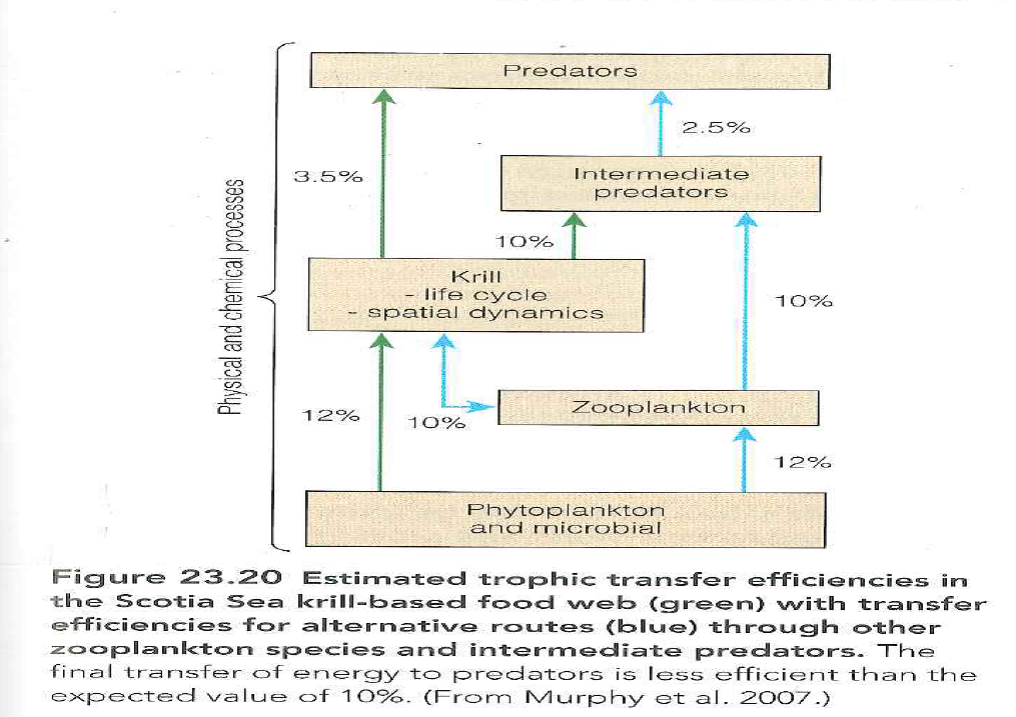
Reference Figure: 23.20
Question
Question
Question
Question

Unlock Deck
Sign up to unlock the cards in this deck!
Unlock Deck
Unlock Deck
1/12

Play

Full screen (f)
Deck 23: Ecosystem Metabolism II: Secondary Production
1
How would you expect trophic level biomass to change as the primary productivity of the community increases? Review the hypotheses of community organization discussed in Chapter 21, and discuss the assumptions underlying your predictions. Compare your expectations with those of Power (1992).
The presence of trophic cascades is not contentious; but still ecologists had a lengthy debate about its ubiquitous nature. Hairston, Slobodkin, and Smith claimed that terrestrial ecosystems function as three trophic level cascade that incited immediate argument. Some of the criticisms against their model were like following:
1) Plants hold several mechanisms of defenses against herbivore. These defenses also help in reducing the effects of herbivores on the population of plants.
2) The populations of herbivore can be restricted by some factors other than predation and food, such as availability of territory and nesting sites.
3) For these trophic cascades to stay ubiquitous, communities need to function as food chains, with distinct trophic levels. However, most of the communities consist of complex food webs. In actual food webs:
• Consumers usually feed at numerous trophic levels.
• Organisms repeatedly change their diet habit as they grow bigger.
• Cannibalism takes place, and consumers are supported by resource input from exterior local communities, all of which haze out the line of divisions between trophic levels.
The most widespread model to describe the organization of a community was given by Menge and Sutherland in 1987. They documented three ecological practices responsible for the organization of the community, they are: predation, physical disturbance, and competition. They included number of variables to form the model. A fundamental assumption of the model is that complexity of food web decreases with increase in the environmental stress. This model gives three predictions for the communities that ensure high recruitment:
a) In stressful environment, herbivores play little role as they are either very rare or completely absent. Thus, plants are controlled directly by the environmental stress. Neither competition nor predation has any significant impact. An example of such type of community is seen in the arctic tundra and a desert.
b) In reasonably stressful environment, consumers are unsuccessful in monitoring of plants. Thus, plants are able to attain high densities. In these communities, competition between plants functions as the principal biological interaction.
c) In benevolent environment, consumers monitor the number of plants, and competition among plant is rare. In these benign conditions, predation functions as the principal biological interaction.
The polar views about the organization of community can be defined as following:
• Bottom-up model : It is postulated as linkage. It means nutrients control the organization of community. It is because; nutrients regulate the number of plants, which sequentially regulate the number of herbivore, that further regulate the number of predators.
• Top down model : It is also called trophic cascade model. It is somewhat similar to Hairston Smith Slobodkin model. It extrapolates about the strong interaction both positive and negative between species across all the trophic levels. Therefore, predators will strongly reduce the number of herbivore. And reduced herbivore would minutely put any effect on the abundance of plant. This profusion of plant would depress the concentration of nutrients.
1) Plants hold several mechanisms of defenses against herbivore. These defenses also help in reducing the effects of herbivores on the population of plants.
2) The populations of herbivore can be restricted by some factors other than predation and food, such as availability of territory and nesting sites.
3) For these trophic cascades to stay ubiquitous, communities need to function as food chains, with distinct trophic levels. However, most of the communities consist of complex food webs. In actual food webs:
• Consumers usually feed at numerous trophic levels.
• Organisms repeatedly change their diet habit as they grow bigger.
• Cannibalism takes place, and consumers are supported by resource input from exterior local communities, all of which haze out the line of divisions between trophic levels.
The most widespread model to describe the organization of a community was given by Menge and Sutherland in 1987. They documented three ecological practices responsible for the organization of the community, they are: predation, physical disturbance, and competition. They included number of variables to form the model. A fundamental assumption of the model is that complexity of food web decreases with increase in the environmental stress. This model gives three predictions for the communities that ensure high recruitment:
a) In stressful environment, herbivores play little role as they are either very rare or completely absent. Thus, plants are controlled directly by the environmental stress. Neither competition nor predation has any significant impact. An example of such type of community is seen in the arctic tundra and a desert.
b) In reasonably stressful environment, consumers are unsuccessful in monitoring of plants. Thus, plants are able to attain high densities. In these communities, competition between plants functions as the principal biological interaction.
c) In benevolent environment, consumers monitor the number of plants, and competition among plant is rare. In these benign conditions, predation functions as the principal biological interaction.
The polar views about the organization of community can be defined as following:
• Bottom-up model : It is postulated as
linkage. It means nutrients control the organization of community. It is because; nutrients regulate the number of plants, which sequentially regulate the number of herbivore, that further regulate the number of predators.• Top down model : It is also called trophic cascade model. It is somewhat similar to Hairston Smith Slobodkin model. It extrapolates about the strong interaction both positive and negative between species across all the trophic levels. Therefore, predators will strongly reduce the number of herbivore. And reduced herbivore would minutely put any effect on the abundance of plant. This profusion of plant would depress the concentration of nutrients.
2
Lodge et al. (1998) found that in freshwater ecosystems nonvascular plant biomass was reduced nearly 60% by herbivores, whereas vascular plant biomass was reduced only 30% on average. Discuss two reasons why this might occur.
Universal homogenization of biota is proceeding through global introduction and establishment of exotic species, also called nonindigenous species. Freshwater ecologists need to devote more attention towards exotic species for two reasons:
• First, exotic species offer an opportunity to examine the hypotheses given to explain the features of the species and habitats responsible for successful establishment and invasibility, respectively.
• Second, envisaging of the species that had introduced huge ecological changes is a vital challenge for the managers of natural resource. Rigorous statistical analyses have found a strong link between the characteristics of the species with the probability of their establishment and their impact on the ecology.
Moreover, it is imperative to know the reliability of different sorts of experiments to direct the predictions. This issue was addressed with various three-dimensional experiments challenging the effects of two predators on the native groups of snail in northern Wisconsin in USA. The lake species include the rusty crayfish Orconectes rusticus , which is an exotic crayfish, and the pumpkinseed sunfish Lepomis gibossus , which is a predator of native fish predator.
For the laboratory experiments of crayfish, the field-cage experiment, and the snapshot inspection of 21 lakes provided consistent results that included:
• the reduced abundance of crayfish
• the richness of the species of native snails
Both laboratory and field experiments proposed that pumpkinseed sunfish must have an equivalent impact; however, the survey of lake suggested tiny impact. Unfortunately, there is no algorithm available to guide the scaling up of small-scale experiments to the long-term management scale in a large lake. In order to defend the native biodiversity, it is required to target the management of freshwater exotic species in lakes or in drainages. It is because they both are very vulnerable to colonization by exotic species that would harbor the endemic species.
• First, exotic species offer an opportunity to examine the hypotheses given to explain the features of the species and habitats responsible for successful establishment and invasibility, respectively.
• Second, envisaging of the species that had introduced huge ecological changes is a vital challenge for the managers of natural resource. Rigorous statistical analyses have found a strong link between the characteristics of the species with the probability of their establishment and their impact on the ecology.
Moreover, it is imperative to know the reliability of different sorts of experiments to direct the predictions. This issue was addressed with various three-dimensional experiments challenging the effects of two predators on the native groups of snail in northern Wisconsin in USA. The lake species include the rusty crayfish Orconectes rusticus , which is an exotic crayfish, and the pumpkinseed sunfish Lepomis gibossus , which is a predator of native fish predator.
For the laboratory experiments of crayfish, the field-cage experiment, and the snapshot inspection of 21 lakes provided consistent results that included:
• the reduced abundance of crayfish
• the richness of the species of native snails
Both laboratory and field experiments proposed that pumpkinseed sunfish must have an equivalent impact; however, the survey of lake suggested tiny impact. Unfortunately, there is no algorithm available to guide the scaling up of small-scale experiments to the long-term management scale in a large lake. In order to defend the native biodiversity, it is required to target the management of freshwater exotic species in lakes or in drainages. It is because they both are very vulnerable to colonization by exotic species that would harbor the endemic species.
3
Could herbivores remove a high fraction of the net primary production in an ecosystem without depressing the standing crop of plants? How might this happen?
The term production refers to formation of fresh organic matter. For instance, crop of wheat develops organic matter during its growth through the process of photosynthesis. The process transforms light energy into chemical energy that is stored in the bonds present within plant tissue. This energy serves as fuels for the plant's metabolic machinery. New structures and compounds are produced, cells divide, and the plants grow in size with time. The plant requires carbon dioxide, sunlight, nutrients and water, to perform photosynthesis. The products of the process include oxygen and reduced carbon compounds. The primary production can be evaluated by measuring the rate of photosynthesis, or the rate at which a specific plant is increasing in mass. Gross Primary Production, abbreviated as GPP, sums the total amount of  fixed by the plant during the process of photosynthesis. Respiration, abbreviated as R, includes the amount of
  that is obtained from an organism and a system from the metabolic activity.
Net Primary Production, abbreviated as NPP, includes the net quantity of primary production after excluding the costs of respiration of plant. Therefore, it can be given as following equation: The primary production could be expressed in terms of the rate of creation of new organic material, per unit of the surface of the earth, per unit of time. The production can be given in two ways:
• Energy in units of .
.
• Dry organic matter in units of .
.
Standing crop is a measure of the biomass of the system at a single point in time, and is measured in .
.
In grasslands, a very small proportion of the primary production is taken up by animals. Herbivores have only about 2 to 7% of the primary production above ground, whereas below ground 7 tO₂6% is consumed. In contrast to this, nearly all of the secondary production formed by herbivores is likely to be consumed by carnivores. Predators can monitor the population of consumer, at least of those that are present aboveground. It has been observed that the percentages of both the production and the consumption increase while moving from short to tall grass prairie.
The hypothesis developed from the examination of grassland ecosystems is that the population of grassland plants can be restricted due to the consumption of their roots by nematode, and by competition for soil, water, nutrients and light. The population of consumers is monitored by predators.
This hypothesis has been studied on a short grass prairie by providing nitrogen and water on a plot of 1-ha for about six years. Primary production augmented intensely by both the treatments, especially in the one in which water along with nitrogen is provided. The number of nematode increases about fourfold on the treated land. Small mammals retorted vividly to these plots because of the improved vegetation cover.
In the paper of Van de Koppel, he did analysis on the two relations that cause the contradictory, that is, level of resources drop because of herbivory, resulting in reduction in the growth of plant. These feedback associations potentially lead to the production of alternative vegetation. He states that the threshold effects in the grazed ecosystems even in the absence of the effect of a non-linear functional response of herbivore or without the competition among plants. The outcomes of the model were comparable with the well-documented interpretations of the spatial and temporal patterns of grazed ecosystems.
fixed by the plant during the process of photosynthesis. Respiration, abbreviated as R, includes the amount of that is obtained from an organism and a system from the metabolic activity.Net Primary Production, abbreviated as NPP, includes the net quantity of primary production after excluding the costs of respiration of plant. Therefore, it can be given as following equation:
The primary production could be expressed in terms of the rate of creation of new organic material, per unit of the surface of the earth, per unit of time. The production can be given in two ways:• Energy in units of
.• Dry organic matter in units of
.Standing crop is a measure of the biomass of the system at a single point in time, and is measured in
.In grasslands, a very small proportion of the primary production is taken up by animals. Herbivores have only about 2 to 7% of the primary production above ground, whereas below ground 7 tO₂6% is consumed. In contrast to this, nearly all of the secondary production formed by herbivores is likely to be consumed by carnivores. Predators can monitor the population of consumer, at least of those that are present aboveground. It has been observed that the percentages of both the production and the consumption increase while moving from short to tall grass prairie.
The hypothesis developed from the examination of grassland ecosystems is that the population of grassland plants can be restricted due to the consumption of their roots by nematode, and by competition for soil, water, nutrients and light. The population of consumers is monitored by predators.
This hypothesis has been studied on a short grass prairie by providing nitrogen and water on a plot of 1-ha for about six years. Primary production augmented intensely by both the treatments, especially in the one in which water along with nitrogen is provided. The number of nematode increases about fourfold on the treated land. Small mammals retorted vividly to these plots because of the improved vegetation cover.
In the paper of Van de Koppel, he did analysis on the two relations that cause the contradictory, that is, level of resources drop because of herbivory, resulting in reduction in the growth of plant. These feedback associations potentially lead to the production of alternative vegetation. He states that the threshold effects in the grazed ecosystems even in the absence of the effect of a non-linear functional response of herbivore or without the competition among plants. The outcomes of the model were comparable with the well-documented interpretations of the spatial and temporal patterns of grazed ecosystems.
4
Population density (no. of individuals per m 2 ) of all organisms in all ecosystems falls with increasing body size, so that larger animals are less common. But for species of equal body size, aquatic organisms are 10-20 times more abundant in lakes than terrestrial organisms on land. Suggest two reasons why this might be. Cyr et al. (1997) discuss this issue.
Unlock Deck
Unlock for access to all 12 flashcards in this deck.
Unlock Deck
k this deck
5
In assessing the metabolic theory of ecology, Sterner (2004) notes that it assumes that limiting resources are simple and consistent across all plant and animal groups. But he notes that the ratios of carbon, nitrogen, and phosphorus as well as other elements vary widely in different organisms. Read Sterner (2004) and discuss whether there could be a universal currency for ecological systems so that we could ignore the chemical peculiarities of individual species.
Unlock Deck
Unlock for access to all 12 flashcards in this deck.
Unlock Deck
k this deck
6
Does any increase in primary production lead to an increase in herbivore grazing pressure, thus maintaining a low standing crop of plants? Discuss what ecological processes might prevent this from happening. Van de Koppel et al. (1996) discuss this question and provide data from a salt marsh grazed by hares, rabbits, and geese.
Unlock Deck
Unlock for access to all 12 flashcards in this deck.
Unlock Deck
k this deck
7
In discussing the reality of trophic levels, Murdoch (1966a, p. 219) states:
Unlike populations, trophic levels are ill-defined and have no distinguishable lateral limits; in addition, tens of thousands of insect species, for example, live in more than one trophic level either simultaneously or at different stages of their life histories. Thus trophic levels exist only as abstractions, and unlike populations they have no empirically measurable properties or parameters.
Discuss.
Unlike populations, trophic levels are ill-defined and have no distinguishable lateral limits; in addition, tens of thousands of insect species, for example, live in more than one trophic level either simultaneously or at different stages of their life histories. Thus trophic levels exist only as abstractions, and unlike populations they have no empirically measurable properties or parameters.
Discuss.
Unlock Deck
Unlock for access to all 12 flashcards in this deck.
Unlock Deck
k this deck
8
Suggest two possible impact pathways for the Scotia Shelf food web shown in figure 23.20. If blue whales regain their former abundance in the Antarctic.
Reference Figure: 23.20
Reference Figure: 23.20
Unlock Deck
Unlock for access to all 12 flashcards in this deck.
Unlock Deck
k this deck
9
How would it be possible to have an inverted Eltonian pyramid of numbers in which, for example, the standing crop of large animals is larger than the standing crop of smaller animals? In what types of communities could this occur? Do Eltonian pyramids apply to both animals and plants? Del Giorgio et al. (1999) discuss these issues.
Unlock Deck
Unlock for access to all 12 flashcards in this deck.
Unlock Deck
k this deck
10
How does the answer to the question What limits secondary production? differ from the answer to the question of whether trophic structure is controlled top-down or bottom-up in communities (see p. 437)?
Unlock Deck
Unlock for access to all 12 flashcards in this deck.
Unlock Deck
k this deck
11
Would you expect that the relationship of metabolic rates to body size would also apply to bacteria and other prokaryotes? Would this imply a universal constant of metabolism for all living things? Makarieva et al. (2005) attempt to answer this question.
Unlock Deck
Unlock for access to all 12 flashcards in this deck.
Unlock Deck
k this deck
12
The basis for estimating secondary production is the estimation of population size, biomass, and growth, and the accuracy of any estimate of production depends on the accuracy of these three measurements. Read Morgan (1980) and then discuss the relative difficulty of measuring these three variables in freshwater ecosystems for zooplankton, benthic invertebrates, and fish.
Unlock Deck
Unlock for access to all 12 flashcards in this deck.
Unlock Deck
k this deck
Unlock Deck
Unlock for access to all 12 flashcards in this deck.






