







 Chat with AI

Deck 10: Marketing Research
Full screen (f)

Question

Question
Question
Question
Question
Question
Question
Question
Question
Question
Question
Question
Question
Question
Question
Question
Question
Question
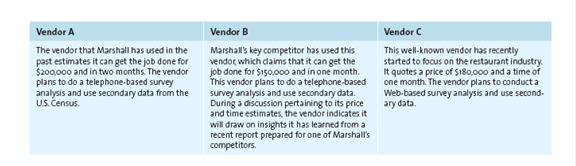
Marshall is planning to launch a new sandwich shop and is trying to decide what features and price would interest consumers. He sends a request for a proposal to four marketing research vendors, and three respond, as described in the table below. Which vendor should Tony use Explain your rationale for picking this vendor over the others.

Unlock Deck
Sign up to unlock the cards in this deck!
Unlock Deck
Unlock Deck
1/18

Play

Full screen (f)
Deck 10: Marketing Research
1
AUTOTRADER.COM: HOW RESEARCH SEPARATES FACT FROM FICTION
Imagine you are responsible for making next year's media buys for a large automobile dealership. You have your choice among traditional media, like television and newspaper advertising, and Internet-based channels, like social networking sites and automotive sites. How do you decide which types of advertising are most likely to build sales How can you determine if an approach that works for a dealership in one city will work in another
The online automobile dealer AutoTrader.com recognizes that convincing car dealers, associations, and manufacturers to advertise on its site requires proof that their media dollars will be well spent. To provide that proof, it offers the numbers that it collects from its website, which show that it hosts more than 3 million vehicle listings from 40,000 dealers and 250,000 private owners and more than 14 million qualified buyers each month. But these basic quantitative details cannot prove that advertising on the site actually leads to sales. To accomplish that goal, AutoTrader.com also conducts market research to help dealers understand how people shop for cars and how the site can deliver those customers as an integral part of the car-shopping process.
Many media buyers assume that the most accurate measure of the success of an online advertisement is click-through rates, that is, the number of clicks on an ad, divided by the number of times the ad gets shown. Although this measure indicates how many times an advertisement is viewed, it does not provide a reliable metric for the ad's impact on customer behavior, especially when it comes to making the final purchase decision. Car dealers also hold their own beliefs about their customers' behavior, which may be inaccurate but still determine their advertising choices. Therefore, to attract advertising dollars, AutoTrader.com needed to provide hard data, coming directly from the source-that is, the dealers and customers themselves.
Therefore, the marketing research performed by AutoTrader.com mainly serves to demonstrate the value of the Internet for selling vehicles. In a survey of recent car buyers, the company found that 71 percent of respondents consulted the Internet to facilitate their new or used car purchase. Most of these buyers reported that the Internet was the single most influential source behind their ultimate purchase choice, that it was the most helpful source of information, and that social media sites played only a small role in their final decision. The study also helped quantify other metrics surrounding car shopping behavior, such as the average length of time consumers spend shopping for a car and how much of that time involved Internet browsing versus visiting dealerships. The result-that buyers spend more than half their shopping time online-helped substantiate the value of advertising on AutoTrader.com. This finding was strengthened by further data showing that independent sites like AutoTrader were used more frequently than dealer or manufacturer sites.
Going even a step further, AutoTrader.com sought to connect advertising on its site to dealership visits, which represent the main goal of advertising on AutoTrader.com by car dealers. Marketing researchers first determined what dealers believed about their customers' behavior, using surveys. Then they gathered information from customers as they left dealerships, to find out the truth. To ensure accuracy and applicability, these researchers solicited customers of dealerships located in diverse markets, selling a variety brands, and operating as both franchises and independently. The results debunked a lot of conventional wisdom (see Exhibit 10.11). For example, newspaper advertising was less effective than dealers had imagined, but Internet advertising played a more significant role in driving walk-in traffic.
While this information might be true based on an average across national dealerships, some dealers believed it was not the case at their particular business. To help convince these skeptics, AutoTrader.com launched hundreds of mini- research studies, including phone interviews with car buyers from individual stores. The results that emerged were remarkably similar to the national study, though some differences reflected geographic locations of the dealership. Armed with this research, you are now confident that you understand the behavior of car buyers well enough to make your media buy. But can you be completely sure that marketing research accurately predicts customer behavior
Probably not, because human behavior depends on a vast array of factors, many of which cannot be measured. But marketing research can help you ensure that your advertising dollars are spent wisely and in ways that seem most likely to increase sales.
What are the objectives of AutoTrader.com's marketing research How have its research projects contributed to the firm's ability to meet these objectives
Imagine you are responsible for making next year's media buys for a large automobile dealership. You have your choice among traditional media, like television and newspaper advertising, and Internet-based channels, like social networking sites and automotive sites. How do you decide which types of advertising are most likely to build sales How can you determine if an approach that works for a dealership in one city will work in another
The online automobile dealer AutoTrader.com recognizes that convincing car dealers, associations, and manufacturers to advertise on its site requires proof that their media dollars will be well spent. To provide that proof, it offers the numbers that it collects from its website, which show that it hosts more than 3 million vehicle listings from 40,000 dealers and 250,000 private owners and more than 14 million qualified buyers each month. But these basic quantitative details cannot prove that advertising on the site actually leads to sales. To accomplish that goal, AutoTrader.com also conducts market research to help dealers understand how people shop for cars and how the site can deliver those customers as an integral part of the car-shopping process.
Many media buyers assume that the most accurate measure of the success of an online advertisement is click-through rates, that is, the number of clicks on an ad, divided by the number of times the ad gets shown. Although this measure indicates how many times an advertisement is viewed, it does not provide a reliable metric for the ad's impact on customer behavior, especially when it comes to making the final purchase decision. Car dealers also hold their own beliefs about their customers' behavior, which may be inaccurate but still determine their advertising choices. Therefore, to attract advertising dollars, AutoTrader.com needed to provide hard data, coming directly from the source-that is, the dealers and customers themselves.
Therefore, the marketing research performed by AutoTrader.com mainly serves to demonstrate the value of the Internet for selling vehicles. In a survey of recent car buyers, the company found that 71 percent of respondents consulted the Internet to facilitate their new or used car purchase. Most of these buyers reported that the Internet was the single most influential source behind their ultimate purchase choice, that it was the most helpful source of information, and that social media sites played only a small role in their final decision. The study also helped quantify other metrics surrounding car shopping behavior, such as the average length of time consumers spend shopping for a car and how much of that time involved Internet browsing versus visiting dealerships. The result-that buyers spend more than half their shopping time online-helped substantiate the value of advertising on AutoTrader.com. This finding was strengthened by further data showing that independent sites like AutoTrader were used more frequently than dealer or manufacturer sites.
Going even a step further, AutoTrader.com sought to connect advertising on its site to dealership visits, which represent the main goal of advertising on AutoTrader.com by car dealers. Marketing researchers first determined what dealers believed about their customers' behavior, using surveys. Then they gathered information from customers as they left dealerships, to find out the truth. To ensure accuracy and applicability, these researchers solicited customers of dealerships located in diverse markets, selling a variety brands, and operating as both franchises and independently. The results debunked a lot of conventional wisdom (see Exhibit 10.11). For example, newspaper advertising was less effective than dealers had imagined, but Internet advertising played a more significant role in driving walk-in traffic.
While this information might be true based on an average across national dealerships, some dealers believed it was not the case at their particular business. To help convince these skeptics, AutoTrader.com launched hundreds of mini- research studies, including phone interviews with car buyers from individual stores. The results that emerged were remarkably similar to the national study, though some differences reflected geographic locations of the dealership. Armed with this research, you are now confident that you understand the behavior of car buyers well enough to make your media buy. But can you be completely sure that marketing research accurately predicts customer behavior
Probably not, because human behavior depends on a vast array of factors, many of which cannot be measured. But marketing research can help you ensure that your advertising dollars are spent wisely and in ways that seem most likely to increase sales.
What are the objectives of AutoTrader.com's marketing research How have its research projects contributed to the firm's ability to meet these objectives
Case origin:
A company which deals with the auto mobile in online dealer conducts a market research to coordinate both the dealers and the customers. This research helps the organization to improve its services to the customers of the company. This process will increase the profitability of the business.
Justification:
The company mainly concentrates both on the direct car dealers and the individual private owners of car. Their main objective is to collect reviews and opinions from both the customers and car dealers to improve the performance of the site. This site helped many car dealers to understand the perception of their customers and the process through which the customers can be focused towards their product. The research information provided by the automobile site is more reliable and authenticated this shows that the dealer can use the information for further development of the business, and the same information can be used to predict their future growth in the industry.
A company which deals with the auto mobile in online dealer conducts a market research to coordinate both the dealers and the customers. This research helps the organization to improve its services to the customers of the company. This process will increase the profitability of the business.
Justification:
The company mainly concentrates both on the direct car dealers and the individual private owners of car. Their main objective is to collect reviews and opinions from both the customers and car dealers to improve the performance of the site. This site helped many car dealers to understand the perception of their customers and the process through which the customers can be focused towards their product. The research information provided by the automobile site is more reliable and authenticated this shows that the dealer can use the information for further development of the business, and the same information can be used to predict their future growth in the industry.
2
What are the steps in the marketing research process
2. What is the difference between data and information
2. What is the difference between data and information
(1)
Steps in marketing research process:
The following are the steps in marketing research process:
• Identifying the methodology to collect the information required and the quality required in the information collected.
• The purpose of collecting the information and the use of the information collected in the previous step should be analyzed.
• Processing the information collected in the previous stage and measuring the importance of the information collected.
• Preparing a questionnaire to collect required data from the market.
• Conducting a sample survey to know the effectiveness of the questionnaire.
• Conducting an information analysis to use the data collected in the previous stages.
(2)
Difference between data and information:
The following are the differences between data and information
• The data are the raw data collected directly from the respondents of the survey. Information is the data which are the final output of the survey.
• Data are not clear and specific, but information is clear which can be used for other purposes.
• Data fails to carry meaning and information carries meaning for the data.
• A single unit of the question is called data and the group of details is called information.
Steps in marketing research process:
The following are the steps in marketing research process:
• Identifying the methodology to collect the information required and the quality required in the information collected.
• The purpose of collecting the information and the use of the information collected in the previous step should be analyzed.
• Processing the information collected in the previous stage and measuring the importance of the information collected.
• Preparing a questionnaire to collect required data from the market.
• Conducting a sample survey to know the effectiveness of the questionnaire.
• Conducting an information analysis to use the data collected in the previous stages.
(2)
Difference between data and information:
The following are the differences between data and information
• The data are the raw data collected directly from the respondents of the survey. Information is the data which are the final output of the survey.
• Data are not clear and specific, but information is clear which can be used for other purposes.
• Data fails to carry meaning and information carries meaning for the data.
• A single unit of the question is called data and the group of details is called information.
3
A large department store collects data about whatits customers buy and stores these data in a data warehouse. If you were the store's buyer for men's shoes, what would you want to know from the data warehouse that would help you be a more successful buyer
Customer buying decision should be based on several assumptions such as product configuration, quality, price, availability, and services available.
You should try to know the most sold models of lawn equipment and the price at which they were sold. You should also obtain information about the features, quality, and specifications of the product you are going to purchase.
This information will assure you and help you to make a correct choice of the products available at the store. It is better to have full information of the product that you think to purchase.
You should also enquire about after sales service of the product, availability of parts in market, installation, and usage. So that you would not face difficulties after buying the product.
Successful buyer is he who has complete information about the product well before purchase.
You should try to know the most sold models of lawn equipment and the price at which they were sold. You should also obtain information about the features, quality, and specifications of the product you are going to purchase.
This information will assure you and help you to make a correct choice of the products available at the store. It is better to have full information of the product that you think to purchase.
You should also enquire about after sales service of the product, availability of parts in market, installation, and usage. So that you would not face difficulties after buying the product.
Successful buyer is he who has complete information about the product well before purchase.
4
Go to the website for the marketing research company, SymphonyIRI (www.symphonyiri.com). Click on "News and Events," and click on one of the recent press releases. What research question was SymphonyIRI addressing What type of research did SymphonyIRI conduct, and what insights did it develop for its clients
Unlock Deck
Unlock for access to all 18 flashcards in this deck.
Unlock Deck
k this deck
5
AUTOTRADER.COM: HOW RESEARCH SEPARATES FACT FROM FICTION
Imagine you are responsible for making next year's media buys for a large automobile dealership. You have your choice among traditional media, like television and newspaper advertising, and Internet-based channels, like social networking sites and automotive sites. How do you decide which types of advertising are most likely to build sales How can you determine if an approach that works for a dealership in one city will work in another
The online automobile dealer AutoTrader.com recognizes that convincing car dealers, associations, and manufacturers to advertise on its site requires proof that their media dollars will be well spent. To provide that proof, it offers the numbers that it collects from its website, which show that it hosts more than 3 million vehicle listings from 40,000 dealers and 250,000 private owners and more than 14 million qualified buyers each month. But these basic quantitative details cannot prove that advertising on the site actually leads to sales. To accomplish that goal, AutoTrader.com also conducts market research to help dealers understand how people shop for cars and how the site can deliver those customers as an integral part of the car-shopping process.
Many media buyers assume that the most accurate measure of the success of an online advertisement is click-through rates, that is, the number of clicks on an ad, divided by the number of times the ad gets shown. Although this measure indicates how many times an advertisement is viewed, it does not provide a reliable metric for the ad's impact on customer behavior, especially when it comes to making the final purchase decision. Car dealers also hold their own beliefs about their customers' behavior, which may be inaccurate but still determine their advertising choices. Therefore, to attract advertising dollars, AutoTrader.com needed to provide hard data, coming directly from the source-that is, the dealers and customers themselves.
Therefore, the marketing research performed by AutoTrader.com mainly serves to demonstrate the value of the Internet for selling vehicles. In a survey of recent car buyers, the company found that 71 percent of respondents consulted the Internet to facilitate their new or used car purchase. Most of these buyers reported that the Internet was the single most influential source behind their ultimate purchase choice, that it was the most helpful source of information, and that social media sites played only a small role in their final decision. The study also helped quantify other metrics surrounding car shopping behavior, such as the average length of time consumers spend shopping for a car and how much of that time involved Internet browsing versus visiting dealerships. The result-that buyers spend more than half their shopping time online-helped substantiate the value of advertising on AutoTrader.com. This finding was strengthened by further data showing that independent sites like AutoTrader were used more frequently than dealer or manufacturer sites.
Going even a step further, AutoTrader.com sought to connect advertising on its site to dealership visits, which represent the main goal of advertising on AutoTrader.com by car dealers. Marketing researchers first determined what dealers believed about their customers' behavior, using surveys. Then they gathered information from customers as they left dealerships, to find out the truth. To ensure accuracy and applicability, these researchers solicited customers of dealerships located in diverse markets, selling a variety brands, and operating as both franchises and independently. The results debunked a lot of conventional wisdom (see Exhibit 10.11). For example, newspaper advertising was less effective than dealers had imagined, but Internet advertising played a more significant role in driving walk-in traffic.
While this information might be true based on an average across national dealerships, some dealers believed it was not the case at their particular business. To help convince these skeptics, AutoTrader.com launched hundreds of mini- research studies, including phone interviews with car buyers from individual stores. The results that emerged were remarkably similar to the national study, though some differences reflected geographic locations of the dealership. Armed with this research, you are now confident that you understand the behavior of car buyers well enough to make your media buy. But can you be completely sure that marketing research accurately predicts customer behavior
Probably not, because human behavior depends on a vast array of factors, many of which cannot be measured. But marketing research can help you ensure that your advertising dollars are spent wisely and in ways that seem most likely to increase sales.
What methods has AutoTrader.com used to collect data about the effectiveness of dealer advertisements displayed on its site
Imagine you are responsible for making next year's media buys for a large automobile dealership. You have your choice among traditional media, like television and newspaper advertising, and Internet-based channels, like social networking sites and automotive sites. How do you decide which types of advertising are most likely to build sales How can you determine if an approach that works for a dealership in one city will work in another
The online automobile dealer AutoTrader.com recognizes that convincing car dealers, associations, and manufacturers to advertise on its site requires proof that their media dollars will be well spent. To provide that proof, it offers the numbers that it collects from its website, which show that it hosts more than 3 million vehicle listings from 40,000 dealers and 250,000 private owners and more than 14 million qualified buyers each month. But these basic quantitative details cannot prove that advertising on the site actually leads to sales. To accomplish that goal, AutoTrader.com also conducts market research to help dealers understand how people shop for cars and how the site can deliver those customers as an integral part of the car-shopping process.
Many media buyers assume that the most accurate measure of the success of an online advertisement is click-through rates, that is, the number of clicks on an ad, divided by the number of times the ad gets shown. Although this measure indicates how many times an advertisement is viewed, it does not provide a reliable metric for the ad's impact on customer behavior, especially when it comes to making the final purchase decision. Car dealers also hold their own beliefs about their customers' behavior, which may be inaccurate but still determine their advertising choices. Therefore, to attract advertising dollars, AutoTrader.com needed to provide hard data, coming directly from the source-that is, the dealers and customers themselves.
Therefore, the marketing research performed by AutoTrader.com mainly serves to demonstrate the value of the Internet for selling vehicles. In a survey of recent car buyers, the company found that 71 percent of respondents consulted the Internet to facilitate their new or used car purchase. Most of these buyers reported that the Internet was the single most influential source behind their ultimate purchase choice, that it was the most helpful source of information, and that social media sites played only a small role in their final decision. The study also helped quantify other metrics surrounding car shopping behavior, such as the average length of time consumers spend shopping for a car and how much of that time involved Internet browsing versus visiting dealerships. The result-that buyers spend more than half their shopping time online-helped substantiate the value of advertising on AutoTrader.com. This finding was strengthened by further data showing that independent sites like AutoTrader were used more frequently than dealer or manufacturer sites.
Going even a step further, AutoTrader.com sought to connect advertising on its site to dealership visits, which represent the main goal of advertising on AutoTrader.com by car dealers. Marketing researchers first determined what dealers believed about their customers' behavior, using surveys. Then they gathered information from customers as they left dealerships, to find out the truth. To ensure accuracy and applicability, these researchers solicited customers of dealerships located in diverse markets, selling a variety brands, and operating as both franchises and independently. The results debunked a lot of conventional wisdom (see Exhibit 10.11). For example, newspaper advertising was less effective than dealers had imagined, but Internet advertising played a more significant role in driving walk-in traffic.
While this information might be true based on an average across national dealerships, some dealers believed it was not the case at their particular business. To help convince these skeptics, AutoTrader.com launched hundreds of mini- research studies, including phone interviews with car buyers from individual stores. The results that emerged were remarkably similar to the national study, though some differences reflected geographic locations of the dealership. Armed with this research, you are now confident that you understand the behavior of car buyers well enough to make your media buy. But can you be completely sure that marketing research accurately predicts customer behavior
Probably not, because human behavior depends on a vast array of factors, many of which cannot be measured. But marketing research can help you ensure that your advertising dollars are spent wisely and in ways that seem most likely to increase sales.
What methods has AutoTrader.com used to collect data about the effectiveness of dealer advertisements displayed on its site
Unlock Deck
Unlock for access to all 18 flashcards in this deck.
Unlock Deck
k this deck
6
What is the difference between internal and external secondary research
Unlock Deck
Unlock for access to all 18 flashcards in this deck.
Unlock Deck
k this deck
7
Identify a not-for-profit organization that might use marketing research, and describe one example of a meaningful research project that it might conduct. Discuss the steps they might engage in for this project.
Unlock Deck
Unlock for access to all 18 flashcards in this deck.
Unlock Deck
k this deck
8
The epinions.com website (www.epinions.com) is a clearinghouse for consumer reviews about different products and services. Think of a particular business with which you are familiar, and then review the ratings and comments for that business on the epinions website. Discuss the extent to which this site might be useful to a marketer for that company who needs to gather market research about the company and its competitors. Identify the type of research this process involves-secondary or primary
Unlock Deck
Unlock for access to all 18 flashcards in this deck.
Unlock Deck
k this deck
9
What are the types of qualitative research
Unlock Deck
Unlock for access to all 18 flashcards in this deck.
Unlock Deck
k this deck
10
Marketing researchers do not always go through the steps in the marketing research process insequential order. Provide an example of a research project that might not follow this sequence.
Unlock Deck
Unlock for access to all 18 flashcards in this deck.
Unlock Deck
k this deck
11
What are the types of quantitative research
2. What are the advantages and disadvantages of primary and secondary research
2. What are the advantages and disadvantages of primary and secondary research
Unlock Deck
Unlock for access to all 18 flashcards in this deck.
Unlock Deck
k this deck
12
A sunglasses retailer is trying to determine if there is a significant market for its merchandise in a specific mall location where it is considering opening a store. Would it be most likely to use primary or secondary data, or a combination of the two, to answer this question
Unlock Deck
Unlock for access to all 18 flashcards in this deck.
Unlock Deck
k this deck
13
Under what circumstances is it ethical to use consumer information in marketing research
2. What challenges do technological advances pose for the ethics of marketing research
2. What challenges do technological advances pose for the ethics of marketing research
Unlock Deck
Unlock for access to all 18 flashcards in this deck.
Unlock Deck
k this deck
14
A consumer package goods company (e.g., Pepsi) has just developed a new beverage. The company needs to estimate the demand for such a new product. What sources of syndicated data could it explore
Unlock Deck
Unlock for access to all 18 flashcards in this deck.
Unlock Deck
k this deck
15
A bank manager notices that by the time customers get to the teller, they seem irritated and impatient. She wants to investigate the problem further, so she hires you to design a research project to figure out what is bothering the customers. The bank wants two studies: (a) several focus groups of their customers and (b) an online survey of 500 customers. Which study is qualitative, and which is quantitative
Unlock Deck
Unlock for access to all 18 flashcards in this deck.
Unlock Deck
k this deck
16
PomWonderful has developed a coffee-flavored pomegranate beverage, and it wants to determine if it should begin to market it throughout the United States. The company used two separate studies for the advertising campaign:
• A focus group to identify the appropriate advertising message for the new beverage.
• A survey to assess the effectiveness of the advertising campaign for the new PomWonderful beverage.
Which study was exploratory and which was conclusive What other studies would you recommend PomWonderful undertake
• A focus group to identify the appropriate advertising message for the new beverage.
• A survey to assess the effectiveness of the advertising campaign for the new PomWonderful beverage.
Which study was exploratory and which was conclusive What other studies would you recommend PomWonderful undertake
Unlock Deck
Unlock for access to all 18 flashcards in this deck.
Unlock Deck
k this deck
17
Suppose your university wants to modify its course scheduling procedures to better serve students. What are some secondary sources of information that might be used to conduct research into this topic Describe how these sources might be used. Describe a method you could use to gather primary research data about the topic. Would you recommend a specific order in obtaining each of these types of data Explain your answer.
Unlock Deck
Unlock for access to all 18 flashcards in this deck.
Unlock Deck
k this deck
18
Marshall is planning to launch a new sandwich shop and is trying to decide what features and price would interest consumers. He sends a request for a proposal to four marketing research vendors, and three respond, as described in the table below. Which vendor should Tony use Explain your rationale for picking this vendor over the others.
Unlock Deck
Unlock for access to all 18 flashcards in this deck.
Unlock Deck
k this deck
Unlock Deck
Unlock for access to all 18 flashcards in this deck.






