







 Chat with AI

Deck 8: The Deaths of Stars
Full screen (f)

Question

Question
Question
Question
Question
Question
Question
Question
Question
Question
Question
Question
Question
Question
Question
Which point indicates the location on the H-R diagram of a one-solar-mass star when it starts to fuse helium? 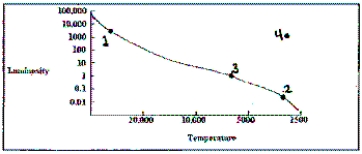
A) 1
B) 2
C) 3
D) 4
A) 1
B) 2
C) 3
D) 4
Question
Question
Question
Question
Question
Question
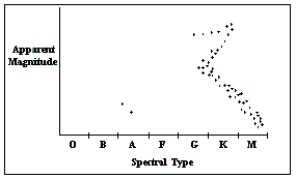
Refer to the H-R diagram. How would the H-R diagram of an older star cluster look different?
A) The points would shift to the right, because all of the stars would have lower temperatures.
B) The lower main sequence would look the same, but the turnoff would be at spectral type K or M.
C) The points would shift down, because all of the stars would have lower luminosities.
D) The lower main sequence would look the same, but the turnoff would be at spectral type F or A.
Question
Question
Question
Question
Question
Question
Question
Question
Question
Question
Refer to the H-R diagram. What type of star do the two data points above spectral type "A" represent?
A) massive main sequence stars
B) massive supergiant stars
C) white dwarfs with mass less than the sun's mass
D) white dwarfs with mass greater than twice the sun's mass
Question
Question
Question
Question
Question
Question
Refer to the H-R diagram. What type of star do the data points above spectral type "M" represent?
A) massive main sequence stars
B) main sequence stars with mass less than the sun's mass
C) main sequence stars with luminosities higher than the sun's luminosity
D) pre-main sequence stars
Question
Question
Question
Question
Question
Question
Question
Question
Question
Question
Question
Question
Question
Question
Question
Question
Question
Question
Question
Question
Question
Question
Question
Question
Question
Question
Question
Question
Question
Question
Question
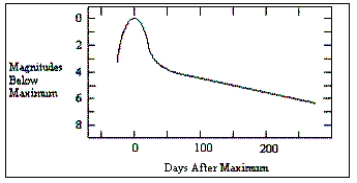
The diagram shows a light curve from a supernova. How many days after maximum light did it take for the supernova to decrease in brightness by 5 magnitudes?
A) less than 50
B) 50
C) 150
D) 250
Question
Question
The diagram shows a light curve from a supernova. About how long did it take for the supernova to reach its maximum luminosity?
A) 25 days
B) 50 days
C) 100 days
D) 200 days
Question
Question
Question
Question
Question
Question
Question
Question
Question
Question

Unlock Deck
Sign up to unlock the cards in this deck!
Unlock Deck
Unlock Deck
1/155

Play

Full screen (f)
Deck 8: The Deaths of Stars
1
A low mass star goes through several stages of life from birth to death. Which of the following lists are in correct order?
A) protostar, main sequence star, red giant, supernova, neutron star
B) protostar, main sequence star, planetary nebula, super giant, supernova
C) protostar, main sequence star, red giant, planetary nebula, white dwarf
D) protostar, main sequence star, white dwarf, red giant
A) protostar, main sequence star, red giant, supernova, neutron star
B) protostar, main sequence star, planetary nebula, super giant, supernova
C) protostar, main sequence star, red giant, planetary nebula, white dwarf
D) protostar, main sequence star, white dwarf, red giant
protostar, main sequence star, red giant, planetary nebula, white dwarf
2
What do we call the region of the HR diagram that represents giant stars that are fusing helium in their cores and then in their shells?
A) turnoff point
B) horizontal branch
C) turn-on point
D) main sequence
A) turnoff point
B) horizontal branch
C) turn-on point
D) main sequence
horizontal branch
3
After what evolutionary stage does a star become a white dwarf?
A) protostar
B) pre-main sequence
C) main sequence
D) giant
A) protostar
B) pre-main sequence
C) main sequence
D) giant
giant
4
About how long will a 0.5-solar-mass star spend on the main sequence?
A) 5 million years
B) 500 million years
C) 5 billion years
D) 50 billion years
A) 5 million years
B) 500 million years
C) 5 billion years
D) 50 billion years
Unlock Deck
Unlock for access to all 155 flashcards in this deck.
Unlock Deck
k this deck
5
When does a star experience helium fusion?
A) just before it enters the main sequence
B) after it has become a red giant star
C) when it is on the horizontal branch
D) before it leaves the main sequence
A) just before it enters the main sequence
B) after it has become a red giant star
C) when it is on the horizontal branch
D) before it leaves the main sequence
Unlock Deck
Unlock for access to all 155 flashcards in this deck.
Unlock Deck
k this deck
6
What happens to stars that have ejected a planetary nebula?
A) They become protostars.
B) They become brown dwarfs.
C) They become white dwarfs.
D) They become red giants.
A) They become protostars.
B) They become brown dwarfs.
C) They become white dwarfs.
D) They become red giants.
Unlock Deck
Unlock for access to all 155 flashcards in this deck.
Unlock Deck
k this deck
7
Why are giant and supergiant stars rare?
A) The giant and supergiant stages are very short.
B) The star blows up before the giant or supergiant stage is reached.
C) They do not form as often as main sequence stars.
D) The giant or supergiant stage is very long.
A) The giant and supergiant stages are very short.
B) The star blows up before the giant or supergiant stage is reached.
C) They do not form as often as main sequence stars.
D) The giant or supergiant stage is very long.
Unlock Deck
Unlock for access to all 155 flashcards in this deck.
Unlock Deck
k this deck
8
How is a giant star different from the star it evolved from?
A) A giant is hotter and more luminous.
B) A giant is hotter and less luminous.
C) A giant is cooler and more luminous.
D) A giant is cooler and less luminous.
A) A giant is hotter and more luminous.
B) A giant is hotter and less luminous.
C) A giant is cooler and more luminous.
D) A giant is cooler and less luminous.
Unlock Deck
Unlock for access to all 155 flashcards in this deck.
Unlock Deck
k this deck
9
In what way are giants and supergiants similar?
A) They are the main sequence stars.
B) They undergo a helium flash stage as they enter the main sequence.
C) They are very luminous.
D) Their cores expand rapidly to reach giant sizes.
A) They are the main sequence stars.
B) They undergo a helium flash stage as they enter the main sequence.
C) They are very luminous.
D) Their cores expand rapidly to reach giant sizes.
Unlock Deck
Unlock for access to all 155 flashcards in this deck.
Unlock Deck
k this deck
10
What will happen to the Sun after it leaves the main sequence?
A) thermonuclear fusion of hydrogen and helium but never hot enough to ignite carbon
B) thermonuclear fusion of hydrogen but never hot enough to ignite helium
C) production of type I supernovae after exhaustion of nuclear fuels
D) production of type II supernovae after exhaustion of nuclear fuels
A) thermonuclear fusion of hydrogen and helium but never hot enough to ignite carbon
B) thermonuclear fusion of hydrogen but never hot enough to ignite helium
C) production of type I supernovae after exhaustion of nuclear fuels
D) production of type II supernovae after exhaustion of nuclear fuels
Unlock Deck
Unlock for access to all 155 flashcards in this deck.
Unlock Deck
k this deck
11
For a star with a mass similar to that of the Sun, what is the last stage of the nuclear fusion?
A) hydrogen to helium
B) helium to carbon and oxygen
C) carbon to magnesium
D) silicon to iron
A) hydrogen to helium
B) helium to carbon and oxygen
C) carbon to magnesium
D) silicon to iron
Unlock Deck
Unlock for access to all 155 flashcards in this deck.
Unlock Deck
k this deck
12
Why are star clusters important to our study of stars?
A) because all stars formed in star clusters
B) because they allow us to test our theories and models of stellar evolution
C) because the Sun was once a member of a globular cluster
D) because they are the only objects that contain Cepheid variables
A) because all stars formed in star clusters
B) because they allow us to test our theories and models of stellar evolution
C) because the Sun was once a member of a globular cluster
D) because they are the only objects that contain Cepheid variables
Unlock Deck
Unlock for access to all 155 flashcards in this deck.
Unlock Deck
k this deck
13
Why can't the lowest mass stars become giants?
A) Their centres never get hot enough.
B) Their rotation is too slow.
C) They do not contain helium.
D) They never use up their hydrogen.
A) Their centres never get hot enough.
B) Their rotation is too slow.
C) They do not contain helium.
D) They never use up their hydrogen.
Unlock Deck
Unlock for access to all 155 flashcards in this deck.
Unlock Deck
k this deck
14
As a star exhausts the hydrogen in its core, what happens to its outer layer?
A) It compresses and heats up.
B) It compresses and cools down.
C) It expands and heats up.
D) It expands and cools down.
A) It compresses and heats up.
B) It compresses and cools down.
C) It expands and heats up.
D) It expands and cools down.
Unlock Deck
Unlock for access to all 155 flashcards in this deck.
Unlock Deck
k this deck
15
Which point indicates the location on the H-R diagram of a one-solar-mass star when it starts to fuse helium?
A) 1
B) 2
C) 3
D) 4
A) 1
B) 2
C) 3
D) 4
Unlock Deck
Unlock for access to all 155 flashcards in this deck.
Unlock Deck
k this deck
16
What property is the same for all stars in a star cluster?
A) age
B) mass
C) luminosity
D) radius
A) age
B) mass
C) luminosity
D) radius
Unlock Deck
Unlock for access to all 155 flashcards in this deck.
Unlock Deck
k this deck
17
As a star exhausts the hydrogen in its core, how does its appearance change?
A) It becomes bluer and more luminous.
B) It becomes bluer and less luminous.
C) It becomes redder and less luminous.
D) It becomes redder and more luminous.
A) It becomes bluer and more luminous.
B) It becomes bluer and less luminous.
C) It becomes redder and less luminous.
D) It becomes redder and more luminous.
Unlock Deck
Unlock for access to all 155 flashcards in this deck.
Unlock Deck
k this deck
18
What is responsible for the mass stars eject during the red giant stage?
A) nuclear fusion near the star's surface
B) the explosion of a white dwarf
C) the increased opacity of the outer layers
D) extra pressure from degenerate matter
A) nuclear fusion near the star's surface
B) the explosion of a white dwarf
C) the increased opacity of the outer layers
D) extra pressure from degenerate matter
Unlock Deck
Unlock for access to all 155 flashcards in this deck.
Unlock Deck
k this deck
19
Which of the following statements best describes why stars eventually die?
A) Their lifespan is limited.
B) They exhaust all their fuel.
C) Their cores become hotter.
D) They become less luminous.
A) Their lifespan is limited.
B) They exhaust all their fuel.
C) Their cores become hotter.
D) They become less luminous.
Unlock Deck
Unlock for access to all 155 flashcards in this deck.
Unlock Deck
k this deck
20
Which of the following occurs during the giant stage?
A) helium fusion in the core and hydrogen fusion in the surrounding shell
B) hydrogen fusion in the core and helium fusion in the surrounding shell
C) hydrogen and helium fusion in the core
D) hydrogen flash
A) helium fusion in the core and hydrogen fusion in the surrounding shell
B) hydrogen fusion in the core and helium fusion in the surrounding shell
C) hydrogen and helium fusion in the core
D) hydrogen flash
Unlock Deck
Unlock for access to all 155 flashcards in this deck.
Unlock Deck
k this deck
21
Refer to the H-R diagram. How would the H-R diagram of an older star cluster look different?
A) The points would shift to the right, because all of the stars would have lower temperatures.
B) The lower main sequence would look the same, but the turnoff would be at spectral type K or M.
C) The points would shift down, because all of the stars would have lower luminosities.
D) The lower main sequence would look the same, but the turnoff would be at spectral type F or A.
Unlock Deck
Unlock for access to all 155 flashcards in this deck.
Unlock Deck
k this deck
22
What is the term for a collection of 10 to 1000 young stars in a region about 80 light-years in diameter?
A) Herbig-Haro object
B) globular cluster
C) open cluster
D) giant cluster
A) Herbig-Haro object
B) globular cluster
C) open cluster
D) giant cluster
Unlock Deck
Unlock for access to all 155 flashcards in this deck.
Unlock Deck
k this deck
23
What is a planetary nebula?
A) the expelled outer envelope of a medium mass star
B) a cloud of hot gas produced by a supernova explosion
C) a nebula within which planets are forming
D) a cloud of hot gas surrounding a planet
A) the expelled outer envelope of a medium mass star
B) a cloud of hot gas produced by a supernova explosion
C) a nebula within which planets are forming
D) a cloud of hot gas surrounding a planet
Unlock Deck
Unlock for access to all 155 flashcards in this deck.
Unlock Deck
k this deck
24
Suppose you discover a binary star system with a 0.7 solar mass giant star and a 2 solar mass main sequence star. Why is this surprising?
A) 0.7 solar mass stars are not expected to become giants.
B) All 2 solar mass stars should have left the main sequence.
C) Giant stars are expected to destroy their companions, so the 2 solar mass star shouldn't exist.
D) The 2 solar mass star should have become a giant before the 0.7 solar mass star.
A) 0.7 solar mass stars are not expected to become giants.
B) All 2 solar mass stars should have left the main sequence.
C) Giant stars are expected to destroy their companions, so the 2 solar mass star shouldn't exist.
D) The 2 solar mass star should have become a giant before the 0.7 solar mass star.
Unlock Deck
Unlock for access to all 155 flashcards in this deck.
Unlock Deck
k this deck
25
Which of the following correctly describes a relationship between pressure, temperature, and density in degenerate matter?
A) Pressure depends only on the temperature.
B) Pressure does not depend on temperature.
C) Temperature depends only on density.
D) Pressure does not depend on density.
A) Pressure depends only on the temperature.
B) Pressure does not depend on temperature.
C) Temperature depends only on density.
D) Pressure does not depend on density.
Unlock Deck
Unlock for access to all 155 flashcards in this deck.
Unlock Deck
k this deck
26
What is the defining characteristic of stars within a cluster that are at the turnoff point?
A) They are just leaving the main sequence.
B) They are just becoming white dwarfs.
C) They are just entering the main sequence.
D) They are about to explode in supernovae.
A) They are just leaving the main sequence.
B) They are just becoming white dwarfs.
C) They are just entering the main sequence.
D) They are about to explode in supernovae.
Unlock Deck
Unlock for access to all 155 flashcards in this deck.
Unlock Deck
k this deck
27
Which scenario is most likely to happen when the Sun enters the red giant stage?
A) Mercury, Venus, and Earth will be destroyed by the expanding Sun.
B) Mercury will be destroyed by the expanding Sun, but Venus and Earth will remain intact.
C) The Sun will engulf and destroy all planets in the Solar System.
D) The Sun will never expand far enough to reach Mercury or any other planets in the Soar System.
A) Mercury, Venus, and Earth will be destroyed by the expanding Sun.
B) Mercury will be destroyed by the expanding Sun, but Venus and Earth will remain intact.
C) The Sun will engulf and destroy all planets in the Solar System.
D) The Sun will never expand far enough to reach Mercury or any other planets in the Soar System.
Unlock Deck
Unlock for access to all 155 flashcards in this deck.
Unlock Deck
k this deck
28
Why is a white dwarf not a true star?
A) It is not hot enough to fuse hydrogen into helium.
B) It has an extremely low luminosity.
C) It is much smaller than a normal star.
D) It is not powered by nuclear reactions.
A) It is not hot enough to fuse hydrogen into helium.
B) It has an extremely low luminosity.
C) It is much smaller than a normal star.
D) It is not powered by nuclear reactions.
Unlock Deck
Unlock for access to all 155 flashcards in this deck.
Unlock Deck
k this deck
29
What does the Chandrasekhar limit tell us?
A) Accretion disks can grow hot through friction.
B) Neutron stars of more than 3 solar masses are not stable.
C) White dwarfs more massive than 1.4 solar masses are not stable.
D) Stars with a mass less than 0.5 solar masses will not go through helium flash.
A) Accretion disks can grow hot through friction.
B) Neutron stars of more than 3 solar masses are not stable.
C) White dwarfs more massive than 1.4 solar masses are not stable.
D) Stars with a mass less than 0.5 solar masses will not go through helium flash.
Unlock Deck
Unlock for access to all 155 flashcards in this deck.
Unlock Deck
k this deck
30
What are the two longest stages in the life of a one solar mass star?
A) protostar, pre-main sequence
B) protostar, white dwarf
C) protostar, main sequence
D) main sequence, white dwarf
A) protostar, pre-main sequence
B) protostar, white dwarf
C) protostar, main sequence
D) main sequence, white dwarf
Unlock Deck
Unlock for access to all 155 flashcards in this deck.
Unlock Deck
k this deck
31
Refer to the H-R diagram. What type of star do the two data points above spectral type "A" represent?
A) massive main sequence stars
B) massive supergiant stars
C) white dwarfs with mass less than the sun's mass
D) white dwarfs with mass greater than twice the sun's mass
Unlock Deck
Unlock for access to all 155 flashcards in this deck.
Unlock Deck
k this deck
32
If the stars at the turnoff point of a cluster have the same mass as the Sun, what is the approximate age of the cluster?
A) 100 million years
B) 1 billion years
C) 10 billion years
D) 100 billion years
A) 100 million years
B) 1 billion years
C) 10 billion years
D) 100 billion years
Unlock Deck
Unlock for access to all 155 flashcards in this deck.
Unlock Deck
k this deck
33
What is the ultimate fate of our Sun?
A) It will become a neutron star.
B) It will explode in a supernova.
C) It will become a white dwarf.
D) It will explode in a nova.
A) It will become a neutron star.
B) It will explode in a supernova.
C) It will become a white dwarf.
D) It will explode in a nova.
Unlock Deck
Unlock for access to all 155 flashcards in this deck.
Unlock Deck
k this deck
34
What is a white dwarf composed of?
A) hydrogen nuclei and degenerate electrons
B) helium nuclei and normal electrons
C) carbon and oxygen nuclei and degenerate electrons
D) degenerate iron nuclei
A) hydrogen nuclei and degenerate electrons
B) helium nuclei and normal electrons
C) carbon and oxygen nuclei and degenerate electrons
D) degenerate iron nuclei
Unlock Deck
Unlock for access to all 155 flashcards in this deck.
Unlock Deck
k this deck
35
As a white dwarf cools, its radius remains the same. Why is this?
A) because pressure due to nuclear reactions in a shell just below the surface keeps it from collapsing
B) because pressure does not depend on temperature for a white dwarf, since the electrons are degenerate
C) because pressure does not depend on temperature, since the star has exhausted all its nuclear fuels
D) because material accreting onto it from a companion maintains a constant radius
A) because pressure due to nuclear reactions in a shell just below the surface keeps it from collapsing
B) because pressure does not depend on temperature for a white dwarf, since the electrons are degenerate
C) because pressure does not depend on temperature, since the star has exhausted all its nuclear fuels
D) because material accreting onto it from a companion maintains a constant radius
Unlock Deck
Unlock for access to all 155 flashcards in this deck.
Unlock Deck
k this deck
36
Which of the following is the most important factor that determines a life cycle of a star (for example, why some stars have a short life span)?
A) mass
B) temperature
C) luminosity
D) radius
A) mass
B) temperature
C) luminosity
D) radius
Unlock Deck
Unlock for access to all 155 flashcards in this deck.
Unlock Deck
k this deck
37
Refer to the H-R diagram. What type of star do the data points above spectral type "M" represent?
A) massive main sequence stars
B) main sequence stars with mass less than the sun's mass
C) main sequence stars with luminosities higher than the sun's luminosity
D) pre-main sequence stars
Unlock Deck
Unlock for access to all 155 flashcards in this deck.
Unlock Deck
k this deck
38
What principle explains why matter flowing from one star in a binary system to its companion forms an accretion disk?
A) conservation of tidal forces
B) conservation of temperature
C) conservation of angular momentum
D) conservation of energy
A) conservation of tidal forces
B) conservation of temperature
C) conservation of angular momentum
D) conservation of energy
Unlock Deck
Unlock for access to all 155 flashcards in this deck.
Unlock Deck
k this deck
39
What is the term for a collection of 105 to 106 old stars in a region 30 to 100 light-years in diameter?
A) Herbig-Haro object
B) globular cluster
C) open cluster
D) giant cluster
A) Herbig-Haro object
B) globular cluster
C) open cluster
D) giant cluster
Unlock Deck
Unlock for access to all 155 flashcards in this deck.
Unlock Deck
k this deck
40
Which nuclear fuels does a one solar mass star use over the course of its entire lifespan?
A) hydrogen
B) hydrogen and helium
C) hydrogen, helium, and carbon
D) hydrogen, helium, carbon, and oxygen
A) hydrogen
B) hydrogen and helium
C) hydrogen, helium, and carbon
D) hydrogen, helium, carbon, and oxygen
Unlock Deck
Unlock for access to all 155 flashcards in this deck.
Unlock Deck
k this deck
41
When material expanding away from a star in a binary system reaches the edge of its Roche lobe, what happens?
A) The material will start to fall back toward the star.
B) All of the material will accrete on to the companion.
C) The material will no longer be gravitationally bound to the star.
D) The material will increase in temperature and eventually undergo thermonuclear fusion.
A) The material will start to fall back toward the star.
B) All of the material will accrete on to the companion.
C) The material will no longer be gravitationally bound to the star.
D) The material will increase in temperature and eventually undergo thermonuclear fusion.
Unlock Deck
Unlock for access to all 155 flashcards in this deck.
Unlock Deck
k this deck
42
What does the explosion of a type II supernova typically leave behind?
A) It leaves behind a planetary nebula.
B) a shell of hot, expanding gas with a white dwarf at the centre.
C) It leaves behind a shell of hot, expanding gas with a neutron star at the centre.
D) Nothing is ever left behind.
A) It leaves behind a planetary nebula.
B) a shell of hot, expanding gas with a white dwarf at the centre.
C) It leaves behind a shell of hot, expanding gas with a neutron star at the centre.
D) Nothing is ever left behind.
Unlock Deck
Unlock for access to all 155 flashcards in this deck.
Unlock Deck
k this deck
43
In which way are type II supernovae different from type I supernovae?
A) Type II supernovae have hydrogen spectral lines.
B) Type II supernovae require a binary system.
C) Type II supernovae are much more luminous.
D) Type II decline in brightness faster at first and then more slowly.
A) Type II supernovae have hydrogen spectral lines.
B) Type II supernovae require a binary system.
C) Type II supernovae are much more luminous.
D) Type II decline in brightness faster at first and then more slowly.
Unlock Deck
Unlock for access to all 155 flashcards in this deck.
Unlock Deck
k this deck
44
Why can't massive stars generate energy through iron fusion?
A) because iron fusion requires very high density
B) because no star can get hot enough for iron fusion
C) because both fusion and fission of iron nuclei absorb energy
D) because massive stars go supernova before they create an iron core
A) because iron fusion requires very high density
B) because no star can get hot enough for iron fusion
C) because both fusion and fission of iron nuclei absorb energy
D) because massive stars go supernova before they create an iron core
Unlock Deck
Unlock for access to all 155 flashcards in this deck.
Unlock Deck
k this deck
45
What generates the energy released in a nova explosion?
A) fusion of hydrogen
B) the helium flash
C) radioactive decay of nickel and cobalt
D) gravitational contraction
A) fusion of hydrogen
B) the helium flash
C) radioactive decay of nickel and cobalt
D) gravitational contraction
Unlock Deck
Unlock for access to all 155 flashcards in this deck.
Unlock Deck
k this deck
46
Under what conditions are Type Ia supernovae believed to occur?
A) when the core of a massive star collapses
B) when a white dwarf exceeds the Chandrasekhar limit
C) when hydrogen detonation occurs
D) when neutrinos in a massive star form a shock wave that explodes the star
A) when the core of a massive star collapses
B) when a white dwarf exceeds the Chandrasekhar limit
C) when hydrogen detonation occurs
D) when neutrinos in a massive star form a shock wave that explodes the star
Unlock Deck
Unlock for access to all 155 flashcards in this deck.
Unlock Deck
k this deck
47
What is the term for the form of electromagnetic radiation produced by rapidly moving electrons spiralling through magnetic fields?
A) Lagrangian radiation
B) ultraviolet radiation
C) synchrotron radiation
D) infrared radiation
A) Lagrangian radiation
B) ultraviolet radiation
C) synchrotron radiation
D) infrared radiation
Unlock Deck
Unlock for access to all 155 flashcards in this deck.
Unlock Deck
k this deck
48
What produces synchrotron radiation?
A) objects with temperatures below 10,000 K
B) high-velocity electrons moving through a magnetic field
C) cold hydrogen atoms in space
D) helium burning in a massive star
A) objects with temperatures below 10,000 K
B) high-velocity electrons moving through a magnetic field
C) cold hydrogen atoms in space
D) helium burning in a massive star
Unlock Deck
Unlock for access to all 155 flashcards in this deck.
Unlock Deck
k this deck
49
Which of the following offered support for the theory that the collapse of a massive star's iron core produces neutrinos?
A) the detection of neutrinos from the supernova of 1987
B) the brightening of supernovae a few days after they are first visible
C) underground counts of solar neutrinos
D) laboratory measurements of the mass of the neutrino
A) the detection of neutrinos from the supernova of 1987
B) the brightening of supernovae a few days after they are first visible
C) underground counts of solar neutrinos
D) laboratory measurements of the mass of the neutrino
Unlock Deck
Unlock for access to all 155 flashcards in this deck.
Unlock Deck
k this deck
50
When mass is transferred toward a white dwarf in a binary system, the material forms a rapidly growing whirlpool of material. What is that whirlpool called?
A) an accretion disk
B) an Algol paradox
C) a planetary nebula
D) a supernova remnant
A) an accretion disk
B) an Algol paradox
C) a planetary nebula
D) a supernova remnant
Unlock Deck
Unlock for access to all 155 flashcards in this deck.
Unlock Deck
k this deck
51
What remains after a nova explosion?
A) scattered fragments of a white dwarf
B) a rapidly spinning neutron star
C) a white dwarf and a main-sequence or giant star
D) a black hole
A) scattered fragments of a white dwarf
B) a rapidly spinning neutron star
C) a white dwarf and a main-sequence or giant star
D) a black hole
Unlock Deck
Unlock for access to all 155 flashcards in this deck.
Unlock Deck
k this deck
52
Which of the following has a radius of about 10 kilometres and is supported by the pressure associated with degenerate neutrons?
A) black hole
B) neutron star
C) white dwarf
D) supernova remnant
A) black hole
B) neutron star
C) white dwarf
D) supernova remnant
Unlock Deck
Unlock for access to all 155 flashcards in this deck.
Unlock Deck
k this deck
53
In the year 1054 CE, Chinese astronomers observed the appearance of a new star. What occupies that location now?
A) a molecular cloud
B) a planetary nebula with a white dwarf in the centre
C) a supernova remnant with a pulsar in the centre
D) nothing
A) a molecular cloud
B) a planetary nebula with a white dwarf in the centre
C) a supernova remnant with a pulsar in the centre
D) nothing
Unlock Deck
Unlock for access to all 155 flashcards in this deck.
Unlock Deck
k this deck
54
When does a type-II supernova occur?
A) when a white dwarf's mass exceeds the Chandrasekhar-Landau limit
B) when the iron core of a massive star collapses
C) directly following a helium flash
D) when two neutron stars collide
A) when a white dwarf's mass exceeds the Chandrasekhar-Landau limit
B) when the iron core of a massive star collapses
C) directly following a helium flash
D) when two neutron stars collide
Unlock Deck
Unlock for access to all 155 flashcards in this deck.
Unlock Deck
k this deck
55
If you were to land on a neutron star, how would your mass change compared to your mass on the Earth?
A) It would increase a lot.
B) It would decrease a lot.
C) It would increase a little.
D) It would remain the same.
A) It would increase a lot.
B) It would decrease a lot.
C) It would increase a little.
D) It would remain the same.
Unlock Deck
Unlock for access to all 155 flashcards in this deck.
Unlock Deck
k this deck
56
Why don't high-mass stars become white dwarfs?
A) Neutron degeneracy pressure supports their weight.
B) Electrons combine with protons to form neutrons.
C) They eject too much mass during supernovae.
D) Fusion of iron requires energy rather than generating it.
A) Neutron degeneracy pressure supports their weight.
B) Electrons combine with protons to form neutrons.
C) They eject too much mass during supernovae.
D) Fusion of iron requires energy rather than generating it.
Unlock Deck
Unlock for access to all 155 flashcards in this deck.
Unlock Deck
k this deck
57
If you were to land on a neutron star, how would your weight change relative to your weight on the Earth?
A) It would increase a lot.
B) It would decrease a lot.
C) It would increase a little.
D) It would remain the same.
A) It would increase a lot.
B) It would decrease a lot.
C) It would increase a little.
D) It would remain the same.
Unlock Deck
Unlock for access to all 155 flashcards in this deck.
Unlock Deck
k this deck
58
Where is synchrotron radiation produced?
A) in planetary nebulae
B) in the outer layers of red dwarfs
C) in the collapsing iron cores of massive stars
D) in supernova remnants
A) in planetary nebulae
B) in the outer layers of red dwarfs
C) in the collapsing iron cores of massive stars
D) in supernova remnants
Unlock Deck
Unlock for access to all 155 flashcards in this deck.
Unlock Deck
k this deck
59
As an astronomer, you observe the night sky on a regular basis. One night, you notice a new, bright star visible with the naked eye. Within the next two years, the new star vanishes from sight. Which of the following best describes the object you observed?
A) a super bright planetary nebula
B) a white dwarf explosion
C) a supernova explosion
D) a red giant explosion
A) a super bright planetary nebula
B) a white dwarf explosion
C) a supernova explosion
D) a red giant explosion
Unlock Deck
Unlock for access to all 155 flashcards in this deck.
Unlock Deck
k this deck
60
What type of object is the Crab nebula?
A) a planetary nebula
B) an open cluster
C) an absorption nebula
D) a supernova remnant
A) a planetary nebula
B) an open cluster
C) an absorption nebula
D) a supernova remnant
Unlock Deck
Unlock for access to all 155 flashcards in this deck.
Unlock Deck
k this deck
61
What would happen if the speed of light were much slower than it actually is?
A) It would take more time for a rocket ship to travel large distances.
B) Length contraction and time dilation would be more difficult to measure.
C) It would take less mass to form a black hole of a certain size.
D) The escape velocity of Earth would decrease.
A) It would take more time for a rocket ship to travel large distances.
B) Length contraction and time dilation would be more difficult to measure.
C) It would take less mass to form a black hole of a certain size.
D) The escape velocity of Earth would decrease.
Unlock Deck
Unlock for access to all 155 flashcards in this deck.
Unlock Deck
k this deck
62
Why are neutron stars expected to spin rapidly?
A) They conserve angular momentum when they collapse.
B) They have high orbital velocities.
C) They have high densities.
D) The energy from the supernova explosion that formed them makes them spin faster.
A) They conserve angular momentum when they collapse.
B) They have high orbital velocities.
C) They have high densities.
D) The energy from the supernova explosion that formed them makes them spin faster.
Unlock Deck
Unlock for access to all 155 flashcards in this deck.
Unlock Deck
k this deck
63
Why can't pulsars be spinning white dwarfs?
A) White dwarfs are not very common.
B) White dwarfs are not dense enough to produce bright pulses.
C) White dwarfs do not have magnetic fields.
D) White dwarfs are too large to produce such short pulses.
A) White dwarfs are not very common.
B) White dwarfs are not dense enough to produce bright pulses.
C) White dwarfs do not have magnetic fields.
D) White dwarfs are too large to produce such short pulses.
Unlock Deck
Unlock for access to all 155 flashcards in this deck.
Unlock Deck
k this deck
64
Which of the following are neutron stars that have magnetic fields 100 times stronger than the average neutron star?
A) hypernovae
B) collapsars
C) white dwarfs
D) magnetars
A) hypernovae
B) collapsars
C) white dwarfs
D) magnetars
Unlock Deck
Unlock for access to all 155 flashcards in this deck.
Unlock Deck
k this deck
65
Your friend travels from Earth to the Moon in a very fast rocket ship. Relative to you on Earth, how would your friend measure the distance she travelled and how long it took?
A) The distance would be longer and it would take more time.
B) The distance would be shorter and it would take less time.
C) The distance would be the same and it would take the same amount of time.
D) The distance would be the same but it would take less time.
A) The distance would be longer and it would take more time.
B) The distance would be shorter and it would take less time.
C) The distance would be the same and it would take the same amount of time.
D) The distance would be the same but it would take less time.
Unlock Deck
Unlock for access to all 155 flashcards in this deck.
Unlock Deck
k this deck
66
What did the experiment by Michelson and Morley demonstrate?
A) Light travels faster when moving parallel to Earth's motion.
B) Light travels faster when moving perpendicular to Earth's motion.
C) Light travels at the same speed in all directions.
D) Light travels at 300 000 km/s.
A) Light travels faster when moving parallel to Earth's motion.
B) Light travels faster when moving perpendicular to Earth's motion.
C) Light travels at the same speed in all directions.
D) Light travels at 300 000 km/s.
Unlock Deck
Unlock for access to all 155 flashcards in this deck.
Unlock Deck
k this deck
67
Which of the following best explains why pulsars rotate more slowly as they age?
A) They lose angular momentum into space via outward streaming particles.
B) They drag companion stars around in their magnetic fields.
C) They conserve angular momentum as they contract.
D) They gain mass from material in their accretion disk.
A) They lose angular momentum into space via outward streaming particles.
B) They drag companion stars around in their magnetic fields.
C) They conserve angular momentum as they contract.
D) They gain mass from material in their accretion disk.
Unlock Deck
Unlock for access to all 155 flashcards in this deck.
Unlock Deck
k this deck
68
The diagram shows a light curve from a supernova. How many days after maximum light did it take for the supernova to decrease in brightness by 5 magnitudes?
A) less than 50
B) 50
C) 150
D) 250
Unlock Deck
Unlock for access to all 155 flashcards in this deck.
Unlock Deck
k this deck
69
Which quantity would observers in all reference frames agree on?
A) the distance between Earth and the Moon
B) the time it takes light to travel from Earth to the Moon
C) the velocity of the Moon as it orbits Earth
D) the speed of a laser beam fired from Earth to the Moon
A) the distance between Earth and the Moon
B) the time it takes light to travel from Earth to the Moon
C) the velocity of the Moon as it orbits Earth
D) the speed of a laser beam fired from Earth to the Moon
Unlock Deck
Unlock for access to all 155 flashcards in this deck.
Unlock Deck
k this deck
70
The diagram shows a light curve from a supernova. About how long did it take for the supernova to reach its maximum luminosity?
A) 25 days
B) 50 days
C) 100 days
D) 200 days
Unlock Deck
Unlock for access to all 155 flashcards in this deck.
Unlock Deck
k this deck
71
A 15-solar-mass star explodes as a supernova but astronomers are unable to find a visible compact object within the remnant. What is the most likely explanation?
A) The supernova created a black hole.
B) The supernova completely destroyed the star, leaving nothing behind.
C) The supernova created a pulsar but it is not visible from Earth because of the direction of its rotational axis.
D) The supernova created a pulsar but it is not visible from Earth because it is too old to generate detectable radio beams.
A) The supernova created a black hole.
B) The supernova completely destroyed the star, leaving nothing behind.
C) The supernova created a pulsar but it is not visible from Earth because of the direction of its rotational axis.
D) The supernova created a pulsar but it is not visible from Earth because it is too old to generate detectable radio beams.
Unlock Deck
Unlock for access to all 155 flashcards in this deck.
Unlock Deck
k this deck
72
Why is the name pulsar a poor description of the object?
A) Pulsars are neutron stars.
B) Pulsars' radio emissions are irregular.
C) Pulsars vibrate rather than pulsate.
D) Pulsars flash rather than pulsate.
A) Pulsars are neutron stars.
B) Pulsars' radio emissions are irregular.
C) Pulsars vibrate rather than pulsate.
D) Pulsars flash rather than pulsate.
Unlock Deck
Unlock for access to all 155 flashcards in this deck.
Unlock Deck
k this deck
73
Which of the following is a property of pulsars?
A) pulsating gravitational field
B) rapid rotation
C) radius of at least 100 km
D) association with white dwarfs
A) pulsating gravitational field
B) rapid rotation
C) radius of at least 100 km
D) association with white dwarfs
Unlock Deck
Unlock for access to all 155 flashcards in this deck.
Unlock Deck
k this deck
74
Who discovered the first pulsar, in November of 1967?
A) Jocelyn Bell
B) Russell Hulse and Joseph Taylor
C) Walter Baade
D) Edwin Hubble
A) Jocelyn Bell
B) Russell Hulse and Joseph Taylor
C) Walter Baade
D) Edwin Hubble
Unlock Deck
Unlock for access to all 155 flashcards in this deck.
Unlock Deck
k this deck
75
If you had an extremely sensitive radio telescope, could you detect every pulsar in the Milky Way galaxy?
A) Yes, because all pulsars emit radio waves.
B) Yes, because all pulsars are nearby.
C) No, some pulsars don't flash all of the time.
D) No, some pulsar beams don't point in the direction of Earth.
A) Yes, because all pulsars emit radio waves.
B) Yes, because all pulsars are nearby.
C) No, some pulsars don't flash all of the time.
D) No, some pulsar beams don't point in the direction of Earth.
Unlock Deck
Unlock for access to all 155 flashcards in this deck.
Unlock Deck
k this deck
76
A rocket ship travels directly toward the Sun at 100 km/s. Relative to someone on the ship, how fast will light rays from the Sun be moving as they pass the ship?
A) 299 900 km/s
B) 300 000 km/s
C) 300 100 km/s
D) 100 km/s
A) 299 900 km/s
B) 300 000 km/s
C) 300 100 km/s
D) 100 km/s
Unlock Deck
Unlock for access to all 155 flashcards in this deck.
Unlock Deck
k this deck
77
Although neutron stars are very hot, they are faint and not easy to see at visual wavelengths. Why is this?
A) Light does not escape from their event horizon.
B) Most neutron stars lie beyond dense dust clouds.
C) They have only a small surface area from which to emit light.
D) The peak of their thermal emission is at infrared wavelengths.
A) Light does not escape from their event horizon.
B) Most neutron stars lie beyond dense dust clouds.
C) They have only a small surface area from which to emit light.
D) The peak of their thermal emission is at infrared wavelengths.
Unlock Deck
Unlock for access to all 155 flashcards in this deck.
Unlock Deck
k this deck
78
What are the postulates of special relativity?
A) Space and time are bound together as space-time.
B) Massive objects distort the fabric of space-time.
C) All observers agree on the laws of physics and the speed of light.
D) Length contraction and time dilation.
A) Space and time are bound together as space-time.
B) Massive objects distort the fabric of space-time.
C) All observers agree on the laws of physics and the speed of light.
D) Length contraction and time dilation.
Unlock Deck
Unlock for access to all 155 flashcards in this deck.
Unlock Deck
k this deck
79
What has greater density than a white dwarf?
A) a neutron star
B) a red dwarf
C) a brown dwarf
D) a red giant
A) a neutron star
B) a red dwarf
C) a brown dwarf
D) a red giant
Unlock Deck
Unlock for access to all 155 flashcards in this deck.
Unlock Deck
k this deck
80
What do astronomers need to measure to estimate a pulsar's age?
A) the luminosity of the pulsar
B) the size of the supernova remnant
C) the time between pulses
D) the mass of the pulsar
A) the luminosity of the pulsar
B) the size of the supernova remnant
C) the time between pulses
D) the mass of the pulsar
Unlock Deck
Unlock for access to all 155 flashcards in this deck.
Unlock Deck
k this deck
Unlock Deck
Unlock for access to all 155 flashcards in this deck.






