







 Chat with AI

Deck 17: Chordata: Urochordata and Cephalochordata
Full screen (f)

Question

Question
Question
Question
Question
Question
Question
Question
Question
Question
Question
Question
Question
Question
Question
Question
Question
Question
Question
Question
Question
Question
Question
Question
Question
Question
Question
Question
Question
Question
Question
Question
Question
Question
Question
Question
Question
Question
Question
Question
Question
Question
Question

Unlock Deck
Sign up to unlock the cards in this deck!
Unlock Deck
Unlock Deck
1/43

Play

Full screen (f)
Deck 17: Chordata: Urochordata and Cephalochordata
1
Members of the phylum __________ include acorn worms and pterobranchs.
A) Hemichordata
B) Echinodermata
C) Echiura
D) Chordata
E) Pogonophora
A) Hemichordata
B) Echinodermata
C) Echiura
D) Chordata
E) Pogonophora
A
2
The ciliated groove that extends longitudinally along the midventral aspect of the pharynx in cephalochordates is the
A) atrium.
B) midgut cecum.
C) cirrus.
D) endostyle.
E) myotome.
A) atrium.
B) midgut cecum.
C) cirrus.
D) endostyle.
E) myotome.
D
3
The unattached end of adult urochordates contains two openings on projecting stalks that permit seawater to circulate through the body. They are called
A) metapleural folds
B) siphons
C) tunicates
D) diverticulae
E) stolons
A) metapleural folds
B) siphons
C) tunicates
D) diverticulae
E) stolons
B
4
The common name acorn worm is derived from the appearance of the __________ of these worms.
A) collar
B) proboscis
C) hepatic cecum
D) trunk
E) tunic
A) collar
B) proboscis
C) hepatic cecum
D) trunk
E) tunic
Unlock Deck
Unlock for access to all 43 flashcards in this deck.
Unlock Deck
k this deck
5
A dorsal tubular nerve cord and pharyngeal gill slits are considered to be evidence of evolutionary ties between hemichordates and
A) echiurans.
B) echinoderms.
C) phoronids.
D) sipunculans.
E) chordates.
A) echiurans.
B) echinoderms.
C) phoronids.
D) sipunculans.
E) chordates.
Unlock Deck
Unlock for access to all 43 flashcards in this deck.
Unlock Deck
k this deck
6
In the tunicates, __________ on the outside of the intestine may function in excretion.
A) rectal cecae
B) chloragogen tissue
C) pyloric glands
D) malpighian tubules
E) coelomocytes
A) rectal cecae
B) chloragogen tissue
C) pyloric glands
D) malpighian tubules
E) coelomocytes
Unlock Deck
Unlock for access to all 43 flashcards in this deck.
Unlock Deck
k this deck
7
The ciliated larva of an acorn worm is called the
A) brachiolaria.
B) bipinnaria.
C) tornaria.
D) trochophore.
E) pluteus.
A) brachiolaria.
B) bipinnaria.
C) tornaria.
D) trochophore.
E) pluteus.
Unlock Deck
Unlock for access to all 43 flashcards in this deck.
Unlock Deck
k this deck
8
Increased larval motility is often adaptive for species with sedentary adults because it promotes
A) dispersal.
B) sexual reproduction.
C) ease of feeding.
D) prey selection.
E) habitat selection.
A) dispersal.
B) sexual reproduction.
C) ease of feeding.
D) prey selection.
E) habitat selection.
Unlock Deck
Unlock for access to all 43 flashcards in this deck.
Unlock Deck
k this deck
9
Development in the tunicates involves a __________ larval stage.
A) planula
B) trochophore
C) tornaria
D) tadpole
E) androgenic
A) planula
B) trochophore
C) tornaria
D) tadpole
E) androgenic
Unlock Deck
Unlock for access to all 43 flashcards in this deck.
Unlock Deck
k this deck
10
Acorn worms belong to the class
A) Ascidacea.
B) Concentricycloidea.
C) Pterobranchia.
D) Enteropneusta.
E) Thaliacea.
A) Ascidacea.
B) Concentricycloidea.
C) Pterobranchia.
D) Enteropneusta.
E) Thaliacea.
Unlock Deck
Unlock for access to all 43 flashcards in this deck.
Unlock Deck
k this deck
11
Which of the following animals is not in the phylum Chordata?
A) sea squirts
B) salps
C) acorn worms
D) hagfish
E) lampreys
A) sea squirts
B) salps
C) acorn worms
D) hagfish
E) lampreys
Unlock Deck
Unlock for access to all 43 flashcards in this deck.
Unlock Deck
k this deck
12
Which class contains the ray-finned fishes?
A) Actinopterygii
B) Sarcopterygii
C) Pterobranchia
D) Chondrichthyes
E) Thaliacea
A) Actinopterygii
B) Sarcopterygii
C) Pterobranchia
D) Chondrichthyes
E) Thaliacea
Unlock Deck
Unlock for access to all 43 flashcards in this deck.
Unlock Deck
k this deck
13
In chordates, the __________ is a dorsal rod, with a sheath of connective tissue, functioning in support.
A) spinal column
B) endostyle
C) hemichord
D) backbone
E) notochord
A) spinal column
B) endostyle
C) hemichord
D) backbone
E) notochord
Unlock Deck
Unlock for access to all 43 flashcards in this deck.
Unlock Deck
k this deck
14
These animals are commonly used in introductory zoology courses because they possess all four chordate characteristics throughout their life.
A) sea squirts
B) appendicularians
C) salps
D) amphioxus
E) acorn worms
A) sea squirts
B) appendicularians
C) salps
D) amphioxus
E) acorn worms
Unlock Deck
Unlock for access to all 43 flashcards in this deck.
Unlock Deck
k this deck
15
Fish, reptiles, birds, and mammals are all members of the subphylum
A) Hyperotreti.
B) Urochordata.
C) Cephalochordata.
D) Craniata.
E) Ascidiacea.
A) Hyperotreti.
B) Urochordata.
C) Cephalochordata.
D) Craniata.
E) Ascidiacea.
Unlock Deck
Unlock for access to all 43 flashcards in this deck.
Unlock Deck
k this deck
16
Which of the following is a characteristic of animals in the phylum Hemichordate?
A) closed circulatory system
B) incomplete digestive tract
C) ciliated pharyngeal slits
D) indeterminate cleavage
E) blastopore develops into the mouth
A) closed circulatory system
B) incomplete digestive tract
C) ciliated pharyngeal slits
D) indeterminate cleavage
E) blastopore develops into the mouth
Unlock Deck
Unlock for access to all 43 flashcards in this deck.
Unlock Deck
k this deck
17
Terrestrial vertebrates made their appearance approximately 400 million years ago, near the end of this period:
A) Permian
B) Ordovician
C) Devonian
D) Cambrian
E) Triassic
A) Permian
B) Ordovician
C) Devonian
D) Cambrian
E) Triassic
Unlock Deck
Unlock for access to all 43 flashcards in this deck.
Unlock Deck
k this deck
18
Tentacles, known as __________ surround the oral hood of the cephalochordate.
A) cirri
B) lophophores
C) apical tufts
D) villi
E) cilia
A) cirri
B) lophophores
C) apical tufts
D) villi
E) cilia
Unlock Deck
Unlock for access to all 43 flashcards in this deck.
Unlock Deck
k this deck
19
In chordates, the __________ are a series of openings in the pharyngeal region, between the digestive tract and the outside of the body.
A) gill slits
B) atriopores
C) stoma
D) diverticulae
E) siphons
A) gill slits
B) atriopores
C) stoma
D) diverticulae
E) siphons
Unlock Deck
Unlock for access to all 43 flashcards in this deck.
Unlock Deck
k this deck
20
The fossil record of the vertebrates is relatively well documented because
A) they were so common.
B) they lived in shallow water, where fossils often are found.
C) there were few scavengers at that time to disrupt the skeletons.
D) they had hard body parts.
E) All of the choices are correct.
A) they were so common.
B) they lived in shallow water, where fossils often are found.
C) there were few scavengers at that time to disrupt the skeletons.
D) they had hard body parts.
E) All of the choices are correct.
Unlock Deck
Unlock for access to all 43 flashcards in this deck.
Unlock Deck
k this deck
21
Which of the following is not one of the four characteristics seen in all chordates at some time in their life history?
A) tubular nerve cord
B) mouth developed from blastopore
C) notochord
D) pharyngeal gill slits
E) postanal tail
A) tubular nerve cord
B) mouth developed from blastopore
C) notochord
D) pharyngeal gill slits
E) postanal tail
Unlock Deck
Unlock for access to all 43 flashcards in this deck.
Unlock Deck
k this deck
22
In the vertebrates, the notochord
A) is present dorsal to the nerve cord.
B) is present ventral to the gut.
C) serves as the chondrocranium.
D) has been transformed into the ear bones.
E) is replaced by the vertebrae in almost all species.
A) is present dorsal to the nerve cord.
B) is present ventral to the gut.
C) serves as the chondrocranium.
D) has been transformed into the ear bones.
E) is replaced by the vertebrae in almost all species.
Unlock Deck
Unlock for access to all 43 flashcards in this deck.
Unlock Deck
k this deck
23
The tunic of tunicates is composed of proteins, various salts, and
A) glycoprotein.
B) sclerotin.
C) glycogen.
D) cellulose.
E) chitin.
A) glycoprotein.
B) sclerotin.
C) glycogen.
D) cellulose.
E) chitin.
Unlock Deck
Unlock for access to all 43 flashcards in this deck.
Unlock Deck
k this deck
24
In the enteropneusts, the anterior region of the digestive tract, which contains the gills, is the
A) pharynx.
B) esophagus.
C) buccal cavity.
D) atrium.
E) stomach.
A) pharynx.
B) esophagus.
C) buccal cavity.
D) atrium.
E) stomach.
Unlock Deck
Unlock for access to all 43 flashcards in this deck.
Unlock Deck
k this deck
25
Root-like extensions of the tunic called __________ are used to anchor a tunicate to the substrate.
A) canaliculi
B) interstyles
C) joints
D) rhizomes
E) stolons
A) canaliculi
B) interstyles
C) joints
D) rhizomes
E) stolons
Unlock Deck
Unlock for access to all 43 flashcards in this deck.
Unlock Deck
k this deck
26
Synchronous breeding by enteropneusts suggests the presence of
A) asexual reproduction.
B) epitoky.
C) parthenogenesis.
D) protandry.
E) pheromones.
A) asexual reproduction.
B) epitoky.
C) parthenogenesis.
D) protandry.
E) pheromones.
Unlock Deck
Unlock for access to all 43 flashcards in this deck.
Unlock Deck
k this deck
27
The cavity surrounding the pharynx of a tunicate is called the
A) atrium.
B) hemocoel.
C) coelom.
D) nephrocoel.
E) branchiocoel.
A) atrium.
B) hemocoel.
C) coelom.
D) nephrocoel.
E) branchiocoel.
Unlock Deck
Unlock for access to all 43 flashcards in this deck.
Unlock Deck
k this deck
28
Coiled masses of fecal material called __________ are deposited on the substrate at one of the openings of the burrow of an enteropneust.
A) castings
B) mucus
C) detritus
D) particulate matter
E) pseudofeces
A) castings
B) mucus
C) detritus
D) particulate matter
E) pseudofeces
Unlock Deck
Unlock for access to all 43 flashcards in this deck.
Unlock Deck
k this deck
29
Hemichordates are characterized by having all of the following body regions, except one. Select the exception.
A) Proboscis
C) Collar
B) Abdomen
D) Trunk
A) Proboscis
C) Collar
B) Abdomen
D) Trunk
Unlock Deck
Unlock for access to all 43 flashcards in this deck.
Unlock Deck
k this deck
30
The gill slits perforating the pharynx of a tunicate are called
A) stenolaemata.
B) stigmas.
C) gymnolaemata.
D) lanquets.
E) laminae.
A) stenolaemata.
B) stigmas.
C) gymnolaemata.
D) lanquets.
E) laminae.
Unlock Deck
Unlock for access to all 43 flashcards in this deck.
Unlock Deck
k this deck
31
The nervous system of enteropneusts is __________ in origin.
A) enterocoelous
B) ectodermal
C) mesodermal
D) endodermal
E) schizocoelous
A) enterocoelous
B) ectodermal
C) mesodermal
D) endodermal
E) schizocoelous
Unlock Deck
Unlock for access to all 43 flashcards in this deck.
Unlock Deck
k this deck
32
Members of this group of hemichordates mostly live in deep waters of the Southern Hemisphere and in habit secreted tubes in asexually produced colonies.
A) Enteropneusta
B) Pterobranchia
C) Ascidiacea
D) Thaliacea
A) Enteropneusta
B) Pterobranchia
C) Ascidiacea
D) Thaliacea
Unlock Deck
Unlock for access to all 43 flashcards in this deck.
Unlock Deck
k this deck
33
Unlock Deck
Unlock for access to all 43 flashcards in this deck.
Unlock Deck
k this deck
34
Exchange of respiratory gases in enteropneusts is accomplished at the gill slits and by
A) diffusion in alveolar lungs.
B) active transport in the tracheal system.
C) diffusion across the body wall.
D) facilitated diffusion in dermal branchiae.
E) facilitated diffusion in book gills.
A) diffusion in alveolar lungs.
B) active transport in the tracheal system.
C) diffusion across the body wall.
D) facilitated diffusion in dermal branchiae.
E) facilitated diffusion in book gills.
Unlock Deck
Unlock for access to all 43 flashcards in this deck.
Unlock Deck
k this deck
35
Members of the phylum Chordata possess all of the following characteristics, except one. Select the exception.
A) Endostyle or thyroid gland
B) Dorsal tubular nerve cord
C) Postanal tail
D) Pharyngeal slits
E) Open circulatory system
A) Endostyle or thyroid gland
B) Dorsal tubular nerve cord
C) Postanal tail
D) Pharyngeal slits
E) Open circulatory system
Unlock Deck
Unlock for access to all 43 flashcards in this deck.
Unlock Deck
k this deck
36
__________ cells in the circulatory system of tunicates accumulate nitrogenous wastes.
A) Erythrocyte
B) Endocyte
C) Exocyte
D) Ameboid
E) Lymphoid
A) Erythrocyte
B) Endocyte
C) Exocyte
D) Ameboid
E) Lymphoid
Unlock Deck
Unlock for access to all 43 flashcards in this deck.
Unlock Deck
k this deck
37
The circulatory system of enteropneusts sends blood anteriorly into a series of sinuses called the __________, that may filter excretory wastes.
A) nephridium
B) flame bulb
C) renette
D) glomerulus
E) renal corpuscle
A) nephridium
B) flame bulb
C) renette
D) glomerulus
E) renal corpuscle
Unlock Deck
Unlock for access to all 43 flashcards in this deck.
Unlock Deck
k this deck
38
Members of which of the following groups are planktonic as adults and possess a tail and notochord that persist into the adult stage?
A) Ascidiacea
B) Thaliacea
C) Appendicularia
D) Enteropneusta
A) Ascidiacea
B) Thaliacea
C) Appendicularia
D) Enteropneusta
Unlock Deck
Unlock for access to all 43 flashcards in this deck.
Unlock Deck
k this deck
39
When we say "my heart was in my throat," that might also apply to tunicates, as their heart is in their
A) oral siphon.
B) endostyle.
C) atrial siphon.
D) stigma.
E) pharynx.
A) oral siphon.
B) endostyle.
C) atrial siphon.
D) stigma.
E) pharynx.
Unlock Deck
Unlock for access to all 43 flashcards in this deck.
Unlock Deck
k this deck
40
Unlike the classic ascidacean sea squirts, some urochordates, such as the salps, may be
A) sessile.
B) carnivores.
C) armed with jaws.
D) bioluminescence and sessile
E) bioluminescent, planktonic, and swarmers
A) sessile.
B) carnivores.
C) armed with jaws.
D) bioluminescence and sessile
E) bioluminescent, planktonic, and swarmers
Unlock Deck
Unlock for access to all 43 flashcards in this deck.
Unlock Deck
k this deck
41
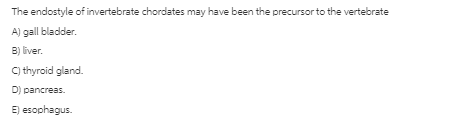
The endostyle of urochordates was the evolutionary forerunner of the ___________ of vertebrates.
A) thymus
B) pituitary gland
C) pancreas
D) thyroid gland
A) thymus
B) pituitary gland
C) pancreas
D) thyroid gland
Unlock Deck
Unlock for access to all 43 flashcards in this deck.
Unlock Deck
k this deck
42
Members of the subphylum Cephalochordata are called
A) lancelets.
B) tunicates.
C) ammocoetes.
D) salps.
E) dolioids.
A) lancelets.
B) tunicates.
C) ammocoetes.
D) salps.
E) dolioids.
Unlock Deck
Unlock for access to all 43 flashcards in this deck.
Unlock Deck
k this deck
43
Nutritionally, pterobranchs are
A) filter feeders.
B) parasitic.
C) mutualistic.
D) commensalists
E) predators.
A) filter feeders.
B) parasitic.
C) mutualistic.
D) commensalists
E) predators.
Unlock Deck
Unlock for access to all 43 flashcards in this deck.
Unlock Deck
k this deck
Unlock Deck
Unlock for access to all 43 flashcards in this deck.






