







 Chat with AI

Deck 11: Fiscal Policy and the Federal Budget
Full screen (f)

Question

Question
Question
Question
Question
Question
Question
Question
Question
Question
Question
Question
Question
Question
Question
Question
Question
Question
Question
Question
Question
Question
Question
Exhibit 11-1
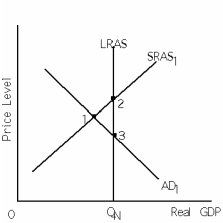
Refer to Exhibit 11-1.The economy is currently at point 1.Suppose the federal government increases purchases and there is complete crowding out.As a result,the aggregate demand (AD)curve in the exhibit
A) maintains its present position at AD1.
B) shifts rightward, but does not shift rightward by enough to go through point 2.
C) shifts rightward by enough to go through point 2.
D) shifts leftward.
Refer to Exhibit 11-1.The economy is currently at point 1.Suppose the federal government increases purchases and there is complete crowding out.As a result,the aggregate demand (AD)curve in the exhibit
A) maintains its present position at AD1.
B) shifts rightward, but does not shift rightward by enough to go through point 2.
C) shifts rightward by enough to go through point 2.
D) shifts leftward.
Question
Question
Question
Question
Exhibit 11-2
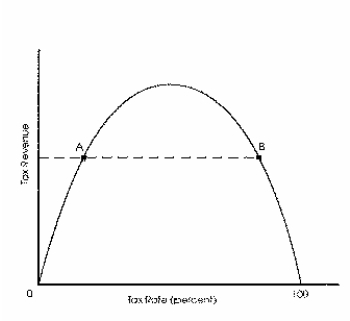
Refer to Exhibit 11-2.Compare points A and B.Which of the following is true?
A) At A and B, the tax rates are the same, but tax revenues are different.
B) At A tax rates are higher than at B, but tax revenues are the same.
C) At B tax rates are higher than at A, but tax revenues are the same.
D) none of the above
Refer to Exhibit 11-2.Compare points A and B.Which of the following is true?
A) At A and B, the tax rates are the same, but tax revenues are different.
B) At A tax rates are higher than at B, but tax revenues are the same.
C) At B tax rates are higher than at A, but tax revenues are the same.
D) none of the above
Question
Question
Question
Exhibit 11-2
Refer to Exhibit 11-2.At point A,if we cut tax rates slightly,tax revenues
A) increase.
B) decrease.
C) will not change.
D) drop to zero.
Refer to Exhibit 11-2.At point A,if we cut tax rates slightly,tax revenues
A) increase.
B) decrease.
C) will not change.
D) drop to zero.
Question
Question
Question
Question
Exhibit 11-1
Refer to Exhibit 11-1.The economy is currently at point 1.In this situation,Keynesian economists would most likely propose
A) an increase in government purchases.
B) a decrease in government purchases.
C) an increase in taxes.
D) a and c
E) b and c
Refer to Exhibit 11-1.The economy is currently at point 1.In this situation,Keynesian economists would most likely propose
A) an increase in government purchases.
B) a decrease in government purchases.
C) an increase in taxes.
D) a and c
E) b and c
Question
Question
Question
Exhibit 11-2
Refer to Exhibit 11-2.At point B,if we cut tax rates slightly,tax revenues
A) increase.
B) decrease.
C) will not change.
D) drop to zero.
Refer to Exhibit 11-2.At point B,if we cut tax rates slightly,tax revenues
A) increase.
B) decrease.
C) will not change.
D) drop to zero.
Question
Question
Question
Question
Question
Question
Question
Question
Exhibit 11-2
Refer to Exhibit 11-2.At the highest point above the horizontal axis,tax revenues
A) are maximized.
B) are lower than at A and higher than at B.
C) are lower than at B and higher than at A.
D) drop to zero.
Refer to Exhibit 11-2.At the highest point above the horizontal axis,tax revenues
A) are maximized.
B) are lower than at A and higher than at B.
C) are lower than at B and higher than at A.
D) drop to zero.
Question
Question
Question
Question
Question
Question
Question
Question
Question
Question
Question
Question
Question
Question
Question
Question
Question
Question
Question
Question
Question
Question
Question
Question
Question
Question
Question
Question
Question
Question
Question
Question
Question
Question
Question

Unlock Deck
Sign up to unlock the cards in this deck!
Unlock Deck
Unlock Deck
1/164

Play

Full screen (f)
Deck 11: Fiscal Policy and the Federal Budget
1
A balanced budget occurs when
A) the national debt is reduced to zero dollars.
B) a budget deficit during one year is matched by a budget surplus in the next year.
C) transfer payments equal tax revenues.
D) government expenditures equal tax revenues.
E) the deficit-GDP ratio equals one.
A) the national debt is reduced to zero dollars.
B) a budget deficit during one year is matched by a budget surplus in the next year.
C) transfer payments equal tax revenues.
D) government expenditures equal tax revenues.
E) the deficit-GDP ratio equals one.
D
2
Suppose the economy is at a position below its institutional production possibilities frontier.In response to this situation,Keynesian economists would propose that government __________ taxes,which will cause the aggregate demand curve to shift to the __________ and Real GDP will __________.
A) increase; right; increase
B) increase; left; decrease
C) decrease; left; decrease
D) decrease; right; decrease
E) decrease; right; increase
A) increase; right; increase
B) increase; left; decrease
C) decrease; left; decrease
D) decrease; right; decrease
E) decrease; right; increase
E
3
Suppose the economy is at a position below the institutional production possibilities frontier.In response to this situation,Keynesian economists would propose that the government should __________ expenditures,which will cause the aggregate demand curve to shift to the __________ in an attempt to close this __________ gap.
A) decrease; left; inflationary
B) increase; right; inflationary
C) decrease; right; inflationary
D) increase; right; recessionary
E) decrease; left; recessionary
A) decrease; left; inflationary
B) increase; right; inflationary
C) decrease; right; inflationary
D) increase; right; recessionary
E) decrease; left; recessionary
D
4
If there is complete crowding out as a result of an increase in government spending there will be
A) a decrease in aggregate demand.
B) no change in aggregate demand.
C) an increase in aggregate demand.
D) a downward movement along the aggregate demand curve.
A) a decrease in aggregate demand.
B) no change in aggregate demand.
C) an increase in aggregate demand.
D) a downward movement along the aggregate demand curve.
Unlock Deck
Unlock for access to all 164 flashcards in this deck.
Unlock Deck
k this deck
5
Crowding out results in a decrease in
A) transfer payments.
B) defense spending.
C) private spending.
D) government spending.
A) transfer payments.
B) defense spending.
C) private spending.
D) government spending.
Unlock Deck
Unlock for access to all 164 flashcards in this deck.
Unlock Deck
k this deck
6
An expansionary fiscal policy will
A) always result in a budget deficit.
B) always result in a budget surplus.
C) sometimes result in a budget deficit.
D) never result in a budget surplus.
E) More information is necessary to answer this question.
A) always result in a budget deficit.
B) always result in a budget surplus.
C) sometimes result in a budget deficit.
D) never result in a budget surplus.
E) More information is necessary to answer this question.
Unlock Deck
Unlock for access to all 164 flashcards in this deck.
Unlock Deck
k this deck
7
Expansionary fiscal policy actions include __________ government spending and/or __________ taxes,while contractionary fiscal policy actions include __________ government spending and/or __________ taxes.
A) increasing; increasing; decreasing; decreasing
B) decreasing; decreasing; increasing; increasing
C) increasing; decreasing; increasing; decreasing
D) decreasing; increasing; increasing; decreasing
E) increasing; decreasing; decreasing; increasing
A) increasing; increasing; decreasing; decreasing
B) decreasing; decreasing; increasing; increasing
C) increasing; decreasing; increasing; decreasing
D) decreasing; increasing; increasing; decreasing
E) increasing; decreasing; decreasing; increasing
Unlock Deck
Unlock for access to all 164 flashcards in this deck.
Unlock Deck
k this deck
8
A federal budget deficit
A) occurs when government expenditures exceed tax revenues.
B) occurs when tax revenues exceed government expenditures.
C) occurs when transfer payments exceed tax revenues.
D) will always result when Congress and the president cannot agree on expenditures.
E) occurs when monetary policy works in the opposite direction of fiscal policy.
A) occurs when government expenditures exceed tax revenues.
B) occurs when tax revenues exceed government expenditures.
C) occurs when transfer payments exceed tax revenues.
D) will always result when Congress and the president cannot agree on expenditures.
E) occurs when monetary policy works in the opposite direction of fiscal policy.
Unlock Deck
Unlock for access to all 164 flashcards in this deck.
Unlock Deck
k this deck
9
Suppose aggregate demand is too low to bring about the Natural Real GDP level.A Keynesian policy prescription would call for a(n)_____________________ to close this recessionary gap.
A) increase in government spending
B) decrease in government spending
C) increase in taxes
D) decrease in taxes
E) a or d
A) increase in government spending
B) decrease in government spending
C) increase in taxes
D) decrease in taxes
E) a or d
Unlock Deck
Unlock for access to all 164 flashcards in this deck.
Unlock Deck
k this deck
10
An example of automatic fiscal policy is
A) the unemployed automatically become eligible for unemployment benefits when they lose their jobs in a recession.
B) when interest rates automatically fall in a recession.
C) Congress passes a law during a recession that automatically extends unemployment benefits for those whose benefits will soon expire.
D) a and b
E) a, b and c
A) the unemployed automatically become eligible for unemployment benefits when they lose their jobs in a recession.
B) when interest rates automatically fall in a recession.
C) Congress passes a law during a recession that automatically extends unemployment benefits for those whose benefits will soon expire.
D) a and b
E) a, b and c
Unlock Deck
Unlock for access to all 164 flashcards in this deck.
Unlock Deck
k this deck
11
Suppose Congress increases income taxes.This is an example of
A) expansionary fiscal policy.
B) expansionary monetary policy.
C) contractionary fiscal policy.
D) contractionary monetary policy.
A) expansionary fiscal policy.
B) expansionary monetary policy.
C) contractionary fiscal policy.
D) contractionary monetary policy.
Unlock Deck
Unlock for access to all 164 flashcards in this deck.
Unlock Deck
k this deck
12
With complete crowding out,an increase in government spending
A) is completely offset by a reduction in private spending.
B) is matched by an increase in private spending.
C) results in an increase in aggregate supply.
D) results in an increase in aggregate demand.
A) is completely offset by a reduction in private spending.
B) is matched by an increase in private spending.
C) results in an increase in aggregate supply.
D) results in an increase in aggregate demand.
Unlock Deck
Unlock for access to all 164 flashcards in this deck.
Unlock Deck
k this deck
13
Fiscal policy refers to
A) efforts to balance a government's budget.
B) changes in the money supply to achieve particular economic goals.
C) changes in government expenditures and taxation to achieve particular economic goals.
D) the change in private expenditures that occurs as a consequence of changes in government spending.
A) efforts to balance a government's budget.
B) changes in the money supply to achieve particular economic goals.
C) changes in government expenditures and taxation to achieve particular economic goals.
D) the change in private expenditures that occurs as a consequence of changes in government spending.
Unlock Deck
Unlock for access to all 164 flashcards in this deck.
Unlock Deck
k this deck
14
A federal budget surplus
A) occurs when government expenditures exceed tax revenues.
B) occurs when tax revenues exceed government expenditures.
C) occurs when tax revenues exceed transfer payments.
D) occurs when monetary policy works in the opposite direction of fiscal policy.
E) is an impossibility.
A) occurs when government expenditures exceed tax revenues.
B) occurs when tax revenues exceed government expenditures.
C) occurs when tax revenues exceed transfer payments.
D) occurs when monetary policy works in the opposite direction of fiscal policy.
E) is an impossibility.
Unlock Deck
Unlock for access to all 164 flashcards in this deck.
Unlock Deck
k this deck
15
Which of the following is an example of crowding out?
A) A decrease in the rate of growth of the money supply which causes a decrease in Real GDP.
B) A deficit causes an increase in interest rates, which causes a decrease in investment spending.
C) An increase in tariffs which causes a decrease in imports.
D) A decrease in government housing subsidies which causes an increase in private spending on housing.
A) A decrease in the rate of growth of the money supply which causes a decrease in Real GDP.
B) A deficit causes an increase in interest rates, which causes a decrease in investment spending.
C) An increase in tariffs which causes a decrease in imports.
D) A decrease in government housing subsidies which causes an increase in private spending on housing.
Unlock Deck
Unlock for access to all 164 flashcards in this deck.
Unlock Deck
k this deck
16
When the economy is in a recessionary gap,Keynesian economists will often advocate expansionary policy measures.Why?
A) Keynesians believe the economy sometimes gets stuck in a recessionary gap and can't get itself out without government intervention.
B) Keynesians believe the economy itself sometimes takes too long to eliminate the recessionary gap and return to full-employment output.
C) Keynesians are generally in favor of increasing taxes.
D) a and b
E) a and c
A) Keynesians believe the economy sometimes gets stuck in a recessionary gap and can't get itself out without government intervention.
B) Keynesians believe the economy itself sometimes takes too long to eliminate the recessionary gap and return to full-employment output.
C) Keynesians are generally in favor of increasing taxes.
D) a and b
E) a and c
Unlock Deck
Unlock for access to all 164 flashcards in this deck.
Unlock Deck
k this deck
17
Suppose Congress decreases income taxes.This is an example of
A) expansionary fiscal policy.
B) expansionary monetary policy.
C) contractionary fiscal policy.
D) contractionary monetary policy.
A) expansionary fiscal policy.
B) expansionary monetary policy.
C) contractionary fiscal policy.
D) contractionary monetary policy.
Unlock Deck
Unlock for access to all 164 flashcards in this deck.
Unlock Deck
k this deck
18
Reductions in private spending as a result of increased government spending or borrowing is called
A) pushing in.
B) rushing forth.
C) crowding in.
D) crowding out.
A) pushing in.
B) rushing forth.
C) crowding in.
D) crowding out.
Unlock Deck
Unlock for access to all 164 flashcards in this deck.
Unlock Deck
k this deck
19
Suppose the economy is at a position below the physical production possibilities frontier but above the institutional production possibilities frontier.In response to this situation,Keynesian economists may propose that government enact __________ fiscal policy to correct this __________ gap by __________ government expenditures.
A) expansionary; inflationary; increasing
B) contractionary; inflationary; decreasing
C) expansionary; recessionary; increasing
D) contractionary; recessionary; decreasing
E) contractionary; inflationary; increasing
A) expansionary; inflationary; increasing
B) contractionary; inflationary; decreasing
C) expansionary; recessionary; increasing
D) contractionary; recessionary; decreasing
E) contractionary; inflationary; increasing
Unlock Deck
Unlock for access to all 164 flashcards in this deck.
Unlock Deck
k this deck
20
__________ flows from government to households.
A) A transfer payment
B) A tax payment
C) The Laffer Curve
D) Crowding out
A) A transfer payment
B) A tax payment
C) The Laffer Curve
D) Crowding out
Unlock Deck
Unlock for access to all 164 flashcards in this deck.
Unlock Deck
k this deck
21
If an individual pays an additional $0.30 in taxes as a result of a $1.00 increase in income,then that individual must have a(n)__________ tax rate of 30 percent.
A) average
B) fixed
C) total
D) marginal
A) average
B) fixed
C) total
D) marginal
Unlock Deck
Unlock for access to all 164 flashcards in this deck.
Unlock Deck
k this deck
22
A curve showing the relationship between tax rates and tax revenues is called a __________ curve.
A) Phillips
B) Keynesian
C) Gaussian
D) Laffer
A) Phillips
B) Keynesian
C) Gaussian
D) Laffer
Unlock Deck
Unlock for access to all 164 flashcards in this deck.
Unlock Deck
k this deck
23
Exhibit 11-1
Refer to Exhibit 11-1.The economy is currently at point 1.Suppose the federal government increases purchases and there is complete crowding out.As a result,the aggregate demand (AD)curve in the exhibit
A) maintains its present position at AD1.
B) shifts rightward, but does not shift rightward by enough to go through point 2.
C) shifts rightward by enough to go through point 2.
D) shifts leftward.
Refer to Exhibit 11-1.The economy is currently at point 1.Suppose the federal government increases purchases and there is complete crowding out.As a result,the aggregate demand (AD)curve in the exhibit
A) maintains its present position at AD1.
B) shifts rightward, but does not shift rightward by enough to go through point 2.
C) shifts rightward by enough to go through point 2.
D) shifts leftward.
Unlock Deck
Unlock for access to all 164 flashcards in this deck.
Unlock Deck
k this deck
24
Fiscal policy may not work as policymakers intend it to work because of
A) crowding out.
B) lags.
C) the position of the physical production possibilities frontier.
D) a and b
E) a, b, and c
A) crowding out.
B) lags.
C) the position of the physical production possibilities frontier.
D) a and b
E) a, b, and c
Unlock Deck
Unlock for access to all 164 flashcards in this deck.
Unlock Deck
k this deck
25
The AD curve shifts to the right with a __________ in government purchases (G)or a __________ in taxes.
A) rise; rise
B) rise; fall
C) fall; rise
D) fall; fall
A) rise; rise
B) rise; fall
C) fall; rise
D) fall; fall
Unlock Deck
Unlock for access to all 164 flashcards in this deck.
Unlock Deck
k this deck
26
Suppose the government increases spending on public education by $700 million and individual spending on private education drops by $700 million.This is an example of
A) incomplete crowding out.
B) complete crowding out.
C) zero crowding out.
D) a and c
E) none of the above
A) incomplete crowding out.
B) complete crowding out.
C) zero crowding out.
D) a and c
E) none of the above
Unlock Deck
Unlock for access to all 164 flashcards in this deck.
Unlock Deck
k this deck
27
Exhibit 11-2
Refer to Exhibit 11-2.Compare points A and B.Which of the following is true?
A) At A and B, the tax rates are the same, but tax revenues are different.
B) At A tax rates are higher than at B, but tax revenues are the same.
C) At B tax rates are higher than at A, but tax revenues are the same.
D) none of the above
Refer to Exhibit 11-2.Compare points A and B.Which of the following is true?
A) At A and B, the tax rates are the same, but tax revenues are different.
B) At A tax rates are higher than at B, but tax revenues are the same.
C) At B tax rates are higher than at A, but tax revenues are the same.
D) none of the above
Unlock Deck
Unlock for access to all 164 flashcards in this deck.
Unlock Deck
k this deck
28
Which of the following illustrates the wait-and-see lag?
A) Policymakers believe an economic downturn has occurred, but they decide not to take action until they are sure.
B) Policymakers are in the process of proposing policy measures to deal with the current economic slowdown.
C) Policymakers first learn of the recession when it is five months old.
D) Policymakers implement policy X, but it will be a few months before it starts working.
E) Policymakers agree to policy X, but it will be at least two months before the policy is implemented.
A) Policymakers believe an economic downturn has occurred, but they decide not to take action until they are sure.
B) Policymakers are in the process of proposing policy measures to deal with the current economic slowdown.
C) Policymakers first learn of the recession when it is five months old.
D) Policymakers implement policy X, but it will be a few months before it starts working.
E) Policymakers agree to policy X, but it will be at least two months before the policy is implemented.
Unlock Deck
Unlock for access to all 164 flashcards in this deck.
Unlock Deck
k this deck
29
Suppose the government increases spending on public education by $700 million and individual spending on private education drops by $500 million.This is an example of
A) incomplete crowding out.
B) complete crowding out.
C) zero crowding out.
D) a and c
E) none of the above
A) incomplete crowding out.
B) complete crowding out.
C) zero crowding out.
D) a and c
E) none of the above
Unlock Deck
Unlock for access to all 164 flashcards in this deck.
Unlock Deck
k this deck
30
Exhibit 11-2
Refer to Exhibit 11-2.At point A,if we cut tax rates slightly,tax revenues
A) increase.
B) decrease.
C) will not change.
D) drop to zero.
Refer to Exhibit 11-2.At point A,if we cut tax rates slightly,tax revenues
A) increase.
B) decrease.
C) will not change.
D) drop to zero.
Unlock Deck
Unlock for access to all 164 flashcards in this deck.
Unlock Deck
k this deck
31
Some economists argue that a rise in the interest rate,brought about by a rise in government borrowing in the loanable funds market to finance the deficit,brings in foreign funds in search of the higher interest rate return.This,in turn,dampens the rise in the interest rate.If this is true as far as it goes,there will be __________ crowding out than there would be if foreign funds did not flow into the country.
A) more
B) less
C) the same amount of
D) none of the above
A) more
B) less
C) the same amount of
D) none of the above
Unlock Deck
Unlock for access to all 164 flashcards in this deck.
Unlock Deck
k this deck
32
The period that elapses between the passage of legislation reducing taxes and the time the tax cut is put into effect is called the __________ lag.
A) data
B) wait-and-see
C) legislative
D) transmission
A) data
B) wait-and-see
C) legislative
D) transmission
Unlock Deck
Unlock for access to all 164 flashcards in this deck.
Unlock Deck
k this deck
33
Suppose the government attempts to stimulate the economy by increasing spending without increasing taxes.Which of the following statements is most likely to be accepted by someone who believes in crowding out?
A) The government's actions will have their intended effect.
B) The government's actions will cause businesses to become more optimistic about the economy, and they will increase their output even more than the government had intended.
C) The government's actions will raise interest rates, causing decreased investment and consumption, and the economy will not expand as much as the government had intended.
D) This is a trick question, because the federal government is required by law to increase taxes by the same amount as it increases expenditures.
A) The government's actions will have their intended effect.
B) The government's actions will cause businesses to become more optimistic about the economy, and they will increase their output even more than the government had intended.
C) The government's actions will raise interest rates, causing decreased investment and consumption, and the economy will not expand as much as the government had intended.
D) This is a trick question, because the federal government is required by law to increase taxes by the same amount as it increases expenditures.
Unlock Deck
Unlock for access to all 164 flashcards in this deck.
Unlock Deck
k this deck
34
Exhibit 11-1
Refer to Exhibit 11-1.The economy is currently at point 1.In this situation,Keynesian economists would most likely propose
A) an increase in government purchases.
B) a decrease in government purchases.
C) an increase in taxes.
D) a and c
E) b and c
Refer to Exhibit 11-1.The economy is currently at point 1.In this situation,Keynesian economists would most likely propose
A) an increase in government purchases.
B) a decrease in government purchases.
C) an increase in taxes.
D) a and c
E) b and c
Unlock Deck
Unlock for access to all 164 flashcards in this deck.
Unlock Deck
k this deck
35
The AD curve shifts to the left with a __________ in government purchases (G)or a __________ in taxes.
A) rise; rise
B) rise; fall
C) fall; rise
D) fall; fall
A) rise; rise
B) rise; fall
C) fall; rise
D) fall; fall
Unlock Deck
Unlock for access to all 164 flashcards in this deck.
Unlock Deck
k this deck
36
Which of the following illustrates the effectiveness lag?
A) Policymakers believe an economic downturn has occurred, but they decide not to take action until they are sure.
B) Policymakers are in the process of proposing policy measures to deal with the current economic slowdown.
C) Policymakers first learn of the recession when it is five months old.
D) Policymakers implement policy X, but it will be a few months before it starts working.
E) Policymakers agree to policy X, but it will be at least two months before the policy is implemented.
A) Policymakers believe an economic downturn has occurred, but they decide not to take action until they are sure.
B) Policymakers are in the process of proposing policy measures to deal with the current economic slowdown.
C) Policymakers first learn of the recession when it is five months old.
D) Policymakers implement policy X, but it will be a few months before it starts working.
E) Policymakers agree to policy X, but it will be at least two months before the policy is implemented.
Unlock Deck
Unlock for access to all 164 flashcards in this deck.
Unlock Deck
k this deck
37
Exhibit 11-2
Refer to Exhibit 11-2.At point B,if we cut tax rates slightly,tax revenues
A) increase.
B) decrease.
C) will not change.
D) drop to zero.
Refer to Exhibit 11-2.At point B,if we cut tax rates slightly,tax revenues
A) increase.
B) decrease.
C) will not change.
D) drop to zero.
Unlock Deck
Unlock for access to all 164 flashcards in this deck.
Unlock Deck
k this deck
38
Elaine's taxable income increases by $1 and her tax payment increases by $0.28.Her marginal tax rate is
A) 72 percent.
B) 28 percent.
C) 56 percent.
D) There is not enough information to answer the question.
A) 72 percent.
B) 28 percent.
C) 56 percent.
D) There is not enough information to answer the question.
Unlock Deck
Unlock for access to all 164 flashcards in this deck.
Unlock Deck
k this deck
39
Which of the following illustrates the data lag?
A) The economy turns down on January 8, 2006, but policymakers do not figure this out until April 19, 2006.
B) Policymakers wait and see what is really going on with the economy.
C)
C) Policymakers implement policy X on September 12, 2006, but the effects are not felt until six months later.
D) The data lag is illustrated equally well by a, b, and
A) The economy turns down on January 8, 2006, but policymakers do not figure this out until April 19, 2006.
B) Policymakers wait and see what is really going on with the economy.
C)
C) Policymakers implement policy X on September 12, 2006, but the effects are not felt until six months later.
D) The data lag is illustrated equally well by a, b, and
Unlock Deck
Unlock for access to all 164 flashcards in this deck.
Unlock Deck
k this deck
40
The lag between an increase in government spending and the impact of this increased spending on the economy is called the __________ lag.
A) effectiveness
B) transmission
C) legislative
D) data
A) effectiveness
B) transmission
C) legislative
D) data
Unlock Deck
Unlock for access to all 164 flashcards in this deck.
Unlock Deck
k this deck
41
An example of contractionary fiscal policy is
A) increasing government spending.
B) increasing taxes.
C) decreasing government spending.
D) decreasing taxes.
E) b and c
A) increasing government spending.
B) increasing taxes.
C) decreasing government spending.
D) decreasing taxes.
E) b and c
Unlock Deck
Unlock for access to all 164 flashcards in this deck.
Unlock Deck
k this deck
42
Keynesians believe
A) in laissez-faire.
B) that equilibrium may exist at less than full employment.
C) in the use of fiscal policy to stabilize the economy.
D) b and c
E) all of the above
A) in laissez-faire.
B) that equilibrium may exist at less than full employment.
C) in the use of fiscal policy to stabilize the economy.
D) b and c
E) all of the above
Unlock Deck
Unlock for access to all 164 flashcards in this deck.
Unlock Deck
k this deck
43
Between the data lag and the legislative lag falls the __________ lag.
A) effectiveness
B) wait-and-see
C) expansionary
D) legislative
A) effectiveness
B) wait-and-see
C) expansionary
D) legislative
Unlock Deck
Unlock for access to all 164 flashcards in this deck.
Unlock Deck
k this deck
44
Increased government spending and tax cuts characterize
A) contractionary fiscal policy.
B) expansionary fiscal policy.
C) expansionary monetary policy.
D) deflationary policy.
E) none of the above
A) contractionary fiscal policy.
B) expansionary fiscal policy.
C) expansionary monetary policy.
D) deflationary policy.
E) none of the above
Unlock Deck
Unlock for access to all 164 flashcards in this deck.
Unlock Deck
k this deck
45
Exhibit 11-2
Refer to Exhibit 11-2.At the highest point above the horizontal axis,tax revenues
A) are maximized.
B) are lower than at A and higher than at B.
C) are lower than at B and higher than at A.
D) drop to zero.
Refer to Exhibit 11-2.At the highest point above the horizontal axis,tax revenues
A) are maximized.
B) are lower than at A and higher than at B.
C) are lower than at B and higher than at A.
D) drop to zero.
Unlock Deck
Unlock for access to all 164 flashcards in this deck.
Unlock Deck
k this deck
46
Supply-side economists believe reductions in tax rates can
A) shift the aggregate demand curve to the left.
B) shift the short run aggregate supply curve to the left.
C) increase output and lower prices.
D) decrease output and lower prices.
A) shift the aggregate demand curve to the left.
B) shift the short run aggregate supply curve to the left.
C) increase output and lower prices.
D) decrease output and lower prices.
Unlock Deck
Unlock for access to all 164 flashcards in this deck.
Unlock Deck
k this deck
47
Some of the crowding out of private expenditures may come in the form of
A) an increase in consumption.
B) an increase in net exports.
C) a decrease in taxes.
D) a decrease in net exports.
A) an increase in consumption.
B) an increase in net exports.
C) a decrease in taxes.
D) a decrease in net exports.
Unlock Deck
Unlock for access to all 164 flashcards in this deck.
Unlock Deck
k this deck
48
An example of contractionary fiscal policy is
A) an increase in government expenditures, or an increase in taxes, or both.
B) a decrease in government expenditures, or a decrease in taxes, or both.
C) an increase in government expenditures, or a decrease in taxes, or both.
D) a decrease in government expenditures, or an increase in taxes, or both.
E) increasing government expenditures while holding taxes constant.
A) an increase in government expenditures, or an increase in taxes, or both.
B) a decrease in government expenditures, or a decrease in taxes, or both.
C) an increase in government expenditures, or a decrease in taxes, or both.
D) a decrease in government expenditures, or an increase in taxes, or both.
E) increasing government expenditures while holding taxes constant.
Unlock Deck
Unlock for access to all 164 flashcards in this deck.
Unlock Deck
k this deck
49
Crowding out suggests that
A) high taxes reduce both consumption and saving.
B) increases in consumption are always at the expense of saving.
C) increases in government spending may raise the interest rate, thereby reducing investment.
D) increases in government spending will close a recessionary gap.
A) high taxes reduce both consumption and saving.
B) increases in consumption are always at the expense of saving.
C) increases in government spending may raise the interest rate, thereby reducing investment.
D) increases in government spending will close a recessionary gap.
Unlock Deck
Unlock for access to all 164 flashcards in this deck.
Unlock Deck
k this deck
50
When a decrease in one or more components of private spending completely offsets the increase in government spending,there is
A) incomplete crowding out.
B) zero crowding out.
C) complete crowding out.
D) complete crowding in.
E) either c or d
A) incomplete crowding out.
B) zero crowding out.
C) complete crowding out.
D) complete crowding in.
E) either c or d
Unlock Deck
Unlock for access to all 164 flashcards in this deck.
Unlock Deck
k this deck
51
An example of expansionary fiscal policy is
A) an increase in government spending, or an increase in taxes, or both.
B) a decrease in government spending, or a decrease in taxes, or both.
C) an increase in government spending, or a decrease in taxes, or both.
D) a decrease in government spending, or an increase in taxes, or both.
E) holding government spending constant while increasing taxes.
A) an increase in government spending, or an increase in taxes, or both.
B) a decrease in government spending, or a decrease in taxes, or both.
C) an increase in government spending, or a decrease in taxes, or both.
D) a decrease in government spending, or an increase in taxes, or both.
E) holding government spending constant while increasing taxes.
Unlock Deck
Unlock for access to all 164 flashcards in this deck.
Unlock Deck
k this deck
52
Suppose the economy's current AD and SRAS curves intersect to the right of Natural Real GDP.Keynesians might advise a policy of tax __________ to shift __________.
A) increases; SRAS to the left
B) increases; AD to the left
C) cuts; SRAS to the right
D) cuts; AD to the right
A) increases; SRAS to the left
B) increases; AD to the left
C) cuts; SRAS to the right
D) cuts; AD to the right
Unlock Deck
Unlock for access to all 164 flashcards in this deck.
Unlock Deck
k this deck
53
Fiscal policy refers to
A) changes in the amount of government expenditures and taxes to achieve particular economic objectives.
B) changes in the composition of a given amount of government expenditures to achieve particular economic objectives.
C) changes in interest rates initiated by government action.
D) any change in government spending or taxes that has the intended effect of destabilizing the economy.
A) changes in the amount of government expenditures and taxes to achieve particular economic objectives.
B) changes in the composition of a given amount of government expenditures to achieve particular economic objectives.
C) changes in interest rates initiated by government action.
D) any change in government spending or taxes that has the intended effect of destabilizing the economy.
Unlock Deck
Unlock for access to all 164 flashcards in this deck.
Unlock Deck
k this deck
54
To eliminate a recessionary gap,Keynesian theory indicates that government should
A) increase taxes.
B) decrease taxes.
C) increase government purchases.
D) decrease government purchases.
E) b or c
A) increase taxes.
B) decrease taxes.
C) increase government purchases.
D) decrease government purchases.
E) b or c
Unlock Deck
Unlock for access to all 164 flashcards in this deck.
Unlock Deck
k this deck
55
Fiscal policy is
A) the money supply policy that the Fed pursues to achieve particular economic goals.
B) the spending and tax policy that the government pursues to achieve particular macroeconomic goals.
C) the investment policy that businesses pursue to achieve particular macroeconomic goals.
D) the spending and saving policy that consumers pursue to achieve particular macroeconomic goals.
E) none of the above
A) the money supply policy that the Fed pursues to achieve particular economic goals.
B) the spending and tax policy that the government pursues to achieve particular macroeconomic goals.
C) the investment policy that businesses pursue to achieve particular macroeconomic goals.
D) the spending and saving policy that consumers pursue to achieve particular macroeconomic goals.
E) none of the above
Unlock Deck
Unlock for access to all 164 flashcards in this deck.
Unlock Deck
k this deck
56
When we speak of expansionary fiscal policy,policymakers __________ government spending,or __________ taxes,or both.
A) decrease; decrease
B) increase; increase
C) increase; decrease
D) decrease; increase
A) decrease; decrease
B) increase; increase
C) increase; decrease
D) decrease; increase
Unlock Deck
Unlock for access to all 164 flashcards in this deck.
Unlock Deck
k this deck
57
To eliminate an inflationary gap,Keynesian theory indicates that government should
A) increase taxes.
B) decrease taxes.
C) increase government purchases.
D) decrease government purchases.
E) either a or d
A) increase taxes.
B) decrease taxes.
C) increase government purchases.
D) decrease government purchases.
E) either a or d
Unlock Deck
Unlock for access to all 164 flashcards in this deck.
Unlock Deck
k this deck
58
Fiscal policy is implemented primarily by
A) local governments alone.
B) the defense department.
C) state governments alone.
D) the federal government.
E) state and local governments.
A) local governments alone.
B) the defense department.
C) state governments alone.
D) the federal government.
E) state and local governments.
Unlock Deck
Unlock for access to all 164 flashcards in this deck.
Unlock Deck
k this deck
59
All other things held constant,lower marginal (income)tax rates
A) necessarily increase tax revenues.
B) necessarily decrease tax revenues.
C) decrease the attractiveness of productive activities relative to leisure and tax- avoidance activities, and shift the SRAS curve rightward.
D) do not affect the attractiveness of productive activities relative to leisure and tax- avoidance activities and therefore the SRAS does not shift rightward or leftward.
E) increase the attractiveness of productive activities relative to leisure and tax- avoidance activities and shift the SRAS curve rightward.
A) necessarily increase tax revenues.
B) necessarily decrease tax revenues.
C) decrease the attractiveness of productive activities relative to leisure and tax- avoidance activities, and shift the SRAS curve rightward.
D) do not affect the attractiveness of productive activities relative to leisure and tax- avoidance activities and therefore the SRAS does not shift rightward or leftward.
E) increase the attractiveness of productive activities relative to leisure and tax- avoidance activities and shift the SRAS curve rightward.
Unlock Deck
Unlock for access to all 164 flashcards in this deck.
Unlock Deck
k this deck
60
An example of expansionary fiscal policy is
A) increasing government expenditures.
B) increasing taxes.
C) decreasing government expenditures.
D) decreasing taxes.
E) a and d
A) increasing government expenditures.
B) increasing taxes.
C) decreasing government expenditures.
D) decreasing taxes.
E) a and d
Unlock Deck
Unlock for access to all 164 flashcards in this deck.
Unlock Deck
k this deck
61
Some economists believe that higher marginal income tax rates __________ the incentive to work and thus shift the __________.
A) increase; AD curve to the right
B) increase; SRAS curve to the right
C) increase; SRAS curve to the left
D) decrease; AD curve to the left
E) decrease; SRAS curve to the left
A) increase; AD curve to the right
B) increase; SRAS curve to the right
C) increase; SRAS curve to the left
D) decrease; AD curve to the left
E) decrease; SRAS curve to the left
Unlock Deck
Unlock for access to all 164 flashcards in this deck.
Unlock Deck
k this deck
62
The economy is in a recessionary gap,wages are inflexible downward,and there is complete crowding out.Which of the following is consistent with this state of affairs?
A) The economy will soon self-regulate and produce Natural Real GDP.
B) Expansionary fiscal policy will be effective at removing the economy from the recessionary gap.
C) If expansionary fiscal policy is implemented, the AD curve will shift to the right, and eventually the price level and Real GDP will rise.
D) b and c
E) none of the above
A) The economy will soon self-regulate and produce Natural Real GDP.
B) Expansionary fiscal policy will be effective at removing the economy from the recessionary gap.
C) If expansionary fiscal policy is implemented, the AD curve will shift to the right, and eventually the price level and Real GDP will rise.
D) b and c
E) none of the above
Unlock Deck
Unlock for access to all 164 flashcards in this deck.
Unlock Deck
k this deck
63
The effectiveness lag is the time between
A) the implementation of a policy and when the impact of the policy is felt.
B) the enactment of a policy and the implementation of the policy.
C) realizing a policy is needed and enacting the policy.
D) the occurrence of an event and policymakers realizing the event has occurred.
A) the implementation of a policy and when the impact of the policy is felt.
B) the enactment of a policy and the implementation of the policy.
C) realizing a policy is needed and enacting the policy.
D) the occurrence of an event and policymakers realizing the event has occurred.
Unlock Deck
Unlock for access to all 164 flashcards in this deck.
Unlock Deck
k this deck
64
The marginal tax rate is equal to the
A) total amount of a person's tax payment divided by the total amount of the person's taxable income.
B) total amount of a person's tax payment divided by the change in the person's taxable income.
C) change in the person's tax payment divided by the total amount of the person's taxable income.
D) change in the person's tax payment divided by the change in the person's taxable income.
A) total amount of a person's tax payment divided by the total amount of the person's taxable income.
B) total amount of a person's tax payment divided by the change in the person's taxable income.
C) change in the person's tax payment divided by the total amount of the person's taxable income.
D) change in the person's tax payment divided by the change in the person's taxable income.
Unlock Deck
Unlock for access to all 164 flashcards in this deck.
Unlock Deck
k this deck
65
Suppose that in a certain nation the flat income tax rate of 40 percent is reduced to 35 percent and as a result taxable income rises from $400 billion to $600 billion.Tax revenues __________,indicating the nation is on the __________ portion of its Laffer curve.
A) rise; upward-sloping
B) rise; downward-sloping
C) fall; upward-sloping
D) fall; downward-sloping
A) rise; upward-sloping
B) rise; downward-sloping
C) fall; upward-sloping
D) fall; downward-sloping
Unlock Deck
Unlock for access to all 164 flashcards in this deck.
Unlock Deck
k this deck
66
The economy is in a recessionary gap and a Keynesian economist advocates expansionary fiscal policy.What is a likely reason this economist advocates expansionary fiscal policy?
A) The economist believes the economy is stuck in a recessionary gap and crowding out will be complete.
B) The economist believes the economy is stuck in a recessionary gap and there will be no crowding out.
C) The economist believes that wages are too flexible and that crowding out will be incomplete.
D) The economist believes the AD curve is downward-sloping, the SRAS curve is upward-sloping, and prices are flexible.
E) none of the above
A) The economist believes the economy is stuck in a recessionary gap and crowding out will be complete.
B) The economist believes the economy is stuck in a recessionary gap and there will be no crowding out.
C) The economist believes that wages are too flexible and that crowding out will be incomplete.
D) The economist believes the AD curve is downward-sloping, the SRAS curve is upward-sloping, and prices are flexible.
E) none of the above
Unlock Deck
Unlock for access to all 164 flashcards in this deck.
Unlock Deck
k this deck
67
Suppose government spending rises by $120 billion.It follows that if private expenditures
A) rise by $120 billion, complete crowding out exists.
B) fall by $100 billion, incomplete crowding out exists.
C) remain unchanged, complete crowding out exists.
D) rise by more than $120 billion, complete crowding out exists.
E) b and c
A) rise by $120 billion, complete crowding out exists.
B) fall by $100 billion, incomplete crowding out exists.
C) remain unchanged, complete crowding out exists.
D) rise by more than $120 billion, complete crowding out exists.
E) b and c
Unlock Deck
Unlock for access to all 164 flashcards in this deck.
Unlock Deck
k this deck
68
Complete crowding out implies that as government increases purchases by $1,
A) private spending decreases by $1.
B) Real GDP remains unchanged.
C) there is an equal offsetting decrease in one or more of the components of private expenditures.
D) all of the above
E) none of the above
A) private spending decreases by $1.
B) Real GDP remains unchanged.
C) there is an equal offsetting decrease in one or more of the components of private expenditures.
D) all of the above
E) none of the above
Unlock Deck
Unlock for access to all 164 flashcards in this deck.
Unlock Deck
k this deck
69
If there is complete crowding out,the change in Real GDP that results from a given change in autonomous spending will be
A) zero.
B) greater than if there was incomplete crowding out.
C) infinite.
D) There is not enough information to answer the question.
A) zero.
B) greater than if there was incomplete crowding out.
C) infinite.
D) There is not enough information to answer the question.
Unlock Deck
Unlock for access to all 164 flashcards in this deck.
Unlock Deck
k this deck
70
The Laffer curve makes the point that cutting a very high marginal tax rate can __________ the tax base enough so that tax revenues __________.
A) lower; rise
B) lower; fall
C) raise; rise
D) raise; fall
A) lower; rise
B) lower; fall
C) raise; rise
D) raise; fall
Unlock Deck
Unlock for access to all 164 flashcards in this deck.
Unlock Deck
k this deck
71
Some economists believe that permanently lower marginal income tax rates __________ the incentive to work and thus shift the __________.
A) increase; LRAS curve to the right
B) increase; AD curve to the right
C) increase; SRAS curve to the left
D) decrease; LRAS curve to the right
E) decrease; AD curve to the left
A) increase; LRAS curve to the right
B) increase; AD curve to the right
C) increase; SRAS curve to the left
D) decrease; LRAS curve to the right
E) decrease; AD curve to the left
Unlock Deck
Unlock for access to all 164 flashcards in this deck.
Unlock Deck
k this deck
72
Smith says that if government purchases rise by $100 billion,the AD curve will shift to the right.Jones says that if government purchases rise by $100 billion,the AD curve will not shift to the right.It follows that
A) Smith believes there will be zero or complete crowding out and Jones believes there will be complete crowding out.
B) Smith believes there will be incomplete or zero crowding out and Jones believes there will be complete crowding out.
C) Smith believes there will be complete crowding out and Jones believes there will be zero crowding out.
D) Both Smith and Jones believe there will be incomplete crowding out, although Jones believes there will be more incomplete crowding out than Smith believes there will be.
E) none of the above
A) Smith believes there will be zero or complete crowding out and Jones believes there will be complete crowding out.
B) Smith believes there will be incomplete or zero crowding out and Jones believes there will be complete crowding out.
C) Smith believes there will be complete crowding out and Jones believes there will be zero crowding out.
D) Both Smith and Jones believe there will be incomplete crowding out, although Jones believes there will be more incomplete crowding out than Smith believes there will be.
E) none of the above
Unlock Deck
Unlock for access to all 164 flashcards in this deck.
Unlock Deck
k this deck
73
The economy is in a recessionary gap,there is incomplete crowding out,and government implements expansionary fiscal policy.It follows that
A) Real GDP will fall.
B) the AD curve will shift to the right.
C) the price level will fall.
D) the recessionary gap will necessarily be completely eliminated.
E) b and d
A) Real GDP will fall.
B) the AD curve will shift to the right.
C) the price level will fall.
D) the recessionary gap will necessarily be completely eliminated.
E) b and d
Unlock Deck
Unlock for access to all 164 flashcards in this deck.
Unlock Deck
k this deck
74
Which of the following is not an example of a "lag" that diminishes the potential impact of fiscal policy?
A) the data lag
B) the recessionary lag
C) the legislative lag
D) the transmission lag
E) None of the above; all are examples of such lags.
A) the data lag
B) the recessionary lag
C) the legislative lag
D) the transmission lag
E) None of the above; all are examples of such lags.
Unlock Deck
Unlock for access to all 164 flashcards in this deck.
Unlock Deck
k this deck
75
There is zero crowding out and the federal budget is balanced at the time government purchases are increased.It follows that the __________ curve shifts to the __________,and in the short run both the price level and Real GDP __________.
A) AD; left; rise
B) AD; right; fall
C) AD; right; rise
D) AD; left; fall
E) SRAS; right; rise
A) AD; left; rise
B) AD; right; fall
C) AD; right; rise
D) AD; left; fall
E) SRAS; right; rise
Unlock Deck
Unlock for access to all 164 flashcards in this deck.
Unlock Deck
k this deck
76
A permanent marginal tax decrease is likely to
A) shift the short-run aggregate supply curve to the left and the long-run aggregate supply curve to the right.
B) shift both the short-run and the long-run aggregate supply curves to the left.
C) shift the short-run aggregate supply curve to the right, and the long-run aggregate supply curve to the left.
D) shift both the short run and the long run aggregate supply curves to the right.
A) shift the short-run aggregate supply curve to the left and the long-run aggregate supply curve to the right.
B) shift both the short-run and the long-run aggregate supply curves to the left.
C) shift the short-run aggregate supply curve to the right, and the long-run aggregate supply curve to the left.
D) shift both the short run and the long run aggregate supply curves to the right.
Unlock Deck
Unlock for access to all 164 flashcards in this deck.
Unlock Deck
k this deck
77
The transmission lag is the time between
A) the implementation of a policy and when the impact of the policy is felt.
B) the enactment of a policy (getting a policy passed by Congress with the president's approval) and the implementation of the policy (putting a policy into effect).
C) realizing a policy is needed and enacting the policy.
D) the occurrence of an event and policymakers realizing the event has occurred.
A) the implementation of a policy and when the impact of the policy is felt.
B) the enactment of a policy (getting a policy passed by Congress with the president's approval) and the implementation of the policy (putting a policy into effect).
C) realizing a policy is needed and enacting the policy.
D) the occurrence of an event and policymakers realizing the event has occurred.
Unlock Deck
Unlock for access to all 164 flashcards in this deck.
Unlock Deck
k this deck
78
The data lag is the time between
A) the implementation of a policy and when the impact of the policy is felt.
B) the enactment of a policy and the implementation of the policy.
C) realizing a policy is needed and enacting the policy.
D) the occurrence of an event and policymakers realizing the event has occurred.
A) the implementation of a policy and when the impact of the policy is felt.
B) the enactment of a policy and the implementation of the policy.
C) realizing a policy is needed and enacting the policy.
D) the occurrence of an event and policymakers realizing the event has occurred.
Unlock Deck
Unlock for access to all 164 flashcards in this deck.
Unlock Deck
k this deck
79
The Laffer curve illustrates that
A) there are two tax rates at which zero tax revenues are raised.
B) a decrease in tax rates can cause an increase in tax revenues.
C) an increase in tax rates can cause an increase in tax revenues.
D) an increase in tax rates can cause a decrease in tax revenues.
E) all of the above
A) there are two tax rates at which zero tax revenues are raised.
B) a decrease in tax rates can cause an increase in tax revenues.
C) an increase in tax rates can cause an increase in tax revenues.
D) an increase in tax rates can cause a decrease in tax revenues.
E) all of the above
Unlock Deck
Unlock for access to all 164 flashcards in this deck.
Unlock Deck
k this deck
80
If an economist recommends that the government reduce the tax rate in order to increase tax revenues (based on the Laffer curve),she is implicitly assuming that the economy is currently operating at a point
A) inside the Laffer curve.
B) outside the Laffer curve.
C) on the upward-sloping portion of the Laffer curve.
D) on the downward-sloping portion of the Laffer curve.
E) where tax revenues are maximized.
A) inside the Laffer curve.
B) outside the Laffer curve.
C) on the upward-sloping portion of the Laffer curve.
D) on the downward-sloping portion of the Laffer curve.
E) where tax revenues are maximized.
Unlock Deck
Unlock for access to all 164 flashcards in this deck.
Unlock Deck
k this deck
Unlock Deck
Unlock for access to all 164 flashcards in this deck.






