







 Chat with AI

Deck 13: Money and Banks
Full screen (f)

Question

Question
Question
Question
Question
Question
Question
Question
Question
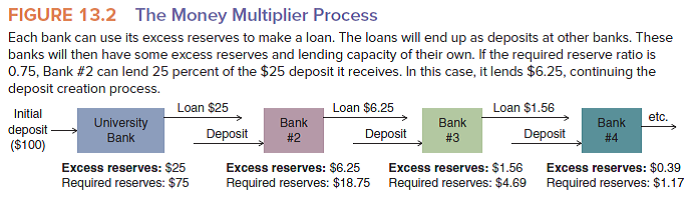
How large a loan can Bank #2 in Figure 13.2 make?
Question
Question
What volume of loans can the banking system in Figure 13.2 support? If the reserve requirement were 80 percent rather than 75 percent, what would the system's lending capacity be?

Question
Question
Question
Question
Question
Question
Question
Question
Question

Unlock Deck
Sign up to unlock the cards in this deck!
Unlock Deck
Unlock Deck
1/20

Play

Full screen (f)
Deck 13: Money and Banks
1
What percent of the money supply depicted in Figure 13.1 is cash?
According to figure 13.1, total money supply (M1) in economy is $3,100 billion
Out of this total money supply, $1,345 billion consist of currency in circulation or cash.
Calculate cash as percentage of total money supply - According to figure 13.1, 43.38 percent of the money supply is cash.
Out of this total money supply, $1,345 billion consist of currency in circulation or cash.
Calculate cash as percentage of total money supply -
According to figure 13.1, 43.38 percent of the money supply is cash. 2
Do eggs satisfy the three conditions for money? Did barter make it easier or more difficult to go to the movies in Russia? (See the News Wire "Barter.")
In order to be classified as money, a commodity or thing has to fulfill three important conditions.
These conditions are as follows -
1. Commodity or thing should be accepted as medium of exchange. In other words, this commodity or thing should readily be accepted by people as payment for goods and services.
2. Commodity of thing should be such that its quality should not deteriorate or spoil and thus it can be held safely for future purchases as well without loss of value.
3. Commodity or thing should be such that it can be use as yardstick to measure prices of other goods and services. In other words, value of other goods and services can be denoted in terms of this commodity with ease.
If we analyze the case of eggs then it can be seen that eggs could act as medium of exchange but not in all situation. For instance, if we have eggs and using them to purchase flour, we could be able to purchase flour, if seller needs the eggs as well otherwise not. So, eggs can support exchange of goods and services but not in universal manner.
Secondly, eggs can get rotten after few days. So, it would be difficult to hold them for future purchases and thus they would not be able to perform the store of value function of money.
Thirdly, eggs cannot be used to measure the value of all goods and services.
Since, egg is not able to satisfactorily satisfy conditions desired of money, it cannot be termed as money.
Barter has made it difficult to go to movies in Russia because in order to go to movies in Russia under barter system a person must have either eggs or empty bottles. So, a person who wants to see movies must possess either eggs or empty bottles or have to undertake other transactions in order to procure these two items then only he would be able to see movies.
This means a person has to spend time and effort conducting series of transactions to obtain requisite commodity to be able to see movies making whole process cumbersome and difficult.
These conditions are as follows -
1. Commodity or thing should be accepted as medium of exchange. In other words, this commodity or thing should readily be accepted by people as payment for goods and services.
2. Commodity of thing should be such that its quality should not deteriorate or spoil and thus it can be held safely for future purchases as well without loss of value.
3. Commodity or thing should be such that it can be use as yardstick to measure prices of other goods and services. In other words, value of other goods and services can be denoted in terms of this commodity with ease.
If we analyze the case of eggs then it can be seen that eggs could act as medium of exchange but not in all situation. For instance, if we have eggs and using them to purchase flour, we could be able to purchase flour, if seller needs the eggs as well otherwise not. So, eggs can support exchange of goods and services but not in universal manner.
Secondly, eggs can get rotten after few days. So, it would be difficult to hold them for future purchases and thus they would not be able to perform the store of value function of money.
Thirdly, eggs cannot be used to measure the value of all goods and services.
Since, egg is not able to satisfactorily satisfy conditions desired of money, it cannot be termed as money.
Barter has made it difficult to go to movies in Russia because in order to go to movies in Russia under barter system a person must have either eggs or empty bottles. So, a person who wants to see movies must possess either eggs or empty bottles or have to undertake other transactions in order to procure these two items then only he would be able to see movies.
This means a person has to spend time and effort conducting series of transactions to obtain requisite commodity to be able to see movies making whole process cumbersome and difficult.
3
If a bank has $100 million in deposits and $18 million in reserves with a reserve requirement of 0.15,
( a ) How much are its required reserves?
( b ) How much excess reserves does it have?
( c ) How much can it lend?
( a ) How much are its required reserves?
( b ) How much excess reserves does it have?
( c ) How much can it lend?
(a) Total deposits with bank = $100 million
Total reserves with bank = $18 million
Reserve requirement = 0.15
Calculate the required reserves - The required reserves with bank are $15 million.
(b) Total reserves with bank = $18 million
Required reserves with bank = $15 million
Calculate excess reserves with bank - Thus, bank has $3 million as excess reserves.
(c) A bank can lend, at maximum, an amount equal to the quantum of excess reserves it held. In given case, bank has excess reserves of $3 million.
So, bank can lend $3 million.
Total reserves with bank = $18 million
Reserve requirement = 0.15
Calculate the required reserves -
The required reserves with bank are $15 million. (b) Total reserves with bank = $18 million
Required reserves with bank = $15 million
Calculate excess reserves with bank -
Thus, bank has $3 million as excess reserves. (c) A bank can lend, at maximum, an amount equal to the quantum of excess reserves it held. In given case, bank has excess reserves of $3 million.
So, bank can lend $3 million.
4
Why aren't mobile payments counted as money?
Unlock Deck
Unlock for access to all 20 flashcards in this deck.
Unlock Deck
k this deck
5
How large is the money multiplier when the required reserve ratio is 0.20? If the required reserve ratio increases to 0.25, what happens to the money multiplier?
Unlock Deck
Unlock for access to all 20 flashcards in this deck.
Unlock Deck
k this deck
6
What percentage of your monthly spending do you pay with ( a ) cash, ( b ) check, ( c ) credit card, ( d ) debit card, or ( e ) automatic transfers? How does your behavior compare to others (see the News Wire "Media of Exchange")?
Unlock Deck
Unlock for access to all 20 flashcards in this deck.
Unlock Deck
k this deck
7
If a bank has total reserves of $200,000 and $1 million in deposits, how much money can it lend if the required reserve ratio is
( a ) 5 percent?
( b ) 10 percent?
( a ) 5 percent?
( b ) 10 percent?
Unlock Deck
Unlock for access to all 20 flashcards in this deck.
Unlock Deck
k this deck
8
If a friend asked you how much money you had to spend, what items would you include in your response?
Unlock Deck
Unlock for access to all 20 flashcards in this deck.
Unlock Deck
k this deck
9
How large a loan can Bank #2 in Figure 13.2 make?
Unlock Deck
Unlock for access to all 20 flashcards in this deck.
Unlock Deck
k this deck
10
Does money have any intrinsic value? If not, why are people willing to accept money in exchange for goods and services?
Unlock Deck
Unlock for access to all 20 flashcards in this deck.
Unlock Deck
k this deck
11
What volume of loans can the banking system in Figure 13.2 support? If the reserve requirement were 80 percent rather than 75 percent, what would the system's lending capacity be?
Unlock Deck
Unlock for access to all 20 flashcards in this deck.
Unlock Deck
k this deck
12
Have you ever borrowed money to buy a car, pay tuition, or for any other purpose? In what form did you receive the money? How did your loan affect the money supply? Aggregate demand?
Unlock Deck
Unlock for access to all 20 flashcards in this deck.
Unlock Deck
k this deck
13
Suppose that a lottery winner deposits $5 million in cash into her transactions account at the Bank of America. Assume a reserve requirement of 20 percent and no excess reserves in the banking system prior to this deposit. Show the changes on the Bank of America balance sheet when the $5 million is initially deposited.
Unlock Deck
Unlock for access to all 20 flashcards in this deck.
Unlock Deck
k this deck
14
Does the fact that your bank keeps only a fraction of your account balance in reserve worry you? Why don't people rush to the bank and retrieve their money? What would happen if they did?
Unlock Deck
Unlock for access to all 20 flashcards in this deck.
Unlock Deck
k this deck
15
In December 1994, a man in Ohio decided to deposit all of the 8 million pennies he had been saving for nearly 65 years. (His deposit weighed over 48,000 pounds!) With a reserve requirement of 10 percent, how did his deposit change the lending capacity of
( a ) His bank?
( b ) The banking system?
( a ) His bank?
( b ) The banking system?
Unlock Deck
Unlock for access to all 20 flashcards in this deck.
Unlock Deck
k this deck
16
If all banks heeded Shakespeare's admonition "Neither a borrower nor a lender be," what would happen to the supply of money?
Unlock Deck
Unlock for access to all 20 flashcards in this deck.
Unlock Deck
k this deck
17
POLICY PERSPECTIVES If the value of bitcoins increases from $250 to $500 this year, by how much will M1 increase?
Unlock Deck
Unlock for access to all 20 flashcards in this deck.
Unlock Deck
k this deck
18
Why would a bank ever hold excess reserves rather than make new loans?
Unlock Deck
Unlock for access to all 20 flashcards in this deck.
Unlock Deck
k this deck
19
If banks stopped making new loans, how would aggregate demand be affected?
Unlock Deck
Unlock for access to all 20 flashcards in this deck.
Unlock Deck
k this deck
20
POLICY PERSPECTIVES If people want more anonymity in their market transactions, why don't they simply use cash instead of bitcoins?
Unlock Deck
Unlock for access to all 20 flashcards in this deck.
Unlock Deck
k this deck
Unlock Deck
Unlock for access to all 20 flashcards in this deck.






