







 Chat with AI

Deck 8: Ethical Leadership and Decision-Making in Accounting
Full screen (f)

Question
Research Triangle Software Innovations (a GVV case)
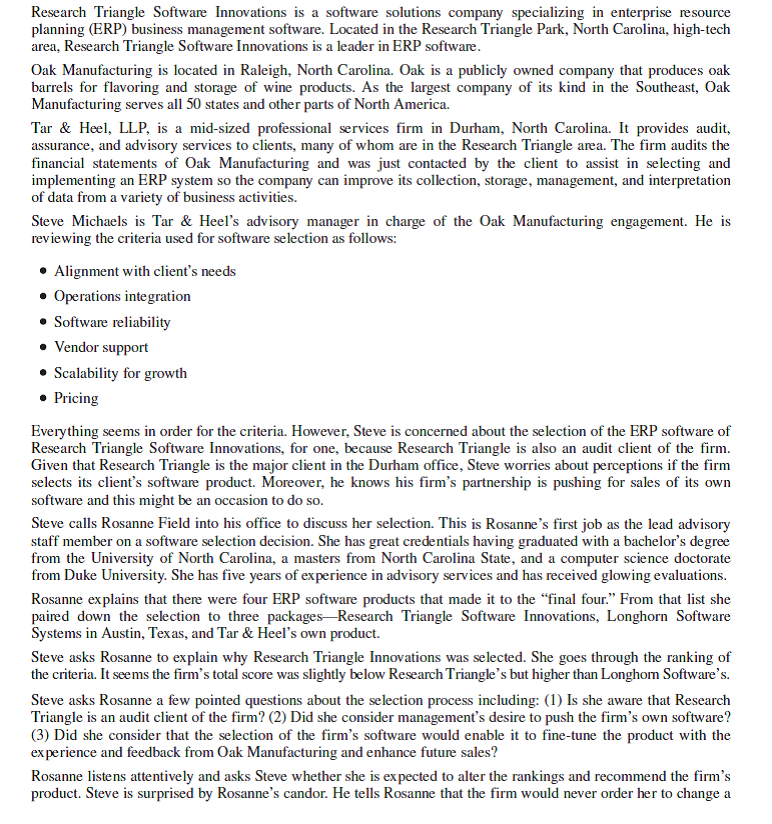
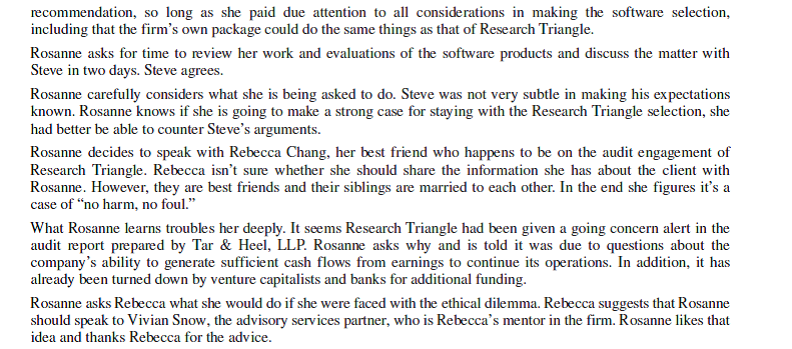
Questions
1. What are the ethical issues in this case? Discuss the obligations of Tar Heel to its stakeholders.
2. Characterize the kind of leadership demonstrated by Steve Michaels.
3. Evaluate moral intensity issues and how they might influence the actions and decisions of Rosanne.
4. Assume Rosanne decides to speak to her mentor. From past experience, she knows Vivian is a team player and has always encouraged Rosanne to do the same. Consider the following, if you were in Rosanne's position, in developing a plan to give voice to your values.
• What is at stake for the key parties, including those who disagree with you?
• What are the likely objections or pushback from Vivian and others?
• How will you counter those positions? Are there any levers you can use to influence those who disagree with you?
• What is your most powerful and persuasive response to the reasons and rationalizations you need to address?
Questions
1. What are the ethical issues in this case? Discuss the obligations of Tar Heel to its stakeholders.
2. Characterize the kind of leadership demonstrated by Steve Michaels.
3. Evaluate moral intensity issues and how they might influence the actions and decisions of Rosanne.
4. Assume Rosanne decides to speak to her mentor. From past experience, she knows Vivian is a team player and has always encouraged Rosanne to do the same. Consider the following, if you were in Rosanne's position, in developing a plan to give voice to your values.
• What is at stake for the key parties, including those who disagree with you?
• What are the likely objections or pushback from Vivian and others?
• How will you counter those positions? Are there any levers you can use to influence those who disagree with you?
• What is your most powerful and persuasive response to the reasons and rationalizations you need to address?

Question
Question
Question
Question
Question
Question
Cumberland Lumber
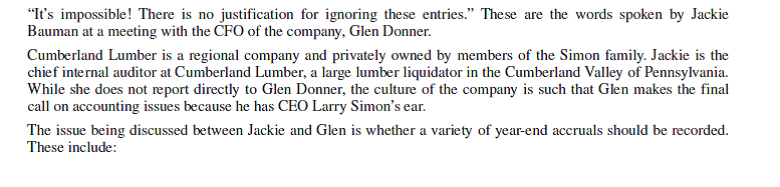
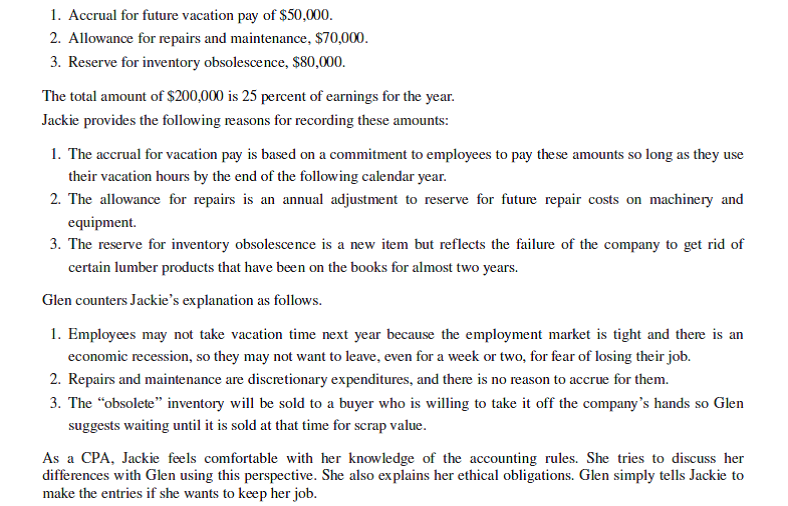
Questions
1. Discuss the appropriateness of making the accrual entries based on the perspectives of Jackie and Glen. What do you believe to be the intent of Glen in this matter? Explain.
2. Characterize the leadership style of Glen and the culture of the company.
3. How does professional identity influence what Jackie might do in this case?
4. What would be most important to you in deciding what to do in this case if you were in Jackie's position? What would you do and why? Be sure to consider the culture of the company and leadership style in crafting a response.
Questions
1. Discuss the appropriateness of making the accrual entries based on the perspectives of Jackie and Glen. What do you believe to be the intent of Glen in this matter? Explain.
2. Characterize the leadership style of Glen and the culture of the company.
3. How does professional identity influence what Jackie might do in this case?
4. What would be most important to you in deciding what to do in this case if you were in Jackie's position? What would you do and why? Be sure to consider the culture of the company and leadership style in crafting a response.
Question
Question
Question
Question
Question
Question
Question
Question
Question
Question
Question
Question
Question
Question
Question
Question
Question
Question
Question
Question
Question
Question
Question
Question
Question
Question
Question
Question
Rhody Electronics: A Difficult Client (a GVV case)

Questions
1. What role should the client have in raising issues related to auditors' planning and execution of the engagement? Support your answer using ethical reasoning.
2. Assume the controller is very defensive and fails to provide acceptable responses to the questions raised by
Norris. Norris is concerned about the ability of the firm to complete the audit on time and under budget. She knows she has to do something to alleviate the tension that has developed with the controller and ensure that the audit comes to a successful conclusion. However, she is not sure how best to get it done. Answer the following questions:
• What role does ethical leadership play in the way Norris deals with the conflict? Consider how the way she handles the matter might influence the behavior of members of the firm.
• What levers can Norris use to convince the controller of the need for better cooperation to ensure successful completion of the audit?
• What are the most persuasive arguments Norris can make of the reasons and rationalizations that may be provided by the controller in discussing/defending his positions?
Questions
1. What role should the client have in raising issues related to auditors' planning and execution of the engagement? Support your answer using ethical reasoning.
2. Assume the controller is very defensive and fails to provide acceptable responses to the questions raised by
Norris. Norris is concerned about the ability of the firm to complete the audit on time and under budget. She knows she has to do something to alleviate the tension that has developed with the controller and ensure that the audit comes to a successful conclusion. However, she is not sure how best to get it done. Answer the following questions:
• What role does ethical leadership play in the way Norris deals with the conflict? Consider how the way she handles the matter might influence the behavior of members of the firm.
• What levers can Norris use to convince the controller of the need for better cooperation to ensure successful completion of the audit?
• What are the most persuasive arguments Norris can make of the reasons and rationalizations that may be provided by the controller in discussing/defending his positions?
Question
Question
Question
Question
Question
Question
Question
Question
Question
Question
Question
Question
Question
Question
Question

Unlock Deck
Sign up to unlock the cards in this deck!
Unlock Deck
Unlock Deck
1/50

Play

Full screen (f)
Deck 8: Ethical Leadership and Decision-Making in Accounting
1
Research Triangle Software Innovations (a GVV case)
Questions
1. What are the ethical issues in this case? Discuss the obligations of Tar Heel to its stakeholders.
2. Characterize the kind of leadership demonstrated by Steve Michaels.
3. Evaluate moral intensity issues and how they might influence the actions and decisions of Rosanne.
4. Assume Rosanne decides to speak to her mentor. From past experience, she knows Vivian is a team player and has always encouraged Rosanne to do the same. Consider the following, if you were in Rosanne's position, in developing a plan to give voice to your values.
• What is at stake for the key parties, including those who disagree with you?
• What are the likely objections or pushback from Vivian and others?
• How will you counter those positions? Are there any levers you can use to influence those who disagree with you?
• What is your most powerful and persuasive response to the reasons and rationalizations you need to address?
Questions
1. What are the ethical issues in this case? Discuss the obligations of Tar Heel to its stakeholders.
2. Characterize the kind of leadership demonstrated by Steve Michaels.
3. Evaluate moral intensity issues and how they might influence the actions and decisions of Rosanne.
4. Assume Rosanne decides to speak to her mentor. From past experience, she knows Vivian is a team player and has always encouraged Rosanne to do the same. Consider the following, if you were in Rosanne's position, in developing a plan to give voice to your values.
• What is at stake for the key parties, including those who disagree with you?
• What are the likely objections or pushback from Vivian and others?
• How will you counter those positions? Are there any levers you can use to influence those who disagree with you?
• What is your most powerful and persuasive response to the reasons and rationalizations you need to address?
Give voice values (GVV) is a revolution in the ethics field and in the quality of a leader. It helps them to decide what to do when something unethical comes up. It is an approach to value driven leadership style. It focuses on ethical implementation rather than ethical analysis.
Company T offers auditing and advisory services to its clients. One of its client Company O asked for an advice in assisting and implementing an EPS in the organization. Company R was specialized in software and was one of the client of T.
1.
The facts of the case show that Company T itself have an Enterprise Resource Planning System, and it wants to promote it. When one of its client asked for the advice regarding EPS.
The facts states that, the advisory manager Person SM of Company T wanted to advice its EPS system but was very subtle about his expectations. The ethical issue in this case is the behavior of advisory manager SM towards the software advisory staff. The behavior was not appropriate.
Person R was asked a number of questions for making the preference list of software which includes the software of Company R (one of the client of T) at the top, and T's software in number 2 just because of few points.
Another ethical issue is with Person RC, she is the part of audit management of company R, and she shares the information of her company with R. In a professional field it is unethical for two professional working in different organization to share the confidential and important information of their company with each other whether these two professionals known or unknown to them.
A company has a number of obligation towards its stakeholders. The obligation of Company T are:
a. Customers : It has an obligation towards its customers for providing satisfactory and fair services.
b. Business partners: It has an obligation towards it business partners for maintaining a loyal and trustworthy relationship with them. The obligation is also for doing business in ethical and legal manner.
C. Community: It has an obligation towards the community in which it operates. A company has to contribute to the society where it works.
d. Employees: It has an obligation towards its employees for complying with all the labor laws and fairly treating all the employees.
2.
Leadership style is the way a leader uses his power for leading the people. There are various types of leadership styles. Some of them are, autocratic, democratic, transformational, team and more.
In the given case, SM seems to be a democratic leader. Democratic leader delegates their duties and responsibility to their subordinates. The final and major responsibility decision is taken by the leader only.
In this case SM delegated its responsibility of choosing the software to his staff. However the final responsibility and decision is in the hand of leader, so is in the given case.
3.
Moral intensity refers to the degree by which an issue is seen as an ethical one. The degree by which an issue can be judged as ethical or unethical is the moral intensity of the issue.
There are various issues that are related to the moral intensity of an issue. The major is that the extent of moral intensity influence the decisions of an individual because it is able to influence individual perspective.
The degree of moral intensity which a person see in an issue also varies from person to person. Higher the degree of moral intensity higher ethical it is and vice versa.
In the given case, if R sees the conversation between her and SM an ethical issue is the decision of selecting the software. R realized that SM was not clearly showing his expectations and was being subtle.
There is no harm in promoting own company's product but doing it in a wrong way is unethical. If R sees the scenario with high degree of moral intensity she can choose not to alter her preference list of companies that can provide software to Company O.
Whereas if she sees the scenario, a normal one and with low degree of moral intensity she can change the list and put Company O in the top of reference list.
4.
a. The party involved in the case and their stakes are:
Company O : It is a main party in the case. O is the company where the EPS is to be installed. So the stake of O is getting an efficient enterprise resource system.
Company T: SM is the advisory manager of T and his actions shows that he wants to advice T's software to company O. this is at stake for T
Company R: R is at the top of the preference list of software. If T advices it's product, R revenue will be on stake.
b. The objections that R would face from 'V' are:
'V' is also a part of that organization which means he will be well versed with the circumstances of the organization. He might be aware of the unethical environmental culture of the organization. If this will be the case, R will have to face the same response that she faced while talking to SM.
c. The counter argument of the pushbacks that R can give is the voice to her ethical values. She can make V realize that there is something wrong in the working environment of the company and the act of the senior executives are doubtful and should be considered.
d. The most powerful persuasive response to the reasons and pushback can either be positive or negative.
In positive persuasion, R would try to convince V to act in an ethical way by telling him the advantages of the ethical working.
Under negative persuasion, R would try to convince V by telling him the negative consequences of not following rules and regulations. This includes legal actions also.
Company T offers auditing and advisory services to its clients. One of its client Company O asked for an advice in assisting and implementing an EPS in the organization. Company R was specialized in software and was one of the client of T.
1.
The facts of the case show that Company T itself have an Enterprise Resource Planning System, and it wants to promote it. When one of its client asked for the advice regarding EPS.
The facts states that, the advisory manager Person SM of Company T wanted to advice its EPS system but was very subtle about his expectations. The ethical issue in this case is the behavior of advisory manager SM towards the software advisory staff. The behavior was not appropriate.
Person R was asked a number of questions for making the preference list of software which includes the software of Company R (one of the client of T) at the top, and T's software in number 2 just because of few points.
Another ethical issue is with Person RC, she is the part of audit management of company R, and she shares the information of her company with R. In a professional field it is unethical for two professional working in different organization to share the confidential and important information of their company with each other whether these two professionals known or unknown to them.
A company has a number of obligation towards its stakeholders. The obligation of Company T are:
a. Customers : It has an obligation towards its customers for providing satisfactory and fair services.
b. Business partners: It has an obligation towards it business partners for maintaining a loyal and trustworthy relationship with them. The obligation is also for doing business in ethical and legal manner.
C. Community: It has an obligation towards the community in which it operates. A company has to contribute to the society where it works.
d. Employees: It has an obligation towards its employees for complying with all the labor laws and fairly treating all the employees.
2.
Leadership style is the way a leader uses his power for leading the people. There are various types of leadership styles. Some of them are, autocratic, democratic, transformational, team and more.
In the given case, SM seems to be a democratic leader. Democratic leader delegates their duties and responsibility to their subordinates. The final and major responsibility decision is taken by the leader only.
In this case SM delegated its responsibility of choosing the software to his staff. However the final responsibility and decision is in the hand of leader, so is in the given case.
3.
Moral intensity refers to the degree by which an issue is seen as an ethical one. The degree by which an issue can be judged as ethical or unethical is the moral intensity of the issue.
There are various issues that are related to the moral intensity of an issue. The major is that the extent of moral intensity influence the decisions of an individual because it is able to influence individual perspective.
The degree of moral intensity which a person see in an issue also varies from person to person. Higher the degree of moral intensity higher ethical it is and vice versa.
In the given case, if R sees the conversation between her and SM an ethical issue is the decision of selecting the software. R realized that SM was not clearly showing his expectations and was being subtle.
There is no harm in promoting own company's product but doing it in a wrong way is unethical. If R sees the scenario with high degree of moral intensity she can choose not to alter her preference list of companies that can provide software to Company O.
Whereas if she sees the scenario, a normal one and with low degree of moral intensity she can change the list and put Company O in the top of reference list.
4.
a. The party involved in the case and their stakes are:
Company O : It is a main party in the case. O is the company where the EPS is to be installed. So the stake of O is getting an efficient enterprise resource system.
Company T: SM is the advisory manager of T and his actions shows that he wants to advice T's software to company O. this is at stake for T
Company R: R is at the top of the preference list of software. If T advices it's product, R revenue will be on stake.
b. The objections that R would face from 'V' are:
'V' is also a part of that organization which means he will be well versed with the circumstances of the organization. He might be aware of the unethical environmental culture of the organization. If this will be the case, R will have to face the same response that she faced while talking to SM.
c. The counter argument of the pushbacks that R can give is the voice to her ethical values. She can make V realize that there is something wrong in the working environment of the company and the act of the senior executives are doubtful and should be considered.
d. The most powerful persuasive response to the reasons and pushback can either be positive or negative.
In positive persuasion, R would try to convince V to act in an ethical way by telling him the advantages of the ethical working.
Under negative persuasion, R would try to convince V by telling him the negative consequences of not following rules and regulations. This includes legal actions also.
2
Choose someone from the business or accounting world who you think is an authentic leader and explain why you believe that to be true.
Authentic leader
An authentic leader is a leader, who follows an authentic leadership quality to accentuate building an honest relationship with his followers and value their inputs and make an ethical foundation. In simple words, authentic leaders are the person who possess positive attitude and have a self-concept to work and promote openness.
Person SP, former CEO of Company IBM can be considered as authentic leader. It is possible to differentiate between a good and a bad leader. Person SP can be considered as a good leader by seeing the following qualities.
1. He always motivated his workers to work efficiently and perform well.
2. He was a loyal person who believed in doing good things he was an open minded person who was also open to others.
3. He believed in making healthy and good relation with others within the organization and beyond the organization.
4. He was the person who always took the side of truth. He was aware of himself and his values.
Hence, it is concluded that SP was an authentic leader.
An authentic leader is a leader, who follows an authentic leadership quality to accentuate building an honest relationship with his followers and value their inputs and make an ethical foundation. In simple words, authentic leaders are the person who possess positive attitude and have a self-concept to work and promote openness.
Person SP, former CEO of Company IBM can be considered as authentic leader. It is possible to differentiate between a good and a bad leader. Person SP can be considered as a good leader by seeing the following qualities.
1. He always motivated his workers to work efficiently and perform well.
2. He was a loyal person who believed in doing good things he was an open minded person who was also open to others.
3. He believed in making healthy and good relation with others within the organization and beyond the organization.
4. He was the person who always took the side of truth. He was aware of himself and his values.
Hence, it is concluded that SP was an authentic leader.
3
Adelphia Communications Corporation Questions
Dearlove and Deloitte had identified the audit as posing much greater risk than normal. Describe the risk factors in the case that most likely would have led to this conclusion.
Dearlove and Deloitte had identified the audit as posing much greater risk than normal. Describe the risk factors in the case that most likely would have led to this conclusion.
Facts:
Mr. DL is an accounting professional worked as an audit partner in assessing the accounting and financial statements of A Corporation.
He works for DL Audit firm, SEC found that the audit report of A Corporation contained issues and the report is not in accordance with the GAAS standards. SEC lodged complaints against Mr. DL on the basis that he engaged in fraudulent misrepresentation of facts and Mr. DL violated professional conduct required of him.
The Administrative law judge also found Mr. DL guilty for violating the record keeping and report making provisions as recommended. ALJ, ruled him out of the practice and Mr. DL contested in the court.
The Court ruled aside the claim made by Mr. D that the SEC made an error in suing for wrong reasons and offered the verdict in favor of the SEC.
Audit risk:
Audit risk can be referred as the risk in identifying the misrepresentations involved in the financial statements.
Also audit risk arises when the auditor mistakenly assesses that the accounting and financial statements are correct when they contain misrepresentation of facts and material omissions.
Discussion:
In the case of A Corporation, its auditor DL and DT auditing Company and its engagement partner Mr. D are equally concerned about the inherent risks associated with the financial transactions of the company and violation of the accounting practices.
A Corporation owned by R engaged in several financial with its subsidiaries and even the subsidies are owned by members of the R family.
The risk arises due to several risk factors from such transactions and the risk factors are identified as given below:
1. DL and DT identified that plenty of risk is arising from the fact that A Corporation is operating in a large and volatile industry, its operations are totally decentralized and it is comprising many functional entities.
Thus, the company is having little control in the actions and the outcomes are unpredictable.
2. Another serious risk factors associated with the company is the debt position of the company. The company had acquired a huge amount of debt and thus is unable to adhere with the debt standards proposed by Debt Standards.
3. The Corporation management did not have the required accounting or technical skills and despite the lack of expertise, they have taken plenty of risks in their operations.
4. A Corporation engaged in numerous financial transactions with their allied companies and those companies are not audited by DL DT.
These are the various risk factors creating an unusually great amount of risk for the auditors in assessing the A Company's financial reports.
Mr. DL is an accounting professional worked as an audit partner in assessing the accounting and financial statements of A Corporation.
He works for DL Audit firm, SEC found that the audit report of A Corporation contained issues and the report is not in accordance with the GAAS standards. SEC lodged complaints against Mr. DL on the basis that he engaged in fraudulent misrepresentation of facts and Mr. DL violated professional conduct required of him.
The Administrative law judge also found Mr. DL guilty for violating the record keeping and report making provisions as recommended. ALJ, ruled him out of the practice and Mr. DL contested in the court.
The Court ruled aside the claim made by Mr. D that the SEC made an error in suing for wrong reasons and offered the verdict in favor of the SEC.
Audit risk:
Audit risk can be referred as the risk in identifying the misrepresentations involved in the financial statements.
Also audit risk arises when the auditor mistakenly assesses that the accounting and financial statements are correct when they contain misrepresentation of facts and material omissions.
Discussion:
In the case of A Corporation, its auditor DL and DT auditing Company and its engagement partner Mr. D are equally concerned about the inherent risks associated with the financial transactions of the company and violation of the accounting practices.
A Corporation owned by R engaged in several financial with its subsidiaries and even the subsidies are owned by members of the R family.
The risk arises due to several risk factors from such transactions and the risk factors are identified as given below:
1. DL and DT identified that plenty of risk is arising from the fact that A Corporation is operating in a large and volatile industry, its operations are totally decentralized and it is comprising many functional entities.
Thus, the company is having little control in the actions and the outcomes are unpredictable.
2. Another serious risk factors associated with the company is the debt position of the company. The company had acquired a huge amount of debt and thus is unable to adhere with the debt standards proposed by Debt Standards.
3. The Corporation management did not have the required accounting or technical skills and despite the lack of expertise, they have taken plenty of risks in their operations.
4. A Corporation engaged in numerous financial transactions with their allied companies and those companies are not audited by DL DT.
These are the various risk factors creating an unusually great amount of risk for the auditors in assessing the A Company's financial reports.
4
Madison Gilmore's Ethical Dilemma (a GVV Case) Questions
Is the accounting for revenue in the Victor transaction a case of operational earnings management or accounting earnings management? Explain. Briefly address auditing challenges of this kind of transaction.
Is the accounting for revenue in the Victor transaction a case of operational earnings management or accounting earnings management? Explain. Briefly address auditing challenges of this kind of transaction.
Unlock Deck
Unlock for access to all 50 flashcards in this deck.
Unlock Deck
k this deck
5
Cendant Corporation 1 The Merger of HFS and CUC
Cendant manipulated the timing of write-offs and improperly determined charges in an attempt to smooth net income. Is income smoothing an ethical practice? Are there circumstances where I might be considered ethical and others where it would not? What motivated Cendant to engage in income smoothing practices in this case?
Cendant manipulated the timing of write-offs and improperly determined charges in an attempt to smooth net income. Is income smoothing an ethical practice? Are there circumstances where I might be considered ethical and others where it would not? What motivated Cendant to engage in income smoothing practices in this case?
Unlock Deck
Unlock for access to all 50 flashcards in this deck.
Unlock Deck
k this deck
6
Vivendi Universal 1 Analyze the actions taken by Messier in the case from the perspective of the discussion of ethical leadership in Chapter 8.
Unlock Deck
Unlock for access to all 50 flashcards in this deck.
Unlock Deck
k this deck
7
Cumberland Lumber
Questions
1. Discuss the appropriateness of making the accrual entries based on the perspectives of Jackie and Glen. What do you believe to be the intent of Glen in this matter? Explain.
2. Characterize the leadership style of Glen and the culture of the company.
3. How does professional identity influence what Jackie might do in this case?
4. What would be most important to you in deciding what to do in this case if you were in Jackie's position? What would you do and why? Be sure to consider the culture of the company and leadership style in crafting a response.
Questions
1. Discuss the appropriateness of making the accrual entries based on the perspectives of Jackie and Glen. What do you believe to be the intent of Glen in this matter? Explain.
2. Characterize the leadership style of Glen and the culture of the company.
3. How does professional identity influence what Jackie might do in this case?
4. What would be most important to you in deciding what to do in this case if you were in Jackie's position? What would you do and why? Be sure to consider the culture of the company and leadership style in crafting a response.
Unlock Deck
Unlock for access to all 50 flashcards in this deck.
Unlock Deck
k this deck
8
Why might a moral person who is not viewed as a moral manager fail to establish an ethical culture in an organization?
Unlock Deck
Unlock for access to all 50 flashcards in this deck.
Unlock Deck
k this deck
9
Adelphia Communications Corporation Classify each of the accounting issues in the case into the financial shenanigans identified by Schilit in Chapter 7. Are there any accounting procedures that do not fit into one of the shenanigans? If not, make up a category to describe such procedures in a general way as did Schilit. Comment on the earnings management effects as well.
Unlock Deck
Unlock for access to all 50 flashcards in this deck.
Unlock Deck
k this deck
10
Royal Ahold N.V. (Ahold) Summary of Court Ruling
Evaluate the decisions made by Deloitte from an ethical reasoning perspective including the effects of its decisions on the stakeholders.
Evaluate the decisions made by Deloitte from an ethical reasoning perspective including the effects of its decisions on the stakeholders.
Unlock Deck
Unlock for access to all 50 flashcards in this deck.
Unlock Deck
k this deck
11
Madison Gilmore's Ethical Dilemma (a GVV Case) Who are the stakeholders in this case and what are their interests? Use ethical reasoning to evaluate the appropriateness of Levin's request.
Unlock Deck
Unlock for access to all 50 flashcards in this deck.
Unlock Deck
k this deck
12
Cendant Corporation 1 The Merger of HFS and CUC
Analyze the actions taken by the company and its management from the perspective of the Fraud Triangle.
Analyze the actions taken by the company and its management from the perspective of the Fraud Triangle.
Unlock Deck
Unlock for access to all 50 flashcards in this deck.
Unlock Deck
k this deck
13
Vivendi Universal 1 Explain how internal controls can facilitate ethical behavior and help prevent financial impropriety. What was the role of internal controls in the Vivendi fraud?
Unlock Deck
Unlock for access to all 50 flashcards in this deck.
Unlock Deck
k this deck
14
Waste Management Case Overview
The SEC charged Andersen with failing to quantify and estimate all known and likely misstatements due to non-GAAP practices. Describe the failings of the firm with respect to professional judgment and ethical expectations under the AICPA Code.
The SEC charged Andersen with failing to quantify and estimate all known and likely misstatements due to non-GAAP practices. Describe the failings of the firm with respect to professional judgment and ethical expectations under the AICPA Code.
Unlock Deck
Unlock for access to all 50 flashcards in this deck.
Unlock Deck
k this deck
15
Parmalat: Europe's Enron 1
Questions
1. What were the failings of ethical leadership and corporate governance by management of Parmalat? How do you think these deficiencies contributed to the fraud?
2. Explain the accounting and financial reporting techniques used by Parmalat to commit accounting fraud with respect to Schilit's financial shenanigans.
3. Do you believe the auditors should have detected the accounting manipulations described in question 2? Critically evaluate whether the firms adhered to generally accepted auditing standards given the information in the case. Was this a case of "poor auditing," as characterized by Judge Kaplan, or fraud?
4. Given our discussion in Chapter 5 of the PCAOB's desire to gain access to audit workpapers of Chinese units of U.S. firms that audit Chinese companies listing in the United States, does it seem reasonable for a U.S. firm such as Deloitte to argue it has no liability for the actions of a network firm in Parmalat? What common characteristics might you look for in these alliances to assess overall firm liability?
Questions
1. What were the failings of ethical leadership and corporate governance by management of Parmalat? How do you think these deficiencies contributed to the fraud?
2. Explain the accounting and financial reporting techniques used by Parmalat to commit accounting fraud with respect to Schilit's financial shenanigans.
3. Do you believe the auditors should have detected the accounting manipulations described in question 2? Critically evaluate whether the firms adhered to generally accepted auditing standards given the information in the case. Was this a case of "poor auditing," as characterized by Judge Kaplan, or fraud?
4. Given our discussion in Chapter 5 of the PCAOB's desire to gain access to audit workpapers of Chinese units of U.S. firms that audit Chinese companies listing in the United States, does it seem reasonable for a U.S. firm such as Deloitte to argue it has no liability for the actions of a network firm in Parmalat? What common characteristics might you look for in these alliances to assess overall firm liability?
Unlock Deck
Unlock for access to all 50 flashcards in this deck.
Unlock Deck
k this deck
16
Distinguish between authentic leadership, transformational leadership, and servant leadership. Are all necessary to change individuals and social systems within an organization?
Unlock Deck
Unlock for access to all 50 flashcards in this deck.
Unlock Deck
k this deck
17
Adelphia Communications Corporation Describe each of the auditing standards and procedures the auditors failed to adhere to given the facts of the case. How did the failure of the auditors to follow them violate Deloitte's ethical standards as evidenced by the deficiencies in the work of Dearlove and other members of the audit engagement team?
Unlock Deck
Unlock for access to all 50 flashcards in this deck.
Unlock Deck
k this deck
18
Royal Ahold N.V. (Ahold) Summary of Court Ruling
The Ahold case is an example of how the courts have, sometimes, ruled more liberally with respect to auditors' legal obligations since the passage of the PSLRA. In the wake of Enron, WorldCom, Adelphia, and other high-profile securities frauds, critics suggest that the law made it too easy to escape liability for securities fraud and thus created a climate in which frauds are more likely to occur. Comment on that statement with respect to the fraud at Royal Ahold. Do you support the more liberal interpretation of proportional liability under the PSLRA versus the previous stricter standard under joint-and-several liability?
The Ahold case is an example of how the courts have, sometimes, ruled more liberally with respect to auditors' legal obligations since the passage of the PSLRA. In the wake of Enron, WorldCom, Adelphia, and other high-profile securities frauds, critics suggest that the law made it too easy to escape liability for securities fraud and thus created a climate in which frauds are more likely to occur. Comment on that statement with respect to the fraud at Royal Ahold. Do you support the more liberal interpretation of proportional liability under the PSLRA versus the previous stricter standard under joint-and-several liability?
Unlock Deck
Unlock for access to all 50 flashcards in this deck.
Unlock Deck
k this deck
19
Madison Gilmore's Ethical Dilemma (a GVV Case) Assume you are in Madison Gilmore's position. Answer the following questions as you prepare for the meeting with Levin and Goldberg.
• What are the main arguments you are trying to counter?
• What is at stake for the key parties, including those who disagree with you?
• What levers can you use to influence those who disagree with you?
• What is your most powerful and persuasive response to the reasons and rationalizations you need to address?
• What are the main arguments you are trying to counter?
• What is at stake for the key parties, including those who disagree with you?
• What levers can you use to influence those who disagree with you?
• What is your most powerful and persuasive response to the reasons and rationalizations you need to address?
Unlock Deck
Unlock for access to all 50 flashcards in this deck.
Unlock Deck
k this deck
20
Cendant Corporation 1 The Merger of HFS and CUC
Describe the role of professional judgment in the audits by EY. Did the firm meet its ethical obligations under the AICPA Code?
Describe the role of professional judgment in the audits by EY. Did the firm meet its ethical obligations under the AICPA Code?
Unlock Deck
Unlock for access to all 50 flashcards in this deck.
Unlock Deck
k this deck
21
Vivendi Universal 1 Why do financial analysts look at measures such as EBITDA and operating free cash flow to evaluate financial results? How do these measures differ from accrual earnings? Do you believe auditors should be held responsible for auditing such information?
Unlock Deck
Unlock for access to all 50 flashcards in this deck.
Unlock Deck
k this deck
22
Waste Management Case Overview
Classify each of the accounting techniques described in the case that contributed to the fraud into one of Schilit's accounting shenanigans. Include a brief discussion of how each technique violated GAAP.
Classify each of the accounting techniques described in the case that contributed to the fraud into one of Schilit's accounting shenanigans. Include a brief discussion of how each technique violated GAAP.
Unlock Deck
Unlock for access to all 50 flashcards in this deck.
Unlock Deck
k this deck
23
Waste Management Case Overview
Characterize the ethical leadership at Waste Management and how it influenced organizational ethics.
Characterize the ethical leadership at Waste Management and how it influenced organizational ethics.
Unlock Deck
Unlock for access to all 50 flashcards in this deck.
Unlock Deck
k this deck
24
KPMG Tax Shelter Scandal
Questions
1. What are the ethical obligations of tax practitioners under the AICPA Code? What are their obligations with respect to taking tax positions?
2. Evaluate the characteristics of ethical leadership with respect to the actions taken by KPMG as described in the case. Link your discussion to the tax standards discussed in your response to question 1.
3. Given that KPMG completely lost sight of its public interest obligations in the tax shelter case, and its actions cost American taxpayers at least $2.5 billion in evaded taxes, do you believe some kind of inspection process for tax advisory/consulting engagements should be established, similar to the one of the PCAOB for audits of public companies? Explain.
Questions
1. What are the ethical obligations of tax practitioners under the AICPA Code? What are their obligations with respect to taking tax positions?
2. Evaluate the characteristics of ethical leadership with respect to the actions taken by KPMG as described in the case. Link your discussion to the tax standards discussed in your response to question 1.
3. Given that KPMG completely lost sight of its public interest obligations in the tax shelter case, and its actions cost American taxpayers at least $2.5 billion in evaded taxes, do you believe some kind of inspection process for tax advisory/consulting engagements should be established, similar to the one of the PCAOB for audits of public companies? Explain.
Unlock Deck
Unlock for access to all 50 flashcards in this deck.
Unlock Deck
k this deck
25
Identify three reasons why there may be ethical leadership failures and explain why failed leadership occurs.
Unlock Deck
Unlock for access to all 50 flashcards in this deck.
Unlock Deck
k this deck
26
Adelphia Communications Corporation Analyze the actions of Deloitte and Dearlove from an ethical reasoning perspective.
Unlock Deck
Unlock for access to all 50 flashcards in this deck.
Unlock Deck
k this deck
27
Royal Ahold N.V. (Ahold) Summary of Court Ruling
Explain the legal liability of auditors under SEC regulations and the Telltabs ruling relied on by the Court. Include in your discussion how scienter is determined. Do you agree with the commission's conclusion that the Deloitte auditors did not violate their legal obligations to shareholders? Why or why not ?
Explain the legal liability of auditors under SEC regulations and the Telltabs ruling relied on by the Court. Include in your discussion how scienter is determined. Do you agree with the commission's conclusion that the Deloitte auditors did not violate their legal obligations to shareholders? Why or why not ?
Unlock Deck
Unlock for access to all 50 flashcards in this deck.
Unlock Deck
k this deck
28
Madison Gilmore's Ethical Dilemma (a GVV Case) Assume the meeting concludes and nothing has changed. Gilmore failed to change the minds of Levin
And Goldberg.
At this point would you recommend to Gilmore that she should go to the audit committee with her
Concerns? Explain your reasoning.
And Goldberg.
At this point would you recommend to Gilmore that she should go to the audit committee with her
Concerns? Explain your reasoning.
Unlock Deck
Unlock for access to all 50 flashcards in this deck.
Unlock Deck
k this deck
29
Cendant Corporation 1 The Merger of HFS and CUC
Trust is a basic element in the relationship between auditor and client. Explain why and how trust broke down in the Cendant case, including shortcomings in corporate governance.
Trust is a basic element in the relationship between auditor and client. Explain why and how trust broke down in the Cendant case, including shortcomings in corporate governance.
Unlock Deck
Unlock for access to all 50 flashcards in this deck.
Unlock Deck
k this deck
30
Waste Management Case Overview
Do you believe auditors should be expected to discover fraud when a client goes to great lengths, as did Waste Management, to withhold evidence from the auditors and mask the true financial effects of transactions? Explain.
Do you believe auditors should be expected to discover fraud when a client goes to great lengths, as did Waste Management, to withhold evidence from the auditors and mask the true financial effects of transactions? Explain.
Unlock Deck
Unlock for access to all 50 flashcards in this deck.
Unlock Deck
k this deck
31
Krispy Kreme Doughnuts, Inc. 1
Questions
1. Explain the dimensions of ethical leadership that did not exist in the Krispy Kreme case both on the part of company management and PwC.
2. Evaluate the corporate governance at Krispy Kreme during its financial statement fraud including management's stewardship responsibility to owners.
3. Do you believe PwC violated its independence obligation in its relationship with Krispy Kreme and audit of its financial statements? What about other ethical requirements? Explain.
4. Using the Fraud Triangle, analyze the incentives, motivations, and/or pressures that existed and how management took advantage of its opportunities to commit the fraud.
Questions
1. Explain the dimensions of ethical leadership that did not exist in the Krispy Kreme case both on the part of company management and PwC.
2. Evaluate the corporate governance at Krispy Kreme during its financial statement fraud including management's stewardship responsibility to owners.
3. Do you believe PwC violated its independence obligation in its relationship with Krispy Kreme and audit of its financial statements? What about other ethical requirements? Explain.
4. Using the Fraud Triangle, analyze the incentives, motivations, and/or pressures that existed and how management took advantage of its opportunities to commit the fraud.
Unlock Deck
Unlock for access to all 50 flashcards in this deck.
Unlock Deck
k this deck
32
Values-driven leadership as envisioned in the Giving Voice to Values technique poses the following question: Once I know what is right, how do I get it done and get it done effectively? Discuss how an authentic leader would go about addressing this question.
Unlock Deck
Unlock for access to all 50 flashcards in this deck.
Unlock Deck
k this deck
33
Madison Gilmore's Ethical Dilemma (a GVV Case) Assume Gilmore goes to the audit committee and nothing changes. The revenue was recorded as earned revenue as of March 31. The goods were shipped to the warehouse on that day. The sale was completed on April 5. A refinancing of the $10 million loan was made shortly after April 5.
If you were in Madison Gilmore's position, would you blow the whistle on what you perceive to be the manipulation of the earnings for the quarter ended March 31? Under what circumstances might you blow the whistle? Who would you contact to inform them of what you consider to be earnings manipulation?
If you were in Madison Gilmore's position, would you blow the whistle on what you perceive to be the manipulation of the earnings for the quarter ended March 31? Under what circumstances might you blow the whistle? Who would you contact to inform them of what you consider to be earnings manipulation?
Unlock Deck
Unlock for access to all 50 flashcards in this deck.
Unlock Deck
k this deck
34
Royal Ahold N.V. (Ahold) Summary of Court Ruling
The court found that Deloitte should not be held liable for the efforts of the client to deprive the auditors of accurate information needed for the audit and masking the true nature of other evidence. Still, the facts of the case do raise questions about whether Deloitte compromised its ethical and professional responsibilities in accepting evidence and explanations provided by the client for the joint venture and promotional allowance transactions. Identify those instances and explain why you believe ethical and professional standards may have been violated.
The court found that Deloitte should not be held liable for the efforts of the client to deprive the auditors of accurate information needed for the audit and masking the true nature of other evidence. Still, the facts of the case do raise questions about whether Deloitte compromised its ethical and professional responsibilities in accepting evidence and explanations provided by the client for the joint venture and promotional allowance transactions. Identify those instances and explain why you believe ethical and professional standards may have been violated.
Unlock Deck
Unlock for access to all 50 flashcards in this deck.
Unlock Deck
k this deck
35
Rhody Electronics: A Difficult Client (a GVV case)
Questions
1. What role should the client have in raising issues related to auditors' planning and execution of the engagement? Support your answer using ethical reasoning.
2. Assume the controller is very defensive and fails to provide acceptable responses to the questions raised by
Norris. Norris is concerned about the ability of the firm to complete the audit on time and under budget. She knows she has to do something to alleviate the tension that has developed with the controller and ensure that the audit comes to a successful conclusion. However, she is not sure how best to get it done. Answer the following questions:
• What role does ethical leadership play in the way Norris deals with the conflict? Consider how the way she handles the matter might influence the behavior of members of the firm.
• What levers can Norris use to convince the controller of the need for better cooperation to ensure successful completion of the audit?
• What are the most persuasive arguments Norris can make of the reasons and rationalizations that may be provided by the controller in discussing/defending his positions?
Questions
1. What role should the client have in raising issues related to auditors' planning and execution of the engagement? Support your answer using ethical reasoning.
2. Assume the controller is very defensive and fails to provide acceptable responses to the questions raised by
Norris. Norris is concerned about the ability of the firm to complete the audit on time and under budget. She knows she has to do something to alleviate the tension that has developed with the controller and ensure that the audit comes to a successful conclusion. However, she is not sure how best to get it done. Answer the following questions:
• What role does ethical leadership play in the way Norris deals with the conflict? Consider how the way she handles the matter might influence the behavior of members of the firm.
• What levers can Norris use to convince the controller of the need for better cooperation to ensure successful completion of the audit?
• What are the most persuasive arguments Norris can make of the reasons and rationalizations that may be provided by the controller in discussing/defending his positions?
Unlock Deck
Unlock for access to all 50 flashcards in this deck.
Unlock Deck
k this deck
36
Are accountants and auditors moral agents of corporations and society? Explain.
Unlock Deck
Unlock for access to all 50 flashcards in this deck.
Unlock Deck
k this deck
37
How might moral intensity influence the decisions made by accounting professionals?
Unlock Deck
Unlock for access to all 50 flashcards in this deck.
Unlock Deck
k this deck
38
Describe the role of professional judgment in ethical leadership as it pertains to accountants and auditors.
Unlock Deck
Unlock for access to all 50 flashcards in this deck.
Unlock Deck
k this deck
39
How does the nature of the internal audit function, strength of ethical leadership, and level of moral intensity influence whether an auditor will record questionable and undocumented journal entries?
Unlock Deck
Unlock for access to all 50 flashcards in this deck.
Unlock Deck
k this deck
40
How might an accounting firm influence whether non-tax practitioners view a contentious issue with a client as having been handled ethically?
Unlock Deck
Unlock for access to all 50 flashcards in this deck.
Unlock Deck
k this deck
41
How does an auditor's commitment to the firm, the profession, and to colleagues influence whether she will blow the whistle on financial wrongdoing?
Unlock Deck
Unlock for access to all 50 flashcards in this deck.
Unlock Deck
k this deck
42
Evaluate the moral intensity of the issues faced by Diem-Thi Le in her whistleblowing experience at DCAA.
Unlock Deck
Unlock for access to all 50 flashcards in this deck.
Unlock Deck
k this deck
43
How does organizational dissonance influence ethical leadership and decision making?
Unlock Deck
Unlock for access to all 50 flashcards in this deck.
Unlock Deck
k this deck
44
Why do you think studies show that no single factor has a bigger impact on the ethicality of a firm's culture than the personal examples set by firm leaders?
Unlock Deck
Unlock for access to all 50 flashcards in this deck.
Unlock Deck
k this deck
45
Audit firms are expected to establish and maintain a system of quality control. PCAOB inspections often cite the lack of quality controls as a deficiency of audit firms. What role does leadership play in developing the kind of quality control system that supports ethical decision making in audits?
Unlock Deck
Unlock for access to all 50 flashcards in this deck.
Unlock Deck
k this deck
46
Explain how the circumstances under each of the following might reflect failed leadership by auditors and the audit firm:
• Under-reporting of time on an engagement
• Premature sign-off on audit procedures
• Accepting weak client explanations for accounting
• Under-reporting of time on an engagement
• Premature sign-off on audit procedures
• Accepting weak client explanations for accounting
Unlock Deck
Unlock for access to all 50 flashcards in this deck.
Unlock Deck
k this deck
47
What is the role of leadership in auditor assessments of the likelihood of fraud in the context of the fraud triangle?
Unlock Deck
Unlock for access to all 50 flashcards in this deck.
Unlock Deck
k this deck
48
Bruns and Merchant found that managers did not agree on the types of earnings management activities that are acceptable. Refer to the definitions of earnings management in Chapter 7.Explain how leadership traits influence how managers might perceive the acceptability of earnings management.
Unlock Deck
Unlock for access to all 50 flashcards in this deck.
Unlock Deck
k this deck
49
Moral legitimacy refers to the generalized perception or assumption of observers that the actions of an entity are desirable, proper, or appropriate within some socially constructed system of norms, values, and beliefs. Explain how moral legitimacy might be applied to assess the actions of audit firms.
Unlock Deck
Unlock for access to all 50 flashcards in this deck.
Unlock Deck
k this deck
50
The American writer, Robert McKee, is quoted as saying, "True character is revealed in the choices a human being makes under pressure." Explain what you think this means in the context of moral intensity and ethical leadership of organizations.
Unlock Deck
Unlock for access to all 50 flashcards in this deck.
Unlock Deck
k this deck
Unlock Deck
Unlock for access to all 50 flashcards in this deck.






