







 Chat with AI

Deck 4: Analyzing Work and Designing Jobs
Full screen (f)

Question

Question
Question
Question
Question
Question
Question
About One in Three High School Grads Hold Middle-Class Jobs
Companies filling jobs that place earners in the middle class tend to require at least an associate's degree, according to research by the Georgetown University Center on Education and the Workforce. (The center defined middle-class earnings as starting at $35,000 per year, which would place a family of four at 150% above the poverty level.) However, 36% of high school graduates with no college education land jobs paying at least $35,000 per year. These jobs are most often in the fields of manufacturing, construction, and transportation and distribution.
Positions such as supervisors, office administrators, and office machine repair technicians tend to require some college education. What KSAOs do you think employers are trying to obtain with this requirement? Can you think of a better way to identify people with those KSAOs?
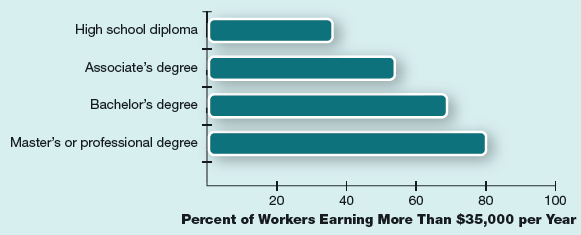
Companies filling jobs that place earners in the middle class tend to require at least an associate's degree, according to research by the Georgetown University Center on Education and the Workforce. (The center defined middle-class earnings as starting at $35,000 per year, which would place a family of four at 150% above the poverty level.) However, 36% of high school graduates with no college education land jobs paying at least $35,000 per year. These jobs are most often in the fields of manufacturing, construction, and transportation and distribution.
Positions such as supervisors, office administrators, and office machine repair technicians tend to require some college education. What KSAOs do you think employers are trying to obtain with this requirement? Can you think of a better way to identify people with those KSAOs?
Question
Question
Question
Question
Question
Question
Question
Question
Question
Question
Question
Question
Question
Question

Unlock Deck
Sign up to unlock the cards in this deck!
Unlock Deck
Unlock Deck
1/21

Play

Full screen (f)
Deck 4: Analyzing Work and Designing Jobs
1
Job Design for Drivers Keeps UPS on the Road to Energy Efficiency
United Parcel Service is famous for its brown-uniformed drivers behind the wheel of brown delivery trucks. But when it comes to energy consumption, UPS is all green. The company is constantly looking for better fuel-efficient vehicles. Its fleet includes electric, hybrid, and natural-gas vehicles, as well as its standard gasoline-powered trucks. Recently, for example, UPS ordered all-electric vans to deliver packages in Southern California and the Central Valley. Because each van travels the same limited route each day, drivers don't have to worry about running out of electricity between charges. Between 2000 and 2009, UPS recorded a 10% improvement in the miles per gallon it gets from its delivery vehicles.
UPS drivers are expected to follow very specific guidelines for how to deliver packages. These aim to complete each route in the fastest, most efficient way possible. The company details the route that each vehicle is to follow; the routes avoid left turns, which require time and gas to idle while the driver waits for oncoming traffic to clear. At each stop, drivers are supposed to walk at a "brisk pace" of 2.5 paces per second as they move to and from their truck. They keep this up as they make an average of up to 20 stops an hour to deliver about 500 packages a day.
Until recently, drivers were supposed to carry their key ring on their ring finger, so they would never need to spend time fumbling around in pockets. Now the company has improved on that method: Drivers no longer need to waste time pulling keys out of the ignition and using them to unlock the door to the packages. Instead, UPS is giving drivers a digital-remote fob to wear on their belts. With the new keyless system, drivers stop the truck and press a button to turn off the engine and unlock the bulkhead door. The changes will save 1.75 seconds at each stop. That's equivalent to an average of 6.5 minutes per driver per day. Besides saving time, the changes save motions by the driver, thus reducing fatigue.
Specific requirements such as these are the result of relentless efforts to improve efficiency. Throughout each day, computers installed in each truck gather data about the truck's activities: how long it idled, how often it backed up, how far it traveled when it was time for the driver's break. The computers also record whether drivers wore their seat belts. At the end of each delivery day, industrial engineers analyze the day's data and look for ways they can save more time, fuel, and money.
The demand to maintain a "brisk pace" is only one reason why jobs for drivers and other workers at UPS can be physically taxing. Besides being able to move quickly, workers are expected to be able to lift packages weighing up to 70 pounds without assistance. Joe Korziuk told a reporter that in more than two decades with UPS, he has enjoyed his jobs driving and washing trucks, but it has taken a toll. He says the surgeries he has had on both knees and a shoulder and the bulging disks in his back are all results of working conditions: "They're always harping on you and pushing you to go faster and faster." As a result, he said, he also was injured when boxes fell on his head, causing a concussion. Responding to complaints such as these, the union representing UPS workers in the Chicago area demanded that UPS reduce workloads and take more responsibility for workers' safety. According to workers, UPS promoted safety and higher efficiency at the same time. Workers trying to keep up with the pace were unable to meet the safety goals. UPS's response has been that safety is a top priority and injury rates are low for the messenger and courier industry. Officials note that when employees experience even minor on-the-job injuries, they receive training in how to prevent similar injuries in the future.
Despite the safety complaints, UPS is a good employer in the opinion of many workers. Drivers appreciate what they consider to be good wages and benefits.
How well does UPS take worker safety into account in its job design? How could the company better incorporate safety into job design in a way that is consistent with the company's business strategy?
United Parcel Service is famous for its brown-uniformed drivers behind the wheel of brown delivery trucks. But when it comes to energy consumption, UPS is all green. The company is constantly looking for better fuel-efficient vehicles. Its fleet includes electric, hybrid, and natural-gas vehicles, as well as its standard gasoline-powered trucks. Recently, for example, UPS ordered all-electric vans to deliver packages in Southern California and the Central Valley. Because each van travels the same limited route each day, drivers don't have to worry about running out of electricity between charges. Between 2000 and 2009, UPS recorded a 10% improvement in the miles per gallon it gets from its delivery vehicles.
UPS drivers are expected to follow very specific guidelines for how to deliver packages. These aim to complete each route in the fastest, most efficient way possible. The company details the route that each vehicle is to follow; the routes avoid left turns, which require time and gas to idle while the driver waits for oncoming traffic to clear. At each stop, drivers are supposed to walk at a "brisk pace" of 2.5 paces per second as they move to and from their truck. They keep this up as they make an average of up to 20 stops an hour to deliver about 500 packages a day.
Until recently, drivers were supposed to carry their key ring on their ring finger, so they would never need to spend time fumbling around in pockets. Now the company has improved on that method: Drivers no longer need to waste time pulling keys out of the ignition and using them to unlock the door to the packages. Instead, UPS is giving drivers a digital-remote fob to wear on their belts. With the new keyless system, drivers stop the truck and press a button to turn off the engine and unlock the bulkhead door. The changes will save 1.75 seconds at each stop. That's equivalent to an average of 6.5 minutes per driver per day. Besides saving time, the changes save motions by the driver, thus reducing fatigue.
Specific requirements such as these are the result of relentless efforts to improve efficiency. Throughout each day, computers installed in each truck gather data about the truck's activities: how long it idled, how often it backed up, how far it traveled when it was time for the driver's break. The computers also record whether drivers wore their seat belts. At the end of each delivery day, industrial engineers analyze the day's data and look for ways they can save more time, fuel, and money.
The demand to maintain a "brisk pace" is only one reason why jobs for drivers and other workers at UPS can be physically taxing. Besides being able to move quickly, workers are expected to be able to lift packages weighing up to 70 pounds without assistance. Joe Korziuk told a reporter that in more than two decades with UPS, he has enjoyed his jobs driving and washing trucks, but it has taken a toll. He says the surgeries he has had on both knees and a shoulder and the bulging disks in his back are all results of working conditions: "They're always harping on you and pushing you to go faster and faster." As a result, he said, he also was injured when boxes fell on his head, causing a concussion. Responding to complaints such as these, the union representing UPS workers in the Chicago area demanded that UPS reduce workloads and take more responsibility for workers' safety. According to workers, UPS promoted safety and higher efficiency at the same time. Workers trying to keep up with the pace were unable to meet the safety goals. UPS's response has been that safety is a top priority and injury rates are low for the messenger and courier industry. Officials note that when employees experience even minor on-the-job injuries, they receive training in how to prevent similar injuries in the future.
Despite the safety complaints, UPS is a good employer in the opinion of many workers. Drivers appreciate what they consider to be good wages and benefits.
How well does UPS take worker safety into account in its job design? How could the company better incorporate safety into job design in a way that is consistent with the company's business strategy?
UPS Ltd does not take into account the safety of the workers very seriously. They have keen training facilities which train worker on how to face any casualty but not on how to prevent any casualty.
Moreover, workers always face injuries because no safety lock is provided to them. This can be done in the form of a uniform which should be able to help the workers to some extent from external injuries.
Moreover, a helper can also be provided to the workers to load and unload the parcels to protect them from heavy injuries.
Moreover, workers always face injuries because no safety lock is provided to them. This can be done in the form of a uniform which should be able to help the workers to some extent from external injuries.
Moreover, a helper can also be provided to the workers to load and unload the parcels to protect them from heavy injuries.
2
Why Employees Are Loyal to Bon Secours Health System
Unemployment may persist in other industries, but even through the recent recession, hospitals have struggled to find and keep enough qualified medical professionals on their staffs. The need to provide care 24 hours a day, seven days a week intensifies the problem. Shortages of nurses and other health care workers have been a constant challenge. Therefore, any hospital's approach to talent management has to include ways to reduce employee turnover.
In Virginia, the Bon Secours Health System meets the challenge with flexible scheduling. The organization runs four hospitals, a separate emergency department, a health center, and a college of nursing. To staff all these facilities, Bon Secours is open to a variety of schedules. Employees may choose to work compressed workweeks of four 10-hour shifts or three 12-hour shifts. They have other choices as well: weekends only (at higher pay), four- or eight-hour shifts, and seven-day workweeks followed by seven-day breaks. Employees who want to work part-time may do so and receive full benefits if they work at least 16 hours a week. These part-time workers are especially important when managers are looking for extra help on busy days.
The scheduling options are popular. In a recent analysis, most Bon Secours employees chose one of these flexible work schedules, with one-fourth opting for temporary or part-time work. In addition, 10% of Bon Secours employees are in job-sharing arrangements, and 3% are engaged in telework.
The variety of schedules reflects management's recognition that employees have a variety of needs. Newly hired employees fresh out of college may welcome a fulltime schedule and be willing to rotate shifts. Employees with children want a schedule that is the same each week and corresponds to times when child care is available. The option of part-time status lets employees adjust their total work hours as family or other needs require. Without that option, some employees would likely quit when full-time work becomes too demanding.
Bon Secours tracks measures that show real benefits from flexible work arrangements. Surveys of employee engagement show that it has risen from 3.6 points out of 5 in 2005 to 4.55 in 2010. During the same period, employee turnover fell dramatically. At 10% per year, turnover among first-year employees is far below the median for hospitals (28.3%). The cost of hiring and training a nurse is estimated to be three times the nurse's annual salary. At that rate, reducing turnover has a real impact on a hospital's financial performance.
Another way Bon Secours retains employees is by offering a comprehensive set of benefits. After financial meltdown of 2008, many workers were devastated by the plummeting value of their homes, followed by tight lending standards that shrank the options of people looking for a way out of the mess. Bon Secours responded by offering financial assistance. It set up financial education programs, seminars to help out unemployed family members, an option to receive cash in exchange for working instead of taking time off, and a crisis fund to help out employees experiencing financial difficulties. Other benefits that help Bon Secours employees make ends meet during lean times include college tuition assistance (for employees and family members) and discounts arranged with local businesses.
Employee turnover is not the only area in which job design is linked to the organization's performance. Bon Secours participates in the Hospital Quality Incentive Demonstration Project, run by the federal government's Centers for Medicare and Medicaid Services as part of a drive to slow rising costs of health care and improve health care outcomes. The project has identified best practices associated with superior results, and it pays a financial award to participating institutions that can demonstrate they have followed these best practices.
Participating in the program means that designated employees monitor the care given to groups of patients, to make sure practices follow established guidelines. For example, when patients undergo knee or hip replacement surgery, a program coordinator visits them to verify that each has received a set of treatments to prevent blood clots. The hospital also set up measures to ensure that these patients stop receiving antibiotics within 24 hours after the surgery to prevent resistance to the drugs. Such measures are a change from days when hospitals left it up to doctors to ensure that the proper care was delivered to each patient. The more structured approach is associated with lower rates of complications, readmissions, and deaths.
How might Bon Secours use competency modeling to improve employee engagement and retention?
Unemployment may persist in other industries, but even through the recent recession, hospitals have struggled to find and keep enough qualified medical professionals on their staffs. The need to provide care 24 hours a day, seven days a week intensifies the problem. Shortages of nurses and other health care workers have been a constant challenge. Therefore, any hospital's approach to talent management has to include ways to reduce employee turnover.
In Virginia, the Bon Secours Health System meets the challenge with flexible scheduling. The organization runs four hospitals, a separate emergency department, a health center, and a college of nursing. To staff all these facilities, Bon Secours is open to a variety of schedules. Employees may choose to work compressed workweeks of four 10-hour shifts or three 12-hour shifts. They have other choices as well: weekends only (at higher pay), four- or eight-hour shifts, and seven-day workweeks followed by seven-day breaks. Employees who want to work part-time may do so and receive full benefits if they work at least 16 hours a week. These part-time workers are especially important when managers are looking for extra help on busy days.
The scheduling options are popular. In a recent analysis, most Bon Secours employees chose one of these flexible work schedules, with one-fourth opting for temporary or part-time work. In addition, 10% of Bon Secours employees are in job-sharing arrangements, and 3% are engaged in telework.
The variety of schedules reflects management's recognition that employees have a variety of needs. Newly hired employees fresh out of college may welcome a fulltime schedule and be willing to rotate shifts. Employees with children want a schedule that is the same each week and corresponds to times when child care is available. The option of part-time status lets employees adjust their total work hours as family or other needs require. Without that option, some employees would likely quit when full-time work becomes too demanding.
Bon Secours tracks measures that show real benefits from flexible work arrangements. Surveys of employee engagement show that it has risen from 3.6 points out of 5 in 2005 to 4.55 in 2010. During the same period, employee turnover fell dramatically. At 10% per year, turnover among first-year employees is far below the median for hospitals (28.3%). The cost of hiring and training a nurse is estimated to be three times the nurse's annual salary. At that rate, reducing turnover has a real impact on a hospital's financial performance.
Another way Bon Secours retains employees is by offering a comprehensive set of benefits. After financial meltdown of 2008, many workers were devastated by the plummeting value of their homes, followed by tight lending standards that shrank the options of people looking for a way out of the mess. Bon Secours responded by offering financial assistance. It set up financial education programs, seminars to help out unemployed family members, an option to receive cash in exchange for working instead of taking time off, and a crisis fund to help out employees experiencing financial difficulties. Other benefits that help Bon Secours employees make ends meet during lean times include college tuition assistance (for employees and family members) and discounts arranged with local businesses.
Employee turnover is not the only area in which job design is linked to the organization's performance. Bon Secours participates in the Hospital Quality Incentive Demonstration Project, run by the federal government's Centers for Medicare and Medicaid Services as part of a drive to slow rising costs of health care and improve health care outcomes. The project has identified best practices associated with superior results, and it pays a financial award to participating institutions that can demonstrate they have followed these best practices.
Participating in the program means that designated employees monitor the care given to groups of patients, to make sure practices follow established guidelines. For example, when patients undergo knee or hip replacement surgery, a program coordinator visits them to verify that each has received a set of treatments to prevent blood clots. The hospital also set up measures to ensure that these patients stop receiving antibiotics within 24 hours after the surgery to prevent resistance to the drugs. Such measures are a change from days when hospitals left it up to doctors to ensure that the proper care was delivered to each patient. The more structured approach is associated with lower rates of complications, readmissions, and deaths.
How might Bon Secours use competency modeling to improve employee engagement and retention?
Competency modelling leads to mapping of the various competencies required in an organization to recruit employees. It happens in a horizontal way.
For example, there can be a set of skills, knowledge and abilities with a particular employee. These KSAOs are mapped with the required KSAOs of a specific job profile. If it matches, candidate is selected and if it does not match, the candidate is rejected.
This can be used in a hospital too. The employees' skill sets can be mapped according to the desired job profile. This will enhance the employees' productivity and make them well verse in their work.
For example, there can be a set of skills, knowledge and abilities with a particular employee. These KSAOs are mapped with the required KSAOs of a specific job profile. If it matches, candidate is selected and if it does not match, the candidate is rejected.
This can be used in a hospital too. The employees' skill sets can be mapped according to the desired job profile. This will enhance the employees' productivity and make them well verse in their work.
3
Consider the "job" of college student. Perform a job analysis on this job. What tasks are required in the job? What knowledge, skills, and abilities are necessary to perform those tasks? Prepare a job description based on your analysis.
In Job analysis, the information required to perform a job is collected and analyzed. This information includes skill sets, knowledge required to complete the tasks. Jobs analysis gives one a clear idea of what is expected of him/her and what is to be done.
Tasks required in a student job:
• Attend classes regularly and listen to lectures attentively
• Timely submission of assignments
• Study regularly and prepare for exams
• Give exams
Knowledge ,skills and abilities required:
• Knowledge of pre requisite courses
• Reading and understanding skills required for the course enrolled
• Ability to work in groups for group assignments
JOB DESCRIPTION:
A student is expected to perform the following duties:
• Attend classes and take notes during classes
• Work collaboratively with fellow students
• Timely submission of homework assignments
• Show considerable academic progress
• Show respect towards teachers and fellow students
Tasks required in a student job:
• Attend classes regularly and listen to lectures attentively
• Timely submission of assignments
• Study regularly and prepare for exams
• Give exams
Knowledge ,skills and abilities required:
• Knowledge of pre requisite courses
• Reading and understanding skills required for the course enrolled
• Ability to work in groups for group assignments
JOB DESCRIPTION:
A student is expected to perform the following duties:
• Attend classes and take notes during classes
• Work collaboratively with fellow students
• Timely submission of homework assignments
• Show considerable academic progress
• Show respect towards teachers and fellow students
4
Job Design for Drivers Keeps UPS on the Road to Energy Efficiency
United Parcel Service is famous for its brown-uniformed drivers behind the wheel of brown delivery trucks. But when it comes to energy consumption, UPS is all green. The company is constantly looking for better fuel-efficient vehicles. Its fleet includes electric, hybrid, and natural-gas vehicles, as well as its standard gasoline-powered trucks. Recently, for example, UPS ordered all-electric vans to deliver packages in Southern California and the Central Valley. Because each van travels the same limited route each day, drivers don't have to worry about running out of electricity between charges. Between 2000 and 2009, UPS recorded a 10% improvement in the miles per gallon it gets from its delivery vehicles.
UPS drivers are expected to follow very specific guidelines for how to deliver packages. These aim to complete each route in the fastest, most efficient way possible. The company details the route that each vehicle is to follow; the routes avoid left turns, which require time and gas to idle while the driver waits for oncoming traffic to clear. At each stop, drivers are supposed to walk at a "brisk pace" of 2.5 paces per second as they move to and from their truck. They keep this up as they make an average of up to 20 stops an hour to deliver about 500 packages a day.
Until recently, drivers were supposed to carry their key ring on their ring finger, so they would never need to spend time fumbling around in pockets. Now the company has improved on that method: Drivers no longer need to waste time pulling keys out of the ignition and using them to unlock the door to the packages. Instead, UPS is giving drivers a digital-remote fob to wear on their belts. With the new keyless system, drivers stop the truck and press a button to turn off the engine and unlock the bulkhead door. The changes will save 1.75 seconds at each stop. That's equivalent to an average of 6.5 minutes per driver per day. Besides saving time, the changes save motions by the driver, thus reducing fatigue.
Specific requirements such as these are the result of relentless efforts to improve efficiency. Throughout each day, computers installed in each truck gather data about the truck's activities: how long it idled, how often it backed up, how far it traveled when it was time for the driver's break. The computers also record whether drivers wore their seat belts. At the end of each delivery day, industrial engineers analyze the day's data and look for ways they can save more time, fuel, and money.
The demand to maintain a "brisk pace" is only one reason why jobs for drivers and other workers at UPS can be physically taxing. Besides being able to move quickly, workers are expected to be able to lift packages weighing up to 70 pounds without assistance. Joe Korziuk told a reporter that in more than two decades with UPS, he has enjoyed his jobs driving and washing trucks, but it has taken a toll. He says the surgeries he has had on both knees and a shoulder and the bulging disks in his back are all results of working conditions: "They're always harping on you and pushing you to go faster and faster." As a result, he said, he also was injured when boxes fell on his head, causing a concussion. Responding to complaints such as these, the union representing UPS workers in the Chicago area demanded that UPS reduce workloads and take more responsibility for workers' safety. According to workers, UPS promoted safety and higher efficiency at the same time. Workers trying to keep up with the pace were unable to meet the safety goals. UPS's response has been that safety is a top priority and injury rates are low for the messenger and courier industry. Officials note that when employees experience even minor on-the-job injuries, they receive training in how to prevent similar injuries in the future.
Despite the safety complaints, UPS is a good employer in the opinion of many workers. Drivers appreciate what they consider to be good wages and benefits.
Based on the information given, what role would you say motivation plays in the design of drivers' jobs at UPS? How could the company make its jobs more motivational?
United Parcel Service is famous for its brown-uniformed drivers behind the wheel of brown delivery trucks. But when it comes to energy consumption, UPS is all green. The company is constantly looking for better fuel-efficient vehicles. Its fleet includes electric, hybrid, and natural-gas vehicles, as well as its standard gasoline-powered trucks. Recently, for example, UPS ordered all-electric vans to deliver packages in Southern California and the Central Valley. Because each van travels the same limited route each day, drivers don't have to worry about running out of electricity between charges. Between 2000 and 2009, UPS recorded a 10% improvement in the miles per gallon it gets from its delivery vehicles.
UPS drivers are expected to follow very specific guidelines for how to deliver packages. These aim to complete each route in the fastest, most efficient way possible. The company details the route that each vehicle is to follow; the routes avoid left turns, which require time and gas to idle while the driver waits for oncoming traffic to clear. At each stop, drivers are supposed to walk at a "brisk pace" of 2.5 paces per second as they move to and from their truck. They keep this up as they make an average of up to 20 stops an hour to deliver about 500 packages a day.
Until recently, drivers were supposed to carry their key ring on their ring finger, so they would never need to spend time fumbling around in pockets. Now the company has improved on that method: Drivers no longer need to waste time pulling keys out of the ignition and using them to unlock the door to the packages. Instead, UPS is giving drivers a digital-remote fob to wear on their belts. With the new keyless system, drivers stop the truck and press a button to turn off the engine and unlock the bulkhead door. The changes will save 1.75 seconds at each stop. That's equivalent to an average of 6.5 minutes per driver per day. Besides saving time, the changes save motions by the driver, thus reducing fatigue.
Specific requirements such as these are the result of relentless efforts to improve efficiency. Throughout each day, computers installed in each truck gather data about the truck's activities: how long it idled, how often it backed up, how far it traveled when it was time for the driver's break. The computers also record whether drivers wore their seat belts. At the end of each delivery day, industrial engineers analyze the day's data and look for ways they can save more time, fuel, and money.
The demand to maintain a "brisk pace" is only one reason why jobs for drivers and other workers at UPS can be physically taxing. Besides being able to move quickly, workers are expected to be able to lift packages weighing up to 70 pounds without assistance. Joe Korziuk told a reporter that in more than two decades with UPS, he has enjoyed his jobs driving and washing trucks, but it has taken a toll. He says the surgeries he has had on both knees and a shoulder and the bulging disks in his back are all results of working conditions: "They're always harping on you and pushing you to go faster and faster." As a result, he said, he also was injured when boxes fell on his head, causing a concussion. Responding to complaints such as these, the union representing UPS workers in the Chicago area demanded that UPS reduce workloads and take more responsibility for workers' safety. According to workers, UPS promoted safety and higher efficiency at the same time. Workers trying to keep up with the pace were unable to meet the safety goals. UPS's response has been that safety is a top priority and injury rates are low for the messenger and courier industry. Officials note that when employees experience even minor on-the-job injuries, they receive training in how to prevent similar injuries in the future.
Despite the safety complaints, UPS is a good employer in the opinion of many workers. Drivers appreciate what they consider to be good wages and benefits.
Based on the information given, what role would you say motivation plays in the design of drivers' jobs at UPS? How could the company make its jobs more motivational?
Unlock Deck
Unlock for access to all 21 flashcards in this deck.
Unlock Deck
k this deck
5
Discuss how the following trends are changing the skill requirements for managerial jobs in the United States: (a) increasing use of computers and the Internet, (b) increasing international competition, and (c) increasing work-family conflicts.
Unlock Deck
Unlock for access to all 21 flashcards in this deck.
Unlock Deck
k this deck
6
Suppose you have taken a job as a trainer in a large bank that has created competency models for all its positions. How could the competency models help you succeed in your career at the bank? How could the competency models help you develop the bank's employees?
Unlock Deck
Unlock for access to all 21 flashcards in this deck.
Unlock Deck
k this deck
7
About One in Three High School Grads Hold Middle-Class Jobs
Companies filling jobs that place earners in the middle class tend to require at least an associate's degree, according to research by the Georgetown University Center on Education and the Workforce. (The center defined middle-class earnings as starting at $35,000 per year, which would place a family of four at 150% above the poverty level.) However, 36% of high school graduates with no college education land jobs paying at least $35,000 per year. These jobs are most often in the fields of manufacturing, construction, and transportation and distribution.
Positions such as supervisors, office administrators, and office machine repair technicians tend to require some college education. What KSAOs do you think employers are trying to obtain with this requirement? Can you think of a better way to identify people with those KSAOs?
Companies filling jobs that place earners in the middle class tend to require at least an associate's degree, according to research by the Georgetown University Center on Education and the Workforce. (The center defined middle-class earnings as starting at $35,000 per year, which would place a family of four at 150% above the poverty level.) However, 36% of high school graduates with no college education land jobs paying at least $35,000 per year. These jobs are most often in the fields of manufacturing, construction, and transportation and distribution.
Positions such as supervisors, office administrators, and office machine repair technicians tend to require some college education. What KSAOs do you think employers are trying to obtain with this requirement? Can you think of a better way to identify people with those KSAOs?
Unlock Deck
Unlock for access to all 21 flashcards in this deck.
Unlock Deck
k this deck
8
Consider the job of a customer service representative who fields telephone calls from customers of a retailer that sells on-line and through catalogs. What measures can an employer take to design this job to make it efficient? What might be some drawbacks or challenges of designing this job for efficiency?
Unlock Deck
Unlock for access to all 21 flashcards in this deck.
Unlock Deck
k this deck
9
Jobs That Literally Make People Sick
While effective human resource management aims to create motivating jobs, poor leadership coupled with difficult circumstances can result in jobs that are so unpleasant that workers' mental health begins to suffer. Researchers at the Australian National University analyzed data about working conditions and mental health in more than 7,000 adults over a seven-year period. They found that the mental health of workers in the worst of these jobs was no better than - and sometimes worse than-the mental health of unemployed adults.
The job characteristics that were mostly strongly associated with mental health were the job's complexity and demands, job security, the perceived fairness of pay, and control over the job (for example, ability to decide how to perform tasks). In highly demanding jobs with low security, unfair pay, and little control, workers experienced declining mental health. Unemployment also had an impact on mental health, but it was not as severe.
People differ in what kinds of work they consider unbearable, but many would have that attitude toward working in an Alabama fish-processing plant. The rooms have to be kept cold, and they are wet as well. Some people would likely object to smelling fish all day long. Workers stand for at least 10 hours a day, making repetitive cuts. For all this, they earn minimum wage and limited benefits. In spite of these conditions, employers were able until recently to fill these positions with immigrant workers. But after Alabama passed a law requiring police to question individuals who they believe could be in the United States illegally, many of those workers left the state. Employers report difficulty filling jobs such as these with U.S. workers.
What would be the consequences to an employer of having highly demanding jobs with low security, unfair pay, and little control?
While effective human resource management aims to create motivating jobs, poor leadership coupled with difficult circumstances can result in jobs that are so unpleasant that workers' mental health begins to suffer. Researchers at the Australian National University analyzed data about working conditions and mental health in more than 7,000 adults over a seven-year period. They found that the mental health of workers in the worst of these jobs was no better than - and sometimes worse than-the mental health of unemployed adults.
The job characteristics that were mostly strongly associated with mental health were the job's complexity and demands, job security, the perceived fairness of pay, and control over the job (for example, ability to decide how to perform tasks). In highly demanding jobs with low security, unfair pay, and little control, workers experienced declining mental health. Unemployment also had an impact on mental health, but it was not as severe.
People differ in what kinds of work they consider unbearable, but many would have that attitude toward working in an Alabama fish-processing plant. The rooms have to be kept cold, and they are wet as well. Some people would likely object to smelling fish all day long. Workers stand for at least 10 hours a day, making repetitive cuts. For all this, they earn minimum wage and limited benefits. In spite of these conditions, employers were able until recently to fill these positions with immigrant workers. But after Alabama passed a law requiring police to question individuals who they believe could be in the United States illegally, many of those workers left the state. Employers report difficulty filling jobs such as these with U.S. workers.
What would be the consequences to an employer of having highly demanding jobs with low security, unfair pay, and little control?
Unlock Deck
Unlock for access to all 21 flashcards in this deck.
Unlock Deck
k this deck
10
How might the job in Question 6 be designed to make it more motivating? How well would these considerations apply to the cashier's job in Question 1?
Unlock Deck
Unlock for access to all 21 flashcards in this deck.
Unlock Deck
k this deck
11
Why Employees Are Loyal to Bon Secours Health System
Unemployment may persist in other industries, but even through the recent recession, hospitals have struggled to find and keep enough qualified medical professionals on their staffs. The need to provide care 24 hours a day, seven days a week intensifies the problem. Shortages of nurses and other health care workers have been a constant challenge. Therefore, any hospital's approach to talent management has to include ways to reduce employee turnover.
In Virginia, the Bon Secours Health System meets the challenge with flexible scheduling. The organization runs four hospitals, a separate emergency department, a health center, and a college of nursing. To staff all these facilities, Bon Secours is open to a variety of schedules. Employees may choose to work compressed workweeks of four 10-hour shifts or three 12-hour shifts. They have other choices as well: weekends only (at higher pay), four- or eight-hour shifts, and seven-day workweeks followed by seven-day breaks. Employees who want to work part-time may do so and receive full benefits if they work at least 16 hours a week. These part-time workers are especially important when managers are looking for extra help on busy days.
The scheduling options are popular. In a recent analysis, most Bon Secours employees chose one of these flexible work schedules, with one-fourth opting for temporary or part-time work. In addition, 10% of Bon Secours employees are in job-sharing arrangements, and 3% are engaged in telework.
The variety of schedules reflects management's recognition that employees have a variety of needs. Newly hired employees fresh out of college may welcome a fulltime schedule and be willing to rotate shifts. Employees with children want a schedule that is the same each week and corresponds to times when child care is available. The option of part-time status lets employees adjust their total work hours as family or other needs require. Without that option, some employees would likely quit when full-time work becomes too demanding.
Bon Secours tracks measures that show real benefits from flexible work arrangements. Surveys of employee engagement show that it has risen from 3.6 points out of 5 in 2005 to 4.55 in 2010. During the same period, employee turnover fell dramatically. At 10% per year, turnover among first-year employees is far below the median for hospitals (28.3%). The cost of hiring and training a nurse is estimated to be three times the nurse's annual salary. At that rate, reducing turnover has a real impact on a hospital's financial performance.
Another way Bon Secours retains employees is by offering a comprehensive set of benefits. After financial meltdown of 2008, many workers were devastated by the plummeting value of their homes, followed by tight lending standards that shrank the options of people looking for a way out of the mess. Bon Secours responded by offering financial assistance. It set up financial education programs, seminars to help out unemployed family members, an option to receive cash in exchange for working instead of taking time off, and a crisis fund to help out employees experiencing financial difficulties. Other benefits that help Bon Secours employees make ends meet during lean times include college tuition assistance (for employees and family members) and discounts arranged with local businesses.
Employee turnover is not the only area in which job design is linked to the organization's performance. Bon Secours participates in the Hospital Quality Incentive Demonstration Project, run by the federal government's Centers for Medicare and Medicaid Services as part of a drive to slow rising costs of health care and improve health care outcomes. The project has identified best practices associated with superior results, and it pays a financial award to participating institutions that can demonstrate they have followed these best practices.
Participating in the program means that designated employees monitor the care given to groups of patients, to make sure practices follow established guidelines. For example, when patients undergo knee or hip replacement surgery, a program coordinator visits them to verify that each has received a set of treatments to prevent blood clots. The hospital also set up measures to ensure that these patients stop receiving antibiotics within 24 hours after the surgery to prevent resistance to the drugs. Such measures are a change from days when hospitals left it up to doctors to ensure that the proper care was delivered to each patient. The more structured approach is associated with lower rates of complications, readmissions, and deaths.
How does Bon Secours make work more motivating?
Unemployment may persist in other industries, but even through the recent recession, hospitals have struggled to find and keep enough qualified medical professionals on their staffs. The need to provide care 24 hours a day, seven days a week intensifies the problem. Shortages of nurses and other health care workers have been a constant challenge. Therefore, any hospital's approach to talent management has to include ways to reduce employee turnover.
In Virginia, the Bon Secours Health System meets the challenge with flexible scheduling. The organization runs four hospitals, a separate emergency department, a health center, and a college of nursing. To staff all these facilities, Bon Secours is open to a variety of schedules. Employees may choose to work compressed workweeks of four 10-hour shifts or three 12-hour shifts. They have other choices as well: weekends only (at higher pay), four- or eight-hour shifts, and seven-day workweeks followed by seven-day breaks. Employees who want to work part-time may do so and receive full benefits if they work at least 16 hours a week. These part-time workers are especially important when managers are looking for extra help on busy days.
The scheduling options are popular. In a recent analysis, most Bon Secours employees chose one of these flexible work schedules, with one-fourth opting for temporary or part-time work. In addition, 10% of Bon Secours employees are in job-sharing arrangements, and 3% are engaged in telework.
The variety of schedules reflects management's recognition that employees have a variety of needs. Newly hired employees fresh out of college may welcome a fulltime schedule and be willing to rotate shifts. Employees with children want a schedule that is the same each week and corresponds to times when child care is available. The option of part-time status lets employees adjust their total work hours as family or other needs require. Without that option, some employees would likely quit when full-time work becomes too demanding.
Bon Secours tracks measures that show real benefits from flexible work arrangements. Surveys of employee engagement show that it has risen from 3.6 points out of 5 in 2005 to 4.55 in 2010. During the same period, employee turnover fell dramatically. At 10% per year, turnover among first-year employees is far below the median for hospitals (28.3%). The cost of hiring and training a nurse is estimated to be three times the nurse's annual salary. At that rate, reducing turnover has a real impact on a hospital's financial performance.
Another way Bon Secours retains employees is by offering a comprehensive set of benefits. After financial meltdown of 2008, many workers were devastated by the plummeting value of their homes, followed by tight lending standards that shrank the options of people looking for a way out of the mess. Bon Secours responded by offering financial assistance. It set up financial education programs, seminars to help out unemployed family members, an option to receive cash in exchange for working instead of taking time off, and a crisis fund to help out employees experiencing financial difficulties. Other benefits that help Bon Secours employees make ends meet during lean times include college tuition assistance (for employees and family members) and discounts arranged with local businesses.
Employee turnover is not the only area in which job design is linked to the organization's performance. Bon Secours participates in the Hospital Quality Incentive Demonstration Project, run by the federal government's Centers for Medicare and Medicaid Services as part of a drive to slow rising costs of health care and improve health care outcomes. The project has identified best practices associated with superior results, and it pays a financial award to participating institutions that can demonstrate they have followed these best practices.
Participating in the program means that designated employees monitor the care given to groups of patients, to make sure practices follow established guidelines. For example, when patients undergo knee or hip replacement surgery, a program coordinator visits them to verify that each has received a set of treatments to prevent blood clots. The hospital also set up measures to ensure that these patients stop receiving antibiotics within 24 hours after the surgery to prevent resistance to the drugs. Such measures are a change from days when hospitals left it up to doctors to ensure that the proper care was delivered to each patient. The more structured approach is associated with lower rates of complications, readmissions, and deaths.
How does Bon Secours make work more motivating?
Unlock Deck
Unlock for access to all 21 flashcards in this deck.
Unlock Deck
k this deck
12
What ergonomic considerations might apply to each of the following jobs? For each job, what kinds of costs would result from addressing ergonomics? What costs might result from failing to address ergonomics?
A.A computer programmer
B.A UPS delivery person
C.A child care worker
A.A computer programmer
B.A UPS delivery person
C.A child care worker
Unlock Deck
Unlock for access to all 21 flashcards in this deck.
Unlock Deck
k this deck
13
Assume you are a manager of a fast-food restaurant. What are the outputs of your work unit? What are the activities required to produce those outputs? What are the inputs?
Unlock Deck
Unlock for access to all 21 flashcards in this deck.
Unlock Deck
k this deck
14
The chapter said that modern electronics have eliminated the need for a store's cashiers to calculate change due on a purchase. How does this development modify the job description for a cashier? If you were a store manager, how does this affect the skills and qualities of job candidates you would want to hire? Does this change in mental processing requirements affect what you would expect from a cashier? How?
Unlock Deck
Unlock for access to all 21 flashcards in this deck.
Unlock Deck
k this deck
15
SHOULD EMPLOYERS FRET ABOUT MAKING EMPLOYEES HAPPY?
One consideration in job design is to increase job satisfaction. The expectation is that employees with high job satisfaction will be motivated to do their best. Some managers are interested in taking this idea a step further. They are applying research into what conditions are associated with happiness. By using our knowledge about what makes people happy, the thinking goes, organizations can try to establish the conditions for a happy workforce.
During the past two decades, psychologists have become much more involved in the study of emotions, especially happiness. As one would expect, they have learned that happiness is greater under conditions such as good health and strong relationships. But the difference that comes from any single condition is not large or long lasting. People do, however, sustain happiness when they experience frequent positive events, even minor ones. Therefore, people can add to their happiness with positive activities such as meditation, exercise, good deeds for others, and social interaction. This logic suggests that organizations could add to employees' happiness by building positive experiences into each day-praise from supervisors, for example, or a time for employees to describe where they have seen acts of kindness at work.
But should employers even take on employee happiness as another project? Time for feel-good activities could take away time from productive activities. And managers might worry that if employees are too comfortable, they won't be motivated to try hard. Psychology professor Daniel Gilbert has one response to those concerns: "people are happiest when they're appropriately challenged." People who aren't challenge get bored, and boredom reduces happiness. Former Verizon CEO Denny Strigl would agree. He notes, "Good results make happy employees-and not the other way around."
What ethical responsibilities do organizations have with regard to employees' health? To their happiness?
One consideration in job design is to increase job satisfaction. The expectation is that employees with high job satisfaction will be motivated to do their best. Some managers are interested in taking this idea a step further. They are applying research into what conditions are associated with happiness. By using our knowledge about what makes people happy, the thinking goes, organizations can try to establish the conditions for a happy workforce.
During the past two decades, psychologists have become much more involved in the study of emotions, especially happiness. As one would expect, they have learned that happiness is greater under conditions such as good health and strong relationships. But the difference that comes from any single condition is not large or long lasting. People do, however, sustain happiness when they experience frequent positive events, even minor ones. Therefore, people can add to their happiness with positive activities such as meditation, exercise, good deeds for others, and social interaction. This logic suggests that organizations could add to employees' happiness by building positive experiences into each day-praise from supervisors, for example, or a time for employees to describe where they have seen acts of kindness at work.
But should employers even take on employee happiness as another project? Time for feel-good activities could take away time from productive activities. And managers might worry that if employees are too comfortable, they won't be motivated to try hard. Psychology professor Daniel Gilbert has one response to those concerns: "people are happiest when they're appropriately challenged." People who aren't challenge get bored, and boredom reduces happiness. Former Verizon CEO Denny Strigl would agree. He notes, "Good results make happy employees-and not the other way around."
What ethical responsibilities do organizations have with regard to employees' health? To their happiness?
Unlock Deck
Unlock for access to all 21 flashcards in this deck.
Unlock Deck
k this deck
16
Consider a job you hold now or have held recently. Would you want this job to be redesigned to place more emphasis on efficiency, motivation, ergonomics, or mental processing? What changes would you want and why? (Or why do you want the job to be redesigned?)
Unlock Deck
Unlock for access to all 21 flashcards in this deck.
Unlock Deck
k this deck
17
Job Design for Drivers Keeps UPS on the Road to Energy Efficiency
United Parcel Service is famous for its brown-uniformed drivers behind the wheel of brown delivery trucks. But when it comes to energy consumption, UPS is all green. The company is constantly looking for better fuel-efficient vehicles. Its fleet includes electric, hybrid, and natural-gas vehicles, as well as its standard gasoline-powered trucks. Recently, for example, UPS ordered all-electric vans to deliver packages in Southern California and the Central Valley. Because each van travels the same limited route each day, drivers don't have to worry about running out of electricity between charges. Between 2000 and 2009, UPS recorded a 10% improvement in the miles per gallon it gets from its delivery vehicles.
UPS drivers are expected to follow very specific guidelines for how to deliver packages. These aim to complete each route in the fastest, most efficient way possible. The company details the route that each vehicle is to follow; the routes avoid left turns, which require time and gas to idle while the driver waits for oncoming traffic to clear. At each stop, drivers are supposed to walk at a "brisk pace" of 2.5 paces per second as they move to and from their truck. They keep this up as they make an average of up to 20 stops an hour to deliver about 500 packages a day.
Until recently, drivers were supposed to carry their key ring on their ring finger, so they would never need to spend time fumbling around in pockets. Now the company has improved on that method: Drivers no longer need to waste time pulling keys out of the ignition and using them to unlock the door to the packages. Instead, UPS is giving drivers a digital-remote fob to wear on their belts. With the new keyless system, drivers stop the truck and press a button to turn off the engine and unlock the bulkhead door. The changes will save 1.75 seconds at each stop. That's equivalent to an average of 6.5 minutes per driver per day. Besides saving time, the changes save motions by the driver, thus reducing fatigue.
Specific requirements such as these are the result of relentless efforts to improve efficiency. Throughout each day, computers installed in each truck gather data about the truck's activities: how long it idled, how often it backed up, how far it traveled when it was time for the driver's break. The computers also record whether drivers wore their seat belts. At the end of each delivery day, industrial engineers analyze the day's data and look for ways they can save more time, fuel, and money.
The demand to maintain a "brisk pace" is only one reason why jobs for drivers and other workers at UPS can be physically taxing. Besides being able to move quickly, workers are expected to be able to lift packages weighing up to 70 pounds without assistance. Joe Korziuk told a reporter that in more than two decades with UPS, he has enjoyed his jobs driving and washing trucks, but it has taken a toll. He says the surgeries he has had on both knees and a shoulder and the bulging disks in his back are all results of working conditions: "They're always harping on you and pushing you to go faster and faster." As a result, he said, he also was injured when boxes fell on his head, causing a concussion. Responding to complaints such as these, the union representing UPS workers in the Chicago area demanded that UPS reduce workloads and take more responsibility for workers' safety. According to workers, UPS promoted safety and higher efficiency at the same time. Workers trying to keep up with the pace were unable to meet the safety goals. UPS's response has been that safety is a top priority and injury rates are low for the messenger and courier industry. Officials note that when employees experience even minor on-the-job injuries, they receive training in how to prevent similar injuries in the future.
Despite the safety complaints, UPS is a good employer in the opinion of many workers. Drivers appreciate what they consider to be good wages and benefits.
How do UPS's goals for environmental sustainability affect its job design?
United Parcel Service is famous for its brown-uniformed drivers behind the wheel of brown delivery trucks. But when it comes to energy consumption, UPS is all green. The company is constantly looking for better fuel-efficient vehicles. Its fleet includes electric, hybrid, and natural-gas vehicles, as well as its standard gasoline-powered trucks. Recently, for example, UPS ordered all-electric vans to deliver packages in Southern California and the Central Valley. Because each van travels the same limited route each day, drivers don't have to worry about running out of electricity between charges. Between 2000 and 2009, UPS recorded a 10% improvement in the miles per gallon it gets from its delivery vehicles.
UPS drivers are expected to follow very specific guidelines for how to deliver packages. These aim to complete each route in the fastest, most efficient way possible. The company details the route that each vehicle is to follow; the routes avoid left turns, which require time and gas to idle while the driver waits for oncoming traffic to clear. At each stop, drivers are supposed to walk at a "brisk pace" of 2.5 paces per second as they move to and from their truck. They keep this up as they make an average of up to 20 stops an hour to deliver about 500 packages a day.
Until recently, drivers were supposed to carry their key ring on their ring finger, so they would never need to spend time fumbling around in pockets. Now the company has improved on that method: Drivers no longer need to waste time pulling keys out of the ignition and using them to unlock the door to the packages. Instead, UPS is giving drivers a digital-remote fob to wear on their belts. With the new keyless system, drivers stop the truck and press a button to turn off the engine and unlock the bulkhead door. The changes will save 1.75 seconds at each stop. That's equivalent to an average of 6.5 minutes per driver per day. Besides saving time, the changes save motions by the driver, thus reducing fatigue.
Specific requirements such as these are the result of relentless efforts to improve efficiency. Throughout each day, computers installed in each truck gather data about the truck's activities: how long it idled, how often it backed up, how far it traveled when it was time for the driver's break. The computers also record whether drivers wore their seat belts. At the end of each delivery day, industrial engineers analyze the day's data and look for ways they can save more time, fuel, and money.
The demand to maintain a "brisk pace" is only one reason why jobs for drivers and other workers at UPS can be physically taxing. Besides being able to move quickly, workers are expected to be able to lift packages weighing up to 70 pounds without assistance. Joe Korziuk told a reporter that in more than two decades with UPS, he has enjoyed his jobs driving and washing trucks, but it has taken a toll. He says the surgeries he has had on both knees and a shoulder and the bulging disks in his back are all results of working conditions: "They're always harping on you and pushing you to go faster and faster." As a result, he said, he also was injured when boxes fell on his head, causing a concussion. Responding to complaints such as these, the union representing UPS workers in the Chicago area demanded that UPS reduce workloads and take more responsibility for workers' safety. According to workers, UPS promoted safety and higher efficiency at the same time. Workers trying to keep up with the pace were unable to meet the safety goals. UPS's response has been that safety is a top priority and injury rates are low for the messenger and courier industry. Officials note that when employees experience even minor on-the-job injuries, they receive training in how to prevent similar injuries in the future.
Despite the safety complaints, UPS is a good employer in the opinion of many workers. Drivers appreciate what they consider to be good wages and benefits.
How do UPS's goals for environmental sustainability affect its job design?
Unlock Deck
Unlock for access to all 21 flashcards in this deck.
Unlock Deck
k this deck
18
Jobs That Literally Make People Sick
While effective human resource management aims to create motivating jobs, poor leadership coupled with difficult circumstances can result in jobs that are so unpleasant that workers' mental health begins to suffer. Researchers at the Australian National University analyzed data about working conditions and mental health in more than 7,000 adults over a seven-year period. They found that the mental health of workers in the worst of these jobs was no better than - and sometimes worse than-the mental health of unemployed adults.
The job characteristics that were mostly strongly associated with mental health were the job's complexity and demands, job security, the perceived fairness of pay, and control over the job (for example, ability to decide how to perform tasks). In highly demanding jobs with low security, unfair pay, and little control, workers experienced declining mental health. Unemployment also had an impact on mental health, but it was not as severe.
People differ in what kinds of work they consider unbearable, but many would have that attitude toward working in an Alabama fish-processing plant. The rooms have to be kept cold, and they are wet as well. Some people would likely object to smelling fish all day long. Workers stand for at least 10 hours a day, making repetitive cuts. For all this, they earn minimum wage and limited benefits. In spite of these conditions, employers were able until recently to fill these positions with immigrant workers. But after Alabama passed a law requiring police to question individuals who they believe could be in the United States illegally, many of those workers left the state. Employers report difficulty filling jobs such as these with U.S. workers.
How could fish-processing plants like the one described here improve jobs so they can fill vacant positions profitably?
While effective human resource management aims to create motivating jobs, poor leadership coupled with difficult circumstances can result in jobs that are so unpleasant that workers' mental health begins to suffer. Researchers at the Australian National University analyzed data about working conditions and mental health in more than 7,000 adults over a seven-year period. They found that the mental health of workers in the worst of these jobs was no better than - and sometimes worse than-the mental health of unemployed adults.
The job characteristics that were mostly strongly associated with mental health were the job's complexity and demands, job security, the perceived fairness of pay, and control over the job (for example, ability to decide how to perform tasks). In highly demanding jobs with low security, unfair pay, and little control, workers experienced declining mental health. Unemployment also had an impact on mental health, but it was not as severe.
People differ in what kinds of work they consider unbearable, but many would have that attitude toward working in an Alabama fish-processing plant. The rooms have to be kept cold, and they are wet as well. Some people would likely object to smelling fish all day long. Workers stand for at least 10 hours a day, making repetitive cuts. For all this, they earn minimum wage and limited benefits. In spite of these conditions, employers were able until recently to fill these positions with immigrant workers. But after Alabama passed a law requiring police to question individuals who they believe could be in the United States illegally, many of those workers left the state. Employers report difficulty filling jobs such as these with U.S. workers.
How could fish-processing plants like the one described here improve jobs so they can fill vacant positions profitably?
Unlock Deck
Unlock for access to all 21 flashcards in this deck.
Unlock Deck
k this deck
19
Why Employees Are Loyal to Bon Secours Health System
Unemployment may persist in other industries, but even through the recent recession, hospitals have struggled to find and keep enough qualified medical professionals on their staffs. The need to provide care 24 hours a day, seven days a week intensifies the problem. Shortages of nurses and other health care workers have been a constant challenge. Therefore, any hospital's approach to talent management has to include ways to reduce employee turnover.
In Virginia, the Bon Secours Health System meets the challenge with flexible scheduling. The organization runs four hospitals, a separate emergency department, a health center, and a college of nursing. To staff all these facilities, Bon Secours is open to a variety of schedules. Employees may choose to work compressed workweeks of four 10-hour shifts or three 12-hour shifts. They have other choices as well: weekends only (at higher pay), four- or eight-hour shifts, and seven-day workweeks followed by seven-day breaks. Employees who want to work part-time may do so and receive full benefits if they work at least 16 hours a week. These part-time workers are especially important when managers are looking for extra help on busy days.
The scheduling options are popular. In a recent analysis, most Bon Secours employees chose one of these flexible work schedules, with one-fourth opting for temporary or part-time work. In addition, 10% of Bon Secours employees are in job-sharing arrangements, and 3% are engaged in telework.
The variety of schedules reflects management's recognition that employees have a variety of needs. Newly hired employees fresh out of college may welcome a fulltime schedule and be willing to rotate shifts. Employees with children want a schedule that is the same each week and corresponds to times when child care is available. The option of part-time status lets employees adjust their total work hours as family or other needs require. Without that option, some employees would likely quit when full-time work becomes too demanding.
Bon Secours tracks measures that show real benefits from flexible work arrangements. Surveys of employee engagement show that it has risen from 3.6 points out of 5 in 2005 to 4.55 in 2010. During the same period, employee turnover fell dramatically. At 10% per year, turnover among first-year employees is far below the median for hospitals (28.3%). The cost of hiring and training a nurse is estimated to be three times the nurse's annual salary. At that rate, reducing turnover has a real impact on a hospital's financial performance.
Another way Bon Secours retains employees is by offering a comprehensive set of benefits. After financial meltdown of 2008, many workers were devastated by the plummeting value of their homes, followed by tight lending standards that shrank the options of people looking for a way out of the mess. Bon Secours responded by offering financial assistance. It set up financial education programs, seminars to help out unemployed family members, an option to receive cash in exchange for working instead of taking time off, and a crisis fund to help out employees experiencing financial difficulties. Other benefits that help Bon Secours employees make ends meet during lean times include college tuition assistance (for employees and family members) and discounts arranged with local businesses.
Employee turnover is not the only area in which job design is linked to the organization's performance. Bon Secours participates in the Hospital Quality Incentive Demonstration Project, run by the federal government's Centers for Medicare and Medicaid Services as part of a drive to slow rising costs of health care and improve health care outcomes. The project has identified best practices associated with superior results, and it pays a financial award to participating institutions that can demonstrate they have followed these best practices.
Participating in the program means that designated employees monitor the care given to groups of patients, to make sure practices follow established guidelines. For example, when patients undergo knee or hip replacement surgery, a program coordinator visits them to verify that each has received a set of treatments to prevent blood clots. The hospital also set up measures to ensure that these patients stop receiving antibiotics within 24 hours after the surgery to prevent resistance to the drugs. Such measures are a change from days when hospitals left it up to doctors to ensure that the proper care was delivered to each patient. The more structured approach is associated with lower rates of complications, readmissions, and deaths.
How does Bon Secours address the mental demands of providing quality patient care?
Unemployment may persist in other industries, but even through the recent recession, hospitals have struggled to find and keep enough qualified medical professionals on their staffs. The need to provide care 24 hours a day, seven days a week intensifies the problem. Shortages of nurses and other health care workers have been a constant challenge. Therefore, any hospital's approach to talent management has to include ways to reduce employee turnover.
In Virginia, the Bon Secours Health System meets the challenge with flexible scheduling. The organization runs four hospitals, a separate emergency department, a health center, and a college of nursing. To staff all these facilities, Bon Secours is open to a variety of schedules. Employees may choose to work compressed workweeks of four 10-hour shifts or three 12-hour shifts. They have other choices as well: weekends only (at higher pay), four- or eight-hour shifts, and seven-day workweeks followed by seven-day breaks. Employees who want to work part-time may do so and receive full benefits if they work at least 16 hours a week. These part-time workers are especially important when managers are looking for extra help on busy days.
The scheduling options are popular. In a recent analysis, most Bon Secours employees chose one of these flexible work schedules, with one-fourth opting for temporary or part-time work. In addition, 10% of Bon Secours employees are in job-sharing arrangements, and 3% are engaged in telework.
The variety of schedules reflects management's recognition that employees have a variety of needs. Newly hired employees fresh out of college may welcome a fulltime schedule and be willing to rotate shifts. Employees with children want a schedule that is the same each week and corresponds to times when child care is available. The option of part-time status lets employees adjust their total work hours as family or other needs require. Without that option, some employees would likely quit when full-time work becomes too demanding.
Bon Secours tracks measures that show real benefits from flexible work arrangements. Surveys of employee engagement show that it has risen from 3.6 points out of 5 in 2005 to 4.55 in 2010. During the same period, employee turnover fell dramatically. At 10% per year, turnover among first-year employees is far below the median for hospitals (28.3%). The cost of hiring and training a nurse is estimated to be three times the nurse's annual salary. At that rate, reducing turnover has a real impact on a hospital's financial performance.
Another way Bon Secours retains employees is by offering a comprehensive set of benefits. After financial meltdown of 2008, many workers were devastated by the plummeting value of their homes, followed by tight lending standards that shrank the options of people looking for a way out of the mess. Bon Secours responded by offering financial assistance. It set up financial education programs, seminars to help out unemployed family members, an option to receive cash in exchange for working instead of taking time off, and a crisis fund to help out employees experiencing financial difficulties. Other benefits that help Bon Secours employees make ends meet during lean times include college tuition assistance (for employees and family members) and discounts arranged with local businesses.
Employee turnover is not the only area in which job design is linked to the organization's performance. Bon Secours participates in the Hospital Quality Incentive Demonstration Project, run by the federal government's Centers for Medicare and Medicaid Services as part of a drive to slow rising costs of health care and improve health care outcomes. The project has identified best practices associated with superior results, and it pays a financial award to participating institutions that can demonstrate they have followed these best practices.
Participating in the program means that designated employees monitor the care given to groups of patients, to make sure practices follow established guidelines. For example, when patients undergo knee or hip replacement surgery, a program coordinator visits them to verify that each has received a set of treatments to prevent blood clots. The hospital also set up measures to ensure that these patients stop receiving antibiotics within 24 hours after the surgery to prevent resistance to the drugs. Such measures are a change from days when hospitals left it up to doctors to ensure that the proper care was delivered to each patient. The more structured approach is associated with lower rates of complications, readmissions, and deaths.
How does Bon Secours address the mental demands of providing quality patient care?
Unlock Deck
Unlock for access to all 21 flashcards in this deck.
Unlock Deck
k this deck
20
Based on Question 1, consider the cashier's job in the restaurant. What are the outputs, activities, and inputs for that job?
Unlock Deck
Unlock for access to all 21 flashcards in this deck.
Unlock Deck
k this deck
21
SHOULD EMPLOYERS FRET ABOUT MAKING EMPLOYEES HAPPY?
One consideration in job design is to increase job satisfaction. The expectation is that employees with high job satisfaction will be motivated to do their best. Some managers are interested in taking this idea a step further. They are applying research into what conditions are associated with happiness. By using our knowledge about what makes people happy, the thinking goes, organizations can try to establish the conditions for a happy workforce.
During the past two decades, psychologists have become much more involved in the study of emotions, especially happiness. As one would expect, they have learned that happiness is greater under conditions such as good health and strong relationships. But the difference that comes from any single condition is not large or long lasting. People do, however, sustain happiness when they experience frequent positive events, even minor ones. Therefore, people can add to their happiness with positive activities such as meditation, exercise, good deeds for others, and social interaction. This logic suggests that organizations could add to employees' happiness by building positive experiences into each day-praise from supervisors, for example, or a time for employees to describe where they have seen acts of kindness at work.
But should employers even take on employee happiness as another project? Time for feel-good activities could take away time from productive activities. And managers might worry that if employees are too comfortable, they won't be motivated to try hard. Psychology professor Daniel Gilbert has one response to those concerns: "people are happiest when they're appropriately challenged." People who aren't challenge get bored, and boredom reduces happiness. Former Verizon CEO Denny Strigl would agree. He notes, "Good results make happy employees-and not the other way around."
If designing work so that employees will be happier will also make employees more engaged in challenging assignments, should employers address happiness in job design? Should they address happiness if it will instead distract employees from their work? Why or why not?
One consideration in job design is to increase job satisfaction. The expectation is that employees with high job satisfaction will be motivated to do their best. Some managers are interested in taking this idea a step further. They are applying research into what conditions are associated with happiness. By using our knowledge about what makes people happy, the thinking goes, organizations can try to establish the conditions for a happy workforce.
During the past two decades, psychologists have become much more involved in the study of emotions, especially happiness. As one would expect, they have learned that happiness is greater under conditions such as good health and strong relationships. But the difference that comes from any single condition is not large or long lasting. People do, however, sustain happiness when they experience frequent positive events, even minor ones. Therefore, people can add to their happiness with positive activities such as meditation, exercise, good deeds for others, and social interaction. This logic suggests that organizations could add to employees' happiness by building positive experiences into each day-praise from supervisors, for example, or a time for employees to describe where they have seen acts of kindness at work.
But should employers even take on employee happiness as another project? Time for feel-good activities could take away time from productive activities. And managers might worry that if employees are too comfortable, they won't be motivated to try hard. Psychology professor Daniel Gilbert has one response to those concerns: "people are happiest when they're appropriately challenged." People who aren't challenge get bored, and boredom reduces happiness. Former Verizon CEO Denny Strigl would agree. He notes, "Good results make happy employees-and not the other way around."
If designing work so that employees will be happier will also make employees more engaged in challenging assignments, should employers address happiness in job design? Should they address happiness if it will instead distract employees from their work? Why or why not?
Unlock Deck
Unlock for access to all 21 flashcards in this deck.
Unlock Deck
k this deck
Unlock Deck
Unlock for access to all 21 flashcards in this deck.






