







 Chat with AI

Deck 13: The Cardiovascular System: Blood Vessels and Circulation
Full screen (f)

Question

Question
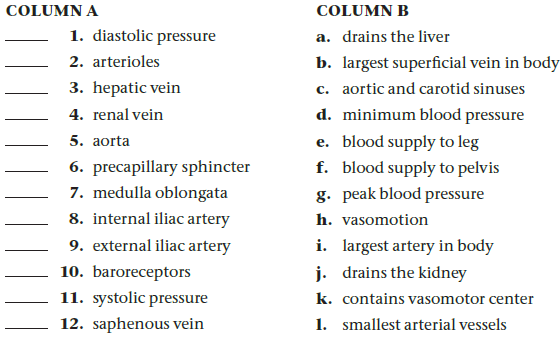
Match each item in column A with the most closely related item in column B. Place letters for answers in the spaces provided.
Question
Question
Question
Question
Question
Question
Question
Question
Question
Question
Question
Question
Question
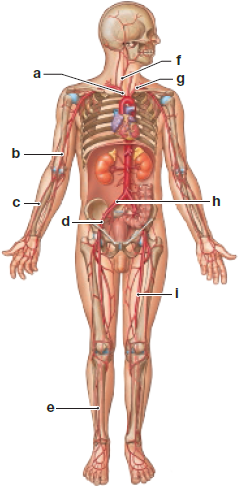
Identify the major arteries in the following diagram.
a) __________
b) __________
c) __________
d) __________
e) __________
f) __________
g) __________
h) __________
i) __________
a) __________
b) __________
c) __________
d) __________
e) __________
f) __________
g) __________
h) __________
i) __________
Question
Question
Question
Question
Question
Question
Question
Question
Question
Question
Question
Question
Question
Question
Question
Question
Question
Question
Question
Question
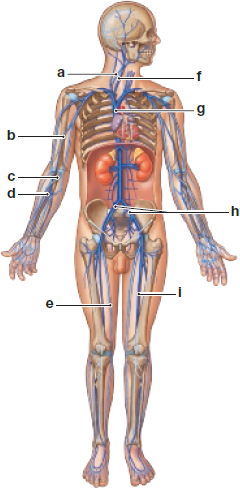
Identify the major veins in the following diagram.
a) __________
b) __________
c) __________
d) __________
e) __________
f) __________
g) __________
h) __________
i) __________
a) __________
b) __________
c) __________
d) __________
e) __________
f) __________
g) __________
h) __________
i) __________
Question
Question
Question
Question
Question
Question
Question
Question
Question
Question
Question
Question
Question
Question
Question
Question
Question
Question
Question
Question
Question
Question
Question
Question
Question
Question
Question

Unlock Deck
Sign up to unlock the cards in this deck!
Unlock Deck
Unlock Deck
1/62

Play

Full screen (f)
Deck 13: The Cardiovascular System: Blood Vessels and Circulation
1
List the five general classes of blood vessels.
The five general classes of blood vessels are:
1. arteries
2. arterioles
3. capillaries
4. venules
5. veins
The arteries are responsible for delivering blood to the body organs, branching off into smaller arterioles. The arterioles supply blood to the capillaries, which are tiny, highly extensive vessels that permit exchange between blood and surrounding interstitial fluid. The veins return blood to the heart and are further classified into small venules.
1. arteries
2. arterioles
3. capillaries
4. venules
5. veins
The arteries are responsible for delivering blood to the body organs, branching off into smaller arterioles. The arterioles supply blood to the capillaries, which are tiny, highly extensive vessels that permit exchange between blood and surrounding interstitial fluid. The veins return blood to the heart and are further classified into small venules.
2
Match each item in column A with the most closely related item in column B. Place letters for answers in the spaces provided.
Diastolic pressure refers to the minimum blood pressure at the conclusion of ventricular diastole. Diastolic pressure is recorded as the lowest blood pressure of the body nearing the second phase of diastole in the ventricles. The pressure in arteries rises during ventricular systole, or contraction, and falls during ventricular diastole, or relaxation. Thus, diastolic pressure describes the opposite of systolic pressure, and is lower in value.
Thus, the correct answer is d
Thus, the correct answer is d
3
A cross section of tissue shows several small, thin-walled vessels with very little smooth muscle tissue in the tunica media. Which type of vessels are these?
A cross-section of tissue with small, thin-walled vessels with little smooth muscle tissue would show veins. Veins have thin walls, as they do not accumulate much pressure. The tunica media of an artery has more smooth muscle tissue than that of a vein. Thus, these blood vessels must be veins, as arteries tend to have thicker walls and more smooth muscle tissue than veins to support their function.
4
What effect would relaxation of precapillary sphincters have on blood flow through a tissue?
Unlock Deck
Unlock for access to all 62 flashcards in this deck.
Unlock Deck
k this deck
5
Why are valves found in veins, but not in arteries?
Unlock Deck
Unlock for access to all 62 flashcards in this deck.
Unlock Deck
k this deck
6
Identify the factors that contribute to total peripheral resistance.
Unlock Deck
Unlock for access to all 62 flashcards in this deck.
Unlock Deck
k this deck
7
In a healthy person, where is blood pressure greater: at the aorta or at the inferior vena cava? Explain.
Unlock Deck
Unlock for access to all 62 flashcards in this deck.
Unlock Deck
k this deck
8
While standing in the hot sun, Sally begins to feel light-headed and then faints. Explain what happened.
Unlock Deck
Unlock for access to all 62 flashcards in this deck.
Unlock Deck
k this deck
9
Describe the actions of vasodilators and vasoconstrictors.
Unlock Deck
Unlock for access to all 62 flashcards in this deck.
Unlock Deck
k this deck
10
How would applying slight pressure to the common carotid artery affect your heart rate?
Unlock Deck
Unlock for access to all 62 flashcards in this deck.
Unlock Deck
k this deck
11
What effect would the vasoconstriction of the renal artery have on blood pressure and blood volume?
Unlock Deck
Unlock for access to all 62 flashcards in this deck.
Unlock Deck
k this deck
12
Why does blood pressure increase during exercise?
Unlock Deck
Unlock for access to all 62 flashcards in this deck.
Unlock Deck
k this deck
13
Name the immediate and long-term problems related to the cardiovascular response to hemorrhaging.
Unlock Deck
Unlock for access to all 62 flashcards in this deck.
Unlock Deck
k this deck
14
Explain the role of aldosterone and ADH in long-term restoration of blood volume.
Unlock Deck
Unlock for access to all 62 flashcards in this deck.
Unlock Deck
k this deck
15
Identify the major arteries in the following diagram.
a) __________
b) __________
c) __________
d) __________
e) __________
f) __________
g) __________
h) __________
i) __________
a) __________
b) __________
c) __________
d) __________
e) __________
f) __________
g) __________
h) __________
i) __________
Unlock Deck
Unlock for access to all 62 flashcards in this deck.
Unlock Deck
k this deck
16
Identify the two circuits of the cardiovascular system.
Unlock Deck
Unlock for access to all 62 flashcards in this deck.
Unlock Deck
k this deck
17
Blood vessels that carry blood away from the heart are called a) veins.
B) arterioles.
C) venules.
D) arteries.
B) arterioles.
C) venules.
D) arteries.
Unlock Deck
Unlock for access to all 62 flashcards in this deck.
Unlock Deck
k this deck
18
Identify the three general functional patterns of the body's blood vessels.
Unlock Deck
Unlock for access to all 62 flashcards in this deck.
Unlock Deck
k this deck
19
The layer of the arteriole wall that provides the properties of contractility and elasticity is the a) tunica adventitia.
B) tunica media.
C) tunica intima.
D) tunica externa.
B) tunica media.
C) tunica intima.
D) tunica externa.
Unlock Deck
Unlock for access to all 62 flashcards in this deck.
Unlock Deck
k this deck
20
Name the blood vessels that enter and exit the lungs, and note whether they contain primarily oxygenated or deoxygenated blood.
Unlock Deck
Unlock for access to all 62 flashcards in this deck.
Unlock Deck
k this deck
21
The two-way exchange of substances between blood and body cells occurs only through a) arterioles.
B) capillaries.
C) venules.
D) a, b, and c are correct.
B) capillaries.
C) venules.
D) a, b, and c are correct.
Unlock Deck
Unlock for access to all 62 flashcards in this deck.
Unlock Deck
k this deck
22
Trace the path of a drop of blood through the lungs, beginning at the right ventricle and ending at the left atrium.
Unlock Deck
Unlock for access to all 62 flashcards in this deck.
Unlock Deck
k this deck
23
The blood vessels that collect blood from all tissues and organs and return it to the heart are the a) veins.
B) arteries.
C) capillaries.
D) arterioles.
B) arteries.
C) capillaries.
D) arterioles.
Unlock Deck
Unlock for access to all 62 flashcards in this deck.
Unlock Deck
k this deck
24
A blockage of which branch of the aortic arch would interfere with blood flow to the left arm?
Unlock Deck
Unlock for access to all 62 flashcards in this deck.
Unlock Deck
k this deck
25
Blood within the veins is prevented from flowing away from the heart because of the presence of a) venous reservoirs.
B) muscular walls.
C) clots.
D) valves.
B) muscular walls.
C) clots.
D) valves.
Unlock Deck
Unlock for access to all 62 flashcards in this deck.
Unlock Deck
k this deck
26
Why would compression of the common carotid arteries cause a person to lose consciousness?
Unlock Deck
Unlock for access to all 62 flashcards in this deck.
Unlock Deck
k this deck
27
The most important factor in vascular resistance is a) the viscosity of the blood.
B) friction between the blood and vessel walls.
C) turbulence due to irregular surfaces of blood vessels.
D) the length of the blood vessels.
B) friction between the blood and vessel walls.
C) turbulence due to irregular surfaces of blood vessels.
D) the length of the blood vessels.
Unlock Deck
Unlock for access to all 62 flashcards in this deck.
Unlock Deck
k this deck
28
Grace is in an automobile accident, and her celiac trunk is ruptured. Which organs will be affected most directly by this injury?
Unlock Deck
Unlock for access to all 62 flashcards in this deck.
Unlock Deck
k this deck
29
In a blood pressure reading of 120/80, the 120 represents _____ and the 80 represents _____. a) diastolic pressure; systolic pressure
B) pulse pressure; mean arterial pressure
C) systolic pressure; diastolic pressure
D) mean arterial pressure; pulse pressure
B) pulse pressure; mean arterial pressure
C) systolic pressure; diastolic pressure
D) mean arterial pressure; pulse pressure
Unlock Deck
Unlock for access to all 62 flashcards in this deck.
Unlock Deck
k this deck
30
Describe the general distribution of major arteries and veins in the neck and limbs. What functional advantage does this distribution provide?
Unlock Deck
Unlock for access to all 62 flashcards in this deck.
Unlock Deck
k this deck
31
Along a capillary, _____ dominates at the arterial end and fluid moves _____; _____ dominates at the venous end and fluid moves _____.
a) osmosis, in; filtration, out
b) filtration, out; osmosis, in
c) filtration, in; osmosis, out
d) osmosis, out; filtration, in
a) osmosis, in; filtration, out
b) filtration, out; osmosis, in
c) filtration, in; osmosis, out
d) osmosis, out; filtration, in
Unlock Deck
Unlock for access to all 62 flashcards in this deck.
Unlock Deck
k this deck
32
Name the three vessels that carry blood to and from the placenta.
Unlock Deck
Unlock for access to all 62 flashcards in this deck.
Unlock Deck
k this deck
33
The two factors that assist the relatively low venous pressures in propelling blood toward the heart are
a) ventricular systole and valve closure.
b) gravity and vasomotion.
c) muscular compression and the respiratory pump.
d) atrial and ventricular contractions.
a) ventricular systole and valve closure.
b) gravity and vasomotion.
c) muscular compression and the respiratory pump.
d) atrial and ventricular contractions.
Unlock Deck
Unlock for access to all 62 flashcards in this deck.
Unlock Deck
k this deck
34
A blood sample taken from the umbilical cord contains high levels of oxygen and nutrients, and low levels of carbon dioxide and waste products. Is this sample from an umbilical artery or from the umbilical vein? Explain.
Unlock Deck
Unlock for access to all 62 flashcards in this deck.
Unlock Deck
k this deck
35
Identify the major veins in the following diagram.
a) __________
b) __________
c) __________
d) __________
e) __________
f) __________
g) __________
h) __________
i) __________
a) __________
b) __________
c) __________
d) __________
e) __________
f) __________
g) __________
h) __________
i) __________
Unlock Deck
Unlock for access to all 62 flashcards in this deck.
Unlock Deck
k this deck
36
Name the structures in the fetal circulation that stop functioning at birth. What becomes of these structures?
Unlock Deck
Unlock for access to all 62 flashcards in this deck.
Unlock Deck
k this deck
37
Arteries of the pulmonary circuit differ from those of the systemic circuit in that they carry a) oxygen and nutrients.
B) deoxygenated blood.
C) oxygenated blood.
D) oxygen, carbon dioxide, and nutrients.
B) deoxygenated blood.
C) oxygenated blood.
D) oxygen, carbon dioxide, and nutrients.
Unlock Deck
Unlock for access to all 62 flashcards in this deck.
Unlock Deck
k this deck
38
Identify components of the cardiovascular system that are affected by age.
Unlock Deck
Unlock for access to all 62 flashcards in this deck.
Unlock Deck
k this deck
39
The two arteries formed by the division of the brachiocephalic trunk are the a) aorta and internal carotid.
B) axillary and brachial.
C) external and internal carotid.
D) common carotid and subclavian.
B) axillary and brachial.
C) external and internal carotid.
D) common carotid and subclavian.
Unlock Deck
Unlock for access to all 62 flashcards in this deck.
Unlock Deck
k this deck
40
Define thrombus.
Unlock Deck
Unlock for access to all 62 flashcards in this deck.
Unlock Deck
k this deck
41
The unpaired arteries supplying blood to the visceral organs include the a) adrenal, renal, and lumbar arteries.
B) iliac, gonadal, and femoral arteries.
C) celiac trunk and superior and inferior mesenteric arteries.
D) a, b, and c are correct.
B) iliac, gonadal, and femoral arteries.
C) celiac trunk and superior and inferior mesenteric arteries.
D) a, b, and c are correct.
Unlock Deck
Unlock for access to all 62 flashcards in this deck.
Unlock Deck
k this deck
42
Define aneurysm.
Unlock Deck
Unlock for access to all 62 flashcards in this deck.
Unlock Deck
k this deck
43
The artery generally used to feel the pulse at the wrist is the
a) ulnar artery.
b) radial artery.
c) fibular artery.
d) dorsalis artery.
a) ulnar artery.
b) radial artery.
c) fibular artery.
d) dorsalis artery.
Unlock Deck
Unlock for access to all 62 flashcards in this deck.
Unlock Deck
k this deck
44
Describe what the cardiovascular system provides for all other body systems.
Unlock Deck
Unlock for access to all 62 flashcards in this deck.
Unlock Deck
k this deck
45
The vein that drains the dural sinuses of the brain is the a) cephalic vein.
B) great saphenous vein.
C) internal jugular vein.
D) superior vena cava.
B) great saphenous vein.
C) internal jugular vein.
D) superior vena cava.
Unlock Deck
Unlock for access to all 62 flashcards in this deck.
Unlock Deck
k this deck
46
What is the relationship between the skeletal system and the cardiovascular system?
Unlock Deck
Unlock for access to all 62 flashcards in this deck.
Unlock Deck
k this deck
47
The vein that collects most of the venous blood from below the diaphragm is the a) superior vena cava.
B) great saphenous vein.
C) inferior vena cava.
D) azygos vein.
B) great saphenous vein.
C) inferior vena cava.
D) azygos vein.
Unlock Deck
Unlock for access to all 62 flashcards in this deck.
Unlock Deck
k this deck
48
a) What are the primary forces that cause fluid to move out of a capillary and into the interstitial fluid at its arterial end? b) What are the primary forces that cause fluid to move into a capillary from the interstitial fluid at its venous end?
Unlock Deck
Unlock for access to all 62 flashcards in this deck.
Unlock Deck
k this deck
49
What two effects result when the baroreceptor response to elevated blood pressure BP) is triggered?
Unlock Deck
Unlock for access to all 62 flashcards in this deck.
Unlock Deck
k this deck
50
What factors affect the activity of chemoreceptors in the carotid and aortic bodies?
Unlock Deck
Unlock for access to all 62 flashcards in this deck.
Unlock Deck
k this deck
51
What cardiovascular changes occur at birth?
Unlock Deck
Unlock for access to all 62 flashcards in this deck.
Unlock Deck
k this deck
52
What age-related changes take place in the blood, heart, and blood vessels?
Unlock Deck
Unlock for access to all 62 flashcards in this deck.
Unlock Deck
k this deck
53
When dehydration occurs, a) water reabsorption at the kidneys accelerates.
B) fluids are reabsorbed from the interstitial fluid.
C) blood osmotic pressure increases.
D) a, b, and c are correct.
B) fluids are reabsorbed from the interstitial fluid.
C) blood osmotic pressure increases.
D) a, b, and c are correct.
Unlock Deck
Unlock for access to all 62 flashcards in this deck.
Unlock Deck
k this deck
54
Increased CO2 levels in tissues would promote a) contraction of precapillary sphincters.
B) an increase in the pH of the blood.
C) relaxation of precapillary sphincters.
D) a decrease of blood flow to tissues.
B) an increase in the pH of the blood.
C) relaxation of precapillary sphincters.
D) a decrease of blood flow to tissues.
Unlock Deck
Unlock for access to all 62 flashcards in this deck.
Unlock Deck
k this deck
55
Elevated levels of the hormones ADH and angiotensin II will produce
a) increased peripheral vasodilation.
b) increased peripheral vasoconstriction.
c) increased peripheral blood flow.
d) increased venous return.
a) increased peripheral vasodilation.
b) increased peripheral vasoconstriction.
c) increased peripheral blood flow.
d) increased venous return.
Unlock Deck
Unlock for access to all 62 flashcards in this deck.
Unlock Deck
k this deck
56
Relate the anatomical differences between arteries and veins to their functions.
Unlock Deck
Unlock for access to all 62 flashcards in this deck.
Unlock Deck
k this deck
57
Why do capillaries permit the diffusion of materials, whereas arteries and veins do not?
Unlock Deck
Unlock for access to all 62 flashcards in this deck.
Unlock Deck
k this deck
58
Why is blood flow to the brain relatively continuous and constant?
Unlock Deck
Unlock for access to all 62 flashcards in this deck.
Unlock Deck
k this deck
59
An accident victim displays the following signs and symptoms: hypotension; pale, cool, moist skin; confusion; and disorientation. Identify her condition, and explain why each of these signs and symptoms occurs. If you took her pulse, what would you find?
Unlock Deck
Unlock for access to all 62 flashcards in this deck.
Unlock Deck
k this deck
60
Bob is sitting outside on a warm day and is sweating profusely. His friend Mary wants to practice taking blood pressures, and he agrees to play patient. Mary finds that Bob's blood pressure is elevated, even though he is resting and has lost fluid from sweating. She reasons that fluid loss should lower blood volume and, thus, blood pressure.) Mary asks you why Bob's blood pressure is high instead of low. What should you tell her?
Unlock Deck
Unlock for access to all 62 flashcards in this deck.
Unlock Deck
k this deck
61
People with allergies frequently take antihistamines and decongestants to relieve their symptoms. These medications mimic the effects of sympathetic stimulation.) The medications' labels warn that such medications should not be taken by individuals being treated for high blood pressure. Why?
Unlock Deck
Unlock for access to all 62 flashcards in this deck.
Unlock Deck
k this deck
62
Gina awakens suddenly to the sound of her alarm clock. Realizing that she is late for class, she jumps to her feet, feels light-headed, and falls back on her bed. What probably caused this to happen? Why doesn't this always happen?
Unlock Deck
Unlock for access to all 62 flashcards in this deck.
Unlock Deck
k this deck
Unlock Deck
Unlock for access to all 62 flashcards in this deck.






