







 Chat with AI

Deck 40: The Animal Body
Full screen (f)

Question

Question
Question
Question
Question
Question
Question
Question
Question
Question
Question
Question
Question
Question
Question
Question
Question
Question
Question
Question
Question
Question
Question
Question
Question
Question
Question
Question
Use the model of circulation in the leg of a Canada goose to answer the following question. 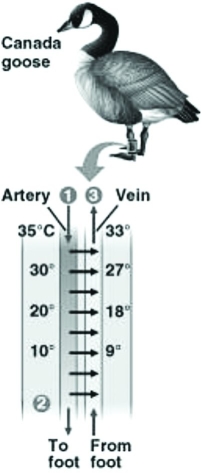 The countercurrent arrangement of blood vessels is an adaptation that allows the goose to ________.
A) minimize heat exchange between the feet and water
B) generate heat using shivering thermogenesis
C) more effectively cool off the goose in the summer
D) conserve heat in the goose's core when the goose is swimming in cold water
The countercurrent arrangement of blood vessels is an adaptation that allows the goose to ________.A) minimize heat exchange between the feet and water
B) generate heat using shivering thermogenesis
C) more effectively cool off the goose in the summer
D) conserve heat in the goose's core when the goose is swimming in cold water
Question
Question
Question
Question
Question
Question
Question
Question
Use the model of circulation in the leg of a Canada goose to answer the following question. 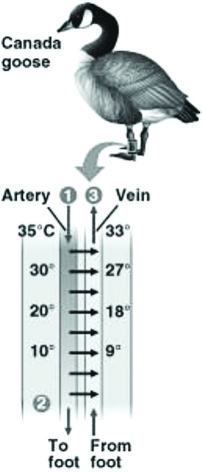 Which of the following is the best interpretation of the model?
A) that warmer arterial blood can bypass the legs as needed, when the legs are too cold to function well
B) that warmer venous blood transfers heat to the cooler arterial blood
C) that warmer arterial blood transfers heat to the cooler venous blood
D) that arterial blood is always cooler in the abdomen, compared to the temperature of the venous blood in the feet of the goose
Which of the following is the best interpretation of the model?A) that warmer arterial blood can bypass the legs as needed, when the legs are too cold to function well
B) that warmer venous blood transfers heat to the cooler arterial blood
C) that warmer arterial blood transfers heat to the cooler venous blood
D) that arterial blood is always cooler in the abdomen, compared to the temperature of the venous blood in the feet of the goose
Question
Question
Question
Question
Question
Question
Question
Question
Question
Question
Question
Question
Question
Question
Question
Use the graph to answer the following question. 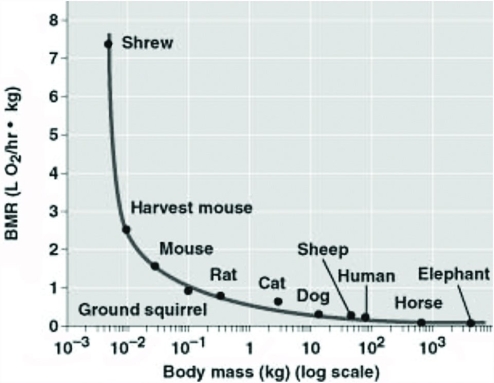 Which of the following statements is most consistent from the data in the graph?
A) A smaller animal would consume less food per gram of tissue.
B) A smaller animal would consume more food per gram of tissue.
C) An elephant uses more energy than a shrew.
D) A shrew uses more energy than an elephant.
Which of the following statements is most consistent from the data in the graph?A) A smaller animal would consume less food per gram of tissue.
B) A smaller animal would consume more food per gram of tissue.
C) An elephant uses more energy than a shrew.
D) A shrew uses more energy than an elephant.
Question
Question
Question
Researchers measure the heart rates, breathing rates, and blood volume (relative to body size) for two mammals (X and Y) and found that all three values were significantly higher in mammal X. Which option in the table best compares mammals X and Y?
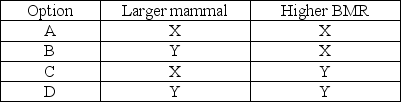
A) A
B) B
C) C
D) D
A) A
B) B
C) C
D) D
Question
A researcher is setting up an experiment to measure basal metabolic rate in prairie voles (Microtus ochrogaster-a small rodent). Which of the following would be the best set of conditions for the voles immediately before and during the measurement?

A) A
B) B
C) C
D) D
A) A
B) B
C) C
D) D
Question
Question
To study circadian rhythms in European hamsters, researchers measured mRNA levels for two clock genes (Per2 and Bmal1) in individuals who were not hibernating, and therefore had normal body temperature and individuals who were hibernating, and therefore had lower-than-normal body temperature. Both sets of individuals were kept in total darkness. The results are shown in the figure. Which statement is best supported using the data? 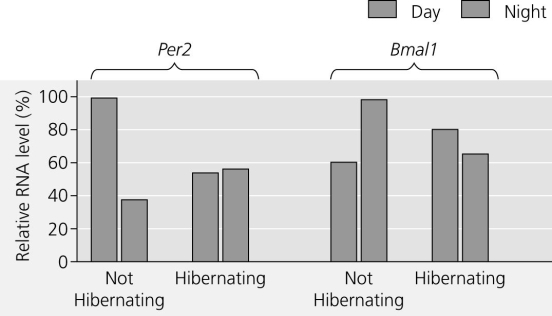
A) At night, during euthermia, there is more Per2 RNA in the hamster than Bmal1 RNA.
B) During hibernation, the clock genes are regulated differently than during euthermia.
C) The Bmal1 gene is only expressed at night during hibernation.
D) The metabolic rate of the hamsters increased during hibernation.
A) At night, during euthermia, there is more Per2 RNA in the hamster than Bmal1 RNA.
B) During hibernation, the clock genes are regulated differently than during euthermia.
C) The Bmal1 gene is only expressed at night during hibernation.
D) The metabolic rate of the hamsters increased during hibernation.
Question

Unlock Deck
Sign up to unlock the cards in this deck!
Unlock Deck
Unlock Deck
1/58

Play

Full screen (f)
Deck 40: The Animal Body
1
Blood is best classified as connective tissue because ________.
A) its cells are separated from each other by an extracellular matrix
B) it contains more than one type of cell
C) its cells can move from place to place
D) it is found within all the organs of the body
A) its cells are separated from each other by an extracellular matrix
B) it contains more than one type of cell
C) its cells can move from place to place
D) it is found within all the organs of the body
A
2
Which of the following options best describes the structure of bone?
A) a mixture of hardened collagen and minerals.
B) chondroitin sulfate secreted by chondrocytes.
C) many columnar epithelial cells packed together.
D) hardened fibrous connective tissue.
A) a mixture of hardened collagen and minerals.
B) chondroitin sulfate secreted by chondrocytes.
C) many columnar epithelial cells packed together.
D) hardened fibrous connective tissue.
A
3
Compared with a smaller cell, a larger cell of the same shape has ________.
A) less surface area
B) less surface area per unit of volume
C) a smaller average distance between its mitochondria and the external source of oxygen
D) a smaller cytoplasm-to-nucleus ratio
A) less surface area
B) less surface area per unit of volume
C) a smaller average distance between its mitochondria and the external source of oxygen
D) a smaller cytoplasm-to-nucleus ratio
B
4
In mammals, growth hormone is an endocrine signaling molecule that stimulates repair and growth of various tissues. Which of the following is required for a tissue to respond to growth hormone?
A) the presence of a growth hormone receptor
B) the tissue must be muscle
C) neurons must connect with the tissue
D) a change in membrane potential must occur
A) the presence of a growth hormone receptor
B) the tissue must be muscle
C) neurons must connect with the tissue
D) a change in membrane potential must occur
Unlock Deck
Unlock for access to all 58 flashcards in this deck.
Unlock Deck
k this deck
5
Which of the following is a unique characteristic of smooth muscle?
A) many cells fused together
B) intercalated discs
C) spindle-shaped cells with a single nucleus
D) striations with sarcomeres
A) many cells fused together
B) intercalated discs
C) spindle-shaped cells with a single nucleus
D) striations with sarcomeres
Unlock Deck
Unlock for access to all 58 flashcards in this deck.
Unlock Deck
k this deck
6
Which type of cell is specialized to store fat in animals?
A) bone cells
B) muscle cells
C) adipose cells
D) red blood cells
A) bone cells
B) muscle cells
C) adipose cells
D) red blood cells
Unlock Deck
Unlock for access to all 58 flashcards in this deck.
Unlock Deck
k this deck
7
Some animals have no gills when young, but then develop gills that grow larger as the animal grows larger. Which of the following statements provides the best explanation for this increase in gill size?
A) The young of these animals are much more active than the adult, which leads to a higher BMR (basal metabolic rate) and, therefore, a higher need for oxygen.
B) Relative to their volume, the young have more surface area across which they can transport all the oxygen they need.
C) The young have a higher heart rate and thus a lower demand for oxygen.
D) Relative to their surface area, the young have more body volume in which they can store oxygen for long periods of time.
A) The young of these animals are much more active than the adult, which leads to a higher BMR (basal metabolic rate) and, therefore, a higher need for oxygen.
B) Relative to their volume, the young have more surface area across which they can transport all the oxygen they need.
C) The young have a higher heart rate and thus a lower demand for oxygen.
D) Relative to their surface area, the young have more body volume in which they can store oxygen for long periods of time.
Unlock Deck
Unlock for access to all 58 flashcards in this deck.
Unlock Deck
k this deck
8
Which characteristic is most likely for an epithelium that is specialized for passive diffusion of materials from one fluid-filled compartment to another?
A) a single layer of flattened cells
B) many layers of cells stacked together
C) large, cube-shaped cells
D) loosely connected cells surrounded by an extracellular matrix
A) a single layer of flattened cells
B) many layers of cells stacked together
C) large, cube-shaped cells
D) loosely connected cells surrounded by an extracellular matrix
Unlock Deck
Unlock for access to all 58 flashcards in this deck.
Unlock Deck
k this deck
9
What tissue lines most exchange surfaces of multicellular animals?
A) connective tissue
B) smooth muscle
C) neural tissue
D) epithelial tissue
A) connective tissue
B) smooth muscle
C) neural tissue
D) epithelial tissue
Unlock Deck
Unlock for access to all 58 flashcards in this deck.
Unlock Deck
k this deck
10
Which type of muscle directly helps move food along the digestive tract?
A) cardiac muscle
B) smooth muscle
C) striated muscle
D) skeletal muscle
A) cardiac muscle
B) smooth muscle
C) striated muscle
D) skeletal muscle
Unlock Deck
Unlock for access to all 58 flashcards in this deck.
Unlock Deck
k this deck
11
Which of the following structural features of the digestive system improves the efficiency of exchange of energy and materials with the environment?
A) more branching or folds
B) increased thickness
C) larger cells
D) decreased blood supply
A) more branching or folds
B) increased thickness
C) larger cells
D) decreased blood supply
Unlock Deck
Unlock for access to all 58 flashcards in this deck.
Unlock Deck
k this deck
12
Which of the following options correctly lists three evolutionary adaptations that help some animals directly exchange matter between the cells of their body and the environment?
A) a gastrovascular cavity, a body with two tissue layers, and a torpedo-like body shape
B) an external respiratory surface, a small body size, and a two-cell-layered body
C) a large body volume, a long, tubular body, and thin covering
D) an unbranched internal surface, a small body size, and thick covering
A) a gastrovascular cavity, a body with two tissue layers, and a torpedo-like body shape
B) an external respiratory surface, a small body size, and a two-cell-layered body
C) a large body volume, a long, tubular body, and thin covering
D) an unbranched internal surface, a small body size, and thick covering
Unlock Deck
Unlock for access to all 58 flashcards in this deck.
Unlock Deck
k this deck
13
Which of the following statements best explains the similarity in the body form of penguins, seals, and tuna?
A) All of the organisms needed to develop similar body shapes so they could swim.
B) All of their bodies have been compressed since birth by intensive underwater pressures.
C) Their shapes are the result of convergent evolution, which reduces drag while swimming.
D) This is the only shape that will allow them to maintain a constant body temperature in water.
A) All of the organisms needed to develop similar body shapes so they could swim.
B) All of their bodies have been compressed since birth by intensive underwater pressures.
C) Their shapes are the result of convergent evolution, which reduces drag while swimming.
D) This is the only shape that will allow them to maintain a constant body temperature in water.
Unlock Deck
Unlock for access to all 58 flashcards in this deck.
Unlock Deck
k this deck
14
Which of the following is a typical characteristic of connective tissues?
A) little space between the membranes of adjacent cells
B) the ability to transmit electrochemical impulses
C) the ability to shorten upon stimulation
D) relatively few cells and a large amount of extracellular matrix
A) little space between the membranes of adjacent cells
B) the ability to transmit electrochemical impulses
C) the ability to shorten upon stimulation
D) relatively few cells and a large amount of extracellular matrix
Unlock Deck
Unlock for access to all 58 flashcards in this deck.
Unlock Deck
k this deck
15
Which of the following characteristics is shared by all types of muscle tissue?
A) striated banding patterns seen under the microscope
B) cells that lengthen when appropriately stimulated
C) a response that can be consciously controlled
D) interactions between actin and myosin
A) striated banding patterns seen under the microscope
B) cells that lengthen when appropriately stimulated
C) a response that can be consciously controlled
D) interactions between actin and myosin
Unlock Deck
Unlock for access to all 58 flashcards in this deck.
Unlock Deck
k this deck
16
Which of the following features is shared by all animals?
A) an external body surface that is dry
B) a basic body plan that resembles a two-layered sac
C) a body surface covered with hair to keep them warm
D) contact between their cells and an aqueous medium
A) an external body surface that is dry
B) a basic body plan that resembles a two-layered sac
C) a body surface covered with hair to keep them warm
D) contact between their cells and an aqueous medium
Unlock Deck
Unlock for access to all 58 flashcards in this deck.
Unlock Deck
k this deck
17
Which of the following properties are displayed by cardiac muscle cells?
A) striated appearance and presence of intercalated disks
B) smooth appearance and under voluntary control
C) striated appearance and under voluntary control
D) smooth appearance and presence of intercalated disks
A) striated appearance and presence of intercalated disks
B) smooth appearance and under voluntary control
C) striated appearance and under voluntary control
D) smooth appearance and presence of intercalated disks
Unlock Deck
Unlock for access to all 58 flashcards in this deck.
Unlock Deck
k this deck
18
Which body system assists with coordination of vertebrate body functions via chemical signals?
A) respiratory system
B) endocrine system
C) integumentary system
D) excretory system
A) respiratory system
B) endocrine system
C) integumentary system
D) excretory system
Unlock Deck
Unlock for access to all 58 flashcards in this deck.
Unlock Deck
k this deck
19
Which is the name of the epithelial cell surface that faces the outside of an organ?
A) apical
B) basal
C) interstitial
D) lumen
A) apical
B) basal
C) interstitial
D) lumen
Unlock Deck
Unlock for access to all 58 flashcards in this deck.
Unlock Deck
k this deck
20
Which of the following is a characteristic of nervous system signals?
A) They allow gradual changes to take place in the body.
B) They travel quickly throughout the body.
C) They usually impact the entire body.
D) They require a voltage change to be transmitted.
A) They allow gradual changes to take place in the body.
B) They travel quickly throughout the body.
C) They usually impact the entire body.
D) They require a voltage change to be transmitted.
Unlock Deck
Unlock for access to all 58 flashcards in this deck.
Unlock Deck
k this deck
21
The panting responses observed in overheated birds and mammals dissipate heat loss by what process?
A) countercurrent exchange
B) acclimation
C) vasoconstriction
D) evaporation
A) countercurrent exchange
B) acclimation
C) vasoconstriction
D) evaporation
Unlock Deck
Unlock for access to all 58 flashcards in this deck.
Unlock Deck
k this deck
22
The use of brown fat to generate metabolic heat is mostly limited to small mammals. Which characteristic of small mammals created the selective pressure that favored the use of brown fat to generate metabolic heat?
A) Small mammals cannot grow enough fur to insulate their bodies.
B) Small mammals have a large surface area to volume ratio, which allows rapid heat loss.
C) Small mammals do not have enough muscle to generate heat by shivering.
D) Small mammals have lost their brown fat through the course of their evolution.
A) Small mammals cannot grow enough fur to insulate their bodies.
B) Small mammals have a large surface area to volume ratio, which allows rapid heat loss.
C) Small mammals do not have enough muscle to generate heat by shivering.
D) Small mammals have lost their brown fat through the course of their evolution.
Unlock Deck
Unlock for access to all 58 flashcards in this deck.
Unlock Deck
k this deck
23
The hypothalamus in the brain releases the hormone corticotropin-releasing hormone (CRH) that triggers the release of adrenocorticotropic hormone (ACTH) from the pituitary gland. ACTH travels through the blood to cause the release of cortisol from the cortex of the adrenal glands. If cortisol acts with negative feedback on CRH and ACTH, what would you expect to happen when cortisol is released?
A) CRH and ACTH levels will decrease
B) CRH levels will increase, but ACTH levels will decrease
C) CRH levels will decrease, but ACTH levels will increase
D) CRH and ACTH levels will increase
A) CRH and ACTH levels will decrease
B) CRH levels will increase, but ACTH levels will decrease
C) CRH levels will decrease, but ACTH levels will increase
D) CRH and ACTH levels will increase
Unlock Deck
Unlock for access to all 58 flashcards in this deck.
Unlock Deck
k this deck
24
Measuring which of the following amounts would most accurately determine the metabolic rate of an animal?
A) the work done by an animal
B) the food consumed during a meal
C) the carbon dioxide produced by an animal in a given time.
D) the energy used by an animal in a given time
A) the work done by an animal
B) the food consumed during a meal
C) the carbon dioxide produced by an animal in a given time.
D) the energy used by an animal in a given time
Unlock Deck
Unlock for access to all 58 flashcards in this deck.
Unlock Deck
k this deck
25
Which of the following increases the rate of heat exchange between an animal and its environment?
A) feathers or fur
B) vasoconstriction
C) wind blowing across the body surface
D) a blubber or fat layer
A) feathers or fur
B) vasoconstriction
C) wind blowing across the body surface
D) a blubber or fat layer
Unlock Deck
Unlock for access to all 58 flashcards in this deck.
Unlock Deck
k this deck
26
The body's automatic tendency to maintain a constant and optimal internal environment is termed as ________.
A) balanced equilibrium
B) physiological chance
C) homeostasis
D) static equilibrium
A) balanced equilibrium
B) physiological chance
C) homeostasis
D) static equilibrium
Unlock Deck
Unlock for access to all 58 flashcards in this deck.
Unlock Deck
k this deck
27
You are studying a large tropical reptile that has a high and relatively stable body temperature. Which of the following observations is best for determining if the animal is an endotherm or an ectotherm?
A) You know from its high and stable body temperature that it must be an endotherm.
B) You know that it is an ectotherm because it is not a bird or mammal.
C) You subject this reptile to various temperatures in the lab and find that its body temperature and metabolic rate change with the ambient temperature. You conclude that it is an ectotherm.
D) You note that its environment has a high and stable temperature. Because its body temperature matches the environmental temperature, you conclude that it is an ectotherm.
A) You know from its high and stable body temperature that it must be an endotherm.
B) You know that it is an ectotherm because it is not a bird or mammal.
C) You subject this reptile to various temperatures in the lab and find that its body temperature and metabolic rate change with the ambient temperature. You conclude that it is an ectotherm.
D) You note that its environment has a high and stable temperature. Because its body temperature matches the environmental temperature, you conclude that it is an ectotherm.
Unlock Deck
Unlock for access to all 58 flashcards in this deck.
Unlock Deck
k this deck
28
Use the model of circulation in the leg of a Canada goose to answer the following question. The countercurrent arrangement of blood vessels is an adaptation that allows the goose to ________.
A) minimize heat exchange between the feet and water
B) generate heat using shivering thermogenesis
C) more effectively cool off the goose in the summer
D) conserve heat in the goose's core when the goose is swimming in cold water
The countercurrent arrangement of blood vessels is an adaptation that allows the goose to ________.A) minimize heat exchange between the feet and water
B) generate heat using shivering thermogenesis
C) more effectively cool off the goose in the summer
D) conserve heat in the goose's core when the goose is swimming in cold water
Unlock Deck
Unlock for access to all 58 flashcards in this deck.
Unlock Deck
k this deck
29
Which of the following is an example of a properly functioning homeostatic control system?
A) the core body temperature of a runner rises gradually from 37°C to 45°C
B) the kidneys excrete salt into the urine when dietary salt levels rise
C) a blood cell shrinks when placed in a solution of salt and water
D) the blood pressure increases in response to an increase in blood volume
A) the core body temperature of a runner rises gradually from 37°C to 45°C
B) the kidneys excrete salt into the urine when dietary salt levels rise
C) a blood cell shrinks when placed in a solution of salt and water
D) the blood pressure increases in response to an increase in blood volume
Unlock Deck
Unlock for access to all 58 flashcards in this deck.
Unlock Deck
k this deck
30
The migratory eel, Anguilla rostrata, lives as a juvenile in fresh water, but then migrates through the ocean as an adult. Which of the following adaptations would facilitate the transition from fresh water to salt water?
A) the juvenile eels being better at removing salt from their bodies compared to adults
B) the adult eels being better at removing salt from their bodies compared to juveniles
C) the juvenile eels spending energy keeping water in their bodies
D) the adult eels spending energy keeping salt in their bodies
A) the juvenile eels being better at removing salt from their bodies compared to adults
B) the adult eels being better at removing salt from their bodies compared to juveniles
C) the juvenile eels spending energy keeping water in their bodies
D) the adult eels spending energy keeping salt in their bodies
Unlock Deck
Unlock for access to all 58 flashcards in this deck.
Unlock Deck
k this deck
31
In a cool environment, an ectotherm is more likely to survive an extended period of food deprivation than would an equally sized endotherm because the ectotherm ________.
A) maintains a higher basal metabolic rate
B) expends more energy per kilogram of body mass than does the endotherm
C) invests little energy in temperature regulation
D) has greater insulation on its body surface
A) maintains a higher basal metabolic rate
B) expends more energy per kilogram of body mass than does the endotherm
C) invests little energy in temperature regulation
D) has greater insulation on its body surface
Unlock Deck
Unlock for access to all 58 flashcards in this deck.
Unlock Deck
k this deck
32
Which principle of heat exchange best explains why birds fluff their feathers in colder weather?
A) Fluffing feathers results in less cooling by radiation because feathers emit less infrared radiation than other tissues do.
B) Fluffing decreases the amount of heat lost by conduction when the bird makes contact with cold objects in its environment.
C) Fluffing creates a pocket of air near the bird that acts as insulation.
D) Fluffing decreases the surface-area-to-volume ratio, thus decreasing the amount of heat lost to the environment.
A) Fluffing feathers results in less cooling by radiation because feathers emit less infrared radiation than other tissues do.
B) Fluffing decreases the amount of heat lost by conduction when the bird makes contact with cold objects in its environment.
C) Fluffing creates a pocket of air near the bird that acts as insulation.
D) Fluffing decreases the surface-area-to-volume ratio, thus decreasing the amount of heat lost to the environment.
Unlock Deck
Unlock for access to all 58 flashcards in this deck.
Unlock Deck
k this deck
33
Which of the following changes to the shape of a cube of clay will decrease its surface area relative to its volume?
A) Pinch the edges of the cube into small folds.
B) Flatten the cube into a pancake shape.
C) Round the clay up into a sphere.
D) Stretch the cube into a long, shoebox shape.
A) Pinch the edges of the cube into small folds.
B) Flatten the cube into a pancake shape.
C) Round the clay up into a sphere.
D) Stretch the cube into a long, shoebox shape.
Unlock Deck
Unlock for access to all 58 flashcards in this deck.
Unlock Deck
k this deck
34
If a person travels to a time zone that was several hours ahead of their own, they may experience tiredness known as jet lag. Jet lag is due to a disruption of ________.
A) homeostasis
B) circadian rhythm
C) body temperature
D) nerve impulses
A) homeostasis
B) circadian rhythm
C) body temperature
D) nerve impulses
Unlock Deck
Unlock for access to all 58 flashcards in this deck.
Unlock Deck
k this deck
35
Which organ system is responsible for protection against injury, infection, and dehydration?
A) reproductive system
B) excretory system
C) skeletal system
D) integumentary system
A) reproductive system
B) excretory system
C) skeletal system
D) integumentary system
Unlock Deck
Unlock for access to all 58 flashcards in this deck.
Unlock Deck
k this deck
36
Use the model of circulation in the leg of a Canada goose to answer the following question. Which of the following is the best interpretation of the model?
A) that warmer arterial blood can bypass the legs as needed, when the legs are too cold to function well
B) that warmer venous blood transfers heat to the cooler arterial blood
C) that warmer arterial blood transfers heat to the cooler venous blood
D) that arterial blood is always cooler in the abdomen, compared to the temperature of the venous blood in the feet of the goose
Which of the following is the best interpretation of the model?A) that warmer arterial blood can bypass the legs as needed, when the legs are too cold to function well
B) that warmer venous blood transfers heat to the cooler arterial blood
C) that warmer arterial blood transfers heat to the cooler venous blood
D) that arterial blood is always cooler in the abdomen, compared to the temperature of the venous blood in the feet of the goose
Unlock Deck
Unlock for access to all 58 flashcards in this deck.
Unlock Deck
k this deck
37
Elephants can often be observed using their trunks to spray water over their bodies, which cools them. What type of heat exchange does this process promote?
A) conduction
B) convection
C) radiation
D) evaporation
A) conduction
B) convection
C) radiation
D) evaporation
Unlock Deck
Unlock for access to all 58 flashcards in this deck.
Unlock Deck
k this deck
38
Which of these provides the best advantage for an animal that conforms to a changing environmental condition, such as temperature?
A) The animal is more likely to sleep during the day.
B) The animal's internal temperature changes opposite to the change in the external temperature.
C) The animal spends more time looking for food.
D) The animal spends less energy regulating its internal temperature.
A) The animal is more likely to sleep during the day.
B) The animal's internal temperature changes opposite to the change in the external temperature.
C) The animal spends more time looking for food.
D) The animal spends less energy regulating its internal temperature.
Unlock Deck
Unlock for access to all 58 flashcards in this deck.
Unlock Deck
k this deck
39
In which process is the metabolic breakdown of specialized brown fat deposits in certain animals substantially increased?
A) acclimatization
B) torpor40.2
C) nonshivering thermogenesis
D) shivering thermogenesis
A) acclimatization
B) torpor40.2
C) nonshivering thermogenesis
D) shivering thermogenesis
Unlock Deck
Unlock for access to all 58 flashcards in this deck.
Unlock Deck
k this deck
40
The temperature-regulating center of vertebrate animals is located in the ________.
A) thyroid gland
B) hypothalamus
C) subcutaneous layer of the skin
D) liver
A) thyroid gland
B) hypothalamus
C) subcutaneous layer of the skin
D) liver
Unlock Deck
Unlock for access to all 58 flashcards in this deck.
Unlock Deck
k this deck
41
The BMR of José, an adult human male, is approximately 1,800 kcal/day. Suppose that José ate 2,400 kcal of food in one day and that walking at a slow pace "burns" approximately 150 kcal per hour. How many hours would José have to walk to have a net zero energy gain for the day?
A) 1 hour
B) 2 hours
C) 3 hours
D) 4 hours
A) 1 hour
B) 2 hours
C) 3 hours
D) 4 hours
Unlock Deck
Unlock for access to all 58 flashcards in this deck.
Unlock Deck
k this deck
42
Which of the following organisms is most likely to have the highest total annual energy expenditure?
A) elephant
B) horse
C) human
D) mouse
A) elephant
B) horse
C) human
D) mouse
Unlock Deck
Unlock for access to all 58 flashcards in this deck.
Unlock Deck
k this deck
43
Which of the following statements is true regarding the impact of the environment on snake behavior?
A) In cold weather, a snake is less active because the food supply is decreased.
B) In dry climates, a snake is less active because there is less moisture in the air.
C) In wet climates, a snake is more active because it does not lose as much heat via evaporation.
D) In hot weather, a snake is more active because it can gain body heat by conduction.
A) In cold weather, a snake is less active because the food supply is decreased.
B) In dry climates, a snake is less active because there is less moisture in the air.
C) In wet climates, a snake is more active because it does not lose as much heat via evaporation.
D) In hot weather, a snake is more active because it can gain body heat by conduction.
Unlock Deck
Unlock for access to all 58 flashcards in this deck.
Unlock Deck
k this deck
44
Consider the energy budgets for a human, an elephant, a penguin, a mouse, and a snake. The ________ would have the highest total annual energy expenditure, and the ________ would have the highest energy expenditure per unit mass.
A) elephant; mouse
B) elephant; human
C) mouse; snake
D) penguin; mouse
A) elephant; mouse
B) elephant; human
C) mouse; snake
D) penguin; mouse
Unlock Deck
Unlock for access to all 58 flashcards in this deck.
Unlock Deck
k this deck
45
Which daily quantity is the least reliable indicator of an animal's metabolic rate, independent of whether an organism is an endotherm or ectoderm?
A) food eaten
B) heat generated
C) oxygen used in mitochondria
D) water consumed
A) food eaten
B) heat generated
C) oxygen used in mitochondria
D) water consumed
Unlock Deck
Unlock for access to all 58 flashcards in this deck.
Unlock Deck
k this deck
46
Which of the following organisms is most likely to have the highest total annual energy expenditure per unit mass?
A) elephant
B) horse
C) human
D) mouse
A) elephant
B) horse
C) human
D) mouse
Unlock Deck
Unlock for access to all 58 flashcards in this deck.
Unlock Deck
k this deck
47
A body tissue that consists largely of material located outside of cells is ________.
A) epithelial tissue
B) connective tissue
C) muscle tissue
D) nervous tissue
A) epithelial tissue
B) connective tissue
C) muscle tissue
D) nervous tissue
Unlock Deck
Unlock for access to all 58 flashcards in this deck.
Unlock Deck
k this deck
48
You are studying a large tropical reptile that has a high and relatively stable body temperature. How do you determine whether this animal is an endotherm or an ectotherm?
A) You know from its high and stable body temperature that it must be an endotherm.
B) You subject this reptile to various temperatures in the lab and find that its body temperature and metabolic rate change with the ambient temperature. You conclude that it is an ectotherm.
C) You note that its environment has a high and stable temperature. Because its body temperature matches the environmental temperature, you conclude that it is an ectotherm.
D) You measure the metabolic rate of the reptile, and because it is higher than that of a related species that lives in temperate forests, you conclude that this reptile is an endotherm and its relative is an ectotherm.
A) You know from its high and stable body temperature that it must be an endotherm.
B) You subject this reptile to various temperatures in the lab and find that its body temperature and metabolic rate change with the ambient temperature. You conclude that it is an ectotherm.
C) You note that its environment has a high and stable temperature. Because its body temperature matches the environmental temperature, you conclude that it is an ectotherm.
D) You measure the metabolic rate of the reptile, and because it is higher than that of a related species that lives in temperate forests, you conclude that this reptile is an endotherm and its relative is an ectotherm.
Unlock Deck
Unlock for access to all 58 flashcards in this deck.
Unlock Deck
k this deck
49
Which of the following animals most likely uses the largest percentage of its energy budget for homeostatic regulation?
A) a marine jelly (an invertebrate) living deep in the ocean
B) a snake in a tropical forest
C) a shark swimming in the open ocean
D) a bird living year-round in a desert
A) a marine jelly (an invertebrate) living deep in the ocean
B) a snake in a tropical forest
C) a shark swimming in the open ocean
D) a bird living year-round in a desert
Unlock Deck
Unlock for access to all 58 flashcards in this deck.
Unlock Deck
k this deck
50
Compared with a smaller cell, a larger cell of the same shape has ________.
A) less surface area
B) less surface area per unit of volume
C) the same surface-area-to-volume ratio
D) a smaller cytoplasm-to-nucleus ratio
A) less surface area
B) less surface area per unit of volume
C) the same surface-area-to-volume ratio
D) a smaller cytoplasm-to-nucleus ratio
Unlock Deck
Unlock for access to all 58 flashcards in this deck.
Unlock Deck
k this deck
51
Use the graph to answer the following question. Which of the following statements is most consistent from the data in the graph?
A) A smaller animal would consume less food per gram of tissue.
B) A smaller animal would consume more food per gram of tissue.
C) An elephant uses more energy than a shrew.
D) A shrew uses more energy than an elephant.
Which of the following statements is most consistent from the data in the graph?A) A smaller animal would consume less food per gram of tissue.
B) A smaller animal would consume more food per gram of tissue.
C) An elephant uses more energy than a shrew.
D) A shrew uses more energy than an elephant.
Unlock Deck
Unlock for access to all 58 flashcards in this deck.
Unlock Deck
k this deck
52
An animal's inputs of energy and materials would exceed its outputs ________.
A) if the animal is an endotherm, which must always take in more energy because of its high metabolic rate
B) if it is actively foraging for food
C) if it is growing and increasing its mass
D) never; due to homeostasis, these energy and material budgets always balance
A) if the animal is an endotherm, which must always take in more energy because of its high metabolic rate
B) if it is actively foraging for food
C) if it is growing and increasing its mass
D) never; due to homeostasis, these energy and material budgets always balance
Unlock Deck
Unlock for access to all 58 flashcards in this deck.
Unlock Deck
k this deck
53
Which statement is true about how standard metabolic rate (SMR) and basal metabolic rate (BMR) are measured?
A) SMR is measured during exercise, whereas BMR is measured at rest.
B) SMR is measured only for vertebrates, whereas BMR is measured only for invertebrates.
C) SMR and BMR are measured across a wide range of temperatures for a given species.
D) SMR and BMR are measured in animals in a resting and fasting state.
A) SMR is measured during exercise, whereas BMR is measured at rest.
B) SMR is measured only for vertebrates, whereas BMR is measured only for invertebrates.
C) SMR and BMR are measured across a wide range of temperatures for a given species.
D) SMR and BMR are measured in animals in a resting and fasting state.
Unlock Deck
Unlock for access to all 58 flashcards in this deck.
Unlock Deck
k this deck
54
Researchers measure the heart rates, breathing rates, and blood volume (relative to body size) for two mammals (X and Y) and found that all three values were significantly higher in mammal X. Which option in the table best compares mammals X and Y?
A) A
B) B
C) C
D) D
A) A
B) B
C) C
D) D
Unlock Deck
Unlock for access to all 58 flashcards in this deck.
Unlock Deck
k this deck
55
A researcher is setting up an experiment to measure basal metabolic rate in prairie voles (Microtus ochrogaster-a small rodent). Which of the following would be the best set of conditions for the voles immediately before and during the measurement?
A) A
B) B
C) C
D) D
A) A
B) B
C) C
D) D
Unlock Deck
Unlock for access to all 58 flashcards in this deck.
Unlock Deck
k this deck
56
Which of the following would increase the rate of heat exchange between an animal and its environment?
A) feathers or fur
B) vasoconstriction
C) wind blowing across the body surface
D) countercurrent heat exchanger
A) feathers or fur
B) vasoconstriction
C) wind blowing across the body surface
D) countercurrent heat exchanger
Unlock Deck
Unlock for access to all 58 flashcards in this deck.
Unlock Deck
k this deck
57
To study circadian rhythms in European hamsters, researchers measured mRNA levels for two clock genes (Per2 and Bmal1) in individuals who were not hibernating, and therefore had normal body temperature and individuals who were hibernating, and therefore had lower-than-normal body temperature. Both sets of individuals were kept in total darkness. The results are shown in the figure. Which statement is best supported using the data?
A) At night, during euthermia, there is more Per2 RNA in the hamster than Bmal1 RNA.
B) During hibernation, the clock genes are regulated differently than during euthermia.
C) The Bmal1 gene is only expressed at night during hibernation.
D) The metabolic rate of the hamsters increased during hibernation.
A) At night, during euthermia, there is more Per2 RNA in the hamster than Bmal1 RNA.
B) During hibernation, the clock genes are regulated differently than during euthermia.
C) The Bmal1 gene is only expressed at night during hibernation.
D) The metabolic rate of the hamsters increased during hibernation.
Unlock Deck
Unlock for access to all 58 flashcards in this deck.
Unlock Deck
k this deck
58
Which of the following animals uses the largest percentage of its energy budget for homeostatic regulation?
A) marine jelly (an invertebrate)
B) snake in a temperate forest
C) desert insect
D) desert bird
A) marine jelly (an invertebrate)
B) snake in a temperate forest
C) desert insect
D) desert bird
Unlock Deck
Unlock for access to all 58 flashcards in this deck.
Unlock Deck
k this deck
Unlock Deck
Unlock for access to all 58 flashcards in this deck.






