







 Chat with AI

Deck 38: Reproduction of Flowering Plants
Full screen (f)

Question

Question
Question
Question
Question
Question
Question
Question
Question
Question
Question
Question
Question
Question
Question
Question
Question
Question
Question
Question
Question
Question
Based on the table below, which species has fruits adapted for dispersal by fruit-eating animals (frugivores)?

A) A
B) B
C) C
D) D
A) A
B) B
C) C
D) D
Question
Question
Question
Question
Question
Question
Question
Question
Question
Question
Question
The following question is based on information from M. C. Cavalcante et al., Pollination requirements and the foraging behavior of potential pollinators of cultivated Brazil nut (Bertholletia excelsa Bonpl.) trees in central Amazon rainforest, Psyche 2012, article ID 978019, 9 pages (2012).
Https://doi.org/10.1155/2012/978019.
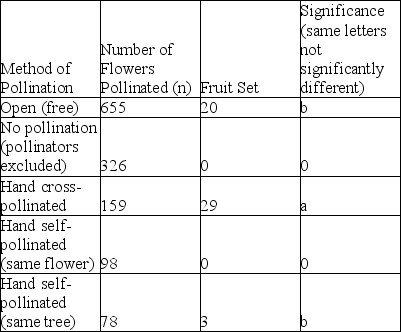
A study was done to test the hypothesis that Brazil nut flowers are self-incompatible. Which set of experiments from the table below suggests that there is genetic variation between flowers on the same tree?
A) pollination exclusion and hand self-pollinated (same flower)
B) open pollinated and hand cross-pollinated
C) open pollinated and hand self-pollinated (same tree)
D) hand self-pollinated (same flower) and hand self-pollinated (same tree)
Https://doi.org/10.1155/2012/978019.
A study was done to test the hypothesis that Brazil nut flowers are self-incompatible. Which set of experiments from the table below suggests that there is genetic variation between flowers on the same tree?
A) pollination exclusion and hand self-pollinated (same flower)
B) open pollinated and hand cross-pollinated
C) open pollinated and hand self-pollinated (same tree)
D) hand self-pollinated (same flower) and hand self-pollinated (same tree)
Question
The table below shows some of the floral characteristics of four different flower species. Which species, A, B, C, or D, is most likely pollinated by a bat?

A) A
B) B
C) C
D) D
A) A
B) B
C) C
D) D
Question
Question
Question
Question
Question
Question
Question
Question
Question
Question
Question
Question
Question
Question
Question
Question
Question
Question
Question
Question
Question
Question
Question
Question
Question
Which of the flowers diagramed below is most likely to be self-compatible? 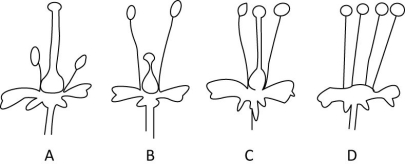
A) A
B) B
C) C
D) D
A) A
B) B
C) C
D) D

Unlock Deck
Sign up to unlock the cards in this deck!
Unlock Deck
Unlock Deck
1/59

Play

Full screen (f)
Deck 38: Reproduction of Flowering Plants
1
Arrange the following structures from largest to smallest, assuming that they belong to two generations of the same angiosperm.
1) ovary
2) ovule
3) egg
4) carpel
5) embryo sac
A) 4, 2, 1, 5, 3
B) 5, 4, 3, 1, 2
C) 5, 1, 4, 2, 3
D) 4, 1, 2, 5, 3
1) ovary
2) ovule
3) egg
4) carpel
5) embryo sac
A) 4, 2, 1, 5, 3
B) 5, 4, 3, 1, 2
C) 5, 1, 4, 2, 3
D) 4, 1, 2, 5, 3
D
2
Which of the following is necessary for a generative cell in a pollen grain to produce two sperm cells?
A) a single mitotic division
B) a single meiotic division
C) two mitotic divisions
D) two meiotic divisions
A) a single mitotic division
B) a single meiotic division
C) two mitotic divisions
D) two meiotic divisions
A
3
Which of the following best describes how sperm cells are formed in plants?
A) meiosis occurs in pollen grains
B) meiosis occurs in anthers
C) mitosis occurs in male gametophyte
D) mitosis occurs in the micropyle
A) meiosis occurs in pollen grains
B) meiosis occurs in anthers
C) mitosis occurs in male gametophyte
D) mitosis occurs in the micropyle
C
4
A summer occupation in maize-growing regions is detasseling the maize: removing unwanted male flowers so that female flowers on the same plant are pollinated by the desired pollen for the hybrid maize. Which of the following best describes maize plant flowers?
A) They have both stamens and carpels and the plant is dioecious.
B) They have both stamens and carpels and the plant is monoecious.
C) They have either stamens or carpels and the plant is dioecious.
D) They have either stamens or carpels and the plant is monoecious.
A) They have both stamens and carpels and the plant is dioecious.
B) They have both stamens and carpels and the plant is monoecious.
C) They have either stamens or carpels and the plant is dioecious.
D) They have either stamens or carpels and the plant is monoecious.
Unlock Deck
Unlock for access to all 59 flashcards in this deck.
Unlock Deck
k this deck
5
Which of the following occurs during the alternation of generations in plants?
A) meiosis produces gametes
B) mitosis produces gametes
C) fertilization produces spores
D) fertilization produces gametes
A) meiosis produces gametes
B) mitosis produces gametes
C) fertilization produces spores
D) fertilization produces gametes
Unlock Deck
Unlock for access to all 59 flashcards in this deck.
Unlock Deck
k this deck
6
Which of the following structures is unique to flowering plants?
A) xylem
B) seeds
C) fruits
D) embryos
A) xylem
B) seeds
C) fruits
D) embryos
Unlock Deck
Unlock for access to all 59 flashcards in this deck.
Unlock Deck
k this deck
7
Which of the following pollinating agents is correctly matched with the type of plant it helps pollinate?
A) birds-smelly flowers
B) bats-colorful flowers
C) wind-grass flowers
D) bees-white flowers
A) birds-smelly flowers
B) bats-colorful flowers
C) wind-grass flowers
D) bees-white flowers
Unlock Deck
Unlock for access to all 59 flashcards in this deck.
Unlock Deck
k this deck
8
How many nuclei are contained in a typical angiosperm embryo sac (female gametophyte)?
A) 2
B) 1
C) 8
D) 4
A) 2
B) 1
C) 8
D) 4
Unlock Deck
Unlock for access to all 59 flashcards in this deck.
Unlock Deck
k this deck
9
Which of the following plant reproductive structures is correctly paired with its life cycle generation?
A) anther-gametophyte
B) pollen-sporophyte
C) ovary-gametophyte
D) stigma-gametophyte
A) anther-gametophyte
B) pollen-sporophyte
C) ovary-gametophyte
D) stigma-gametophyte
Unlock Deck
Unlock for access to all 59 flashcards in this deck.
Unlock Deck
k this deck
10
A hypothetical dye stains sporophyte tissue blue and gametophyte tissue red. What would a researcher most likely observe if a section through the center of a seed was stained with this dye?
A) a pure blue sample
B) a red center surrounded by blue
C) a blue center surrounded by red
D) a blue center, surrounded by red, inside a blue exterior
A) a pure blue sample
B) a red center surrounded by blue
C) a blue center surrounded by red
D) a blue center, surrounded by red, inside a blue exterior
Unlock Deck
Unlock for access to all 59 flashcards in this deck.
Unlock Deck
k this deck
11
In a typical angiosperm, what is the sequence of structures encountered by the tip of a growing pollen tube on its way to the egg?
A) stigma → style → ovary → micropyle
B) stigma → ovary → style → micropyle
C) micropyle→ ovary → stigma → style
D) ovary → style → stigma → micropyle
A) stigma → style → ovary → micropyle
B) stigma → ovary → style → micropyle
C) micropyle→ ovary → stigma → style
D) ovary → style → stigma → micropyle
Unlock Deck
Unlock for access to all 59 flashcards in this deck.
Unlock Deck
k this deck
12
If an ovary contains 50 ovules, what is the minimum number of pollen grains that must land to form 50 mature seeds?
A) 25
B) 50
C) 100
D) 500
A) 25
B) 50
C) 100
D) 500
Unlock Deck
Unlock for access to all 59 flashcards in this deck.
Unlock Deck
k this deck
13
Following meiosis in a typical dicot ovule, a single surviving megaspore divides how many times and how many nuclei are ultimately produced?
A) 2 divisions; 6 nuclei
B) 3 divisions; 8 nuclei
C) 3 divisions; 12 nuclei
D) 4 divisions; 16 nuclei
A) 2 divisions; 6 nuclei
B) 3 divisions; 8 nuclei
C) 3 divisions; 12 nuclei
D) 4 divisions; 16 nuclei
Unlock Deck
Unlock for access to all 59 flashcards in this deck.
Unlock Deck
k this deck
14
Which of the following best describes a selective advantage of retaining the gametophyte within the living sporophyte of land plants?
A) The gametophyte is able to grow much larger than if it was independent.
B) The gametophyte can be raised into the air, exposing it to more light for photosynthesis.
C) Meiosis can now occur in haploid gametophyte cells.
D) Nutrients needed for the gametophyte to produce gametes can be provided by the parent plant.
A) The gametophyte is able to grow much larger than if it was independent.
B) The gametophyte can be raised into the air, exposing it to more light for photosynthesis.
C) Meiosis can now occur in haploid gametophyte cells.
D) Nutrients needed for the gametophyte to produce gametes can be provided by the parent plant.
Unlock Deck
Unlock for access to all 59 flashcards in this deck.
Unlock Deck
k this deck
15
Which of the following is the correct order of floral organs from the outside to the inside of a complete flower?
A) petals → sepals → stamens → carpels
B) sepals → stamens → petals → carpels
C) spores → gametes → zygote → embryo
D) sepals → petals → stamens → carpels
A) petals → sepals → stamens → carpels
B) sepals → stamens → petals → carpels
C) spores → gametes → zygote → embryo
D) sepals → petals → stamens → carpels
Unlock Deck
Unlock for access to all 59 flashcards in this deck.
Unlock Deck
k this deck
16
Which of the following statements regarding flowering plants is correct?
A) The gametophyte is the dominant generation.
B) Female gametophytes develop from megaspores within the anthers.
C) Pollination is the delivery of pollen to the stigma of a carpel.
D) The food-storing endosperm is derived from the cell that contains one polar nucleus and two sperm nuclei.
A) The gametophyte is the dominant generation.
B) Female gametophytes develop from megaspores within the anthers.
C) Pollination is the delivery of pollen to the stigma of a carpel.
D) The food-storing endosperm is derived from the cell that contains one polar nucleus and two sperm nuclei.
Unlock Deck
Unlock for access to all 59 flashcards in this deck.
Unlock Deck
k this deck
17
What is the typical ploidy of endosperm cells in an angiosperm seed?
A) 2n
B) 3n
C) 4n
D) n
A) 2n
B) 3n
C) 4n
D) n
Unlock Deck
Unlock for access to all 59 flashcards in this deck.
Unlock Deck
k this deck
18
Suppose that 100 pollen grains land on a stigma, and 50 mature seeds are formed in the fruit. What does this indicate about the pollination process and success?
A) 100% success: 100 pollen grains grew to 50 ovules, two to each, and double fertilization occurred.
B) 100% success: Only 50% of the pollen grains germinated, but each produced 2 sperms to complete double fertilization in 50 seeds.
C) 50% success: 50 sperm fertilized 50 eggs, and 50 sperm fused with 50 polar nuclei.
D) 50% success: 50 sperm fertilized 50 eggs, and 50 sperm fused with 100 polar nuclei.
A) 100% success: 100 pollen grains grew to 50 ovules, two to each, and double fertilization occurred.
B) 100% success: Only 50% of the pollen grains germinated, but each produced 2 sperms to complete double fertilization in 50 seeds.
C) 50% success: 50 sperm fertilized 50 eggs, and 50 sperm fused with 50 polar nuclei.
D) 50% success: 50 sperm fertilized 50 eggs, and 50 sperm fused with 100 polar nuclei.
Unlock Deck
Unlock for access to all 59 flashcards in this deck.
Unlock Deck
k this deck
19
In which of the following pairs of structures are the two terms equivalent?
A) ovule-egg
B) embryo sac-female gametophyte
C) seed-zygote
D) microspore-pollen grain
A) ovule-egg
B) embryo sac-female gametophyte
C) seed-zygote
D) microspore-pollen grain
Unlock Deck
Unlock for access to all 59 flashcards in this deck.
Unlock Deck
k this deck
20
Which of the following best describes double fertilization in flowering plants?
A) flowers must be pollinated twice to yield both fruits and seeds
B) one sperm fertilizes the egg, and a second sperm fertilizes both polar nuclei
C) the egg of the embryo sac is diploid
D) two sperms are needed to fertilize the egg
A) flowers must be pollinated twice to yield both fruits and seeds
B) one sperm fertilizes the egg, and a second sperm fertilizes both polar nuclei
C) the egg of the embryo sac is diploid
D) two sperms are needed to fertilize the egg
Unlock Deck
Unlock for access to all 59 flashcards in this deck.
Unlock Deck
k this deck
21
A pineapple is composed of fused carpels from multiple flowers. Botanically, a pineapple is which kind of fruit?
A) simple
B) multiple
C) aggregate
D) accessory
A) simple
B) multiple
C) aggregate
D) accessory
Unlock Deck
Unlock for access to all 59 flashcards in this deck.
Unlock Deck
k this deck
22
Based on the table below, which species has fruits adapted for dispersal by fruit-eating animals (frugivores)?
A) A
B) B
C) C
D) D
A) A
B) B
C) C
D) D
Unlock Deck
Unlock for access to all 59 flashcards in this deck.
Unlock Deck
k this deck
23
Which of the following flower parts develops into the pulp of a fleshy fruit?
A) stigma
B) style
C) ovule
D) ovary
A) stigma
B) style
C) ovule
D) ovary
Unlock Deck
Unlock for access to all 59 flashcards in this deck.
Unlock Deck
k this deck
24
If the egg of a plant has a haploid chromosome number of 12 (n = 12)which of the following statements is true about the number of chromosomes in the cells of other tissues of this plant?
A) The sperm has 6 chromosomes.
B) The leaves and stems have 12 chromosomes.
C) The zygote has 12 chromosomes.
D) The endosperm has 36 chromosomes.
A) The sperm has 6 chromosomes.
B) The leaves and stems have 12 chromosomes.
C) The zygote has 12 chromosomes.
D) The endosperm has 36 chromosomes.
Unlock Deck
Unlock for access to all 59 flashcards in this deck.
Unlock Deck
k this deck
25
Which of the following flower parts develops into a seed?
A) ovule
B) ovary
C) stamen
D) carpel
A) ovule
B) ovary
C) stamen
D) carpel
Unlock Deck
Unlock for access to all 59 flashcards in this deck.
Unlock Deck
k this deck
26
In many fruits it is commonly observed that some ovules become mature seeds, whereas other ovules do not. Which of the following conclusion(s) is/are supported by this observation?
A) The flowers that gave rise to such fruits were not pollinated.
B) Pollen tubes did not enter all of the ovules in such fruits.
C) There was apparently not enough endosperm to distribute to all of the ovules in such pods.
D) The ovules that failed to develop into seeds were derived from sterile floral parts.
A) The flowers that gave rise to such fruits were not pollinated.
B) Pollen tubes did not enter all of the ovules in such fruits.
C) There was apparently not enough endosperm to distribute to all of the ovules in such pods.
D) The ovules that failed to develop into seeds were derived from sterile floral parts.
Unlock Deck
Unlock for access to all 59 flashcards in this deck.
Unlock Deck
k this deck
27
Which of the following is a true statement about asexual reproduction in plants?
A) Asexual clones of plants do not occur naturally.
B) Cloning, although achieved in animals, has not been demonstrated in plants.
C) Making cuttings of ornamental plants is a form of fragmentation.
D) Asexual reproduction is more common than sexual reproduction in flowering plants.
A) Asexual clones of plants do not occur naturally.
B) Cloning, although achieved in animals, has not been demonstrated in plants.
C) Making cuttings of ornamental plants is a form of fragmentation.
D) Asexual reproduction is more common than sexual reproduction in flowering plants.
Unlock Deck
Unlock for access to all 59 flashcards in this deck.
Unlock Deck
k this deck
28
Asexual reproduction can produce offspring more quickly than sexual reproduction; yet most plants reproduce sexually in nature. Which of the following best explains why sexual reproduction is more prevalent?
A) it is more energy efficient than asexual reproduction
B) it ensures genetic continuity from parents to offspring
C) it recombines alleles, contributing to variation in a species
D) it does not depend on other agents for pollination
A) it is more energy efficient than asexual reproduction
B) it ensures genetic continuity from parents to offspring
C) it recombines alleles, contributing to variation in a species
D) it does not depend on other agents for pollination
Unlock Deck
Unlock for access to all 59 flashcards in this deck.
Unlock Deck
k this deck
29
Early in the spring, a gardener's bare plot was weed free. Three days after turning over the soil, she was amazed to see dozens of tiny weed seedlings. Which answer gives the most likely reason these weeds germinated?
A) Their large seeds needed soil disturbance to germinate.
B) Their small seeds needed light to germinate.
C) Their large seeds were physically scarified by her shovel or rake.
D) Their small seeds needed exposure to higher levels of oxygen to germinate.
A) Their large seeds needed soil disturbance to germinate.
B) Their small seeds needed light to germinate.
C) Their large seeds were physically scarified by her shovel or rake.
D) Their small seeds needed exposure to higher levels of oxygen to germinate.
Unlock Deck
Unlock for access to all 59 flashcards in this deck.
Unlock Deck
k this deck
30
Cottonwood, aspen, willow trees are dioecious and have flowers without petals that appear before the leaves are out in the spring. Based on these observations, what is their likely pollination strategy?
A) Each species has its own specific insect pollinator.
B) Early emerging insects cross pollinate these species.
C) Their pollen is randomly dispersed by wind.
D) These species are self-pollinating.
A) Each species has its own specific insect pollinator.
B) Early emerging insects cross pollinate these species.
C) Their pollen is randomly dispersed by wind.
D) These species are self-pollinating.
Unlock Deck
Unlock for access to all 59 flashcards in this deck.
Unlock Deck
k this deck
31
In plant biotechnology, if a new plant is grown from a single cell, the original cell must be which of the following?
A) photosynthetic
B) a clone
C) totipotent
D) sclerenchyma
A) photosynthetic
B) a clone
C) totipotent
D) sclerenchyma
Unlock Deck
Unlock for access to all 59 flashcards in this deck.
Unlock Deck
k this deck
32
The Brazil nut tree, Bertholletia excelsa is a tall tropical tree with pale yellow flowers that cannot fertilize themselves. Which of the following is the most likely pollinator?
A) bees
B) wind
C) birds
D) squirrels
A) bees
B) wind
C) birds
D) squirrels
Unlock Deck
Unlock for access to all 59 flashcards in this deck.
Unlock Deck
k this deck
33
The following question is based on information from M. C. Cavalcante et al., Pollination requirements and the foraging behavior of potential pollinators of cultivated Brazil nut (Bertholletia excelsa Bonpl.) trees in central Amazon rainforest, Psyche 2012, article ID 978019, 9 pages (2012).
Https://doi.org/10.1155/2012/978019.
A study was done to test the hypothesis that Brazil nut flowers are self-incompatible. Which set of experiments from the table below suggests that there is genetic variation between flowers on the same tree?
A) pollination exclusion and hand self-pollinated (same flower)
B) open pollinated and hand cross-pollinated
C) open pollinated and hand self-pollinated (same tree)
D) hand self-pollinated (same flower) and hand self-pollinated (same tree)
Https://doi.org/10.1155/2012/978019.
A study was done to test the hypothesis that Brazil nut flowers are self-incompatible. Which set of experiments from the table below suggests that there is genetic variation between flowers on the same tree?
A) pollination exclusion and hand self-pollinated (same flower)
B) open pollinated and hand cross-pollinated
C) open pollinated and hand self-pollinated (same tree)
D) hand self-pollinated (same flower) and hand self-pollinated (same tree)
Unlock Deck
Unlock for access to all 59 flashcards in this deck.
Unlock Deck
k this deck
34
The table below shows some of the floral characteristics of four different flower species. Which species, A, B, C, or D, is most likely pollinated by a bat?
A) A
B) B
C) C
D) D
A) A
B) B
C) C
D) D
Unlock Deck
Unlock for access to all 59 flashcards in this deck.
Unlock Deck
k this deck
35
Which of the following statements about fruit ripening is an example of positive feedback?
A) Chemical signals increase enzymatic activity in fruit to convert sugars into starches, thicken pulp, and maintain color in the fruit.
B) Once seeds reach maturity, chemical signals block enzymatic steps that normally convert sugars into starches, and sugars accumulate from photosynthetic activity within the fruit.
C) Chemical signals stimulate enzymatic activities that convert starches into sugars, soften fruit pulp, and produce more chemical signals.
D) Chemical signals shut down enzymatic activities that convert starches into sugars, soften fruit pulp, and color change of fruit.
A) Chemical signals increase enzymatic activity in fruit to convert sugars into starches, thicken pulp, and maintain color in the fruit.
B) Once seeds reach maturity, chemical signals block enzymatic steps that normally convert sugars into starches, and sugars accumulate from photosynthetic activity within the fruit.
C) Chemical signals stimulate enzymatic activities that convert starches into sugars, soften fruit pulp, and produce more chemical signals.
D) Chemical signals shut down enzymatic activities that convert starches into sugars, soften fruit pulp, and color change of fruit.
Unlock Deck
Unlock for access to all 59 flashcards in this deck.
Unlock Deck
k this deck
36
The Brazil nut tree, Bertholletia excelsa (2n = 34) produces tough-walled fruits, each containing 8-25 seeds (Brazil nuts). When you eat a Brazil nut, which is composed primarily of endosperm, how many chromosomes are in most of the cells you are eating?
A) 17
B) 34
C) 51
D) both B and C
A) 17
B) 34
C) 51
D) both B and C
Unlock Deck
Unlock for access to all 59 flashcards in this deck.
Unlock Deck
k this deck
37
During pollination, multiple pollen grains are delivered to the stigma. Which of the following phenotype traits provides the greatest selective advantage for successful fertilization?
A) high pollen tube growth rate and ability to detect chemicals from synergid cells surrounding the egg
B) high rate of mitosis in the growing pollen tube
C) elaborate and striking UV "nectary guides" on the petals to guide an insect to the stigma
D) Pollen grain with large generative cell to provide enough cytoplasm for pollen tube growth
A) high pollen tube growth rate and ability to detect chemicals from synergid cells surrounding the egg
B) high rate of mitosis in the growing pollen tube
C) elaborate and striking UV "nectary guides" on the petals to guide an insect to the stigma
D) Pollen grain with large generative cell to provide enough cytoplasm for pollen tube growth
Unlock Deck
Unlock for access to all 59 flashcards in this deck.
Unlock Deck
k this deck
38
Which of the following could be considered an evolutionary advantage of asexual reproduction in plants?
A) increased success of progeny in a stable environment
B) increased agricultural productivity in a rapidly changing environment
C) maintenance and expansion of a large genome
D) increased ability to adapt to a change in the environment
A) increased success of progeny in a stable environment
B) increased agricultural productivity in a rapidly changing environment
C) maintenance and expansion of a large genome
D) increased ability to adapt to a change in the environment
Unlock Deck
Unlock for access to all 59 flashcards in this deck.
Unlock Deck
k this deck
39
Which of these processes occurs earliest when seed germination begins?
A) Cell division occurs in the embryo as dormancy is broken.
B) Mitochondria multiply in the endosperm and provide energy for growth processes.
C) Water is taken up by cells of the seed coat.
D) Oxygen is produced and proteins are synthesized by the endosperm.
A) Cell division occurs in the embryo as dormancy is broken.
B) Mitochondria multiply in the endosperm and provide energy for growth processes.
C) Water is taken up by cells of the seed coat.
D) Oxygen is produced and proteins are synthesized by the endosperm.
Unlock Deck
Unlock for access to all 59 flashcards in this deck.
Unlock Deck
k this deck
40
The vast number and variety of flowering plant species is probably related to which of the following?
A) soils
B) pollinators
C) herbivores
D) climatic conditions
A) soils
B) pollinators
C) herbivores
D) climatic conditions
Unlock Deck
Unlock for access to all 59 flashcards in this deck.
Unlock Deck
k this deck
41
Some plant species produce male and female individuals in which the males have an XY genotype and the females have an XX genotype. After double fertilization, what would be the genotypes of the embryos and endosperm nuclei?
A) embryo XY/endosperm XXX or embryo XX/endosperm XXY
B) embryo XX/endosperm XX or embryo XY/endosperm XY
C) embryo XX/endosperm XXX or embryo XY/endosperm XYY
D) embryo XX/endosperm XXX or embryo XY/endosperm XXY
A) embryo XY/endosperm XXX or embryo XX/endosperm XXY
B) embryo XX/endosperm XX or embryo XY/endosperm XY
C) embryo XX/endosperm XXX or embryo XY/endosperm XYY
D) embryo XX/endosperm XXX or embryo XY/endosperm XXY
Unlock Deck
Unlock for access to all 59 flashcards in this deck.
Unlock Deck
k this deck
42
Farmers traditionally kept some of the seeds from their best plants in one season to plant the following year. Now that farmers mostly plant hybrid seed this practice is no longer effective because ________.
A) hybrid seed is homozygous, so it is not self-fertile
B) hybrid plants are bred to be incompatible
C) hybrid seeds are heterozygous and not true-breeding
D) hybrid plants are genetically engineered and could be harmful if used for new seed
A) hybrid seed is homozygous, so it is not self-fertile
B) hybrid plants are bred to be incompatible
C) hybrid seeds are heterozygous and not true-breeding
D) hybrid plants are genetically engineered and could be harmful if used for new seed
Unlock Deck
Unlock for access to all 59 flashcards in this deck.
Unlock Deck
k this deck
43
Which of the following is the best argument for pursuing plant biotechnology?
A) Genetically modified (GM) plants can provide greater plant productivity on the same amount of land.
B) GM plants can reduce reliance on imported oil.
C) Genetic engineering can decrease genetic diversity of crop plants making them more fit for their environment.
D) Genetic engineering can make it easier to overcome pollination incompatibility.
A) Genetically modified (GM) plants can provide greater plant productivity on the same amount of land.
B) GM plants can reduce reliance on imported oil.
C) Genetic engineering can decrease genetic diversity of crop plants making them more fit for their environment.
D) Genetic engineering can make it easier to overcome pollination incompatibility.
Unlock Deck
Unlock for access to all 59 flashcards in this deck.
Unlock Deck
k this deck
44
Which statement concerning grafting is correct?
A) Stocks and scions refer to twigs of different species.
B) Stocks and scions must come from unrelated species.
C) Stocks provide root systems for grafting.
D) Grafting creates new species.
A) Stocks and scions refer to twigs of different species.
B) Stocks and scions must come from unrelated species.
C) Stocks provide root systems for grafting.
D) Grafting creates new species.
Unlock Deck
Unlock for access to all 59 flashcards in this deck.
Unlock Deck
k this deck
45
Double fertilization means that ________.
A) flowers must be pollinated twice to yield fruits and seeds
B) every egg must receive two sperm to produce an embryo
C) one sperm is needed to fertilize the egg, and a second sperm is needed to fertilize the polar nuclei
D) every sperm has two nuclei
A) flowers must be pollinated twice to yield fruits and seeds
B) every egg must receive two sperm to produce an embryo
C) one sperm is needed to fertilize the egg, and a second sperm is needed to fertilize the polar nuclei
D) every sperm has two nuclei
Unlock Deck
Unlock for access to all 59 flashcards in this deck.
Unlock Deck
k this deck
46
A fruit is ________.
A) a mature ovary
B) a mature ovule
C) a seed plus its integuments
D) an enlarged embryo sac
A) a mature ovary
B) a mature ovule
C) a seed plus its integuments
D) an enlarged embryo sac
Unlock Deck
Unlock for access to all 59 flashcards in this deck.
Unlock Deck
k this deck
47
Which of the following is a potential advantage of introducing apomixis into hybrid crop species?
A) Cultivars would be better able to cope with a rapidly changing environment.
B) They would have a larger potential genome than inbred crops.
C) All of the desirable traits of the cultivar would be passed on to offspring.
D) They would benefit from positive mutations in their DNA.
A) Cultivars would be better able to cope with a rapidly changing environment.
B) They would have a larger potential genome than inbred crops.
C) All of the desirable traits of the cultivar would be passed on to offspring.
D) They would benefit from positive mutations in their DNA.
Unlock Deck
Unlock for access to all 59 flashcards in this deck.
Unlock Deck
k this deck
48
In a species showing sporophytic incompatibility, which type(s) of pollen could successfully fertilize an S2S3 flower?
A) S1 pollen from an S1S3 flower
B) S2 or S3 pollen from an S2S3 flower
C) S3 pollen from an S1S1 flower
D) S1 pollen from an S1S1 flower
A) S1 pollen from an S1S3 flower
B) S2 or S3 pollen from an S2S3 flower
C) S3 pollen from an S1S1 flower
D) S1 pollen from an S1S1 flower
Unlock Deck
Unlock for access to all 59 flashcards in this deck.
Unlock Deck
k this deck
49
Which of the following are potential benefits of producing genetically modified crops?
I) create crops that can grow on land previously unsuitable for agriculture
II) create crops with better potential for biofuel production
III) create crops with better nutritional attributes
IV) increase crop yield
A) III only
B) III and IV only
C) II III and IV only
D) I, II, III, and IV
I) create crops that can grow on land previously unsuitable for agriculture
II) create crops with better potential for biofuel production
III) create crops with better nutritional attributes
IV) increase crop yield
A) III only
B) III and IV only
C) II III and IV only
D) I, II, III, and IV
Unlock Deck
Unlock for access to all 59 flashcards in this deck.
Unlock Deck
k this deck
50
Over human history, which process has been most important in improving the features of plants that have long been used by humans as staple foods?
A) genetic engineering
B) artificial selection
C) sexual selection
D) pesticide and herbicide application
A) genetic engineering
B) artificial selection
C) sexual selection
D) pesticide and herbicide application
Unlock Deck
Unlock for access to all 59 flashcards in this deck.
Unlock Deck
k this deck
51
The black dots that cover strawberries are actually fruits formed from the separate carpels of a single flower. The fleshy and tasty portion of a strawberry derives from the receptacle of a flower with many separate carpels. Therefore, a strawberry is ________.
A) a simple fruit with many seeds
B) both a multiple fruit and an accessory fruit
C) both a simple fruit and an aggregate fruit
D) both an aggregate fruit and an accessory fruit
A) a simple fruit with many seeds
B) both a multiple fruit and an accessory fruit
C) both a simple fruit and an aggregate fruit
D) both an aggregate fruit and an accessory fruit
Unlock Deck
Unlock for access to all 59 flashcards in this deck.
Unlock Deck
k this deck
52
"Golden Rice" is a GM crop designed to enhance which of the following traits?
A) increase resistance to various herbicides, making it practical to weed rice fields with those herbicides
B) produce a toxin that reduces damage from insect pests
C) produce larger grains that increase crop yields and profits
D) increase vitamin A content, a common dietary deficiency in developing countries
A) increase resistance to various herbicides, making it practical to weed rice fields with those herbicides
B) produce a toxin that reduces damage from insect pests
C) produce larger grains that increase crop yields and profits
D) increase vitamin A content, a common dietary deficiency in developing countries
Unlock Deck
Unlock for access to all 59 flashcards in this deck.
Unlock Deck
k this deck
53
Resistance to the herbicide Roundup™ is one of the earliest, and most common, traits engineered into crop plants. Which of the following best explains how many common weeds are becoming Roundup™ resistant?
A) Extensive use of Roundup™ is driving natural selection for resistance in weeds.
B) Roundup™ resistance is spreading from genetically modified crops to weedy species.
C) Male sterility in not effective in genetically modified plants that can pollinate weed species.
D) weedy species are less stable than crop plants and develop resistance in response to Roundup™ application.
A) Extensive use of Roundup™ is driving natural selection for resistance in weeds.
B) Roundup™ resistance is spreading from genetically modified crops to weedy species.
C) Male sterility in not effective in genetically modified plants that can pollinate weed species.
D) weedy species are less stable than crop plants and develop resistance in response to Roundup™ application.
Unlock Deck
Unlock for access to all 59 flashcards in this deck.
Unlock Deck
k this deck
54
Which of the following types of flowers are incapable of self-pollination?
A) flowers lacking petals
B) flowers lacking anthers
C) wind-pollinated flowers
D) insect-pollinated flowers
A) flowers lacking petals
B) flowers lacking anthers
C) wind-pollinated flowers
D) insect-pollinated flowers
Unlock Deck
Unlock for access to all 59 flashcards in this deck.
Unlock Deck
k this deck
55
Which of the following is the strongest environmental argument against the introduction of genetically modified crops?
A) Lateral transfer of genes between species does not occur naturally.
B) Transgenic crops can no longer reproduce sexually and would go extinct in nature.
C) The pollen of genetically modified flowers would be sterile.
D) Transgenic crops hybridize with related native species, allowing modified traits to spread in the wild.
A) Lateral transfer of genes between species does not occur naturally.
B) Transgenic crops can no longer reproduce sexually and would go extinct in nature.
C) The pollen of genetically modified flowers would be sterile.
D) Transgenic crops hybridize with related native species, allowing modified traits to spread in the wild.
Unlock Deck
Unlock for access to all 59 flashcards in this deck.
Unlock Deck
k this deck
56
Which of these human activities is not part of the development of crop plants from wild relatives?
A) observing variation in the characteristics of plants
B) selecting seeds from the most desirable plants to plant the next year
C) eating products from only the plants with desired characteristics
D) hybridization between different, but related, species
A) observing variation in the characteristics of plants
B) selecting seeds from the most desirable plants to plant the next year
C) eating products from only the plants with desired characteristics
D) hybridization between different, but related, species
Unlock Deck
Unlock for access to all 59 flashcards in this deck.
Unlock Deck
k this deck
57
Bt maize ________.
A) is resistant to various herbicides, making it practical to weed maize fields with those herbicides
B) contains transgenes that increase vitamin A content
C) includes bacterial genes that produce a toxin that reduces damage from insect pests
D) is a "boron (B)-tolerant" transgenic variety of maize
A) is resistant to various herbicides, making it practical to weed maize fields with those herbicides
B) contains transgenes that increase vitamin A content
C) includes bacterial genes that produce a toxin that reduces damage from insect pests
D) is a "boron (B)-tolerant" transgenic variety of maize
Unlock Deck
Unlock for access to all 59 flashcards in this deck.
Unlock Deck
k this deck
58
If pollen from a plant with the S1S2 genotype is recognized and allowed to germinate on the stigma of the same plant with the S1S2 genotype, the plant is mostly likely ________.
A) self-compatible and can self-pollinate
B) self-compatible and must cross-pollinate
C) self-incompatible and can self-pollinate
D) self-incompatible and must cross-pollinate
A) self-compatible and can self-pollinate
B) self-compatible and must cross-pollinate
C) self-incompatible and can self-pollinate
D) self-incompatible and must cross-pollinate
Unlock Deck
Unlock for access to all 59 flashcards in this deck.
Unlock Deck
k this deck
59
Which of the flowers diagramed below is most likely to be self-compatible?
A) A
B) B
C) C
D) D
A) A
B) B
C) C
D) D
Unlock Deck
Unlock for access to all 59 flashcards in this deck.
Unlock Deck
k this deck
Unlock Deck
Unlock for access to all 59 flashcards in this deck.






