







 Chat with AI

Deck 32: The Deuterostomes
Full screen (f)

Question

Question
Question
Question
Figure 32-1
Use the figure to answer the corresponding question(s).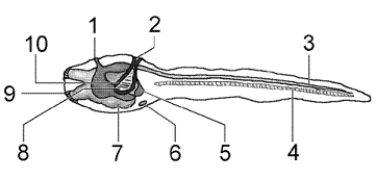
Lancelets are:
A) carnivores.
B) filter feeders.
C) parasites.
D) herbivores.
E) algae feeders.
Use the figure to answer the corresponding question(s).
Lancelets are:
A) carnivores.
B) filter feeders.
C) parasites.
D) herbivores.
E) algae feeders.
Question
Question
Figure 32-1
Use the figure to answer the corresponding question(s).
The structure in Figure 32-1 labeled __________ is characteristic of the phylum to which this organism belongs.
A) 9
B) 6
C) 5
D) 4
E) 10
Use the figure to answer the corresponding question(s).
The structure in Figure 32-1 labeled __________ is characteristic of the phylum to which this organism belongs.
A) 9
B) 6
C) 5
D) 4
E) 10
Question
Question
Question
Question
Question
Figure 32-1
Use the figure to answer the corresponding question(s).
The organism in Figure 32-1 is a representative of:
A) the phylum Hemichordata.
B) the phylum Echinodermata.
C) the phylum Chordata.
D) the subphylum Urochordata.
E) the subphylum Cephalochordata.
Use the figure to answer the corresponding question(s).
The organism in Figure 32-1 is a representative of:
A) the phylum Hemichordata.
B) the phylum Echinodermata.
C) the phylum Chordata.
D) the subphylum Urochordata.
E) the subphylum Cephalochordata.
Question
Question
Figure 32-1
Use the figure to answer the corresponding question(s).
Adult tunicates resemble __________ and are __________.
A) eels; carnivorous.
B) corals; photosynthetic
C) starfish; carnivorous
D) sponges; filter feeders
E) earthworms; detritivores
Use the figure to answer the corresponding question(s).
Adult tunicates resemble __________ and are __________.
A) eels; carnivorous.
B) corals; photosynthetic
C) starfish; carnivorous
D) sponges; filter feeders
E) earthworms; detritivores
Question
Question
Question
Question
Question
Question
Question
Question
Question
Question
Question
Question
Question
Question
Question
Question
Question
Question
Question
Question
Question
Question
Question
Question
Question
Question
Question
Question
Question
Question
Question
Question
Question
Question
Question
Question
Question
Question
Question
Question
Question
Question
Question
Question
Question
Question
Question
Question
Question
Question
Question
Question
Question
Question
Question
Question
Question
Question
Question
Question
Question
Question
Question
Question
Question
Question
Question

Unlock Deck
Sign up to unlock the cards in this deck!
Unlock Deck
Unlock Deck
1/90

Play

Full screen (f)
Deck 32: The Deuterostomes
1
One characteristic of the class Holothuroidea is:
A) that most are predators that consume partially digested prey.
B) that most of the species are extinct.
C) that they have a reduced endoskeleton consisting of microscopic plates embedded in the body wall.
D) that moveable spines are used to facilitate locomotion.
E) that they have a distinct central disk with very long, slender arms.
A) that most are predators that consume partially digested prey.
B) that most of the species are extinct.
C) that they have a reduced endoskeleton consisting of microscopic plates embedded in the body wall.
D) that moveable spines are used to facilitate locomotion.
E) that they have a distinct central disk with very long, slender arms.
C
2
The most unique feature of the echinoderms is their:
A) digestive system.
B) nervous system.
C) closed circulatory system.
D) water vascular system.
E) mantle.
A) digestive system.
B) nervous system.
C) closed circulatory system.
D) water vascular system.
E) mantle.
D
3
Which class of echinoderms has the greatest species diversity?
A) Asteroidea
B) Holothuroidea
C) Ophiuroidea
D) Echinoidea
E) Crinoidea
A) Asteroidea
B) Holothuroidea
C) Ophiuroidea
D) Echinoidea
E) Crinoidea
C
4
Figure 32-1
Use the figure to answer the corresponding question(s).
Lancelets are:
A) carnivores.
B) filter feeders.
C) parasites.
D) herbivores.
E) algae feeders.
Use the figure to answer the corresponding question(s).
Lancelets are:
A) carnivores.
B) filter feeders.
C) parasites.
D) herbivores.
E) algae feeders.
Unlock Deck
Unlock for access to all 90 flashcards in this deck.
Unlock Deck
k this deck
5
Which of the following statements about tunicates is false?
A) Tunicates are in subphylum Cephalochordata.
B) Tunicates are in phylum Chordata.
C) Tunicates are freshwater organisms.
D) Tunicates develop as deuterostomes.
E) Tunicates are a living chordate group.
A) Tunicates are in subphylum Cephalochordata.
B) Tunicates are in phylum Chordata.
C) Tunicates are freshwater organisms.
D) Tunicates develop as deuterostomes.
E) Tunicates are a living chordate group.
Unlock Deck
Unlock for access to all 90 flashcards in this deck.
Unlock Deck
k this deck
6
Figure 32-1
Use the figure to answer the corresponding question(s).
The structure in Figure 32-1 labeled __________ is characteristic of the phylum to which this organism belongs.
A) 9
B) 6
C) 5
D) 4
E) 10
Use the figure to answer the corresponding question(s).
The structure in Figure 32-1 labeled __________ is characteristic of the phylum to which this organism belongs.
A) 9
B) 6
C) 5
D) 4
E) 10
Unlock Deck
Unlock for access to all 90 flashcards in this deck.
Unlock Deck
k this deck
7
Which of the following is not a characteristic shared by all chordates at some point in their life cycle?
A) possession of a coelom
B) three primary cell layers
C) dorsal tubular nerve cord
D) pharyngeal gill slits
E) vertebrae
A) possession of a coelom
B) three primary cell layers
C) dorsal tubular nerve cord
D) pharyngeal gill slits
E) vertebrae
Unlock Deck
Unlock for access to all 90 flashcards in this deck.
Unlock Deck
k this deck
8
All Echinodermata are found:
A) in marine habitats.
B) in freshwater.
C) on land.
D) on the bottom of the ocean or lakes.
E) in shallow ocean waters.
A) in marine habitats.
B) in freshwater.
C) on land.
D) on the bottom of the ocean or lakes.
E) in shallow ocean waters.
Unlock Deck
Unlock for access to all 90 flashcards in this deck.
Unlock Deck
k this deck
9
Echinoderms are unique because:
A) the larvae are radially symmetrical and the adult is bilaterally symmetrical.
B) the adults and larva are both pentaradially symmetrical.
C) the adult and larva are both radially symmetrical.
D) the adult and larva are both biradially symmetrical.
E) their larvae are bilaterally symmetrical while the adult is pentaradially symmetrical.
A) the larvae are radially symmetrical and the adult is bilaterally symmetrical.
B) the adults and larva are both pentaradially symmetrical.
C) the adult and larva are both radially symmetrical.
D) the adult and larva are both biradially symmetrical.
E) their larvae are bilaterally symmetrical while the adult is pentaradially symmetrical.
Unlock Deck
Unlock for access to all 90 flashcards in this deck.
Unlock Deck
k this deck
10
Urochordates are odd chordates, as typically only the __________ shows the basic chordate characteristics.
A) head end
B) tail end
C) adult
D) larva
E) egg
A) head end
B) tail end
C) adult
D) larva
E) egg
Unlock Deck
Unlock for access to all 90 flashcards in this deck.
Unlock Deck
k this deck
11
Figure 32-1
Use the figure to answer the corresponding question(s).
The organism in Figure 32-1 is a representative of:
A) the phylum Hemichordata.
B) the phylum Echinodermata.
C) the phylum Chordata.
D) the subphylum Urochordata.
E) the subphylum Cephalochordata.
Use the figure to answer the corresponding question(s).
The organism in Figure 32-1 is a representative of:
A) the phylum Hemichordata.
B) the phylum Echinodermata.
C) the phylum Chordata.
D) the subphylum Urochordata.
E) the subphylum Cephalochordata.
Unlock Deck
Unlock for access to all 90 flashcards in this deck.
Unlock Deck
k this deck
12
Sea cucumbers will __________ when environmental conditions deteriorate.
A) eject their digestive tract, respiratory structures, and gonads.
B) crawl to an area with more favorable conditions.
C) form a resistant spore.
D) float to the surface and then later drop to a more favorable location.
E) crawl deep into the ocean mud on the bottom.
A) eject their digestive tract, respiratory structures, and gonads.
B) crawl to an area with more favorable conditions.
C) form a resistant spore.
D) float to the surface and then later drop to a more favorable location.
E) crawl deep into the ocean mud on the bottom.
Unlock Deck
Unlock for access to all 90 flashcards in this deck.
Unlock Deck
k this deck
13
Figure 32-1
Use the figure to answer the corresponding question(s).
Adult tunicates resemble __________ and are __________.
A) eels; carnivorous.
B) corals; photosynthetic
C) starfish; carnivorous
D) sponges; filter feeders
E) earthworms; detritivores
Use the figure to answer the corresponding question(s).
Adult tunicates resemble __________ and are __________.
A) eels; carnivorous.
B) corals; photosynthetic
C) starfish; carnivorous
D) sponges; filter feeders
E) earthworms; detritivores
Unlock Deck
Unlock for access to all 90 flashcards in this deck.
Unlock Deck
k this deck
14
Echinoderms are unusual invertebrates as they have all of the following except:
A) an endoskeleton.
B) pentaradial symmetry.
C) a water vascular system.
D) pedicellariae present in some classes.
E) small disc-shaped flat bodies.
A) an endoskeleton.
B) pentaradial symmetry.
C) a water vascular system.
D) pedicellariae present in some classes.
E) small disc-shaped flat bodies.
Unlock Deck
Unlock for access to all 90 flashcards in this deck.
Unlock Deck
k this deck
15
Deuterostomes are characterized by __________ and __________ cleavage.
A) radial; determinate
B) radial; indeterminate
C) spiral; determinate
D) spiral; indeterminate
E) blastopore;synapomorphy
A) radial; determinate
B) radial; indeterminate
C) spiral; determinate
D) spiral; indeterminate
E) blastopore;synapomorphy
Unlock Deck
Unlock for access to all 90 flashcards in this deck.
Unlock Deck
k this deck
16
Class __________ includes mostly extinct species and a few current species such as feather stars and sea lilies.
A) Asteroidea
B) Holothuroidea
C) Ophiuroidea
D) Echinoidea
E) Crinoidea
A) Asteroidea
B) Holothuroidea
C) Ophiuroidea
D) Echinoidea
E) Crinoidea
Unlock Deck
Unlock for access to all 90 flashcards in this deck.
Unlock Deck
k this deck
17
Sea stars eat:
A) large fish.
B) mostly algae.
C) sea weed.
D) mostly crustaceans and mollusks.
E) debris on the bottom.
A) large fish.
B) mostly algae.
C) sea weed.
D) mostly crustaceans and mollusks.
E) debris on the bottom.
Unlock Deck
Unlock for access to all 90 flashcards in this deck.
Unlock Deck
k this deck
18
Deuterostomes evolved during the:
A) Cambrian.
B) Proterozoic.
C) Paleozoic.
D) Cenozoic.
E) Devonian.
A) Cambrian.
B) Proterozoic.
C) Paleozoic.
D) Cenozoic.
E) Devonian.
Unlock Deck
Unlock for access to all 90 flashcards in this deck.
Unlock Deck
k this deck
19
Prominent spines are found on __________ of the phylum Echinodermata.
A) Ophiuroidea
B) Echinoidea
C) Asteroidea
D) Concentricycloidea
E) Holothuroidea
A) Ophiuroidea
B) Echinoidea
C) Asteroidea
D) Concentricycloidea
E) Holothuroidea
Unlock Deck
Unlock for access to all 90 flashcards in this deck.
Unlock Deck
k this deck
20
Sea stars are primarily:
A) herbivores.
B) omnivores.
C) carnivores.
D) detritivores.
E) saprophytes.
A) herbivores.
B) omnivores.
C) carnivores.
D) detritivores.
E) saprophytes.
Unlock Deck
Unlock for access to all 90 flashcards in this deck.
Unlock Deck
k this deck
21
A fish with a cartilaginous skeleton and paired fins would be:
A) an Actinopterygian.
B) a Crinoid.
C) a Cephalochordate.
D) a Urochordate.
E) a Chondrichthyean.
A) an Actinopterygian.
B) a Crinoid.
C) a Cephalochordate.
D) a Urochordate.
E) a Chondrichthyean.
Unlock Deck
Unlock for access to all 90 flashcards in this deck.
Unlock Deck
k this deck
22
The neural crest cells of vertebrates influence the development of all of the following except the:
A) lungs.
B) nerves.
C) cranium.
D) jaws.
E) head muscles.
A) lungs.
B) nerves.
C) cranium.
D) jaws.
E) head muscles.
Unlock Deck
Unlock for access to all 90 flashcards in this deck.
Unlock Deck
k this deck
23
In which group did lungs first evolve?
A) cartilagineous fish
B) ray finned fish
C) lampreys
D) coelacanths
E) lungfish
A) cartilagineous fish
B) ray finned fish
C) lampreys
D) coelacanths
E) lungfish
Unlock Deck
Unlock for access to all 90 flashcards in this deck.
Unlock Deck
k this deck
24
Sharks may detect their prey using all of the following except:
A) olfaction.
B) their lateral lines.
C) electroreceptors.
D) sight.
E) hearing.
A) olfaction.
B) their lateral lines.
C) electroreceptors.
D) sight.
E) hearing.
Unlock Deck
Unlock for access to all 90 flashcards in this deck.
Unlock Deck
k this deck
25
Which chordate group has the most species?
A) bony fishes
B) reptiles
C) amphibians
D) mammals
E) cartilaginous fishes
A) bony fishes
B) reptiles
C) amphibians
D) mammals
E) cartilaginous fishes
Unlock Deck
Unlock for access to all 90 flashcards in this deck.
Unlock Deck
k this deck
26
Which of the following terms can be applied to both monotremes and sharks?
A) oviparous
B) viviparous
C) ovoviviparous
D) placental
E) eutherial
A) oviparous
B) viviparous
C) ovoviviparous
D) placental
E) eutherial
Unlock Deck
Unlock for access to all 90 flashcards in this deck.
Unlock Deck
k this deck
27
Sharks detect motion in the water or waves by their:
A) lateral lines.
B) electroreceptors.
C) keen olfaction.
D) sight.
E) dorsal fin.
A) lateral lines.
B) electroreceptors.
C) keen olfaction.
D) sight.
E) dorsal fin.
Unlock Deck
Unlock for access to all 90 flashcards in this deck.
Unlock Deck
k this deck
28
Extinct jawless fish include the:
A) lungfish.
B) lancelets.
C) placoderms.
D) acanthodians.
E) ostracoderms.
A) lungfish.
B) lancelets.
C) placoderms.
D) acanthodians.
E) ostracoderms.
Unlock Deck
Unlock for access to all 90 flashcards in this deck.
Unlock Deck
k this deck
29
Placoid scales are found on:
A) lungfish.
B) sharks.
C) ray-finned fish.
D) lob-finned.
E) snakes.
A) lungfish.
B) sharks.
C) ray-finned fish.
D) lob-finned.
E) snakes.
Unlock Deck
Unlock for access to all 90 flashcards in this deck.
Unlock Deck
k this deck
30
The two groups representing the "jawless" fishes are:
A) Cephalochordata and Placoderms.
B) Chondrichthyes and Actinistia.
C) Myxini and Petromyzontida.
D) Dipnoi and Actinistia.
E) Placoderms and Petromyzontida.
A) Cephalochordata and Placoderms.
B) Chondrichthyes and Actinistia.
C) Myxini and Petromyzontida.
D) Dipnoi and Actinistia.
E) Placoderms and Petromyzontida.
Unlock Deck
Unlock for access to all 90 flashcards in this deck.
Unlock Deck
k this deck
31
The coelacanth is found in the class:
A) Dipnoi.
B) Actinistia.
C) Placoderms.
D) Cephalochordata.
E) Urochordata.
A) Dipnoi.
B) Actinistia.
C) Placoderms.
D) Cephalochordata.
E) Urochordata.
Unlock Deck
Unlock for access to all 90 flashcards in this deck.
Unlock Deck
k this deck
32
In which group did the amniote egg first evolve?
A) amphibians
B) birds
C) reptiles
D) mammals
E) frogs
A) amphibians
B) birds
C) reptiles
D) mammals
E) frogs
Unlock Deck
Unlock for access to all 90 flashcards in this deck.
Unlock Deck
k this deck
33
Which structure is used to help regulate buoyancy of fish?
A) kidney
B) stomach
C) intestine
D) swim bladder
E) ureter
A) kidney
B) stomach
C) intestine
D) swim bladder
E) ureter
Unlock Deck
Unlock for access to all 90 flashcards in this deck.
Unlock Deck
k this deck
34
There are about __________ identified species of vertebrates.
A) 2,000
B) 5,000
C) 30,000
D) 50,000
E) 125,000
A) 2,000
B) 5,000
C) 30,000
D) 50,000
E) 125,000
Unlock Deck
Unlock for access to all 90 flashcards in this deck.
Unlock Deck
k this deck
35
Sharks that are __________ incubate their eggs in the uterus.
A) oviparous
B) viviparous
C) ovoviviparous
D) placental
E) eutherial
A) oviparous
B) viviparous
C) ovoviviparous
D) placental
E) eutherial
Unlock Deck
Unlock for access to all 90 flashcards in this deck.
Unlock Deck
k this deck
36
Which of the following characteristics is used to characterize vertebrates?
A) a bony endoskeleton
B) blood containing hemoglobin
C) a four-chambered heart
D) lungs
E) live birth
A) a bony endoskeleton
B) blood containing hemoglobin
C) a four-chambered heart
D) lungs
E) live birth
Unlock Deck
Unlock for access to all 90 flashcards in this deck.
Unlock Deck
k this deck
37
Which of the following would describe an animal that lays eggs?
A) oviparous
B) viviparous
C) ovoviviparous
D) placental
E) eutherial
A) oviparous
B) viviparous
C) ovoviviparous
D) placental
E) eutherial
Unlock Deck
Unlock for access to all 90 flashcards in this deck.
Unlock Deck
k this deck
38
Hagfishes are differentiated from lampreys and all other fishes in that:
A) hagfishes do not have gills.
B) hagfishes lack a jaw.
C) hagfishes are parasitic.
D) hagfishes lack vertebrae.
E) hagfishes have notochords.
A) hagfishes do not have gills.
B) hagfishes lack a jaw.
C) hagfishes are parasitic.
D) hagfishes lack vertebrae.
E) hagfishes have notochords.
Unlock Deck
Unlock for access to all 90 flashcards in this deck.
Unlock Deck
k this deck
39
The most closely related animal to vertebrates are the:
A) Hemichordata.
B) Urodela.
C) Cephalochordata.
D) Ophiuroidea.
E) Urochordates.
A) Hemichordata.
B) Urodela.
C) Cephalochordata.
D) Ophiuroidea.
E) Urochordates.
Unlock Deck
Unlock for access to all 90 flashcards in this deck.
Unlock Deck
k this deck
40
The first members of classes Osteichthyes and Chondrichthyes appeared in the __________ period.
A) Permian
B) Paleozoic
C) Devonian
D) Jurassic
E) Cretaceous
A) Permian
B) Paleozoic
C) Devonian
D) Jurassic
E) Cretaceous
Unlock Deck
Unlock for access to all 90 flashcards in this deck.
Unlock Deck
k this deck
41
At some point in their life cycle, amphibians may respire via all of the following except:
A) gills.
B) lungs.
C) swim bladder.
D) skin.
E) book lungs.
A) gills.
B) lungs.
C) swim bladder.
D) skin.
E) book lungs.
Unlock Deck
Unlock for access to all 90 flashcards in this deck.
Unlock Deck
k this deck
42
Salamanders are members of the order:
A) Apoda.
B) Urodela.
C) Anuran.
D) Tetrapoda.
E) Squamata.
A) Apoda.
B) Urodela.
C) Anuran.
D) Tetrapoda.
E) Squamata.
Unlock Deck
Unlock for access to all 90 flashcards in this deck.
Unlock Deck
k this deck
43
Snakes are most closely related to:
A) lizards.
B) turtles.
C) eels.
D) caecilians.
E) synapsids.
A) lizards.
B) turtles.
C) eels.
D) caecilians.
E) synapsids.
Unlock Deck
Unlock for access to all 90 flashcards in this deck.
Unlock Deck
k this deck
44
The heart of amphibians has __________ chambers.The hearts of birds and mammals have __________ chambers.
A) two; three
B) three; four
C) two; four
D) three; five
E) three; two
A) two; three
B) three; four
C) two; four
D) three; five
E) three; two
Unlock Deck
Unlock for access to all 90 flashcards in this deck.
Unlock Deck
k this deck
45
Which of the following is not an adaptation of reptiles for life in a terrestrial habitat?
A) internal fertilization
B) an amniotic egg
C) better developed lungs
D) dry, scaly skin
E) vertebrate column
A) internal fertilization
B) an amniotic egg
C) better developed lungs
D) dry, scaly skin
E) vertebrate column
Unlock Deck
Unlock for access to all 90 flashcards in this deck.
Unlock Deck
k this deck
46
The only living descendant of the dinosaurs are the:
A) marsupials.
B) monotremes.
C) birds.
D) mammals.
E) amphibians.
A) marsupials.
B) monotremes.
C) birds.
D) mammals.
E) amphibians.
Unlock Deck
Unlock for access to all 90 flashcards in this deck.
Unlock Deck
k this deck
47
The amphibians are believed to have arisen from ancestral:
A) chondrichthyean fish.
B) actinopterygian fish.
C) reptiles.
D) dipnoi.
E) actinistia.
A) chondrichthyean fish.
B) actinopterygian fish.
C) reptiles.
D) dipnoi.
E) actinistia.
Unlock Deck
Unlock for access to all 90 flashcards in this deck.
Unlock Deck
k this deck
48
Which of the following structures places a fish in the class Actinopterygii?
A) swim bladder
B) pharynx with gills
C) nerve chord
D) pelvic fin
E) dorsal fins
A) swim bladder
B) pharynx with gills
C) nerve chord
D) pelvic fin
E) dorsal fins
Unlock Deck
Unlock for access to all 90 flashcards in this deck.
Unlock Deck
k this deck
49
Within the chordate classes, the unique characteristic of the class Aves is:
A) flight.
B) production of uric acid.
C) feathers.
D) endothermy.
E) a forked tongue.
A) flight.
B) production of uric acid.
C) feathers.
D) endothermy.
E) a forked tongue.
Unlock Deck
Unlock for access to all 90 flashcards in this deck.
Unlock Deck
k this deck
50
The tetrapods include:
A) fish, amphibians, reptiles, and mammals.
B) lancelets, cartilage, and bony fish.
C) amphibians and reptiles.
D) amphibians, reptiles, birds, and mammals.
E) echinoderms and chordates.
A) fish, amphibians, reptiles, and mammals.
B) lancelets, cartilage, and bony fish.
C) amphibians and reptiles.
D) amphibians, reptiles, birds, and mammals.
E) echinoderms and chordates.
Unlock Deck
Unlock for access to all 90 flashcards in this deck.
Unlock Deck
k this deck
51
Order __________ includes the turtles and tortoises.
A) Crocodilia
B) Squamata
C) Testudines
D) Apoda
E) Anapsida
A) Crocodilia
B) Squamata
C) Testudines
D) Apoda
E) Anapsida
Unlock Deck
Unlock for access to all 90 flashcards in this deck.
Unlock Deck
k this deck
52
Order __________ includes the snakes.
A) Apoda
B) Chelonia
C) Aves
D) Squamata
E) Reptilia
A) Apoda
B) Chelonia
C) Aves
D) Squamata
E) Reptilia
Unlock Deck
Unlock for access to all 90 flashcards in this deck.
Unlock Deck
k this deck
53
Which of the following adaptations is NOT associated with the ability of birds to fly?
A) high metabolic rate
B) broad, keeled breast bone
C) "one-way" air flow through the respiratory system
D) hollow bones
E) enlarged visual centers
A) high metabolic rate
B) broad, keeled breast bone
C) "one-way" air flow through the respiratory system
D) hollow bones
E) enlarged visual centers
Unlock Deck
Unlock for access to all 90 flashcards in this deck.
Unlock Deck
k this deck
54
For most reptiles, fertilization is __________ and they are __________.
A) external; ovoviviparous
B) external; oviparous
C) internal; ovoviviparous
D) internal; oviparous
E) external; viviparous
A) external; ovoviviparous
B) external; oviparous
C) internal; ovoviviparous
D) internal; oviparous
E) external; viviparous
Unlock Deck
Unlock for access to all 90 flashcards in this deck.
Unlock Deck
k this deck
55
The first function of feathers was most likely:
A) protection from predators.
B) insulation.
C) communicating with rivals.
D) climbing in trees.
E) protection from parasites.
A) protection from predators.
B) insulation.
C) communicating with rivals.
D) climbing in trees.
E) protection from parasites.
Unlock Deck
Unlock for access to all 90 flashcards in this deck.
Unlock Deck
k this deck
56
Metamorphosis occurs in which of the following vertebrate classes?
A) Chondrichthyes
B) Reptilia
C) Myxiniformes
D) Amphibia
E) Actinistia
A) Chondrichthyes
B) Reptilia
C) Myxiniformes
D) Amphibia
E) Actinistia
Unlock Deck
Unlock for access to all 90 flashcards in this deck.
Unlock Deck
k this deck
57
Birds are most closely related to:
A) reptiles.
B) testudines.
C) mammals.
D) labyrinthodonts.
E) terrapins.
A) reptiles.
B) testudines.
C) mammals.
D) labyrinthodonts.
E) terrapins.
Unlock Deck
Unlock for access to all 90 flashcards in this deck.
Unlock Deck
k this deck
58
About __________ species of birds have been described.
A) 1,000
B) 2,000
C) 4,500
D) 9,000
E) 20,000
A) 1,000
B) 2,000
C) 4,500
D) 9,000
E) 20,000
Unlock Deck
Unlock for access to all 90 flashcards in this deck.
Unlock Deck
k this deck
59
Which of these pairings is not correct?
A) diapsids-lizards
B) diapsids-turtles
C) synapsids-dinosaurs
D) synapsids-mammals
E) synapsid-birds
A) diapsids-lizards
B) diapsids-turtles
C) synapsids-dinosaurs
D) synapsids-mammals
E) synapsid-birds
Unlock Deck
Unlock for access to all 90 flashcards in this deck.
Unlock Deck
k this deck
60
Which of the following functions is not associated with the presence of feathers in birds?
A) temperature regulation
B) minimization of water loss
C) respiration
D) flight
E) protection
A) temperature regulation
B) minimization of water loss
C) respiration
D) flight
E) protection
Unlock Deck
Unlock for access to all 90 flashcards in this deck.
Unlock Deck
k this deck
61
Which of the following characteristics does not apply to members of the group that includes hedgehogs?
A) teeth reduced or absent
B) insectivores
C) some are arboreal
D) complex social interactions
E) lay eggs in pouch
A) teeth reduced or absent
B) insectivores
C) some are arboreal
D) complex social interactions
E) lay eggs in pouch
Unlock Deck
Unlock for access to all 90 flashcards in this deck.
Unlock Deck
k this deck
62
Echinoderms are characterized by bilateral symmetry in adults, a water vascular system, tube feet, and spiny skin.
____________________
____________________
Unlock Deck
Unlock for access to all 90 flashcards in this deck.
Unlock Deck
k this deck
63
Marsupials include the:
A) cat.
B) armadillo.
C) opossum.
D) crocodile.
E) spiny anteater.
A) cat.
B) armadillo.
C) opossum.
D) crocodile.
E) spiny anteater.
Unlock Deck
Unlock for access to all 90 flashcards in this deck.
Unlock Deck
k this deck
64
The chordate nerve cord is hollow and located ventrally.
____________________
____________________
Unlock Deck
Unlock for access to all 90 flashcards in this deck.
Unlock Deck
k this deck
65
The earliest vertebrates had jaws.
____________________
____________________
Unlock Deck
Unlock for access to all 90 flashcards in this deck.
Unlock Deck
k this deck
66
Vertebrates have a closed circulatory system with a dorsal heart and blood containing hemoglobin.
____________________
____________________
Unlock Deck
Unlock for access to all 90 flashcards in this deck.
Unlock Deck
k this deck
67
Which of the following characteristics does not apply to members of Protheria?
A) nocturnal
B) insectivores
C) aquatic
D) placental mammals
E) some weigh less than 5 g
A) nocturnal
B) insectivores
C) aquatic
D) placental mammals
E) some weigh less than 5 g
Unlock Deck
Unlock for access to all 90 flashcards in this deck.
Unlock Deck
k this deck
68
Echinoderms are related to Chordates because the first opening in development becomes the mouth.
____________________
____________________
Unlock Deck
Unlock for access to all 90 flashcards in this deck.
Unlock Deck
k this deck
69
In vertebrates, somites give rise to the post anal tail, ribs, and certain skeletal muscles.
____________________
____________________
Unlock Deck
Unlock for access to all 90 flashcards in this deck.
Unlock Deck
k this deck
70
Compare and contrast monotremes and Metatheria (marsupials).Identify two representatives of each group.
Unlock Deck
Unlock for access to all 90 flashcards in this deck.
Unlock Deck
k this deck
71
The neural crest cells of vertebrates develop into nerves, head muscles, cranium, and jaws.
____________________
____________________
Unlock Deck
Unlock for access to all 90 flashcards in this deck.
Unlock Deck
k this deck
72
Mammals descended from a group of reptiles known as:
A) eutherians.
B) lancelets.
C) therapsids.
D) holothurians.
E) labyrinthodonts.
A) eutherians.
B) lancelets.
C) therapsids.
D) holothurians.
E) labyrinthodonts.
Unlock Deck
Unlock for access to all 90 flashcards in this deck.
Unlock Deck
k this deck
73
An echinoderm characteristic is the exoskeleton,
____________________
____________________
Unlock Deck
Unlock for access to all 90 flashcards in this deck.
Unlock Deck
k this deck
74
Describe the shared derived characteristics that support grouping the hemichordates, chordates, and echinoderms together as deuterostomes.
Unlock Deck
Unlock for access to all 90 flashcards in this deck.
Unlock Deck
k this deck
75
The monotremes are an unusual group of mammals because they:
A) lack mammary glands.
B) lack hair.
C) lay eggs.
D) have pouches.
E) exhibit parthenogenesis.
A) lack mammary glands.
B) lack hair.
C) lay eggs.
D) have pouches.
E) exhibit parthenogenesis.
Unlock Deck
Unlock for access to all 90 flashcards in this deck.
Unlock Deck
k this deck
76
The chordate notochord is a dorsal longitudinal rod composed of cartilage.
____________________
____________________
Unlock Deck
Unlock for access to all 90 flashcards in this deck.
Unlock Deck
k this deck
77
The wide adaptive radiation of mammals occurred during the early:
A) Cenozoic.
B) Paleozoic.
C) Tertiary.
D) Devonian.
E) Jurassic.
A) Cenozoic.
B) Paleozoic.
C) Tertiary.
D) Devonian.
E) Jurassic.
Unlock Deck
Unlock for access to all 90 flashcards in this deck.
Unlock Deck
k this deck
78
The earliest mammals resembled small:
A) dogs.
B) koalas.
C) kangaroos.
D) monkeys.
E) shrews.
A) dogs.
B) koalas.
C) kangaroos.
D) monkeys.
E) shrews.
Unlock Deck
Unlock for access to all 90 flashcards in this deck.
Unlock Deck
k this deck
79
Spiny anteaters are unlike other mammals because they
A) have endothermy.
B) do not have two pairs of temporal openings in the skull.
C) have mammary glands.
D) have hair.
E) do not have nipples.
A) have endothermy.
B) do not have two pairs of temporal openings in the skull.
C) have mammary glands.
D) have hair.
E) do not have nipples.
Unlock Deck
Unlock for access to all 90 flashcards in this deck.
Unlock Deck
k this deck
80
All of the characteristics are seen only in mammals except:
A) hair.
B) mammary glands.
C) three middle ear bones.
D) incisors, canines, premolars, and molars.
E) diapsid skull.
A) hair.
B) mammary glands.
C) three middle ear bones.
D) incisors, canines, premolars, and molars.
E) diapsid skull.
Unlock Deck
Unlock for access to all 90 flashcards in this deck.
Unlock Deck
k this deck
Unlock Deck
Unlock for access to all 90 flashcards in this deck.






