







 Chat with AI

Deck 18: Legal Follow-Up
Full screen (f)

Question

Question
Question
Question
Question
Question
Question
Question
Question
Question
Question
Question
Question
Question
Question
Question
Question
Question
Question
Question
Question
Question
Question
Question
Question
Question
Question
Question
Question
Question
Question
Question
Question
Question
Question
Question
Question
Question
Question
Question
Question
Question
Question
Question
Question
Question
Question
Question
Question
Question
Question
Question
Question
Question
Question
Question
Question
Question
Question
Question
Question
Question
Question
Question
Question
Question
Question
Question
Question
Question
Question
Question
Question
Question
Question
Question
Question
Question
Question
Question

Unlock Deck
Sign up to unlock the cards in this deck!
Unlock Deck
Unlock Deck
1/120

Play

Full screen (f)
Deck 18: Legal Follow-Up
1
To be convicted in a criminal case, the standard of evidence is:
A) Beyond a shadow of a doubt.
B) Beyond a reasonable doubt.
C) Preponderance of evidence.
D) All of the above.
A) Beyond a shadow of a doubt.
B) Beyond a reasonable doubt.
C) Preponderance of evidence.
D) All of the above.
The correct option is
 .
.
Explanation:
Option (b) is correct because it applies actually with respect to criminal cases, where the crime committed by the accused must be proved beyond a reasonable doubt. The burden of proof that is required to prove the crime of an accused for a criminal case is at much higher level than that of the crime committed by an accused in a civil case.
In civil cases there is much emphasis on preponderance of evidence standard where the accusation is very likely to be correct. Hence option (c) is incorrect.
Option (a) is incorrect as this standard of proof implies that there would remain absolutely no doubt about the case which is in fact quite impossible to have.
Option (d) is invalid as options (a) and (c) are incorrect.
.Explanation:
Option (b) is correct because it applies actually with respect to criminal cases, where the crime committed by the accused must be proved beyond a reasonable doubt. The burden of proof that is required to prove the crime of an accused for a criminal case is at much higher level than that of the crime committed by an accused in a civil case.
In civil cases there is much emphasis on preponderance of evidence standard where the accusation is very likely to be correct. Hence option (c) is incorrect.
Option (a) is incorrect as this standard of proof implies that there would remain absolutely no doubt about the case which is in fact quite impossible to have.
Option (d) is invalid as options (a) and (c) are incorrect.
2
What is/are the distinguishing factor(s) between the lower and higher state trial courts
A) Amount of monetary damage.
B) Seriousness of the crime.
C) Availability of the court.
D) Both a and b.
E) All of the above.
A) Amount of monetary damage.
B) Seriousness of the crime.
C) Availability of the court.
D) Both a and b.
E) All of the above.
The correct option is
 .
.
Explanation:
State courts are organized as low level courts and then higher level courts. The low level courts deal with civil and crime cases of less severity which amount to less than $ 10,000.
The high level courts try both civil and criminal cases which are of more severity than the ones that are tried at low level courts and also the amount at this level exceeds $ 10,000.
Hence both options (a) and (b) are correct. Since both (a) and (b) are correct option (d) stands valid.
Option (c) is not applicable because availability of court is not a distinguishing feature of any of the low or high state court and hence the option is rejected.
.Explanation:
State courts are organized as low level courts and then higher level courts. The low level courts deal with civil and crime cases of less severity which amount to less than $ 10,000.
The high level courts try both civil and criminal cases which are of more severity than the ones that are tried at low level courts and also the amount at this level exceeds $ 10,000.
Hence both options (a) and (b) are correct. Since both (a) and (b) are correct option (d) stands valid.
Option (c) is not applicable because availability of court is not a distinguishing feature of any of the low or high state court and hence the option is rejected.
3
NO ANSWER
4
Fraud investigators can assist in a case in which of the following ways
A) By preparing questions to ask opposing witnesses during depositions.
B) By evaluating whether documents produced by the opposing side satisfy a production request.
C) By assisting in the preparation of a production request because of their knowledge of a case.
D) By a and b.
E) By a, b, and c.
A) By preparing questions to ask opposing witnesses during depositions.
B) By evaluating whether documents produced by the opposing side satisfy a production request.
C) By assisting in the preparation of a production request because of their knowledge of a case.
D) By a and b.
E) By a, b, and c.
Unlock Deck
Unlock for access to all 120 flashcards in this deck.
Unlock Deck
k this deck
5
Having a civil trial before a criminal trial has which of the following benefits
A) Defendant may make admissions during civil trial that can be used in criminal trial.
B) Greater access to documents of the defendant.
C) Defendant is not guaranteed the right to an attorney.
D) Both a and b.
A) Defendant may make admissions during civil trial that can be used in criminal trial.
B) Greater access to documents of the defendant.
C) Defendant is not guaranteed the right to an attorney.
D) Both a and b.
Unlock Deck
Unlock for access to all 120 flashcards in this deck.
Unlock Deck
k this deck
6
In a civil trial, settlements may be negotiated:
A) At any time during the litigation.
B) After arraignment.
C) At no time once negotiation begins.
D) Only after the judge orders negotiation between parties.
A) At any time during the litigation.
B) After arraignment.
C) At no time once negotiation begins.
D) Only after the judge orders negotiation between parties.
Unlock Deck
Unlock for access to all 120 flashcards in this deck.
Unlock Deck
k this deck
7
The Fourth Amendment requires that probable cause exist before a defendant is arrested or searched. Which of the following levels of evidence is necessary to show probable cause
A) Less than certainty, but more than speculation or suspicion.
B) Speculation or suspicion.
C) Beyond a reasonable doubt.
D) Preponderance of the evidence.
A) Less than certainty, but more than speculation or suspicion.
B) Speculation or suspicion.
C) Beyond a reasonable doubt.
D) Preponderance of the evidence.
Unlock Deck
Unlock for access to all 120 flashcards in this deck.
Unlock Deck
k this deck
8
A deposition is a testimony taken before the trial begins in a situation that is usually less formal than a courtroom, but in which the court rules and regulations still apply.
Unlock Deck
Unlock for access to all 120 flashcards in this deck.
Unlock Deck
k this deck
9
To be convicted in a criminal case, the standard of evidence is:
A) Beyond a shadow of a doubt.
B) Beyond a reasonable doubt.
C) Preponderance of evidence.
D) All of the above.
A) Beyond a shadow of a doubt.
B) Beyond a reasonable doubt.
C) Preponderance of evidence.
D) All of the above.
Unlock Deck
Unlock for access to all 120 flashcards in this deck.
Unlock Deck
k this deck
10
What is/are the distinguishing factor(s) between the lower and higher state trial courts
A) Amount of monetary damage.
B) Seriousness of the crime.
C) Availability of the court.
D) Both a and b.
E) All of the above.
A) Amount of monetary damage.
B) Seriousness of the crime.
C) Availability of the court.
D) Both a and b.
E) All of the above.
Unlock Deck
Unlock for access to all 120 flashcards in this deck.
Unlock Deck
k this deck
11
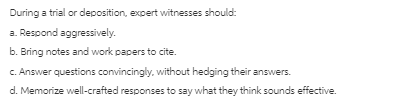
During a trial or deposition, expert witnesses should:
A) Respond aggressively.
B) Bring notes and work papers to cite.
C) Answer questions convincingly, without hedging their answers.
D) Memorize well-crafted responses to say what they think sounds effective.
A) Respond aggressively.
B) Bring notes and work papers to cite.
C) Answer questions convincingly, without hedging their answers.
D) Memorize well-crafted responses to say what they think sounds effective.
Unlock Deck
Unlock for access to all 120 flashcards in this deck.
Unlock Deck
k this deck
12
Fraud investigators can assist in a case in which of the following ways
A) By preparing questions to ask opposing witnesses during depositions.
B) By evaluating whether documents produced by the opposing side satisfy a production request.
C) By assisting in the preparation of a production request because of their knowledge of a case.
D) By a and b.
E) By a, b, and c.
A) By preparing questions to ask opposing witnesses during depositions.
B) By evaluating whether documents produced by the opposing side satisfy a production request.
C) By assisting in the preparation of a production request because of their knowledge of a case.
D) By a and b.
E) By a, b, and c.
Unlock Deck
Unlock for access to all 120 flashcards in this deck.
Unlock Deck
k this deck
13
Having a civil trial before a criminal trial has which of the following benefits
A) Defendant may make admissions during civil trial that can be used in criminal trial.
B) Greater access to documents of the defendant.
C) Defendant is not guaranteed the right to an attorney.
D) Both a and b.
A) Defendant may make admissions during civil trial that can be used in criminal trial.
B) Greater access to documents of the defendant.
C) Defendant is not guaranteed the right to an attorney.
D) Both a and b.
Unlock Deck
Unlock for access to all 120 flashcards in this deck.
Unlock Deck
k this deck
14
In a civil trial, settlements may be negotiated:
A) At any time during the litigation.
B) After arraignment.
C) At no time once negotiation begins.
D) Only after the judge orders negotiation between parties.
A) At any time during the litigation.
B) After arraignment.
C) At no time once negotiation begins.
D) Only after the judge orders negotiation between parties.
Unlock Deck
Unlock for access to all 120 flashcards in this deck.
Unlock Deck
k this deck
15
The Fourth Amendment requires that probable cause exist before a defendant is arrested or searched. Which of the following levels of evidence is necessary to show probable cause
A) Less than certainty, but more than speculation or suspicion.
B) Speculation or suspicion.
C) Beyond a reasonable doubt.
D) Preponderance of the evidence.
A) Less than certainty, but more than speculation or suspicion.
B) Speculation or suspicion.
C) Beyond a reasonable doubt.
D) Preponderance of the evidence.
Unlock Deck
Unlock for access to all 120 flashcards in this deck.
Unlock Deck
k this deck
16
A deposition is a testimony taken before the trial begins in a situation that is usually less formal than a courtroom, but in which the court rules and regulations still apply.
Unlock Deck
Unlock for access to all 120 flashcards in this deck.
Unlock Deck
k this deck
17
Most fraud cases are tried in federal courts.
Unlock Deck
Unlock for access to all 120 flashcards in this deck.
Unlock Deck
k this deck
18
Civil cases must consist of a jury of at least six jurors.
Unlock Deck
Unlock for access to all 120 flashcards in this deck.
Unlock Deck
k this deck
19
If, during a preliminary hearing, sufficient evidence is not available to show probable cause, the defendant can still be prosecuted at a later time when more evidence is available.
Unlock Deck
Unlock for access to all 120 flashcards in this deck.
Unlock Deck
k this deck
20
To be successful, the plaintiff in a civil case must prove his or her case beyond a reasonable doubt.
Unlock Deck
Unlock for access to all 120 flashcards in this deck.
Unlock Deck
k this deck
21
An initial pleading or complaint generally includes an explanation of the alleged violation and the monetary expenses or damages sought.
Unlock Deck
Unlock for access to all 120 flashcards in this deck.
Unlock Deck
k this deck
22
A request for confession asks the opposing party to admit designated facts relevant to litigation.
Unlock Deck
Unlock for access to all 120 flashcards in this deck.
Unlock Deck
k this deck
23
If responses to interrogatories are not given in a timely fashion, the court may charge fees and costs to a noncomplying party and issue an order demanding that all questions be answered.
Unlock Deck
Unlock for access to all 120 flashcards in this deck.
Unlock Deck
k this deck
24
Most fraud cases are tried in federal courts.
Unlock Deck
Unlock for access to all 120 flashcards in this deck.
Unlock Deck
k this deck
25
Civil cases must consist of a jury of at least six jurors.
Unlock Deck
Unlock for access to all 120 flashcards in this deck.
Unlock Deck
k this deck
26
If, during a preliminary hearing, sufficient evidence is not available to show probable cause, the defendant can still be prosecuted at a later time when more evidence is available.
Unlock Deck
Unlock for access to all 120 flashcards in this deck.
Unlock Deck
k this deck
27
To be successful, the plaintiff in a civil case must prove his or her case beyond a reasonable doubt.
Unlock Deck
Unlock for access to all 120 flashcards in this deck.
Unlock Deck
k this deck
28
John was recently convicted by a jury of committing fraud against his employer. After the trial, it was revealed that some key evidence against John used in trial was obtained through his employer's records and John's workstation computer. Before searching John's computer, the investigators did not have any evidence or idea that John was involved in the fraud. In fact, they stumbled on the fraud by accident. John is convinced that he has grounds for appeal. He believes the evidence found on his work computer is inadmissible because the investigators did not have probable cause to search his computer. 1. Is John right that he could appeal the guilty verdict
2. Were his rights violated
2. Were his rights violated
Unlock Deck
Unlock for access to all 120 flashcards in this deck.
Unlock Deck
k this deck
29
A request for confession asks the opposing party to admit designated facts relevant to litigation.
Unlock Deck
Unlock for access to all 120 flashcards in this deck.
Unlock Deck
k this deck
30
If responses to interrogatories are not given in a timely fashion, the court may charge fees and costs to a noncomplying party and issue an order demanding that all questions be answered.
Unlock Deck
Unlock for access to all 120 flashcards in this deck.
Unlock Deck
k this deck
31
A Wall Street bond trader turned on the television one day and saw a news report accusing him of committing a large securities scam. This trader learned that his employer had accused him of creating $300 million of phony profits and, as a result, getting bogus bonuses of $8 million. He claimed he was innocent, and it took about three years for him to prove his innocence. In the months that followed the accusations, he was investigated by the SEC, the National Association of Securities Dealers, and the Justice Department. Three years later, the bond trader was cleared of all major charges brought against him.
1. Assume that you are the employer. What type of legal action would you seek against this bond trader Why
2. To what type of court would your case most likely be assigned Why
1. Assume that you are the employer. What type of legal action would you seek against this bond trader Why
2. To what type of court would your case most likely be assigned Why
Unlock Deck
Unlock for access to all 120 flashcards in this deck.
Unlock Deck
k this deck
32
Briefly research a recent publicized fraud to become familiar with the major facts involved. Identify ways that a fraud investigator could add value in the (1) investigation, (2) legal follow-up, and (3) implementation of controls to prevent similar problems from happening in the future.
Unlock Deck
Unlock for access to all 120 flashcards in this deck.
Unlock Deck
k this deck
33
You are a manager for a large department store. It has recently come to light that a receiving clerk has been stealing merchandise. About $5,000 has been stolen. The clerk has stopped stealing, and the faulty internal control weaknesses that were determined to have allowed the fraud have been fixed. No action has been taken yet to punish the perpetrator, who still works at his same job. The clerk happens to be the nephew of one of the other managers, who, while he understands that his nephew's behavior was unacceptable, would like to keep the theft relatively quiet.
1. What action, if any, should be taken against the receiving clerk in this situation What consequences will probably result from that action
1. What action, if any, should be taken against the receiving clerk in this situation What consequences will probably result from that action
Unlock Deck
Unlock for access to all 120 flashcards in this deck.
Unlock Deck
k this deck
34
You are involved as an expert witness in a case of alleged fraud by top management against the corporation. Supposedly, working in collusion, top management defrauded the company of $5 million over two years. The allegations suggest that the fraud involved stealing $5 million and then concealing the fraud by overstating expense accounts and manipulating balance sheet accounts.
Following the initial discovery of this alleged fraud, shareholders of the company brought a lawsuit against top management. The prosecuting attorney for the shareholders has retained you to assist as an expert witness in this case. The case has already moved into the discovery phase.
1. What will your role likely be as an expert witness At what point in the process will you be most involved What might you do to assist the prosecution as much as possible
Following the initial discovery of this alleged fraud, shareholders of the company brought a lawsuit against top management. The prosecuting attorney for the shareholders has retained you to assist as an expert witness in this case. The case has already moved into the discovery phase.
1. What will your role likely be as an expert witness At what point in the process will you be most involved What might you do to assist the prosecution as much as possible
Unlock Deck
Unlock for access to all 120 flashcards in this deck.
Unlock Deck
k this deck
35
An initial pleading or complaint generally includes an explanation of the alleged violation and the monetary expenses or damages sought.
Unlock Deck
Unlock for access to all 120 flashcards in this deck.
Unlock Deck
k this deck
36
Mr. Oaks has worked as the CEO of Turley Bank for the last three years. This past year, the outside auditor discovered some fraudulent loan activity in which Mr. Oaks was circumventing internal controls to lend money to friends and family. After a thorough investigation, the board of trustees concluded that Mr. Oaks had committed more than $10 million in loan fraud. Mr. Oaks denied any wrongdoing. Now, the board is contemplating pursuing a civil case against Mr. Oaks, seeking repayment of the $10 million.
1. What are some reasons why Turley Bank would not pursue a civil case against Mr. Oaks
2. If Turley Bank decides to pursue a civil case against Mr. Oaks, what are some reasons why the bank would settle out of court before the actual trial
3. If Turley Bank decides to pursue a civil case against Mr. Oaks, what are some reasons why Mr. Oaks would settle out of court before the actual trial
1. What are some reasons why Turley Bank would not pursue a civil case against Mr. Oaks
2. If Turley Bank decides to pursue a civil case against Mr. Oaks, what are some reasons why the bank would settle out of court before the actual trial
3. If Turley Bank decides to pursue a civil case against Mr. Oaks, what are some reasons why Mr. Oaks would settle out of court before the actual trial
Unlock Deck
Unlock for access to all 120 flashcards in this deck.
Unlock Deck
k this deck
37
To help you understand the material discussed in the chapter, do the following:
1. Give at least three characteristics of a grand jury.
2. Without looking at the list in the chapter, list at least three dos and don'ts that an expert witness should keep in mind during cross-examination.
3. During the discovery stage of a civil litigation process, several methods of obtaining information may be used. One of these methods is by taking depositions.
a. What are depositions
b. Why are depositions a powerful tool in obtaining evidence
c. What are the other three stages of civil litigation that cases usually go through in addition to discovery
1. Give at least three characteristics of a grand jury.
2. Without looking at the list in the chapter, list at least three dos and don'ts that an expert witness should keep in mind during cross-examination.
3. During the discovery stage of a civil litigation process, several methods of obtaining information may be used. One of these methods is by taking depositions.
a. What are depositions
b. Why are depositions a powerful tool in obtaining evidence
c. What are the other three stages of civil litigation that cases usually go through in addition to discovery
Unlock Deck
Unlock for access to all 120 flashcards in this deck.
Unlock Deck
k this deck
38
A Wall Street bond trader turned on the television one day and saw a news report accusing him of committing a large securities scam. This trader learned that his employer had accused him of creating $300 million of phony profits and, as a result, getting bogus bonuses of $8 million. He claimed he was innocent, and it took about three years for him to prove his innocence. In the months that followed the accusations, he was investigated by the SEC, the National Association of Securities Dealers, and the Justice Department. Three years later, the bond trader was cleared of all major charges brought against him.
1. Assume that you are the employer. What type of legal action would you seek against this bond trader Why
2. To what type of court would your case most likely be assigned Why
1. Assume that you are the employer. What type of legal action would you seek against this bond trader Why
2. To what type of court would your case most likely be assigned Why
Unlock Deck
Unlock for access to all 120 flashcards in this deck.
Unlock Deck
k this deck
39
Briefly research a recent publicized fraud to become familiar with the major facts involved. Identify ways that a fraud investigator could add value in the (1) investigation, (2) legal follow-up, and (3) implementation of controls to prevent similar problems from happening in the future.
Unlock Deck
Unlock for access to all 120 flashcards in this deck.
Unlock Deck
k this deck
40
You are a manager for a large department store. It has recently come to light that a receiving clerk has been stealing merchandise. About $5,000 has been stolen. The clerk has stopped stealing, and the faulty internal control weaknesses that were determined to have allowed the fraud have been fixed. No action has been taken yet to punish the perpetrator, who still works at his same job. The clerk happens to be the nephew of one of the other managers, who, while he understands that his nephew's behavior was unacceptable, would like to keep the theft relatively quiet.
1. What action, if any, should be taken against the receiving clerk in this situation What consequences will probably result from that action
1. What action, if any, should be taken against the receiving clerk in this situation What consequences will probably result from that action
Unlock Deck
Unlock for access to all 120 flashcards in this deck.
Unlock Deck
k this deck
41
You are involved as an expert witness in a case of alleged fraud by top management against the corporation. Supposedly, working in collusion, top management defrauded the company of $5 million over two years. The allegations suggest that the fraud involved stealing $5 million and then concealing the fraud by overstating expense accounts and manipulating balance sheet accounts.
Following the initial discovery of this alleged fraud, shareholders of the company brought a lawsuit against top management. The prosecuting attorney for the shareholders has retained you to assist as an expert witness in this case. The case has already moved into the discovery phase.
1. What will your role likely be as an expert witness At what point in the process will you be most involved What might you do to assist the prosecution as much as possible
Following the initial discovery of this alleged fraud, shareholders of the company brought a lawsuit against top management. The prosecuting attorney for the shareholders has retained you to assist as an expert witness in this case. The case has already moved into the discovery phase.
1. What will your role likely be as an expert witness At what point in the process will you be most involved What might you do to assist the prosecution as much as possible
Unlock Deck
Unlock for access to all 120 flashcards in this deck.
Unlock Deck
k this deck
42
John was recently convicted by a jury of committing fraud against his employer. After the trial, it was revealed that some key evidence against John used in trial was obtained through his employer's records and John's workstation computer. Before searching John's computer, the investigators did not have any evidence or idea that John was involved in the fraud. In fact, they stumbled on the fraud by accident. John is convinced that he has grounds for appeal. He believes the evidence found on his work computer is inadmissible because the investigators did not have probable cause to search his computer. 1. Is John right that he could appeal the guilty verdict
2. Were his rights violated
2. Were his rights violated
Unlock Deck
Unlock for access to all 120 flashcards in this deck.
Unlock Deck
k this deck
43
Mr. Oaks has worked as the CEO of Turley Bank for the last three years. This past year, the outside auditor discovered some fraudulent loan activity in which Mr. Oaks was circumventing internal controls to lend money to friends and family. After a thorough investigation, the board of trustees concluded that Mr. Oaks had committed more than $10 million in loan fraud. Mr. Oaks denied any wrongdoing. Now, the board is contemplating pursuing a civil case against Mr. Oaks, seeking repayment of the $10 million.
1. What are some reasons why Turley Bank would not pursue a civil case against Mr. Oaks
2. If Turley Bank decides to pursue a civil case against Mr. Oaks, what are some reasons why the bank would settle out of court before the actual trial
3. If Turley Bank decides to pursue a civil case against Mr. Oaks, what are some reasons why Mr. Oaks would settle out of court before the actual trial
1. What are some reasons why Turley Bank would not pursue a civil case against Mr. Oaks
2. If Turley Bank decides to pursue a civil case against Mr. Oaks, what are some reasons why the bank would settle out of court before the actual trial
3. If Turley Bank decides to pursue a civil case against Mr. Oaks, what are some reasons why Mr. Oaks would settle out of court before the actual trial
Unlock Deck
Unlock for access to all 120 flashcards in this deck.
Unlock Deck
k this deck
44
To help you understand the material discussed in the chapter, do the following:
1. Give at least three characteristics of a grand jury.
2. Without looking at the list in the chapter, list at least three dos and don'ts that an expert witness should keep in mind during cross-examination.
3. During the discovery stage of a civil litigation process, several methods of obtaining information may be used. One of these methods is by taking depositions.
a. What are depositions
b. Why are depositions a powerful tool in obtaining evidence
c. What are the other three stages of civil litigation that cases usually go through in addition to discovery
1. Give at least three characteristics of a grand jury.
2. Without looking at the list in the chapter, list at least three dos and don'ts that an expert witness should keep in mind during cross-examination.
3. During the discovery stage of a civil litigation process, several methods of obtaining information may be used. One of these methods is by taking depositions.
a. What are depositions
b. Why are depositions a powerful tool in obtaining evidence
c. What are the other three stages of civil litigation that cases usually go through in addition to discovery
Unlock Deck
Unlock for access to all 120 flashcards in this deck.
Unlock Deck
k this deck
45
How are federal courts organized
Unlock Deck
Unlock for access to all 120 flashcards in this deck.
Unlock Deck
k this deck
46
What steps are involved in the civil litigation process
Unlock Deck
Unlock for access to all 120 flashcards in this deck.
Unlock Deck
k this deck
47
What is a deposition
Unlock Deck
Unlock for access to all 120 flashcards in this deck.
Unlock Deck
k this deck
48
How might a fraud investigator benefit by attending the deposition of opposing experts
Unlock Deck
Unlock for access to all 120 flashcards in this deck.
Unlock Deck
k this deck
49
What is discovery
Unlock Deck
Unlock for access to all 120 flashcards in this deck.
Unlock Deck
k this deck
50
What is the purpose of having a fraud investigator or another expert witness provide testimony in a trial
Unlock Deck
Unlock for access to all 120 flashcards in this deck.
Unlock Deck
k this deck
51
What types of fraud-related things can an expert witness testify about
Unlock Deck
Unlock for access to all 120 flashcards in this deck.
Unlock Deck
k this deck
52
How are federal courts organized
Unlock Deck
Unlock for access to all 120 flashcards in this deck.
Unlock Deck
k this deck
53
What steps are involved in the civil litigation process
Unlock Deck
Unlock for access to all 120 flashcards in this deck.
Unlock Deck
k this deck
54
What is a deposition
Unlock Deck
Unlock for access to all 120 flashcards in this deck.
Unlock Deck
k this deck
55
How might a fraud investigator benefit by attending the deposition of opposing experts
Unlock Deck
Unlock for access to all 120 flashcards in this deck.
Unlock Deck
k this deck
56
What is discovery
Unlock Deck
Unlock for access to all 120 flashcards in this deck.
Unlock Deck
k this deck
57
What is the purpose of having a fraud investigator or another expert witness provide testimony in a trial
Unlock Deck
Unlock for access to all 120 flashcards in this deck.
Unlock Deck
k this deck
58
What types of fraud-related things can an expert witness testify about
Unlock Deck
Unlock for access to all 120 flashcards in this deck.
Unlock Deck
k this deck
59
Most court cases are decided in state courts, except when:
A) Federal laws are in question.
B) The case involves several states.
C) The amount exceeds $100,000.
D) Both a and b are correct.
A) Federal laws are in question.
B) The case involves several states.
C) The amount exceeds $100,000.
D) Both a and b are correct.
Unlock Deck
Unlock for access to all 120 flashcards in this deck.
Unlock Deck
k this deck
60
Which of the following rights is not provided by the Fifth Amendment
A) Individuals are protected from double jeopardy (being tried twice for the same crime).
B) States cannot seize private property without just compensation.
C) Individuals have the right to refuse to incriminate themselves.
D) Miranda rights must be read upon arrest.
A) Individuals are protected from double jeopardy (being tried twice for the same crime).
B) States cannot seize private property without just compensation.
C) Individuals have the right to refuse to incriminate themselves.
D) Miranda rights must be read upon arrest.
Unlock Deck
Unlock for access to all 120 flashcards in this deck.
Unlock Deck
k this deck
61
During cross-examination, expert witnesses should:
A) Address areas outside of their areas of expertise.
B) Appreciate opposing council when they act very friendly.
C) Respond evasively and ambiguously to tough questions.
D) Maintain the same positions taken during direct testimony.
A) Address areas outside of their areas of expertise.
B) Appreciate opposing council when they act very friendly.
C) Respond evasively and ambiguously to tough questions.
D) Maintain the same positions taken during direct testimony.
Unlock Deck
Unlock for access to all 120 flashcards in this deck.
Unlock Deck
k this deck
62
When deposing an expert witness, the opposing attorneys try to achieve all of the following goals except:
A) Understanding the expert's opinion.
B) Understanding the expert's credentials.
C) Seeking admission of guilt.
D) Obtaining an assessment of how difficult the expert will be in the case.
A) Understanding the expert's opinion.
B) Understanding the expert's credentials.
C) Seeking admission of guilt.
D) Obtaining an assessment of how difficult the expert will be in the case.
Unlock Deck
Unlock for access to all 120 flashcards in this deck.
Unlock Deck
k this deck
63
Which of the following is not one of the common stages of a criminal case
A) Filing a criminal charge.
B) Filing a complaint.
C) Discovery.
D) Trial and appeal.
A) Filing a criminal charge.
B) Filing a complaint.
C) Discovery.
D) Trial and appeal.
Unlock Deck
Unlock for access to all 120 flashcards in this deck.
Unlock Deck
k this deck
64
Which of the following actions can fraud victims pursue after sufficient evidence is obtained
A) Prosecute in a criminal court.
B) Pursue civil litigation.
C) Take no action at all.
D) Two of the above.
A) Prosecute in a criminal court.
B) Pursue civil litigation.
C) Take no action at all.
D) Two of the above.
Unlock Deck
Unlock for access to all 120 flashcards in this deck.
Unlock Deck
k this deck
65
The federal courts will only hear cases that involve federal law, more than one state, or a federal statute.
Unlock Deck
Unlock for access to all 120 flashcards in this deck.
Unlock Deck
k this deck
66
Most court cases are decided in state courts, except when:
A) Federal laws are in question.
B) The case involves several states.
C) The amount exceeds $100,000.
D) Both a and b are correct.
A) Federal laws are in question.
B) The case involves several states.
C) The amount exceeds $100,000.
D) Both a and b are correct.
Unlock Deck
Unlock for access to all 120 flashcards in this deck.
Unlock Deck
k this deck
67
Which of the following rights is not provided by the Fifth Amendment
A) Individuals are protected from double jeopardy (being tried twice for the same crime).
B) States cannot seize private property without just compensation.
C) Individuals have the right to refuse to incriminate themselves.
D) Miranda rights must be read upon arrest.
A) Individuals are protected from double jeopardy (being tried twice for the same crime).
B) States cannot seize private property without just compensation.
C) Individuals have the right to refuse to incriminate themselves.
D) Miranda rights must be read upon arrest.
Unlock Deck
Unlock for access to all 120 flashcards in this deck.
Unlock Deck
k this deck
68
During cross-examination, expert witnesses should:
A) Address areas outside of their areas of expertise.
B) Appreciate opposing council when they act very friendly.
C) Respond evasively and ambiguously to tough questions.
D) Maintain the same positions taken during direct testimony.
A) Address areas outside of their areas of expertise.
B) Appreciate opposing council when they act very friendly.
C) Respond evasively and ambiguously to tough questions.
D) Maintain the same positions taken during direct testimony.
Unlock Deck
Unlock for access to all 120 flashcards in this deck.
Unlock Deck
k this deck
69
When deposing an expert witness, the opposing attorneys try to achieve all of the following goals except:
A) Understanding the expert's opinion.
B) Understanding the expert's credentials.
C) Seeking admission of guilt.
D) Obtaining an assessment of how difficult the expert will be in the case.
A) Understanding the expert's opinion.
B) Understanding the expert's credentials.
C) Seeking admission of guilt.
D) Obtaining an assessment of how difficult the expert will be in the case.
Unlock Deck
Unlock for access to all 120 flashcards in this deck.
Unlock Deck
k this deck
70
Which of the following is not one of the common stages of a criminal case
A) Filing a criminal charge.
B) Filing a complaint.
C) Discovery.
D) Trial and appeal.
A) Filing a criminal charge.
B) Filing a complaint.
C) Discovery.
D) Trial and appeal.
Unlock Deck
Unlock for access to all 120 flashcards in this deck.
Unlock Deck
k this deck
71
Which of the following actions can fraud victims pursue after sufficient evidence is obtained
A) Prosecute in a criminal court.
B) Pursue civil litigation.
C) Take no action at all.
D) Two of the above.
A) Prosecute in a criminal court.
B) Pursue civil litigation.
C) Take no action at all.
D) Two of the above.
Unlock Deck
Unlock for access to all 120 flashcards in this deck.
Unlock Deck
k this deck
72
The federal courts will only hear cases that involve federal law, more than one state, or a federal statute.
Unlock Deck
Unlock for access to all 120 flashcards in this deck.
Unlock Deck
k this deck
73
Mr. Bill is the sole proprietor of a small play-dough production company. Over the last few months, he noticed revenues dropping and started wondering what is going on. After giving it much thought, he realizes that his accountant, Mr. Pringles, has been cooking the books and stealing money from him-at least that seems to be the case. Mr. Bill is pretty upset and immediately runs down to the local courthouse and files a complaint against his accountant. Too anxious to wait for the legal process to continue, Mr. Bill decides to go to his accountant's personal residence and search for evidence of fraud. To his delight, he finds some papers that document his accountant's illegal activities.
Mr. Bill hurries to the office, where he confronts his accountant and shows him all of the papers he found at his house, informing him that a complaint has been filed. Mr. Pringles, calmly laughs and walks away, apparently not affected at all by what Mr. Bill has told him.
Explain why Mr. Pringles is not worried in the least about Mr. Bill's discovery.
Mr. Bill hurries to the office, where he confronts his accountant and shows him all of the papers he found at his house, informing him that a complaint has been filed. Mr. Pringles, calmly laughs and walks away, apparently not affected at all by what Mr. Bill has told him.
Explain why Mr. Pringles is not worried in the least about Mr. Bill's discovery.
Unlock Deck
Unlock for access to all 120 flashcards in this deck.
Unlock Deck
k this deck
74
State courts hear bankruptcy cases.
Unlock Deck
Unlock for access to all 120 flashcards in this deck.
Unlock Deck
k this deck
75
The prosecution usually prefers to present evidence at a grand jury because the accused does not have the right to hear the evidence.
Unlock Deck
Unlock for access to all 120 flashcards in this deck.
Unlock Deck
k this deck
76
The burden of proof necessary to prove a defendant is guilty in a criminal trial is significantly greater than that in a civil trial.
Unlock Deck
Unlock for access to all 120 flashcards in this deck.
Unlock Deck
k this deck
77
Investigation is the legal process by which each party's attorneys try to find all information about the other side's case before the trial begins.
Unlock Deck
Unlock for access to all 120 flashcards in this deck.
Unlock Deck
k this deck
78
An interrogatory is a series of written questions that specifically identifies information needed from the opposing party.
Unlock Deck
Unlock for access to all 120 flashcards in this deck.
Unlock Deck
k this deck
79
The parties in a civil case may negotiate a settlement during any stage of litigation.
Unlock Deck
Unlock for access to all 120 flashcards in this deck.
Unlock Deck
k this deck
80
During deposition, what posture should an expert witness display
Unlock Deck
Unlock for access to all 120 flashcards in this deck.
Unlock Deck
k this deck
Unlock Deck
Unlock for access to all 120 flashcards in this deck.






