







 Chat with AI

Deck 12: The Old South and Slavery, 1830-1860
Full screen (f)

Question

Question
Question
Question
Question
Question
Question
Question
Question
Question
Question
Question
Question
Question
Question
Question
Question
Question
Question
Question
Question
Question
Question
Question
Question
Question
Question
Question
Question
Question
Question
Question
Question
Question
Question
Question
Question
Question
Question
Question
Question
MAP QUESTIONS
Instructions: Choose the letter on the accompanying map of the South that correctly identifies each of the following:
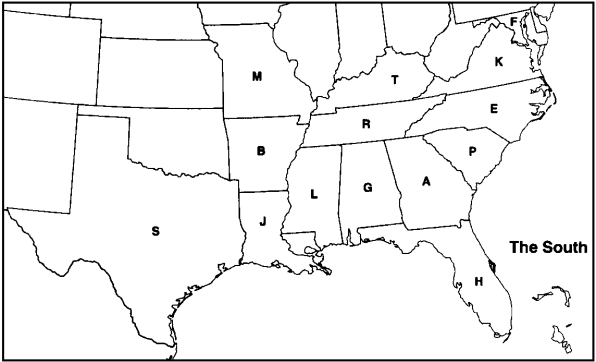
South Carolina
Instructions: Choose the letter on the accompanying map of the South that correctly identifies each of the following:
South Carolina
Question
MAP QUESTIONS
Instructions: Choose the letter on the accompanying map of the South that correctly identifies each of the following:
Texas
Instructions: Choose the letter on the accompanying map of the South that correctly identifies each of the following:
Texas
Question
MAP QUESTIONS
Instructions: Choose the letter on the accompanying map of the South that correctly identifies each of the following:
Tennessee
Instructions: Choose the letter on the accompanying map of the South that correctly identifies each of the following:
Tennessee
Question
MAP QUESTIONS
Instructions: Choose the letter on the accompanying map of the South that correctly identifies each of the following:
Virginia
Instructions: Choose the letter on the accompanying map of the South that correctly identifies each of the following:
Virginia
Question
MAP QUESTIONS
Instructions: Choose the letter on the accompanying map of the South that correctly identifies each of the following:
Alabama
Instructions: Choose the letter on the accompanying map of the South that correctly identifies each of the following:
Alabama
Question
MAP QUESTIONS
Instructions: Choose the letter on the accompanying map of the South that correctly identifies each of the following:
Missouri
Instructions: Choose the letter on the accompanying map of the South that correctly identifies each of the following:
Missouri
Question
MAP QUESTIONS
Instructions: Choose the letter on the accompanying map of the South that correctly identifies each of the following:
Arkansas
Instructions: Choose the letter on the accompanying map of the South that correctly identifies each of the following:
Arkansas
Question
MAP QUESTIONS
Instructions: Choose the letter on the accompanying map of the South that correctly identifies each of the following:
Maryland
Instructions: Choose the letter on the accompanying map of the South that correctly identifies each of the following:
Maryland
Question
Question
MAP QUESTIONS
Instructions: Choose the letter on the accompanying map of the South that correctly identifies each of the following:
North Carolina
Instructions: Choose the letter on the accompanying map of the South that correctly identifies each of the following:
North Carolina
Question
MAP QUESTIONS
Instructions: Choose the letter on the accompanying map of the South that correctly identifies each of the following:
Georgia
Instructions: Choose the letter on the accompanying map of the South that correctly identifies each of the following:
Georgia
Question
MAP QUESTIONS
Instructions: Choose the letter on the accompanying map of the South that correctly identifies each of the following:
Kentucky
Instructions: Choose the letter on the accompanying map of the South that correctly identifies each of the following:
Kentucky
Question
MAP QUESTIONS
Instructions: Choose the letter on the accompanying map of the South that correctly identifies each of the following:
Florida
Instructions: Choose the letter on the accompanying map of the South that correctly identifies each of the following:
Florida
Question
Question
MAP QUESTIONS
Instructions: Choose the letter on the accompanying map of the South that correctly identifies each of the following:
Mississippi
Instructions: Choose the letter on the accompanying map of the South that correctly identifies each of the following:
Mississippi
Question
Question
MAP QUESTIONS
Instructions: Choose the letter on the accompanying map of the South that correctly identifies each of the following:
Louisiana
Instructions: Choose the letter on the accompanying map of the South that correctly identifies each of the following:
Louisiana

Unlock Deck
Sign up to unlock the cards in this deck!
Unlock Deck
Unlock Deck
1/57

Play

Full screen (f)
Deck 12: The Old South and Slavery, 1830-1860
1
What shaped relations among whites in the Old South?
A) A complex code of honor
B) A federal code of laws
C) An ancient list of dos and don'ts
D) A strict set of state regulations
E) A historic code of morality
A) A complex code of honor
B) A federal code of laws
C) An ancient list of dos and don'ts
D) A strict set of state regulations
E) A historic code of morality
A complex code of honor
2
Why did Southern education lag behind northern education?
A) The South had no money for schools.
B) Southerners rejected compulsory education.
C) There were too many children to be educated.
D) Slaves demanded to be educated along with whites.
E) Southerners wanted to educate their slaves but did not have the tax base to do so.
A) The South had no money for schools.
B) Southerners rejected compulsory education.
C) There were too many children to be educated.
D) Slaves demanded to be educated along with whites.
E) Southerners wanted to educate their slaves but did not have the tax base to do so.
Southerners rejected compulsory education.
3
Which of the following is not one of the reasons that nonslaveholding southerners supported the slave system?
A) Some hoped to become slaveholders.
B) They accepted the racist assumptions of slavery.
C) They feared what freed slaves might do.
D) They knew that they were outnumbered and had no choice but to support it
E) They felt that their futures were tied to the survival of the system.
A) Some hoped to become slaveholders.
B) They accepted the racist assumptions of slavery.
C) They feared what freed slaves might do.
D) They knew that they were outnumbered and had no choice but to support it
E) They felt that their futures were tied to the survival of the system.
They knew that they were outnumbered and had no choice but to support it
4
Which of the following was not one of the reasons that cotton became "king" in the South?
A) It could be grown profitably on any scale, not just on large plantations.
B) Southern climate was suited to cotton cultivation.
C) The growth of the British textile industry had created a huge demand for cotton.
D) Indian removals had made way for southern expansion into the "Cotton Kingdom."
E) It required the use of slaves.
A) It could be grown profitably on any scale, not just on large plantations.
B) Southern climate was suited to cotton cultivation.
C) The growth of the British textile industry had created a huge demand for cotton.
D) Indian removals had made way for southern expansion into the "Cotton Kingdom."
E) It required the use of slaves.
Unlock Deck
Unlock for access to all 57 flashcards in this deck.
Unlock Deck
k this deck
5
What did the typical southern yeoman want?
A) Self-sufficiency with a modest profit
B) Profit more than self-sufficiency
C) Large numbers of slaves
D) Opportunities to invest in northern factories
E) A chance to move to the city
A) Self-sufficiency with a modest profit
B) Profit more than self-sufficiency
C) Large numbers of slaves
D) Opportunities to invest in northern factories
E) A chance to move to the city
Unlock Deck
Unlock for access to all 57 flashcards in this deck.
Unlock Deck
k this deck
6
Which list of states contains only states that were part of the Upper South?
A) Kentucky, Tennessee, and Maryland
B) Alabama, Virginia, and South Carolina
C) Virginia, North Carolina, and South Carolina
D) Virginia, North Carolina, and Arkansas
E) Tennessee, Mississippi, and Missouri
A) Kentucky, Tennessee, and Maryland
B) Alabama, Virginia, and South Carolina
C) Virginia, North Carolina, and South Carolina
D) Virginia, North Carolina, and Arkansas
E) Tennessee, Mississippi, and Missouri
Unlock Deck
Unlock for access to all 57 flashcards in this deck.
Unlock Deck
k this deck
7
Why did factories develop slowly in the South?
A) Slave discipline was difficult to maintain in a factory system.
B) The economic rewards of agriculture were more certain.
C) Industrialization might have disrupted the traditional southern social structure.
D) To raise the capital needed to build factories, Southerners would have had to sell slaves.
E) All of these choices
A) Slave discipline was difficult to maintain in a factory system.
B) The economic rewards of agriculture were more certain.
C) Industrialization might have disrupted the traditional southern social structure.
D) To raise the capital needed to build factories, Southerners would have had to sell slaves.
E) All of these choices
Unlock Deck
Unlock for access to all 57 flashcards in this deck.
Unlock Deck
k this deck
8
How did the Lower South acquire the slaves it used after 1808?
A) It continued to import slaves from Africa.
B) It bought them from plantation owners in the Caribbean.
C) It established breeding centers in northwestern Georgia.
D) It acquired most of its slaves from the Upper South.
E) It arranged for the passage of Africans as indentured servants and then forced them into slavery.
A) It continued to import slaves from Africa.
B) It bought them from plantation owners in the Caribbean.
C) It established breeding centers in northwestern Georgia.
D) It acquired most of its slaves from the Upper South.
E) It arranged for the passage of Africans as indentured servants and then forced them into slavery.
Unlock Deck
Unlock for access to all 57 flashcards in this deck.
Unlock Deck
k this deck
9
By 1860 what percentage of white southern families owned slaves?
A) 25%
B) 2%
C) 75%
D) 100%
E) 50%
A) 25%
B) 2%
C) 75%
D) 100%
E) 50%
Unlock Deck
Unlock for access to all 57 flashcards in this deck.
Unlock Deck
k this deck
10
Which of the following statements is not an accurate description of slavery?
A) Family life was very important to a slave's existence.
B) Religion offered slaves hope and a meaning to life.
C) Most slaves gladly accepted the limits on their freedom in return for security.
D) Slaves sometimes protested in small but significant ways.
E) Most slaves worked in agriculture.
A) Family life was very important to a slave's existence.
B) Religion offered slaves hope and a meaning to life.
C) Most slaves gladly accepted the limits on their freedom in return for security.
D) Slaves sometimes protested in small but significant ways.
E) Most slaves worked in agriculture.
Unlock Deck
Unlock for access to all 57 flashcards in this deck.
Unlock Deck
k this deck
11
What characterized life for most plantation mistresses?
A) Isolation, drudgery, and humiliation.
B) An endless round of parties and dances.
C) Frequent trips to town to buy new gowns.
D) Secret abolitionist activity.
E) Hours of exposure each day to the sun, as they supervised the slaves.
A) Isolation, drudgery, and humiliation.
B) An endless round of parties and dances.
C) Frequent trips to town to buy new gowns.
D) Secret abolitionist activity.
E) Hours of exposure each day to the sun, as they supervised the slaves.
Unlock Deck
Unlock for access to all 57 flashcards in this deck.
Unlock Deck
k this deck
12
Why was the Tredegar Iron Works significant?
A) It was one of the few, large iron producers in the South.
B) It provided the steel to build the skyscrapers in the north.
C) It employed only free blacks.
D) It was one of the few southern companies that used slaves.
E) It was the first of many iron works that developed in the South in the 1840s.
A) It was one of the few, large iron producers in the South.
B) It provided the steel to build the skyscrapers in the north.
C) It employed only free blacks.
D) It was one of the few southern companies that used slaves.
E) It was the first of many iron works that developed in the South in the 1840s.
Unlock Deck
Unlock for access to all 57 flashcards in this deck.
Unlock Deck
k this deck
13
Which of the following statements is true of plantation life?
A) Once established, a plantation could basically run by itself.
B) Most fixed costs for plantations were quite low.
C) The fact that plantation families seldom moved created a great deal of stability.
D) The suicide rate was twice the rate of Northern factory workers.
E) Psychological strains compounded economic woes.
A) Once established, a plantation could basically run by itself.
B) Most fixed costs for plantations were quite low.
C) The fact that plantation families seldom moved created a great deal of stability.
D) The suicide rate was twice the rate of Northern factory workers.
E) Psychological strains compounded economic woes.
Unlock Deck
Unlock for access to all 57 flashcards in this deck.
Unlock Deck
k this deck
14
How had the American slave population changed by about 1830?
A) It had declined.
B) It had become largely African-born.
C) It had nearly doubled.
D) It had become fragmented because of the lack of a common language.
E) It had become predominantly male.
A) It had declined.
B) It had become largely African-born.
C) It had nearly doubled.
D) It had become fragmented because of the lack of a common language.
E) It had become predominantly male.
Unlock Deck
Unlock for access to all 57 flashcards in this deck.
Unlock Deck
k this deck
15
Which of the following was one of the few groups in the Old South to reject the dueling, brawling, and drinking of southern society?
A) The people of the pine barrens
B) Plantation mistresses.
C) Evangelical churches
D) State legislatures
E) Lawyers of the Lower South
A) The people of the pine barrens
B) Plantation mistresses.
C) Evangelical churches
D) State legislatures
E) Lawyers of the Lower South
Unlock Deck
Unlock for access to all 57 flashcards in this deck.
Unlock Deck
k this deck
16
Which of the following statements accurately describes the Upper South and the Lower South?
A) The Upper South depended entirely on cotton, while the Lower South had a diversified economy.
B) Both sections aggressively advocated secession.
C) After about 1830, both were united in their defense of slavery.
D) The Upper South tended to identify more with the North than with the Lower South.
E) Both sections were beginning to industrialize.
A) The Upper South depended entirely on cotton, while the Lower South had a diversified economy.
B) Both sections aggressively advocated secession.
C) After about 1830, both were united in their defense of slavery.
D) The Upper South tended to identify more with the North than with the Lower South.
E) Both sections were beginning to industrialize.
Unlock Deck
Unlock for access to all 57 flashcards in this deck.
Unlock Deck
k this deck
17
How would you describe antebellum southern politics?
A) Serious and divisive issues caused fragmentation.
B) Only the Democratic party had any support in the South.
C) An underlying political unity reigned despite conflicts.
D) The political structure was controlled by one social group.
E) None of these choices
A) Serious and divisive issues caused fragmentation.
B) Only the Democratic party had any support in the South.
C) An underlying political unity reigned despite conflicts.
D) The political structure was controlled by one social group.
E) None of these choices
Unlock Deck
Unlock for access to all 57 flashcards in this deck.
Unlock Deck
k this deck
18
What was the largest group of southern whites in the antebellum period?
A) Planters
B) Small slaveholders
C) Nonslaveholding yeomen
D) Urban shopkeepers
E) People of the pine barrens
A) Planters
B) Small slaveholders
C) Nonslaveholding yeomen
D) Urban shopkeepers
E) People of the pine barrens
Unlock Deck
Unlock for access to all 57 flashcards in this deck.
Unlock Deck
k this deck
19
Which of the following was one of the hallmarks of the West African cultures from which many American slaves had originated?
A) Broad kinship ties
B) Loose standards of morality
C) Lack of a work ethic
D) No knowledge of relatives
E) An overriding parent-child bond
A) Broad kinship ties
B) Loose standards of morality
C) Lack of a work ethic
D) No knowledge of relatives
E) An overriding parent-child bond
Unlock Deck
Unlock for access to all 57 flashcards in this deck.
Unlock Deck
k this deck
20
Who led the 1831 rebellion in Southampton County, VA that terrified the South for generations?
A) Denmark Vesey
B) Gabriel Prosser
C) Nat Turner
D) Frederick Douglass
E) John Sambo
A) Denmark Vesey
B) Gabriel Prosser
C) Nat Turner
D) Frederick Douglass
E) John Sambo
Unlock Deck
Unlock for access to all 57 flashcards in this deck.
Unlock Deck
k this deck
21
Which of the following is an accurate description of the typical slave diet?
A) Slaves usually suffered from malnutrition.
B) They ate better than whites during the summer, but worse during the winter.
C) It was generally unbalanced, but there was plenty of food.
D) It was vegetarian.
E) It was heavy in seafood but low in grains and vegetables.
A) Slaves usually suffered from malnutrition.
B) They ate better than whites during the summer, but worse during the winter.
C) It was generally unbalanced, but there was plenty of food.
D) It was vegetarian.
E) It was heavy in seafood but low in grains and vegetables.
Unlock Deck
Unlock for access to all 57 flashcards in this deck.
Unlock Deck
k this deck
22
Why did the growth rate of the free black population in the South slow after 1810?
A) Fewer southern whites were freeing their slaves.
B) The number of births was declining.
C) Plantation conditions for slaves were improving.
D) Blacks began to view freedom as too dangerous.
E) It became easier for free blacks to move to the North.
A) Fewer southern whites were freeing their slaves.
B) The number of births was declining.
C) Plantation conditions for slaves were improving.
D) Blacks began to view freedom as too dangerous.
E) It became easier for free blacks to move to the North.
Unlock Deck
Unlock for access to all 57 flashcards in this deck.
Unlock Deck
k this deck
23
In 1860, about what percent of slave owners owned more than 20 slaves?
A) Only about 12 percent.
B) Only about 20 percent.
C) Only about 30 percent.
D) Only about 40 percent.
E) Only about 50 percent.
A) Only about 12 percent.
B) Only about 20 percent.
C) Only about 30 percent.
D) Only about 40 percent.
E) Only about 50 percent.
Unlock Deck
Unlock for access to all 57 flashcards in this deck.
Unlock Deck
k this deck
24
What was Pidgin?
A) It was a language forced upon the slaves by their white masters.
B) It was a language developed by American-born slaves.
C) It was an area in Africa where most slaves originated.
D) It was a food preferred by most coastal slaves.
E) It was a secret tongue used in slave resistance.
A) It was a language forced upon the slaves by their white masters.
B) It was a language developed by American-born slaves.
C) It was an area in Africa where most slaves originated.
D) It was a food preferred by most coastal slaves.
E) It was a secret tongue used in slave resistance.
Unlock Deck
Unlock for access to all 57 flashcards in this deck.
Unlock Deck
k this deck
25
Which of the following is an accurate statement about slave uprisings in the antebellum South?
A) They occurred frequently.
B) They were infrequent but usually bloody.
C) There were only three, and only one resulted in white deaths.
D) No slave uprising occurred after 1787.
E) Slaveowners had no fear of them.
A) They occurred frequently.
B) They were infrequent but usually bloody.
C) There were only three, and only one resulted in white deaths.
D) No slave uprising occurred after 1787.
E) Slaveowners had no fear of them.
Unlock Deck
Unlock for access to all 57 flashcards in this deck.
Unlock Deck
k this deck
26
Which of the following words accurately describe the pine barren people?
A) Sullen and unhappy
B) Dependent and angry
C) Self-reliant and independent
D) Racist and wealthy
E) Hungry and sickly
A) Sullen and unhappy
B) Dependent and angry
C) Self-reliant and independent
D) Racist and wealthy
E) Hungry and sickly
Unlock Deck
Unlock for access to all 57 flashcards in this deck.
Unlock Deck
k this deck
27
Which of the following is not a reason why the Upper South tended to identify with the Lower South rather than with the North?
A) The settlers in the Lower South had come from the Upper South.
B) Abolitionist criticism drew southerners together.
C) Railroads linked Upper and Lower South.
D) All southerners benefited from the three-fifths compromise in the Constitution.
E) The Upper and Lower South were tied economically.
A) The settlers in the Lower South had come from the Upper South.
B) Abolitionist criticism drew southerners together.
C) Railroads linked Upper and Lower South.
D) All southerners benefited from the three-fifths compromise in the Constitution.
E) The Upper and Lower South were tied economically.
Unlock Deck
Unlock for access to all 57 flashcards in this deck.
Unlock Deck
k this deck
28
What was unusual about William Tiler Johnson?
A) He ran a plantation where he allowed his slaves to do extra work to earn their freedom.
B) He was the only black man in the South to hold an elected office.
C) He was one of the few southerners who supported the Underground Railroad.
D) He was a free black who owned slaves.
E) He was a white minister who spoke out against slavery.
A) He ran a plantation where he allowed his slaves to do extra work to earn their freedom.
B) He was the only black man in the South to hold an elected office.
C) He was one of the few southerners who supported the Underground Railroad.
D) He was a free black who owned slaves.
E) He was a white minister who spoke out against slavery.
Unlock Deck
Unlock for access to all 57 flashcards in this deck.
Unlock Deck
k this deck
29
Which of the following was the most interracial institution in the Old South?
A) Grammar school
B) Voluntary organization
C) Church
D) Fraternity
E) College
A) Grammar school
B) Voluntary organization
C) Church
D) Fraternity
E) College
Unlock Deck
Unlock for access to all 57 flashcards in this deck.
Unlock Deck
k this deck
30
Which of the following was one of the Southern reactions to the Nat Turner rebellion?
A) Protestant missionaries intensified their efforts to convert slaves.
B) Laws restricting free blacks were loosened so that.....
C) Leaders in many Southern cities imposed bans on slaves working in the city.
D) There was a wave of bloody revenge attacks orchestrated by members of the K.K.K.
E) State governments passed laws making it illegal for slaves to read the Bible.
A) Protestant missionaries intensified their efforts to convert slaves.
B) Laws restricting free blacks were loosened so that.....
C) Leaders in many Southern cities imposed bans on slaves working in the city.
D) There was a wave of bloody revenge attacks orchestrated by members of the K.K.K.
E) State governments passed laws making it illegal for slaves to read the Bible.
Unlock Deck
Unlock for access to all 57 flashcards in this deck.
Unlock Deck
k this deck
31
Which of the following was a common form of slave resistance?
A) Armed uprisings
B) Escape to freedom in the North
C) Work stoppages
D) Refusal to marry
E) Murder
A) Armed uprisings
B) Escape to freedom in the North
C) Work stoppages
D) Refusal to marry
E) Murder
Unlock Deck
Unlock for access to all 57 flashcards in this deck.
Unlock Deck
k this deck
32
What was the religion of the majority of slaves when they were transported from Africa to the United States?
A) Catholic
B) Muslim
C) A variety of native religions
D) Protestant
E) Hindu
A) Catholic
B) Muslim
C) A variety of native religions
D) Protestant
E) Hindu
Unlock Deck
Unlock for access to all 57 flashcards in this deck.
Unlock Deck
k this deck
33
According to Frederick Douglass, slaves sang most when they were
A) escaping from the plantation.
B) most unhappy.
C) eating their dinner.
D) about to be married.
E) about to be sold to a new master.
A) escaping from the plantation.
B) most unhappy.
C) eating their dinner.
D) about to be married.
E) about to be sold to a new master.
Unlock Deck
Unlock for access to all 57 flashcards in this deck.
Unlock Deck
k this deck
34
Where did over half of all free blacks in the Lower South live?
A) In rural areas
B) In cities
C) On plantations
D) In shacks on river banks or near railroad lines
E) In small coastal villages
A) In rural areas
B) In cities
C) On plantations
D) In shacks on river banks or near railroad lines
E) In small coastal villages
Unlock Deck
Unlock for access to all 57 flashcards in this deck.
Unlock Deck
k this deck
35
Why were some slaves allowed to work in towns or cities?
A) Slaveowners needed the extra income.
B) Slaveowners usually did not have enough work for them to do on the plantation.
C) Southern reformers wanted slaves to learn new skills for later in life.
D) Slaveowners believed that it would be a way for slaves to "let off some steam" and would therefore prevent slave uprisings.
E) They were in steady demand to work in ports, on the rivers, and in mining and lumbering.
A) Slaveowners needed the extra income.
B) Slaveowners usually did not have enough work for them to do on the plantation.
C) Southern reformers wanted slaves to learn new skills for later in life.
D) Slaveowners believed that it would be a way for slaves to "let off some steam" and would therefore prevent slave uprisings.
E) They were in steady demand to work in ports, on the rivers, and in mining and lumbering.
Unlock Deck
Unlock for access to all 57 flashcards in this deck.
Unlock Deck
k this deck
36
In The Impending Crisis of the South, Hinton Helper argued that
A) popular sovereignty was the solution to the nation's crisis.
B) the South had to secede from the Union.
C) nonslaveholders should abolish slavery in their own interest.
D) the Republican party wanted to enslave the South.
E) the South had to industrialize to survive.
A) popular sovereignty was the solution to the nation's crisis.
B) the South had to secede from the Union.
C) nonslaveholders should abolish slavery in their own interest.
D) the Republican party wanted to enslave the South.
E) the South had to industrialize to survive.
Unlock Deck
Unlock for access to all 57 flashcards in this deck.
Unlock Deck
k this deck
37
What was an overseer?
A) He was a spiritual guide for many slaves.
B) He was a slave owner's assistant who managed the discipline and punishment on a plantation.
C) He was the most respected black slave on the plantation.
D) He was one of the rare white slaves that was owned in the South.
E) He was a free black who owned slaves.
A) He was a spiritual guide for many slaves.
B) He was a slave owner's assistant who managed the discipline and punishment on a plantation.
C) He was the most respected black slave on the plantation.
D) He was one of the rare white slaves that was owned in the South.
E) He was a free black who owned slaves.
Unlock Deck
Unlock for access to all 57 flashcards in this deck.
Unlock Deck
k this deck
38
Which profession was open to free blacks in the Old South?
A) Carpentry
B) Barrel making
C) Barbering
D) Small traders
E) All of these choices
A) Carpentry
B) Barrel making
C) Barbering
D) Small traders
E) All of these choices
Unlock Deck
Unlock for access to all 57 flashcards in this deck.
Unlock Deck
k this deck
39
Which of the following is not a reason that music and dance were important to slaves?
A) They allowed slaves to demonstrate religious beliefs.
B) They allowed slaves to lessen the tedium of work.
C) They allowed slaves to express the sorrows of slavery.
D) They allowed slaves to call for deliverance from earthly travails.
E) They allowed slaves to use church music as coded signals to begin an uprising.
A) They allowed slaves to demonstrate religious beliefs.
B) They allowed slaves to lessen the tedium of work.
C) They allowed slaves to express the sorrows of slavery.
D) They allowed slaves to call for deliverance from earthly travails.
E) They allowed slaves to use church music as coded signals to begin an uprising.
Unlock Deck
Unlock for access to all 57 flashcards in this deck.
Unlock Deck
k this deck
40
Most runaway slaves
A) escaped to the North on the Underground Railroad.
B) remained in the South.
C) relocated with the help of northern abolitionists.
D) were recaptured and beaten to death.
E) returned to Africa.
A) escaped to the North on the Underground Railroad.
B) remained in the South.
C) relocated with the help of northern abolitionists.
D) were recaptured and beaten to death.
E) returned to Africa.
Unlock Deck
Unlock for access to all 57 flashcards in this deck.
Unlock Deck
k this deck
41
MAP QUESTIONS
Instructions: Choose the letter on the accompanying map of the South that correctly identifies each of the following:
South Carolina
Instructions: Choose the letter on the accompanying map of the South that correctly identifies each of the following:
South Carolina
Unlock Deck
Unlock for access to all 57 flashcards in this deck.
Unlock Deck
k this deck
42
MAP QUESTIONS
Instructions: Choose the letter on the accompanying map of the South that correctly identifies each of the following:
Texas
Instructions: Choose the letter on the accompanying map of the South that correctly identifies each of the following:
Texas
Unlock Deck
Unlock for access to all 57 flashcards in this deck.
Unlock Deck
k this deck
43
MAP QUESTIONS
Instructions: Choose the letter on the accompanying map of the South that correctly identifies each of the following:
Tennessee
Instructions: Choose the letter on the accompanying map of the South that correctly identifies each of the following:
Tennessee
Unlock Deck
Unlock for access to all 57 flashcards in this deck.
Unlock Deck
k this deck
44
MAP QUESTIONS
Instructions: Choose the letter on the accompanying map of the South that correctly identifies each of the following:
Virginia
Instructions: Choose the letter on the accompanying map of the South that correctly identifies each of the following:
Virginia
Unlock Deck
Unlock for access to all 57 flashcards in this deck.
Unlock Deck
k this deck
45
MAP QUESTIONS
Instructions: Choose the letter on the accompanying map of the South that correctly identifies each of the following:
Alabama
Instructions: Choose the letter on the accompanying map of the South that correctly identifies each of the following:
Alabama
Unlock Deck
Unlock for access to all 57 flashcards in this deck.
Unlock Deck
k this deck
46
MAP QUESTIONS
Instructions: Choose the letter on the accompanying map of the South that correctly identifies each of the following:
Missouri
Instructions: Choose the letter on the accompanying map of the South that correctly identifies each of the following:
Missouri
Unlock Deck
Unlock for access to all 57 flashcards in this deck.
Unlock Deck
k this deck
47
MAP QUESTIONS
Instructions: Choose the letter on the accompanying map of the South that correctly identifies each of the following:
Arkansas
Instructions: Choose the letter on the accompanying map of the South that correctly identifies each of the following:
Arkansas
Unlock Deck
Unlock for access to all 57 flashcards in this deck.
Unlock Deck
k this deck
48
MAP QUESTIONS
Instructions: Choose the letter on the accompanying map of the South that correctly identifies each of the following:
Maryland
Instructions: Choose the letter on the accompanying map of the South that correctly identifies each of the following:
Maryland
Unlock Deck
Unlock for access to all 57 flashcards in this deck.
Unlock Deck
k this deck
49
Who was the famous American who, as a slave, borrowed sailor's papers and escaped from Baltimore to New York City in 1838?
A) Frederick Douglass
B) Gabriel Prosser
C) Hinton Helter
D) Fitzhugh Pidgin
E) Denmark Vesey
A) Frederick Douglass
B) Gabriel Prosser
C) Hinton Helter
D) Fitzhugh Pidgin
E) Denmark Vesey
Unlock Deck
Unlock for access to all 57 flashcards in this deck.
Unlock Deck
k this deck
50
MAP QUESTIONS
Instructions: Choose the letter on the accompanying map of the South that correctly identifies each of the following:
North Carolina
Instructions: Choose the letter on the accompanying map of the South that correctly identifies each of the following:
North Carolina
Unlock Deck
Unlock for access to all 57 flashcards in this deck.
Unlock Deck
k this deck
51
MAP QUESTIONS
Instructions: Choose the letter on the accompanying map of the South that correctly identifies each of the following:
Georgia
Instructions: Choose the letter on the accompanying map of the South that correctly identifies each of the following:
Georgia
Unlock Deck
Unlock for access to all 57 flashcards in this deck.
Unlock Deck
k this deck
52
MAP QUESTIONS
Instructions: Choose the letter on the accompanying map of the South that correctly identifies each of the following:
Kentucky
Instructions: Choose the letter on the accompanying map of the South that correctly identifies each of the following:
Kentucky
Unlock Deck
Unlock for access to all 57 flashcards in this deck.
Unlock Deck
k this deck
53
MAP QUESTIONS
Instructions: Choose the letter on the accompanying map of the South that correctly identifies each of the following:
Florida
Instructions: Choose the letter on the accompanying map of the South that correctly identifies each of the following:
Florida
Unlock Deck
Unlock for access to all 57 flashcards in this deck.
Unlock Deck
k this deck
54
The Underground Railroad
A) provided an effective way for slaves to escape.
B) an effort to help slaves to escape, but it had only limited success.
C) offered slaves the opportunity to leave a plantation for a few days before returning.
D) helped close to 25,000 slaves escape to the North.
E) was largely financed by wealthy southern abolitionists.
A) provided an effective way for slaves to escape.
B) an effort to help slaves to escape, but it had only limited success.
C) offered slaves the opportunity to leave a plantation for a few days before returning.
D) helped close to 25,000 slaves escape to the North.
E) was largely financed by wealthy southern abolitionists.
Unlock Deck
Unlock for access to all 57 flashcards in this deck.
Unlock Deck
k this deck
55
MAP QUESTIONS
Instructions: Choose the letter on the accompanying map of the South that correctly identifies each of the following:
Mississippi
Instructions: Choose the letter on the accompanying map of the South that correctly identifies each of the following:
Mississippi
Unlock Deck
Unlock for access to all 57 flashcards in this deck.
Unlock Deck
k this deck
56
What was the status of the black slave family?
A) Children and mothers were kept together.
B) It had no legal status.
C) It was the institution that kept the slave system functioning for many generations.
D) It was the same as that of free white families.
E) Extended families spanning several generations were common.
A) Children and mothers were kept together.
B) It had no legal status.
C) It was the institution that kept the slave system functioning for many generations.
D) It was the same as that of free white families.
E) Extended families spanning several generations were common.
Unlock Deck
Unlock for access to all 57 flashcards in this deck.
Unlock Deck
k this deck
57
MAP QUESTIONS
Instructions: Choose the letter on the accompanying map of the South that correctly identifies each of the following:
Louisiana
Instructions: Choose the letter on the accompanying map of the South that correctly identifies each of the following:
Louisiana
Unlock Deck
Unlock for access to all 57 flashcards in this deck.
Unlock Deck
k this deck
Unlock Deck
Unlock for access to all 57 flashcards in this deck.






