







 Chat with AI

Deck 2: The Rise of the Atlantic World, 1400-1625
Full screen (f)

Question

Question
Question
Question
Question
Question
Question
Question
Question
Question
Question
Question
Question
Question
Question
Question
Question
Question
Question
Question
Question
Question
MAP QUESTIONS
Instructions: Choose the letter on the accompanying map of Africa that correctly identifies each of the following:
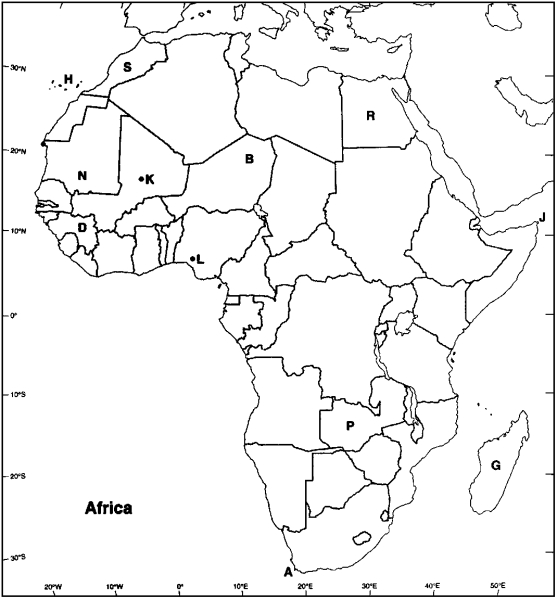
Cape of Good Hope
Instructions: Choose the letter on the accompanying map of Africa that correctly identifies each of the following:
Cape of Good Hope
Question
MAP QUESTIONS
Instructions: Choose the letter on the accompanying map of Africa that correctly identifies each of the following:
Timbuktu, Mali
Instructions: Choose the letter on the accompanying map of Africa that correctly identifies each of the following:
Timbuktu, Mali
Question
Question
Question
Question
Question
Question
MAP QUESTIONS
Instructions: Choose the letter on the accompanying map of Africa that correctly identifies each of the following:
Benin
Instructions: Choose the letter on the accompanying map of Africa that correctly identifies each of the following:
Benin
Question
Question
Question
Question
Question
Question
Question
Question
Question
MAP QUESTIONS
Instructions: Choose the letter on the accompanying map of Africa that correctly identifies each of the following:
Sahara Desert
Instructions: Choose the letter on the accompanying map of Africa that correctly identifies each of the following:
Sahara Desert
Question
Question
Question
MAP QUESTIONS
Instructions: Choose the letter on the accompanying map of Africa that correctly identifies each of the following:
Canary Islands
Instructions: Choose the letter on the accompanying map of Africa that correctly identifies each of the following:
Canary Islands
Question
Instructions: Choose the letter on the accompanying map of the North Atlantic region that correctly identifies each of the following:
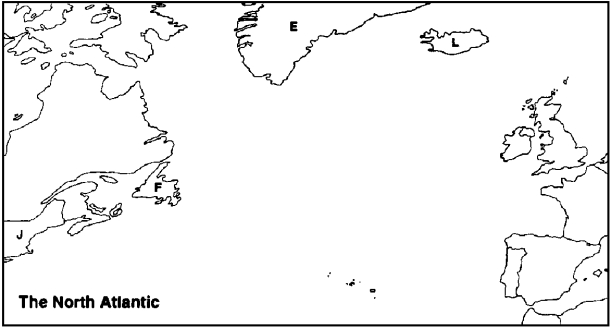
New England
New England
Question
Instructions: Choose the letter on the accompanying map of the United States that correctly identifies each of the following:
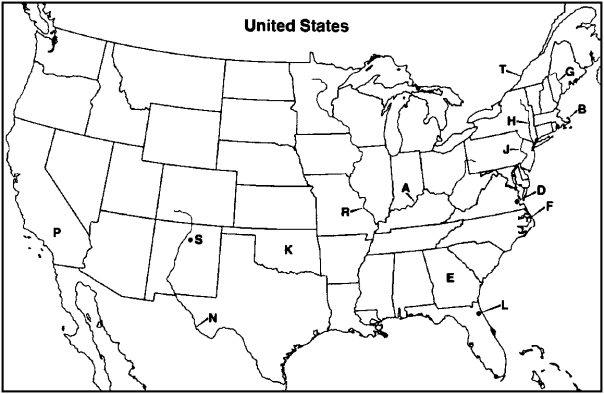
St. Lawrence River
St. Lawrence River
Question
Instructions: Choose the letter on the accompanying map of Europe that correctly identifies each of the following:
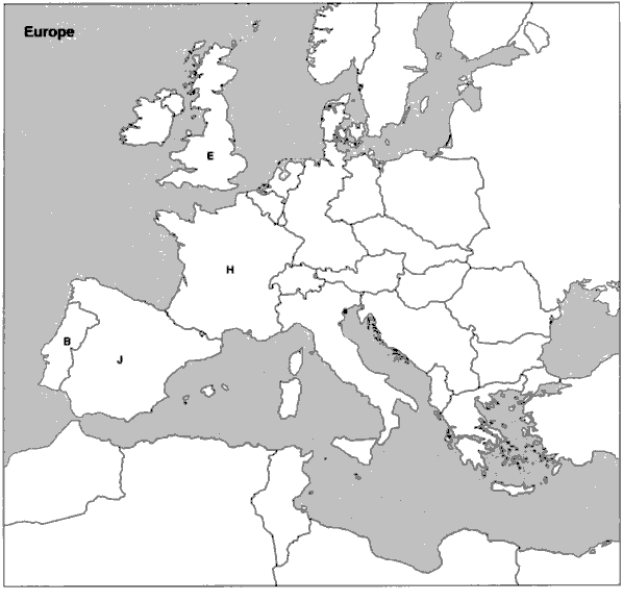
Portugal
Portugal
Question
Instructions: Choose the letter on the accompanying map of the North Atlantic region that correctly identifies each of the following:
Newfoundland
Newfoundland
Question
Instructions: Choose the letter on the accompanying map of the North Atlantic region that correctly identifies each of the following:
Greenland
Greenland
Question
Instructions: Choose the letter on the accompanying map of Europe that correctly identifies each of the following:
France
France
Question
Instructions: Choose the letter on the accompanying map of the North Atlantic region that correctly identifies each of the following:
Iceland
Iceland
Question
Instructions: Choose the letter on the accompanying map of the United States that correctly identifies each of the following:
St. Augustine, Florida
St. Augustine, Florida
Question
Instructions: Choose the letter on the accompanying map of Europe that correctly identifies each of the following:
Spain
Spain
Question
Instructions: Choose the letter on the accompanying map of the United States that correctly identifies each of the following:
Hudson River
Hudson River
Question
Instructions: Choose the letter on the accompanying map of the United States that correctly identifies each of the following:
Kennebec River, Maine
Kennebec River, Maine
Question
Instructions: Choose the letter on the accompanying map of the United States that correctly identifies each of the following:
Jamestown, Virginia
Jamestown, Virginia
Question
Instructions: Choose the letter on the accompanying map of the United States that correctly identifies each of the following:
Roanoke Island, North Carolina
Roanoke Island, North Carolina
Question
Instructions: Choose the letter on the accompanying map of Europe that correctly identifies each of the following:
England
England

Unlock Deck
Sign up to unlock the cards in this deck!
Unlock Deck
Unlock Deck
1/55

Play

Full screen (f)
Deck 2: The Rise of the Atlantic World, 1400-1625
1
Where was the first permanent European settlement on future United States soil?
A) Jamestown, Virginia
B) Quebec, Canada
C) St. Augustine, Florida
D) Plymouth, Massachusetts
E) Santa Fe, New Mexico
A) Jamestown, Virginia
B) Quebec, Canada
C) St. Augustine, Florida
D) Plymouth, Massachusetts
E) Santa Fe, New Mexico
St. Augustine, Florida
2
What was the primary object of Spanish explorers in the New World?
A) Agricultural land
B) Gold
C) Land
D) A fountain of youth
E) Furs
A) Agricultural land
B) Gold
C) Land
D) A fountain of youth
E) Furs
Gold
3
Which of the following statements accurately describe Prince Henry the Navigator's role in encouraging Portuguese exploration?
A) Most of his financial support came from the Pope.
B) He discouraged Portuguese seamen from using caravels because he thought they were unreliable.
C) He looked for alternative routes to Asia.
D) He wrote a popular book about the value of Benin.
E) He led a Portuguese fleet around Cape Horn.
A) Most of his financial support came from the Pope.
B) He discouraged Portuguese seamen from using caravels because he thought they were unreliable.
C) He looked for alternative routes to Asia.
D) He wrote a popular book about the value of Benin.
E) He led a Portuguese fleet around Cape Horn.
He looked for alternative routes to Asia.
4
Where did the French attempt to make their first settlement in North America?
A) Along the St. Lawrence Valley
B) South Carolina
C) Jacksonville, Florida
D) Fort Nassau
E) None of these choices
A) Along the St. Lawrence Valley
B) South Carolina
C) Jacksonville, Florida
D) Fort Nassau
E) None of these choices
Unlock Deck
Unlock for access to all 55 flashcards in this deck.
Unlock Deck
k this deck
5
Which of the following statements about the fifteenth century slave trade is correct?
A) Slavery already existed in West African societies and was a much harsher, less humane form of slavery than that practiced by the Europeans.
B) The only motivation was economic, and race had no role.
C) Slave traders often traded gold for the African slaves.
D) The trade began accidentally because of a linguistic misunderstanding between Portuguese seamen and African tribes.
E) Those sold into slavery by African kings were primarily undesirables such as lawbreakers or persons accused of witchcraft.
A) Slavery already existed in West African societies and was a much harsher, less humane form of slavery than that practiced by the Europeans.
B) The only motivation was economic, and race had no role.
C) Slave traders often traded gold for the African slaves.
D) The trade began accidentally because of a linguistic misunderstanding between Portuguese seamen and African tribes.
E) Those sold into slavery by African kings were primarily undesirables such as lawbreakers or persons accused of witchcraft.
Unlock Deck
Unlock for access to all 55 flashcards in this deck.
Unlock Deck
k this deck
6
Which of the following statements does not correctly portray an aspect of the "Columbian exchange"?
A) Europe carried deadly germs to the Americas.
B) The Americas sent corn and potatoes to Europe.
C) The Americas sent horses and sheep to Europe.
D) Europeans transported silver to the Americas to finance new settlements.
E) Europe sent coffee and sugar to the Americas.
A) Europe carried deadly germs to the Americas.
B) The Americas sent corn and potatoes to Europe.
C) The Americas sent horses and sheep to Europe.
D) Europeans transported silver to the Americas to finance new settlements.
E) Europe sent coffee and sugar to the Americas.
Unlock Deck
Unlock for access to all 55 flashcards in this deck.
Unlock Deck
k this deck
7
In the early 1500s what percentage of Europe's population consisted of peasants?
A) Less than 10 percent
B) Between 40 percent and 50 percent
C) About 75 percent
D) Less than one percent
E) Over 90 percent
A) Less than 10 percent
B) Between 40 percent and 50 percent
C) About 75 percent
D) Less than one percent
E) Over 90 percent
Unlock Deck
Unlock for access to all 55 flashcards in this deck.
Unlock Deck
k this deck
8
How did the European slavery that arose in the fifteenth century differ from other forms of European slavery?
A) The "new slavery" was a high-volume business.
B) Slaves taken under the "new slavery" were treated harshly and were destined for exhausting, mindless labor rather than domestic service.
C) Slaves were regarded ad property rather than merely as persons of low status.
D) The "new slavery" was based explicitly on the blackness and cultural differences of Africans.
E) All of these choices
A) The "new slavery" was a high-volume business.
B) Slaves taken under the "new slavery" were treated harshly and were destined for exhausting, mindless labor rather than domestic service.
C) Slaves were regarded ad property rather than merely as persons of low status.
D) The "new slavery" was based explicitly on the blackness and cultural differences of Africans.
E) All of these choices
Unlock Deck
Unlock for access to all 55 flashcards in this deck.
Unlock Deck
k this deck
9
Which of the following is not a legacy of the Reformation?
A) The development of various denominations in Europe
B) A belief in the importance of reading
C) The idea that clergy have no special powers
D) A counter-reformation by the Catholic Church
E) Cooperation between Protestant denominations and the Catholic Church
A) The development of various denominations in Europe
B) A belief in the importance of reading
C) The idea that clergy have no special powers
D) A counter-reformation by the Catholic Church
E) Cooperation between Protestant denominations and the Catholic Church
Unlock Deck
Unlock for access to all 55 flashcards in this deck.
Unlock Deck
k this deck
10
Which of the following was not a development of the "maritime revolution" of the fifteenth century?
A) New materials for constructing ships
B) A more maneuverable ship
C) A new type of sail
D) Mastering the compass
E) Better use of the astrolabe
A) New materials for constructing ships
B) A more maneuverable ship
C) A new type of sail
D) Mastering the compass
E) Better use of the astrolabe
Unlock Deck
Unlock for access to all 55 flashcards in this deck.
Unlock Deck
k this deck
11
Which of the following was not one of the Puritan beliefs?
A) Salvation was predetermined.
B) Christ was not present in the Eucharist.
C) A learned sermon was the heart of worship.
D) Membership in the church should be extended to anyone who had been baptized.
E) It was necessary to live lives of severe self-discipline.
A) Salvation was predetermined.
B) Christ was not present in the Eucharist.
C) A learned sermon was the heart of worship.
D) Membership in the church should be extended to anyone who had been baptized.
E) It was necessary to live lives of severe self-discipline.
Unlock Deck
Unlock for access to all 55 flashcards in this deck.
Unlock Deck
k this deck
12
Which of the following is true of both African and Indian religion?
A) Both believed the practice of magic was wrong.
B) Both believed that another world lay beyond the one the people perceived with their five senses.
C) Both believed in a devil.
D) Both believed that human beings ultimately could become gods.
E) All of these are true.
A) Both believed the practice of magic was wrong.
B) Both believed that another world lay beyond the one the people perceived with their five senses.
C) Both believed in a devil.
D) Both believed that human beings ultimately could become gods.
E) All of these are true.
Unlock Deck
Unlock for access to all 55 flashcards in this deck.
Unlock Deck
k this deck
13
Which of the following was not one of the problems in English society in the fifteenth and sixteenth centuries?
A) High unemployment
B) A declining population
C) Falling wages
D) Class differences
E) Widening gap between rich and poor
A) High unemployment
B) A declining population
C) Falling wages
D) Class differences
E) Widening gap between rich and poor
Unlock Deck
Unlock for access to all 55 flashcards in this deck.
Unlock Deck
k this deck
14
Which of the following statements about Christopher Columbus is correct?
A) He believed by sailing west he could reach Asia.
B) He had been recruited by the King and Queen of Spain to be the agent of Spanish territorial expansion.
C) He embarked on his expedition with limited navigating experience.
D) His sole goal was to glorify his god, and he thought nothing of personal gain or even the finances of his expedition.
E) He was simply one of about a dozen would-be explorers who roamed Europe endlessly hawking their enterprises.
A) He believed by sailing west he could reach Asia.
B) He had been recruited by the King and Queen of Spain to be the agent of Spanish territorial expansion.
C) He embarked on his expedition with limited navigating experience.
D) His sole goal was to glorify his god, and he thought nothing of personal gain or even the finances of his expedition.
E) He was simply one of about a dozen would-be explorers who roamed Europe endlessly hawking their enterprises.
Unlock Deck
Unlock for access to all 55 flashcards in this deck.
Unlock Deck
k this deck
15
How did the Puritans want to reform the Church of England?
A) They wanted to revert to purer Roman Catholic rituals.
B) They wanted to purify it of Roman Catholic rituals.
C) They wanted to purge the church of Quaker influences.
D) They wanted to distinguish between the clergy and the congregation.
E) They wanted to discourage laypersons from interfering in church affairs.
A) They wanted to revert to purer Roman Catholic rituals.
B) They wanted to purify it of Roman Catholic rituals.
C) They wanted to purge the church of Quaker influences.
D) They wanted to distinguish between the clergy and the congregation.
E) They wanted to discourage laypersons from interfering in church affairs.
Unlock Deck
Unlock for access to all 55 flashcards in this deck.
Unlock Deck
k this deck
16
Which of the following nations led the way in exploration in the fifteenth century?
A) England
B) Portugal
C) The Netherlands
D) Spain
E) France
A) England
B) Portugal
C) The Netherlands
D) Spain
E) France
Unlock Deck
Unlock for access to all 55 flashcards in this deck.
Unlock Deck
k this deck
17
When Columbus first encountered the Tainos, how did he react?
A) He assumed they were bloodthirsty killers.
B) He said that they reminded him of residents of England.
C) He concluded that they were simplistic innocents who could be Christianized.
D) He wanted to sell them as slaves in earn gold.
E) He assumed that they were stupid savages who were good for nothing.
A) He assumed they were bloodthirsty killers.
B) He said that they reminded him of residents of England.
C) He concluded that they were simplistic innocents who could be Christianized.
D) He wanted to sell them as slaves in earn gold.
E) He assumed that they were stupid savages who were good for nothing.
Unlock Deck
Unlock for access to all 55 flashcards in this deck.
Unlock Deck
k this deck
18
Why was John Rolfe important to the eventual success of the Jamestown settlement?
A) He adapted a salable variety of tobacco to conditions in Virginia.
B) He negotiated agreements with the Indians that provided essential food between 1607 and 1610.
C) He resolved the problem of an inadequate labor supply by importing slaves from Africa.
D) He introduced the policy that if you did not work you would not eat.
E) He persuaded Powhatan to teach the settlers how to grow food.
A) He adapted a salable variety of tobacco to conditions in Virginia.
B) He negotiated agreements with the Indians that provided essential food between 1607 and 1610.
C) He resolved the problem of an inadequate labor supply by importing slaves from Africa.
D) He introduced the policy that if you did not work you would not eat.
E) He persuaded Powhatan to teach the settlers how to grow food.
Unlock Deck
Unlock for access to all 55 flashcards in this deck.
Unlock Deck
k this deck
19
What was the general social structure in European society in the sixteenth century?
A) Egalitarian
B) Hierarchical
C) Communistic
D) Matriarchal
E) Socialistic
A) Egalitarian
B) Hierarchical
C) Communistic
D) Matriarchal
E) Socialistic
Unlock Deck
Unlock for access to all 55 flashcards in this deck.
Unlock Deck
k this deck
20
Which statement concerning the West African empires prior to 1600 is true?
A) They engaged in vigorous trade, were Islamic, and were known for their wealth.
B) They had no written language and no transportation infrastructure.
C) They were infested with tsetse flies and therefore unable to develop a state bureaucracy.
D) They were generally warrior states with little inclination to develop agriculture.
E) They were ruled over by kings whose absolute political power was based on ruthless use of force.
A) They engaged in vigorous trade, were Islamic, and were known for their wealth.
B) They had no written language and no transportation infrastructure.
C) They were infested with tsetse flies and therefore unable to develop a state bureaucracy.
D) They were generally warrior states with little inclination to develop agriculture.
E) They were ruled over by kings whose absolute political power was based on ruthless use of force.
Unlock Deck
Unlock for access to all 55 flashcards in this deck.
Unlock Deck
k this deck
21
What was a result of the battle of Lake Champlain in 1609?
A) The French gained control of Atlantic Canada.
B) Indian-European relations entered a deadly era of trade, diplomacy, and warfare.
C) The lake's value as a highway for Indian traders, diplomats, and warriors ended.
D) The English controlled all of North America except for Florida.
E) The fish and waterfowl populations virtually died out.
A) The French gained control of Atlantic Canada.
B) Indian-European relations entered a deadly era of trade, diplomacy, and warfare.
C) The lake's value as a highway for Indian traders, diplomats, and warriors ended.
D) The English controlled all of North America except for Florida.
E) The fish and waterfowl populations virtually died out.
Unlock Deck
Unlock for access to all 55 flashcards in this deck.
Unlock Deck
k this deck
22
MAP QUESTIONS
Instructions: Choose the letter on the accompanying map of Africa that correctly identifies each of the following:
Cape of Good Hope
Instructions: Choose the letter on the accompanying map of Africa that correctly identifies each of the following:
Cape of Good Hope
Unlock Deck
Unlock for access to all 55 flashcards in this deck.
Unlock Deck
k this deck
23
MAP QUESTIONS
Instructions: Choose the letter on the accompanying map of Africa that correctly identifies each of the following:
Timbuktu, Mali
Instructions: Choose the letter on the accompanying map of Africa that correctly identifies each of the following:
Timbuktu, Mali
Unlock Deck
Unlock for access to all 55 flashcards in this deck.
Unlock Deck
k this deck
24
How did the Renaissance encourage exploration?
A) It led Italian monarchs to support explorers in search of a return to Rome's greatness.
B) It encouraged individuals to search for new knowledge and information.
C) It destroyed the connections between Christianity and science.
D) It ended the disputes between Protestantism and Catholicism
E) It motivated many to look for lost treasures.
A) It led Italian monarchs to support explorers in search of a return to Rome's greatness.
B) It encouraged individuals to search for new knowledge and information.
C) It destroyed the connections between Christianity and science.
D) It ended the disputes between Protestantism and Catholicism
E) It motivated many to look for lost treasures.
Unlock Deck
Unlock for access to all 55 flashcards in this deck.
Unlock Deck
k this deck
25
To Europeans, what was the "little commonwealth"?
A) It was the individual.
B) It was the nuclear family.
C) It was the extended family.
D) It was the local village.
E) It was the entire colony.
A) It was the individual.
B) It was the nuclear family.
C) It was the extended family.
D) It was the local village.
E) It was the entire colony.
Unlock Deck
Unlock for access to all 55 flashcards in this deck.
Unlock Deck
k this deck
26
According to Martin Luther, what is the basis of a person's salvation?
A) People can buy their salvation by giving money to the church.
B) People can earn their salvation by doing good works.
C) People can only gain their salvation through faith in God.
D) People can gain their salvation after seeing Jesus Christ.
E) None of these choices
A) People can buy their salvation by giving money to the church.
B) People can earn their salvation by doing good works.
C) People can only gain their salvation through faith in God.
D) People can gain their salvation after seeing Jesus Christ.
E) None of these choices
Unlock Deck
Unlock for access to all 55 flashcards in this deck.
Unlock Deck
k this deck
27
Where was the first permanent English settlement in the New World?
A) Plymouth
B) Newport
C) St. Augustine
D) Jamestown
E) Charles Town
A) Plymouth
B) Newport
C) St. Augustine
D) Jamestown
E) Charles Town
Unlock Deck
Unlock for access to all 55 flashcards in this deck.
Unlock Deck
k this deck
28
How were the early English efforts at settlement paid for?
A) Through the issuance of company stock
B) Through the sale of slaves
C) Through the floating of government bonds
D) Through the raising of income taxes
E) Through deficit spending by the government
A) Through the issuance of company stock
B) Through the sale of slaves
C) Through the floating of government bonds
D) Through the raising of income taxes
E) Through deficit spending by the government
Unlock Deck
Unlock for access to all 55 flashcards in this deck.
Unlock Deck
k this deck
29
MAP QUESTIONS
Instructions: Choose the letter on the accompanying map of Africa that correctly identifies each of the following:
Benin
Instructions: Choose the letter on the accompanying map of Africa that correctly identifies each of the following:
Benin
Unlock Deck
Unlock for access to all 55 flashcards in this deck.
Unlock Deck
k this deck
30
Who did Virginia rely on for most of its labor in its initial years as a colony?
A) Indentured servants
B) Hessians
C) Irish laborers
D) Slaves
E) Indians
A) Indentured servants
B) Hessians
C) Irish laborers
D) Slaves
E) Indians
Unlock Deck
Unlock for access to all 55 flashcards in this deck.
Unlock Deck
k this deck
31
What was the leading empire in West Africa in the 14th and early 15th centuries?
A) Ashanti
B) Zulu
C) Sambura
D) Mali
E) Yoruba
A) Ashanti
B) Zulu
C) Sambura
D) Mali
E) Yoruba
Unlock Deck
Unlock for access to all 55 flashcards in this deck.
Unlock Deck
k this deck
32
Who broke with the Catholic Church and persuaded Parliament to create the Church of England?
A) Richard I
B) Henry VIII
C) Mary I
D) Elizabeth I
E) James I
A) Richard I
B) Henry VIII
C) Mary I
D) Elizabeth I
E) James I
Unlock Deck
Unlock for access to all 55 flashcards in this deck.
Unlock Deck
k this deck
33
Where was New Netherland established?
A) On the Hudson River
B) On the St. Lawrence River
C) On the Potomac River
D) On the Delaware River
E) On the Savannah River
A) On the Hudson River
B) On the St. Lawrence River
C) On the Potomac River
D) On the Delaware River
E) On the Savannah River
Unlock Deck
Unlock for access to all 55 flashcards in this deck.
Unlock Deck
k this deck
34
In the 1570s, what were England's objectives in the Western Hemisphere?
A) It wanted to find the Northwest Passage and to harass the Spanish.
B) It wanted to find a steady source of furs for aristocratic English women.
C) It wanted to convert the Native Americans to Protestantism and to establish colonies.
D) It wanted to discover new sources of gold and to develop new markets for English goods.
E) It wanted to lay claim to new fishing beds and to find an outpost to which they could exile Irish rebels.
A) It wanted to find the Northwest Passage and to harass the Spanish.
B) It wanted to find a steady source of furs for aristocratic English women.
C) It wanted to convert the Native Americans to Protestantism and to establish colonies.
D) It wanted to discover new sources of gold and to develop new markets for English goods.
E) It wanted to lay claim to new fishing beds and to find an outpost to which they could exile Irish rebels.
Unlock Deck
Unlock for access to all 55 flashcards in this deck.
Unlock Deck
k this deck
35
What was European reciprocity?
A) It was when European monarchs funded explorers in return for any riches found during the explorations.
B) It was when Europeans paid for exploration with gold and silver.
C) It was when the upper classes acted with dignity and the lower classes showed deference to their superiors.
D) It was the agreement between the Pope and Protestant monarchs to collaborate on colonizing the New World.
E) None of these choices
A) It was when European monarchs funded explorers in return for any riches found during the explorations.
B) It was when Europeans paid for exploration with gold and silver.
C) It was when the upper classes acted with dignity and the lower classes showed deference to their superiors.
D) It was the agreement between the Pope and Protestant monarchs to collaborate on colonizing the New World.
E) None of these choices
Unlock Deck
Unlock for access to all 55 flashcards in this deck.
Unlock Deck
k this deck
36
What was the Mayflower Compact?
A) It was an agreement reached by the first Pilgrims to constitute themselves a civil body politic.
B) It was an agreement reached by the first Pilgrims to live in harmony with the local Indians.
C) It was an agreement reached by the first Pilgrims to be governed directly by England.
D) It was an agreement reached by the first Pilgrims to establish a colony open to all newcomers.
E) None of these choices
A) It was an agreement reached by the first Pilgrims to constitute themselves a civil body politic.
B) It was an agreement reached by the first Pilgrims to live in harmony with the local Indians.
C) It was an agreement reached by the first Pilgrims to be governed directly by England.
D) It was an agreement reached by the first Pilgrims to establish a colony open to all newcomers.
E) None of these choices
Unlock Deck
Unlock for access to all 55 flashcards in this deck.
Unlock Deck
k this deck
37
What was one of the purposes of the settlement at Plymouth Plantation?
A) The settlers wanted to form a religious outpost to convert the Native Americans to Christianity.
B) The settlers wanted to establish a community in which all members could freely practice the religion of their choice.
C) The settlers wanted to compete with the Virginia colony for furs.
D) The settlers wanted to identify a source of gold to finance future religious wars.
E) The settlers wanted to send back lumber, furs, and fish.
A) The settlers wanted to form a religious outpost to convert the Native Americans to Christianity.
B) The settlers wanted to establish a community in which all members could freely practice the religion of their choice.
C) The settlers wanted to compete with the Virginia colony for furs.
D) The settlers wanted to identify a source of gold to finance future religious wars.
E) The settlers wanted to send back lumber, furs, and fish.
Unlock Deck
Unlock for access to all 55 flashcards in this deck.
Unlock Deck
k this deck
38
MAP QUESTIONS
Instructions: Choose the letter on the accompanying map of Africa that correctly identifies each of the following:
Sahara Desert
Instructions: Choose the letter on the accompanying map of Africa that correctly identifies each of the following:
Sahara Desert
Unlock Deck
Unlock for access to all 55 flashcards in this deck.
Unlock Deck
k this deck
39
What was the main problem that crippled the Roanoke colony and hurt Jamestown in its early years?
A) The English settlers refused to work.
B) The nearby French settlement monopolized the Native American labor supply.
C) The Native Americans refused to trade with the English settlers.
D) The British refused to send more supplies.
E) The blacks brought by the English refused to live in harmony with the Native Americans.
A) The English settlers refused to work.
B) The nearby French settlement monopolized the Native American labor supply.
C) The Native Americans refused to trade with the English settlers.
D) The British refused to send more supplies.
E) The blacks brought by the English refused to live in harmony with the Native Americans.
Unlock Deck
Unlock for access to all 55 flashcards in this deck.
Unlock Deck
k this deck
40
How did Governor Francis Wyatt wage the Second Anglo-Powhatan War?
A) He ordered all captured Indians enslaved.
B) He made an alliance with Chippewa Indians to overwhelm the Powhatan Indians.
C) He used ruthless tactics like destroying food supplies and driving Indians from their homes during winter.
D) He attempted to minimize bloodshed by offering generous concession to the Indians if they stopped fighting.
E) He laid siege to the Indians' villages and then negotiated.
A) He ordered all captured Indians enslaved.
B) He made an alliance with Chippewa Indians to overwhelm the Powhatan Indians.
C) He used ruthless tactics like destroying food supplies and driving Indians from their homes during winter.
D) He attempted to minimize bloodshed by offering generous concession to the Indians if they stopped fighting.
E) He laid siege to the Indians' villages and then negotiated.
Unlock Deck
Unlock for access to all 55 flashcards in this deck.
Unlock Deck
k this deck
41
MAP QUESTIONS
Instructions: Choose the letter on the accompanying map of Africa that correctly identifies each of the following:
Canary Islands
Instructions: Choose the letter on the accompanying map of Africa that correctly identifies each of the following:
Canary Islands
Unlock Deck
Unlock for access to all 55 flashcards in this deck.
Unlock Deck
k this deck
42
Instructions: Choose the letter on the accompanying map of the North Atlantic region that correctly identifies each of the following:
New England
New England
Unlock Deck
Unlock for access to all 55 flashcards in this deck.
Unlock Deck
k this deck
43
Instructions: Choose the letter on the accompanying map of the United States that correctly identifies each of the following:
St. Lawrence River
St. Lawrence River
Unlock Deck
Unlock for access to all 55 flashcards in this deck.
Unlock Deck
k this deck
44
Instructions: Choose the letter on the accompanying map of Europe that correctly identifies each of the following:
Portugal
Portugal
Unlock Deck
Unlock for access to all 55 flashcards in this deck.
Unlock Deck
k this deck
45
Instructions: Choose the letter on the accompanying map of the North Atlantic region that correctly identifies each of the following:
Newfoundland
Newfoundland
Unlock Deck
Unlock for access to all 55 flashcards in this deck.
Unlock Deck
k this deck
46
Instructions: Choose the letter on the accompanying map of the North Atlantic region that correctly identifies each of the following:
Greenland
Greenland
Unlock Deck
Unlock for access to all 55 flashcards in this deck.
Unlock Deck
k this deck
47
Instructions: Choose the letter on the accompanying map of Europe that correctly identifies each of the following:
France
France
Unlock Deck
Unlock for access to all 55 flashcards in this deck.
Unlock Deck
k this deck
48
Instructions: Choose the letter on the accompanying map of the North Atlantic region that correctly identifies each of the following:
Iceland
Iceland
Unlock Deck
Unlock for access to all 55 flashcards in this deck.
Unlock Deck
k this deck
49
Instructions: Choose the letter on the accompanying map of the United States that correctly identifies each of the following:
St. Augustine, Florida
St. Augustine, Florida
Unlock Deck
Unlock for access to all 55 flashcards in this deck.
Unlock Deck
k this deck
50
Instructions: Choose the letter on the accompanying map of Europe that correctly identifies each of the following:
Spain
Spain
Unlock Deck
Unlock for access to all 55 flashcards in this deck.
Unlock Deck
k this deck
51
Instructions: Choose the letter on the accompanying map of the United States that correctly identifies each of the following:
Hudson River
Hudson River
Unlock Deck
Unlock for access to all 55 flashcards in this deck.
Unlock Deck
k this deck
52
Instructions: Choose the letter on the accompanying map of the United States that correctly identifies each of the following:
Kennebec River, Maine
Kennebec River, Maine
Unlock Deck
Unlock for access to all 55 flashcards in this deck.
Unlock Deck
k this deck
53
Instructions: Choose the letter on the accompanying map of the United States that correctly identifies each of the following:
Jamestown, Virginia
Jamestown, Virginia
Unlock Deck
Unlock for access to all 55 flashcards in this deck.
Unlock Deck
k this deck
54
Instructions: Choose the letter on the accompanying map of the United States that correctly identifies each of the following:
Roanoke Island, North Carolina
Roanoke Island, North Carolina
Unlock Deck
Unlock for access to all 55 flashcards in this deck.
Unlock Deck
k this deck
55
Instructions: Choose the letter on the accompanying map of Europe that correctly identifies each of the following:
England
England
Unlock Deck
Unlock for access to all 55 flashcards in this deck.
Unlock Deck
k this deck
Unlock Deck
Unlock for access to all 55 flashcards in this deck.






