







 Chat with AI

Deck 25: Applied and Industrial Microbiology of Foods Online Only
Full screen (f)

Question

Question
Question
Question
Question
Question
Question
Question
Question
Question
Question
Question
Question
Question
Question
Question
Question
Question
Question
Question
Question
Question
Question
Question
Question
Question
Question
Question
Question
Question
Question
On completing this chapter on food microbiology, test your knowledge of its contents by using the following syllables to compose the term that answers the clue. Each term is a genus of microorganism important in food microbiology. The number of letters in the genus is indicated by the dashes, and the number of syllables in the genus is shown by the number in parentheses. Each syllable is used only once.
A A A AS AS BA BAC BAC CE CEPS CHLA CIL CLAV CLO CLO CO COC CUS DI DO EN GIL I I I LA LEU LUS LUS LUS MO MON MY NEL NOS O PER PSEU RA SAL SER STREP STRID STRID TER TER TER TI TO TO TOC US US
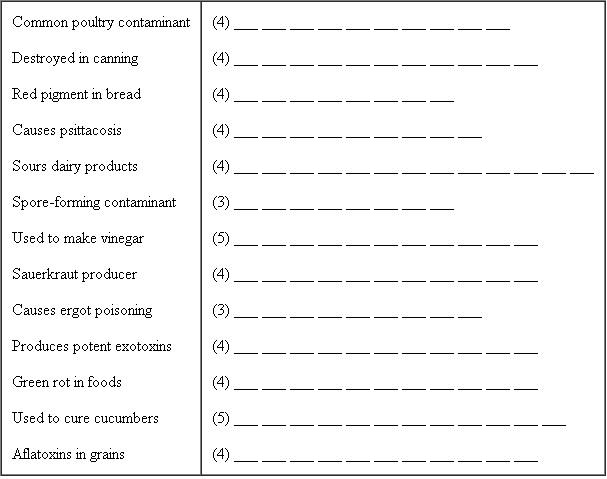
A A A AS AS BA BAC BAC CE CEPS CHLA CIL CLAV CLO CLO CO COC CUS DI DO EN GIL I I I LA LEU LUS LUS LUS MO MON MY NEL NOS O PER PSEU RA SAL SER STREP STRID STRID TER TER TER TI TO TO TOC US US
Question
Question
Question
Question
Question
Question
Question
Question
Question
Question

Unlock Deck
Sign up to unlock the cards in this deck!
Unlock Deck
Unlock Deck
1/41

Play

Full screen (f)
Deck 25: Applied and Industrial Microbiology of Foods Online Only
1
The souring of bakery cream fillings and toppings is due to microbial _____.
A) protein degradation
B) acids
C) carbohydrate hydrolysis
D) fat breakdown
A) protein degradation
B) acids
C) carbohydrate hydrolysis
D) fat breakdown
Bakery products can be contaminated with microorganisms. The sources of these pathogens are the ingredients, like eggs, sugar and flour, used in the manufacturing of bakery products. During the process of baking, majority of them got killed, but some of the bacterial species and molds survive this condition.
Toppings and cream fillings used in the bakery products also get contaminated with microorganism as they furnish perfect physical and chemical conditions for the survival of these contaminants. Protein degradation by bacterial species causes foul smell in the food commodity. Bacteria degrade the protein to amino acids and then after further degradation they convert it to the pungent-smelling substance.
The degradation of fats into fatty acids produces souring in the toppings and cream fillings, rich in fat content. Therefore, the agent of souring is fatty acids. Carbohydrate hydrolysis produce acids, but it may, form other products. Hence, solely carbohydrate hydrolysis is not responsible for the rancid taste of the bakery products.
Hence, options A, C and D are incorrect.
Carbohydrate hydrolysis produces acids. These acids develop souring in the bakery products like toppings and cream fillings. This action is performed by the metabolism action of streptococcus and lactobacillus. Therefore, the component responsible for the souring of toppings and cream fillings are acids.
Hence, the correct answer is option
 .
.
Toppings and cream fillings used in the bakery products also get contaminated with microorganism as they furnish perfect physical and chemical conditions for the survival of these contaminants. Protein degradation by bacterial species causes foul smell in the food commodity. Bacteria degrade the protein to amino acids and then after further degradation they convert it to the pungent-smelling substance.
The degradation of fats into fatty acids produces souring in the toppings and cream fillings, rich in fat content. Therefore, the agent of souring is fatty acids. Carbohydrate hydrolysis produce acids, but it may, form other products. Hence, solely carbohydrate hydrolysis is not responsible for the rancid taste of the bakery products.
Hence, options A, C and D are incorrect.
Carbohydrate hydrolysis produces acids. These acids develop souring in the bakery products like toppings and cream fillings. This action is performed by the metabolism action of streptococcus and lactobacillus. Therefore, the component responsible for the souring of toppings and cream fillings are acids.
Hence, the correct answer is option
. 2
Identify the two types of fungi that can spoil grain by producing toxins. ( Key Concept 1 )
Food spoilage is a process in which the food decays to the extent, that it loses its edibility. The intrinsic properties of food, like flavor, texture and nutritional value were reduced. Grains are spoiled by fungus, because of their ability to grow in less moisture condition. They infect the grains by producing mycotoxins.
Aspergillus flavus produces aflatoxins and cause the spoilage of stored grains, like soybeans, peanuts, corn and wheat. Aflatoxin is a kind of mycotoxin produced by Aspergillus flavus. This toxin is poisonous and can be a carcinogen. It is associated with aflatoxicosis. This disease is primarily found in domestic animals, humane and livestock.
The development of this mycotoxin is effected by various environmental factors, like agronomic practices, susceptibility of the invaded organism, geographic location and processing of food.
The mold grows in soil and stored, dried grains. This mold can easily grows on these food commodities as they have the ability to grow in less moisture. The spoilage is done by the accumulation of this toxin into the stored grains.
Claviceps purpurea is mainly found in rye plant. This fungus produces alkaloids to induce the infection in the plant. The disease caused by the fungus is termed as Ergot disease. The alkaloid causing the disease is ergotamine. This species can also cause spoilage of barley and wheat. The toxins produced by the mold can cause hallucinations and convulsions after consumption.
Aspergillus flavus produces aflatoxins and cause the spoilage of stored grains, like soybeans, peanuts, corn and wheat. Aflatoxin is a kind of mycotoxin produced by Aspergillus flavus. This toxin is poisonous and can be a carcinogen. It is associated with aflatoxicosis. This disease is primarily found in domestic animals, humane and livestock.
The development of this mycotoxin is effected by various environmental factors, like agronomic practices, susceptibility of the invaded organism, geographic location and processing of food.
The mold grows in soil and stored, dried grains. This mold can easily grows on these food commodities as they have the ability to grow in less moisture. The spoilage is done by the accumulation of this toxin into the stored grains.
Claviceps purpurea is mainly found in rye plant. This fungus produces alkaloids to induce the infection in the plant. The disease caused by the fungus is termed as Ergot disease. The alkaloid causing the disease is ergotamine. This species can also cause spoilage of barley and wheat. The toxins produced by the mold can cause hallucinations and convulsions after consumption.
3
On Saturday, a man buys a steak and a pound of liver and places them in the refrigerator. On Monday, he must decide which to cook for dinner. Microbiologically, which is the better choice Why
Preservation is defined as a techniques applied for preventing the growth of bacteria, fungi or other microbes to prevent spoilage of food. It helps to maintain the nutritional value, flavor or texture of the foodstuffs.
Disinfection is defined as the process in which a pathogen that causes diseases is inactivated or killed. There are three methods for disinfection namely physical, chemical as well as burial. Physical methods include processes like autoclaving, pasteurization, dry heating, boiling, refrigeration, dehydration as well as freezing.
In between the steak and the liver, the man should choose liver for cooking because organ meats such as liver, kidneys and sweetbreads are less compact tissue so they spoil very quickly. Also, these organs may contain the filtering tissue, bacterial cells can be trapped in the tissue. So, these foods can be cooked as soon as possible after the purchase.
In case of the steak, it spoiled very slowly and after extent of contamination, it consists of the harmless "greening" seen on the surface. It is commonly due to the gram-positive rod Lactobacillus or gram-positive Coccus Leuconostoc. But it has possess no hazard to the consumer.
Disinfection is defined as the process in which a pathogen that causes diseases is inactivated or killed. There are three methods for disinfection namely physical, chemical as well as burial. Physical methods include processes like autoclaving, pasteurization, dry heating, boiling, refrigeration, dehydration as well as freezing.
In between the steak and the liver, the man should choose liver for cooking because organ meats such as liver, kidneys and sweetbreads are less compact tissue so they spoil very quickly. Also, these organs may contain the filtering tissue, bacterial cells can be trapped in the tissue. So, these foods can be cooked as soon as possible after the purchase.
In case of the steak, it spoiled very slowly and after extent of contamination, it consists of the harmless "greening" seen on the surface. It is commonly due to the gram-positive rod Lactobacillus or gram-positive Coccus Leuconostoc. But it has possess no hazard to the consumer.
4
The fungal aflatoxins are typically found in _____.
A) rye plants
B) stored grains
C) rotten eggs
D) spoiled meat
A) rye plants
B) stored grains
C) rotten eggs
D) spoiled meat
Unlock Deck
Unlock for access to all 41 flashcards in this deck.
Unlock Deck
k this deck
5
Discuss how milk and dairy products become soured or spoiled. ( Key Concept 1 )
Unlock Deck
Unlock for access to all 41 flashcards in this deck.
Unlock Deck
k this deck
6
Foods from tropical nations such as Mexico tend to be very spicy, with lots of hot peppers, spices, garlic, and lemon juice. By contrast, foods from cooler countries such as Norway and Sweden tend to be much less spicy. Why do you think this pattern has evolved over the ages
Unlock Deck
Unlock for access to all 41 flashcards in this deck.
Unlock Deck
k this deck
7
Milk spoilage is usually due to species of _____.
A) Streptococcus
B) Escherichia
C) Salmonella
D) Pseudomonas
A) Streptococcus
B) Escherichia
C) Salmonella
D) Pseudomonas
Unlock Deck
Unlock for access to all 41 flashcards in this deck.
Unlock Deck
k this deck
8
Describe the methods used to preserve milk and other beverages. ( Key Concept 2 )
Unlock Deck
Unlock for access to all 41 flashcards in this deck.
Unlock Deck
k this deck
9
A standard set of recommendations and regulations exists for individuals who work in restaurants and cook food for customers (i.e., food handlers). However, very few regulations exist for individuals who pick fruits or vegetables in the fields. What regulations would you recommend for such workers
Unlock Deck
Unlock for access to all 41 flashcards in this deck.
Unlock Deck
k this deck
10
The flash method of pasteurization subjects milk to a temperature of ___°C for ___ seconds.
A) 62.9; 30
B) 71.6; 15
C) 140; 3
D) 161; 5
A) 62.9; 30
B) 71.6; 15
C) 140; 3
D) 161; 5
Unlock Deck
Unlock for access to all 41 flashcards in this deck.
Unlock Deck
k this deck
11
Assess the effectiveness of low temperatures for preserving foods and beverages. ( Key Concept 2 )
Unlock Deck
Unlock for access to all 41 flashcards in this deck.
Unlock Deck
k this deck
12
To keep foods fresh longer or frozen, a home refrigerator should keep foods at ___°C, while the freezer should be kept at ___°C.
A) 4; -10
B) 10; -4
C) 10; 0
D) 32; 4
A) 4; -10
B) 10; -4
C) 10; 0
D) 32; 4
Unlock Deck
Unlock for access to all 41 flashcards in this deck.
Unlock Deck
k this deck
13
Summarize how conventional drying and freeze-drying preserve foods. ( Key Concept 2 )
Unlock Deck
Unlock for access to all 41 flashcards in this deck.
Unlock Deck
k this deck
14
Lyophilized foods have been _____.
A) heat-dried
B) irradiated
C) chemically treated
D) freeze-dried
A) heat-dried
B) irradiated
C) chemically treated
D) freeze-dried
Unlock Deck
Unlock for access to all 41 flashcards in this deck.
Unlock Deck
k this deck
15
Identify the chemical preservatives used in foods and beverages and describe how they contribute to preservation. ( Key Concept 2 )
Unlock Deck
Unlock for access to all 41 flashcards in this deck.
Unlock Deck
k this deck
16
Which one of the following is NOT a chemical preservative
A) Propionic acid
B) Penicilloic acid
C) Sulfur dioxide
D) Benzoic acid
A) Propionic acid
B) Penicilloic acid
C) Sulfur dioxide
D) Benzoic acid
Unlock Deck
Unlock for access to all 41 flashcards in this deck.
Unlock Deck
k this deck
17
Discuss how radiation can preserve foods and contribute to their shelf life. ( Key Concept 2 )
Unlock Deck
Unlock for access to all 41 flashcards in this deck.
Unlock Deck
k this deck
18
Commercial foods can be sterilized using _____.
A) gamma rays
B) microwaves
C) UV light
D) X rays
A) gamma rays
B) microwaves
C) UV light
D) X rays
Unlock Deck
Unlock for access to all 41 flashcards in this deck.
Unlock Deck
k this deck
19
Contrast between a foodborne infection and a foodborne intoxication. ( Key Concept 2 )
Unlock Deck
Unlock for access to all 41 flashcards in this deck.
Unlock Deck
k this deck
20
Food intoxications include all the following except _____.
A) staphylococcal food poisoning
B) botulism
C) hepatitis A
D) salmonellosis
A) staphylococcal food poisoning
B) botulism
C) hepatitis A
D) salmonellosis
Unlock Deck
Unlock for access to all 41 flashcards in this deck.
Unlock Deck
k this deck
21
Assess the importance of the HACCP system to food safety. ( Key Concept 2 )
Unlock Deck
Unlock for access to all 41 flashcards in this deck.
Unlock Deck
k this deck
22
Food safety in the United States is under the supervision of the _____.
A) CDC
B) USDA
C) DOE
D) HHS
A) CDC
B) USDA
C) DOE
D) HHS
Unlock Deck
Unlock for access to all 41 flashcards in this deck.
Unlock Deck
k this deck
23
Summarize how fermentation can act as a food preservation mechanism and name several common fermented foods. ( Key Concept 3 )
Unlock Deck
Unlock for access to all 41 flashcards in this deck.
Unlock Deck
k this deck
24
Identify potential microbial sources leading to food spoilage.
b. List the conditions that make foods susceptible to growth and spoilage by microorganisms.
c. What type of microbial products lead to spoilage
d. Summarize how meats and seafood can become contaminated.
e. Why are eggs and poultry so susceptible to spoilage
f. What types of organisms may grow in bakery products if they are not refrigerated
g. What type of microbial products lead to spoilage in bakery products and grains
h. Summarize the ways milk can become spoiled.
b. List the conditions that make foods susceptible to growth and spoilage by microorganisms.
c. What type of microbial products lead to spoilage
d. Summarize how meats and seafood can become contaminated.
e. Why are eggs and poultry so susceptible to spoilage
f. What types of organisms may grow in bakery products if they are not refrigerated
g. What type of microbial products lead to spoilage in bakery products and grains
h. Summarize the ways milk can become spoiled.
Unlock Deck
Unlock for access to all 41 flashcards in this deck.
Unlock Deck
k this deck
25
All of the following foods or beverages involve a fermentation step except _____.
A) sauerkraut
B) vinegar
C) soft drinks
D) pickles
A) sauerkraut
B) vinegar
C) soft drinks
D) pickles
Unlock Deck
Unlock for access to all 41 flashcards in this deck.
Unlock Deck
k this deck
26
Discuss the role of microorganisms to the cheese manufacture process. ( Key Concept 3 )
Unlock Deck
Unlock for access to all 41 flashcards in this deck.
Unlock Deck
k this deck
27
Foods can become spoiled by _____.
A) human handling
B) rodent or insect contamination
C) contamination during packaging
D) All the above ( A-C ) are true.
A) human handling
B) rodent or insect contamination
C) contamination during packaging
D) All the above ( A-C ) are true.
Unlock Deck
Unlock for access to all 41 flashcards in this deck.
Unlock Deck
k this deck
28
Fermented dairy products include _____.
A) eggs
B) buttermilk
C) yogurt
D) Both B and C are correct.
A) eggs
B) buttermilk
C) yogurt
D) Both B and C are correct.
Unlock Deck
Unlock for access to all 41 flashcards in this deck.
Unlock Deck
k this deck
29
Chicken and salad are two items on the dinner menu at home, and you are put in charge of preparing both. You have a cutting board and knife for slicing up the salad items and for cutting the chicken into pieces. Which task should you perform first Why What other precautions might you take to ensure that the meal is not remembered for the wrong reason
Unlock Deck
Unlock for access to all 41 flashcards in this deck.
Unlock Deck
k this deck
30
Distinguish between the various forms of heat in the process of pasteurization.
b. How does refrigeration temperature slow down the growth of microbes
c. How do lyophilization and osmotic pressure preserve foods
d. How do chemical preservatives work to prevent spoilage
e. What type of radiation is used to irradiate foods
f. How do food infections differ from food intoxications
g. What are critical control points in the seafood, meat, and poultry industries .
b. How does refrigeration temperature slow down the growth of microbes
c. How do lyophilization and osmotic pressure preserve foods
d. How do chemical preservatives work to prevent spoilage
e. What type of radiation is used to irradiate foods
f. How do food infections differ from food intoxications
g. What are critical control points in the seafood, meat, and poultry industries .
Unlock Deck
Unlock for access to all 41 flashcards in this deck.
Unlock Deck
k this deck
31
On completing this chapter on food microbiology, test your knowledge of its contents by using the following syllables to compose the term that answers the clue. Each term is a genus of microorganism important in food microbiology. The number of letters in the genus is indicated by the dashes, and the number of syllables in the genus is shown by the number in parentheses. Each syllable is used only once.
A A A AS AS BA BAC BAC CE CEPS CHLA CIL CLAV CLO CLO CO COC CUS DI DO EN GIL I I I LA LEU LUS LUS LUS MO MON MY NEL NOS O PER PSEU RA SAL SER STREP STRID STRID TER TER TER TI TO TO TOC US US
A A A AS AS BA BAC BAC CE CEPS CHLA CIL CLAV CLO CLO CO COC CUS DI DO EN GIL I I I LA LEU LUS LUS LUS MO MON MY NEL NOS O PER PSEU RA SAL SER STREP STRID STRID TER TER TER TI TO TO TOC US US
Unlock Deck
Unlock for access to all 41 flashcards in this deck.
Unlock Deck
k this deck
32
You and a friend go to an orchard to pick apples with the intention of pressing them in your new cider mill. However, you are aware of the recent outbreaks of infection with E. coli O157:H7 that were traced to fresh apple cider. What precautions can you take to ensure a "healthy" experience
Unlock Deck
Unlock for access to all 41 flashcards in this deck.
Unlock Deck
k this deck
33
Identify the common end products to fermented foods, such as sauerkraut, vinegar, and soy sauce.
b. What types of microbes can be found in cheeses
b. What types of microbes can be found in cheeses
Unlock Deck
Unlock for access to all 41 flashcards in this deck.
Unlock Deck
k this deck
34
Describe the conditions that promote food spoilage by microorganisms. ( Key Concept 1 )
Unlock Deck
Unlock for access to all 41 flashcards in this deck.
Unlock Deck
k this deck
35
Suppose you had the choice of purchasing "yogurt made with pasteurized milk" or "pasteurized yogurt." Which would you choose Why What are the "active cultures" in a cup of yogurt
Unlock Deck
Unlock for access to all 41 flashcards in this deck.
Unlock Deck
k this deck
36
All of the following are spoilage products produced by microorganisms except _____.
A) lysozyme
B) hydrogen sulfide
C) ethyl alcohol
D) skatole
A) lysozyme
B) hydrogen sulfide
C) ethyl alcohol
D) skatole
Unlock Deck
Unlock for access to all 41 flashcards in this deck.
Unlock Deck
k this deck
37
Assess how meats and fish become contaminated. ( Key Concept 1 )
Unlock Deck
Unlock for access to all 41 flashcards in this deck.
Unlock Deck
k this deck
38
Why might blue (Stilton) cheese pose a possible threat to someone who has an acute allergy to penicillin
Unlock Deck
Unlock for access to all 41 flashcards in this deck.
Unlock Deck
k this deck
39
The bacterial genus _____ is a common source of poultry and egg contamination.
A) Escherichia
B) Listeria
C) Salmonella
D) Clostridium
A) Escherichia
B) Listeria
C) Salmonella
D) Clostridium
Unlock Deck
Unlock for access to all 41 flashcards in this deck.
Unlock Deck
k this deck
40
Determine how breads and bakery products can support microbial growth. ( Key Concept 1 )
Unlock Deck
Unlock for access to all 41 flashcards in this deck.
Unlock Deck
k this deck
41
Which principles of preservation ensure that each of the following remains uncontaminated on the pantry shelf: vinegar, olive oil, brown sugar, tea bags, spaghetti, hot cocoa mix, pancake syrup, soy sauce, and rice
Unlock Deck
Unlock for access to all 41 flashcards in this deck.
Unlock Deck
k this deck
Unlock Deck
Unlock for access to all 41 flashcards in this deck.






